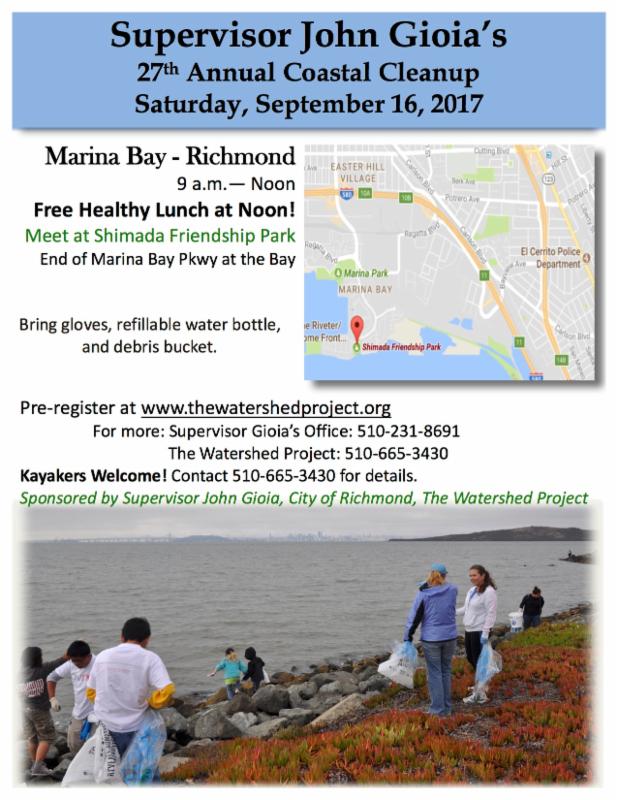
Volunteer for Annual Coastal Cleanup Day in Contra Costa this Saturday, Sept. 16
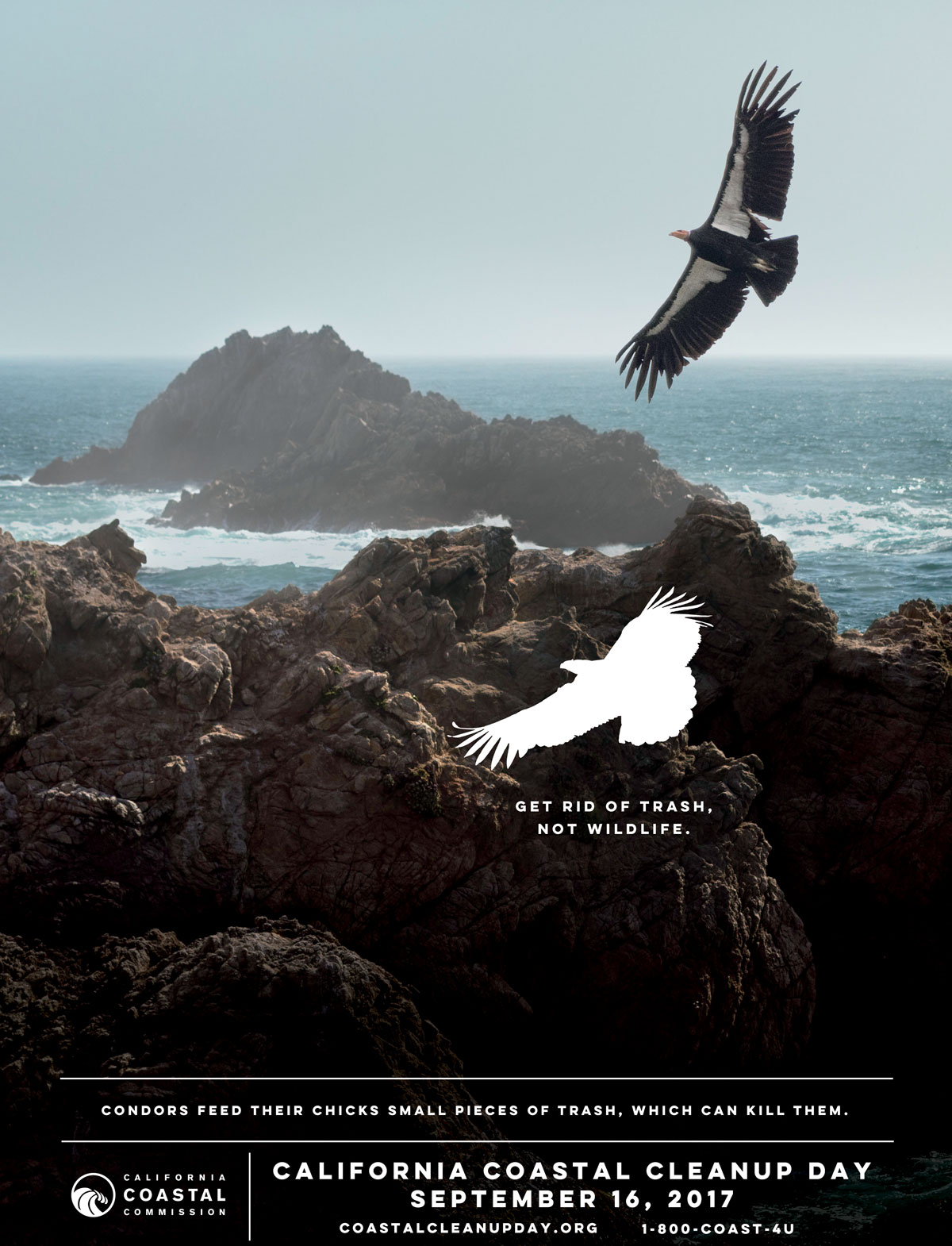
The 33rd Annual California Coastal Cleanup Day, the state’s largest volunteer event, is going to take place this Saturday, September 16, 2017 from 9 AM to Noon.
On Friday, Sept. 15 in Antioch will be the 4th Annual Coastal Cleanup Kayak Day. (Click here for details). Then on Saturday in Richmond another kayak cleanup will take place at Shimada Friendship Park. (See below)
The event is expected to draw more than 70,000 volunteers who will combat marine debris at over 800 locations throughout the state by removing the trash that has accumulated on California’s beaches and inland shorelines over the past year.
There are multiple locations throughout Contra Costa County where you can volunteer. Click on the name, below of the one you’re interested in to go to the information page for that location:
Marsh Creek Watershed, East County
Garrity Creek at Hilltop, Richmond
Antioch – 3 locations to choose from. Details here.
Point Isabel Regional Shoreline, Richmond
Richmond Greenway at Carlson Avenue
Richmond Greenway Rain Garden & Bioswale
Shimada Friendship Park, Richmond
Shimada Friendship Park-Kayak cleanup
Wildcat Creek at Verde Elementary School, Richmond
County Draft Hazard Mitigation Plan Update available for public review, input
Comment Period Runs from September 1 – 15, 2017
Your input is welcomed as Contra Costa County and our regional planning partners have now completed a draft update to the County’s Multi-Jurisdictional Hazard Mitigation Plan. In November 2016, a coalition of Contra Costa County cities and special districts embarked on a planning process to prepare for, and lessen the impacts of, specified natural hazards by updating the County’s Plan. Responding to federal mandates in the Disaster Mitigation Act of 2000 (Public Law 106-390), the partnership was formed to pool resources and to create a uniform hazard mitigation strategy that can be consistently applied to the defined planning area and used to ensure eligibility for specified grant funding success.
The County and regional planning partners invite residents and other stakeholders to review and comment on the recently completed draft update. The 14-day public review period of the Draft Plan began on September 1st and ends on September 15th, at 5:00 p.m. You can attend one of the public meeting below to hear a brief presentation regarding the Draft Plan; you can also offer public comment at the meeting:
September 12, 2017 4:00 PM 7:00 PM
San Ramon City Hall, 7000 Bollinger Canyon Road, San Ramon, CA 94583
Members of the Public can also provide written comments of the draft plan via the Local Hazard Mitigation Plan website, which can be found at: http://www.contracosta.ca.gov/6415/Local-Hazard-Mitigation-Plan. The Plan contains two volumes:
- Volume 1 contains components that apply to all partners and the broader planning area.
- Volume 2 contains all components that are jurisdiction-specific. Each planning partner has a dedicated annex in Volume 2.
Please direct your comments and questions on the HMP to Rob Flaner, Tetra Tech, Inc. at: rob.flaner@tetratech.com<mailto:rob.flaner@tetratech.com>, or (208)939-4391.
New County Sustainability Commission to help Supervisors make Contra Costa cleaner, healthier
Next meeting Monday, August 28
The Contra Costa County Sustainability Commission will hold its second meeting on Monday, August 28, 2017, 5-7 p.m., at 30 Muir Road, Martinez. The Board of Supervisors created the Sustainability Commission earlier this year to advise the Board and County staff on how to make Contra Costa County healthier and reduce pollution, important goals of the County’s Climate Action Plan. The agenda for the meeting can be found here.
Thirty-five people applied for the 10 seats on the Sustainability Commission. Given the high level of interest and the opportunity to include more voices, the Board of Supervisors created an additional At-Large seat and allowed each Supervisor to appoint an alternate from his or her district. The 15 members and alternates of the Sustainability Commission appointed to date come from across the County and represent a range of interests and professional experience. The members include:
Nick Despota, Member, District 1. Nick Despota, a longtime resident of Richmond, has served on numerous commissions and non-profit boards. His professional career has included video production, writing for educational media, and web design. After retiring in 2016, he began volunteering with an environmental organization to develop its online media presence. Nick currently leads the communication team for the Alameda Chapter of the Citizens’ Climate Lobby.
Victoria Smith, Member, District 2. Victoria Smith is the former Mayor of Orinda and longtime City Council Member. Victoria served as Chair of the Central Contra Costa Solid Waste Authority, RecycleSmart, which provides recycling, reuse and garbage services to the cities of Orinda, Lafayette, Moraga, Walnut Creek, Danville, and central Contra Costa County. Victoria is a graduate of UC Berkeley and UC Hastings College of the Law, and practices real estate law.
Reid Edwards, Alternate, District 2. Reid Edwards is a retired senior public affairs executive who worked for many years on all aspects of energy and environmental issues, both locally and in Washington, D.C. He resides in Lafayette and has lived in Contra Costa County, with short interruptions, since 1963. He currently volunteers with a number of local institutions including White Pony Express and the Food Bank of Contra Costa and Solano.
John Sierra, Member, District 3. John Sierra teaches AP Environmental Science and was the Freedom High School teacher of the year in 2013. He is actively involved with multiple community organizations and frequently takes his students on adventures near and far including Yosemite and Nicaragua. John is dedicated to protecting natural resources while creating a healthy living environment for all.
Gretchen Logue, Alternate, District 3. Gretchen Logue is dedicated to community civic engagement, and has a lifelong passion for environmental sustainability. She is the co-founder of the Tassajara Valley Preservation Association, an organization dedicated to the sustainability of Contra Costa County. In addition to serving as a board member on the Tassajara Hills Foundation, fundraising for educational programs, this mother of three is also a California Naturalist.
Wes Sullens, Member, District 4. Wes Sullens, LEED Fellow, is the Director of Codes Technical Development at the US Green Building Council. Prior to joining USGBC, Mr. Sullens worked for a local government agency in Alameda County, California (StopWaste), where he provided green codes advocacy, building and product standards development, and green building policy support. Previous to StopWaste, he was an energy and sustainability consultant at a prominent firm in the US.
Travis Curran, Alternate, District 4. A lifelong environmentalist, Travis Curran has spent the past 11 years working in adult mental health. The Administrator at Crestwood Healing Center in Pleasant Hill, Travis led a sustainability project that transformed facility practices, saving over 2 million gallons of water, and earning a green certification and multiple green awards in the process. Travis is passionate about waste reduction, and the preservation and protection of our state and national parks.
Charles Davidson, Member, District 5. Charles was the lead community organizer for MoveOn East Bay during the housing crisis. He then became involved with 350BayArea and helped found the Sunflower Alliance, organizing for climate and environmental justice issues, opposing multiple planned large-scale toxic tar sands refinery expansion projects, and lobbying for Community Choice Energy and a fossil-free and inexpensive clean energy future. Charles has studied cancer biology and medical physics at the graduate school level and holds a US patent in advanced medical imaging.
Mark Thomson, Alternate, District 5. Long-time Martinez resident Mark Thomson is Co-President of the John Muir Association, which works closely with the National Park Service to share the legacy of John Muir. Mark is also Co-Facilitator of Thousand Friends of Martinez, an organization dedicated to defending parks, creeks, wetlands, open space and historic elements in the Martinez area. Mark has previously volunteered with the Boy Scouts, Mt. Diablo Peace and Justice Center, and other organizations. His professional background is in Information Technology.
Howdy Goudey, At-Large, Community Group. Howdy Goudey has an Engineering Physics degree from UC Berkeley and has worked for 24 years in the research and development of energy efficient buildings, particularly windows, at the Lawrence Berkeley National Laboratory. He has also been a member of the City of El Cerrito Environmental Quality Committee for 9 years, as well as a volunteer with community gardens and native habitat restoration.
Harry Thurston, At-Large, Community Group. Antioch resident Harry Thurston is committed to furthering sustainable resource usage by Contra Costa County and the municipalities within. He received formal training in sustainable resource usage from Humboldt State University, receiving a BS in Forestry. He put this knowledge into practice as a Peace Corps volunteer, followed by 10 years of Commercial Forestry practice, receiving California certification as a Registered Professional Forester. Most recently, over the last several years, he has been leading the East Contra Costa effort to implement a Community Choice Energy program for the County’s unincorporated area and for the incorporated municipalities within the County. Harry is a member of the Contra Costa Clean Energy Alliance.
Kathy Cutting, At-Large, Business. Kathy Cutting is a Bay Area native, settling in Oakley in 1989, where she raised her family. Over the last 20 years she has enjoyed working as a residential landscape designer promoting sustainable land options for homeowners. As an alumna of Cal State East Bay, Kathy now works at the University’s Concord Campus, where she is a liaison for all sustainability programs within the Concord campus community.
Nicholas Snyder, At-Large, Business. Nicholas Snyder is a Senior Analyst at Tierra Resource Consultants, an energy and natural resource consulting firm in Walnut Creek. Most recently, he has served as a lead on the funding and financing of energy efficiency, renewables, and energy storage. Before joining Tierra, he interned at Contra Costa County Climate Leaders and the Energy Division of the California Public Utilities Commission, where he supported regulatory oversight of the Energy Watch, Regional Energy Network, and Community Choice Energy programs.
Doria Robinson, At-Large, Environmental Justice. Doria is third generation resident of Richmond, California and the Executive Director of Urban Tilth, a community based organization rooted in Richmond dedicated to cultivating urban agriculture to help the community build a more sustainable, healthy, and just food system. Doria is trained as a Watershed Restoration Ecologist, and is a Certified Permaculture Designer, Certified Bay Friendly Gardener, a Certified Nutrition Educator, and a Certified Yoga Instructor and the founder of Sanctuary Yoga. She was recognized as Environmental Advocate of the Year for Contra Costa County and as Woman of the Year for Contra Costa County in 2010. In 2011, she was presented with a Community Resiliency Leadership Award from Bay Localize.
Scott Warfe, At-Large, Education. Scott Warfe is an Assistant Professor of English and Developmental Education Lead at Los Medanos College. In addition to work in the English Department, Scott is also one of the founders of the LMC Food Pantry and volunteers with The Trinity Center, which serves homeless and working poor people in East Contra Costa County.
Final Plan Bay Area 2040 and Environmental Impact Report approved by regional agencies
Main focus is on transportation and land-use; also focuses on economic development
The Association of Bay Area Governments (ABAG) and the Metropolitan Transportation Commission (MTC), on Wednesday, July 26 adopted Plan Bay Area 2040 and its associated Environmental Impact Report (EIR). The nearly unanimous vote – with 41 of the 43 officials from the two bodies voting in the affirmative on the Plan and 39 for the EIR – caps a three-year process of plan development and intensive public outreach.
The second such regional housing and transportation plan adopted by MTC and ABAG, Plan Bay Area 2040 is a long-range blueprint to guide transportation investments and land-use decisions through 2040, while meeting the requirements of California’s landmark 2008 Senate Bill 375, which calls on each of the state’s 18 metropolitan areas to develop a Sustainable Communities Strategy to accommodate future population growth and reduce greenhouse gas emissions from cars and light trucks.
The Plan shines a spotlight on the region’s housing crisis – in terms of housing availability and affordability – and calls on citizens to join with business, government, academia and the non-profit sector to solve it. The Bay Area must “pursue a multi-pronged strategy that emphasizes the construction of new homes for residents of all incomes, the protection of the region’s most vulnerable households, and the need to advocate for more financial resources to pursue local and regional solutions,” the Plan notes.
The Plan points to two recent developments that will improve the region’s ability to address its chronic housing and affordability challenges. The recent integration of MTC’s and ABAG’s staff into a unified team will lead to more effective long-range planning and strengthen the region’s housing policy resources. And the newly created CASA initiative – the blue-ribbon Committee to House the Bay Area – is bringing together diverse interests to develop a bold new strategy for housing production and preservation.
The Action Plan portion of Plan Bay Area 2040 also focuses on economic development, particularly improving transportation access to jobs, increasing middle-wage job creation and maintaining the region’s infrastructure. Another focus of the Action element is resilience in terms of enhancing climate protection and adaptation efforts, strengthening open space protections, creating healthy and safe communities, and protecting communities against natural hazards.
Leaders of ABAG and MTC applauded the Plan’s adoption.
“The ABAG Executive Board’s and MTC’s passage of Plan Bay Area 2040 recognizes the changes that have occurred to our region’s cities and counties and adjusts the actions we need to take to meet our shared challenges,” commented ABAG President and Clayton Councilmember Julie Pierce. “This successful second round of Plan Bay Area also highlights the good work that the agencies have done together in conjunction with the cities and counties.”
“The updated Plan charts a smart course by identifying the strategic investments and policy directions necessary to keep the Bay Area economy growing while maintaining a high quality of life,” stated MTC Chair and Rohnert Park Mayor Jake Mackenzie.
The draft Plan and approved revisions can be viewed at 2040.planbayarea.org/reports. The final report integrating the comments will be available in the coming weeks at the same location. MTC is the transportation planning, financing and coordinating agency for the nine-county San Francisco Bay Area. ABAG is the council of governments and official regional planning agency for the 101 cities and towns, and nine counties of the Bay Area.
Restore the Delta prepares for litigation after DWR’s filing of WaterFix tunnels NOD
Stockton, CA – As anticipated, the California Department of Water Resources issued the Notice of Determination (NOD) for CA WaterFix on Friday, July 21.
Executive Director for Restore the Delta Barbara Barrigan-Parrilla issued the following statement:
“We are not surprised that the Notice of Determination has been issued. The Brown Administration will celebrate this document as a type of victory regarding the advancement of CA WaterFix. But it’s not. The EIR and the plan for the tunnels are deeply flawed as the project will not create water supply reliability in a world with increased and prolonged droughts, but perhaps up to 75 years of debt to be paid back by water ratepayers as recently proposed by Goldman Sachs representatives.
“We, other environmental organizations, and other parties in the Delta are preparing for litigation. We will expand our fight in the court of public opinion. We are considering all possible legal and political options to stop the project.”
Supplementary Documents:
FINAL Mitigation Monitoring and Reporting Program for the California WaterFix
CEQA Findings of Fact and Statement of Overriding Considerations
Frazier: Delta tunnels project must not proceed
SACRAMENTO – Assemblymember Jim Frazier (D–Discovery Bay), co-chairman of the California Legislative Delta Caucus, released the following statement Friday, July 21 after reports Gov. Jerry Brown’s administration has given the green light to the proposed Delta tunnels project.
“I represent more of the Delta than any other member of the Assembly, and I will do everything in my power to stop this ill-conceived and destructive project,” Frazier stated. “The truth is, ultimately the disaster of an idea called the Delta tunnels would disrupt the Delta economy and significantly burden agricultural production, recreational activities, the natural migratory paths of endangered fish species and legacy communities. The governor needs to explore real options that communities throughout the Delta can support to achieve the co-equal goals of restoring and protecting the Delta’s habitat, and providing clean and reliable water to Californians. He must not green light the tunnels plan.”
Delta tunnels project reaches key milestone as state environmental review is certified
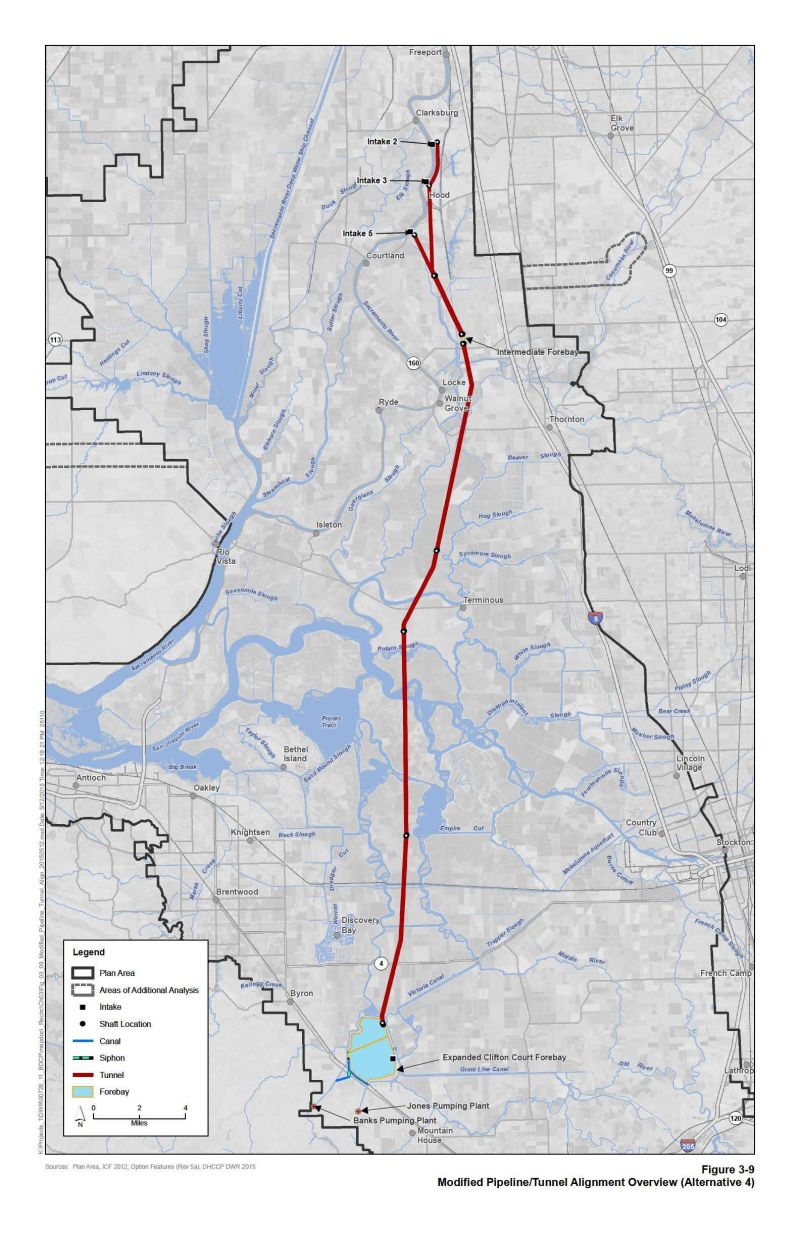
California WaterFix map
SACRAMENTO – Clearing another major milestone toward the modernization of the state’s water delivery system, the California Department of Water Resources (DWR) today certified the environmental analysis of the California WaterFix, also known as the Delta tunnels. Friday’s announcement follows recent federal biological opinions that confirm the project is consistent with environmental and wildlife protection standards.
“Today, we have reached our next important benchmark in moving California towards a more reliable water supply,” said DWR Acting Director Cindy Messer. “With this certification, our state is now closer to modernizing our aging water delivery system in a way that improves reliability and protects the environment.”
The WaterFix will modernize a 50-year-old water delivery system that is increasingly vulnerable to disruption by natural disaster and climate change. With new intakes along the Sacramento River, the project also would give water project operators the flexibility to divert water at times of high flow when the risk to native fish at the new diversion facilities is minimal, thus better balancing water supply and environmental protection needs.
Friday’s certification comes after more than a decade of analysis, review, and public comment. State and federal water and wildlife agencies have been working since 2006 to find the best way to improve how the State Water Project and Central Valley Project obtain water from the channels of the Sacramento-San Joaquin Delta. Together, the projects supply 25 million Californians with some or all of their drinking water supply and help irrigate three million acres of farmland.
The Notice of Determination and decision documents signed by Acting Director Messer approve WaterFix as the proposed project under the California Environmental Quality Act (CEQA). The project helps ensure stable water supplies for millions of Californians. CEQA requires state and local agencies to identify the significant environmental impacts of their actions and to avoid or mitigate those impacts, if feasible. See the Notice Of Determination, here: WaterFix Notice of Determination
DWR, which operates the State Water Project, screened more than 100 different proposals before analyzing 18 alternatives in depth in the final 50,000-page Environmental Impact Report (EIR) under CEQA. The combined public comment period on these environmental analyses lasted nearly a year.
The project was refined several times to shrink its footprint, minimize impacts to Delta landowners, and make other changes.
The CEQA certification, Notice of Determination, and decision documents put WaterFix a step closer to construction, which could begin as early as 2018. As both a modern and ambitious infrastructure project, WaterFix will require world-class engineering, efficient construction management, aggressive cost containment, and transparent business operations.
In addition to the certification, DWR also filed a “validation action” today with the Sacramento County Superior Court to affirm the department’s authority to, among other things, issue revenue bonds to finance the planning, design, construction and other capital costs of California WaterFix. A validation action is necessary to provide assurances to the financial community for the sale of the California WaterFix revenue bonds.
Meantime, DWR and the federal Bureau of Reclamation have completed a substantial portion of the proceedings before the State Water Resources Control Board to change the point of diversion for the state and federal water projects to allow operation of the WaterFix.
For more information, including fact sheets about project costs, cost allocation, project delivery and environmental benefits, visit www.californiawaterfix.com.
Potentially harmful blue-green algae blooms detected in Discovery Bay
Contra Costa health officials and the Central Valley Regional Water Quality Control Board advise people and pets in the Discovery Bay community to avoid contact with local bodies of water because of blue-green algae blooms.
Contra Costa Health Services Environmental Health Division (CCEH) received results this week for several water samples taken in late June from the southwestern section of Discovery Bay. Results found elevated levels of a natural toxin produced by blue-green algae blooms.
“We are advising residents to stay out of the water and keep their pets out of the water in the southwestern portion of Discovery Bay,” said CCEH Director, Dr. Marilyn C Underwood, “However, water circulates throughout the community, so the algae can also move and spread and therefore it is prudent to be cautious and to stay out of the water if you see scum or algae blooms.”
Exposure to the toxin can cause rashes, skin and eye irritation, allergic reactions, gastrointestinal upset and other symptoms.
“It’s important to know that dogs are especially vulnerable to getting sick from this toxin. There have been reports from past incidents of dogs dying after drinking the water or licking algae from their fur after swimming in water with blue-green algae blooms. If your pet gets ill after swimming in water with an algae bloom, take them to the vet immediately,” said Christine Joab, Cyanobacteria Coordinator for the Central Valley Water Board.
For a fact sheet to help veterinarians diagnose illness related blue-green algae exposure, visit www.mywaterquality.ca.gov/habs/what/vet_habs_factsheet.pdf
Blooms of blue-green algae, also known as cyanobacteria, can look like green, blue-green, white or brown foam or scum floating on top of water, or suspended in the water. Warm water temperatures and nutrients contribute to blooms, but these will eventually subside under cooler conditions.
CCEH will regularly test bodies of water throughout Discovery Bay and update the community while these conditions persist.
“Anyone who had contact with blue-green algae and has now developed symptoms or believes they may have consumed contaminated water should contact their healthcare provider immediately or call California Poison Control at 1-800-222-1222,” said Underwood.
No illnesses linked to Discovery Bay algae blooms have been reported in 2017. A child became sick after swimming in Discovery Bay during a similar event in 2016. Only recreational water areas are affected. Tap water in Discovery Bay is unaffected by the algal bloom.
FAQs
Is it safe for me to go in the water in Discovery Bay?
It depends where you are and if there are advisories posted in the area.
A CAUTION sign means:
Do not swim or wade near algae or scum
Keep your children away from algae in the water or on the shore
Do not drink the water or use it for cooking
Do not let pets or livestock go into or drink the water or eat scum on the shoreline
Do not eat shellfish from the water
A WARNING sign means:
No swimming
Stay away from scum, and cloudy or discolored water
Do not use these waters for drinking or cooking
Do not let pets or livestock go into or drink the water, or go near the scum
Do not eat shellfish from these waters
For fish caught here, throw away guts and clean fillets with tap water or bottled water before cooking
A DANGER sign means:
Stay out of the water until further notice. Do not touch scum in the water or on shore.
Do not let pets or livestock drink or go into the water or go near the scum
Do not eat fish or shellfish from these waters
Do not use the water for drinking or cooking. Boiling or filtering will not make the water safe.
Exposure to blue-green algae can cause rashes, skin and eye irritation, allergic reactions, gastrointestinal upset, and other effects. At high levels, exposure can result in serious illness or death, according to the California Department of Public Health.
What about my pets?
Keep pets out of water with blue-green algae blooms. Dogs are especially vulnerable to getting sick and there have been reports through the years of dogs dying following exposure associated with drinking the water and licking algae from their fur after wading/swimming in water with blue-green algae blooms.
Is there an issue with drinking water?
No, contamination only affects recreational water areas, not drinking water from the tap in Discovery Bay.
Who should I contact if I swam in the water and now have symptoms?
If you think you or someone else is displaying symptoms of blue-green algae poisoning, contact your health care provider or the California Poison Center Help Hotline at 1-800-222-1222.
What can I do to get rid of blue-green algae in Discovery Bay?
We do not recommend attempting to treat or remove the algae. Blue-green algae blooms are natural to the environment’s food chain, and eventually dissipate on their own. Chemical treatment is often ineffective and can result in more toxins being released into the water as algae cells die, as well as unintended effects on other species in the area.
Algae blooms result from changes in water conditions that encourage sudden growth of the species. The best way to reduce and prevent blooms is to reduce water pollution, particularly from runoff containing fertilizers or pesticides. Pick up trash dumped in waterways, and make sure all household sewer systems are working properly.
Treating aquariums with a hydrogen peroxide solution is a common way to get rid of some kinds of algae. But the Delta is not a closed system like an aquarium, so the results would be unpredictable, both in terms of efficacy and impact on the environment.
For updates, detailed explanations of posted advisories, a map of sampling sites and other information, visit cchealth.org/eh/blue-green-algae.
Los Vaqueros Reservoir expansion draft documents available; public meetings in July

Los Vaqueros Reservoir. Photo by Aerial Photographer Dick Jones. Courtesy of CCWater.com
Next meeting Tuesday in Brentwood
The Contra Costa Water District (CCWD) and the Bureau of Reclamation (Reclamation) have taken the next step necessary in evaluating the Phase 2 expansion of Los Vaqueros Reservoir from 160,000 acre-feet up to 275,000 acre-feet at an estimated cost of $800 million. Interested stakeholders can now review the draft document, and provide comments in writing or at a public meeting scheduled in July. (See Fact Sheet, here: http://www.ccwater.com/DocumentCenter/View/4033)
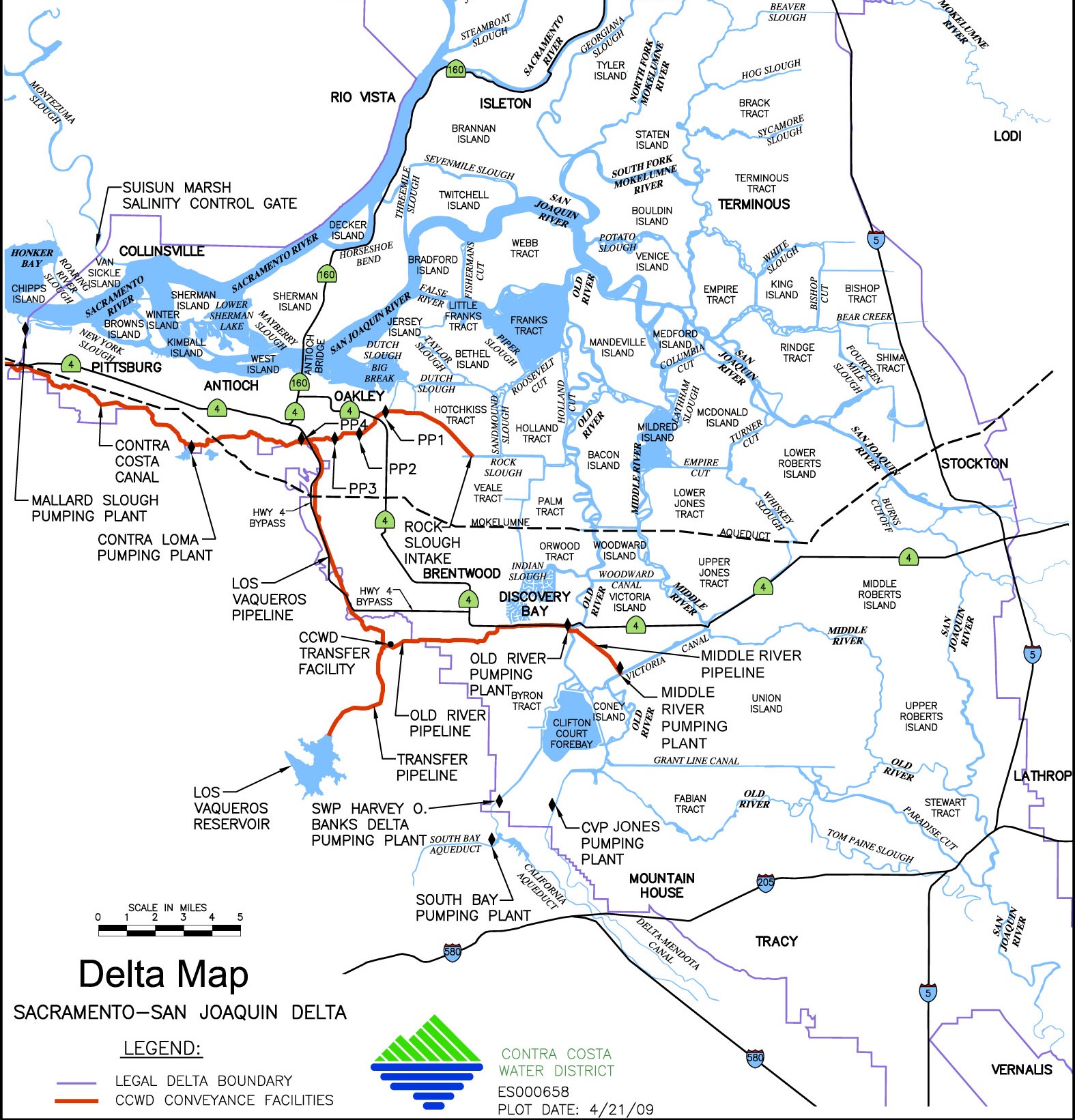 Los Vaqueros Reservoir, south of Brentwood, is owned and operated by CCWD. CCWD and Reclamation have been working on a joint evaluation of expanding Los Vaqueros Reservoir to develop water supplies for environmental management for fish and habitats, increase water supply reliability, and improve the quality of water deliveries. In 2012, the first phase of the expansion increasing capacity from 100,000 acre-feet to 160,000 acre-feet was completed by CCWD and provides customers with drought supply and water supply reliability benefits.
With the State’s announcement of availability of Proposition 1 funding for storage projects, a group of 11 water agencies entered into agreements with CCWD to prepare a funding application and necessary environmental documents for a Phase 2 Expansion of Los Vaqueros Reservoir from 160,000 acre-feet up to 275,000 acre-feet.
The next step in evaluating that further expansion is releasing the Draft Supplement to the Final Environmental Impact Statement / Environmental Impact Report (EIS/EIR) for public review. The Final EIS/EIR was certified in 2010 by CCWD – the Draft Supplement to the Final EIS/EIR updates that document with new information available. See the draft documents, here: http://www.ccwater.com/709/Expansion-Documents.
CCWD is currently working with the Bureau of Reclamation and local partners to evaluate project alternatives, facilities and operations. Upcoming key milestones include a funding application due to the California Water Commission in August 2017 and completion of the Final Federal Feasibility Report in November 2018. Construction could begin as early as 2022.
The potential local partners include:
o Alameda County Water District
o Bay Area Water Supply and Conservation Agency
o Byron Bethany Irrigation District
o City of Brentwood
o East Bay Municipal Utility District
o East Contra Costa Irrigation District
o Grassland Water District
o Santa Clara Valley Water District
o San Francisco Public Utilities Commission
o San Luis & Delta-Mendota Water Authority
o Zone 7 Water Agency
Interested stakeholders can participate in six public meetings to learn more about the Phase 2 Expansion and provide comments. Meeting locations allow for attendance by customers of the water agencies considering project participation. All meetings will start with an open house and presentation in the first hour, followed by a public hearing for the second hour. Remaining meeting details are as follows:
Brentwood: Tuesday, July 25, 2017, 6:30 – 8:30 p.m., Brentwood Community Center, 35 Oak Street
Los Banos: Thursday, July 27, 2017, 1:30 – 3:30 p.m., San Luis National Wildlife Refuge Complex Headquarters and Visitors Center, 7376 S. Wolfsen Road
For further information about the Draft Supplement to the Final EIS/EIR, public meetings and how to comment, please visit: www.ccwater.com/lvstudies and http://www.ccwater.com/832/Los-Vaqueros-FAQ.
- « Previous Page
- 1
- …
- 8
- 9
- 10
- 11
- 12
- 13
- Next Page »