• Home
  • About The Herald
  • Local Agencies
  • Daily Email Update
  • Legal Notices
  • Classified Ads

Contra Costa Herald

News Of By and For The People of Contra Costa County, California

  • Arts & Entertainment
  • Business
  • Community
  • Crime
  • Dining
  • Education
  • Faith
  • Health
  • News
  • Politics & Elections
  • Real Estate

West Contra Costa Unified fails to provide qualified teachers, complaints allege

February 5, 2024 By Publisher Leave a Comment

By Monica Velez, EdSource – Republished with permission

Three complaints have been filed last week with the West Contra Costa Unified School District alleging some schools failed to provide students with qualified teachers, according to Public Advocates, a nonprofit civil rights law firm.

Attorneys have discovered numerous teacher vacancies at Stege Elementary School, Helms Middle School and John F. Kennedy High School, according to the complaints. There’s also been a pattern of filling vacancies with long-term substitutes, which attorneys say is illegal.

Although teacher shortages are a national problem, West Contra Costa is facing more vacancies than surrounding districts, said Karissa Provenza, a law fellow at Public Advocates. If the district can’t fill vacancies, officials need to “take advantage of the numerous lawful options for filling vacancies with emergency yearlong teachers instead of subs,” she said.

“Beyond the emergency fixes, the district and the state need to boldly invest in sustainable solutions to attract and retain teachers from within the community who reflect the diverse backgrounds of their students,” Provenza added.

Teacher vacancies are not only undermining quality instruction for students, attorneys said, but they’re placing burdens on educators in the district by relying on them to fill vacant classes and passing students along.

“Some (students) have gone several years in a row being assigned to a class without a permanent, qualified teacher,” said Jeremiah Romm, a complainant and educator who has taught at Helms Middle School for 16 years, in a statement. “It becomes difficult to convince students that this district cares about their success, and I don’t know if I believe that myself.”

Educator vacancies have kept Sam Cleare, a complainant and educator at Stege Elementary School for seven years, from collaborating with other teachers and focusing on instruction. Cleare said there have been times when 10 or more students are placed in classrooms for multiple days because of the lack of substitutes.

“Working over the contractual limit of students is unacceptable,” Cleare said. “It is impossible for students to learn or for me to teach with these conditions. I have had to speak with many parents and explain that their child hasn’t had a teacher for multiple years. These conversations leave me heartbroken. The inequitable learning opportunities are unacceptable.”

The school district was contacted for a response to this article. Please check back later for any updates.

Allen D. Payton contributed to this report.


Filed Under: Education, News, West County

7 San Ramon Valley Unified students advance in local Shark Tank Competition 

January 27, 2024 By Publisher Leave a Comment

SRVUSD student entrepreneurs of 10 finalists to be judged by global business executives Feb. 6

By Ilana Israel, Director of Communications, Family and Community Engagement, San Ramon Valley Unified School District

Of the top ten finalists in the Contra Costa Shark Tank Youth Competition that have been announced, including three teams, five placements went to seven students from Bella Vista, Venture, Dougherty Valley High School, Monte Vista High School, and San Ramon Valley High School in the San Ramon Valley Unified School District. The seven students’ entrepreneurial projects cover various industries, including health care, environmentalism, and health and wellness.

The over 300 Contra Costa Shark Tank Youth Competition applicants were evaluated based on their enthusiasm for entrepreneurship, how the business is presented, the viability of the business and how the prize money will be used to launch a new business or grow an existing business.

The annual competition is open to all Contra Costa County students in kindergarten to 12th grade. The program promotes youth entrepreneurship and teaches important life skills, including perseverance, self-confidence, and financial literacy. Winners receive $1,000 (first place), $500 (second place), and $250 (third place). The competition was created by Maya Hammerman, an entrepreneur and Campolindo High School student, to inspire kids in Contra Costa County to explore entrepreneurship and new business ideas.

The finalists from San Ramon Valley Unified School District are:

  • Nicolas Angel-Ordonez & Shashank Koundinya, 11th Grade, San Ramon Valley High School – MiracleAlgae
  • Fatimah Hussain, 12th grade, Dougherty Valley High School – Workout Wizard
  • Himna Imam & Mahum Malik, 9th grade, Venture & Dougherty Valley High School – Tied Up in a Bow
  • Ronen Jain, 10th grade, Monte Vista High School – ElderSafe
  • Archit Kundu, 5th grade, Bella Vista Elementary School – Experimental Kids

“I congratulate our students who have followed their entrepreneurial spirit and worked very hard to bring their business ideas to life,” said Dr. John Malloy, Superintendent, San Ramon Valley Unified School District. “I wish our students the best of luck at the final pitch.”

As previously reported, the other five finalists are:

  • Valerie Castellanos, Angie Alvarenga, Giovanny Perez, 7th Grade, Summit Tamalpais, Richmond – Loonies
  • Hector Espinoza, 12th Grade, Freedom High, Oakley – Synchroma Studio
  • Beatrice Roberge, 12th Grade, Campolindo High, Moraga – ScrubWoofer™
  • Hunter Smith, 5th Grade, Burton Valley Elementary, Lafayette – SportzCity
  • Lydia Stewart, 7th Grade, Homeschool, Antioch – Lydia’s Soap

The top ten finalists will compete in the Finalist Pitch Event on February 6, 2024, at the Lafayette Library (3491 Mt. Diablo Blvd, Lafayette, CA). The judges include Jason Gardner, Founder, Chairman, and Former CEO of Marqeta, Inc.; Stephanie Williams, CFO and Controller of Pacific Gas & Electric Company; Roxanne Christophe, Founder and CEO of Girls Crushing It; Anthony Marino, President of thredUp; and Maya Hammerman, Founder of Moon Blossom Collection.

More information about the event, including tickets, is available at https://contracostasharktank.org/.

About San Ramon Valley Unified School District: Located in the San Francisco Bay Area, San Ramon Valley Unified School District (SRVUSD) is one of the highest-achieving school districts in California. With approximately 29,000 students, the district encompasses the communities of Alamo, Danville, San Ramon, and a small portion of Walnut Creek and Pleasanton.

SRVUSD has been recognized at state and national levels with many awards and achievements. The district is designated by AASA, The School Superintendents Association, as a Learning 2025 Lighthouse District because it serves as a model of positive change in public education and is committed to the whole child. Based on a foundation of academic excellence, SRVUSD’s work is guided by the district’s Strategic Directions, and broadening the definition of success so all students can thrive. The district maintains graduation rates above 96%. The Learner Profile outlines the competencies the district aspires for students to possess upon graduation, preparing students to be Critical Thinkers, Creative Contributors, Intentional Collaborators, Adaptable Learners, and Effective Communicators.


Allen D. Payton contributed to this report.

Filed Under: Business, Education, News, San Ramon Valley, Youth

Charting a Different Course: California Maritime Academy’s unique approach to education

January 26, 2024 By Publisher Leave a Comment

The Training Ship Golden Bear and scenic waterfront at Cal Maritime. Photo by Neil Sterud.

By Neil Sterud

Nestled amidst the picturesque hills along the San Pablo Bay waterfront, California State University Maritime Academy (Cal Maritime) stands as a hidden gem. Despite being the smallest campus of the CSU system, Cal Maritime boasts an impressive track record far beyond its modest size. Graduates from this maritime-focused institution consistently achieve remarkable success.

However, it’s not just the size that separates. The campus embraces a distinctive culture that sets it apart from other universities. Here, students don uniforms, engage in military-style formations, and unite under the distinctive banner of The Keelhauler.

While enjoying a commendable reputation among those familiar with its offerings, Cal Maritime faces the challenge of limited awareness beyond its niche maritime industry market. The school’s staff recognizes this hurdle, and the academy has been diligently working to overcome it and shed light on the exceptional educational opportunities it offers.

The university’s flagship vessel, Training Ship Golden Bear, has traversed the waters of many countries, embodying the global reach of Cal Maritime. Setting itself apart, the academy mandates an international experience for students pursuing any of its majors. This distinctive feature underscores the institution’s commitment to providing a comprehensive education beyond traditional classroom boundaries.

Specializing in business administration, engineering, marine transportation, oceanography, and international strategy and security, Cal Maritime caters to students with clear aspirations. Notably, the academy is responsible for licensing students entering the United States Coast Guard (USCG) and offers an officer program for those with a patriotic calling to serve our nation.

Furthermore, the university offers a program tailored for individuals aspiring to join the Strategic Sealift Midshipman Force (SSMF), a crucial component of the United States Navy. This initiative equips Navy Reserve Officers with civilian Merchant Mariner credentials and specialized military training. The primary mission of the SSMF is to bolster the United States organic Sealift fleet, particularly in contested environments. Additionally, the force is vital in supporting Maritime Domain Operations and fortifying the Maritime Industrial Base.

In summary, Cal Maritime is a unique educational institution notable for its global exposure, mandatory international programs, and specialized tracks for USCG licensing and the Strategic Sealift Midshipman Force. As awareness about its offerings grows, Cal Maritime is a solid choice for individuals seeking a practical and specialized academic experience.

Sterud is an Antioch resident and a senior at Cal Maritime.

Filed Under: Bay Area, Education, Military, News

Golden Hills Christian School in Brentwood to hold open house Jan. 29

January 24, 2024 By Publisher Leave a Comment

Golden Hills Christian School in Brentwood is a TK–8th Grade school, accredited through ACSI and WASC. We’re hosting our annual Open House on January 29, 2024 from 6:00 p.m. to 8:00 p.m. to welcome prospective families to check out the campus and meet the staff. Open enrollment will also begin that day.

This is a great opportunity to meet our teachers, look at the school curriculum, and learn more about the enrollment process. For more info about Golden Hills Christian School you can visit ghcs.org and RSVP below to let us know you’re coming!

The event will be held and the school is located in the Education Building at 2401 Shady Willow Lane in Brentwood.

Filed Under: Children & Families, Education, Faith

CSU to provide faculty with 5% pay increase effective January 31, 2024

January 20, 2024 By Publisher Leave a Comment

But faculty union wants 12% pay raise

By CSU Strategic Communications and Public Affairs

​The California State University (CSU) announced on January 9, 2024, that it will be providing all instructional faculty, librarians, counselors and coaches with a general salary increase of 5% effective January 31, 2024, concluding contract negotiations and exhausting the state’s impasse process. This decision was made after the latest round of negotiations with the California Faculty Association (CFA) failed to yield an agreement that would provide faculty salary increases while still allowing the CSU to best serve students within the limits of its resources.

However, according to the CFA, they’re demanding a 12% pay increase. (See related article)

Throughout the bargaining process, the CFA never veered from its initial salary demand, which was not financially viable and would have resulted in massive cuts to campuses — including layoffs — that would have jeopardized the CSU’s educational mission. In addition to the general salary increase, the CSU will be increasing department chairperson pay and allowing for modest parking fee increases.

“With this action, we will ensure that well-deserved raises get to our faculty members as soon as possible,” said Leora Freedman, vice chancellor for human resources. “We have been in the bargaining process for eight months and the CFA has shown no movement, leaving us no other option.”

The 5% salary increase is consistent with agreements the CSU has already reached with five of its labor unions.

“Our overriding responsibility is to manage a systemwide budget in a fiscally sustainable manner,” said Freedman. “We are committed to paying fair, competitive salaries and benefits for our hard-working faculty members, who are delivering instruction to our students every day and are the cornerstone of our university system. But we must also operate within our means to protect the long-term success and stability of the university, our students and our faculty.”

Without a change in bargaining position by CFA, this concludes bargaining on their contract reopener. The CSU and CFA can now begin successor bargaining on the full contract. The CSU remains committed to the collective bargaining process.

CSU Agrees with Majority of Neutral Factfinder Recommendations in Labor Negotiations with Faculty Union

On Dec. 1, 2023, the CSU announced that it is prepared to agree to the vast majority of the recommendations contained in a neutral factfinder report addressing negotiations between the CSU and the California Faculty Association (CFA). The report was made public today following a state-mandated 10-day “quiet” period.

“We believe that the factfinder’s report offers many thoughtful recommendations and a pathway to resolving all of the open issues,” said Leora Freedman, vice chancellor for human resources. “CSU is prepared to get back to the bargaining table with CFA at any time to reach a fiscally sustainable agreement that provides salary increases for our valued faculty.”

The independent factfinder provided recommendations on all open issues, which fall into 15 categories. On 13 of the 15 categories, CSU indicated in its response that it is prepared to agree to the factfinder’s recommendations, subject to bargaining with the CFA. These recommendations include increasing paid parental leave from six to eight weeks and improving the alternative paid workload reduction program for faculty with new children by increasing the workload reduction from 40% to 60%. Recommendations also address issues such as minimum pay ranges for lecturers, additional pay for department chairs, workload, personal leave, counselor ratios, gender-inclusive bathrooms and lactations spaces, parking and other issues.

On salary, the factfinder recommended using changes in the Consumer Price Index for goods and services (CPI-U) to propose a 7% general salary increase plus other adjustments. CSU has proposed 15% in general salary increases for faculty over three years, plus additional increases that would make some faculty eligible for up to 20.3% in salary increases. CSU’s proposal would provide general salary increases for all faculty that exceed the anticipated increase in the CPI-U over the next three years.

CFA has demanded a 12% general salary increase for one year, which would cost $380 million in new recurring spending. For context, CFA’s salary demand would cost $150 million more than the funding increase that the CSU received from the State of California for all operations in 2023-24.

“CSU strives to provide fair, competitive pay and benefits for all of our employees.  We recognize the need to increase compensation and are committed to doing so, but our financial commitments must be fiscally sustainable,” said Freedman.

The CSU has reached agreement with four employee unions representing about 26,000 employees. The CSU has yet to reach agreement with the CFA and Teamsters Local 2010 who represent skilled trade employees including electricians, plumbers and facilities maintenance workers. The CSU is at impasse with the Teamsters and will begin the statutory factfinding process with the union in the next few weeks.

The CFA has announced that it will conduct one-day strikes the following week at four CSU campuses.

“We respect the right of our labor unions to engage in strike activities, and we are prepared to minimize any disruptions to our campuses,” said Freedman. “Our hope is that the planned strike activities pose no hardships on our students and that we can get back to the bargaining table as soon as possible with the CFA to come to an agreement.”

For more information, view the factfinder’s​ report on the CSU Labor and Employee Relations website.

About the California State University 

The California State University is the nation’s largest four-year public university system, providing transformational opportunities for upward mobility to more than 450,000 students from all socioeconomic backgrounds. More than half of CSU students are people of color, and nearly one-third of them are first-generation college students. Because the CSU’s 23 universities provide a high-quality education at an incredible value, they are rated among the best in the nation for promoting social mobility in national college rankings from U.S. News & World Report, the Wall Street Journal and Washington Monthly. The CSU powers California and the nation, sending nearly 127,000 career-ready graduates into the workforce each year. In fact, one in every 20 Americans holding a college degree earned it at the CSU. Connect with and learn more about the CSU in the CSU newsroom.​​

Allen D. Payton contributed to this report.


Filed Under: Education, Labor & Unions, News

California Faculty Association to picket CSU East Bay in Hayward during system-wide strike

January 20, 2024 By Publisher Leave a Comment

California Faculty Association protest. Source: Facebook posted on June 1, 2023.

Jan. 22-26 calling for “Equity and fair labor conditions to meet the needs of our students.”

Teamsters support effort announce settlement; Associated Students also support strike

By Kevin Pina, calfac.org

In a decisive move for educational equity and fair labor conditions, the California Faculty Association (CFA) has announced a strike set to take place from January 22-26, 2024. CFA is a union of 29,000 professors, lecturers, librarians, counselors, and coaches who teach and provide services to the California State University system’s 485,000 students.  During the strike, members of CFA will be picketing the entrances of California State University, East Bay (CSUEB) in Hayward California (Carlos Bee Blvd. & Harder Rd). This decision comes after extensive negotiations and discussions with the California State University (CSU) Chancellor’s office have broken down. 

To kick off the first day of the strike at the CSUEB Hayward campus on Monday, January 22, Assemblymember Liz Ortega, California 20th Assembly District and Keith Brown, Executive Secretary-Treasurer of the Alameda Labor Council, AFL-CIO, will join the rally at Carlos Bee Blvd. in support of CFA’s bargaining positions.  

The primary focus of the strike is to draw attention to how poor working conditions and remuneration for CFA members negatively impacts the education offered to California State University (CSU) students. The CFA is advocating for a 12% wage increase for all faculty, reasonable workload requirements, longer parental leave, and broader access to campus facilities. The goal is to create an environment that fosters academic excellence, while ensuring the well-being of those who dedicate their careers to shaping the minds of the next generation. 

A Dec. 20, 2023, post on the CFA Facebook page claimed the strike is also for “more mental health counselors…and safe campuses.”

The decision to strike was not taken lightly, and the CFA has exhaustively engaged with the CSU leadership to seek alternative solutions. Unfortunately, the inability to reach a mutually beneficial agreement has led to the inevitable decision to strike. 

The strike garnered the support of the Teamsters of CSU which announced a settlement with CSU in a post on the CFA Facebook page on Saturday, Jan. 20th.

Source: CFA Facebook page

The strike is also supported by the Associated Students, Incorporated of Cal State East Bay. The following “Solidarity Statement” was posted on the CFA Facebook page on Friday.

The CFA remains committed to open dialogue with university administrators and encourages them to prioritize the needs of faculty members and our students. CFA believes that through collective efforts, a resolution can be achieved that benefits both faculty and the institutions they serve. 

Allen D. Payton contributed to this report.


Filed Under: East Bay, Education, Labor & Unions, News

Princeton University student from Antioch wins Projects for Peace award

January 20, 2024 By Publisher Leave a Comment

Princeton University senior and Dozier-Libbey Medical High School of Antioch graduate Carlos Cortez, 2023 Projects for Peace grant recipient. Photo by Gwen McNamara.

It takes a village: Carlos Cortez – Class of ’24 – and the people of Zináparo bring music and soccer to their youth

By Lou Chen, Trenton Arts at Princeton Program Manager

Originally published by Princeton University’s Pace Center for Community Service. Republished with permission.

Carlos Cortez ’24 straddles two worlds.

The 2020 Dozier-Libbey Medical High School gradaute’s family is from Zináparo, a small rural village in Michoácan, Mexico, where few people have ever heard of Princeton University.

The son of Carlos and Eréndira Cortez is a senior at Princeton University, where few people have ever heard of Zináparo.

But Carlos, the student, had an idea to bring these two worlds together. Last year, with the funding he won as Princeton’s 2023 Projects for Peace award recipient, he started a music and soccer summer camp for Zináparo youth.

Now everyone in Zináparo knows Princeton. And Princeton is just getting to know Zináparo.

Carlos Cortez (back right) and his soccer team. Photo by Lou Chen.

An Idea

Even though Carlos was born and raised in Antioch, California, he considers his real hometown to be Zináparo, where most of his extended family still lives. Twice every year, he travels to Zináparo to enjoy the balmy summers and festive winters, hiking in the nearby mountains and participating in the annual peregrinación (religious pilgrimage).

Accepted into Princeton as a Questbridge scholar, Carlos chose to major in neuroscience and committed to the pre-med track, supplementing his coursework with research and tutoring jobs. Despite his busy schedule, he felt restless. His thoughts constantly returned to Zináparo.

Carlos in Zináparo’s town square. Photo by Lou Chen.

“My dream was to become a doctor and open a pediatric clinic in Zináparo,” he says. “But I realized that it would be many years before I could accomplish this. I didn’t want to wait that long. I wanted a chance to do something now.”

That chance soon arrived. During his junior year, he heard about the Pace Center for Civic Engagement’s Projects for Peace initiative, which provides Princeton undergraduates with a $10,000 award to implement a service project anywhere in the world. With his family’s encouragement, he proposed a music and soccer summer camp for children in Zináparo.

“Growing up in California, music and soccer were very important for me in making community,” he says. “I wanted the kids in Zináparo to have the same experience.”

In the spring of 2023, he won the award.

According to a preview article about his project, “He saw his project as an opportunity to not only influence the youth of his town, but to have positive reverberations for the entire community and surrounding communities as well.

He summarizes this hope as he looks forward to this summer by saying, ‘just like a musical note can travel through both time and space when it is played, I am hopeful of learning how my project’s ideals and goals are going to have transgenerational effects on the future generations of Zináparo and ultimately transcend beyond the borders of my hometown,” he shared before the project began.’”

Carlos and his music students. Photo by Adrián Pimentel.

A Village

As any entrepreneur will tell you, the road from idea to execution is a winding one. “Right before arriving in Zináparo, I was feeling that the process would be easy,” Carlos says. “But when I landed in Zináparo, I started to realize that it was going to be a long journey with a lot of challenges.”

The first challenge was recruiting children for the camp, which Carlos had titled, “Musical Notes: A Composition for Peace.” Even though Carlos was a frequent visitor to Zináparo, he remained an unfamiliar face to many people. It didn’t matter that Princeton was supporting the camp; none of the children knew what Princeton even was.

Carlos purchases a bass in Paracho. Photo by Adrián Pimentel.

He began by visiting the local high school where his aunt Noemí taught history and ethics, going from classroom to classroom and telling students about his new program. He later found out that one of the students called up Noemí, a widely respected community leader in Zináparo, and told her that someone from Princeton University wanted to start a summer camp. “Do you know about this?” the student asked. “Can we trust him?”

“Of course, you can,” Noemí replied. “He’s my nephew!”

Another challenge was procuring instruments. Almost 40 kids wanted to learn guitar, violin, or bass—but none of them had their own instrument. One hot summer day, Carlos, his younger sister Natalia, his mother, his uncle Adrián, and his grandfather Guillermo piled into the family van and drove two hours to Paracho, a small town in Michoácan that specializes in making instruments. (Paracho inspired the setting of the Oscar-winning animated film Coco.)

Once in Paracho, they purchased several instruments from a local luthier. Somehow, they crammed one bass, five guitars, and seven violins into a van that already contained five people. “I was pressed up against the side of the van,” says Carlos. “It was definitely an experience.” They made several return trips to Paracho for more instruments, and on one occasion, the aforementioned luthier drove a second bass all the way to Zináparo by himself.

Carlos was surprised by how enthusiastically the Zináparo community rallied around the camp. Countless people pitched in: the neighbor who let them use his house for rehearsals; the business owner who let them use his shop for a private recital; and Carlos’ 10-year-old student Hector and Hector’s mother Luz, who cleaned up after every rehearsal. “Without everyone’s help, this project would not have been possible,” says Carlos.

The camp exceeded even Carlos’ wildest expectations. Every Monday through Thursday for two and a half months, almost 100 children aged four to 17 participated in one or more classes: soccer, choir, guitar, and violin/bass. Carlos coached the soccer team and hired teachers for the other subjects. “I wanted teachers who were passionate about working with kids,” says Carlos. “I didn’t want them to treat this as just another way to make money.”

On the last day of camp, his soccer team surprised him with a loud round of applause. One student cried out, “Carlos for president!” Carlos promised to buy them jerseys out of his own money if they continued to practice soccer.

Carlos and his soccer team. Photo by Adrián Pimentel.

Continue they did. Even though Carlos had to return to Princeton for his senior year, he was determined to keep the camp going. He found two people to coach the soccer team on a volunteer basis; they had recently moved to Zináparo and had long dreamed of coaching their own team. He used his leftover Projects for Peace funding to pay for weekly choral and instrumental lessons for his students until December and let them keep their instruments. Noemí took his place as the point person for the program.

For Carlos, the experience was a blessing. “I just wanted to change the future of even one of the kids,” he says. “I’m seeing that difference already.”

A Debut

On January 7, Carlos woke up with butterflies in his stomach. Today was the debut of Musical Notes: A Composition for Peace. Since the summer, the choir and orchestra (consisting of guitar, violin, and bass) had been rehearsing weekly for a big concert in the Zináparo town square. The entire community had been invited, and Carlos’ extended family in California had flown out to watch.

Carlos’ soccer team wears their new Princeton-themed jerseys. Photo by Lou Chen.

First, Carlos stopped by the soccer field to observe a match between his team and a team from a neighboring town. He had kept his promise: His team was wearing brand-new orange and black jerseys. Natalia had designed the jerseys, including the iconic image of a Princeton tiger glaring through claw marks.

“In one of our first games, we played against a team from a much wealthier town,” says Carlos. “I could tell how discouraged my students were to see how much nicer [the opposing team’s] field was. I got them jerseys because I wanted them to feel proud to be on this team. I wanted them to feel like they were a part of something bigger…like they had the support of Princeton University.” The new jerseys seemed to do the trick: After putting them on, his team won the next game.

After the match, Carlos and his parents walked to the town square to set up for the performance. The owner of the local funeral home, whose daughter was in the choir, had donated 150 chairs for the audience—and had even purchased new ones so that there would be enough.

The audience seated (and standing) in the town square. Photo by Lou Chen.

Carlos was worried that not enough people were going to show up to fill the seats. But as people started entering the town square, he realized that he had the opposite problem: He didn’t have enough seats. His family raced to the rehearsal space, grabbed as many chairs as they could, carried them back, and set them up with only minutes to spare. The new chairs were quickly occupied, and latecomers had to stand. At least 350 people were in the audience.

The choir performs “Noche de paz.” Photo by Lou Chen.

As Natalia helped tune the guitars, she noticed a student looking forlorn. She asked him what was wrong, and he quietly asked if this was the last day of the program. “Of course not,” Natalia assured him. He smiled.

The choir opened the concert with six Christmas carols. During “Noche de paz” (Silent Night), they cradled candles in their hands, their faces glowing as if lit from within. For their final song, “Ven a Cantar” (Sing with Us), they rolled up their sleeves, revealing bracelets made of jingle bells. As they clapped their hands, the ringing of bells filled the crisp winter air.

The orchestra was up next, performing two songs that featured a 15-year-old choral student named Andrea. Her voice, initially hesitant and wavering, gradually grew in power. The guitarists kept the orchestra together with their steady strumming, and the violinists trained their eyes on the conductor, determined not to miss their tremolo entrance. In the very back, a student plucked away at the bass that Carlos had brought back from Paracho.

José delivers his speech. Photo by Lou Chen.

After the orchestra finished, Noemí invited Hector and Luz to the stage and thanked them for keeping the rehearsal space clean. She presented them with gifts and embraced a clearly overcome Luz. The crowd cheered.

Next to speak was Carlos’ student José, who at 17 years old was the oldest member of the program. “I want to give a special thank you to Carlos for giving me and the children of this town the opportunity to learn music,” he said. “I hope this continues…Zináparo needs these programs.”

Carlos walked onstage to deliver the concluding remarks. “Thank you to my grandparents for giving me a love of Zináparo,” he said, choking back tears. “I know I wasn’t born here, but this is my home.”

As Carlos left the stage, he was mobbed by students, parents, complete strangers—all of whom wanted to take a picture with him. Grown men were crying and little kids were beaming. “Before this camp, the children of Zináparo didn’t have anything like this,” says Eréndira. “But now, they do.”

Carlos hopes that the camp will take place every summer, with weekly programming throughout the rest of the year. He hopes that someday his music students will be paid to perform or even to teach. (This is already happening: José has been invited by his guitar teacher to perform in a mariachi band, and Carlos wants him to teach for the camp.) He hopes to solicit donations from Zináparo residents who have immigrated to the United States, and to potentially seek funding from the Mexican government.

Musical Notes: A Composition for Peace. Photo by Lou Chen.

These are all big dreams. It’s a lot for one Princeton student—and soon-to-be-alum—to take on alone.

But Carlos knows he isn’t alone. “I feel honored to have so many different communities believe in the project,” he says. “It ensures the life of the project, because there are so many people invested in wanting to see the kids succeed.”

To learn more about Musical Notes: A Composition for Peace, follow them on Instagram. Their full debut performance can be viewed on YouTube.

Allen D. Payton contributed to this report.

Filed Under: Arts & Entertainment, Community, East County, Education, International, News, Sports, Youth

DeSaulnier announces 2023 Congressional App Challenge winner

January 8, 2024 By Publisher Leave a Comment

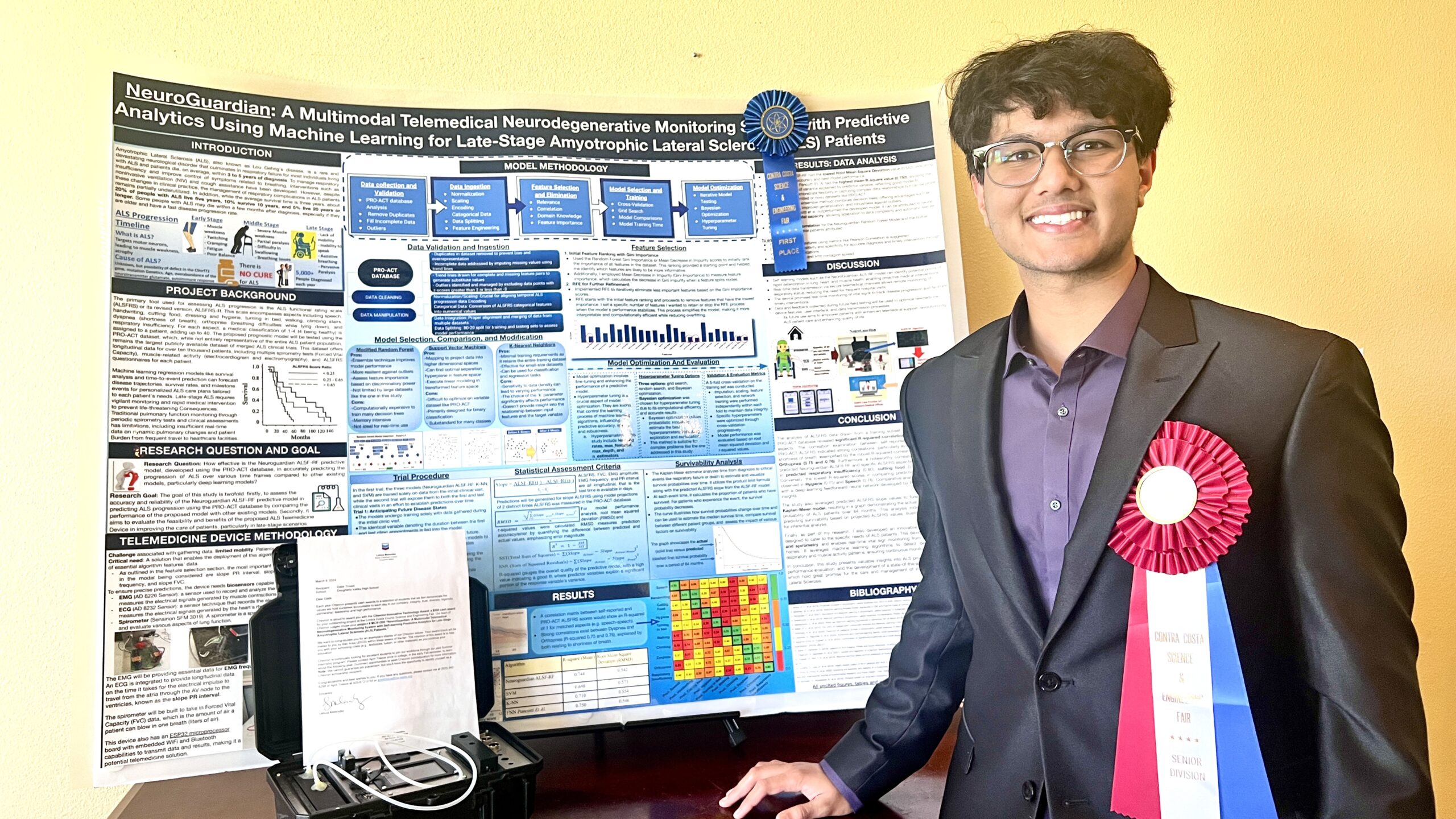
U.S. Rep. Mark DeSaulnier held a reception Friday to announce the winner of the 2023 Congressional App Challenge, Sania Bidurukontam of Dougherty Valley High School. Four Dougherty Valley students tied for second place. Photo: Office of U.S. Rep. Mark DeSaulnier

Dougherty Valley High junior from San Ramon invents CogniPro

3 other Dougherty Valley students and Dublin High team tie for second, third place winner from Monte Vista High

On Friday, Jan. 5, 2024, Congressman Mark DeSaulnier (CA-10) announced that Sania Bidurukontam of San Ramon is the winner of the 2023 Congressional App Challenge (CAC) for California’s 10th Congressional District. Bidurukontam, is a junior at Dougherty Valley High School. She invented the CogniPro app, which aims to reduce misdiagnoses of attention-deficit/hyperactivity disorder (ADHD) and help mental health professionals properly diagnose ADHD. The app includes a 2D platform game and embedded eye tracking to monitor levels of hyperactivity, impulsivity, and inattention, the most common symptoms of ADHD.

“It’s such a joy to see students’ creativity and talent on display each year during our Congressional App Challenge,” said DeSaulnier. “As a proud advocate in Congress for improving youth mental health, I am proud to see young people like Sania working on ways to better identify and address the challenges faced by her peers. Congratulations, Sania!”

Second place was a four-way tie with Advita Goyal (Dougherty Valley High School), Aryan Agrawal (Dougherty Valley High School), Prisha Marpu (Dougherty Valley High School), and a team comprised of Rohan Vij, Ayush Garg, Mohit Varikuti, and Jimin Lim (Dublin High School)—all recognized for their apps SkinScan, WellTeen, Med Track, and Politica AI, respectively. SkinScan helps to identify and monitor skin conditions, WellTeen helps to manage stress and promote mental wellbeing, Med Track helps users track their daily medications, and Politica AI helps users identify political biases and misinformation while reading the news. Third place was awarded to Jacob Trentini (Monte Vista High School) for his app BreatheFree, which monitors air quality and pollen levels.

This year’s winners were chosen by a panel of judges from the STEM and education fields, all of whom live or work in California’s 10th Congressional District.

The CAC is a public initiative to encourage young people to learn how to code in an effort to inspire creativity and encourage interest in STEM education. In the eight years of the CAC, the program has yielded 46,928 applicants across all 50 states.

Filed Under: Education, News, San Ramon Valley, Technology, Youth

League of Women Voters to host webinar on election mis-/dis-information Jan. 18

January 4, 2024 By Publisher Leave a Comment

Community conversation moderated by Truth in Common founder, News Guard News Acting Director & Verification Editor

By Gail Murray

Are you feeling overwhelmed by the preponderance of mis- and dis-information, the role of AI and the potential effects on the 2024 election? Join a Community Conversation webinar on Thursday, January 18 from 4 p.m. to 5:30 p.m. titled “Mis/Dis-Information: How to Recognize and Respond to It” to learn how falsehoods spread and how we can avoid them.

The webinar will feature Deanna Troust, founder of Truth in Common, who will moderate the event.  Troust will outline an approach for social change to address this pervasive issue.  She will discuss recent research and skills to deepen our capacity for constructive civil discourse, based on her workshop series titled “Misinformation: How it Spreads and How to Avoid it.” Troust will be joined in the discussion by McKenzie Sadeghi, Acting Director and Verification Editor for News Guard News.

Register for the Zoom link here:

https://ccclib.bibliocommons.com/events/65833f5767e8ac3700b79931

Information on how to access the Zoom webinar will be sent to your email address 24 hours before the program. Audience questions will be collected and answered through the Zoom chat.

Community Conversations are sponsored by the League of Women Voters of Diablo Valley, the League of Women Voters of West Contra Costa County, CCTV, and the Contra Costa County Library.

The Library will provide closed captioning for this event and simultaneous Spanish translation.  This program will be recorded and uploaded to the Library’s YouTube channel after the event.

Contact programs@lwvdv.org for more information.

Filed Under: Community, Education, Politics & Elections

Brentwood: Presentation at Bristow Middle School following gun violence threats

November 28, 2023 By Publisher Leave a Comment

Opportunity for public to speak Wednesday, Nov. 29th

In the wake of a recent gun violence threat at Bristow Middle School in Brentwood, Digital4Good has taken a proactive stance to address the issue head-on by organizing an educational initiative aimed at raising awareness and promoting a safer environment for students.

On Wednesday, November 29th, Kim Karr, the visionary behind Digital4Good formerly #ICANHELP, will be speaking at Bristow to engage with students, faculty, and the community at

large. The focus of Karr’s presentation will be on fostering understanding, and open dialogue, and providing valuable information about recognizing and responding to potential threats.

Digital4Good has been a support to schools for 10 years in dealing with social media education and Bristow was one of the first rooted schools to use the #ICANHELP programs. Mental health plays a crucial role in the goals surrounding the non-profit and continues to be a topic of conversation at the upcoming forum.

This critical event aims to empower students and the community with knowledge and resources to prevent, identify, and report potential threats of gun violence. Digital4Good believes that education is a powerful tool in creating a safer and more secure environment for everyone.

The event will include 3 student presentations, staff training and a parent night by Kim Karr, followed by an open forum for questions and discussion. Digital4Good encourages parents, community members, and local media to attend and participate in this important conversation.

Details of the event:

Time: 6-7 pm

Location: Bristow Middle School, 855 Minnesota Avenue, Brentwood

Virtual option will be available

Digital4Good remains committed to fostering safer communities through education, awareness, and community engagement. For more information about the organization and its initiatives, please visit www.icanhelp.net or contact Kim Karr at kim@icanhelp.com.

About Digital4Good

Digital4Good is a non-profit dedicated to educating and empowering students and educators to promote good use of technology, make a positive impact within communities, and help them to become inspirational digital citizens to prevent cyberbullying and other types of abuse.

Filed Under: Community, East County, Education

  • « Previous Page
  • 1
  • …
  • 9
  • 10
  • 11
  • 12
  • 13
  • …
  • 34
  • Next Page »
RepublicServices-Antioch-ad (1)
Furniture-Clrnc-Outlet-0626
Monica's dinner 05-26 CCH
Celia's-06-26
Delta-RC-A (2)
Deer-Valley-Chiro-06-22

Copyright © 2026 · · Contra Costa Herald · All Rights Reserved