• Home
  • About The Herald
  • Local Agencies
  • Daily Email Update
  • Legal Notices
  • Classified Ads

Contra Costa Herald

News Of By and For The People of Contra Costa County, California

  • Arts & Entertainment
  • Business
  • Community
  • Crime
  • Dining
  • Education
  • Faith
  • Health
  • News
  • Politics & Elections
  • Real Estate

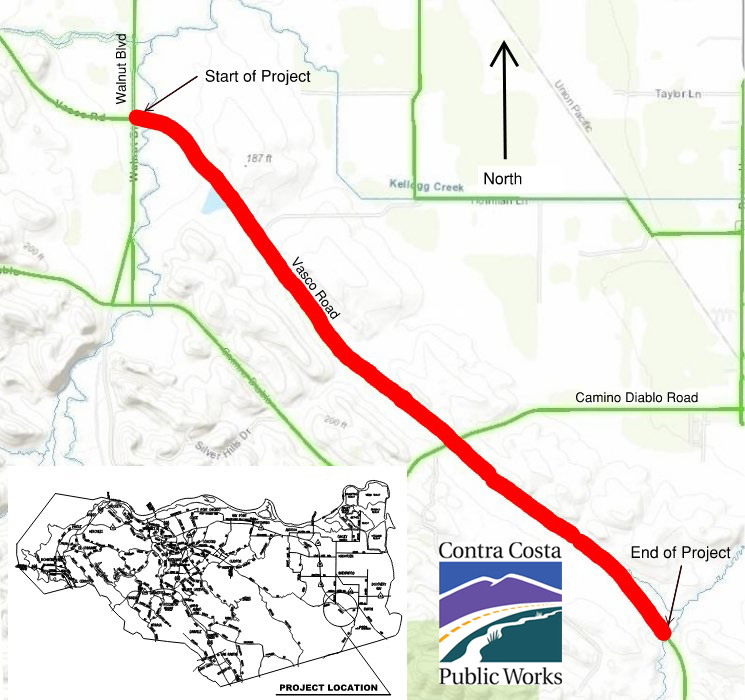
Vasco Road Safety Improvements Project construction continues through Nov. 21

November 6, 2025 By Publisher Leave a Comment

Source: CCC Public Works

Walnut Boulevard to Frisk Creek Bridge

By Kelly Kalfsbeek, Community & Media Relations Coordinator, PIO, Contra Costa County Public Works Department

November 6, 2025, Byron, CA- The Contra Costa County Public Works Department is continuing construction on the Vasco Road Safety Improvements Project – Walnut Boulevard to Frisk Creek Bridge. Work will continue through Friday, November 21, 2025, barring unforeseen circumstances and weather permitting. Message boards will alert drivers about the work. Drivers should expect delays of up to 10 minutes through the construction zone and consider alternative routes during working hours.

The work will occur in multiple phases:

Phase 1 (continuing through Friday, November 14) work will occur between 8:30 a.m. and 3:30 p.m. Monday through Saturday (excluding holidays) and consists of centerline rumble strip installation, centerline striping, and channelizer placement.

Phase 2 (Wednesday, November 19, through Friday, November 21) work will occur Wednesday through Friday nights, starting at 8:00 p.m. and lasting until 5:00 a.m. the following morning. The work includes improvements to the traffic signal lights for increased visibility at the intersections of Vasco Road and Walnut Boulevard, and Vasco Road and Camino Diablo.

Additional work on the signals may occur during the day, with minimal to no impacts to traffic expected.

Funding for this project is provided by State Highway Safety Improvement Program (HSIP) funds and Local Road Funds.  For more information, visit: https://www.contracosta.ca.gov/9962/Vasco-Road-Safety-Improvements-Project–.

For Construction Status contact at Carlos Melendez (510) 385-0506.

About Contra Costa County Public Works Department:

Contra Costa County Public Works Department (CCCPWD) maintains over 660 miles of roads, 150 miles of streams, channels, and other drainage, and over 150 County buildings throughout Contra Costa County. CCCPWD provides services such as Parks and Recreation, Sandbag Distribution, and Flood Control throughout unincorporated areas of Contra Costa County.  CCCPWD operates two airports, Buchanan Field Airport in Concord and Byron Airport in Byron. For more information about CCCPWD, please visit us at: www.cccpublicworks.org.

Filed Under: Construction, East County, News, Transportation

California invests $5 billion for local projects, bridge repairs, alternative transport options, freight movement

October 23, 2025 By Publisher Leave a Comment

$5.3 million for Contra Costa projects in Danville, Richmond

By Edward Barrera, Division Chief, Caltrans Public Affairs

The California Transportation Commission on Friday, Oct. 17, 2025, approved $4.9 billion to improve safety and mobility on local streets and state highways as well as fund new alternative transportation options and zero emissions projects.

“California is investing in itself — in our communities, our people, and the places we drive, walk, and ride every day. We’re making our roads safer, our commutes smoother, and our transportation system cleaner and more connected,” said Governor Gavin Newsom.

More than half of the allocation will provide 600 local governments and regional transportation agencies with their annual funding to fix roads, bridges and other transportation needs statewide.

“This nearly $5 billion investment highlights California’s strong commitment to creating a modern, resilient transportation system that enhances local streets and strengthens connections between neighborhoods, job centers and schools. Thanks to Governor Newsom’s leadership, Caltrans’ work and the Commission, we are building a safer, more connected and future-ready transportation network that serves all Californians,” said Toks Omishakin, California Transportation Secretary

Among the projects approved is $700 million for repairs and critical upgrades needed for the Vincent Thomas Bridge, a 60-year-old span in the Port of Los Angeles that will soon undergo a major deck refurbishment. Another $140 million will fund truck climbing lanes among other improvements to Interstate 80 in the Sierra foothills between Applegate and Emigrant Gap, a major west coast freight thoroughfare.

“Our local partners are steadfast contributors and valued partners in keeping California’s vast transportation network safe and efficient. When added to the various highway projects also approved, this month’s action ensures that hundreds of essential improvements in our cities and neighborhoods will better enable people and goods to flow throughout the state and beyond,” said Caltrans Director Dina El-Tawansy.

Of the total allocation this month, $470 million comes through Senate Bill (SB) 1, the Road Repair and Accountability Act of 2017, and $4.2 billion from the federal Infrastructure Investment and Jobs Act. The larger than normal funding relates almost exclusively to the annual allocation provided to local governments and regional transportation agencies.

“The Commission is committed to ensuring that California’s transportation system is safe and reliable for everyone who uses it,” said Tanisha Taylor, California Transportation Commission Executive Director. “Today’s nearly $5 billion investment in projects will improve multimodal access to schools and employment centers, boost our growing economy, and reduce out-of-pocket expenses for all Californians.”

Pedestrian facilities also received support from the allocations, including an award of $97 million to replace a pedestrian bridge that connects neighborhoods south of the City College of San Francisco campus and other improvements to Interstate 280 between San Francisco and San Mateo counties. And $6.3 million will be spent on new sidewalks, bike lanes and traffic controls in the cities of Santa Barbara and Santa Rosa and in Santa Clara County.

Other notable Bay Area projects include $10 million to build a floating charging station for zero emission ferries in San Francisco Bay.

Contra Costa County projects include:

  • $5,040,000 In Danville, at the I-680 southbound onramp to El Cerro Blvd. Due to heavy winter rains during January and February 2025 caused damage at three locations due to saturated soils, erosion, and earth movement. The damage includes roadway settlement, leaning sound wall, and slope erosion. This project will repair roadway using polyurethane injection and grind and pave methods, replace damaged portion of sound wall, reconstruct guardrail, stabilize slope embankment, and place erosion control.
  • $276,000 Construction of widened and ADA-compliant sidewalks along Market Avenue, curb extensions at Giaramita Street/Verde Street intersection, and urban greening in Richmond. Construct 4,390 feet of widened sidewalks, narrowed travel lanes, install 4 curb extensions and 18 ADA-compliant curb ramps.

California is expected to receive nearly $42 billion in federal infrastructure funding over a span of five years. These investments will upgrade the state’s roads, bridges, rail, public transit, airports, ports and the electric vehicle charging network.

SB 1 has invested approximately $5 billion annually toward transportation projects since 2017. It provides funding split between the state and local agencies. Road projects progress through construction phases more quickly based on the availability of funds, including projects that are partially funded by SB 1.

For more information about transportation and other infrastructure projects funded with state and federal investments, visit build.ca.gov.

Allen D. Payton contributed to this report.


Filed Under: Construction, News, San Ramon Valley, State of California, Transportation, West County

California invests $3 billion to enhance safety, improve travel times, boost multimodal travel options

October 22, 2025 By Publisher Leave a Comment

Over $107 million for Contra Costa projects including $46.9 million on Hwy 4 improvements in East County, $42.4 billion on 680 in San Ramon Valley and $14.6 million on Caldecott Tunnel

By Edward Barrera, Division Chief, Caltrans Public Affairs

In August, the California Transportation Commission (CTC) approved $3 billion in allocations to enhance safety and mobility across the state highway system and expand multimodal travel, including bike lanes and pedestrian pathways. Guided by Governor Gavin Newsom’s Build More, Faster – For All infrastructure agenda, these improvements will make California communities safer, cleaner and increase access to active transportation options.

Of the $3 billion allocated, $663 million derives from Senate Bill (SB) 1, the Road Repair and Accountability Act of 2017 and approximately $2 billion from the federal Infrastructure Investment and Jobs Act of 2021 (IIJA). The funds will serve as a catalyst to increase the capacity of the state’s transportation system, rehabilitate aging roadways and improve travel times, while balancing community impacts and promoting environmental benefits.

The “…investments reflect California’s long-term commitment to safer roads, smarter traffic management and expanded transportation choices that get people where they need to go,” said Caltrans Director Dina El-Tawansy.

“The funds allocated…reflect the Commission’s commitment to investing taxpayer dollars strategically. These investments will improve the safety and reliability of the state’s transportation network and support a thriving economy by improving the movement of freight and reducing out-of-pocket expenses for all California,” said Darnell Grisby, Chair of the California Transportation Commission.

Projects in Contra Costa County approved by the Commission include:

  • $46,900,000 on SR-4 in and near Antioch and Brentwood, from Hillcrest Avenue to Byron Highway, to rehabilitate pavement and drainage systems, upgrade facilities to ADA standards, install Accessible Pedestrian Signals (APS), high-visibility crosswalks, bike loop detectors, and construct Class II bike lanes. This will extend pavement service life and improve ride quality.
  •  $42,374,000 on I-680 in San Ramon and Danville, from Alcosta Boulevard to 0.1 mile north of Diablo Road, to rehabilitate pavement, upgrade guardrail, and upgrade facilities to ADA standards. This will extend pavement service life and improve ride quality.
  • $14,584,000 on SR-24 in Orinda, at the Caldecott Tunnel, to rehabilitate and upgrade the ventilation system in Bores 1, 2, and 3. This will ensure structural integrity and prolong tunnel service life.
  • $1,301,000 on SR-4 in Concord, 0.5 mile east of Port Chicago Highway, to reconstruct a failed slope embankment and repair a displaced down drain due to heavy rainfall in February and March 2025. Work includes installing Rock Slope Protection (RSP), and repairing the down drain, guardrail, and dike. This will enhance driver and pedestrian safety.
  • • $1,275,000 on SR-4 near Pittsburg, 0.3 mile west of Bailey Road, to reconstruct a slope embankment and repair a displaced down drain due to heavy rainfall in February and March 2025. Work includes installing Rock Slope Protection (RSP). This will improve roadway safety.
  • $999,000 on SR-24 in Lafayette, from 0.7 to 1.0 mile east of Acalanes Road, to rehabilitate pavement due to ponding and water seepage caused by heavy rainfall in February and March 2025, which led to cracking and settlement. This will extend pavement life and improve safety.

IIJA is a once-in-a-generation investment in our nation’s infrastructure to improve the sustainability and resiliency of our country’s energy, water, broadband and transportation systems. The total funding for California is nearly $54 billion. This includes investments to upgrade the state’s roads, bridges, rail, public transit, airports, ports, waterways and the electric vehicle charging network.

SB 1 has invested approximately $5 billion annually toward transportation projects since its adoption. It provides funding split between the state and local agencies. Road projects progress through construction phases more quickly, based on the availability of funds, including those partially funded by SB 1.

Visit build.ca.gov to learn more about transformative infrastructure projects happening in communities throughout the state.

Filed Under: Construction, Finances, Infrastructure, News, State of California, Transportation

East County: 60-hour weekend closure of Hwy 160 Oct. 10-13

October 8, 2025 By Publisher 2 Comments

Southbound auxiliary lane

By Nathaniel Fowler, Health & Safety Specialist, Caltrans

Caltrans has scheduled a 60-hour weekend closure of the southbound State Route 160 (SR-160) auxiliary lane between Wilbur Avenue and East 18th Street/Main Street. The closure will begin Friday, Oct. 10, 2025, at 5:00 PM and remain in effect until Monday, Oct. 13 at 5:00 AM.

Please be advised that Wilbur Avenue On-Ramp to southbound SR-160 and E. 18th Street Off-Ramp on southbound SR-160 will remain closed throughout the closure. This extended closure is required to safely and efficiently complete construction activities in the area.

Detour signs will be posted, and Changeable Message Signs (CMS) will alert drivers of the closure. Drivers should expect delays, allow extra travel time and exercise caution while navigating the detours. All work is weather permitted. Caltrans appreciates the public’s patience and cooperation while crews perform this critical work.

For 24/7 traffic updates, follow 511.org on Twitter/X. For real-time traffic, visit Caltrans QuickMap.

Filed Under: Construction, East County, News, Transportation

West County: Eastbound Hwy 4, Richmond-San Rafael Bridge closures Oct. 7-10 & 13

October 6, 2025 By Publisher Leave a Comment

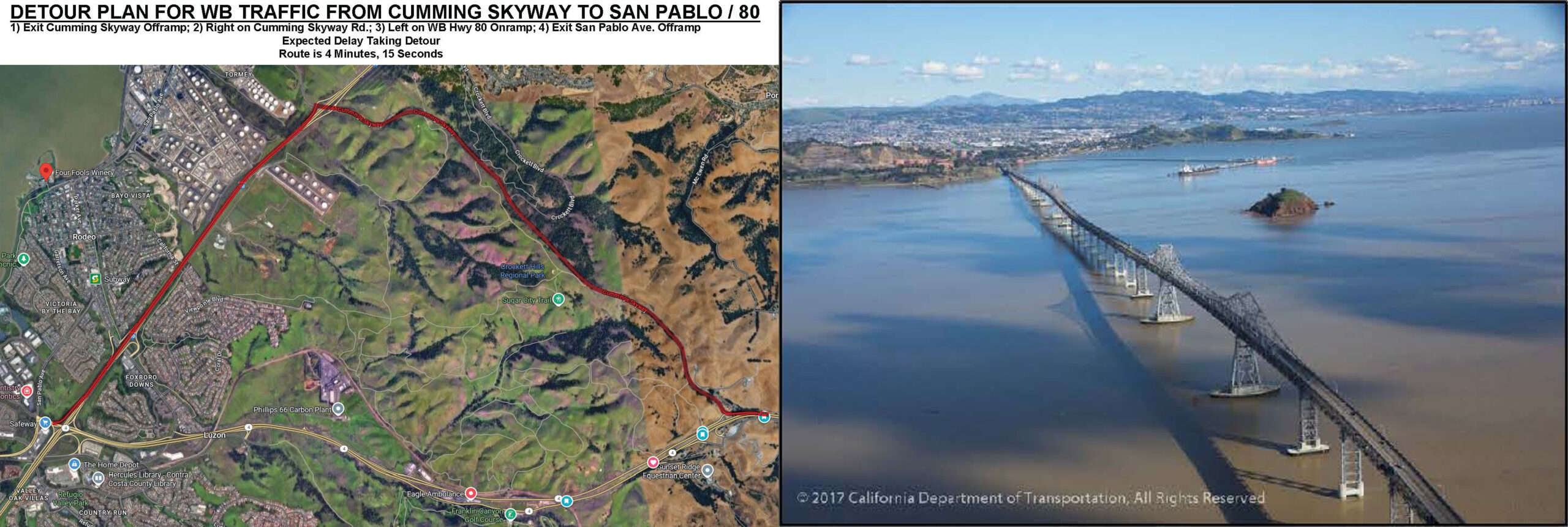
Detour map for eastbound Highway 4 in West County and Richmond-San Rafael for closures this week and next. Source: Caltrans

By Denise Harding, PIO & Nathaniel Fowler, Health & Safety Specialist, Caltrans

Caltrans will implement a full closure of eastbound State Route 4 (SR-4) between San Pablo Avenue in Hercules in Western Contra Costa County and Cummings Skyway, beginning Tuesday, October 7 through Friday, October 10, nightly and on Monday, October 13, 2025, nightly from 7:00 PM to 5:00 AM. On-ramps along eastbound SR-4 during this time, will be closed include San Pablo Avenue, Willow Avenue and Franklin Canyon Road. The closures are necessary to allow paving crews to complete work in the Cummings Skyway area. Westbound SR-4 traffic is not expected to be affected.

Detour Plan for EB SR-4 Traffic from I-80 to Cummings Skyway

  1. Continue EB 80 to Cummings Skyway Exit
  2. Exit on Cummings Skyway road;
  3. Right on Cummings Skyway road;
  4. Right on EB Hwy 4 Onramp

Detour Plan for EB SR-4 Traffic from Willow Avenue to Cummings Skyway

  1. Continue West on Willow Ave.;
  2. Right on Sycamore Ave.;
  3. Right on San Pablo Ave.;
  4. 80 to Cummings Skyway Exit;
  5. Exit on Cummings Skyway road;
  6. Right on Cummings Skyway road;
  7. Right on EB Hwy 4 Onramp

Richmond–San Rafael Bridge (I-580) Nighttime Lane Closures – Oct 7–10, 9PM–5AM (EB) & Oct 9–10, 8PM–5AM (WB) Maintenance work between Toll Plaza & Marin end.

Caltrans will be closing lanes on the Richmond-San Rafael Bridge (I-580), nightly starting Tuesday, October 7th through Friday, October 10th westbound 8:00 PM until 5:00 AM and eastbound 9:00 PM until 5:00 AM, the following morning due to maintenance. The lane closures will begin from the Toll Plaza to the west end of the bridge in Marin County. One lane will remain OPEN at all times. Expect delays & drive safely.  Detours in place – expect delays.

Closure Details:

  • Eastbound – Left Shoulder and Lane #2 will be closed Tuesday, Oct. 7th-10th, 9 PM to 5 AM.
  • Westbound – Lane #2 will be Closed Thursday, Oct. 9th & 10th, 8PM to 5AM

Traffic Control Measures:

Changeable Message Signs (CMS) will alert drivers of closure. Motorists should expect minor delays, reduce speed and plan extra travel time.

Please note this information is tentative and subject to change depending on weather conditions and construction progress. Please follow posted signs and detour routes during the closure periods. Motorists are advised to expect delays and allow extra time. For 24/7 traffic updates, follow 511.org on Twitter/X. For real-time traffic, visit Caltrans QuickMap.

Filed Under: Construction, News, Transportation, West County

ABAG, BAHFA leaders withdraw $20 billion housing bond measure from November ballot

August 14, 2024 By Publisher Leave a Comment

High-density, high-rise housing construction would have been funded by the bond measure. Photo: BAHFA

Removed from all nine Bay Area counties after Contra Costa attorney opposed to measure filed lawsuit claiming ballot language was slanted, forced BAHFA to correct more than $240 million error

20 Billion Reasons opposition campaign responds

By Allen D. Payton

Bay Area Housing Finance Authority (BAHFA) Chair Alfredo Pedroza and Belia Ramos, president of the Association of Bay Area Governments (ABAG)’s Executive Board today, Wednesday, August 14, 2024, issued a joint statement following BAHFA’s decision this morning to remove a $20 billion general obligation bond measure for the production and preservation of affordable housing from the November 5 general election ballot in all nine Bay Area counties:

“The BAHFA Board’s decision to withdraw the affordable housing bond measure from this November’s ballot is not one that was taken lightly. The Bay Area’s housing affordability crisis has been decades in the making and is far too big for any one city or county to solve on its own. This is the reason the state Legislature established BAHFA. A robust source of funding for safe and affordable housing across our diverse, nine-county region is essential to the Bay Area’s economic and environmental health and to its residents’ quality of life.

The decision followed the action of a group of Bay Area residents, known as Opportunity Now, who opposed the $20 billion regional housing bond measure and filed a court challenge on Thursday, Aug. 8, 2024, to Regional Measure 4’s (RM4) 75-word ballot question claiming it was slanted.

Source: Opportunity Now

Following is the press release from the group announcing the lawsuit, entitled “BAHFA blunders on ballot language for Bay Area tax measure” and “Gets busted for wildly lowballing cost to taxpayers”:

“Talk about misinformation. The discredited Bay Area Housing Finance Authority yesterday admitted that they’d misrepresented in ballot language the annual cost to taxpayers of the mammoth bond by (hold on) more than $240 million (you read that right) per year.

“The Bay Area Housing Finance Authority (BAHFA), a recently created regional agency, placed RM4 on the November 5 ballot. The unprecedented size of the bond measure has already drawn opposition.

The 20BillionReasons.com group helped pull together ballot arguments rebutting the claims for the measure. The lawsuit asserts that the ballot question is slanted to prejudice voters to vote in favor of the measure.

BAHFA conducted multiple polls to test various phrases in relation to the measure and picked the most popular ones. The lawsuit asserts that the ballot question contains a series of phrases that are not found in the language of the measure. The legal standard is that the ballot question must be an accurate synopsis.

Opponents’ Attorney Jason Bezis sent BAHFA a letter last Friday demanding a series of nine language changes to remove prejudicial language. Opponents assert that the true annual cost of the measure is nearly 36% higher than the amount shown in the ballot question.

The very name of the measure is deceptive: Bay Area Affordable Plan. This measure’s taxes will make the Bay Area even less affordable. In response, BAHFA held a special meeting of its Executive Committee this morning.

The lawsuit has already had success: The Committee adopted General Counsel Kathleen Kane’s recommendation “to correct the Ballot Question for Regional Measure 4 by deleting ‘$670,000,000’ from the Ballot Question and replacing it with ‘$910,976,423’.” No other changes to the ballot question were adopted today.

General Counsel Kane described this as a “mathematical error”. Plaintiff Marc Joffe retorted: “How can the public trust an agency that can’t do basic arithmetic with nearly $50 billion of its taxes? Ridiculous.”

“By law, Regional Measure 4 is coordinated by the Santa Clara County Registrar of Voters, so the Santa Clara County Superior Court is where this challenge was filed. The final language of the RM4 ballot question will now be determined by the court. See www.NoOnRM4.com for further information.”

“This public body, MTC in the form BAHFA, they finally acknowledged the public is not willing to support more taxes. It’s completely new to them. They’ve never recognized it before. They exist in this world in which the public is there to give them all the resources they want to monkey around with,” said David Schonbrunn, paralegal for the lawsuit said after the measure was removed from the ballot. “The worst part is MTC, when it comes to their transportation decision making, they have a dismal record on outcomes. Their outcomes are horrible. What I see them doing is it’s all about political deal making and it’s not about delivering solutions to the public.”

The BAHFA statement continued, “The BAHFA Board has always understood that it would be a steep climb to establish this source of funding. Recent developments have led the Board to conclude that the wise choice is to look ahead to another election season for a regional housing measure when there is more certainty and the voters have weighed in affirmatively on Proposition 5.

“In the meantime, BAHFA will continue to work on increasing the production of housing at all income levels, to preserve existing affordable housing, and to protect current residents from displacement. This includes maintaining, refining and expanding pilot programs such as the online Doorway Housing portal that makes it easier for prospective tenants to find and apply for affordable housing throughout the region and easier for developers and property managers to lease up their apartments; working to move thousands of planned housing units through the predevelopment pipeline; and implementing innovative programs to preserve affordable housing and prevent homelessness.

“BAHFA’s commitment to a regional approach toward solving the Bay Area’s housing affordability problems is stronger than ever. When the climb toward passage of a regional revenue measure resumes, the Board looks forward to teaming with every one of the Bay Area’s nine counties and 101 cities; and with the hundreds of other public, private and nonprofit partners who already have invested so much energy into this effort. Their work to prepare for a November bond measure, and the relationships built along the way, have laid a strong foundation for future success. Each step brings us closer to the summit.”

BAHFA is jointly governed by the ABAG’s Executive Board and by the BAHFA Board, which is comprised of the same membership as the Metropolitan Transportation Commission (MTC). BAHFA and MTC Chair Pedroza and ABAG Executive Board President Ramos both also serve as members of the Napa County Board of Supervisors.

20 Billion Reasons Campaign Responds

In response to the withdrawal of the measure from the ballot, the opposition campaign, 20 Billion Reasons, responded with their own statement on Wednesday, August 14, 2024:

“This morning, the Bay Area Housing Finance Authority (BAHFA) voted to pull Regional Measure 4, the $20 billion dollar regional bond measure, off the November ballot. Gus Mattammal, President of the 20 Billion Reasons campaign to defeat the bond measure in November, hailed the move.

Said Mattammal, “This decision is a win for Bay Area taxpayers, and a win for affordable housing. To address housing affordability in a meaningful way, we have to address root causes, not soak taxpayers for billions of dollars to pay bonds that would waste two thirds of their tax money on interest and overhead while barely making a dent in the issue.”

The 20 Billion Reasons campaign brought together Democrats, Republicans, Libertarians, and Independents in a single campaign, a rarity in recent times, but a necessity.

“Actually, working on the root causes of the housing crisis in California – a crisis created by our legislature and the corporate interests to which they are beholden – is politically difficult. It’s much easier to simply raise taxes,” said Mattammal. “That’s why it’s so important for voters to say ‘no’ to deeply flawed proposals such as Regional Measure 4: every time we do say no, it helps create the political conditions to work on the problem in a meaningful way.”

Though Regional Measure 4 is off the ballot for November, many other expensive proposals remain on that ballot. The $20 Billion Reasons campaign team is excited to regroup and consider the best way forward to help ensure that Bay Area taxpayers are getting real solutions for the taxes they pay and that they have a real voice in what is done with their tax money.”

John Goodwin, Assistant Director of Communications, Rebecca Long, Director, Legislation & Public Affairs, Metropolitan Transportation Commission contributed to this report.

Filed Under: Construction, Finances, Growth & Development, News, Politics & Elections

Lamorinda cities, County work together to saves construction dollars

July 14, 2024 By Publisher Leave a Comment

Patchwork being performed on a residential street in Lafayette. Photo: City of Lafayette

The City of Lafayette has sought opportunities to combine relatively small projects with the City of Orinda, Town of Moraga, and Contra Costa County to take on larger, less expensive projects for each public agency.

LAFAYETTE, CALIF. — When cities join forces, they can achieve cost savings on construction projects. By combining multiple construction projects into one larger project, cities attract more contractors and receive more competitive bids.

This ultimately means more efficient use of taxpayer dollars, improved infrastructure, and a better overall quality of life for residents in each participating community.

Through these joint efforts, the cities can use economies of scale for construction projects and save money because the contractor’s overhead becomes a smaller percentage of the overall project costs.

“This can take the form of lower unit prices for asphalt pavement and surface seal materials or an increase in the number of bidders, thus a more competitive bidding environment,” explained Mike Moran, the Director of Engineering and Public Works for the City of Lafayette, CA.

Lafayette has collaborated with the City of Orinda, Town of Moraga, and Contra Costa County to combine smaller projects into one large project that is more cost-effective for each public agency. Two recent examples of such projects include the following:

  • 2019 Surface Seal Project with the town of Moraga; Lafayette spent $391,000, and Moraga spent $1.5 million.
  • 2022 Surface Seal Project with the town of Moraga and Contra Costa County; Lafayette spent $2 million, Moraga spent $418,000, and the County spent $60,000.

          “By collaborating with our neighboring cities and the County, we spent less money and fostered stronger working relationships with our neighbors,” says Lafayette Engineering Services Manager Matt Luttropp. 

According to City Manager Niroop Srivatsa, the City continuously seeks ways to save money and secure more. “Additional funding is necessary to maintain the City’s infrastructure, with a particular focus on road maintenance needs,” Srivatsa concludes.

About The City of Lafayette

Lafayette is a charming small community located in Contra Costa County, 30 miles from The City of Oakland. It’s known for its beautiful green hills, excellent schools, and miles of hiking trails, making it an attractive place to live. The City has a population of more than 25,000 highly educated residents, with 75.2% of them holding a bachelor’s degree or higher. Additionally, 73.6% of the homes in Lafayette are owner-occupied. The median home value is $1,914,700, while the median household income is $219,250. The total area of the city is 15.22 square miles.

For more information, email LafayetteListens@LoveLafayette.org, call (925) 299-3206 , or visit www.LoveLafayette.org.

Filed Under: Construction, Finances, Government, Lamorinda, News

Alamo: Livorna Road Shoulder Widening Project construction begins Monday, July 15

July 14, 2024 By Publisher Leave a Comment

Livorna Road Shoulder Widening project Work Area Map. Source: CCC Public Works Dept

By Kelly Kalfsbeek, Community & Media Relations Coordinator, PIO, Contra Costa County Public Works Department

Alamo, CA – Contra Costa County Public Works will begin construction of the Livorna Road Shoulder Widening Project on Monday, July 15, 2024, and continue through Friday, August 2, 2024, barring unforeseen circumstances. Work will take place between 8:00 a.m. – 4:00 p.m., Monday through Friday, weather permitting. The work consists of roadway shoulder widening along a 200-foot segment of Livorna Road between Douglas Court and Paseo De Sol.

Traffic control will be used. Message boards will alert drivers about the work. Drivers should expect delays of up to 10 minutes through the construction zone and consider alternative routes during working hours.

Funding for this project is provided by a local Transportation Development Act grant and Gas Tax Funds. For more information visit: https://www.contracosta.ca.gov/9876/Livorna-Road-Shoulder-Widening

About Contra Costa County Public Works Department:

Contra Costa County Public Works Department (CCCPWD) maintains over 660 miles of roads, 150 miles of streams, channels, and other drainage and over 150 County buildings throughout Contra Costa County. CCCPWD provides services such as Parks and Recreation, Sandbag Distribution and Flood Control throughout unincorporated areas of Contra Costa County.  CCCPWD operates two airports, Buchanan Field Airport in Concord, and Byron Airport in Byron. For more information about CCCPWD, please visit us at: www.cccpublicworks.org

Filed Under: Construction, News, San Ramon Valley, Transportation

Innovative permanent supportive housing complex to open in San Pablo

July 13, 2024 By Publisher Leave a Comment

El Portal Place. Photo: Overaa Construction

$21.5 million in public funds for 540 micro-apartments for homeless adults with disabilities; on-site services provided

Originally built by grandfather, renovated by grandson 56 years later

By Contra Costa Health

Contra Costa County Supervisor John Gioia and Contra Costa Health (CCH) hosted a grand opening for El Portal Place, a 54-unit micro-unit apartment building for homeless adults with disabilities, on Saturday, July 13, 2024. The project is the second completed in Contra Costa using state Homekey project funding, as well as funding from the county’s Measure X half-cent sales tax. The event began with prepared comments by elected and CCH homeless services officials followed by guided site tours. will be on hand to interview regarding the project.

Contra Costa County has transformed the vacant office building at 2555 El Portal Drive to serve some of the county’s most vulnerable residents with permanent supportive housing that includes onsite services such as case management, community supports, and referrals to services such as behavioral health, benefits assistance, and healthcare.

According to Overaa Construction, the builder responsible for the renovations, the design-build, adaptive reuse project reimagined an old, two-level, 27,000 square-foot office building as small homes for 60 individuals. Jerry Overaa built the original office building in 1968 and fifty-six years later, his grandson, Jared, spearheaded its conversion. The architectural design for the project was by Studio T Square and Base Landscape architects. (See project video)

El Portal Place Floor Plan. Source: Overaa Construction

“El Portal Place is an innovative project connecting people in desperate need with quality housing and services to improve their health,” said District 1 Supervisor Gioia, whose district includes San Pablo. “We appreciate our strong partnership with the City of San Pablo, and the continued support from Governor Gavin Newsom. These homes help us achieve equity and improved health for county residents.”

The facility will become the first built by the county specifically for residents who meet federal criteria for chronic homelessness, meaning they have been unhoused for a long period of time and have disabilities that prevent them from maintaining permanent housing on their own.

When tenants arrive later this summer, each will live in a micro-unit apartment with bathroom, kitchenette and workspace, in a complex with a community room, courtyard, garden and dog park. Onsite staff will assist in coordinating a comprehensive range of services for residents, supported by federal and state funding.

“Providing stability for people experiencing homelessness not only lifts up those served, but it also lifts our entire community,” said Federal Glover, chair of the county Board of Supervisors. “El Portal Place is an example of putting public funds to work to do something about homelessness.”

Unit kitchenette. Source: Overaa Construction

Contra Costa’s Measure X, approved by county voters in 2020, contributed $5.2 million toward the project, to go along with a $16 million grant from California’s Homekey program, resulting in a cost of slightly more than $398,000 per unit.

A separate $21.5 million award helped the county build the first project, Delta Landing, a 172-unit interim housing site in Pittsburg, in 2022.

“Contra Costa, like all of California, is experiencing a profound housing crisis. Every partnership, collaboration, and new idea to address homelessness is crucial,” said Anna Roth, CEO of Contra Costa Health.

Contra Costa’s point-in-time survey of homelessness in the county in January estimated 2,843 people experiencing homelessness in the county on any given night, an increase of 18.5% from the previous year’s estimate. The county increased its daily capacity of temporary and permanent housing beds by 26% during the same period.

People who need assistance with housing in Contra Costa County can call 211 to reach CCH’s CORE homeless outreach team.

Allen D. Payton contributed to this report.

Filed Under: Construction, Homeless, News, State of California, West County

Veolia North America unveils $40 million upgrade to Richmond wastewater treatment plant

July 11, 2024 By Publisher Leave a Comment

Residents tour the Richmond wastewater treatment plant during the open house on Thursday, July 11, 2024. Photos: Veolia

Open house provides community with behind-the-scenes look at significant infrastructure improvements for better air, water quality

Three-year construction project brings substantial improvements to wastewater treatment and odor control systems at Richmond Water Pollution Control Plant

Veolia North America, the leading provider of environmental solutions in the U.S. and Canada, on Thursday, July 11, 2024, unveiled to the public $40 million worth of major upgrades to the Richmond Water Pollution Control Plant. The investment will improve wastewater treatment, environmental compliance and odor control for Richmond and nearby communities on the San Francisco Bay.

Local community leaders and neighbors attended an open house at the plant to see the results of the work and to learn how this infrastructure investment will improve their surroundings. It provided a rare opportunity for an in-depth, guided tour of the major capital improvement.

Richmond’s Water Pollution Control Plant is located at 601 Canal Blvd. in Richmond, California on the southwest side of the city.

Veolia has operated the plant for more than two decades, and the construction project marks a significant step forward in modernizing the plant’s ability to effectively treat the city’s wastewater and protect its environment. Veolia welcomed local community leaders and neighbors to the plant for an open house today to see the results of this work and to learn how this infrastructure investment will improve their surroundings.

“Veolia is proud to be a key partner to the city of Richmond as it continually improves its infrastructure and its resiliency for the future,” said Karine Rougé, CEO for Municipal Water at Veolia North America, who attended the open house. “These vital improvements will make a significant impact in how the wastewater treatment plant functions in the community, by improving the quality of treated water released into San Francisco Bay, delivering more efficient operations to the city, and better controlling the odors produced by the wastewater treatment process.”

The wastewater system improvements are expected to provide additional environmental and financial benefits to Richmond, as more efficient equipment will require less energy and lower levels of chemical treatment to operate, reducing the city’s costs as well as its greenhouse gas emissions. These achievements exemplify the goals of Veolia’s global GreenUp strategy, which strives to lead the ecological transformation of the planet by accelerating water quality improvement, decarbonization and technological innovation. Some 61% of Americans are concerned that worsening climate conditions may result in a deterioration of their quality of life, according to Veolia’s Barometer of Ecological Transformation survey, and projects which respond to ecological threats while also addressing infrastructure needs help build long-term solutions for the environment and public health.

The Richmond Water Pollution Control Plant construction project replaced outdated or ineffective equipment used in major functions at the plant:

  • Fine screens – Two new mechanical fine screens were installed to filter out trash, rags and other larger debris from the wastewater stream. This prevents that material from clogging pipes and pumps, and potentially polluting the San Francisco Bay.
  • Vortex grit removal system – Grit and sand settles at the bottom of wastewater treatment tanks, where it can cause wear and tear on machinery. The new grit removal system allows those fine materials to be easily separated from wastewater.
  • Biofilter – Gases released by the wastewater treatment process are captured and forced through a new filtration system. Many layers of porous materials in the biofilter promote the growth of specialized microorganisms that break down the odor-causing compounds.
  • Blower building – a new structure holds powerful mechanical turbo blowers, which ingest outside air that is diffused into wastewater to promote the treatment process.
  • Aeration basins – a new system in the bottom of wastewater treatment tanks diffuses air into the water as fine bubbles, rather than the previous mechanical mixing system. These fine bubble diffusers are more consistent, efficient and resilient than the prior system.

The completion of this construction project marks another milestone for Veolia’s partnership with Richmond, in which Veolia is responsible for operating and maintaining the city’s wastewater treatment plant, sewer system and stormwater collection system. Since the partnership began in 2002, the city’s environmental performance has improved significantly.

About Veolia North America  

A subsidiary of Veolia Group, Veolia North America (VNA) offers a full spectrum of water, waste and energy management services, including water and wastewater treatment, commercial and hazardous waste collection and disposal, energy consulting and resource recovery. VNA helps commercial, industrial, healthcare, higher education and municipality customers throughout North America. Headquartered in Boston, Mass., Veolia North America has more than 10,000 employees working at more than 350 locations across the continent. www.veolianorthamerica.com

About Veolia Group

Veolia’s ambition is to become the benchmark company for ecological transformation. With nearly 218,000 employees on five continents, the Group designs and deploys useful, practical solutions for managing water, waste and energy that help to radically change the world. Through its three complementary activities, Veolia contributes to developing access to resources, preserving available resources and renewing them. In 2023, the Veolia group served 113 million people with drinking water and 103 million with wastewater services, produced 42 terawatt-hours of energy and recovered 63 million metric tons of waste. Veolia Environnement (Paris Euronext: VIE) generated consolidated sales of €45.3 billion in 2023. www.veolia.com

Filed Under: Construction, Infrastructure, News, West County

  • 1
  • 2
  • 3
  • …
  • 5
  • Next Page »
Monica's-Riverview-Jan-2026
Liberty-Tax-Jan-Apr-2026
Deer-Valley-Chiro-06-22

Copyright © 2026 · Contra Costa Herald · Site by Clifton Creative Web