• Home
  • About The Herald
  • Local Agencies
  • Daily Email Update
  • Legal Notices
  • Classified Ads

Contra Costa Herald

News Of By and For The People of Contra Costa County, California

  • Arts & Entertainment
  • Business
  • Community
  • Crime
  • Dining
  • Education
  • Faith
  • Health
  • News
  • Politics & Elections
  • Real Estate

Election 2020: Proposition 19 is latest assault on taxpayers

July 12, 2020 By Publisher Leave a Comment

OPINION

By Jon Coupal, President, Howard Jarvis Taxpayers Association

The assaults on California property owners and taxpayers never stop. And once again the California Legislature has advanced a massive tax increase at the last possible moment when they thought no one was paying attention.

Assembly Constitutional Amendment No. 11 (ACA11), approved by the California Legislature, takes away Proposition 13 protections that California families have under current law and replaces them with a billion-dollar tax increase. Voters will have an opportunity to reject this scheme come November, as ACA11 will appear on the ballot as Proposition 19.

After the historic passage of Proposition 13 in 1978, Californians finally had certainty about their future property tax liability because increases in the “taxable value” of property were limited to 2 percent per year. Property would be reassessed to market value only when it changed hands. To prevent families from getting hit with huge tax increases, voters overwhelmingly passed Proposition 58 in 1986, changing the state constitution to ensure that transfers of certain property between parents and children could occur without triggering the sticker shock of reassessment.

Under Prop. 58, a home of any value and up to a million dollars of assessed value of other property may be transferred between parents and children without reassessment. Proposition 19 (2020) would repeal Proposition 58 (1986) and force the reassessment of inherited or transferred property within families. The only exception is if the property is used as the principal residence of the person to whom it was transferred, and even that exclusion is capped.

The Legislative Analyst’s Office estimates that the repeal of the “intergenerational transfer protections” guaranteed by Props. 58 and 193 will result in 40,000 to 60,000 families getting hit with higher property taxes every year. Prop. 19’s massive tax increase has been included in this initiative to offset another proposed constitutional change: the expansion of the ability for older homeowners to move to a replacement home and transfer their base-year property tax assessment from their previous home to the new property. While this “portability” expansion has some merit, voters rejected this idea in 2018. Oddly, the backers of the proposal think they can sell it again by adding a tax increase.

As ill-advised as Proposition 19 is as matter of policy, the contortions executed by the California Legislature to place it on the ballot were nothing short of bizarre. The primary sponsor of ACA11 was the California Association of Realtors (CAR) which first wrote a similar proposal as an initiative and gathered signatures to put it on the ballot. It appears CAR is motivated by the desire to churn more home sales, even at the expense of a multi-billion-dollar tax increase.

For reasons related to placating progressive Democrats in the Legislature as well as labor unions, CAR wanted to withdraw its previously qualified initiative and have the Legislature replace it with a similar tax increase proposal.

But something funny happened on the way to the ballot. CAR missed the constitutional deadline for withdrawing its initiative, so as a matter of law, it appeared that there would be two nearly identical measures on the ballot, causing confusion, not to mention additional costs. So, Secretary of State Padilla dutifully took the CAR measure off the ballot even though he had already certified it under the procedures set forth in the California Constitution.

Our current political establishment ignores all rules and laws when it comes to achieving a desired political end. And, as usual, the desired end here is billions of dollars in higher property taxes.

Filed Under: Opinion, Politics & Elections, Seniors, Taxes

Sen. Glazer touts latest legislative accomplishments, including placing $1 billion tax increase on November ballot

July 9, 2020 By Publisher 1 Comment

State Senator Steve Glazer (D-7-Orinda)

SACRAMENTO – Sen. Steve Glazer’s legislative agenda – including a three-bill package to help residents survive power outages – cleared the Senate this spring and moved to the Assembly despite challenging conditions brought on by the COVID-19 pandemic.

In addition to the power outage bills, Glazer carried measures to deter unsafe house parties in short-term rentals – prompted by an Orinda tragedy in which five people were killed – and another to ban the sale of flavored tobacco products, which have been used to lure kids into the nicotine habit.

Behind the scenes, the senator also played a key role in passing a constitutional amendment (ACA 11) that could make it easier for seniors to sell their house and buy another without incurring huge increases in their property tax bills. That measure would increase taxes in the state by $1 billion per  year, raising money for fire protection by closing a loophole that has allowed out of state investors and absentee landlords to take advantage of a law meant to help people pass on their family home to their children.

The power outage package was intended to address issues with cell phone service, medical devices and hospitals during shutdowns triggered by utilities trying to avoid sparking a fire during high-wind events.

The bills were:

SB 431– (co-authored with Sen. Mike McGuire) to require a 72-hour backup power for cell towers to ensure people have access to cellphone communications during a wildfire power shutdown;

SB 801 – to require utilities to provide backup power sources to protect residents who rely on electricity to power life-saving medical devices;

SB 1099 (co-authored with Sen. Bill Dodd) – to allow hospitals to use backup power without facing local penalties.

“Senator Glazer has truly been a champion of persons with disabilities, older adults and wildfire victims and we commend his work in carrying legislation to ensure that power companies are required to provide backup power to many of them during Public Safety Power Shutoff events,” said Curtis Child, legislative director for Disability Rights California, referring to SB 1099. “This legislation will save lives.”

The Senate also approved Senator Glazer’s bill, SB 1049, increasing penalties for short-term rentals that allow disruptive and dangerous events. Last Halloween in Orinda a mass shooting left five people dead at a party hosted at an AirBnB property.

“In a few short months amidst a deadly crisis, lawmakers were asked to scale back their legislative agendas,” Senator Glazer said. “So, I am thrilled with how much important work we were able to get done, and am especially glad I could address some critical issues for residents in my district.”

The Senate also approved SB 793, which Glazer co-authored with Sen. Jerry Hill, to ban the sale of flavored tobacco products. This bill is similar to previous legislation Glazer has co-authored with Hill banning tobacco and e-cigarette companies from marketing flavored products to children.

The Senate also approved Senator Glazer’s bill, SB 1232, to help student parents pay for books and college supplies with a Cal-WORKS grant. It would also exempt these students from having to meet work requirements.

Assembly Constitutional Amendment 11, which Glazer helped push through the Senate, allow seniors and disabled people to sell their home and buy another one without having to pay the substantially higher property taxes that would typically be assessed on the new purchase. This will allow more empty-nesters to move out of larger homes that have more space than they need while freeing up homes for young families who have been squeezed out by the housing shortage. It appears on the November ballot as Proposition 19.

The constitutional amendment, if approved by voters in November, would also close a loophole that gives people a property tax break when they inherit a home from their parents. People who live in the home they inherit would still get the benefit but it would no longer be available to landlords.

According to the California Board of Equalization, “Proposition 58, effective November 6, 1986, is a constitutional amendment approved by the voters of California which excludes from reassessment transfers of real property between parents and children.

Proposition 193, effective March 27, 1996, is a constitutional amendment approved by the voters of California which excludes from reassessment transfers of real property from grandparents to grandchildren, providing that all the parents of the grandchildren who qualify as children of the grandparents are deceased as of the date of transfer.”

According to Jon Coupal, president of the Howard Jarvis Taxpayers Association in his latest California Commentary, “the Legislative Analyst’s Office estimates that the repeal of the ‘intergenerational transfer protections’ guaranteed by Props. 58 and 193 will result in 40,000 to 60,000 families getting hit with higher property taxes every year.”

The two changes could eventually raise $1 billion a year in new revenue that would be dedicated to fire protection.

“Senator Glazer’s efforts to create a dedicated fund to support underfunded fire districts in California show how effective a resourceful and persistent lawmaker can be in delivering much needed funds to his fire districts,” said Brian K. Rice President, California Professional Firefighters. “We are grateful for the support Senator Glazer has provided us and should ACA 11 (Proposition 19) be passed by the voters, we look forward to working with him to secure funds for his district.”

Glazer worked with the authors of the measure to ensure that a portion of the revenue would be available to the East Contra Costa Fire Protection District, which has been forced to reduce services and close a number of stations because state funding formulas gave it far less property tax revenue than a typical fire district.

“This fire district has never had the revenue it needs to serve the fast-growing East County,” Glazer said. “ACA 11 is a smart, fair tax reform that will help seniors while generating more resources for fighting fires. If it passes, I will work with my fellow legislators to make sure that the East County district gets its fair share.”

Allen Payton contributed to this report.

Filed Under: Legislation, News, Politics & Elections, Taxes

Secretary of State Padilla assigns numbers to November ballot measures, invites ballot arguments

July 6, 2020 By Publisher Leave a Comment

Two tax increases included in Props 15 and 19; Prop 18 lowers voting age to 17

SACRAMENTO, CA – Secretary of State Alex Padilla on Wednesday, July 1, assigned proposition numbers to the legislative, initiative, and referendum measures set to appear on the November 3, 2020 General Election ballot. Secretary Padilla also invited interested Californians to submit arguments to be considered for inclusion in the Official Voter Information Guide. The guide is mailed to every voting household in California and posted on the Secretary of State’s website.

The propositions are listed below, along with the Legislative Counsel’s digest or the Attorney General’s official circulating title and summary.

Proposition 14

AUTHORIZES BONDS TO CONTINUE FUNDING STEM CELL AND OTHER MEDICAL RESEARCH. INITIATIVE STATUTE. Authorizes $5.5 billion in state general obligation bonds to fund grants from the California Institute of Regenerative Medicine to educational, non-profit, and private entities for: (1) stem cell and other medical research, therapy development, and therapy delivery; (2) medical training; and (3) construction of research facilities. Dedicates $1.5 billion to fund research and therapy for Alzheimer’s, Parkinson’s, stroke, epilepsy, and other brain and central nervous system diseases and conditions. Limits bond issuance to $540 million annually. Appropriates money from General Fund to repay bond debt, but postpones repayment for first five years. Summary of estimate by Legislative Analyst and Director of Finance of fiscal impact on state and local governments: State costs of $7.8 billion to pay off principal ($5.5 billion) and interest ($2.3 billion) on the bonds. Associated average annual debt payments of about $310 million for 25 years. The costs could be higher or lower than these estimates depending on factors such as the interest rate and the period of time over which the bonds are repaid. The state General Fund would pay most of the costs, with a relatively small amount of interest repaid by bond proceeds. (19-0022A1.)

Proposition 15

INCREASES FUNDING FOR PUBLIC SCHOOLS, COMMUNITY COLLEGES, AND LOCAL GOVERNMENT SERVICES BY CHANGING TAX ASSESSMENT OF COMMERCIAL AND INDUSTRIAL PROPERTY. INITIATIVE CONSTITUTIONAL AMENDMENT. Increases funding for K-12 public schools, community colleges, and local governments by requiring that commercial and industrial real property be taxed based on current market value. Exempts from this change: residential properties; agricultural properties; and owners of commercial and industrial properties with combined value of $3 million or less. Increased education funding will supplement existing school funding guarantees. Exempts small businesses from personal property tax; for other businesses, exempts $500,000 worth of personal property. Summary of estimate by Legislative Analyst and Director of Finance of fiscal impact on state and local governments: Net increase in annual property tax revenues of $7.5 billion to $12 billion in most years, depending on the strength of real estate markets. After backfilling state income tax losses related to the measure and paying for county administrative costs, the remaining $6.5 billion to $11.5 billion would be allocated to schools (40 percent) and other local governments (60 percent). (19-0008.)

Proposition 16

ACA 5 (Resolution Chapter 23), Weber. Government preferences.

The California Constitution, pursuant to provisions enacted by the initiative Proposition 209 in 1996, prohibits the state from discriminating against, or granting preferential treatment to, any individual or group on the basis of race, sex, color, ethnicity, or national origin in the operation of public employment, public education, or public contracting. The California Constitution defines the state for these purposes to include the state, any city, county, public university system, community college district, school district, special district, or any other political subdivision or governmental instrumentality of, or within, the state.

This measure would repeal these provisions. The measure would also make a statement of legislative findings in this regard.

WHEREAS, Equal opportunity is deeply rooted in the American ideals of fairness, justice, and equality. Programs to meet the goals of equal opportunity seek to realize these basic values. Equal opportunity not only helps individuals, but also helps communities in need and benefits our larger society. California’s equal opportunity program was upended by the passage of Proposition 209 in 1996; and

WHEREAS, Proposition 209, entitled the California Civil Rights Initiative, amended Article I of the California Constitution to prohibit race- and gender-conscious remedies to rectify the underutilization of women and people of color in public employment, as well as public contracting and education; and

WHEREAS, Proposition 209 invalidated a series of laws that had been enacted by the California Legislature over the 20 years prior to it that required state agencies to eliminate traditional patterns of segregation and exclusion in the workforce, to increase the representation of women and minorities in the state service by identifying jobs for which their employment was underrepresented due to discrimination, and to develop action plans to remedy such underrepresentation without effectuating quota systems; and

WHEREAS, Proposition 209 also overshadowed other landmark civil rights and antidiscrimination laws. In 1959, after a 37-year campaign by labor and civil rights groups, the Unruh Civil Rights Act was passed, which was the forerunner of the Civil Rights Act of 1964; and

WHEREAS, As a result of the passage of Proposition 209, women and people of color continue to face discrimination and disparity in opportunities to participate in numerous forms of association and work that are crucial to the development of talents and capabilities that enable people to contribute meaningfully to, and benefit from, the collective possibilities of national life; and

WHEREAS, The State of California has provided employment opportunities for people of color and women of all races. However, lingering, and even increasing, disparity still exists, particularly for Asian Americans, Pacific Islanders, Black Americans, Latino Americans, Native Americans, and women, and should be rectified; and

WHEREAS, Proposition 209 has impeded California’s continuing interest in supporting the equal participation of women in the workforce and in public works projects, in addressing the historical and present manifestations of gender bias, and in promulgating policies to enforce antidiscrimination in the workplace and on public projects; and

WHEREAS, In the wake of Proposition 209, California saw stark workforce diversity reductions for people of color and women in public contracting and in public education. Studies show that more diverse workforces perform better financially and are significantly more productive and focused; and

WHEREAS, Since the passage of Proposition 209, the state’s minority-owned and women-owned business enterprise programs have been decimated. A 2016 study conservatively estimates that the implementation of Proposition 209 cost women and people of color over $1,000,000,000 annually in lost contract awards. Most procurement and subcontracting processes remain effectively closed to these groups due to the changes brought on by Proposition 209; and

WHEREAS, Women are vastly underrepresented among firms receiving public contracts and the dollars awarded to certified women-owned business enterprises fell by roughly 40 percent, compared to levels before Proposition 209. In addition, only one-third of certified minority business enterprises in California’s transportation construction industry are still in operation today, compared to 20 years ago; and

WHEREAS, Women, particularly women of color, continue to face unequal pay for equal work. White women are paid 80 cents to every dollar paid to white men doing the same work. Black women are paid 60 cents for every dollar paid to white men doing the same work and would theoretically have to work an extra seven months every year to overcome that differential. This persistent gender wage gap continues to harm women, their families, and communities; and

WHEREAS, Despite a booming economy with almost full employment, a persistent racial wealth gap remains rooted in income inequality. Improving minority access to educational and labor market opportunity reduces the wealth gap and strengthens the economy; and

WHEREAS, Proposition 209 has had a devastating impact on minority equal opportunity and access to California’s publicly funded institutions of higher education. This violates the spirit of the California Master Plan for Higher Education by making it more difficult for many students to obtain an affordable and accessible high quality public education. While federal law allows schools to use race as a factor when making admissions decisions, California universities are prohibited by Proposition 209 from engaging in targeted outreach and extra efforts to matriculate high-performing minority students. This reduces .the graduation rates of students of color and, in turn, contributes to the diminution of the “pipeline” of candidates of color for faculty positions; and

WHEREAS, Since the passage of Proposition 209, diversity within public educational institutions has been stymied. Proposition 209 instigated a dramatic change in admissions policy at the University of California, with underrepresented group enrollment at the Berkeley and Los Angeles campuses of the University of California immediately falling by more than 60 percent and systemwide underrepresented group enrollment falling by at least 12 percent. Underrepresented group high school graduates faced substantial long-term declines in educational and employment outcomes as a result of these changes; and

WHEREAS, Among California high school graduates who apply to the University of California, passage of Proposition 209 has led to a decreased likelihood of earning a college degree within six years, a decreased likelihood of ever earning a graduate degree, and long-run declines in average wages and the likelihood of earning high wages measured by California standards. The University of California has never recovered the same level of diversity that it had before the loss of affirmative action nearly 20 years ago, a level that, at the time, was widely considered to be inadequate to meet the needs of the state and its young people because it did not achieve parity with the state’s ethnic demographics; and

WHEREAS, The importance of diversity in educational settings cannot be overstated. The Supreme Court of the United States outlined the benefits that arise from diversity, as follows, “the destruction of stereotypes, the promotion of cross-racial understanding, the preparation of a student body for an increasingly diverse workforce and society, and the cultivation of a set of leaders with legitimacy in the eyes of the citizenry”; and

WHEREAS, Federal courts continue to reaffirm the value of diversity in favor of race conscious admissions, as exemplified by United States District Judge Allison D. Burroughs who stated, “race conscious admissions programs that survive strict scrutiny have an important place in society and help ensure that colleges and universities can offer a diverse atmosphere that fosters learning, improves scholarship, and encourages mutual respect and understanding. Further, Judge Burroughs recognized that there are no race-neutral alternatives that would allow a university to achieve an adequately diverse student body while still perpetuating its standards for academic and other forms of excellence; and

WHEREAS, It is the intent of the Legislature that California remedy discrimination against, and underrepresentation of, certain disadvantaged groups in a manner consistent with the United States Constitution and allow gender, racial, and ethnic diversity to be considered among the factors used to decide college admissions and hiring and contracting by government institutions; and

WHEREAS, It is further the intent of the Legislature that California transcend a legacy of unequal treatment of marginalized groups and promote fairness and equal citizenship by affording the members of marginalized groups a fair and full opportunity to be integrated into state public institutions that advance upward mobility, pay equity, and racial wealth gap reduction; now, therefore, be it Resolved by the Assembly, the Senate concurring, That the Legislature of the State of California at its 2019-20 Regular Session commencing on the third day of December 2018, two-thirds of the membership of each house concurring, hereby proposes to the people of the State of California, that the Constitution of the State be amended as follows:

That Section 31 of Article I thereof is repealed.

Proposition 17

ACA 6 (Resolution Chapter 24), McCarty. Elections: disqualification of electors.

The California Constitution requires the Legislature to provide for the disqualification of electors while mentally incompetent or imprisoned or on parole for the conviction of a felony. Existing statutory law, for purposes of determining who is entitled to register to vote, defines imprisoned as currently serving a state or federal prison sentence.

This measure would instead direct the Legislature to provide for the disqualification of electors who are serving a state or federal prison sentence for the conviction of a felony. This measure would also delete the requirement that the Legislature provide for the disqualification of electors while on parole for the conviction of a felony. The measure would provide for the restoration of voting rights upon completion of the prison term.

Resolved by the Assembly, the Senate concurring, That the Legislature of the State of California at its 2019-20 Regular Session commencing on the third day of December 2018, two-thirds of the membership of each house concurring, hereby proposes to the people of the State of California, that the Constitution of the State be amended as follows:

First-That Section 2 of Article II thereof is amended to read:

SEC. 2. (a) A United States citizen 18 years of age and resident in this State may vote.

(b) An elector disqualified from voting while serving a state or federal prison term, as described in Section 4, shall have their right to vote restored upon the completion of their prison term.

Second-That Section 4 of Article II thereof is amended to read:

SEC. 4. The Legislature shall prohibit improper practices that affect elections and shall provide for the disqualification of electors while mentally incompetent or serving a state or federal prison term for the conviction of a felony.

Proposition 18

ACA 4 (Resolution Chapter 30), Mullin. Elections: voting age.

The California Constitution authorizes any person who is a United States citizen, at least 18 years of age, and a resident of the state to vote.

This measure, in addition, would authorize a United States citizen who is 17 years of age, is a resident of the state, and will be at least 18 years of age at the time of the next general election to vote in any primary or special election that occurs before the next general election in which the citizen would be eligible to vote if at least 18 years of age.

Proposition 19

ACA 11 (Resolution Chapter 31), Mullin. The Home Protection for Seniors, Severely Disabled, Families, and Victims of Wildfire or Natural Disasters Act.

The California Constitution limits the amount of ad valorem taxes on real property to 1% of the full cash value of that property, defined as the county assessor’s valuation of real property as shown on the 1975–76 tax bill and, thereafter, the appraised value of the property when purchased, newly constructed, or a change in ownership occurs after the 1975 assessment, subject to an annual inflation adjustment not to exceed 2%. The California Constitution authorizes the Legislature to authorize a person over 55 years of age or any severely and permanently disabled person residing in property eligible for the homeowner’s exemption to transfer the base year value of that property to a replacement dwelling of equal or lesser value located in the same county, or another county that has adopted an ordinance allowing base years value transfers from other counties, as provided. The California Constitution also provides that the purchase or transfer of the principal residence, and the first $1,000,000 of other real property, of a transferor in the case of a transfer between parents and their children, or between grandparents and their grandchildren if all the parents of those grandchildren are deceased, is not a “purchase” or “change in ownership” for purposes of determining the “full cash value” of property for taxation.

This measure, beginning on and after April 1, 2021, would authorize an owner of a primary residence who is over 55 years of age, severely disabled, or a victim of a wildfire or natural disaster, as defined, to transfer the taxable value, defined as the base year value plus inflation adjustments, of their primary residence to a replacement primary residence located anywhere in the state, regardless of the location or value of the replacement primary residence, that is purchased or newly constructed as that person’s principal residence within 2 years of the sale of the original primary residence. The measure would limit a person who is over 55 years of age or severely disabled to 3 transfers under these provisions.

The measure, beginning on and after February 16, 2021, would exclude from the terms “purchase” and “change in ownership” for purposes of determining the “full cash value” of property the purchase or transfer of a family home or family farm, as those terms are defined, of the transferor in the case of a transfer between parents and their children, or between grandparents and their grandchildren if all the parents of those grandchildren are deceased. In the case of a transfer of a family home, the measure would require that the property continue as the family home of the transferee. The measure would require that the taxable value of the property be determined as provided. In the case of property tax benefits provided to a family home under these provisions, the bill would require the transferee to claim the homeowner’s or disabled veteran’s exemption within one year of the transfer. The measure would specify that the above-described provisions relating to transfers between parents or grandparents and children or grandchildren would apply to transfers occurring on or before February 15, 2021.

The measure would establish the California Fire Response Fund in the State Treasury. The measure would require the Controller to annually transfer a specified amount, based on calculations by the Director of Finance, of the additional revenues and savings that accrued to the state from the implementation of this measure’s provisions from the General Fund to that fund. However, the measure would provide that, if the amount required to be transferred to the California Fire Response Fund exceeds the amount transferred for the previous fiscal year by more than 10%, that excess amount would not be transferred to the California Fire Response Fund. The measure would require the Legislature to appropriate moneys in the fund solely for the purpose of funding fire suppression staffing by the Department of Forestry and Fire Protection and underfunded special districts that provide fire protection services, as provided.

The measure would also establish the County Revenue Protection Fund and continuously appropriate moneys in that fund for the purpose of reimbursing eligible local agencies, as provided. The measure would require the Controller to annually transfer a specified amount, based on the above-described calculations by the Director of Finance, from the General Fund to that fund. The measure would require each county to annually determine the gain of the county and any local agency within the county resulting from the implementation of this measure and, if that amount of gain is negative, provide that specified eligible local agencies may receive a reimbursement from the County Revenue Protection Fund. The measure would require the California Department of Tax and Fee Administration to provide a reimbursement to each eligible local agency that has a negative gain, determined every 3 years based on the aggregate gain of the eligible local agency, as provided, and require the Controller to transfer any remaining balance in the County Revenue Protection Fund to the General Fund at the end of each 3-year period, to be available for appropriation for any purpose.

Proposition 20

RESTRICTS PAROLE FOR NON-VIOLENT OFFENDERS. AUTHORIZES FELONY SENTENCES FOR CERTAIN OFFENSES CURRENTLY TREATED ONLY AS MISDEMEANORS. INITIATIVE STATUTE. Imposes restrictions on parole program for non-violent offenders who have completed the full term for their primary offense. Expands list of offenses that disqualify an inmate from this parole program. Changes standards and requirements governing parole decisions under this program. Authorizes felony charges for specified theft crimes currently chargeable only as misdemeanors, including some theft crimes where the value is between $250 and $950. Requires persons convicted of specified misdemeanors to submit to collection of DNA samples for state database. Summary of estimate by Legislative Analyst and Director of Finance of fiscal impact on state and local government: Increased state and local correctional costs likely in the tens of millions of dollars annually, primarily related to increases in penalties for certain theft-related crimes and the changes to the nonviolent offender release consideration process. Increased state and local court-related costs of around a few million dollars annually related to processing probation revocations and additional felony theft filings. Increased state and local law enforcement costs not likely to exceed a couple million dollars annually related to collecting and processing DNA samples from additional offenders. (17-0044.)

Proposition 21

EXPANDS LOCAL GOVERNMENTS’ AUTHORITY TO ENACT RENT CONTROL ON RESIDENTIAL PROPERTY. INITIATIVE STATUTE. Amends state law to allow local governments to establish rent control on residential properties over 15 years old. Allows rent increases on rent-controlled properties of up to 15 percent over three years from previous tenant’s rent above any increase allowed by local ordinance. Exempts individuals who own no more than two homes from new rent-control policies. In accordance with California law, provides that rent-control policies may not violate landlords’ right to a fair financial return on their property. Summary of estimate by Legislative Analyst and Director of Finance of fiscal impact on state and local governments: Potential reduction in state and local revenues of tens of millions of dollars per year in the long term. Depending on actions by local communities, revenue losses could be less or more. (19-0001.)

Proposition 22

CHANGES EMPLOYMENT CLASSIFICATION RULES FOR APP-BASED TRANSPORTATION AND DELIVERY DRIVERS. INITIATIVE STATUTE. Establishes different criteria for determining whether app-based transportation (rideshare) and delivery drivers are “employees” or “independent contractors.” Independent contractors are not entitled to certain state-law protections afforded employees—including minimum wage, overtime, unemployment insurance, and workers’ compensation. Instead, companies with independent contractor drivers will be required to provide specified alternative benefits, including: minimum compensation and healthcare subsidies based on engaged driving time, vehicle insurance, safety training, and sexual harassment policies. Restricts local regulation of app-based drivers; criminalizes impersonation of such drivers; requires background checks. Summary of estimate by Legislative Analyst and Director of Finance of fiscal impact on state and local governments: Increase in state personal income tax revenue of an unknown amount. (19-0026A1)

Proposition 23

AUTHORIZES STATE REGULATION OF KIDNEY DIALYSIS CLINICS. ESTABLISHES MINIMUM STAFFING AND OTHER REQUIREMENTS. INITIATIVE STATUTE. Requires at least one licensed physician on site during treatment at outpatientkidney dialysis clinics; authorizes Department of Public Health to exempt clinics from thisrequirement due to shortages of qualified licensed physicians if at least one nurse practitioner orphysician assistant is on site. Requires clinics to report dialysis-related infection data to state andfederal governments. Requires state approval for clinics to close or reduce services. Prohibitsclinics from discriminating against patients based on the source of payment for care. Summaryof estimate by Legislative Analyst and Director of Finance of fiscal impact on state and local governments: Increased state and local health care costs, likely in the low tens of millions of dollars annually, resulting from increased dialysis treatment costs. (19-0025A1.)

Proposition 24

AMENDS CONSUMER PRIVACY LAWS. INITIATIVE STATUTE. Permits consumers to: (1) prevent businesses from sharing personal information; (2) correct inaccurate personal information; and (3) limit businesses’ use of “sensitive personal information”—such as precise geolocation; race; ethnicity; religion; genetic data; union membership; private communications; and certain sexual orientation, health, and biometric information. Changes criteria for which businesses must comply with these laws. Prohibits businesses’ retention of personal information for longer than reasonably necessary. Triples maximum penalties for violations concerning consumers under age 16. Establishes California Privacy Protection Agency to enforce and implement consumer privacy laws, and impose administrative fines. Requires adoption of substantive regulations. Summary of estimate by Legislative Analyst and Director of Finance of fiscal impact on state and local governments: Increased annual state costs of roughly $10 million for a new state agency to monitor compliance and enforcement of consumer privacy laws. Increased state costs, potentially reaching the low millions of dollars annually, from increased workload to DOJ and the state courts, some or all of which would be offset by penalty revenues. Unknown impact on state and local tax revenues due to economic effects resulting from new requirements on businesses to protect consumer information. (19-0021A1.)

Proposition 25

REFERENDUM TO OVERTURN A 2018 LAW THAT REPLACED MONEY BAIL SYSTEM WITH A SYSTEM BASED ON PUBLIC SAFETY RISK. If this petition is signed by the required number of registered voters and timely filed, a referendum will be placed on the next statewide ballot requiring a majority of voters to approve a 2018 state law before it can take effect. The 2018 law replaces the money bail system with a system for pretrial release from jail based on a determination of public safety or flight risk, and limits pretrial detention for most misdemeanors. (18-0009.)

Ballot Arguments

Arguments may be submitted for or against the measures. Arguments selected for the Official Voter Information Guide will be on public display between July 21 and August 10. If multiple arguments are submitted for a proposition, state law gives first priority to arguments written by legislators in the case of legislative measures and to proponents of an initiative or referendum; subsequent priority goes to bona fide citizen associations and then to individuals. No more than three signers are allowed to appear on an argument or rebuttal to an argument.

Ballot arguments cannot exceed 500 words and rebuttals to ballot arguments cannot exceed 250 words. All submissions should be typed and double-spaced.  Arguments may be hand-delivered to the Secretary of State’s Elections Division at 1500 11th Street, 5th Floor, Sacramento, California 95814; faxed to (916) 653-3214; or emailed to VIGarguments@sos.ca.gov. If faxed or emailed, the original documents must be received within 72 hours.  The deadline to submit ballot arguments is July 7 by 5:00 p.m. The deadline to submit rebuttals to the ballot arguments is July 16 by 5:00 p.m.

Candidate Statements in the County Voter Information Guide

Candidates for the United States House of Representatives, California State Senate, and California State Assembly have until August 7 to submit candidate statements to their county elections official for the local sample ballot in the county or counties in which the district lies.

For more information on ballot measures, candidate filing requirements, and election deadlines, please visit: https://www.sos.ca.gov/elections/upcoming-elections/general-election-november-3-2020/


Filed Under: Crime, Education, Finances, Government, News, Politics & Elections, Seniors, Taxes

Contra Costa supervisors agree to hire pollster for possible half cent sales tax measure, extend ban on evictions to November

May 27, 2020 By Publisher Leave a Comment

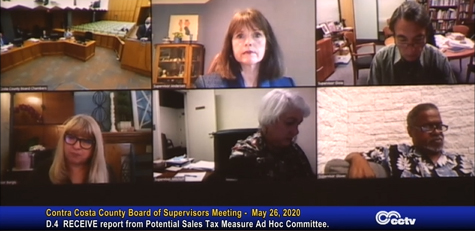
Screenshot of the Contra Costa County Board of Supervisors’ online meeting on Tuesday, May 26, 2020.

County Health Services using Remdesivir for COVID-19 patients; get glimpse of COVID-19 era libraries

By Daniel Borsuk

The Contra Costa County Board of Supervisors discussed possibly placing a half-cent sales tax measure to fund health and social services on the November ballot and approved hiring a pollster on a split vote. The tax measure would be in addition to a proposed Bay Area-wide half-cent sales tax measure for transportation expected to be on the November ballot, as well.

Approve Hiring Pollster for Half Cent Sales Tax Study

In response to the Contra Costa Needs Assessment from the county’s Sales Tax Working Group a countywide half-cent sales tax is being proposed “to shore up access to medical and behavioral health services, and bolster county safety-net programs.” BOS 052620 Contra Costa Needs Assessment

At least for now, it is uncertain if the board will move forward with a sales tax increase measure for the November ballot. Supervisors voted 4-1, with Board Chair Candace Andersen casting the lone, dissenting vote, to spend as much as $60,000 to hire a pollster to test whether voters would support one. But since the outbreak of COVID-19, public support for such a tax measure might have waned.

“We need further direction and getting results from a poll will help,” said Supervisor Karen Mitchoff. “Before COVID, support for a tax increase was optimistic, but with COVID it might be different.”

District 1 Supervisor John Gioia, a big booster of a sales tax increase, said it would cost $30,000 to $40,000 to poll 600,000 to 800,000 prospective voters. Mitchoff said a more realistic cost is $60,000.

Both Gioia and Mitchoff serve on the Potential Sales Tax Measure Ad Hoc Committee.

“Right now, is not the time to spend county funds for a poll,” said chair Andersen of Danville.

Extend Temporary Ban on Evictions and Residential Rent Increase Moratorium

With the supervisors’ month-old ordinance that imposed a temporary ban on evictions and a residential rent increase moratorium at the end of May, supervisors acted to extend the ordinance through July 15. Supervisors also imposed a one-year grace period and defined a commercial real property eligible for the ordinance “…as an independently owned and operated business that is not dominate in its field of operation, has its principal office in California, has 100 or fewer employees, and has average annual gross receipts of $15 million or less over the previous three years.”

Figuring the economy will not recover quickly to restore jobs, some speakers asked supervisors to extend the rent increase moratorium one year.

“Keep pace with Alameda County,” said Dick Offerman of Pleasant Hill. “See that no one is evicted in our county. Extend the moratorium one year.”

Mitchoff took time to warn landlords who are violating the county ordinance. “Landlords know about this ordinance. There are some bad actors who take advantage of people who speak English as a second language, this must stop,” she said.

County Health Uses Remdesivir for COVID-19 Patients

Contra Costa County Public Health Officer Dr. Christopher Farnitano informed supervisors that Contra Costa County Public Health has begun administering the anti-viral drug Remdesivir to COVID-19 patients. A total of 105 dosages were given last week, Dr. Farnitano said.

“The company that is making it (the drug) is giving this to the United States.” Dr. Farnitano said that the drug is “This drug is somewhat beneficial.”

Dr. Farnitano said there were as of Tuesday 13 COVID-19 patients in Contra Costa Medical Center, compared to 19 patients two weeks ago. Since the outbreak of the pandemic in March, 37 persons have died from COVID-19 in the county, four deaths occurred in the past week with one of the deaths in the person’s early 30’s, which is uncommon.

So far, the county is COVID-19 testing daily 95 people per 100,000 residents when the daily goal should be 200 people per 100,000 residents.

This drew Supervisor Mitchoff to question the testing.

“We’re about halfway there,” she said. “I did not want to test, but now I want to test in order to get our numbers up.”

Board Vice Chair Supervisor Diane Burgis of Brentwood asked why the COVID-19 test takers at county sites have to wait for results as long as 10 days when persons at three state sites get results within five days.

Contra Costa County Health Department Director Anna Roth said the average turnaround for COVID-19 results is three to five days, but it could be up to 10 days.

Get Glimpse of COVID-19 Era Libraries

took a glimpse of what the COVID-19 era might look like on Tuesday visualizing the 26 public libraries could offer some type of front door service for patrons to pick up checked out books in bags and when libraries do open doors possibly on June 15 seating capacity will be reduced 20 percent at each location right when outdoor temperatures are peaking above 100 degrees and libraries often serve as cooling centers for the public.

Supervisors unanimously approved the Contra Costa County Library Pandemic Preparedness Plan presented by County Librarian Melinda Cervantes that promotes hygiene, social distancing, and reduced seating. BOS 052620 CCCL Pandemic Preparedness Plan Draft Final

“We plan to begin service as soon as possible,” Cervantes told supervisors during the teleconferenced board meeting.

During the presentation, supervisors learned 36 library accounting positions might be eliminated because of COVID-19 related revenue losses. The potential loss of the library jobs will undermine library book purchasing.

“We need to get through the state budget,” responded county administrator David Twa, who said the 36 library accounting jobs are “potential job layoffs” and are subject to the meet and confer process. The state budget will be unveiled in mid-June.

Approve Purchase of DA’s Office Mobile Forensic Vehicle

In other action, the supervisors approved the District Attorney’s Office request to execute an agreement with the City of San Jose for the expenditure of up to $200,000 to procure a mobile forensic vehicle for the Silicon Valley Internet Crimes Against Children Task Force. The vehicle is expected to cost $48,285.

Filed Under: Health, News, Supervisors, Taxes

Reminder: Federal income tax filing and payment deadline extended to July 15, 2020

April 15, 2020 By Publisher Leave a Comment

The Treasury Department and the Internal Revenue Service are providing special tax filing and payment relief to individuals and businesses in response to the COVID-19 Outbreak. The filing deadline for tax returns has been extended from April 15 to July 15, 2020. The IRS urges taxpayers who are owed a refund to file as quickly as possible. For those who can’t file by the July 15, 2020 deadline, the IRS reminds individual taxpayers that everyone is eligible to request an extension to file their return.

This filing and payment relief includes:

The 2019 income tax filing and payment deadlines for all taxpayers who file and pay their Federal income taxes on April 15, 2020, are automatically extended until July 15, 2020. This relief applies to all individual returns, trusts, and corporations. This relief is automatic, taxpayers do not need to file any additional forms or call the IRS to qualify.

This relief also includes estimated tax payments for tax year 2020 that are due on April 15, 2020.

Penalties and interest will begin to accrue on any remaining unpaid balances as of July 16, 2020. You will automatically avoid interest and penalties on the taxes paid by July 15.

Individual taxpayers who need additional time to file beyond the July 15 deadline can request a filing extension by filing Form 4868 through their tax professional, tax software or using the Free File link on IRS.gov. Businesses who need additional time must file Form 7004.

State tax returns

This relief only applies to federal income returns and tax (including tax on self-employment income) payments otherwise due April 15, 2020, not state tax payments or deposits or payments of any other type of federal tax. Taxpayers also will need to file income tax returns in 42 states plus the District of Columbia. State filing and payment deadlines vary and are not always the same as the federal filing deadline. The IRS urges taxpayers to check with their state tax agencies for those details. More information is available at https://www.taxadmin.org/state-tax-agencies.


Filed Under: News, Taxes

Gov. Newsom signs Executive Order providing relief to California small businesses

March 31, 2020 By Publisher Leave a Comment

Order provides 90-day extension in state and local taxes, including sales tax; extends licensing deadlines and requirements for a number of industries

SACRAMENTO – On Monday, Governor Gavin Newsom signed an executive order that will provide tax, regulatory and licensing extensions for businesses.

The executive order allows the California Department of Tax and Fee Administration (CDTFA) to offer a 90-day extension for tax returns and tax payments for all businesses filing a return for less than $1 million in taxes. That means small businesses will have until the end of July to file their first-quarter returns.

Additionally, the order extends the statute of limitations to file a claim for refund by 60 days to accommodate tax and fee payers.

The executive order also includes extensions that impact state government workers, as well as consumers. For instance, the Department of Motor Vehicles will limit in-person transactions for the next 60 days, allowing instead for mail-in renewals. Additionally, the Department of Consumer Affairs will waive continuing education requirements for several professions, also for the next 60 days.

Further, the order will extend the Office of Administrative Law’s deadlines to review regular department proposed regulations. The order also extends by 60 days the time period to complete investigation of public safety officers based on allegations of misconduct. Finally, deadlines for trainings, investigations, and adverse actions for state workers will also be extended.

A copy of the Governor’s executive order can be found here, and the text of the order can be found here.

For the latest on the state’s COVID-19 response, visit covid19.ca.gov.

Filed Under: Business, Government, Health, News, Taxes

COVID-19: County Tax Collector cancels late-payment charges if you miss April 10 property tax deadline

March 25, 2020 By Publisher Leave a Comment

By Susan Shiu, Director, Office of Communications and Media, Contra Costa County

The Contra Costa County Tax Collector’s Office understands and shares the public’s concern about the impacts of the COVID-19 pandemic on our residents and businesses, and we are committed to helping in any way we can. While we have no legal authority to extend the April 10 property tax delinquent deadline, we can cancel late-payment charges.

  • Existing law R&T 4985.2 authorizes us to cancel penalties and interest on a delinquent payment due to circumstances, such as the pandemic that impacts a taxpayer’s ability to make timely payment. Note the penalty cancellation process will require documentation.
  • Nevertheless, those able to pay should do so online, over the phone, through bill pay at one’s own bank, or by mail.  We will honor the U.S. Postal Services’ cancellation postmark as the receiving day for mail-in payments.  The Office cannot accept walk-in payments.
  • For receipt of payment, a copy of your tax bill with the installment’s payment date is available online in View Bill under Account Lookup. We can mail you a copy as well.

For additional information, please refer to our Frequently Asked Questions, visit our website at www.cctax.us, or email our office at taxinfo@tax.cccounty.us.

For the latest updates on the impacts of the COVID-19 on property tax deadlines, please refer to the Statement from Russell V. Watts, Treasurer-Tax Collector.

Filed Under: News, Taxes

County elections update: Glover inches closer to victory, 30,500 ballots remaining to be counted

March 14, 2020 By Publisher Leave a Comment

Manual tally to begin Monday, four of six tax measures in county passing, Danville development referendum successful

By Allen Payton

With the latest, Interim Update 3 from the Contra Costa County Elections Division from the March 3rd Presidential Primary posted Friday, March 13, there are still approximately 30,500 votes remaining to be counted in the county.

Supervisor Federal Glover gained on his two opponents and is now less than 0.12% from winning re-election outright. He now has 49.89% of the vote for a total of 20,330 votes. His next closest opponent, County Assessor Gus Kramer has 25.62% of the vote or 10,440 votes, followed closely by Martinez Planning Commissioner Sean Trambley with 24.49% or 9,981 votes.

If Glover doesn’t end up having 50% plus one vote, he will face the second-place finisher in a November General Election run-off.

Four of Six Tax Measures Passing

Four of the six tax measures on the ballot in Contra Costa are passing, as of the latest update.

In the Lafayette Measure L school district parcel tax election, which requires a 2/3’s vote to pass, it’s succeeding with 72.6% of the vote and a lead of 4,589 votes.

In the Moraga School District, the Measure M parcel tax election, which also requires a 2/3’s vote to pass, is succeeding with 70.27% of the vote and a margin of 2,731 votes.

In the West Contra Costa Unified School District Measure R school bond election, which requires a 55% vote to succeed, it is passing with 57.3% of the vote and leading the No votes by 8,009 votes.

The election for the Antioch Unified School District’s Measure T school improvement bond, is still too close to call. It needs 55% of the vote to pass and currently has 53.13% with a margin of 1,511 votes.In the Lafayette Measure L school district parcel tax election, which requires a 2/3’s vote to pass, it’s succeeding with 72.6% of the vote and a lead of 4,589 votes.

The Pleasant Hill Park and Recreation Department’s Measure A bond measure, which requires a 2/3’s vote to pass, is failing with only 59.55% of the vote, but leading by 2,463 votes. It needs an increase of 6.12% from the remaining votes.

The countywide Measure J half-cent sales tax for transportation, which requires a 2/3’s vote to pass, was also failing with just 50.6% of the vote, and barely leading by 3,472 votes out of 288,644 counted so far.

Danville Development Referendum Passing

In the Town of Danville’s Measure Y referendum, which will approve the development of 69 homes on 410 acres and requires a simple majority to pass, is winning with 54.26% of the vote and a margin of 1,477 votes.

Following are the estimated number of ballots that remain to be counted as of Friday, March 13.

500          Other

29,200     Provisional

800          Conditional Voter Registration

30,500     Total Estimate

Manual Tally

Beginning Monday, March 16 the Elections Division will conduct a manual audit of ballots cast in the March 3rd Presidential Primary. The public is invited to observe the count.

Filed Under: Education, News, Politics & Elections, Taxes

Want to serve on the county’s Treasury Oversight Committee?

February 28, 2020 By Publisher Leave a Comment

The Contra Costa County Board of Supervisors is seeking an individual with sound knowledge and experience in the field of public and private finance to serve on the Treasury Oversight Committee (Committee) in the Public Representative Seat #3.  To be considered, candidates must be County residents, may not be employed by an entity that has contributed to the reelection campaign of the County Treasurer or a member of the Board of Supervisors in the previous three years, may not directly or indirectly raise money for the County Treasurer or a member of the Board of Supervisors while a member of the Committee, and may not work for bond underwriters, bond counsel, security brokerages or dealers, or financial services firms with whom the County Treasurer does business, either during his or her tenure on the committee or for one year after leaving the Committee. (Government Code §27132.3).

The Committee meets at 3:00 p.m. on the third Tuesday of the month following each quarter at 625 Court Street, Room B001, Martinez, CA 94553.  Each meeting lasts approximately one hour.  The Committee’s duties include reviewing and monitoring the County Treasurer’s annual investment policy, and ensuring an annual audit is conducted to determine the County Treasurer is in compliance with Government Code §§27130-27137. The annual audits, meeting agendas and minutes of the Committee are available online. Members of the Committee receive no compensation for their service.  The Board of Supervisors will appoint the selected individual to complete the four-year term on May 1, 2020 through April 30, 2024.

Application forms can be obtained from the Clerk of the Board of Supervisors by calling (925) 335-1900 or by clicking on the following link: Application Form.  Applications should be returned to the Clerk of the Board of Supervisors, Room 106, County Administration Building, 651 Pine Street, Martinez, CA 94553 no later than Friday, March 27, 2020 by 5 p.m.  More information about the Treasury Oversight Committee can be obtained by calling Russell Watts at (925) 957-2888 or visiting the Treasurer-Tax Collector’s Treasury Oversight Committee webpage.

Filed Under: Finances, Government, Taxes

Supervisors demand NuStar Energy safety probe before Crockett plant is reopened following fire

October 24, 2019 By Publisher Leave a Comment

The Contra Costa County Board of Supervisors conducted a hearing on Tuesday to learn from county fire and hazardous materials officials what may have caused the Oct. 15 fire that caused the destruction of 250,000 gallons of ethanol, a chemical mixed with gasoline At the meeting were from left County Administrator David Twa, Contra Costa County Assistant Counsel Mary Ann Mason, Contra Costa County Fire Protection District Deputy Fire Chief Aaron McAllister, CCCFPD Fire Chief Lewis Broschard, and Contra Costa County Hazardous Materials Program Director Randy Sawyer. Photos by Daniel Borsuk.

Form committee to consider half-cent sales tax measure for Nov. 2020 ballot

By Daniel Borsuk

Contra Costa County Supervisors on Tuesday demanded that county officials confirm that operators of the fire damaged NuStar Energy plant in Crockett not resume operations until its fire and hazardous materials safety measures have been completely reviewed and upgraded by state and federal authorities.

“I want updated progress reports on your investigations,” demanded Board Chair John Gioia, whose District 1 covers the Crockett refinery location where the fire erupted from a tank filled with ethanol at 1:45 p.m. on Tuesday, October 15. The fire spread, catching a nearby tank also containing ethanol. Some 250,000 gallons of ethanol were destroyed in the fire.

The blaze forced county authorities to call a Shelter in Place in the Crockett area. Interstate 80 was closed for six hours. The incident was officially over at 8:10 p.m. when I-80 was reopened to traffic by the Highway Patrol, said Contra Costa County Director of Hazardous Materials Randy Sawyer.

“At the end of the day, the incident was contained, “said Contra Costa County Fire Protection District Chief Lewis Broschard. “No other tanks were destroyed. No other materials were discharged.”

Broschard told supervisors it was through the fire fighting resources of NuStar Energy and several other refineries that were able to promptly respond to the fire site to assist CCCFPD in extinguishing fire. Those refineries – Shell, Chevon, Phillips 66, Tessoro, and Marathon – supplied foam that the county fire district did not have to adequately extinguish the blaze, said Chief Broschard.

Chief Broschard said at this time there is no known cause for the fire including whether arson may have been a factor.

Gioia made it clear to Contra Costa County Fire Protection District Chief Broschard and Contra Costa County Hazardous Materials Program Director Randy Sawyer that he wants a thorough investigation completed before “there is a reopening” of the NuStar plant.

Supervisors heard from eight speakers, all critical of NuStar and its safety track record.

NuStar spokesperson Mary Rose Brown told the Contra Costa Herald via an emailed message:

“We absolutely agree, and we are working closely and cooperatively with CalOSHA and other regulatory agencies on detailed plans to ensure that the facility is safe to operate before it is reopened. We also are continuing to work in very close cooperation with all applicable local and state regulatory agencies to investigate the root cause of the incident so that we can take whatever measures are required to ensure the continued safety of our employees, contractors, neighbors and the community. We worked over the weekend to pump liquids out of the incident area and CalOSHA and local fire investigators accessed the area today (Tuesday).”

County resident Carl Davidson suggested that the NuStar plant incident may have been triggered by a seismic event since the facility is located on the Pinole fault and the fire erupted after seismic events were reported in the Pleasant Hill area the previous day.

Twenty-five-year Crockett area resident Isabella Izzi said the board of supervisors and regulators should clamp down on NuStar for this environmental violation and future violations by requiring the refiner to provide hazmat masks to all residents of Crockett. “The Board of Supervisors should make it clear that it will deny any new expansion at that refinery,” she said.

Dan Torres, a representative of an industrial fire sprinkler installation union, questioned the quality and reliability of the fire sprinkler system installed at NuStar.

At the end, Chair Gioia asked that updates on the NuStar fire will be reported at the Public Safety Committee that he chairs.

The Contra Costa County Board of Supervisors recognized the community service of CERT C-8 on Tuesday. Currently consisting of 70 members, supervisors recognized the organization that is known to dispatch volunteers to train senior care staff, serve as Amateur Radio Operators, Red Cross Shelter workers, traffic control and join the Contra Costa CART. C-8 has helped to get Spanish Cert out to many areas of the county. The program is called Listos.

Sales Tax Ad Hoc Committee Formed

Supervisors voted 4-0 to create an ad hoc committee to explore the feasibility of placing on the ballot a sales tax measure. The committee will consist mainly of union leaders, county agency heads and nonprofit organizations leaders.

On the vote, District 5 Supervisor Federal Glover was absent.

At the recommendation of District 4 Supervisor Karen Mitchoff, who serves on the Finance Committee, proposed the establishment of a citizen-based ad hoc committee to study a proposal that could wind up on a ballot for county voters to decide on perhaps by the November 2020 general election.

In California, the maximum sales, use, and transactions tax rate is 9.25 percent. That includes a statewide base sale and use tax of 7.25 percent and up to 2 percent for local district transaction and use taxes.

Current projections for annual revenues for a countywide transaction and use tax are one half cent $93 million and quarter cent $46.5 million. Current projections for annual revenues for an unincorporated area transaction and use tax are one half cent: $8.32 million and one.

So far, the ad hoc committee will study several potential tax scenarios. Current projections for annual revenues for a countywide transaction and use tax area:

. 0.50 percent (1/2 cent): $93 million

. 0.25 percent (1/4 cent): $46.5 million

Projections for annual revenues for an unincorporated area transaction and use tax are:

. 0.50 percent (1/2 cent): $8.32 million

. 0.25 percent (1/4 cent): $4.16 million

Mitchoff said she is promoting the sales tax ad hoc committee because she frequently hears from constituents why Contra Costa County does not have a sales tax while other counties like Alameda, San San Mateo, Santa Clara and others do draw additional revenues for county services from a sales tax.

The ad hoc committee will be led by stake holders, not supervisors, Mitchoff said. “We want all comers at the table,” she said. “This will be a difficult lift.”

“This is a huge opportunity,” said Sean Casey, executive director of the nonprofit organization First 5. “16,000 families could benefit from this in Contra Costa County.”

The Contra Costa County Board of Supervisors designated November 6 as ”Shelter-in-Place-Education Day” in all public and private schools and children centers in the county. The Contra Costa Community Awareness Emergency Response Group – CAER – is sponsoring the 18th Annual Shelter-in-Place Drill and assisting schools and childcare centers with their emergency preparedness. At the resolution presentation during the board’s Tuesday meeting were from left REACHProject Executive Director Mickie Marchetti, District 4 Supervisor Karen Mitchoff, Board Chair John Gioia, Contra Costa County Hazardous Materials Program Director Randy Sawyer, District 3 Supervisor Diane Burgis, and Vice Chair Candace Andersen.

In other business, the supervisors:

-Approved a $240,000 contract to Concord Yellow Cab, Inc. to provide non-emergency taxicab transportation services for Contra Costa Regional Medical center and Contra Costa Health Center patients for the period July 1, 2019 through June 30, 2020. The county pays taxicab service for patients unable to transport themselves to medical appointments due to medical conditions, including physical disabilities, patients who have verifiable seizure disorder or patients who have received medications which has or could impair their mobility.

-Approved a $1.97 million Public Works Department contract with Debri-Tech, Inc. to provide on-call assistance with trash and abandoned waste cleanup and removal for the Contra Costa County Watershed Program for the program October 15, 2019 through September 30, 2022.

-Approved the issuance of $85 million in Multifamily Housing Revenue Bond by the California Statewide Communities Development Authority for the Fairfield Hilltop LP, a California limited partnership, to provide for the financing of the acquisition and rehabilitation of a 322-unit multi-family housing development known as Hilltop Commons Apartments located at 15690l Crestwood Drive.

Some of the county’s major figures in the arts were honored by the Contra Costa County Board of Supervisors on Tuesday. Supervisors presented Awards for Outstanding Contributions to the Arts. Supervisors recognized the Lafayette Town Hall Theater for reaching a milestone celebrating its 75th anniversary and 300th theatre production. The theater’s theater and dance education programs serve 600 families each year. The Blue Devil Performing Arts, founded by Tony and Ann Odello in 1957, was recognized for serving more than 6,000 young persons during a long celebrated history. The Blue Devil Performing Arts, founded as a Drum Corps with a separate marching team, but later added glockenspiels (bells), Color Guard and horns to their productions was undefeated State Champion drum and Bell Corps from 1957 to 1970. The majorettes earned six National Championships and 12 National Team titles. Supervisors also honored Michelle Seville, who is retiring after 12 years as manager of Richmond’s Arts & Culture Center. Seveille was one of the original park rangers at the Rosie the Riveter National Historical Park when it was first established in 2000.

Filed Under: News, Supervisors, Taxes, West County

  • « Previous Page
  • 1
  • …
  • 5
  • 6
  • 7
  • 8
  • Next Page »
Liberty-Tax-Jan-Apr-2026
Deer-Valley-Chiro-06-22

Copyright © 2026 · Contra Costa Herald · Site by Clifton Creative Web