• Home
  • About The Herald
  • Local Agencies
  • Daily Email Update
  • Legal Notices
  • Classified Ads

Contra Costa Herald

News Of By and For The People of Contra Costa County, California

  • Arts & Entertainment
  • Business
  • Community
  • Crime
  • Dining
  • Education
  • Faith
  • Health
  • News
  • Politics & Elections
  • Real Estate

Supervisors brush off Contra Costa Budget Justice Coalition for upcoming hearings

January 31, 2018 By Publisher 1 Comment

Told they should focus on job training and housing in 2018 and beyond, during Tuesday retreat in Pleasant Hill

By Daniel Borsuk

The unveiling of a new citizens organization designed to inject more citizen involvement in the county’s budget development process was torpedoed by the Contra Costa County Board of Supervisors on Tuesday, Jan. 30.

During a board retreat at the Pleasant Hill Community Center, supervisors informed representatives of the two-month-old Contra Costa Budget Justice Coalition that since 82 percent of next year’s proposed $3.4 billion 2018-2019 fiscal budget will come from federal and state funding sources, those funds are mandated for either health services at 55 percent and the sheriff-coroner at 27 percent and there is no room for discussion from the public.

The county’s current fiscal year budget is $3.1 billion.

Supervisors are scheduled to adopt the proposed budget on May 8.  They have scheduled a public hearing on the budget on April 17 with the possibility a second hearing on April 24 if one is needed.

Supervisors told coalition representatives that it would essentially be a waste of time to make a pitch about the budget either at the public hearing or by scheduling meetings with supervisors in their district offices.

“We have a lot of restrictions on our money,” said board chairperson Karen Mitchoff of Pleasant Hill.  “Go ahead with holding your community meetings about the county budget, but they will be limited.”

“We have very limited money,” District 5 Supervisor Federal Glover said.  “Our health and safety funds are mandated by the federal or state government agencies.”

“I am always open to have the public engaged in public policymaking, but we have to face the fact that our budget is mostly funded through mandated categorical sources, “said Supervisor John Gioia of District 1.

“We understand that the budget is already stacked up with required mandated funding, but there is still some flexibility in the process,” Dan Geiger of the Contra Costa Budget Justice Coalition and director of Human Services Alliance of Contra Costa told the Contra Costa Herald.  “We are asking the board to give us some say.”

“We will likely do what we have initially planned to do and that includes meet individual supervisors in their district offices to discuss budget issues,” Geiger said.  “We will also attend the April 17 public hearing.”

Geiger said the objective of the organization, which began with nine non-profit organizations in December and is growing with the potential 48 new organizations, is to open up the county’s budget process.

The new coalition aims to practice its “values-based budgeting principles” that promote safety and affordable housing, stable employment with fair wages, sufficient healthy food, essential health care, access to critical social services, quality early care and education.

Geiger said formation of the Contra Costa Budget Justice coalition occurs at a time there is mounting uncertainty about the future of federal funding coming out of Washington for the upcoming 2018-2019 fiscal year and beyond.  Those budget priorities include housing, health care for low income residents, children and youth services, and mental-behavioral health.

Economic Outlook: Housing Shortage and Job Training

The economic focus in Contra Costa County in 2018 and beyond should be on job training and housing county supervisors were told by Christopher Thornberg, Director of the University of California at Riverside Center for Forecasting and Development.

The economist presented his yearly Economic Outlook Focus on the Contra Costa Economy during the board of supervisors’ retreat.

While the nation’s economy experienced “good growth in 2017” at 2.6 percent in the fourth quarter, Thornberg said California, and especially Contra Costa County is facing two economic problems, a shortage of trained workers even though since 2010 there has been a phenomenal number of job openings and a severe housing shortage.

“We are running out of trained workers,” he said.  This is due to an increasing number of trained workers retiring.  Thornberg suggested as a partial solution to the worsening employment crisis is raising the Social Security retirement age requirement age by two years from 70 to 72.

“In Contra Costa County you have the jobs.  There are a lot of job openings.  Job training and housing should be your focus,” he said.

Thornberg said it is up to the supervisors to find ways to address the housing crisis with rising housing prices.

“We’re seeing a tighter housing market in Contra Costa County with the median house price at $550,000, “he said.

Filed Under: Finances, News, Supervisors

Supervisors increase fees by 150% for non-franchised solid waste haulers

January 26, 2018 By Publisher Leave a Comment

Approve purchase of five new fire trucks for Con-Fire

By Daniel Borsuk

Without a whimper of a protest from a non-franchised solid waste hauler, Contra Costa County Board of Supervisors voted 5-0 to make it costly to operate a business in the county.

At the request of District 1 Supervisor John Gioia, supervisors agreed to raise the performance bond to $50,000 from $20,000 even though at one point the supervisor from Richmond attempted to press on the need to lift up the performance bond as much as $100,000.

In addition to paying for the annual performance bond, anyone conducting business as a non-franchise waste hauler in the county would have to pay $229 for an annual permit per vehicle and meet other rules the Contra Costa County Health Services Department has developed.

Independent trash hauling operators would also be subject to annual inspections and would have to adhere to other rules county supervisors established in an ordinance passed last November.

The non-franchised waste haulers ordinance is set to go be enforced in March.  County officials are uncertain how many non-franchise trash haulers there are in the county because they work undercover in warehouses and illegally dump loads usually under the cloak of darkness and in out-of-the-way unincorporated parts of the county.

“I’ve been working on this issue in North Richmond for 20 years, and if they (i.e. homeowners) can hire someone to haul their trash for $20 versus $70 they’ll do it for $20,” said Gioia.  “The question is whether we are setting the bar too low.”

The supervisor contends his District 1 in West county and District 5 in East County represented by supervisor Federal Glover tend to be hit the hardest by non-franchised solid waste haulers who illegally dump trash in unincorporated areas thereby forcing the county to spend thousands of dollars to clean up sites.

“If you make it too expensive, “warned Supervisor Candace Andersen, whose District 2 gets perhaps the least amount of trash illegally dumped by non-franchised haulers, “there will be more of a need for haulers to resort to the black market.”

District 3 Supervisor Diane Burgis, who has observed hundreds of paint cans litter Marsh Creek Road, commented, “These people can do a lot of damage with one load.  Twenty thousand dollars for a performance bond is nothing.  I’d like to set it higher. “

At the suggestion of Board Chair and District 4 Supervisor Karen Mitchoff, Gioia and other supervisors agreed the $50,000 performance bond would be a good start to assess independent trash haulers not affiliated with either of the two major trash haulers, Republic Services and Mt. Diablo Resource Recovery.  Both companies played key roles in compelling the supervisors to approve the ordinance last year.

District 5 Supervisor Federal Glover of Pittsburg said the problem of trash dumped by non-franchised haulers on vacant lots is a countywide problem, not mainly an East and West county issue.  While he supports raising the performance bond to $50,000, he said the board of supervisors needs to be proactive and needs to monitor how the non-franchised trash haulers respond to the new ordinance.

Board chairperson Mitchoff requested that Marilyn Underwood of the Contra Costa Health Services Department, the department enforcing the ordinance, to give the board a progress report in March once the ordinance becomes enforced.

Fire District to Acquire 5 New Trucks

The Contra Costa Fire Protection District will add sorely needed new fire equipment with the supervisors 5-0 consent action approval to buy five new fire engines from Golden State Fire Apparatus Inc. at a price tag not to exceed $4.6 million.  The new vehicles will be delivered to the CCFPD in January 2019.

Supervisors voted to acquire four Type I fire engines and one 100-foot aerial ladder truck from Golden State Fire Apparatus to help alleviate an aging fleet of 35 Type I engines with an average age of 9.3 years per vehicle.  All engines that are more than 10 years old, Fire Chief Jeff Carman reported, have more than 100,000 miles.  Four Type I engines targeted for replacement each have more than 125,000 miles.  One engine sustained a catastrophic motor failure while responding to a state mutual aid response in Southern California this fall.

The new aerial apparatus truck will be the fire district’s 10th ladder truck.

The county has arranged a 10-year lease agreement through PNC Equipment Financial LLC worth an amount not to exceed $4.6 million with annual payments of $460,000 at an annual interest rate of 3.5 percent.

Filed Under: Business, Fire, Garbage, News, Supervisors

New Board of Supervisors Chair Mitchoff spotlights four key issues for 2018

January 11, 2018 By Publisher 1 Comment

Glover highlights accomplishments this past year as Board Chair for possibly, the final time

By Daniel Borsuk

Water, air quality, transportation and the new Pleasant Hill public library will be top 2018 hot button issues of newly elected Contra Costa County Board of Supervisors Chair Karen Mitchoff. District 1 Supervisor John Gioia of Richmond was elected Vice Chair for 2018, in the annual rotation of the board’s leadership.

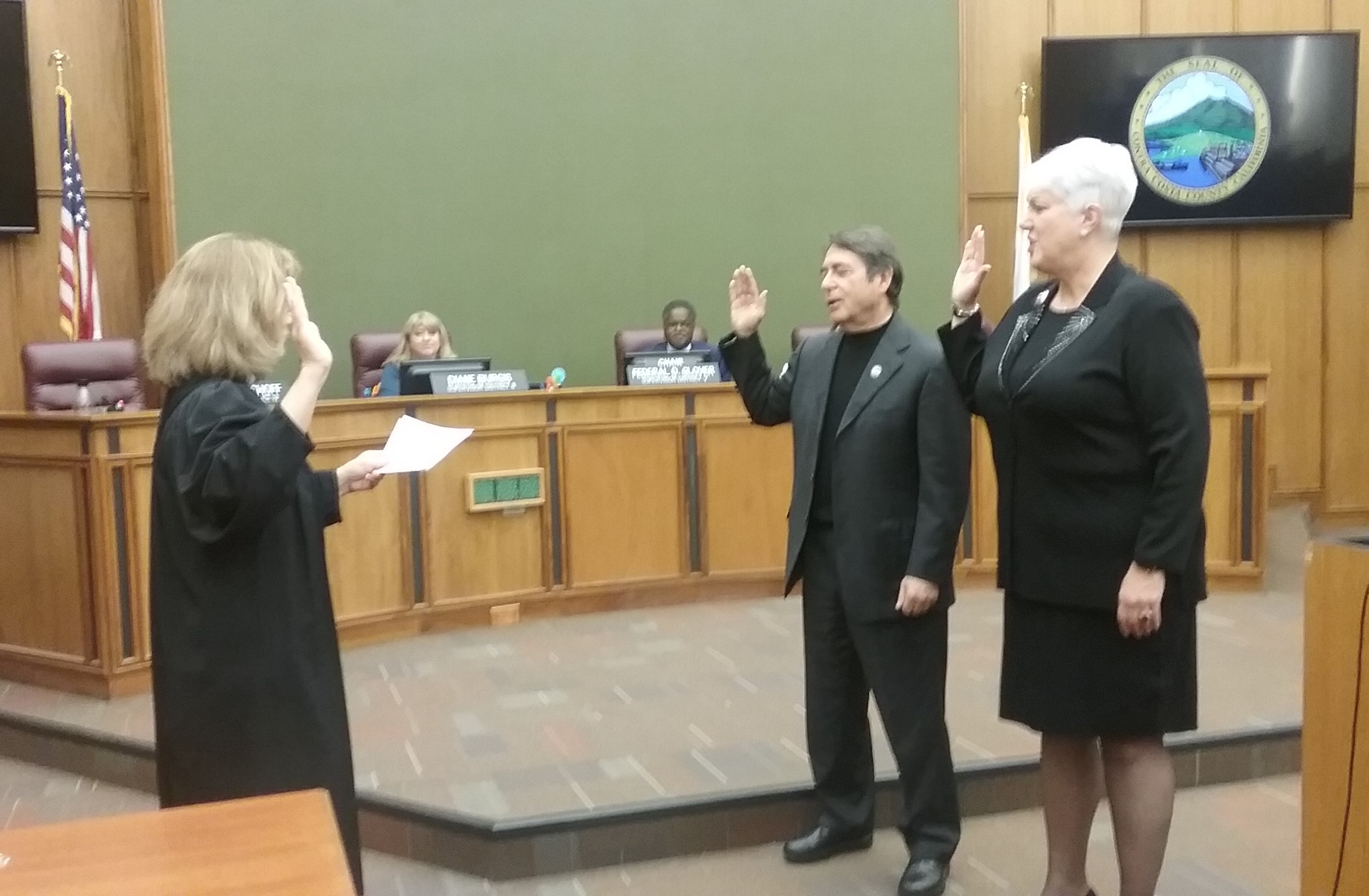
Contra Costa Superior Court Judge Jill Gannin gives the oath of office to county new Board of Supervisors Vice Chair John Gioia and to Chair Karen Mitchoff on Tuesday, Jan. 11, 2018. Photo by Daniel Borsuk

A supervisor from Pleasant Hill and representing District 4 on the board, Mitchoff said after being sworn into office by Contra Costa County Superior Court Judge Jill Fannin on Tuesday, “The new year ushers in a rush of ideas of reflection and projection” as she aims to apply the four key issues during her administration in 2018.

“While I doubt the $3 bridge toll increase will pass, I believe the measure should be placed on the ballot so that the people have the opportunity to vote on it,” she said, who replaces District 5 Supervisor Federal Glover of Pittsburg as chairperson.

Concerning water quality issues, Mitchoff said Gov. Jerry Brown’s $16 billion Twin Tunnels project is “going nowhere.”  The supervisor added, “This project does not have the funding.”

The supervisor said state and local governments need to come up with more sensible, less costly and more environmentally compatible water projects similar to the proposed Los Vaqueros Reservoir expansion project near Brentwood.

“I’m happy to say it’s been a great year,” said outgoing board chairman Federal Glover of Pittsburg.  “We did everything from A to Z.”

One of the county’s major accomplishments has been the continual financial stability, Glover said.  “We’ve been financially stable the last seven years,” he said.  The county has maintained a Standard & Poors AAA rating an Aa3 rating from Moody’s Investor Services.

Glover was also proud of the work done on the Northern Waterfront Planning Area.  “The Northern Waterfront initiative is becoming a reality with new business opportunities,” the supervisor from Pittsburg said.

“It is predicted by the year 2030 some 18,000 new jobs will be created along the waterfront,” Glover continued.

The Northern Waterfront is already being planned to be used for a self-driving car testing site and as a potential public university campus site.

In 2018, the county will break ground to construct a $60 million county administration building to be constructed nearby the existing administration building in downtown Martinez, the county seat since 1850.  An additional $40 million will be allocated to build a modern Emergency Operations Center at Glacier Drive in Martinez.  The county closed on $100.3 million in lease revenue bonds to construct the new administration building and Emergency Operations Center.  The bonds were sold for a 15-year term at an interest rate of 2.387 percent.

During 2017, the board of supervisors were responsible for 35 major achievements, said Glover.  Some of those achievements were:

  • The appointment of interim District Attorney Diana Becton, who replaced former District Attorney Mark Peterson who was found guilty for misuse of campaign funds.
  • Creation of the Stand Together CoCo, a rapid response and community education project to support safety and justice for immigrant families in Contra Costa.
  • Ended the year at 83 percent Live Release Rate for all animals at county run Animal Services facilities. The live release rate for dogs and cats was 87 percent, up from 67.17 percent in 2014.
  • Contra Costa County Fire Protection District ambulance service performance is now required to arrive 90 percent of the time within 11 minutes and 45 seconds in all zones except Richmond, where they are required to arrive within 10 minutes and 90 percent of the time. District performance has consistently been in the 95 percent range and at time as high 98 percent. This means ambulance response times are much quicker.
  • Approved the mixed use Saranap Village Project near Walnut Creek. The project will provide 198 housing units and a significant amount of commercial space.

During her initial year in office, District 3 Supervisor Diane Burgis of Brentwood listed a number of accomplishments in 2017 including seeing the opening of a Veterans services office in Brentwood and the start of Tri Delta bus service to the Martinez Veterans Medical Center.

Burgis said she looks forward to a number of accomplishments in 2018 that will benefit East County constituents including completion of work on the Morgan Territory, Byron Highway and Balfour Highway projects and the startup of EBART train service.

Filed Under: News, Supervisors

County to refund $8.8 million in excessive Juvenile Hall housing, electronic monitoring fees

December 13, 2017 By Publisher Leave a Comment

Supervisors approve $17 million in bonds for Richmond senior housing project; $1.6 million for Walnut Creek affordable housing project

Example of an ankle monitor. Photo by securitycameraking.com

By Daniel Borsuk

Beginning next month, 6,000 and as many as 12,000 Contra Costa County residents will receive letters from the county that they could be entitled to refunds to be disbursed because the county Probation Department overcharged them fees for Juvenile Cost of Care and Cost of Electronic Surveillance of Minors. (See agenda item,  here.)

County Supervisors initiated the notification process at Tuesday’s board meeting on a 4-0 vote.  Letters printed in English and Spanish will be mailed to up to 6,000 individuals who may be due a refund because they may have been overcharged when they had a juvenile housed at a county juvenile hall facility from 2010 to 2016.  The county ceased assessing the fees in 2016.  The letters will instruct the recipients how to file for a claim.

District 2 Supervisor Candace Andersen of Danville was absent for the vote.

The county estimates parents of juveniles held in county juvenile hall facilities were overcharged $8.8 million dating back to 1990.

The board’s Public Safety Committee will review whether another 6,000 residents living in the county between 1990 and 2010 might be eligible for refunds.  Supervisors would also establish a procedure whereby residents could claim money that was improperly withheld when youths were detained in juvenile hall facilities.  Supervisors will determine if the county improperly overcharged for electronic monitoring fees.

Assistant County Administrator Timothy Ewell told supervisors there are about 12,000 cases that the county has identified from 1990 to 2016 that might be entitled to refund checks averaging $262 per account because of the work by Contra Costa supervisors did, and support from citizen organizations like the Racial Justice Coalition, statewide to make juvenile hall housing fees illegal on racial and financial hardship grounds.

Contra Costa is the first county in the state to begin the procedure of refunding money to parents or guardians of juveniles who were held in juvenile hall facility and were overcharged.

“No one is expecting a mad rush of people to file claims,” said District 1 Supervisor John Gioia of Richmond, who was a key player at the county and state level in igniting the juvenile hall overcharge refund movement.

District 4 Supervisor Karen Mitchoff said it should be up to the claimants to show proof in the form of canceled checks, bank statements or some other proof of payment when filing a claim.

“Family members should never have been penalized,” admonished Willie Mims of the East County Branch of the NAACP.  “You should have the records and not lay that responsibility on the persons who might receive these letters.”

The fiscal impact to the General Fund is projected to be $136,000.

Supervisors OK Bonds for Multi-Family Housing Projects

Site of the approved Heritage Point Senior Apartments in North Richmond.

On a 5-0 vote, supervisors flashed the green light for construction to get underway for a $27 million senior housing project in North Richmond fronting the east side of Fred Jackson Way between Grove Avenue and Chelsey Avenue.  The 42-unit, Heritage Point Senior Apartments will be financed by the county with up to $17 million in Multifamily Housing Revenue Bonds.

It is a project of the Community Housing and Development Corporation of North Richmond (CHDC). According to their website, the organization was “founded in 1990 by local leaders…to eliminate blight, improve housing opportunities for current and future residents, and create better economic conditions.” It has since “added over 200 owner-occupied homes to the Richmond area along with street improvements, public services, senior and family rental housing.”

According to the staff report, there is “No impact to the General Fund. At the closing for the Bonds, the County is reimbursed for costs incurred in the issuance process. Annual expenses for monitoring of Regulatory Agreement provisions ensuring units in the Development will be rented to low income households will be reimbursed through issuer fees established in the documents for the Bonds. The Bonds will be solely secured by and payable from revenues (e.g. Development rents, reserves, etc.) pledged under the Bond documents. No County funds are pledged to secure the Bonds.”

Supervisors were informed that financing for the Heritage Point development is secure.  However, future affordable housing developments might be in jeopardy depending how the 2018 United States budget reform bill shapes up. Contra Costa County could potentially lose $3.5 million in bond financing for the North Richmond project if the budget reform bill is passed by Congress, said Maureen Toms of the Contra Costa County Conservation and Development Department.  Fortunately, the county has enough money in reserves to fill in funding gaps for projects like the Heritage Point development, she added.

Riviera Family Apartments. Rendering by RCD.

“This could be the tip of the iceberg on the potential elimination of public funding for future affordable housing developments,” Gioia warned.

In addition, the board approved converting $1.6 million in taxable bonds into tax-exempt bonds for a 58-unit, multi-family affordable housing apartment project in Walnut Creek. The Riviera Family Apartments will be located on two separate parcels, at 1515 and 1738 Rivera Avenue. The County had previously approved $19.2 million in tax-exempt bonds for the development in May 2016. The developer is Resources for Community Development in Berkeley. According to the staff report, no County funds are pledged to secure the bonds.

Honor 35-Year County Employee

In other action, the board honored Carmen Piña-Delgado who is the Supervising Real Property Agent with the Public Works Department in the Real Estate Division for her 35 years as a county employee. She started her career with the County Administrator’s Office as a Clerk-Experienced Level under the Affirmative Action Officer and due to budget cuts was let go. But, then in October, Piña-Delgado was rehired by the Health Services Department as a Clerk-Experienced Level in the Public Health Division.

In January 1992 she was promoted to the position of Real Property Technical Assistant in the Real Estate Division, where she has worked for the remainder of her career. In May 2001, Piña-Delgado graduated from Los Medanos College completing the Associate of Science Degree in Real Estate in order to qualify for advancement into the Real Property Agent Series. The resolution adopted by the Board recognizing her service states, she “has a great work ethic and has made a difference in the Public Works Department by delivering quality services in each division, County-wide, and with outside agencies/consultants.”

Filed Under: Central County, Community, Crime, News, Supervisors, West County, Youth

Sheriff boycotts Public Protection Committee meeting on threats of $25 million loss in federal DOJ funds

December 8, 2017 By Publisher 1 Comment

Due to state sanctuary policies, county policy to go into effect next year; response due today

By Daniel Borsuk

With neither Sheriff-Coroner David Livingston nor one of his representatives in attendance at a meeting of the Contra Costa County Board of Supervisors’ Public Protection Committee on Thursday, there was more concern as to why the sheriff wasn’t in attendance than the topic at hand:  the possibility the county could lose up to $24.7 million in federal assistance.

Representatives from the District Attorney’s Office, Public Defender’s Office, Probation, Employment and Human Services, and County Administrator were present at the committee meeting conducted by Supervisor John Gioia of Richmond and attended by Supervisor Federal Glover of Pittsburg.

Without Livingston or his representative at the committee table, supervisors and citizens serving on the committee could not get a proper read on the status of the sheriff’s policy on the arrest and detention of undocumented immigrants primarily at West County Jail, and how well deputies interface with Immigration and Customs Enforcement agents and United States Marshals.

Some $19.8 million of the $24.7 million in federal aid that the county receives from the federal government is allocated to the Sheriff-Coroner Office.  Employment and Human Services receives $1.9 million in federal aid, Probation pulls in $1.1 million, the County Administrator draws $983,971, the District Attorney gets $563,848, and the Public Defender collects $180,412.

“I am surprised and disappointed that the sheriff is not here,” said Supervisor Gioia.  “I don’t know if this has ever happened before where the sheriff has not appeared at a Public Protection Committee meeting.”

“I’m shocked and dismayed that no one from the Sheriff’s Office is here,” said Renee Zeimer representing Organizing for Contra Costa Action.  “How is the sheriff held accountable to the public?”

About four other also persons complained that the sheriff or a representative should have been in attendance at the committee meeting.

The fate of federal money that California cities and 58 counties receive will probably be decided in United States District Court on Wednesday, Dec. 13, when U.S. District Judge William Orrick is expected to rule on whether California Senate Bill 54 or “the Sanctuary State Bill” that was recently signed by Gov. Jerry Brown and goes into effect Jan. 1 conflicts with Executive Order 1373 that President Donald J. Trump inked on Jan. 25, 2017.

Executive Order 1373 assigns broad powers to the U.S. Department of Justice, Immigration and Customs Enforcement (ICE) and U.S. Marshalls to investigate, arrest, and deport undocumented immigrants in order to secure the safety of the interior of the nation.  The executive order also gives the DOJ investigative power to determine if states, cities, and counties are in compliance with Executive Order 1373.

In Sanctuary States like California, Contra Costa County and other counties are aligning policies to conform with SB 54 unaware how Judge Orrick will rule.

When asked if the county has a Plan B should the U.S. District Court strikes down SB 54 and uphold Executive Order 1373, Supervisor Gioia remarked, “That’ll be an issue for the state and every city and county effected by SB54.”

Sheriff Receives DOJ Letter

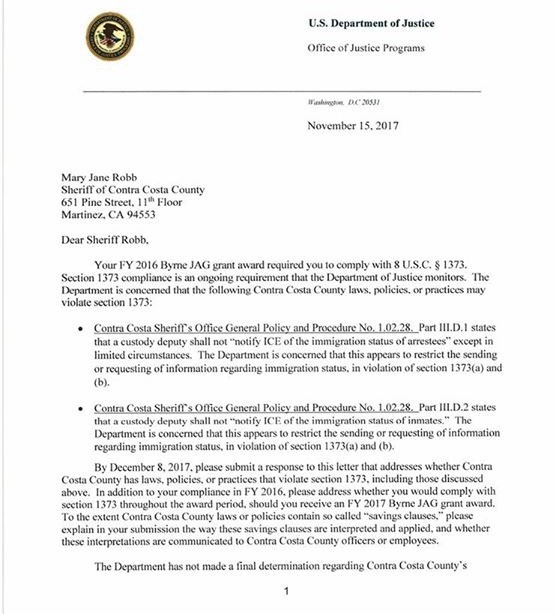
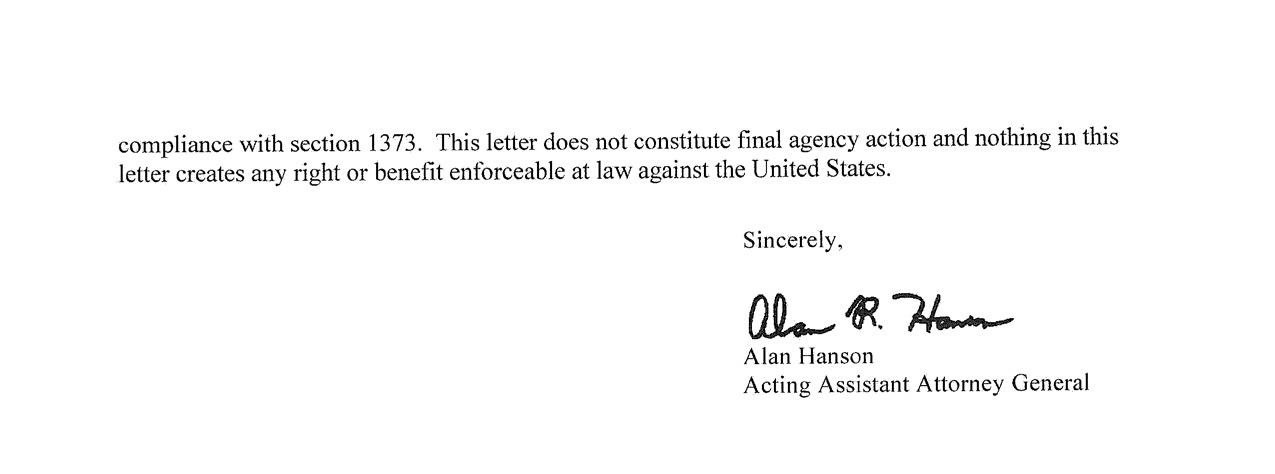
The Sheriff-Coroner Office received on November 15 a letter from U.S. Department of Justice Acting Assistant Attorney General Alan Hansen inquiring whether the sheriff office is in conflict with Executive Order 1373 if a custody deputy does not inform ICE of the immigration status of inmates. “The department is concerned that this appears to restrict the sending or requesting of information regarding immigration status in violation of section 1373 (a) and (b),” wrote Hansen.

The letter was directed to Mary Jay Robb, the Chief for Management Services in the Sheriff’s Office.

Livingston would not respond to calls from the Herald with questions about the letter. The Sheriff’s Public Information Officer Jimmy Lee instead referred calls to County Administrator David Twa.

One program that wasn’t included in the DOJ inquiry is the Stand Together CoCo program, which the Board of Supervisors approved in September with $500,000 in state AB 109 funds to help launch the program.  The Public Defender’s Office is overseeing the program.

Twa confirmed that the DOJ letter is about the state’s sanctuary policies, not the county’s new policy that will not go into effect until next year.

County Has Until Today to Respond to DOJ

The county needs to respond to the DOJ inquiry by today, Friday, Dec. 8.

The Stand Together program will monitor ICE arrests of undocumented immigrants in the county.  The program that is also funded through private sources will have counselors visiting undocumented immigrants held at West County Jail.  The Stand Together CoCo program expects to counsel up to 180 undocumented immigrants held at the jail during the first six months of the program.  The program gets underway January 1, 2018.

Filed Under: Crime, News, Sheriff, Supervisors

County eyes MicroPAD miniature homes as new tool to reduce homelessness

November 15, 2017 By Publisher Leave a Comment

A MicroPAD miniature home can be towed to its location. Photos from Panoramic Interests.

Rendering of the interior of a MicroPAD home.

By Daniel Borsuk

Perhaps by this time next year, Contra Costa County officials will be offering MicroPADs as a new alternate form of housing in its repertoire of programs designed to reduce homelessness, a major economic and social issue that is, at least in this East Bay county showing signs of fading away.

The number of homeless individuals in the county declined seven percent from 2016 to 1,607 homeless persons as of Jan. 25, 2017, an annual report stated and accepted by the supervisors on a 3-0 vote at Tuesday’s Board of Supervisors meeting.

Board chair Federal Glover was absent due to a death in the family and Supervisor Diane Burgis of Brentwood was absent because she was recovering from a surgical procedure.

The county’s success in decreasing the number of homeless individuals or families living outdoors or in cars can be credited to the county’s wide array of federal and state funded programs and services worth $15 million last year.  Those services range from emergency shelters, support services only, transitional housing, rapid rehousing, permanent supportive housing, street outreach and preventive programs.

MicroPAD interior view.

Next month the county expects to learn how much money it will receive from the United States Department of Housing and Urban Development in its newest service designed to further drive down homelessness – the MicroPAD, said Lavonna Martin, Director of Contra Costa County Health, Housing and Homeless Services.

The MicroPAD miniature, stackable home is a relatively new weapon in the fight against homelessness.  It is now in use in San Francisco, a city and county well known for its high cost of housing and homeless population problems.

Each 160-square foot modular prefabricated dwelling unit comes with a furnished bedroom, private bathroom, and kitchenette.  In Contra Costa, in order for a homeless individual to be eligible to occupy a MicroPAD he or she would have to pay 30 percent of their monthly income (i.e. SSI) towards rent, said Martin.

Contra Costa County could have as many as 50 MicroPADs available for eligible homeless persons.

Supervisors wanted to know if a site had been selected to place the MicroPADs, but the county homeless director said that a site has not been selected even though the county and City of Richmond were co-sponsoring a presentation at the same time the Board of Supervisors meeting was in session.  At the Richmond Civic Center presentation, a MicroPAD was on display for the public to see.  A similar MicroPAD presentation was conducted on Wednesday at the Richmond Civic Center.

Another interior view of a MicroPAD miniature home.

District 1 Supervisor John Gioia of Richmond was slated to appear at Tuesday’s civic center presentation following the board meeting.

“We do not have a site set yet,” Martin told supervisors.  “We’ll be working on that over the next few months.”

“It’s going to be challenging to find the right location,” acknowledged Gioia.  “The homeless will not get off the street if you offer them shelter, but this (i.e. MicroPADs) will get them off the street because it is housing.  The challenge will be finding an appropriate location.”

Supervisor Candace Andersen of Danville was also supportive of the MicroPAD concept that the county is pursuing.  “What can we do to effect a positive situation?” she asked.  “I am excited about the MicroPAD program with its small units and the support services that will be available for occupants.”

To view a news report by KRON 4 TV news with video of a MicroPAD home, click here. To learn more about MicroPADs click here.

Supervisors Accept Winter Storm Preparedness Report

During the Tuesday meeting, Supervisors also approved a report that the county is prepared for whatever amount of rainfall this winter season will bring.  The report on Winter Storm Preparedness in Contra Costa County was presented by Tim Jensen of the Public Works Department.

The report highlighted Walnut Creek Intermediate School’s “Stay Out Stay Alive” publicity campaign to warn students and the public about the dangers of Walnut Creek especially when it is full of raging water during a major rain storm.  Two years ago, two persons died when they fell into the rain swollen creek that that bisects the school.

The report also informed the public about the county’s sand bag stations, media outreach, newsletter, and flood control district webpage – http://www.cccounty.us/5906FloodPreparedness

Filed Under: Homeless, News, Supervisors

Supervisors vote 5-0 to dissolve Los Medanos Healthcare District, send to LAFCo for final decision

November 8, 2017 By Publisher 2 Comments

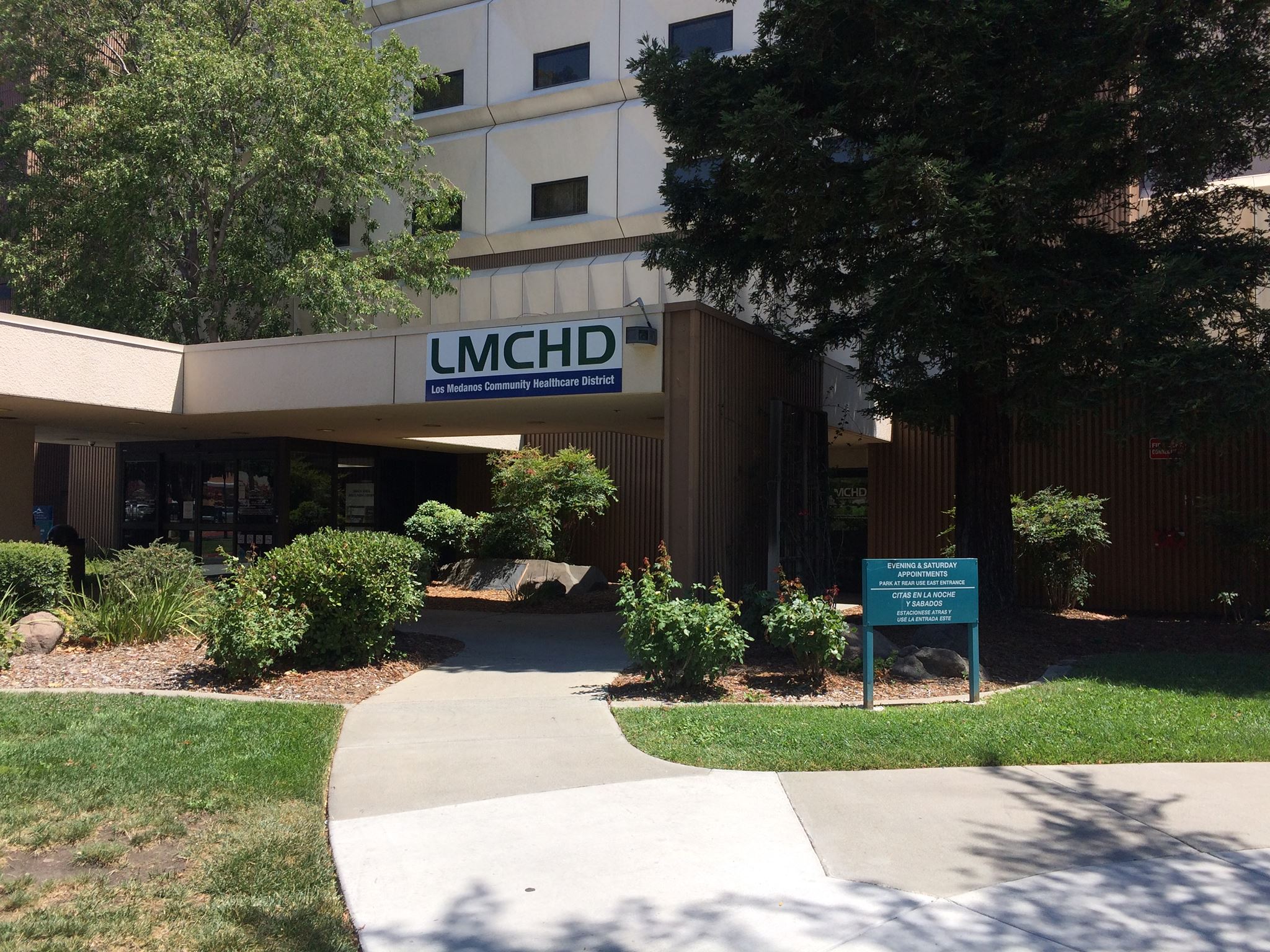
The Los Medanos Community Healthcare District building, formerly Los Medanos Hospital. Photo from the LMCHD Facebook page.

“The need for a healthcare district board of directors has come and gone.” – Supervisor Federal Glover

By Daniel Borsuk

The little heard of governmental entity dubbed the Contra Costa Local Agency Formational Commission (CCLAFCo) will consider either at its February or April 2018 meeting a resolution unanimously passed by the Contra Costa County Board of Supervisors on Tuesday to dissolve the financially troubled Los Medanos Community Healthcare District (LMCHD).

Established in 1963 by the state legislature to sort out local governmental agency boundary issues and other inter-county government problems, every county in the state has a local agency formation commission.  The CCLAFCo consists of seven voting members, with two members representing the board of supervisors, two members representing city councils, two representing special district boards and one public member.

In this instance, Board of Supervisors Chair Federal Glover, who represents Pittsburg and Bay Point which are the two communities served by LMCHD, and District 2 Supervisor Candace Andersen have already voted to dissolve the LMCHD and both serve on the CCLAFCo board and will have a second opportunity to vote on the issue when it comes before the commission.  District 3 Supervisor Diane Burgis of Brentwood also serves as an alternate to the CCLAFCo only when either Glover or Andersen cannot attend a meeting.

On its face there seems to be a potential conflict of interest or perhaps not.

CCLAFCo Executive Administrator Lou Anne Texeira told the Herald that when this item comes up, the two supervisors can vote on the issue and will not have to recuse themselves as long as they have no financial stake in their action.

“There is no law or rule that bars them from voting on the matter again,” Texeira said.  “They do have the option to recuse themselves when the matter comes up for a vote if they so choose to do so.”

“All of this will be considered before LAFCo,” said Glover before the supervisors’ vote.  “The need for a healthcare district board of directors has come and gone.  I accept the staff’s recommendation.”

At Tuesday’s supervisors meeting, the decision to approve the County Administrator’s Office recommendation took less than 20 minutes.

LMCHD Executive Director Godfrey L. Wilson admitted he was caught off guard that the board of supervisors were considering dissolving the financially struggling healthcare district in this manner by placing the issue on the board’s agenda.

Recent financial data indicates the healthcare district that serves Pittsburg and Bay Point is not perking along well.  The district had healthcare grant programs, which are the district’s core operation of $268,569 or 25 percent of total revenues of $1,060,330.  At the same time, district financial records show general administration costs, including board member stipends represented 33 percent of the district’s expenses or $345,383.

When asked what way CCLAFCo may vote when the issues come before that panel next year, LMCHD Executive Director Wilson responded in an unoptimistic manner, “I think some people have already made up their minds on that issue.”

The county health department that has operated the Pittsburg Health Clinic at the 130,000-square foot building at 2311 Loveridge Road since 1998 will continue to operate the health clinic that is the most successful clinic in the county treating more than 100,000 patients a year.

The county has paid $100,000 a year in rent to the California Office of Statewide Health Planning and Development for use of the Loveridge Road property.  In addition, the county has paid the state $24 million for capital improvements to the building on Loveridge Road.

The county-run Pittsburg Health Center accounts for 65 percent of all clinic visits in East Contra Costa County.  The clinic provides primary adult care as well as pediatrics care, audiology, orthopedics, podiatry, and dental care services.

Filed Under: East County, Health, News, Supervisors

Supervisors OK private residential medical marijuana cultivation, storage and sale

October 27, 2017 By Publisher Leave a Comment

By Daniel Borsuk

Contra Costa County Supervisors unanimously passed an ordinance on Tuesday that will allow homeowners living in unincorporated areas of the county to cultivate, store, manufacture, transport and sell medical cannabis from their properties.

The hitch is that the homeowner can grow no more than six cannabis plants on each residential property.

The new law that met scant opposition will go into effect Nov. 24.

The ordinance requires that living cannabis plants in excess of 28.5 grams must be kept in a locked space, enclosed, and must not be visible to the public.

Only persons 21 years or older may be allowed to perform any of the activities included in the ordinance, such as cultivation, delivery, sales, and storage.

The ordinance is in compliance with the Nov. 8 2016 voter approved Proposition 64, which enacted the Control, Regulate, and Tax Adult Use of Marijuana Act (CRTAUMA).

The new residential cannabis ordinance is the county’s first salvo in how the county plans to regulate every aspect of the legal commercialized cannabis market.

Contra Costa County is not expected to complete implementation of CRTAUMA until at least after November 2018 when supervisors will place a cannabis tax measure on the ballot for voters to act on.

At Tuesday’s meeting, supervisors, reviewed a wide range of tax proposals presented by Mark Lovelace of the consulting firm HdL Companies.

Lovelace , who said Contra Costa like most other California counties is moving along in compliance with CRTAUMA, presented to supervisors a variety of tax scenarios set at 3 percent, 5 percent and 7 percent, but noted the cumulative tax impact on cannabis retailers, wholesalers and distributors the costs could be as high as 29.5 percent.

For Contra Costa, which could be a major cannabis manufacturing hub with 5 to 20 manufacturers, Lovelace said at a 3 percent tax rate the county could potentially generate $1.27 million in tax revenue a year.  At 5 percent the county could draw $1.87 million and at 7 percent the county could ring up $2.75 million.

With that revealed, District 3 Supervisor Diane Burgis commented, “Five percent is a good conservative number.”

But Supervisor Karen Mitchoff seemed she could go with a higher tax rate when the supervisor for District 4 remarked, “I want to do whatever needs to be done to maximize tax revenue.”

Business owner Ben Zachery warned supervisors to not go heavy on taxes and regulations during the public hearing.

“Sixty percent of your constituents approved Proposition 64,” he said.  “Don’t slap on strict rules and big taxes on cannabis.”

But Jane Rich called on supervisors to not implement CRTAUMA.

“Make marijuana an unwelcomed drug in Contra Costa County,” she said. “It’s a real issue.  You have to question about the delivery of marijuana to those under 21.”

Next month, county planners are expected to unveil a revised draft of the cannabis ordinance that will address issues like prioritizing requests for proposals, establishing buffer zones, and imposing restrictions on cannabis deliveries.

Supervisors Approve $47 Million Rehabilitation Project

Supervisors unanimously approved as a consent item a $47 million proposal from Monterey Venture Ltd. to acquire and rehabilitate the 324-unit apartment complex at 680 37th Street in Richmond.  Monterey Venture Ltd. is a subsidiary of MRK Partners.   Monterey Venture received tax exempt financing for the rehabilitation project through the California Municipal Finance Authority.


Filed Under: Health, News, Supervisors

Supervisors fund illegal immigrant family aid program to monitor ICE actions in county

September 20, 2017 By Publisher 1 Comment

Helps pay for “Rapid Response” inspectors, education workshops, legal aid sessions

By Daniel Borsuk

In response to policies and actions by President Trump and to assist illegal immigrant families “facing immediate separation due to deportation,” Contra Costa County supervisors unanimously agreed to use $500,000 of AB 109 funds to cover expenses and match funds from non-profit organizations for the launch of a Stand Together CoCo pilot project in January. Stand Together CoCo 8_16_17

The proposal by the Contra Costa Immigration Rights Alliance, originally submitted earlier this year needed a total of $1,002,750 for the program. The county will use funds from state Assembly Bill 109 automobile license fee revenues. According to their Facebook page, “CCIRA seeks to end ICE collaboration in Contra Costa and to promote immigrant rights, inclusion and a spirt of welcome in cities throughout the county.” Draft CoCoCo Immigrant Legal & Ed P-ship

The effort had already rounded up $585,000 from six non-profit organizations that will help fund Stand Together CoCo operate during its inaugural year of operations consisting of education workshops, legal aid sessions, and the hiring and oversight of 12 Rapid Response inspectors who will be dispatched around the county to observe and take notes on how United States Immigration and Custom Enforcement agents conduct themselves at arrest sites.

According to the staff report, “The proposal requests that the Board of Supervisors authorize the Office of the Public Defender to establish Stand Together CoCo as a pilot project. The requested allocation is $500,000 in FY 17/18 funding to support operations in the January-June 2018 first phase, with a further commitment that the County will provide $500,000 in annual support in each of fiscal years 2018-19 and 2019-20. Working with key local partners, Stand Together CoCo will then use this commitment to generate funding from other public and private sources.”

Presently the program has received letters of commitment from the Y & H Soda Foundation of $275,000, the San Francisco Foundation of $100,000, the East Bay Community Foundation of $50,000, and the Firedoll Foundation of $50,000, and letters of intention from the Richmond Community Foundation of $10,000 and the California Endowment of $100,000.

During the public hearing portion that drew 21 persons speaking in support of the program that Contra Costa County Deputy Public Defender Ali Saidi will oversee, District 2 Supervisor Candace Andersen questioned about the functions of the Rapid Response Dispatch Inspectors and whether they would create potential legal problems with the federal government should Rapid Response Inspectors interfere with ICE agents.

“I don’t want to see ordinary citizens getting in the way of the actions of ICE agents,” Andersen said

In the early going it looked like Andersen was going to possibly cast the lone negative vote, but later on she decided to vote along with her colleagues.

“I’m going to take a leap of faith.  I am concerned about public safety,” the supervisor later said before casting a yes vote for the program.

Andersen also voiced concern that this new county-backed immigrant rights program might duplicate services already provided in the county through existing nonprofit organizations like the Contra Costa Crisis Center.

“I don’t want to spend one half million dollars on duplicating services,” said the supervisor who represents a large minority population consisting of Chinese, Indian, and Pakistani residents.

“A Google search doesn’t show what’s really being done,” District 1 Supervisor John Gioia said in response to Andersen’s concern about the potential duplication of legal aid services for immigrants.

Deborah Bernstein of the Jewish Family and Community Services in Walnut Creek said her organization has served 875 county residents seeking immigration legal assistance from January through August.

“These people are living in a high level of fear,” she said.

Since January, Catholic Charities of Contra Costa County has helped 924 people receive legal immigration aid.

“We’ve seen a big increase in people needing help,” said Christopher Martinez of Catholic Charities.

Rubicon Contract Approved

In other action, supervisors approved a $408,750 contract with Rubicon Programs, Inc., an ex-felon nonprofit assistance program, after receiving a letter from Contra Costa Sheriff-Coroner David Livingston that he is now satisfied the one-year contract extension complies with contract protocol.  Last week, supervisors had delayed action on the contract because of the sheriff’s concern that the contract did not go through adequate review by a county contract panel.

The practice of assessing $30 a day cost living charges for juveniles serving sentences at the county’s two juvenile facilities – Juvenile Hall in Martinez and Boys Ranch in Discovery Bay, is over.  Supervisors voted 5-0 to officially end the bill that parents or legal guardian had to pay the county upon the release of their child for the daily living (meals, lodging, other expenses).  Contra Costa County joins other counties like San Francisco, Alameda, Santa Cruz and Los Angeles ditching the juvenile hall daily cost of living fee because it is viewed as being financially retaliatory to parents of children in the juvenile justice system.  The county had begun to temporarily cease the billing practice in 2016.

Next week, supervisors will vote on permanently ending the $17 daily electronic surveillance fee of minors in the juvenile justice system.

The county can afford to eliminate the daily cost of living fee and daily electronic surveillance fee because county officials laid off two fulltime juvenile hall clerical positions.

Supervisors also instructed John Kopchik, director of the Conservation and Development Department, to present to the board by next February proposed regulations for short-term rentals in unincorporated areas of the county.  Supervisors especially representing Discovery Bay, Kensington, Alamo, and Black Hawk have seen a surge in short-term rentals that have produced parking, noise and other problems.  County planners will develop an ordinance by examining what other jurisdictions like San Francisco, San Luis Obispo, Sacramento and other counties have drafted.

Filed Under: Immigration, News, Supervisors

Contra Costa Supervisors select first African-American and female District Attorney Diana Becton

September 13, 2017 By Publisher 2 Comments

Retired Judge Diane Becton. Courtesy of CCLawyer.cccba.org.

By Daniel Borsuk

On an initial split vote, Contra Costa County Supervisors picked Superior Court Judge Diana Becton to complete the nine remaining months of former Contra Costa County District Attorney Mark Peterson on Tuesday.

Supervisors initially made their preferences known on a 3-2 split vote, to pick Becton from a field of five well-qualified competitors, for the top county criminal prosecutor post that pays $21,415 a month. Supervisors John Gioia of Richmond who represents District 1 and Diane Burgis chose Becton, while Candace Andersen and Karen Mitchoff chose Senior Deputy District Attorney Paul Graves. Board Chair Federal Glover broke the tie and stated his preference for Becton.

A few minutes later, supervisors voted to unanimously approve the selection of Becton as interim DA.

She has announced her retirement as judge in order to assume the DA position next Monday.

Becton, the first African American female judge to be selected by former California Republican Gov. Pete Wilson, will now become the first African American and first female in history to be in charge of the Contra Costa County District Attorney’s Office, an office marred by scandal, most recently the June resignation of Peterson for illegally spending of $66,000 of his campaign funds over a five-year period for personal use, then not disclosing it on finance reports.  In 2008, the county DA office was rocked when deputy prosecutor Michael Gressett was charged with allegedly raping a female DA colleague.

Graves, who had won the endorsement from the Contra Costa County District Attorney’s Association and most all of the police officers associations in the county, has already announced his candidacy to run for the DA office in the June election. Santa Clara County Supervising Deputy District Attorney Patrick Vanier, another applicant for the interim post, has also announced his candidacy.  Vanier, who is running on a campaign of conducting a “comprehensive audit” of the department, did not draw a vote from any supervisor.

In addition to Vanier, Contra Costa Superior Court Judge Danielle Douglas, a former San Francisco prosecutor, did not attract any votes from supervisors, either.  Douglas portrayed a conservative management “if it isn’t broken don’t fix it” style that may have turned off supervisors.

During the public hearing prior to the supervisors’ vote, Becton had scored the most support from 20 out of 40 speakers, many who had acknowledged the judge’s 22 years of criminal courtroom experience and progressive views about bail reform and the need to decrease the rising number of BART crimes, gang and freeway shootings.  Becton also earned the endorsement of the NAACP clergy, following the East County Branch’s public interview of the five applicants, last Saturday.

On the topic of plagiarizing material for her application for the post Becton admitted, “I did liberally copy from all sorts of sources.  I own those mistakes. But you have to look at my 22 years of service in this county of working with integrity to improve our criminal justice system.”

She also stated that she didn’t think U.S. Senator Kamala Harris (D-CA) would have a problem with Becton’s use of her words.

Under questioning from supervisor Andersen, Contra Costa County Assistant District Attorney Thomas Kensok, a 30-year veteran of the DA office, also admitted he had copied material in his application without identifying his sources.

“I should have put in quotation marks, but I did not think of it,” he said. “There was no intent to deceive.  I’m sorry for the way it came out.”

So far Becton has not stated whether she will run in the 2018 election campaign for the full-time position.

Sheriff David Livingston chipped in a recommendation that supervisors might want to develop a duo DA position with Beckton/Kensok holding the post in a caretaking status until the June election. That idea did not draw any reaction from supervisors.

“There is need for change.  The department needs to be transparent,” said Glover of Pittsburg, who represents District 5. “We want the department to think differently, and Judge Beckton can bring that.”

On the initial vote, District 4 Supervisor Mitchoff voted for Graves because of his “integrity and extensive prosecution experience.” Later on the supervisor joined her colleagues to make the appointment of Becton unanimous on a second vote.

Andersen of Danville, who represents District 2, had also initially voted for Graves, but later voted to support Judge Becton. “We need to have a person who can restore public trust, public safety, and protect the mentally ill who enter our criminal justice system,” she said in support of Graves.

District 5 Supervisor Burgis of Oakley said, “My first choice is Judge Diane Becton.”  Burgis said Becton will promote diversity and that “she’s earned the trust of our community.”

Supervisors to Consider Rubicon Contract

In a related matter, supervisors will get an update at their Tuesday, Sept. 19 meeting on the status of a $408,750 contract with the non-profit ex-felon organization Rubicon Programs, Inc.

With the contract expiring at the end of September, a political tiff has developed between Livingston and Gioia, who had opposed the recently approved $70 million West County Detention Jail expansion in north Richmond, a major project of the sheriff.

The problem is the CCP panel is not scheduled to convene until November, too late to renew the Rubicon Contract for the West County Reentry Success Center.

Filed Under: District Attorney, Government, News, Supervisors

  • « Previous Page
  • 1
  • …
  • 18
  • 19
  • 20
  • 21
  • 22
  • 23
  • Next Page »
Liberty-Tax-Jan-Apr-2026
Deer-Valley-Chiro-06-22

Copyright © 2026 · Contra Costa Herald · Site by Clifton Creative Web