• Home
  • About The Herald
  • Local Agencies
  • Daily Email Update
  • Legal Notices
  • Classified Ads

Contra Costa Herald

News Of By and For The People of Contra Costa County, California

  • Arts & Entertainment
  • Business
  • Community
  • Crime
  • Dining
  • Education
  • Faith
  • Health
  • News
  • Politics & Elections
  • Real Estate

City of Lafayette explains use of property taxes

August 10, 2024 By Publisher Leave a Comment

Source: City of Lafayette

As council asks voters to increase sales tax

By City of Lafayette

Have you ever wondered where the revenue from property taxes goes?

As seen in the above graphic, the largest share (57%) goes to school districts, including the community college; 14.1% goes to the Contra Costa Fire District; 11.1% to the County; 3.9% to utilities (EBMUD & CentralSan); 3.4% to parks (including the East Bay Regional Park District); and 3.9% going to various other public agencies (including BART).  The City of Lafayette receives only 6.67%.  Thus, for a single-family house assessed at $1M, while the property owner will pay $10,000 annually for the Countywide tax; the City receives only $670.

“People think that because Lafayette is considered an affluent community with expensive homes that, the City must get plenty of money from property taxes,” says City Manager, Niroop K. Srivatsa; “however, that is not the case.”

In fact, the City of Lafayette receives a lesser percentage of the Countywide property tax revenue than most surrounding cities. “Many people are surprised to learn that the distribution of property tax varies widely among the incorporated cities,” Srivatsa points out.  In Contra Costa County, the rate ranges between 5.4% to 27.7%.”  As to why that is, the answer is somewhat complicated, but goes back to 1978 when Prop 13 was passed.  At that time, the City had not imposed any local property taxes while other cities had.  When Prop. 13 standardized the Countywide general 1% rate, cities got the same percentage of the Countywide tax that had previously been levied locally.   That percentage was zero in the case of Lafayette.  Over the course of the next 10 years, Lafayette’s rate has increased to the current 6.67%, and that is where it has been for the last 36 years.

When asked if the City can get a larger share of these property taxes, the City Manager answers, “Unfortunately No.”  She explains, “100% of the general property tax has been accounted for; thus, increasing Lafayette’s share would mean decreasing another agency’s share, which would be virtually impossible.”

Even with this “low” allocation, the City’s number one source of revenue is still property taxes, generating approximately $7M each year – about 35% of the total General Fund revenue. With the addition of other funding sources like sales tax, franchise, and service fees, the City provides Lafayette residents with important public services such as:

  •  Maintaining public streets and storm drains in their present condition and providing timely pothole repair.
  •  Wildfire preparedness activities.
  •  Keeping the number of sworn police officers at the current level
  •  Providing services for senior citizens.
  •  Landscaping and maintaining City parks, open spaces, paths, and playfields.
  •  Traffic safety programs for all public road and pathway users, including people driving, biking, and walking.
  •  Continuing support for our community partners like the Chamber of Commerce and the Lafayette School District.

However, mostly due to inflation, the City is now facing a deficit of more than $2M annually.  Without additional revenue, City officials will have to make difficult decisions about which programs and services to cut back or altogether eliminate.

As part of the budgeting process, City leaders evaluated several possible options for generating additional revenues. They determined that instead of asking voters to raise property taxes by an average of $200 per parcel, they are asking the voters to authorize a 1/2% increase in the City’s Sales Tax, which amounts to one-half of a penny for every taxable dollar spent locally.

A half-cent increase will generate approximately $2.4 million annually; enough to close the budget deficit and maintain the status quo but not enough to address new or unfunded projects and programs.  A sales tax is paid by visitors who dine and shop in Lafayette, as well as by residents; therefore, funds are brought into the community to benefit Lafayette residents by people who reside outside the City.

If authorized, Lafayette Sale Tax will increase from 8.75 to 9.25%, which is less than the rates in Moraga and Orinda.

The funding Measure will appear on the November 5, 2024 ballot. Passage requires simple majority support (50%, plus 1 vote).  Revenues from the Measure will be placed into the City’s General Fund.  The City Council will appoint an Oversight Committee to monitor the way these monies are spent, and there will be an annual audit, which will be made available to the public.

The City Manager concludes, “Our goal is to keep pace with existing services and programs, while maintaining the City’s finances.”

As previously reported, the Lafayette City Council is asking voters to approve a half-cent sales tax increase to 9.25% on the November 5th ballot. They claim it’s needed due to inflation, unfunded state mandates and would last seven years.

About The City of Lafayette

Lafayette is a charming small community located in Contra Costa County, 30 miles from The City of Oakland. It’s known for its beautiful green hills, excellent schools, and miles of hiking trails, making it an attractive place to live. The City has a population of more than 25,000 highly educated residents, with 75.2% of them holding a bachelor’s degree or higher. Additionally, 73.6% of the homes in Lafayette are owner-occupied. The median home value is $1,914,700, while the median household income is $219,250. The total area of the city is 15.22 square miles.

Allen D. Payton contributed to this report.

Filed Under: Central County, News, Politics & Elections, Taxes

Misinformation and Disinformation: Election Edition in Lafayette Aug. 22

July 27, 2024 By Publisher Leave a Comment

Source: LWV

By Gail Murray, League of Women Voters of Diablo Valley

Join a presentation from 6:30 p.m. to 7:45 p.m. at the Lafayette Library on Thursday, August 22 for an eye-opening discussion of the impact of misinformation and disinformation on elections.

Learn how to spot fake news, fact-check sources and navigate the complexities of today’s media landscape to become a more informed voter and citizen.

The presentation by the League of Women Voters of Diablo Valley will take place in the Homework Center, 3491 Mt. Diablo Blvd., Lafayette.

Register at www.tinyurl.com/LAF-misinfo

Contact programs@lwvdv.org for more information.

Filed Under: Lamorinda, Politics & Elections

Brentwood vice mayor responds to rumors surrounding son’s arrest

July 18, 2024 By Publisher 1 Comment

The CCC Sheriff’s Office Incident Summary for July 13, 2024, shows the response to the call regarding the alleged assault by Zachary Taylor on Sunday night at 10:40 p.m. Source: CCC Sheriff’s Offic

“I have not used my position to seek any special treatment or favors for myself or my family.” – Susannah Meyer

Zachary Meyer in a photo posted on his mother’s personal Facebook page on Dec. 12, 2020.

By Allen D. Payton

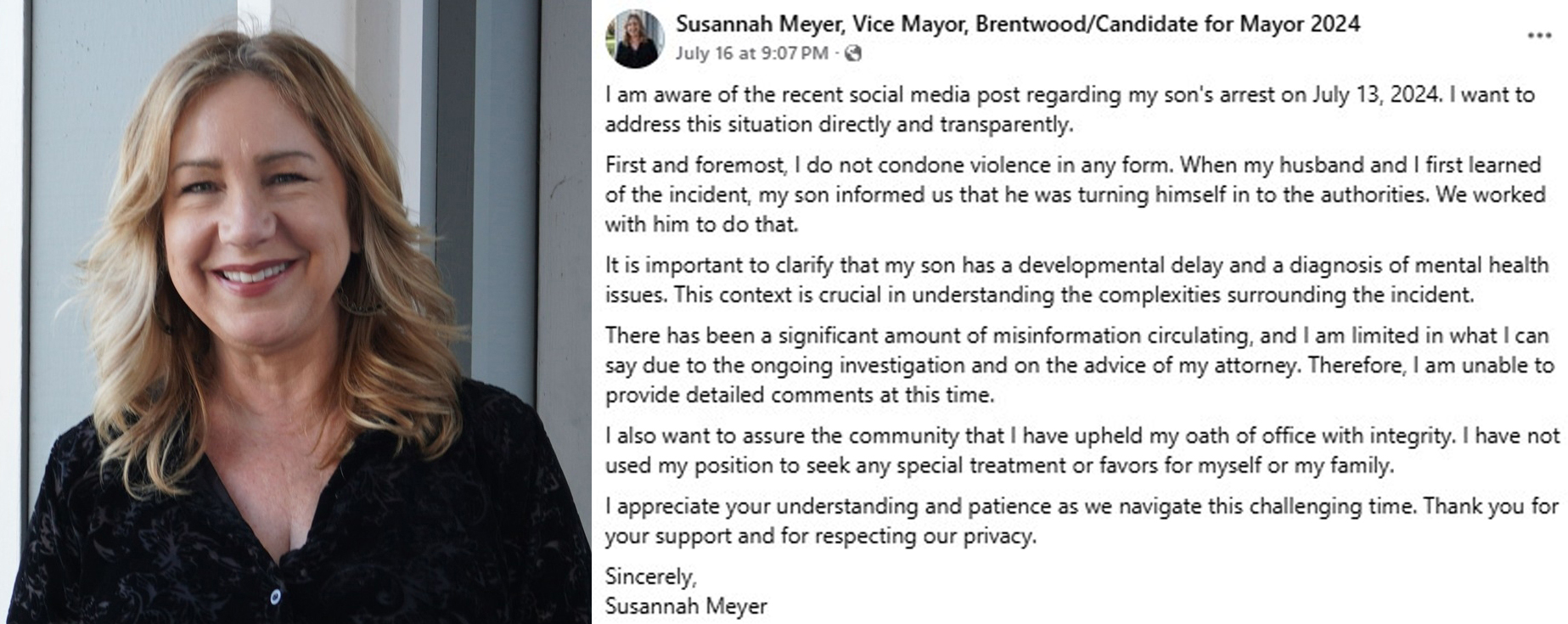
Brentwood Vice Mayor Susannah Meyer took to social media on Tuesday, July 16, 2024, to respond to rumors surrounding the arrest of her son on Saturday and dispel accusations that she received special treatment. The now candidate for mayor in the November election wrote on her official Facebook page, “I have not used my position to seek any special treatment or favors for myself or my family.”

According to localcrimenews.com, Zachary Taylor was arrested for “assault with any means of force likely to produce great bodily injury”. According to the Contra Costa County Sheriff’s Office Incident Summary Report for July 13, 2024, it occurred at 10:40 PM in the 3700 block of Porter Circle on Bethel Island inside a mobile home park and is listed as assault with a deadly weapon.

Sheriff’s spokesman Jimmy Lee later confirmed that information when he shared, “On Saturday, July 13, 2024, at about 10:40 PM, Deputy Sheriffs responded to a report of a battery at a residence on the 3700 block of Porter Circle in Bethel Island. Deputies contacted a person who had been physically assaulted. The victim was transported to a local hospital. The suspect was later taken into custody after returning to the scene. He is identified as 30-year-old Zachary Meyer of Bethel Island. He was booked into the Martinez Detention Facility for an assault with a deadly weapon charge. He was being held in lieu of $30,000 bail but has since bailed out.”

Also, according to Contra Costa County Sheriff’s Office Zachary Meyer was booked early Monday morning, July 14 and was released on bond early Monday afternoon.

Susannah Meyer in a photo on her official Facebook page on Aug. 8, 2023, and the post on Tuesday, Aug. 17, 2024, about her son’s arrest.

In her post the councilwoman wrote, “I am aware of the recent social media post regarding my son’s arrest on July 13, 2024. I want to address this situation directly and transparently.

First and foremost, I do not condone violence in any form. When my husband and I first learned of the incident, my son informed us that he was turning himself in to the authorities. We worked with him to do that.

It is important to clarify that my son has a developmental delay and a diagnosis of mental health issues. This context is crucial in understanding the complexities surrounding the incident.

There has been a significant amount of misinformation circulating, and I am limited in what I can say due to the ongoing investigation and on the advice of my attorney. Therefore, I am unable to provide detailed comments at this time.

I also want to assure the community that I have upheld my oath of office with integrity. I have not used my position to seek any special treatment or favors for myself or my family.

I appreciate your understanding and patience as we navigate this challenging time. Thank you for your support and for respecting our privacy.

Sincerely,

Susannah Meyer”

Efforts to reach the councilwoman for additional details about her son were unsuccessful prior to publication time. Please check back later for any updates to this report.

Filed Under: Crime, East County, Government, News, Politics & Elections, Sheriff

Local election nomination period opens Monday, July 15

July 14, 2024 By Publisher Leave a Comment

Seats on city councils, school boards, special districts up for election throughout Contra Costa County

Special instructions for Lafayette City Council candidates

By Allen D. Payton

The nomination period for local offices including city councils, school districts and special districts will open on Monday, July 15, 2024, and nomination papers will be available for candidates running for office. The nomination period runs through 5:00 pm Friday, August 9, 2024. The election will be consolidated with the statewide General Election on Tuesday, November 5th, 2024.

Papers for offices that are up for election will be available at the Contra Costa Elections Office, 555 Escobar Street in Martinez or at each city clerk’s office for city offices.

“The 2024 General Election has officially begun,” said Kristin B. Connelly, Contra Costa Registrar of Voters. “Candidate Filing begins Monday July 15, and our Candidate Services team is ready to help our residents who are looking to serve their communities in an elected position.”

If an incumbent does not file to run for office by the deadline on August 9th, the filing period for that office will extend until 5:00 pm on Wednesday, August 14, 2024.

Interested candidates can schedule an appointment through email at candidate.services@vote.cccounty.us or by calling 925-335-7800. Walk-ins are accepted, but service is subject to the availability of staff. Appointments are available on weekdays from 8:30 am to 4:30 pm. Filing documents and information will be provided to interested constituents at their appointment. The process takes 20 minutes.

For further information on the General Election and key dates, go to www.contracostavote.gov

The following offices are up for election in November:

City Councils

Antioch – Mayor, City Clerk, City Treasurer, Districts 2 & 3 Councilmembers

Brentwood – Mayor, Districts 1 & 3 Councilmembers

Clayton – 3 Councilmembers

Concord – Districts 2 & 4 Councilmembers

Danville – 3 Councilmembers

El Cerrito – 3 Councilmembers

Hercules – 3 Councilmembers

Lafayette – 3 full-term, 4-year Councilmembers; 1 partial term, 2-year Councilmember

Martinez – Treasurer, District 2 & 3 Councilmembers

Moraga – 3 Councilmembers

Oakley – Districts 1, 3 & 5 Councilmembers

Orinda – 2 Councilmembers

Pinole – Treasurer, 2 Councilmembers

Pittsburg – 2 Councilmembers

Pleasant Hill – Districts 1, 2 & 5 Councilmembers

Richmond – Districts 1, 5 & 6 Councilmembers

San Pablo – 3 Councilmembers

San Ramon – Mayor, Districts 1 & 3 Councilmembers

Walnut Creek – 3 Councilmembers

School Districts

Acalanes Union High School District – 2 Governing Board Members

Antioch Unified School District – Areas 1, 3 & 4 Governing Board Members

Brentwood Union School District – 2 Governing Board Members

Byron Union School District – 2 Governing Board Members (4-year terms), 1 Governing Board Member (2-year term)

Canyon Elementary School District – 2 Governing Board Members

Chabot-Las Positas Community College – Ward 7 Governing Board Member (Shared with Alameda which is county of jurisdiction)

Contra Costa County Board of Education – Areas 1 & 3 Governing Board Members

Contra Costa Community College District Wards 2 & 5 Governing Board Members

John Swett Unified School District – 3 Governing Board Members

Knightsen Elementary School District – 3 Governing Board Members

Lafayette School District – 2 Governing Board Members

Liberty Union High School District – Areas 1 & 2 Governing Board Members (4-year terms), Area 4 Governing Board Member (2-year term)

Livermore Valley Joint Unified School District – 2 Governing Board Members (Shared with Alameda which is county of jurisdiction)

Martinez Unified School District – Areas 1, 2 & 4 – 1 Governing Board Members

Moraga School District – 2 Governing Board Members

Mt. Diablo Unified School District – Areas 3 & 5 Governing Board Members

Oakley Union Elementary School District – Areas 1 & 2 Governing Board Members

Orinda Union School District – 2 Governing Board Members

Pittsburg Unified School District – 2 Governing Board Members

San Ramon Valley Unified School District – Areas 2 & 3 Governing Board Members

Walnut Creek School District – 2 Governing Board Members (4-year terms), 1 Governing Board Member (2-year term)

West Contra Costa Unified School District – Districts 1, 2 & 3 Governing Board Members

Special Districts (Nomination Papers issued by County Elections Division)

Alameda-Contra Costa Transit District – Ward 1 Director (Shared with Alameda which is the county of jurisdiction)

Ambrose Recreation & Park District – 2 Directors

Bethel Island Municipal Improvement District – 3 Directors

Byron-Bethany Irrigation District – Division 2 Director

Byron Sanitary District – 3 Directors

Castle Rock County Water District – 3 Directors

Central Contra Costa Sanitary District – Divisions 1, 4 & 5 Directors (4-year terms), Division 3 Director (2-year term)

Contra Costa Water District – Divisions 3, 4 & 5 Directors

Crockett Community Services District – 2 Directors (4-year terms), 1 Director (2-year term)

Diablo Community Services District – 2 Directors

Diablo Water District – Wards 1 & 5 Directors

Town of Discovery Bay Community Services District – 2 Directors

Dublin San Ramon Services District – Division 1 Director

East Bay Municipal Utility District – Ward 1 Director (4-year term), Ward 2 Director (2-year term)

East Bay Regional Park District – Wards 1 & 2 Directors (Shared with Alameda which is county of jurisdiction)

East Contra Costa Irrigation District – Divisions 2, 3 & 5 Directors

Green Valley Recreation & Park District – 2 Directors

Ironhouse Sanitary District – 3 Directors

Kensington Fire Protection District – 2 Directors

Kensington Police Protection & Community Services District – 2 Directors

Moraga-Orinda Fire Protection District – Divisions 2 & 5 Director

Mt. View Sanitary District – Area 1 Director (2-year term) Areas 3, 4 & 5 Directors (4-year term)

Pleasant Hill Recreation & Park District – 2 Directors

Rodeo-Hercules Fire Protection District – 2 Directors

Rodeo Sanitary District 3 Directors

San Francisco Bay Area Rapid Transit District (BART) – District 1 Director, Districts 3 & 5 Directors (Shared with Alameda which is county of jurisdiction)

San Ramon Valley Fire Protection District – 3 Directors

Stege Sanitary District – 2 Directors

West County Wastewater District – Divisions 2 & 4 Directors

See list of offices currently up for election here.

Lafayette

In Lafayette, the nomination period will close on Friday, August 9, 2024, at 4:00 p.m. If nomination documents from any incumbent is not filed by that date, the nomination period shall be extended until Wednesday, August 14, 2024, at 4:00 p.m. During this extension period, no incumbent is allowed to file nomination documents.

For the Lafayette City Council, appointments for obtaining and filing nomination papers are required and can be requested by emailing City Clerk Joanne Robbins jrobbins@lovelafayette.org or call 925-284-1968. The Lafayette City Clerk’s office is located at 3675 Mt. Diablo Blvd., second floor, Lafayette. Appointments will be scheduled during the hours of 9:00 a.m. to 4:00 p.m. Monday through Friday.

Starting July 15, information on individuals who have been issued nomination papers will be posted on www.lovelafayette.org/election.

Kristin B. Connelly, County Clerk-Recorder and Registrar of Voters, Dawn Kruger, Civic Outreach and Engagement Specialist, Contra Costa Clerk-Recorder-Elections Department and Suzanne Iarla, Communications Analyst/PIO, City of Lafayette contributed to this report.

Filed Under: News, Politics & Elections

BAHFA to place $20 billion affordable housing bond measure on Nov. ballot in Bay Area counties

June 27, 2024 By Publisher Leave a Comment

Source: BAHFA

First-of-its-kind measure to help build, preserve more than 70,000 additional homes

Contra Costa County would receive $1.9 billion

By John Goodwin, Assistant Director of Communications & Rebecca Long, Director, Legislation & Public Affairs, Metropolitan Transportation Commission

The Bay Area Housing Finance Authority (BAHFA) on Wednesday, June 26, 2024, adopted a resolution to place a general obligation bond measure on the November 5 general election ballot in each of the nine Bay Area counties to raise and distribute $20 billion for the production of new affordable housing and the preservation of existing affordable housing throughout the region. BAHFA is jointly governed by the Association of Bay Area Governments (ABAG)’s Executive Board and by the BAHFA Board, which is comprised of the same membership as the Metropolitan Transportation Commission (MTC).

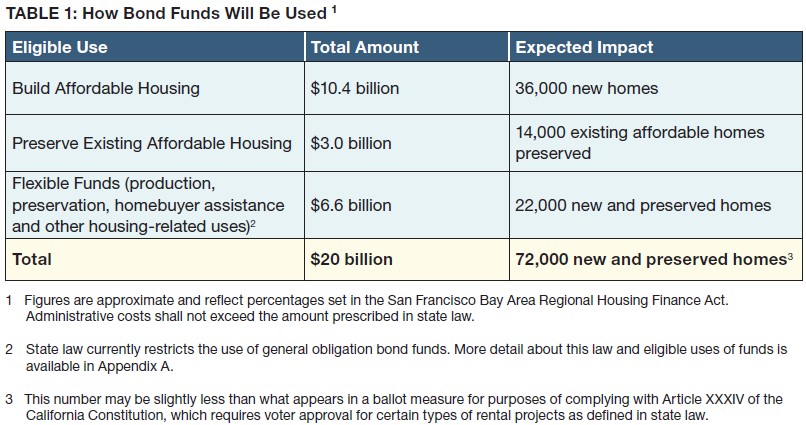
The bond could create 72,000 new affordable homes – more than double what would be possible without a bond. Without more funding, only about 71,000 affordable homes will be built or preserved in the Bay Area over the next 15 years – a status quo that is failing to meet the needs of the people who live and work here.

Currently, the Bay Area doesn’t have enough homes for the people who live here. As a result of the region’s housing shortage:

  • In 2022, 37,000 people were unhoused in the Bay Area.
  • 1.4 million people—23% of Bay Area renters—spend over half their income on rent.
  • High rents and home prices force people to live far from work, making congestion and pollution much worse, and putting a major strain on working families.
  • Too many Bay Area residents live in overcrowded and unsafe housing.
  • Vital employees and community members are leaving the area.

Wednesday’s unanimous vote by the BAHFA Board marks the final discretionary step in the process to place the measure on the November ballot. Under state law, each Bay Area county will now take a non-discretionary, ministerial vote to place the measure on the ballot in that county, in accordance with election deadlines.

The BAHFA bond measure currently would require approval by at least two-thirds of voters to pass. Voters throughout California this November will consider Assembly Constitutional Amendment 1 (ACA 1) — which would set the voter threshold at 55 percent for voter approval of bond measures for affordable housing and infrastructure. If a majority of California voters support ACA 1, the 55 percent threshold will apply to the BAHFA bond measure.

“Today’s vote is the culmination of so many years of effort by so many people all around our region,” observed BAHFA Chair and Napa County Supervisor Alfredo Pedroza. “The Bay Area’s longstanding housing affordability problems affect all of us, our friends, our neighbors and our family members. This vote is about preserving opportunity for everyone.”

Source: BAHFA

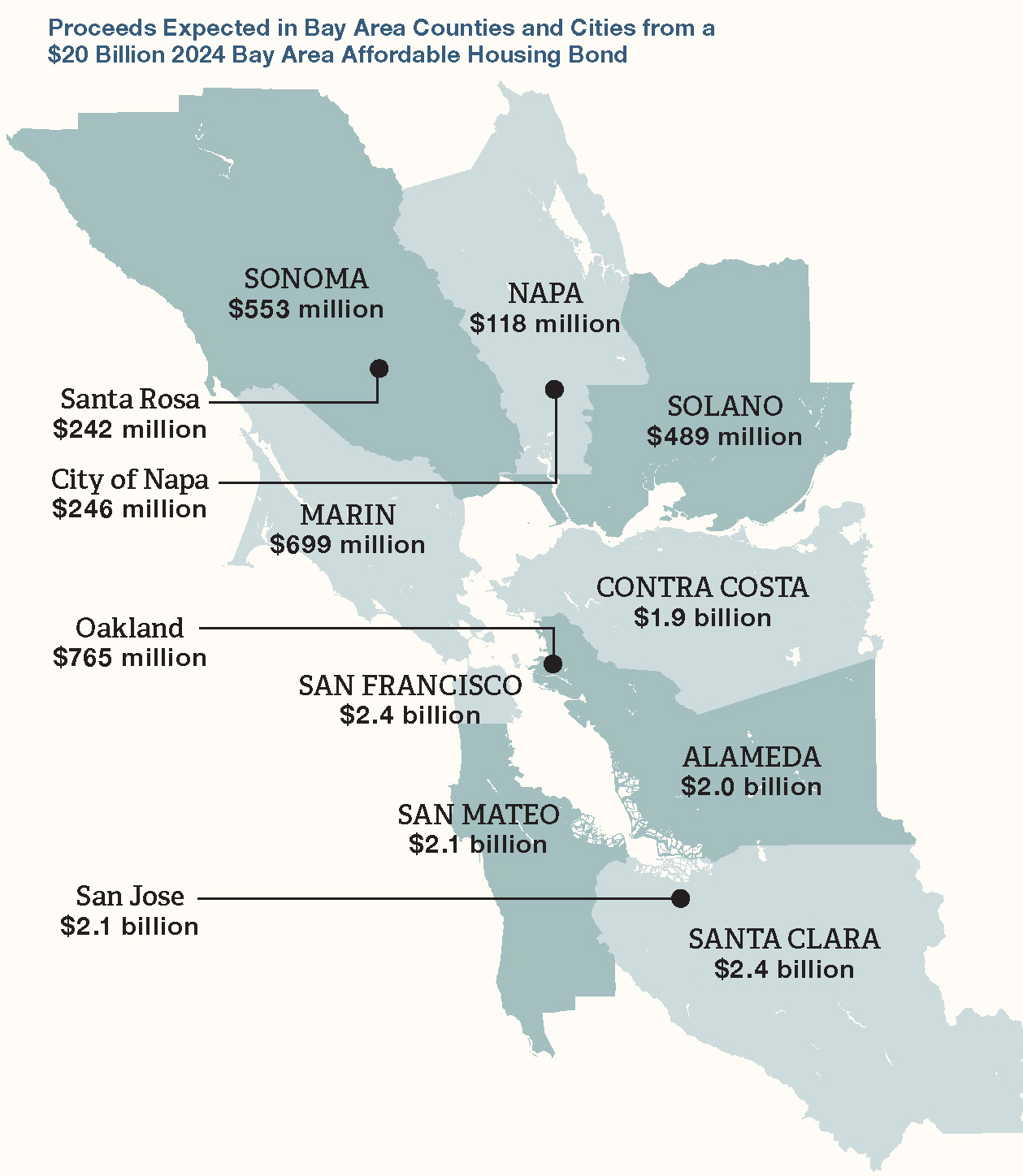
The proposed BAHFA bond measure calls for 80 percent of the funds to go directly to the nine Bay Area counties (and to the cities of San Jose, Oakland, Santa Rosa and Napa, each of which carries more than 30 percent of their county’s low-income housing need), in proportion to each county’s tax contribution to the bond. In consultation with its cities and towns, each county would determine how to distribute bond funds to best meet its jurisdictions’ most pressing housing needs. These distributions would include:

  • Contra Costa County: $1.9 billion
  • Alameda County: $2 billion
  • Marin County: $699 million
  • Napa County: $118 million
  • San Francisco County: $2.4 billion
  • San Mateo County: $2.1 billion
  • Santa Clara County: $2.4 billion
  • Solano County: $489 million
  • Sonoma County: $553 million
  • City of Napa: $246 million
  • City of Oakland: $765 million
  • City of San Jose: $2.1 billion
  • City of Santa Rosa: $242 million

The remaining 20 percent, or $4 billion, would be used by BAHFA to establish a new regional program to fund affordable housing construction and preservation projects throughout the Bay Area. Most of this money (at least 52 percent) must be spent on new construction of affordable homes, but every city and county receiving a bond allocation must also spend at least 15 percent of the funds to preserve existing affordable housing. Almost one-third of funds may be used for the production or preservation of affordable housing, or for housing-related uses such as infrastructure needed to support new housing.

Source: BAHFA

The California Constitution currently does not allow bond funds to be used for tenant protections such as rental assistance, but planned investments in new housing and affordable housing preservation will protect tens of thousands of low-income renters and vulnerable residents.

The BAHFA Board also adopted on Wednesday, resolutions approving the Authority’s Business Plan and its Regional Expenditure Plan, which explain the prioritization for use of the funds that would be directly administered by BAHFA.

Oversight and accountability provisions to be included in the BAHFA bond measure include the creation of a special bond proceeds account; establishment of a Citizens’ Oversight Committee that would review the expenditure of bond proceeds and report to the BAHFA and ABAG Executive Boards on whether the funds were spent appropriately; an independent annual performance audit; a requirement that all bond-projects be consistent with state laws on labor standards; a requirement that administrative costs not exceed the amount prescribed in state law; and a prohibition against any public official who voted to send the ballot measure to the voters bidding on any work funded with proceeds from the bond.

The ABAG Executive Board voted unanimously at its April meeting to adopt a resolution approving BAHFA’s Business Plan and its Expenditure Plan, as well as to endorse placement of the bond measure on the November ballot. In her remarks preceding the vote, ABAG President and Napa County Supervisor Belia Ramos noted, “This is a remarkable milestone moment for our region. Housing stability is essential for our community to thrive, and this proposal is a once-in-a-generation opportunity.”

Read the Bond Report and learn more about the bond measure, here and here.

Filed Under: Bay Area, Finances, Growth & Development, Homeless, News, Politics & Elections

Contra Costa launches nation’s most ambitious, countywide campaign to elevate trust in elections

June 22, 2024 By Publisher Leave a Comment

Community Ambassadors meeting. Photo: CCC Elections Division

“Contra Costa County is home to one of the safest, most secure, and transparent election systems in the nation.”

By Contra Costa Elections Division

In light of a growing tide of election misinformation, the Contra Costa County Clerk-Recorder-Elections Department is taking a stand. The Elections Division is launching a far-reaching marketing and community engagement campaign this week to reassure voters of election integrity and security by shining a light on the comprehensive steps taken to deliver on that promise.

“Elections are more secure than ever and we’re proud of Contra Costa County’s reputation for fair and secure elections. We have to make sure our voters know about the work we’re doing and have the information that inspires faith in our elections,” says Kristin B. Connelly, Contra Costa Registrar of Voters.

Asked for examples of election misinformation in Contra Costa County, the Election Division’s Community and Media Relations Coordinator Dawn Kruger responded, “Unfortunately, we’ve seen and heard lots of misinformation on social media and media comment sections as well as at community meetings.

Some of the most common misconceptions and questions we get are about voter registration requirements, voting by mail, how we prevent voter fraud, and how we secure election technology.

Thanks to the 48 election security safeguards we have in place, elections are more secure than ever, and we want to show voters everything the Contra Costa County Elections Division does to protect their vote. That’s why we’ve compiled all the information voters may want to know and made it available to the public. Voters can get clear and accurate information and responses to some of the most common questions about election security at www.secure-election.org/facts.”

Source: CCC Elections Division

Marketing Campaign

A multi-faceted marketing campaign is in place to deliver that message. In addition to county-wide advertising in print, television, radio and digital media, the campaign also includes the recruitment and training of nearly 100 election ambassadors who have volunteered to carry forward the election integrity message through social media channels and speaking engagements around the county. A companion website, www.secure-election.org, has also been launched, which includes a comprehensive collection of videos, fact sheets, Q&As and social media graphics illustrating how Contra Costa County protects its elections. All this is complemented by opportunities for the public to observe election activities and the county’s award-winning Certified Election Observer program.

“While trust in Contra Costa County elections is high, we’re facing a growing tide of mis- and disinformation that confuses voters and undermines the legitimacy of our elections,” said Kruger. “This voter education campaign fights those myths with solid facts and information, equipping volunteers in our community with a host of tools to help put the real story out there about how safe elections are.”

Contra Costa County was one of 10 election divisions nationwide to be awarded a grant to improve its election processes and chose to pilot this voter education work. The ambitious and robust campaign is expected to reach every resident of the county multiple times and in different ways, hammering home the many steps and precautions in place to ensure only eligible voters vote, that every legitimate vote is counted, and that the county’s election system is secure from fraud. The campaign is predicated on transparency, inviting the public to look more closely at how elections are handled and the exhaustive efforts to protect them.

The first wave of election integrity advertising will run June – July and a second wave will run September – October. These advertisements will coincide with the ambassador’s social media efforts and speaking engagements. Any organization interested in scheduling an ambassador speaking engagement can email info@contracostavote.org. For more information about the campaign and election security, visit secure-election.org.

Allen D. Payton contributed to this report.

Filed Under: News, Politics & Elections

Mis/Disinformation: Election Edition presentation June 25

June 21, 2024 By Publisher Leave a Comment

Join a presentation at the Moraga Library on Tuesday, June 25 from 6 p.m. to 7:30 p.m. for an eye-opening discussion of the impact of misinformation and disinformation on elections.  Learn how to spot fake news, fact-check sources and navigate the complexities of today’s media landscape to become a more informed voter and citizen.

The presentation by the League of Women Voters of Diablo Valley will be in the library, 1500 St Mary’s Road in Moraga.

For more information contact programs@lwvdv.org.


Filed Under: Lamorinda, Politics & Elections

CA Supreme Court removes Taxpayer Protection Act from Nov. ballot

June 20, 2024 By Publisher Leave a Comment

“The measure exceeds the scope of the power to amend the Constitution via citizen initiative” – California Supreme Court

“Today’s ruling is the greatest threat to democracy California has faced in recent memory…the California Supreme Court has put politics ahead of the Constitution” – Californians for Taxpayer Protection and Government Accountability

By Allen D. Payton

In response to a lawsuit by Gov. Gavin Newsom and the state legislature, the California Supreme Court justices unanimously ruled, today, Thursday, June 20, 2024, the measure known as the Taxpayer Protection and Government Accountability Act amounts to an illegal constitutional revision and removed it from the November election ballot. However, proponents vowed to continue to explore their legal options and efforts to minimize

According to Ballotpedia, “The initiative would have amended the California Constitution to define all state and local levies, charges, and fees as taxes. The initiative would have also required new or increased taxes to be passed by a two-thirds legislative vote in each chamber and approved by a simple majority of voters. It would also have increased the vote requirement for local taxes proposed by local government or citizens to a two-thirds vote of the local electorate. The increased vote requirements for new or higher taxes would have not applied to citizen-initiated state ballot measures. As of 2024, state tax increases require approval by a two-thirds vote in each chamber or a simple majority vote at a statewide election

In addition, a ‘yes’ vote on the measure would have supported “amending the state constitution to define all state and local levies, charges, and fees as taxes and to require new state taxes proposed by the state legislature to be enacted via a two-thirds legislative vote and voter approval and new local taxes to be enacted via a two-thirds vote of the electorate.”

However, according to the Associated Press, “The biggest impact…would have been that the measure threatened to retroactively reverse most tax increases approved since Jan. 1, 2022. Local governments warned they would have lost billions of dollars in revenue that had previously approved by voters. And it would have threatened recent statewide tax increases.”

Proponents

Proponents of the measure, Californians for Taxpayer Protection and Government Accountability, self-described as “a bipartisan coalition of homeowners, taxpayers and businesses committed to ensuring California remains affordable for families and accountable to its voters,” led the campaign in support of the initiative.  The campaign explained the initiative, saying, “The Taxpayer Protection and Government Accountability Act will give voters the right to vote on all future state taxes and holds politicians accountable for new fees and other increased costs paid by working families and all Californians. The measure increases accountability by requiring politicians to spend new or higher tax revenue on its intended purpose. It will provide much-needed relief to families, farmers, and business owners, helping them to combat the growing cost-of-living crisis facing all Californians.”

Supporters included the California Business Roundtable, California NAIOP Commercial Real Estate Development Association, and the Howard Jarvis Taxpayers Association. The campaign had received $17.8 million in contributions.

According to the NAIOP, the measure would have given “voters the right to vote on all future state taxes and holds politicians accountable for new fees and other increased costs paid by working families and all Californians.” It would have increased “accountability by requiring politicians to spend new or higher tax revenue on its intended purpose. It will provide much-needed relief to families, farmers, and business owners, helping them to combat the growing cost-of-living crisis facing all Californians. The Act doesn’t cut any current state or local government funding. It simply gives voters the right to vote on all future tax increases and stops working families from paying billions more in “hidden taxes” imposed by unelected bureaucrats.  They are currently gathering signatures and will need $70 million in fundraising efforts to pass the ballot measure in November of 2022.”

View materials on the proposed ballot measure.

Supporters Respond, Will Seek Legal Options, Continue Efforts

In response to the court’s ruling, the Taxpayer Protection and Government Accountability Act (TPA) campaign issued the following statement from Rob Lapsley, president of the California Business Roundtable, Jon Coupal, president of the Howard Jarvis Taxpayers Association (HJTA) and Matthew Hargrove, president and CEO of the California Business Properties Association:

“Today’s ruling is the greatest threat to democracy California has faced in recent memory. Governor Newsom has effectively erased the voice of 1.43 million voters who signed the petition to qualify the Taxpayer Protection Act for the November ballot. Most importantly, the governor has cynically terminated Californians’ rights to engage in direct democracy despite his many claims that he is a defender of individual rights and democracy. Evidently, the governor wants to protect democracy and individual rights in other states, but not for all Californians.

We are disappointed that the California Supreme Court has put politics ahead of the Constitution, disregarding long-standing precedent that they should not intervene in an election before voters decide qualified initiatives.

Direct democracy and our initiative process are now at risk with this decision, showing California is firmly a one-party state where the governor and Legislature can politically influence courts to block ballot measures that threaten their ability to increase spending and raise taxes. Using the courts to block voters’ voices is the latest effort from the Democrats’ supermajority to remove any accountability measures that interfere with their agenda – a failed agenda that continues to drive up the cost of living with little accountability and few results.

This ruling sends a damning message to businesses in California and across the country that it is politically perilous to invest and grow jobs for the future.

In light of this ruling and the state’s large budget deficit, a huge amount of tax increases are on the way that are sure to make California’s cost of living even higher.

We will continue to explore our legal options and fight for the people’s right to hold their government accountable through direct democracy.”

Opponents

The measure was opposed by Governor Newsom, CA Attorney General Rob Bonta, AFSCME California, SEIU California State Council, California Special Districts Association, California State Association of Counties, and League of California Cities. Graham Knaus, executive director of the California State Association of Counties (CSAC), said, “This deceptive initiative would undermine the rights of local voters and their elected officials to make decisions on critical local services that residents rely upon. It creates major new tax loopholes at the expense of residents and will weaken our local services and communities.”

Bonta had relabeled the measure’s title to, “Limits Ability of Voters and State and Local Governments to Raise Revenues for Government Services. Initiative Constitutional Amendment.” The summary he required to be included on signature petition sheets read as follows: “For new or increased state taxes currently enacted by two-thirds vote of Legislature, also requires statewide election and majority voter approval. Limits voters’ ability to pass voter-proposed local special taxes by raising vote requirement to two-thirds. Eliminates voters’ ability to advise how to spend revenues from proposed general tax on same ballot as the proposed tax. Expands definition of ‘taxes’ to include certain regulatory fees, broadening application of tax approval requirements. Requires Legislature or local governing body set certain other fees.”

In spite of that, supporters were still able to gather the required signatures to qualify the measure for the ballot. The signature gathering occurred in 2022.

Court’s Decision

According to information about the case #S281977 entitled LEGISLATURE OF THE STATE OF CALIFORNIA v. WEBER (HILTACHK) on the state Supreme Court’s website, it “presented the following issues: (1) Does the Taxpayer Protection and Government Accountability Act (TPA) constitute an impermissible attempted revision of the California Constitution by voter initiative? (2) Is this initiative measure subject to invalidation on the ground that, if adopted, it would impair essential government functions?”

The court wrote in its unanimous opinion, “we conclude that the TPA would clearly ‘accomplish such far reaching changes in the nature of our basic governmental plan as to amount to a revision’ of the (state) Constitution. The measure exceeds the scope of the power to amend the Constitution via citizen initiative.”

“It is within the people’s prerogative to make these changes, but they must be undertaken in a manner commensurate with their gravity: through the process for revision set forth in Article XVIII of the Constitution,” the decision continued.

The court concluded by “directing the (CA) Secretary of State to refrain from taking steps to place” the initiative “on the November 5, 2024 election ballot or to include the measure in the voter information guide.”

However, Section 3 of that Article clearly reads, “The electors may amend the Constitution by initiative.” Coupal of the HJTA was asked to explain what the court is referring to and what other approach or process should the proponents have followed. He did not respond prior to publication time.

See Court ruling, here.

For more information about the ballot measure and the coalition that supported it visit www.taxpayerprotection.com.

Please check back later for any updates to this report.

Filed Under: Government, Legal, News, Politics & Elections, State of California

Grayson endorses Avila Farias to replace him in the Assembly

June 15, 2024 By Publisher Leave a Comment

MARTINEZ, CA—State Assembly candidate Anamarie Avila Farias announced, Thursday, June 13, 2024, the endorsement of Contra Costa Assemblyman Tim Grayson for her campaign to represent Northern Contra Costa County in the State Legislature.

“Anamarie’s experience in our local communities, especially her service on the Martinez City Council and Contra Costa County Board of Education, has prepared her to be an effective voice for us in the Legislature,” said Assemblymember Grayson. “I’m looking forward to partnering with her as we fight for Contra Costa’s share of state resources and policies that help working families get ahead.”

“Tim Grayson’s a voice of reason and purpose in the Legislature,” said Anamarie. “I’ll bring a similar attitude to making state policies: Results over rhetoric, progress over politics.

“I really appreciate Assemblymember Grayson’s support and look forward to working with him.”

Avila Farias was the second-place finisher in the March Primary election but the top vote-getter in the field of three Democrats and faces off against the Republican candidate in November’s election. Democratic voters outnumber Republicans 52%-19% in District 15’s registration numbers. If elected, she would be the first Latina to serve Contra Costa in the State Legislature.

She has an extensive record serving her community and setting state policy. She currently serves as a Trustee of the Contra Costa County Board of Education and has consistently pushed for improved public education in Contra Costa schools. She also served on the Martinez City Council from 2012-2016.

Avila Farias is running to represent California State Assembly District 15. The district encompasses Martinez, Pleasant Hill, Concord, Clayton, Pittsburg, Bay Point, Antioch, Crockett portions of Brentwood and unincorporated areas of Contra Costa County.

To learn more about her campaign, visit anamarie4assembly.com.

Filed Under: News, Politics & Elections

Initiative to repeal Prop 47 soft-on-crime measure qualifies for Nov. ballot

June 11, 2024 By Publisher Leave a Comment

Photos: Californians for Safer Communities

Allows felony charges and increases sentences for certain theft and drug crimes, including fentanyl

Sacramento, CA – California Secretary of State Shirley N. Weber, Ph.D. announced that an initiative became eligible for the November 5, 2024, General Election ballot on June 10, 2024.

In order to become eligible for the ballot, the initiative needed 546,651 valid petition signatures, which is equal to five percent of the total votes cast for governor in the November 2022 General Election.

A measure can become eligible via random sampling of petition signatures if the sampling projects that the number of valid signatures is greater than 110 percent of the required number. The initiative needed at least 601,317 projected valid signatures to become eligible by random sampling, and it has exceeded that threshold today.

On June 27, 2024, the Secretary of State will certify the initiative as qualified for the November 5, 2024, General Election ballot, unless it is withdrawn by the proponent prior to certification pursuant to Elections Code section 9604(b).

While the proponents of the initiative, Californians for Safer Communities labeled it The Homelessness, Drug Addiction, and Theft Reduction Act. But Attorney General Rob Bonta’s official title and summary of the measure is as follows: ALLOWS FELONY CHARGES AND INCREASES SENTENCES FOR CERTAIN DRUG AND THEFT CRIMES. INITIATIVE STATUTE.

– Allows felony charges for possessing certain drugs, including fentanyl, and for thefts under $950—both currently chargeable only as misdemeanors—with two prior drug or two prior theft convictions, as applicable. Defendants who plead guilty to felony drug possession and complete treatment can have charges dismissed.

– Increases sentences for other specified drug and theft crimes.

– Increased prison sentences may reduce savings that currently fund mental health and drug treatment programs, K-12 schools, and crime victims; any remaining savings may be used for new felony treatment program.

Summary of estimate by Legislative Analyst and Director of Finance of fiscal impact on state and local governments: Increased state criminal justice system costs potentially in the hundreds of millions of dollars annually, primarily due to an increase in the state prison population. Some of these costs could be offset by reductions in state spending on local mental health and substance use services, truancy and dropout prevention, and victim services due to requirements in current law. Increased local criminal justice system costs potentially in the tens of millions of dollars annually, primarily due to increased court-related workload and a net increase in the number of people in county jail and under county community supervision. (23-0017A1)

According to Ballotpedia.com, the political action committee supporting the measure, Californians to Reduce Homelessness, Drug Addiction, and Theft, has raised over $7.2 million to support the effort. Of that amount $2.5 million was contributed by Walmart, $1.0 million from Home Depot, $500,000 from Target, $300,000 each from 7-Eleven and California Correctional Peace Officers Association Truth in American Government Fund.

The Secretary of State’s tracking number for this measure is 1959 and the Attorney General’s tracking number is 23-0017A1.

The proponent of the measure is Thomas W. Hiltachk of the Bell, McAndrews & Hiltachk law firm. They can be reached at (916) 442-7757. The address for the proponent is 455 Capitol Mall, Suite 600, Sacramento, CA 95814.

For more information about how an initiative qualifies for the ballot in California, visit https://www.sos.ca.gov/elections/ballot-measures/how-qualify-initiative/

Allen D. Payton contributed to this report.


Filed Under: Crime, Drugs, Homeless, News, Politics & Elections, State of California

  • « Previous Page
  • 1
  • …
  • 4
  • 5
  • 6
  • 7
  • 8
  • …
  • 46
  • Next Page »
Furniture-Clearance-02-26B
Liberty-Tax-Jan-Apr-2026
Deer-Valley-Chiro-06-22

Copyright © 2026 · Contra Costa Herald · Site by Clifton Creative Web