• Home
  • About The Herald
  • Local Agencies
  • Daily Email Update
  • Legal Notices
  • Classified Ads

Contra Costa Herald

News Of By and For The People of Contra Costa County, California

  • Arts & Entertainment
  • Business
  • Community
  • Crime
  • Dining
  • Education
  • Faith
  • Health
  • News
  • Politics & Elections
  • Real Estate

Contra Costa College Board votes for gerrymandered redistricting map protecting incumbents, splitting more cities

January 13, 2022 By Publisher Leave a Comment

The approved new Contra Costa Community College Trustee Ward Boundaries Map showing the location of high schools in the county, except for Deer Valley High School in Antioch. The name of Dozier-Libbey Medical High School, also located in Antioch, is misspelled. Source: 4CD

4-0-1 vote approves staff drawn map keeping boundaries significantly the same as current, politically drawn wards map from 2011; leaves portions of East County in same ward with most of the San Ramon Valley; Crockett, Rodeo and portions of Hercules in same district with Walnut Creek, Alamo

By Allen Payton

The Contra Costa Community College board, on a 4-0-1 vote, approved a final redistricting, staff-drawn map that keeps the ward boundaries significantly gerrymandered, protecting each of the incumbents for re-election. Ward 5 Trustee Fernando Sandoval voted to abstain. During a public hearing on Ward Equalization Based on the 2020 Census at their regular meeting Wednesday night, the trustees reviewed three maps drawn by district staff, and only one member of the public, a former trustee, spoke. The new wards will go into effect for this year’s November elections, in which both Ward 3 Trustee Rebecca Barrett and Ward 4 Trustee Andy Li face re-election if they decide to run.

In addition, the board again discussed the “Public employee discipline/dismissal/release/complaint” of Chancellor Bryan Reece during a special meeting at 5:00 p.m. But no reportable action was taken during the closed session.

During the staff presentation on redistricting, Executive Vice Chancellor for Education and Technology Mojdeh Mehdizadeh said, “This is the fourth meeting we’ve held in order to achieve equalization” which was the main focus of the staff-drawn maps. Those include a Community Roundtable on Ward Redistricting on Jan. 6.

“You wanted to see more maps and interactive maps, you wanted to have the high school markers placed on the maps and more time for public input,” she continued. “We also asked the public for more input through an online survey…which went live on Dec. 17. We received a total of 12 responses.”

Three maps were offered to the public, two that are very similar to the current wards map, and one similar to the map that the county Board of Supervisors adopted, with a significantly gerrymandered Ward 2 which is very different than Supervisorial District 5. (See related article)

“Nearly 60% (7 people) indicated that Map 2 is the favored map. Map 3 was the least favored map. About 75% of respondents (8 or 9 people) said it was the least favorite,” Mehdizadeh stated. “We continue to offer Map 2 as the best map.”

That was the same map she and the district’s attorney recommended previously.

The three proposed maps show the locations of the high schools in the county except for Deer Valley High School in Antioch and misspelled the name of Dozier-Libbey Medical High School, also in Antioch.

Splits More Cities

While the new trustee ward map has a total population deviation of just 1.7% between wards – which is closer to the intent of the Constitution of ensuring one-person-one-vote – it keeps things pretty much the same as the 2011 map. It continues to split Antioch, Brentwood and Pittsburg in East County, Martinez, Concord, Walnut Creek and now, one of the county’s smallest cities, Clayton, in Central County, and in West County, instead of splitting Pinole, as the current map does, the new map splits Hercules.

Public Comments

Former board trustee Greg Enholm was the only person to speak during public comments saying, “as a trustee for 2012 to 2020 I did not participate in the ward equalization process for the 2000 and 2010 Census data. But I was affected as a candidate for the subsequent 2006 and 2010 Ward 3 elections created from the 2000 Census Data and the 2012, 2016, and 2020 elections created from the 2010 Census Data.”

“I have been a candidate in five contested elections being elected in two,” he continued. “I have had many opportunities to interact as a candidate with the approximately 200,000 4CD constituents each in Wards 3 and 5 as well as eight years being accountable to all one million 4CD constituents. I believe that the voters must select their representatives not the reverse. I hope that all five trustees agree with that statement and will ask that staff prevent or at least reveal any inappropriate effort by any current or prior trustee to use ward equalization to primarily improve their opportunity to be re-elected or affect any current or prior trustee’s opportunities to be a successful candidate using the 2000, 2010, and/or 2020 ward equalization process.”

Enholm provided each of the trustees with a copy of his comments on the three maps proposed by staff.

“Please read my comment below on all three proposed maps and ask staff if they have assured that the 2000 and 2010 ward maps were created in full compliance with all applicable laws, rules, and regulations in effect when they were adopted,” he said.

Trustee Comments

Ward 3 Trustee Fernando Sandoval was the only member of the board to speak, asking, “Can you tell me the implications for adopting each map? Can we respond to Mr. Enholm’s question…if the maps were created fairly.”

All three maps comply with population balance, Mehdizadeh pointed out.

“Map number 1 is a slight variation of the first one we presented you,” she said. “As it pertains to the second map, we attempted to keep as many cities as tight knit.”

However, both proposed Maps 1 and 2 split more cities than the current ward map.

“The third map was a request that came from the December meeting…that the Board of Supervisors had adopted their map…that was a consideration, as well,” Mehdizadeh stated.

In response to Sandoval she said, “Your question about the 2000 and 2010 process, I personally was not involved in the 2000 process.”

Mehdizadeh again spoke of population balance.

“In 2010 I can tell you I was directly involved,” she stated. “We worked closely with our legal counsel…we spent quality time with our governing board to get public input.”

“Our county Office of Education chose to adopt the same map,” Mehdizadeh added. “That showed a reduction in costs” for printing and mailing ballots during elections.

“I do know they have a meeting on the 19th,” Sandoval said referring to the county Board of Education. “But this year they hired their own demographer. I don’t know why. Is there a reason we wouldn’t wait for them to come back? We want to make sure the alignment is consistent. Would it be prudent to wait until they vote on a final recommendation?”

“That could be our challenge,” Mehdizadeh responded. “Our maps have to be approved by the end of February. It really is who ultimately who votes and makes a determination of their maps. They have been working closely with us, as staff. They are very well apprised of the timelines. It really is up to the board.”

With no other comments by the trustees Board President and District 2 Trustee Judy Walters closed the public hearing.

Board Adopts Map 2

Then later during the meeting, under NonConsent Agenda – Action Items – Miscellaneous, on a motion by Trustee Li and seconded by Ward 1 Trustee John Marquez, the board voted 4-0-1 to adopt Map 2. Sandoval voted to abstain. Student Trustee Austin Green also voted for the motion, but the vote is advisory, only.

However, the resolution signed by both Walters and Marquez, who is the Board Secretary, incorrectly shows Sandoval voted for the map and Marquez voted to abstain. 4CD adopted Ward Equalization Resolution 0122-20B-MI – incorrect

When reached for comment about the mistake Sandoval said “that’s wrong. I’ll call John Marquez.”

When informed of the mistake, Marquez said, “I’ll call the staff member who handles that, Pat (Kaya) and get it corrected, right away.”

Filed Under: Education, News, Politics & Elections

Rep. DeSaulnier announces re-election campaign for California’s new 10th Congressional District

January 9, 2022 By Publisher Leave a Comment

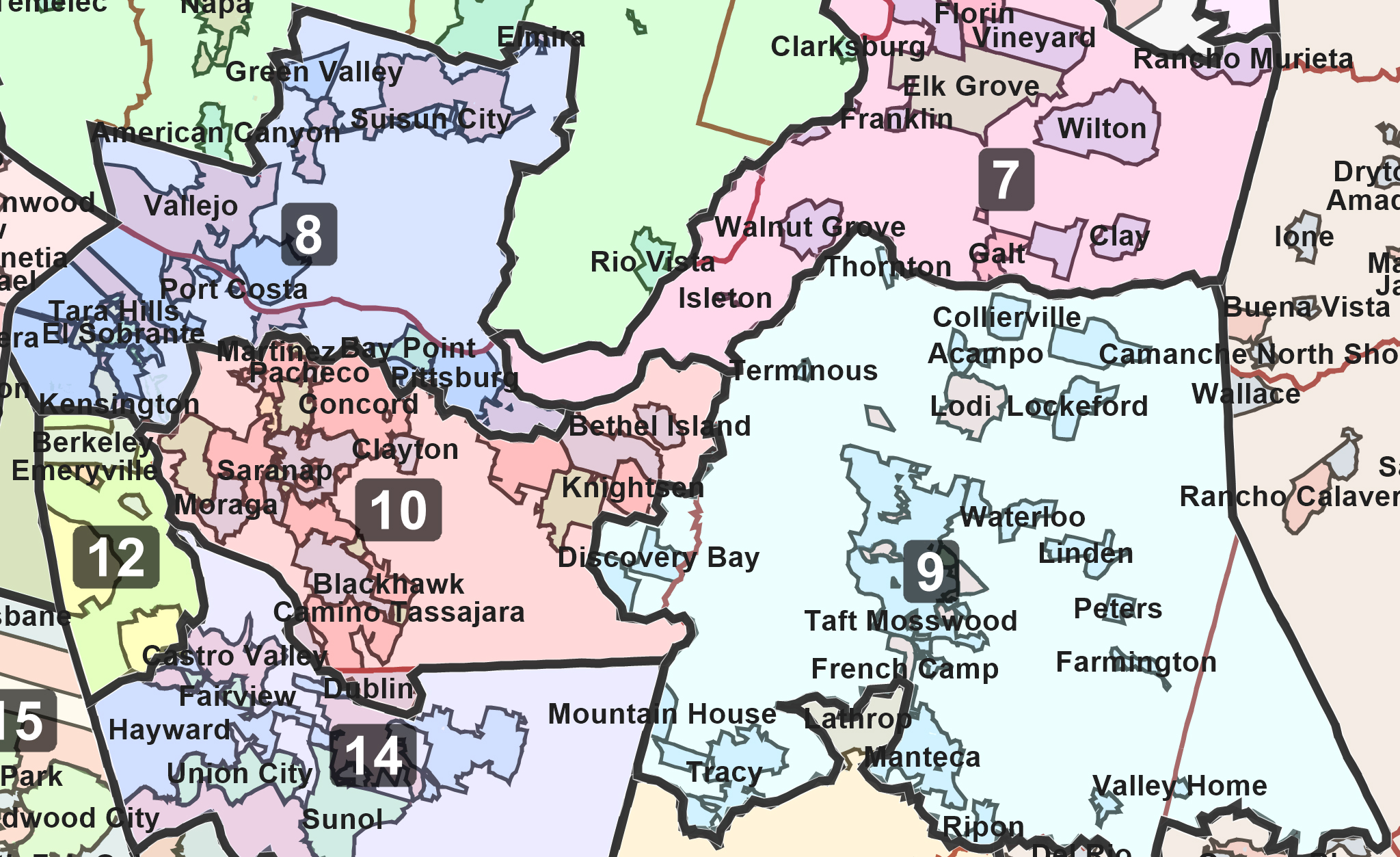
The newly drawn California 10th Congressional District. Source: wedrawthelinesca.org.  Rep. Mark DeSaulnier. Official photo.

Pledges to continue work in Congress for Contra Costa; lists his endorsements

CONTRA COSTA, CA – The DeSaulnier for Congress Campaign announced the launch of the congressman’s re-election effort for California’s newly drawn 10th Congressional district, as approved by the California Citizens’ Redistricting Commission (CCRC) on Monday, Dec. 20th. Mark DeSaulnier has represented Concord and Contra Costa County in Congress since 2015 and vows to continue to work hard for his constituents, fighting for working families.

Th 10th District encompasses most of Contra Costa County, including Lamorinda, the San Ramon Valley, Concord, Clayton, Clyde, Pacheco, Pleasant Hill, Walnut Creek, and portions of Martinez in Central County, and in East County, Brentwood, Oakley, Bethel Island, Knightsen and portions of Antioch, plus portions of Dublin in Alameda County.

“Throughout my time in Congress, my guiding principle has always been this: I work for you,” said Congressman DeSaulnier. “It’s been my honor to represent this area for nearly three decades, on the Contra Costa County Board of Supervisors, in the California State Legislature, and for the past six years as a Member of Congress. My priority has always been serving the people of Contra Costa and making our voices heard during the tough fights, when it matters most.”

DeSaulnier lives in Concord where he raised his two sons, Tristan and Tucker, and opened and operated a small business, TR’s restaurant.

He’s also spent three decades as a public servant: representing his community on the Concord City Council, as Mayor of Concord, as a three-term Contra Costa County Supervisor, in the California State Legislature, and currently as a Member of Congress.

As Supervisor, he served on the California Air Resources Board, the Association of Bay Area Governments, the Bay Area Air Quality Management District, and the Metropolitan Transportation Commission. He was elected to the State Assembly in 2006 where he served one term and received the distinction of being the first freshman in history to chair the Assembly Transportation Committee. DeSaulnier was elected to two terms in the California State Senate in 2008 and 2012 where he served as Chair of the California State Senate Transportation and Housing Committee. During his time in Congress, DeSaulnier has been honored to represent California’s 11th Congressional District including Richmond, El Cerrito, Kensington, and Pittsburg, now in the new 8th District, and looks forward to continuing to serve them in 2022.

Congressman DeSaulnier is running for re-election to fight against the reckless Republican agenda and move our nation forward by:

  • Ensuring every American has access to quality, affordable health insurance and care;
  • Confronting racial injustice;
  • Creating national common sense gun violence reforms;
  • Helping America’s students receive a quality education without being shackled by debt;
  • Protecting Medicare and Social Security;
  • Safeguarding the environment;
  • Overseeing the largest investment in our nation’s infrastructure in modern history, and
  • Ensuring government is accountable to the public.

The campaign is proud to announce the following endorsements:

  • Alex Padilla, United States Senator for California
  • Karen Bass, United States Representative (CA)
  • Jared Huffman, United States Representative (CA)
  • Barbara Lee, United States Representative (CA)
  • Doris Matsui, United States Representative (CA)
  • Eric Swalwell, United States Representative (CA)
  • Mike Thompson, United States Representative (CA)
  • George Miller, Former United States Representative (CA)
  • Rosa DeLauro, United States Representative (CT)
  • Betty T. Yee, California State Controller
  • Ricardo Lara, California Insurance Commissioner
  • Rob Bonta, Attorney General of California
  • Tony Thurmond, California State Superintendent of Public Instruction
  • Tom Torlakson, Former California State Superintendent of Public Instruction
  • Steve Glazer, California State Senator
  • Rebecca Bauer-Kahan, California State Assemblymember
  • Tim Grayson, California State Assemblymember
  • Diane Burgis, Supervisor, Contra Costa County
  • Federal Glover, Supervisor, Contra Costa County
  • John Gioia, Supervisor, Contra Costa County
  • Karen Mitchoff, Supervisor, Contra Costa County
  • Diana Becton, District Attorney, Contra Costa County
  • Lynn Mackey, Superintendent of Schools, Contra Costa County
  • Holly Tillman, Vice Mayor, City of Clayton
  • Julie Pierce, Former Mayor, City of Clayton
  • Dominic Aliano, Mayor, City of Concord
  • Carlyn Obringer, Council Member, City of Concord
  • Edi E. Birsan, Council Member, City of Concord
  • Tim McGallian, Council Member, City of Concord
  • Newell Arnerich, Mayor, Town of Danville
  • Teresa Gerringer, Mayor, City of Lafayette
  • Susan Candell, Council Member, City of Lafayette
  • Cameron Burks, Former Council Member, City of Lafayette
  • Rob Shroder, Mayor of the City of Martinez
  • Lara DeLaney, Council Member, City of Martinez
  • Mark Ross, Council Member, City of Martinez
  • Dennis Fay, Mayor, City of Orinda
  • Amy R. Worth, Council Member, City of Orinda
  • Inga Miller, Council Member, City of Orinda
  • Kevin Wilk, Council Member, City of Walnut Creek
  • Cindy Darling, Council Member, City of Walnut Creek
  • Michael Harris, Mayor, City of Pleasant Hill
  • Sue Noack, Council Member, City of Pleasant Hill
  • Matthew Rinn, Council Member, City of Pleasant Hill
  • Ken Carlson, Councilmember, City of Pleasant Hill
  • Merl Craft, Council Member, City of Pittsburg
  • Tom Butt, Mayor, City of Richmond
  • Gabriel Quinto, Mayor, City of El Cerrito
  • Lisa Motoyama, Mayor Pro Tem, City of El Cerrito
  • Janet Abelson, Council Member, City of El Cerrito
  • Paul Fadelli, Council Member, City of El Cerrito
  • Rita Xavier, Mayor, City of San Pablo
  • Abel Pineda, Council Member, City of San Pablo
  • Linda Mayo, Trustee, Mt. Diablo Unified School District
  • Mae Torlakson, Vice Chair, Ambrose Recreation and Park District in Bay Point
  • Judy Walters, Ph.D., President, Contra Costa Community College District Governing Board
  • Fernando Sandoval, Vice President, Contra Costa Community College District Governing Board
  • Rebecca Barrett, Board Trustee, Contra Costa Community College District Governing Board
  • Andy Li, Board Trustee, Contra Costa Community College District Governing Board
  • John E. Marquez, Board Trustee, Contra Costa Community College District Governing Board


Filed Under: Central County, Lamorinda, News, Politics & Elections, San Ramon Valley

So, you want to run for office? Contra Costa Elections to hold Candidate Workshops in Jan. and Feb.

January 5, 2022 By Publisher Leave a Comment

Have you ever considered running for office? Then consider checking out one of Contra Costa Elections Division’s Candidate Workshops.

This engaging workshop is designed to remove the mystery from running for office. Experts will cover what’s involved in running for office, including how to file and appear on the ballot, campaign finance disclosure requirements, strategies for spreading your message (including social media), and what happens when you’re in the public eye.

The first of three workshops will be held on January 18th at the Lafayette Library from 6 pm until 9 pm. Please reserve a free ticket here:  https://www.eventbrite.com/e/221010988817

The second of three workshops will be held on January 29th at the Richmond Civic Auditorium from 9 am until 12 pm. Please reserve a free ticket here:  https://www.eventbrite.com/e/219543840537

The last of three workshops will be held on February 2nd at the Antioch Community Center at Prewett Park from 6 pm until 9 pm. Please reserve a free ticket here:  https://www.eventbrite.com/e/221022543377

If you have any questions, please contact Karen Tedford at 925-335-7863 or by email at ktedford@cr.cccounty.us.


Filed Under: East County, Lamorinda, Politics & Elections, West County

Analysis: with redistricting Martinez has it best, Brentwood is a close second

December 30, 2021 By Publisher Leave a Comment

Source: City of Martinez

Both offer a citizen-driven, transparent process; Martinez council has no say, Brentwood council will only make final choice; Antioch and Richmond get honorable mentions for offering online mapping tools

By Allen Payton

Comparing the redistricting process used by the county supervisors, cities, education boards and special districts in Contra Costa County whose members are elected by district, ward or area, it’s clear that just like the slogan they’ve been using for the past few years, it really is better in Brentwood – than most. But Martinez offers the best process in the county. Both have independent redistricting commissions and offer the same, easy-to-use online mapping tool for the public to draw and submit their own maps. While Brentwood’s process ends with the council only choosing from already completed maps, the Martinez council has no say and takes what their commission gives them.

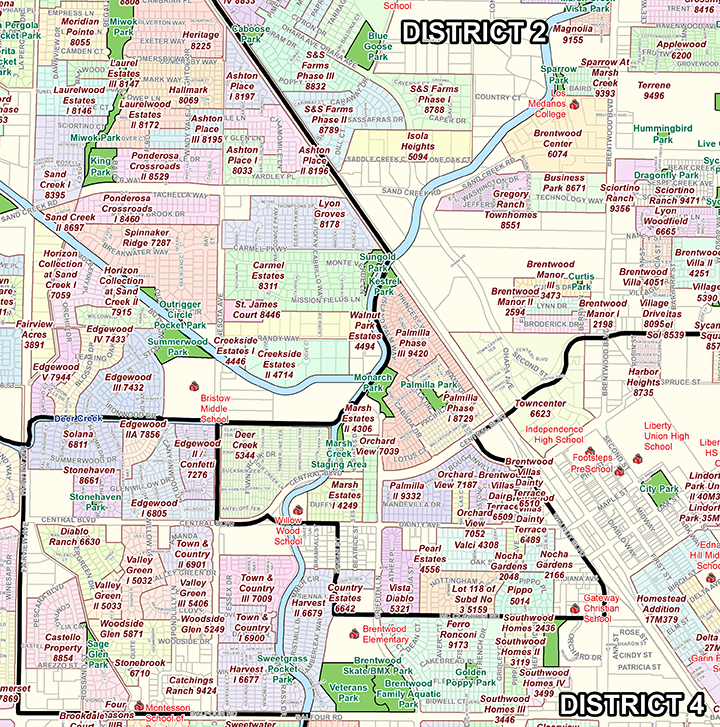
At least Brentwood’s doing it right, this time. That’s because when the initial districts were drawn and approved in 2019 for the 2020 election and based on the 2010 Census, the Brentwood city council map for Districts 2 and 4 was obviously gerrymandered to benefit one if not more incumbents. Just look at the section of District 2 on the southwest side of the BNSF railroad tracks and you’ll see, that’s surrounded on three sides by District 4. But it really had no effect since those two seats aren’t up for election until next November.

Section of current Brentwood City Council Districts 2 and 4.

Besides Martinez and Brentwood, the following cities and school districts elect their members by district and are undergoing a redistricting process:

Antioch City Council – District Elections – City of Antioch, California (antiochca.gov) – Antioch online mapping tool

Antioch School Board – Post Census Redistricting / 2020 Census Redistricting (antiochschools.net) – No online mapping tool.

Concord City Council – Redistricting | Concord, CA (cityofconcord.org) – No online mapping tool, yet. Process started Nov. 2.

Richmond City Council – Redistricting 2020 Census | Richmond, CA – Official Website – For online mapping tools click on “Draw Map”.

San Ramon City Council – Redistricting 2022 – City of San Ramon (ca.gov)  – No online mapping tool.  The council will consider final redistricting maps on Tuesday, March 22, 2022.

Contra Costa Water District – No redistricting page nor online mapping tool. The board was given a redistricting presentation during their Oct. 15 meeting. The next meeting will be held on Jan. 5 with expected completion by March 16.

Contra Costa Community College District – www.4cd.edu/gb/redistricting – No online mapping tool. See below for process information.

In 2010, both the college board and the Contra Costa County Board of Education adopted the same exact map. But their website doesn’t offer a very detailed map for the public to see in which district they live and which trustee is their representative.

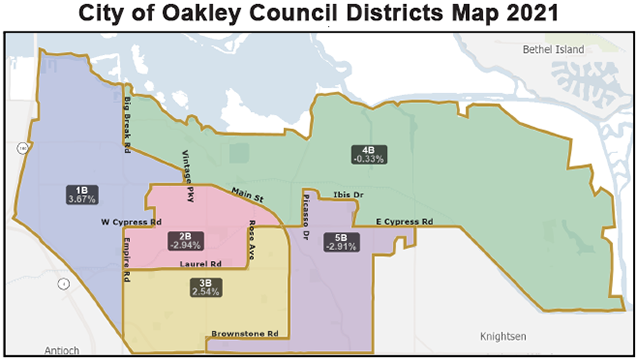
Source: City of Oakley

Oakley Council Converts to District Elections

The Oakley City Council just completed the process of converting to district elections and adopted a five-member map during their meeting on Nov. 9.

Most Gerrymandered Current District Map

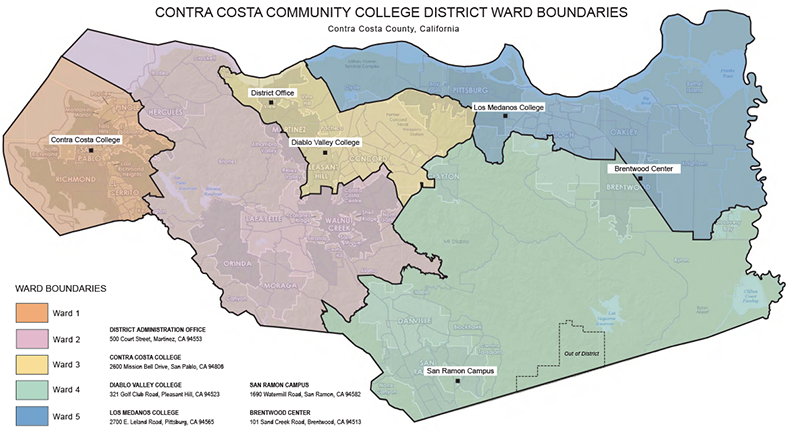
So far, the current map in the county with the most gerrymandered districts I’ve seen is for the Contra Costa Community College District, and as a result of the above, the county Board of Education, too. It combines Lamorinda with Hercules, Rodeo and Crockett in one ward and all of the San Ramon Valley, sans Alamo, in the same ward as Byron and Discovery Bay. Plus, it splits six cities, as well.  Those trustee ward lines were clearly drawn in 2011 to protect the incumbents, at that time.

This year, the college district staff tried to present their board with only one map to consider – drawn by staff and an attorney, with minor changes to the current map, continuing to protect incumbents. Where the current council or board members live is not a required consideration for redistricting. However, it’s understandable why that it would happen since staff members have a conflict of interest and inherent bias in wanting to please their bosses, instead of drawing maps to serve we the people.  (See related article)

Fortunately, the college board wisely directed staff to open up the process for more public input and offer two more proposed maps and an online survey about those choices, although they aren’t offering an online mapping tool.

Current Contra Costa Community College District ward boundaries map approved in 2011. Source: 4CD

Different Deadlines

While school boards have a deadline of March 1, 2022, to complete the process and submit an approved map, city councils have until April 17. The supervisors had to complete their process sooner, because filing for the June Primary election for Districts 1 and 4 opens mid-February and closes mid-March.

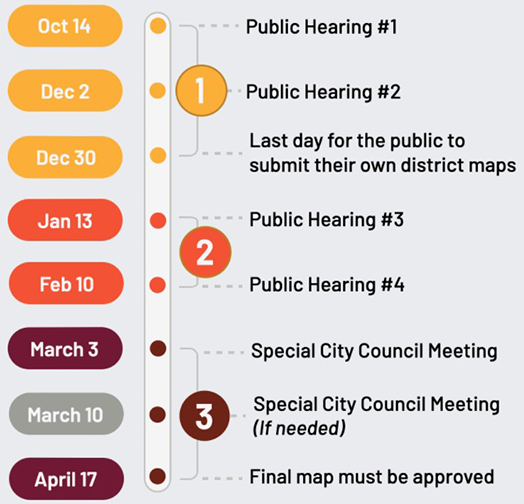
While some cities, like Antioch were trying to complete their process by the end of January – which the council just extended by a month – Brentwood’s process, which began Oct. 14 won’t be completed until March 3 and possibly not until March 10.

While congressional redistricting is the most difficult because it requires no more than a one person difference between districts, all other districts can have a maximum of a five percent population deviation from average, referred to as ideal, to be legally acceptable.

Process in Martinez Started First, Includes Independent Commission

Martinez, which began their redistricting process way back in January, has a seven-member independent redistricting commission, not chosen by the council. In August four commissioners were randomly drawn by the Deputy City Clerk from different quadrants in the city. Then those commissioners selected three additional commissioners from a designated pool of applicants. Finally, another random draw was undertaken to determine the two alternates from the remaining pool of qualified applicants.

The commissioners are responsible for drawing council districts in Martinez and held their first meeting on Sept. 22. So, the council has no say. They get what the people give them.

Martinez offers residents an online mapping tool to draw and submit alternative maps, just like the county supervisors’ did, and Brentwood and Antioch offer. While the supervisors’ online tool was easy to use, the tool offered by Martinez and Brentwood is easier. Each of the proposed maps and even the draft maps drawn by members of the public are on the site and can be viewed by anyone.

City of Brentwood 2021-22 redistricting schedule.

Redistricting in Brentwood Better Than Most

Brentwood’s redistricting process also offers residents an online mapping tool. Like Martinez, each of the proposed maps and even the draft maps drawn by members of the public are included on the City’s redistricting website for all to see and review to maximize public input.

The Brentwood city council established an independent, citizens redistricting commission, whose five members and four alternates volunteered and were selected by retired Judge Thelton Henderson – not the mayor and council members – following an application process. All but the last step of the redistricting process was transferred to them. The commission is leading the redistricting process by holding public hearings, reviewing all maps submitted by the public and gathering “community input to ensure everyone’s voice is heard”.

When the commission’s part of the process is complete, it will submit two or more potential boundary maps to the City Council and – here’s the best part – the Council must then select one of the submitted maps – wait for it – without modifying!

Interestingly enough, many of the publicly submitted maps in Brentwood look similar in how best to create new, common-sense districts – drawn based on the principals of compactness, Communities of Interest, using natural and man-made barriers for boundary lines and one-person-one-vote, with the smallest population percentage deviation from average as possible. Unfortunately, some of the maps submitted for the Brentwood City Council process don’t follow the aforementioned principles and can’t be considered because they don’t comply with the maximum population deviation percent requirement.

Honorable Mentions

Both Antioch and Richmond also offer online mapping tools and while Antioch’s has had glitches, it appears those have been worked out. Richmond was using the same tool as Martinez and Brentwood, known as DistrictR. But it has been replaced with Dave’s Redistricting App (DRA) because DistrictR uses population estimates while Dave’s Redistricting App uses the official population. Dave’s is difficult to use.

Richmond also offers Maptitude, which is the same software app used by the consultant to the state Citizens Redistricting Commission. But both require someone to sign up in order to use them. People can use Antioch’s online mapping tool as a guest, which requires the map be drawn all in one setting because it can’t be saved without signing up and logging in.

Other Councils and Boards Should Follow Example of Martinez and Brentwood

I can often be pretty tough on candidates and elected officials in my media role and responsibility of holding them accountable. But I also believe it’s good to praise those who are doing it right.

Neither the council members in Martinez nor Brentwood can make any changes to the final maps, thus, they won’t have any ability to gerrymander their districts to benefit themselves. They’ve empowered the people to have control over choosing who they will have represent them instead of the other way around. Representative government in our republic. Hey, what a concept!

Why don’t all the other boards of government agencies in our county do the same? Martinez and Brentwood are the example for the Board of Supervisors, other city councils, school and college boards to follow for the best way to handle the redistricting process.

The Brentwood City Council should be congratulated for doing it right and the best, when it comes to redistricting, this year.

Hopefully, all the other cities and districts, and the supervisors in Contra Costa will duplicate what Brentwood is doing, 10 years from now, the next time they will redistrict. Actually, they don’t have to wait. Once the current process is completed for the 2022 elections, the other councils and districts will have plenty of time for a redo by the 2024 elections.

Unless that happens, then remember, folks, the district lines approved this time will be in place for the next 10 years. So, while the redistricting process may be technical and dry, the decisions made now can and will affect who we have representing us during that time, and making decisions affecting our lives, homes, schools, businesses, and communities. So, stay informed, engaged and give your input on redistricting.


Filed Under: Government, Opinion, Politics & Elections

Congressman Garamendi announces re-election in California’s newly redrawn 8th District which includes northern Contra Costa

December 23, 2021 By Publisher Leave a Comment

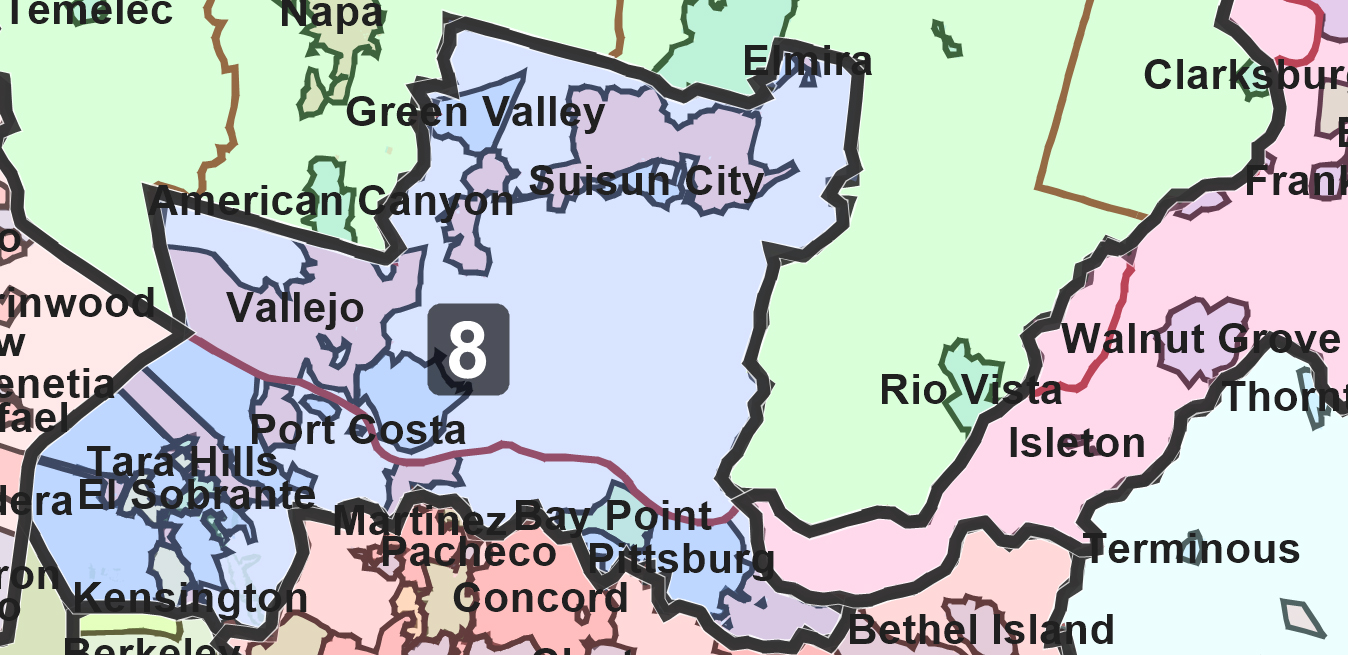
The new 8th Congressional District and the location of Walnut Grove (right) where Garamendi lives. Source: WeDrawTheLinesCA.org

Former California State Assemblyman, State Senator, two-time Insurance Commissioner, and Lt. Governor

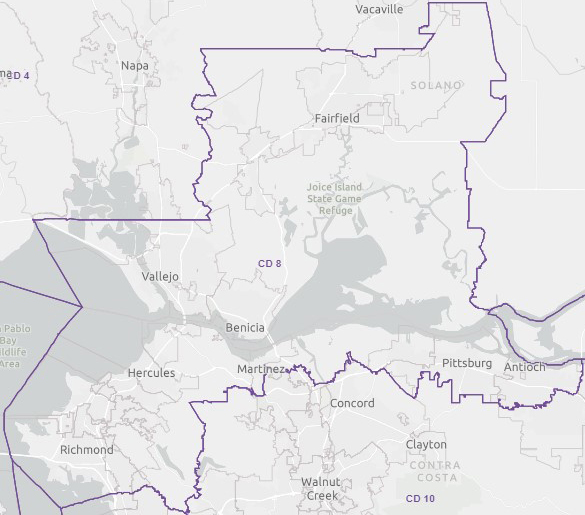
District includes Richmond, El Cerrito, San Pablo, El Sobrante, Pinole, Hercules, Rodeo, Crockett, Bay Point, Pittsburg and portions of Martinez and Antioch.

Rep. John Garamendi. Official photo.

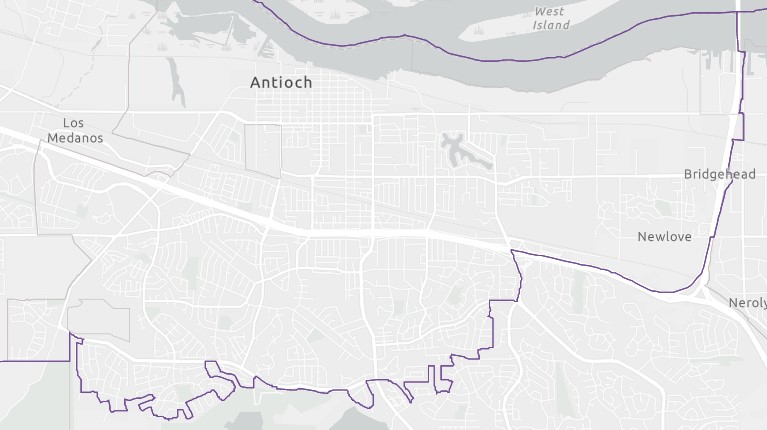
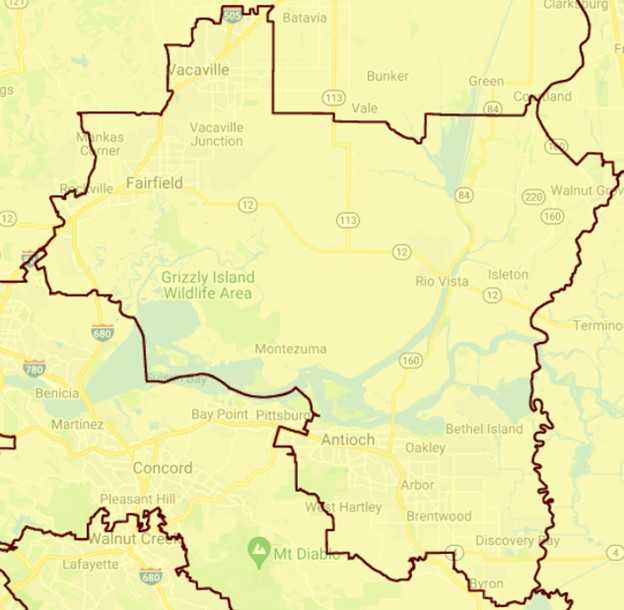
Contra Costa and Solano Counties – Following the release of the final district maps by the California Citizens Redistricting Commission on Monday, Congressman John Garamendi (D-CA) announced, that day, he is running for re-election in the newly redrawn 8th Congressional District of California. The district now encompasses most of Solano County and the northern, waterfront portions of Contra Costa County including Richmond, El Cerrito, San Pablo, El Sobrante, Pinole, Hercules, Rodeo, Crockett, Bay Point, Pittsburg and portions of Martinez and Antioch.

Garamendi has served in Congress since 2009 and represented Contra Costa and Solano Counties during his tenure, which are included in CA-08. Prior to his election to Congress, Garamendi served in the California Assembly and Senate, twice as California’s elected Insurance Commissioner, as Deputy Secretary of the U.S. Department of Interior under President Bill Clinton, and as California’s Lieutenant Governor. Garamendi also served in the Peace Corps with his wife, Patti Garamendi. The two have raised six children who share their commitment to public service. They also have 13 grandchildren.

“The 760,000 residents of the 8th Congressional District want a proven progressive who will fight for them every single day. That’s exactly what I’ve done my entire tenure in Congress, and that’s what I’ll continue to do. That’s why, today, I’m kicking off my re-election campaign for Congress,” Garamendi said.

Although he lives in Walnut Grove, in the newly redrawn 7th Congressional District, where both Representatives Doris Matsui and Ami Bera also live, members of the House of Representatives aren’t required to live in the district they represent. They’re only required to live in the same state. The 76-year-old Garamendi currently represents most of Solano County in the 3rd Congressional District and previously represented Antioch and other portions of Contra Costa County in the then-10th District, from 2009 to 2013.

“When our economy is strong, America is strong. In Congress, I fight every day for a fairer economy that works for middle class families, not just those at the very top,” the congressman stated.

“We know the economy can’t move if people can’t move. That’s why I helped champion the Infrastructure and Jobs Act—the largest investment in our infrastructure ever—and secured an $86 million grant to expand lanes on I-80 and reduce traffic,” Garamendi continued. “We know that a strong middle class is the bedrock of our nation. That’s why I fought for the American Rescue Plan, which combatted the COVID-19 pandemic, created the largest tax cut for the middle class ever, put students safely back in school, and helped create over 6 million new jobs for hardworking families.”

The new 8th Congressional District map. Source: WeDrawTheLinesCA.org

First elected to public office in 1974 as a member of the State Assembly, then the State Senate in 1976, Garamendi was elected California Insurance Commissioner in 1990. From 1995 to 2003 he served as the Deputy Secretary of the Interior during the Clinton Administration. In 2002 he was elected, again as Insurance Commissioner, then Lieutenant Governor in 2006. Garamendi was first elected to Congress in a special election in 2009.

“We know that Americans deserve universal paid family leave, affordable housing, cheaper prescription drugs, universal healthcare, cleaner air and water, affordable education, and a free and just society. That’s why I’ve helped champion these efforts in Congress and voted to make this attainable for every American,” he shared.

“All of this and more is what we achieved in 2021 alone, and we are just getting started. I have devoted my life to public service, and I will continue fighting for you every day. That’s why I’m announcing my re-election campaign for Congress in the 8th district. I want to continue fighting for a bold, progressive, and transformative vision of America—and I would be honored to have your support,” Garamendi concluded.

The Antioch portion of the new 8th Congressional District. Source: WeDrawTheLinesCA.org

According to his Wikipedia page, Garamendi was born in 1945 in Camp Blanding, Florida, and was raised in Mokelumne Hill, California. His paternal grandparents were Basque immigrants from Spain and his mother was of half Irish and half Italian ancestry. Garamendi received a degree in business from U.C. Berkeley, where he was a football player and wrestler, and a Master of Business Administration degree from Harvard Business School. He served in the Peace Corps in Ethiopia from 1966 to 1968. Garamendi is an Eagle Scout and a member of Sigma Chi, as a brother of the Alpha Beta Chapter at Berkeley.

Below is an overview of Garamendi’s priorities and recent achievements in Congress. More information is available at Garamendi.org:

A Champion for Working Families

Congressman Garamendi believes that every American has a right to a good-paying job, and he fights every day in Congress to build a strong middle class. In 2021 alone, Garamendi fought for:

  • The Largest Middle Class Tax Cut in History: Congressman Garamendi secured an Expanded Child Tax Credit that cuts taxes for middle class families in our region by $3,000 per year on average and lifts half of all children out of poverty. This helps families put food on the table, purchase school supplies, cover rent, pay down debts, support the local economy, and make ends meet.
  • Universal Pre-K & Affordable College: Garamendi voted to establish a universal pre-K program for all children. He also successfully led the effort in Congress to expand the Pell Grant to help millions of students attend community college of a four-year university without significant student loan debt.
  • Paid Family Leave: America is the only major nation without a national paid family leave program, and Garamendi thinks this is unconscionable. That’s why Congressman Garamendi voted to create America’s first ever universal paid family leave program to ensure no family must choose between caring for their newborn or receiving their paycheck.
  • New Affordable Housing: We know that California’s housing prices are out of control and working families are losing more of their paychecks to rent or mortgage payments. Garamendi knows that this forces middle class families to make the impossible choice between paying their rent or supporting their healthcare and education. That’s why Garamendi voted to create 1 million new affordable rental homes and cut taxes for the middle class to help cover rent and mortgage payments.
  • A Fighter for Stronger, Climate-Resilient Infrastructure

Congressman Garamendi knows that the economy can’t move if people can’t move. As he works to represent us, he sees that traffic on I-80 is bumper-to-bumper, Highway 4 has too many potholes, and public transportation needs to be improved and expanded.

Many elected officials simply talk about rebuilding our infrastructure, but John Garamendi acts. In 2021, Congressman Garamendi helped design the new Infrastructure and Jobs Act and enact it into law. Through that, Garamendi helped secure:

  • $25 billion to rebuild California’s roads and bridges. This will create 1.5 million new jobs every year, which will go to middle class families and include strong wages and benefits.
  • $9.45 billion to improve California’s public transportation.
  • $86 million to expand lanes on I-80 and reduce traffic.
  • $65 billion to build a new power grid and provide affordable electricity and increase fire safety.
  • $50 billion for drought relief.
  • $55 billion to replace every lead water pipe in America.
  • Expand Make it in America and Buy America requirements to ensure we rebuild our infrastructure using American Materials and workers.

Additionally, Garamendi helped expand BART services into Contra Costa County. He also authored and passed the “Ocean Shipping Reform Act” in the U.S. House of Representatives to fight inflation, address the supply chain crisis, and support American businesses and jobs.

All the infrastructure improvements Garamendi helped secure will be built to withstand the impacts of climate change. They will also help reduce pollution to ensure the air we breathe and the water we drink is clean for all.

A Supporter of Medicare for All and a Green New Deal

Congressman Garamendi served as California’s first ever elected Insurance Commissioner. There, he

  • Introduced and passed the first universal healthcare plan anywhere in America. His plan was adopted by President Bill Clinton and used as a national.
  • Fought against redlining and other unfair insurance practices to protect consumers.
  • Now, in Congress Garamendi is a champion for Medicare for All. Congressman Garamendi believes healthcare is a basic human right, and he won’t stop fighting until every American has universal healthcare coverage.

Congressman Garamendi also believes that climate change is the defining issue of our time. We know that California’s fire season is now 12-months, droughts are more frequent and severe, and our coats are threatened by sea level rise. Garamendi has shown a lifelong commitment to saving our planet from the climate crisis and ensuring clean water and air is available for our children. In Congress he’s fighting for:

  • A Green New Deal that provides historic relief to combat the climate crisis, create millions of good-paying union jobs, and establish a renewable energy economy for the future.
  • $555 billion in clean energy and climate investments—the largest single investment in climate resiliency in American history.
  • Clean energy tax credits to promote wind and solar energy. Garamendi authored the first ever California renewable energy tax credit as a member of the California Assembly.

Allen Payton contributed to this report.
Filed Under: Central County, Concord, East County, News, Politics & Elections, West County

College board trustees ask for more public input on ward redistricting, staff offers workshop, two more gerrymandered maps, online survey

December 22, 2021 By Publisher 2 Comments

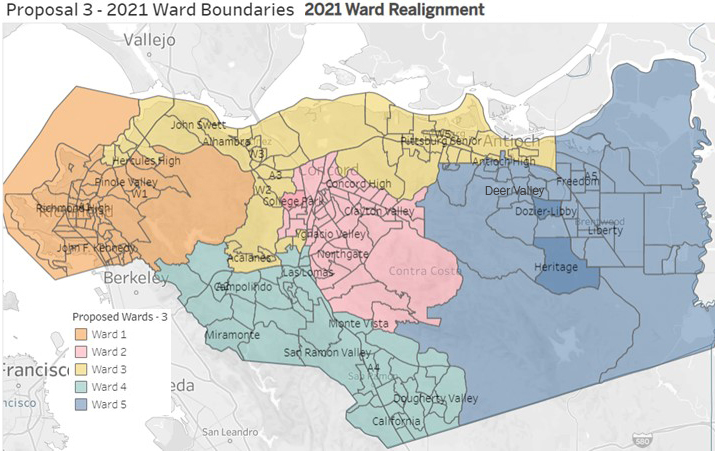
Proposed Contra Costa Community College District Ward Realignment Map 3 balances populations using the county Supervisor’s newly adopted map as a guide and includes the locations of the high schools (the name of Deer Valley High in Antioch added by the Herald). But Trustee Ward 3 in this proposed map is significantly different than the new Supervisorial District 5. See the other two proposed maps at www.4cd.edu/gb/redistricting/. Source: 4CD

Sandoval pushes for more community input, transparency; he and Barrett ask for more maps; Walters asks for informal, round table meeting; one new proposed map similar to Board of Supervisors’ new map; Community Roundtable on Ward Redistricting during special Zoom meeting Jan. 6 for community input; second public hearing on redistricting during regular board meeting Jan 12.

By Allen Payton

In response to public pressure, the Contra Costa Community College District (4CD) Governing Board is seeking additional community input to adjust trustee ward boundaries and ensure population balance based on county demographic changes identified in the 2020 Census. During the Dec. 8 board meeting, (see 36-minute mark) Ward 5 Trustee Fernando Sandoval and Ward 2 Trustee Rebecca Barrett pressed for more public input, and wanted to review more than just the one map provided by the district’s staff and attorney David Saldani. They only provided slight changes to the current, gerrymandered map. (See related article)

Board Calls for More Public Input

At their December 8, 2021, meeting, (see item 10.A.) the Board reviewed only one staff-recommended map that highlighted how trustee area boundaries could change and received community input on the proposed map before determining the need for additional community input. In 2010, both the college board and the Contra Costa County Board of Education adopted the same exact maps, according to Saldani. The 4CD staff is expected to collaborate with the board of education, again, this year.

Only two members of the public offered comments during the hearing, including former college board trustee Greg Enholm who said “I hope the trustees agree that voters should choose their representatives not the reverse.  He also said he agreed with this reporter “regarding his concerns about the proposed ward map,” referring to the current map being drawn based on political considerations to protect incumbents at the time it was adopted.

“I also hope that Board Vice President Walters and Board Secretary Sandoval will explain why they are not advocating for an independent redistricting body to redraw the wards as they pledged to do,” Enholm stated.

“The map must be the best one possible meeting all requirements,” he concluded and said he provided to the trustees a copy of the 1990 ward map.

“We support a good governance model which includes community meetings. We are a little surprised that…the college district did not engage in a community participation process,” said Maria Alegria, representing Latinx for Inclusion. “It looks like you’ve done this in-house for the past three decades.”

Barrett had questions about the process, including the FAIR Maps Act.

“Certainly, this year, more than ever, the politics surrounding redistricting is greater,” said Executive Vice Chancellor, Education and Technology Mojdeh Mehdizadeh. “This is the first year that the Census data was released six months later than usual.”

“Can you explain the California FAIR Maps Act of 2017 and how it impacts the way cities and counties conduct their post-Census redistricting?” Barrett asked.

“We don’t have to comply with the provisions. It gives more direction with the criteria,” Saldani responded. “The FAIR Maps Act requires cities and counties have…two pre-map hearings then two post-map hearings. It doesn’t apply to the college district.”

“We used traditional redistricting criteria,” he added.

Sandoval said “you spoke about population balance. You guys really didn’t talk about communities of interest. What Mr. Enholm stated…there was some work that was done for political boundary changes in the past and I’m concerned those still haven’t been addressed.”

“It’s not just population balance, it’s communities,” Sandoval continued. “We’re here to make sure the maps represent the communities of interest as they go forward.”

“The other thing I’m concerned about is, the map itself that we have in there, is not an interactive map. You should be able to show that,” he stated. “The fact that we only have one map says that we only have one option. I’m all about transparency. When I talked about the independent commission it’s really about transparency and making sure that the public has an opportunity to weigh in and put a comment…so the board can go ahead and try to understand what the concerns of the community are. We don’t know what they are, right now. I think we need to do more.”

“From my perspective there’s not have enough transparency and we need to ensure we go ahead and take care of the public interest,” he concluded.

“In fact, we heard public feedback, tonight,” said Saldani.

“I think we haven’t done enough,” Sandoval responded. “Give them more of an opportunity. Publicizing it and just having it on our website is not enough. We should have more than one map.”

Barrett then said, “I do have some concerns. I would like to have a more detailed map. Are the politicians giving feedback? Because it’s self-serving. The staff and demographer have worked to keep this away from board input. In some respects, I would hope the board and public could get a more detailed map with geographic markers…things to help identify. I would appreciate a little more detail and understanding. I think the board could give you more input that communities of interest don’t fit nicely…in your statistical analysis. I do think multiple maps would have been helpful. It would give the public a sense that there are choices.”

“I think most of us won’t be here, in 10 years on this board,” she continued. “So, one of the things we can do as a board is to codify our expectations around the redistricting process. Do we want to look at an independent redistricting commission or some kind of hybrid? But that’s a more long-term project.”

“Your free of the accusation that you’re trying to benefit yourself,” Barrett added.

“Would it be possible to have, I’ll use the word workshop, or gathering?” asked Board Vice President Judy Walters.

“Certainly. I thought that’s what we were doing, here, tonight,” responded Mehdizadeh.

Walters suggested a meeting that is “less formal…more of a roundtable kind of thing.”

“On a personal level, I’m happy with the work done, tonight,” she said. “I’m concerned that we have to meet our deadline and we don’t spend a jillion dollars doing stuff.”

“We’re happy to answer any additional questions and do a deeper dive from an interactive perspective,” Mehdizadeh responded. “While we would love to do that, we’re not resourced to do that.”

“We tried to keep it in-house. Let them do their independent work,” Board President Andy Li said. “I’m supportive of some open, community input.”

“The document…that’s…showing racial demographics is wonderful,” Walters added. But she didn’t call for an independent citizen redistricting commission as she committed to do during her campaign, last year.

“I heard some requests to follow the county in drawing our districts,” Li said. “But I found that there are three trustees in the same ward.”

However, where incumbents live is not a requirement that must be considered when redrawing ward boundaries.

“I appreciate the work done by the county. But they have different communities of interest than we do,” Barrett said. “We could be drawing our maps off of the school district boundaries.”

“We tried to keep as many as communities together as possible,” Mehdizadeh said.

Staff agreed to consider offering more public meetings and has since offered two more maps and post all three on the district’s website.

January 6 Community Roundtable on Ward Redistricting

The public can review three mapping options of how trustee boundaries could be balanced on the 4CD website located at www.4cd.edu/gb/redistricting. Community members can use a new interactive mapping feature that will help identify how each mapping option could change your trustee representation. The website also gives the public the opportunity to provide online comments and feedback that will be considered by the Board. In addition, 4CD will conduct a Community Roundtable on Ward Redistricting during a special Governing Board meeting via Zoom on Thursday, January 6, 2022, beginning at 5:00 p.m. to conduct a community roundtable to review the different mapping options and receive additional community input. Zoom details can be found in the official Governing Board meeting agenda for this community roundtable.

January 12 Second Redistricting Public Hearing

The Board will review the additional community input and hold a second redistricting public hearing at their regularly scheduled public meeting on January 12, 2022, beginning at 6:00 p.m. The public is invited to attend this meeting in-person at 500 Court Street, 2nd Floor Board Room, in Martinez or via Zoom. Zoom details for this meeting are contained in the official Board meeting agenda located on the 4CD website.

“Based on the community input we received so far, the Board decided it was prudent to expand the redistricting choices available and provide more opportunity for the public to weigh in on this important decision,” said Walters. “The additional steps we are taking, which are beyond what is legally required, are appropriate and convey to our community we are rebalancing our trustee wards in a transparent way, and is being completed in a fair, objective, and non-partisan manner.”

Special districts like 4CD are legally obligated to follow Education Code Section 5019.5, which highlights the process to follow, ensuring the population of trustee wards is balanced based on the changing demographics of the community. Legally, the population can be as great as 10% between districts. Despite receiving the 2020 Census data six months late, 4CD is still required to complete this process by February 28, 2022.

After receiving the 2020 Census data in September 2021, staff began working with legal counsel to analyze and prepare its ward redistricting recommendation. The Board received a report outlining the plan to rebalance the ward boundaries at their November 10, 2021, meeting, including a review of the population changes throughout Contra Costa County.

Public Participation

Should you wish to make public comment in person, please fill out the yellow public comment card (sample attached) that will be available at the meeting and give it to the Executive Coordinator.  For those attending remotely, the Governing Board President will ask for general comments or those specific to a certain agenda item.

  • Please note that submissions of public comments will be considered a public record under the Public Records Act and are therefore subject to public disclosure; submissions must either address an item on the agenda or be within the subject matter jurisdiction of the Governing Board.
  • If a translator for the speaker is needed, please contact the Executive Coordinator at pkaya@4cd.edu or leave a message at 925.229.6821, the Friday prior to the meeting so appropriate accommodations may be made.

According to Government Code Section 54954.2(a), when responding to public comment, Governing Board members and staff may respond as summarized below.

  • Briefly respond to statements made or questions posed by persons making public comment;
  • ask questions for clarification or make a brief announcement;
  • provide a reference to staff or other resources for factual information;
  • request staff to report back to the body at a later meeting; or
  • direct staff to place the matter on a future agenda.

Timothy Leong, 4CD Public Information Officer, contributed to this report.

Filed Under: Education, Government, News, Politics & Elections

Two more days to offer input on California Citizens Redistricting Commission’s final maps for state districts

December 21, 2021 By Publisher 4 Comments

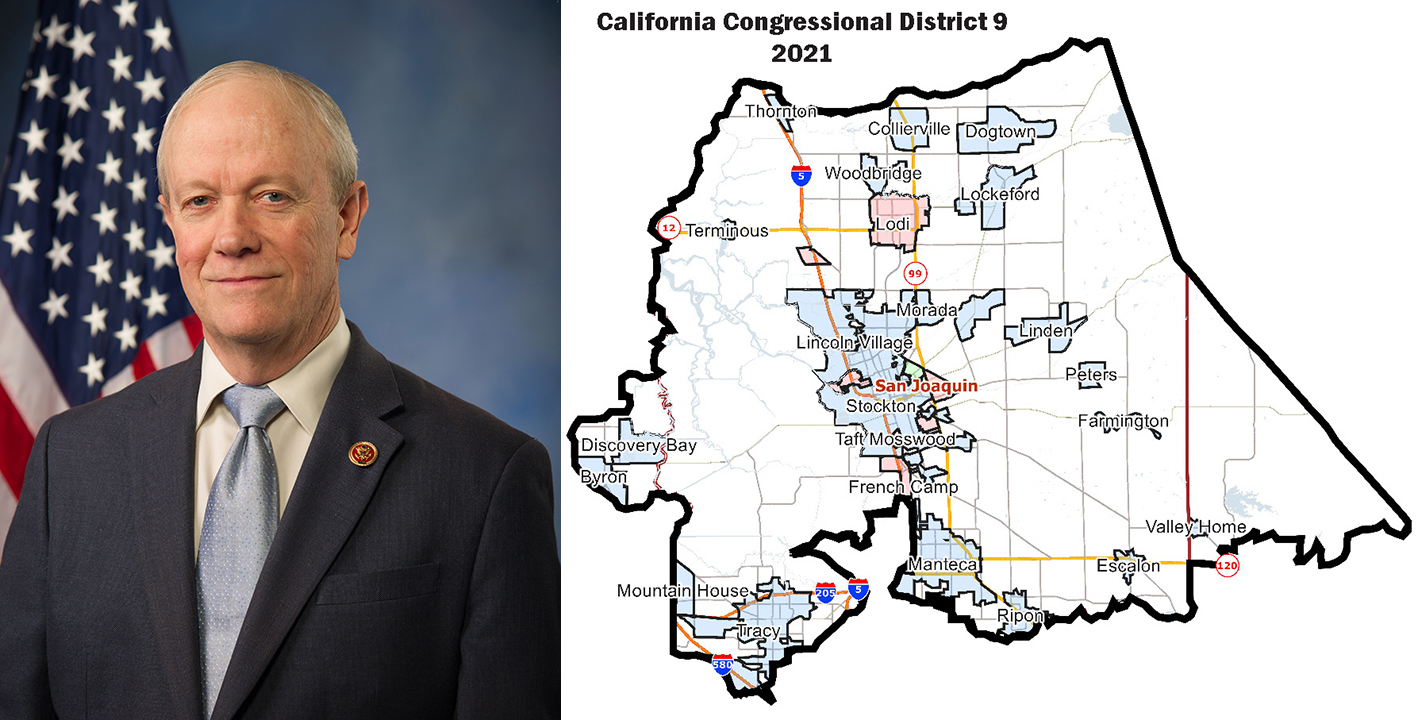
The commission’s final maps show Contra Costa County divided into Congressional Districts 8, 9 and 10. Source: WeDrawTheLinesCA.org

Divides Contra Costa County in multiple ways, combining portions with communities in other counties as far away as Sonoma and Yolo Counties over 90 miles away

By Allen Payton

On Monday, the 2020 California Citizens Redistricting Commission completed and approved final maps for the state’s Congressional, Senate, Assembly, and Board of Equalization districts that are significantly different than the draft maps presented last month. The new maps, which will be in place and affect elections for the  next 10 years, split up Contra Costa County in multiple ways and combine portions with other counties and communities as much as 93 miles away.

The California Constitution states that public comment shall be taken for at least three days from the date of public display of any final statewide maps. Additionally, the Commission shall not display any other map for public comment during that period. (To offer additional public comment click here)

“We have reached the finish line for the people’s redistricting process in California. When voters approved the Voters FIRST Act, it created a monumental shift in this decennial process,” stated Commission Chair Alicia Fernandez. “As Californians, my colleagues on this Commission and I answered the call to serve for this great state we honor and love. We conclude our map drawing responsibilities with pride in our final product. We started this process leaving politics out of the equation in hopes of achieving fairer and more equitable maps. I think I speak for my colleagues when I say mission accomplished! Thank you to all that participated in this process.”

The Commission drew 4 Board of Equalization districts, 52 Congressional districts, 40 Senatorial districts, and 80 Assembly districts. All districts were drawn within the permissible population deviation.

The commission’s final maps show Contra Costa County divided into State Senate Districts 3, 7 and 9. Source: WeDrawTheLinesCA.org

Maps Split Up Contra Costa County More

While the current maps approved in 2011 divide the county amongst four Congressional, two State Senate and three State Assembly districts, what the Commission did to Contra Costa, this time, was split it up even more into three Congressional, three State Senate, and four Assembly districts.

For the State Senate map, the majority of the county, from Crockett in West County to Antioch in East County is combined with San Leandro, Castro Valley and San Lorenzo in southwest Alameda County. Like the draft maps issued by the Commission in November, the new Senate map includes the Far East County cities of Brentwood and Oakley and communities of Discovery Bay, Byron, Bethel Island and Knightsen in the same district as Vallejo, Napa, Rohnert Park in Sonoma County, over 90 miles away.  In addition, the map combines all of West County with the cities of Berkeley, Oakland and Alameda.

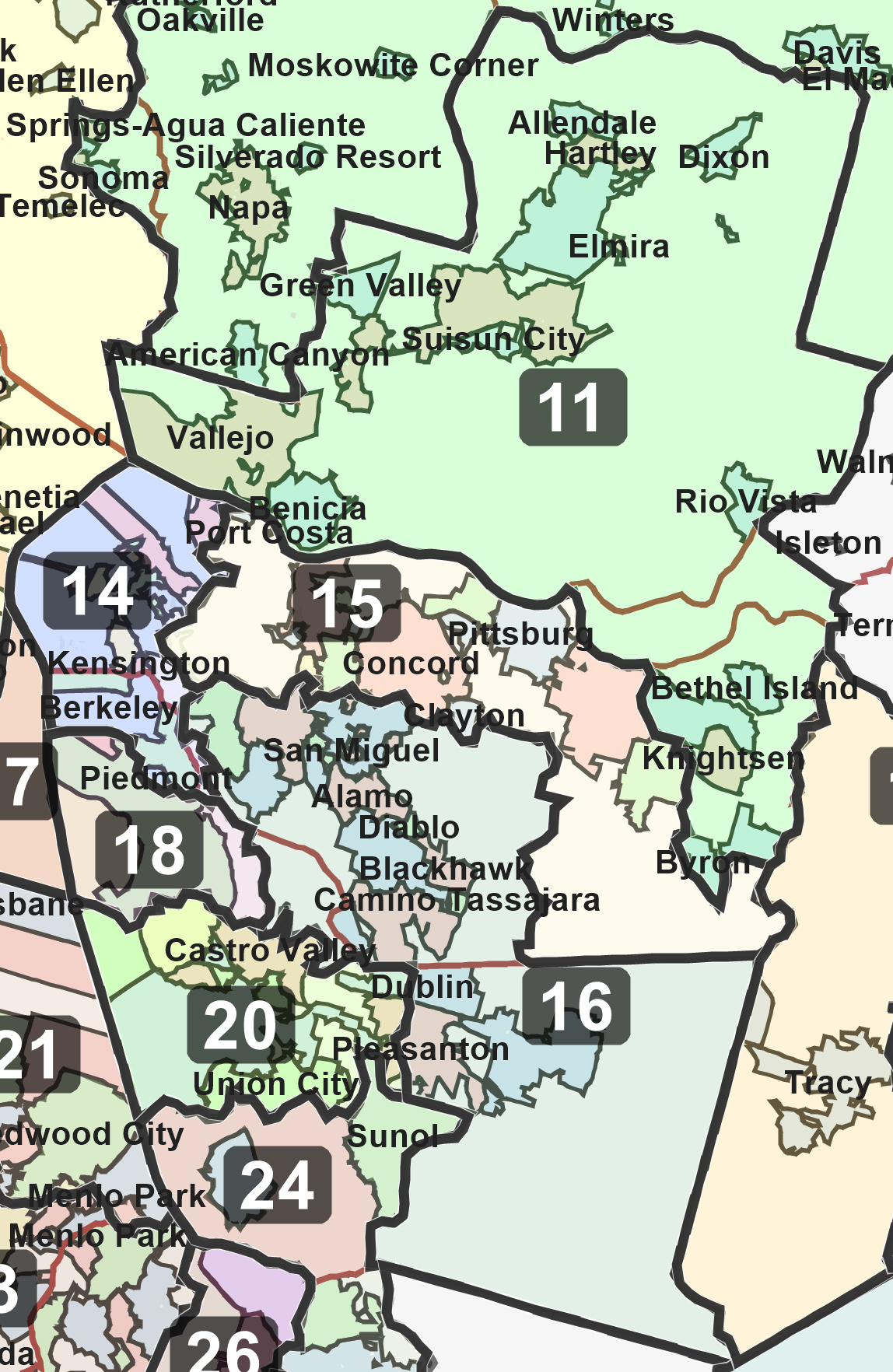
For the State Assembly map, the Commission keeps the county split in four districts keeping Far East County except for Brentwood, in the same district as most of Solano County including Vallejo, Fairfield, Vacaville and Dixon. It keeps most of West County in the same district, except for Crockett, which is included in the same district as Martinez, Pleasant Hill, Concord, Clayton, Bay Point, Pittsburg, Antioch and Brentwood.

The commission, only split the county amongst three districts for the Congressional map. But it splits up East County into those three, new separate districts by carving out Discovery Bay and Byron and leaving them in the same district as most of San Joaquin County. The proposed final map also combines the southern portion of Antioch, plus Brentwood, Oakley, Bethel Island and Knightsen with Central County, including most of Concord, plus Lamorinda, the San Ramon Valley and a portion of Dublin in the same congressional district. Finally, it splits off the northern portion of Antioch, plus Pittsburg and Bay Point, and includes it in a district with the other part of Concord, plus Martinez, West County cities of Richmond, El Cerrito, San Pablo, Pinole, Hercules and Crockett with most of Solano County.

Independent Commission Creates Maps That Benefit Democrats

The place of residence of any incumbent or political candidate may not be considered in the creation of a map, and districts may not be drawn for the purpose of favoring or discriminating against an incumbent, political candidate, or political party.

However, according to a news report by the left-leaning Politico, “California’s new congressional map boosts Democrats” in their “uphill quest to maintain their minuscule House majority”. The new lines “create more challenging districts for Republican incumbents without substantially undermining the prospects of vulnerable Democrats.” The “map could point to Democrats holding ground or picking up seats.”

The commission’s final maps show Contra Costa divided into Assembly Districts 11, 14, 15 and 16. Source: WeDrawTheLinesCA.org

Shape Files/Equivalency Files/Stats and Map Viewer: https://www.wedrawthelinesca.org/final_maps

In accordance with the California Constitution, the Commission followed these criteria, in this order, to draw district maps:

  1. Districts must be of equal population to comply with the U.S. Constitution.
  2. Districts must comply with the Voting Rights Act to ensure that minorities have an equal opportunity to elect representatives of their choice.
  3. Districts must be drawn contiguously, so that all parts of the district are connected to each other.
  4. Districts must minimize the division of cities, counties, neighborhoods and communities of interest to the extent possible.
  5. Districts should be geographically compact: such that nearby areas of population are not bypassed for a more distant population. This requirement refers to density, not shape. Census blocks cannot be split.
  6. Where practicable each Senate District should be comprised of two complete and adjacent Assembly Districts, and Board of Equalization districts should be comprised of 10 complete and adjacent State Senate Districts.

The last of the criteria makes sense, as there are twice as many Assembly districts as Senatorial districts, and the Commission could have simply divided each Senatorial district into two. But they chose not to follow it when drawing the new maps.

Additional Commission Meetings

The Commission is continuing to hold meetings Sunday and next Monday and accepting additional public comments on the final maps. At the start of Tuesday’s meeting, Chair Fernandez announced that the meetings scheduled for tomorrow (Wednesday) and Thursday, as shown on the Commission’s website, have been cancelled.

December 26, 2021 CRC Business Meeting – 2020 Citizens Redistricting Commission Meeting – 11:00 A.M. – 1:00 P.M. daily or upon conclusion of business  Public Input Form

December 27, 2021 CRC Business Meeting – 2020 Citizens Redistricting Commission Meeting – 11:00 A.M. – 1:00 P.M. daily or upon conclusion of business  Public Input Form

Background on Redistricting and Commission

Every 10 years, after the federal government publishes updated census information, California must redraw the boundaries of its electoral districts so that the state’s population is evenly allocated among the new districts.

In 2008, California voters passed the Voters First Act, authorizing the creation of the independent California Citizens Redistricting Commission to draw new State Senate, State Assembly, and State Board of Equalization district lines. In 2010, the Voters First Act for Congress gave the Commission the responsibility of drawing new Congressional districts following every census.

For more information, please visit www.WeDrawTheLinesCA.org. To offer additional comments to the Commission about the proposed final maps visit www.wedrawthelinesca.org/contact by Thursday, Dec. 23 at 5:00 p.m.

Filed Under: News, Politics & Elections, State of California

BART Director Debora Allen announces candidacy for District 4 Contra Costa County Supervisor 2022

December 18, 2021 By Publisher 4 Comments

Deborah Allen

BART Director Debora Allen, a long-time advocate for improved public safety and a common-sense approach to government spending, today announced her candidacy for Contra Costa Supervisor District 4.

“I’m excited to take this important step in my fight to improve the quality of life of all Contra Costa residents,” said Allen, a 35-year Contra Costa resident. “I believe my close scrutiny of government spending, my background as a business owner and my experience fighting for fiscal transparency and stability for the region’s largest transportation agency make me uniquely qualified to serve as county supervisor. I’m looking forward to the upcoming campaign and the June primary.”

Allen was first elected as Board Director for BART District 1 in 2016 and easily won re-election in 2020, besting her nearest opponent by 75,000 votes. Her willingness to stand up for suburban taxpayers and fight for quality-of-life improvements for transit riders – including station hardening, a ban on panhandling, and tougher crime and fare evasion enforcement – often put her at odds with the urban city-backed majority on the board.

Allen was instrumental in the creation and development of the Office of BART Inspector General and serves as the first Chair of the Standing BART Audit Committee, important steps in eliminating wasteful spending practices at the transportation agency.

If elected supervisor, she would bring that same tenacity, accountability and common-sense approach to government spending to the county board. Allen says that as supervisor her priorities would include public safety, regional transportation issues, improved mental health services and the efficient use of taxpayer money. Though a supporter of new housing, she would also fight to bring new jobs to the county in order to improve the overall jobs-housing balance.

“Building new housing alone won’t solve the issues facing working-class families and average county taxpayers,” Allen said. “We need to fund effective and successful mental health programs, bring in new jobs and improve our transportation network in a coordinated approach that addresses the quality of life for all residents. We must also address why the cost of new housing construction is so unaffordable and take steps to reduce the burden placed on small businesses to fund basic services.”

Allen, a Clayton resident, spent 30 years in financial management as a CPA, tax manager, CFO and business owner. Prior to her time on the BART board, she served six years on the Contra Costa employees’ pension board, where she fought for reforms in the public pension system.

Allen currently serves on several transportation-related boards and regional commissions, including Capitol Corridor JPA, Innovate 680 and the Contra Costa Transportation Authority.

Allen is seeking the District 4 supervisor seat being vacated by Karen Mitchoff, who served three terms. District 4 covers Concord, much of Walnut Creek, Pleasant Hill, Clayton and unincorporated areas around Mount Diablo. CCCBOS 2021 District Map

For more information about Debora Allen for Contra Costa County Supervisor visit DeboraAllen.com.


Filed Under: Central County, News, Politics & Elections, Supervisors

Letters: Attorney reveals Contra Costa Democrats supported defunding police, sheriff’s office last year

December 8, 2021 By Publisher Leave a Comment

Former Central Committee member claims he was kicked out for voting against resolutions

“It is crucial to reallocate funds from police and sheriff departments” – approved CCC Democratic Party resolution

Segments of the Contra Costa County Democratic Party July 31, 2020 letter to the Board of Supervisors. Source: Jason Bezis

Dear Editor:

Please see the PDF attachment, which I received from the County of Contra Costa this morning in response to a Public Records Act/Better Government Ordinance request. CCCDP – Alegria Communications (12.6.21 Response)

This is the Contra Costa County Democratic Party’s local homage to the national “Defund the Police” movement:

(1) In the July 31, 2020 County Democratic Party letter to the Contra Costa County Board of Supervisors: “What is needed is an unprecedented and urgent redirection of funds from law enforcement …  It is crucial to reallocate funds from police and sheriff departments …”

[The earlier version that the County Democratic Central Committee passed called for “divestment.”  After I protested use of the word “divestment”, due to its very strong connotation in connection with 1980s “divestment” from the South Africa apartheid regime, County Party leaders softened it with the language above.]

(2)  July 2020 Contra Costa County Democratic Party resolution: “Shift Funding from Police and Sheriff Departments to Community Services … Therefore, be it resolved that we, the Democratic Party of Contra Costa County, encourage city councils to decrease police department funding and that County Boards of Supervisors decrease Sheriff Department funding, and instead shift these funds …”

I voted “no” on both actions.  The County Democratic Party retaliated by kicking me out of their organization (as the Contra Costa Herald already has reported, in part, in April of 2021).

The Contra Costa County Democratic Party buffoons who approved this resolution and letter enabled the recent horrifying robbery at Broadway Plaza in Walnut Creek and similar criminal conspiracies at Stoneridge Mall in Pleasanton, Southland Mall in Hayward, and at Union Square in San Francisco.

DPCCC 2020 endorsement promos for Kevin Wilk and Cindy Darling. Provided by Jason Bezis

Walnut Creek Mayor Kevin Wilk and Councilmember Cindy Darling sought and secured endorsements for their 2020 re-election campaigns from the County Democratic Party at the same time all of these “Shift Funds from Police” actions were taken by the County Democratic Party. The “Herald” should ask Wilk and Silva to publicly disclose their answers to Democratic Party written questionnaires in 2020, especially about any police funding questions.  Were they asked about police funding in oral interviews? (Police funding/oversight was a major issue in Walnut Creek in 2020 with the “Justice for Miles Hall” movement.) CADEM2020 Slate Cards – WalnutCreek

The “Herald” also ought to ask Sheriff Livingston and his announced opponent(s) about what they think of the July 2020 Democratic Party letter and resolution about police and sheriff funding.  I expect that candidates might make themselves unavailable for public comment. The District 4 Supervisorial District candidates (Birsan, Obringer, and ???) also should be asked whether or not they supported this resolution and letter, both then in 2020 and now in 2021 after the nationally notorious crime wave that struck Broadway Plaza.  Birsan now is on the Cal. Dem. Party Executive Board. Again, watch for candidates to be unavailable for public comment.

The PDF attachment is a public record.

Best regards,

Jason Bezis

Lafayette, Calif.

Filed Under: Letters to the Editor, Opinion, Politics & Elections

CC Community College Board proposed redistricting map keeps wards gerrymandered protecting incumbents

December 4, 2021 By Publisher 2 Comments

COE refers to County Office of Education and indicates the residence location of a county Board of Education Trustee. Source: 4CD. Additional city and community information added by the Herald.

Will hold their only public hearing on Wed., Dec. 8; staff’s one map makes few changes to wards, keeps six cities split, splits two more including Clayton, violates community of interest and compactness guidelines

By Allen Payton

The Contra Costa Community College District (4CD) will hold a public hearing at the December 8, 2021, Governing Board meeting to seek community input on a staff proposal to adjust trustee area boundaries and ensure population balance that keeps the wards gerrymandered with few changes to the politically drawn 2011 map. The regular meeting begins at 6:00 p.m., and will include a review of the proposed ward map based on population changes unveiled in the 2020 Census. (See related article)

The current trustee ward boundary map approved in 2011, was drawn to benefit the late Trustee Sheila Grilli, who represented Ward 3, and include Bay Point, where former Trustee Greg Enholm lives, in a separate district, so he couldn’t run against her, again. He was elected to the board the following year. The current map also benefited the late Trustee John Nejedly, who represented Ward 4, by including most of San Ramon with the more politically conservative portions of Antioch and Brentwood in East County.

It also combined the southern portions of Pittsburg with Concord, rather than use the hills as a natural boundary. It also splits Alamo from the rest of the San Ramon Valley, and includes Lamorinda with portions of Martinez and Hercules, as well as Rodeo and Crockett, again, not using the hills as a natural boundary. The trustee representing that ward must travel outside of their ward to get to the other sections. Such politically based drawing of representative district maps is referred to as gerrymandering.

Both the current and proposed maps violate two basic principles for drawing district or ward boundary maps including keeping communities of interest together and compactness. That’s in spite of the fact Board president Andy Li recently wrote “4CD is following a process to re-draw ward boundaries to ensure population balance and proportion as stipulated in Education Code. Other considerations presented and discussed at the Governing Board’s November 10, 2021, meeting, included ensuring compliance with the federal voter rights act, compact and contiguous areas, respecting communities of interest as much as possible, and respecting incumbency.”

However, respecting incumbency is not one of the guidelines in the state education code and is not a requirement for redrawing boundary maps. It’s a political consideration. For example, the Antioch School Board drew their area boundary map in 2019 resulting in two incumbents residing in the same district. The same can occur with the new college board ward map.

Proposed Trustee Wards Map

While the proposed trustee ward map has a total population deviation of just 1.7% between wards – which is closer to the intent of the Constitution of ensuring one-person-one-vote than the new map recently approved by the Board of Supervisors with a 9.77% population deviation between districts – it keeps things pretty much the same as the 2011 map. It continues to split Antioch, Brentwood, Pittsburg in East County, Martinez, Concord, Walnut Creek and one of the county’s smallest cities, Clayton, in Central County, and in West County, instead of splitting Pinole, as the current map does, the proposed map splits Hercules.

The proposed map indicates where the incumbents currently live, labeled as W’s and shows both Ward 2 Trustee and Board Vice President Judy Walters and Ward 3 Trustee Rebecca Barrett both live in Martinez.

The proposed map also indicates where the county Board of Education (labeled with A’s and COE for County Office of Education) trustees live, because that board normally uses the same map that the college board approves.

Source: 4CD

Incorrect List of Ward Member Cities and Communities for Both Maps

The staff report includes a list of cities and unincorporated communities associated with each ward for both maps. But it is incorrect. The correct information is as follows:

Ward 1 John E. Márquez 2011: El Cerrito, El Sobrante, Kensington, Richmond, San Pablo, parts of Pinole

2021: El Cerrito, El Sobrante, Kensington, Pinole, Richmond, San Pablo, and parts of Hercules

Ward 2 Judy E. Walters 2011: Alamo, Canyon, Crockett, Hercules, Lafayette, Moraga, Orinda, Port Costa, Rodeo, parts of Pinole, parts of Pleasant Hill and parts of Walnut Creek

2021: Alamo, Canyon, Crockett, Lafayette, Moraga, Orinda, Port Costa, Rodeo, parts of Clayton, parts of Hercules, parts of Pleasant Hill and parts of Walnut Creek

Ward 3 Rebecca Barrett 2011: Pacheco, parts of Bay Point, parts of Concord, parts of Martinez and parts of Pleasant Hill

2021: Pacheco, parts of Clayton, parts of Concord, parts of Martinez, parts of Pittsburg and parts of Pleasant Hill

Ward 4 Andy Li 2011: Blackhawk, Byron, Danville, Discovery Bay, San Ramon, Camino Tassajara, and parts of Antioch, parts of Brentwood and parts of Clayton

2021: Blackhawk, Byron, Danville, Discovery Bay, San Ramon, Camino Tassajara, parts of Antioch and parts of Brentwood

Ward 5 Fernando Sandoval 2011: Bay Point, Bethel Island, Clyde, Knightsen, Oakley, parts of Antioch, parts of Brentwood and parts of Pittsburg

2021: Bay Point, Bethel Island, Clyde, Knightsen, Oakley, parts of Antioch, parts of Brentwood and parts of Pittsburg.

Public Hearing In-Person and Online

The community is invited to participate in this conversation by either attending the meeting in-person at 500 Court Street, Second Floor Board Room, Martinez, California, or by joining the meeting via Zoom. A link to the public meeting is located on the 4CD website at www.4cd.edu in the December 8, 2021, Governing Board meeting agenda.

Special districts like 4CD are legally obligated to follow Education Code Section 5019.5, which highlights the process to follow, ensuring the population of trustee wards is balanced based on the changing demographics of the community. Community college districts are required to complete this process by February 28, 2022.

The first phase of this work began at the Governing Board’s November 10, 2021, meeting, when trustees received a presentation that outlined the demographic changes of Contra Costa County highlighted in the 2020 Census. Under the direction of legal counsel, 4CD research staff analyzed the 2020 Census information to develop the proposed ward map.

4CD Regular Governing Board Meeting – 12.8.21 agenda

The agenda for the above meeting and a memo highlighting certain reports are attached. The agenda can also be accessed at:  2021-12-08-GB Agenda

If you are attending in person, public session will begin at 6:00 p.m. and will be held in the Second Floor Board Room.  Please note that according to Contra Costa Health Services and effective August 3, 2021, masks are required for everyone, regardless of vaccination status, in indoor public spaces such as businesses, classrooms and offices.

If you are attending remotely, please see the information below to access the meeting.

Meeting link:                https://tinyurl.com/2021-12-08-GB-Agenda                       

            Meeting ID No.:           972 7628 0768

            Passcode:                     205040         

            Phone option:               1.669.900.6833          

Public Comment:  You may address an item on the agenda or a subject of your choice. The desired goal is to create an environment of mutual respect between participants of Governing Board meeting discussions; to enhance intellectual thought; and to insure that all present have an opportunity to present their views in an orderly fashion.  If you would like to make public comment at this meeting, please see the information listed on the attached agenda.  A fillable public comment card is also attached within the agenda and included here: 4CD Board Mtg Public Comment Card

Filed Under: Education, News, Politics & Elections

  • « Previous Page
  • 1
  • …
  • 15
  • 16
  • 17
  • 18
  • 19
  • …
  • 46
  • Next Page »
Furniture-Clearance-02-26B
Liberty-Tax-Jan-Apr-2026
Deer-Valley-Chiro-06-22

Copyright © 2026 · Contra Costa Herald · Site by Clifton Creative Web