• Home
  • About The Herald
  • Local Agencies
  • Daily Email Update
  • Legal Notices
  • Classified Ads

Contra Costa Herald

News Of By and For The People of Contra Costa County, California

  • Arts & Entertainment
  • Business
  • Community
  • Crime
  • Dining
  • Education
  • Faith
  • Health
  • News
  • Politics & Elections
  • Real Estate

BART Board will consider third proposed map during final redistricting public outreach meeting Wednesday

January 29, 2022 By Publisher Leave a Comment

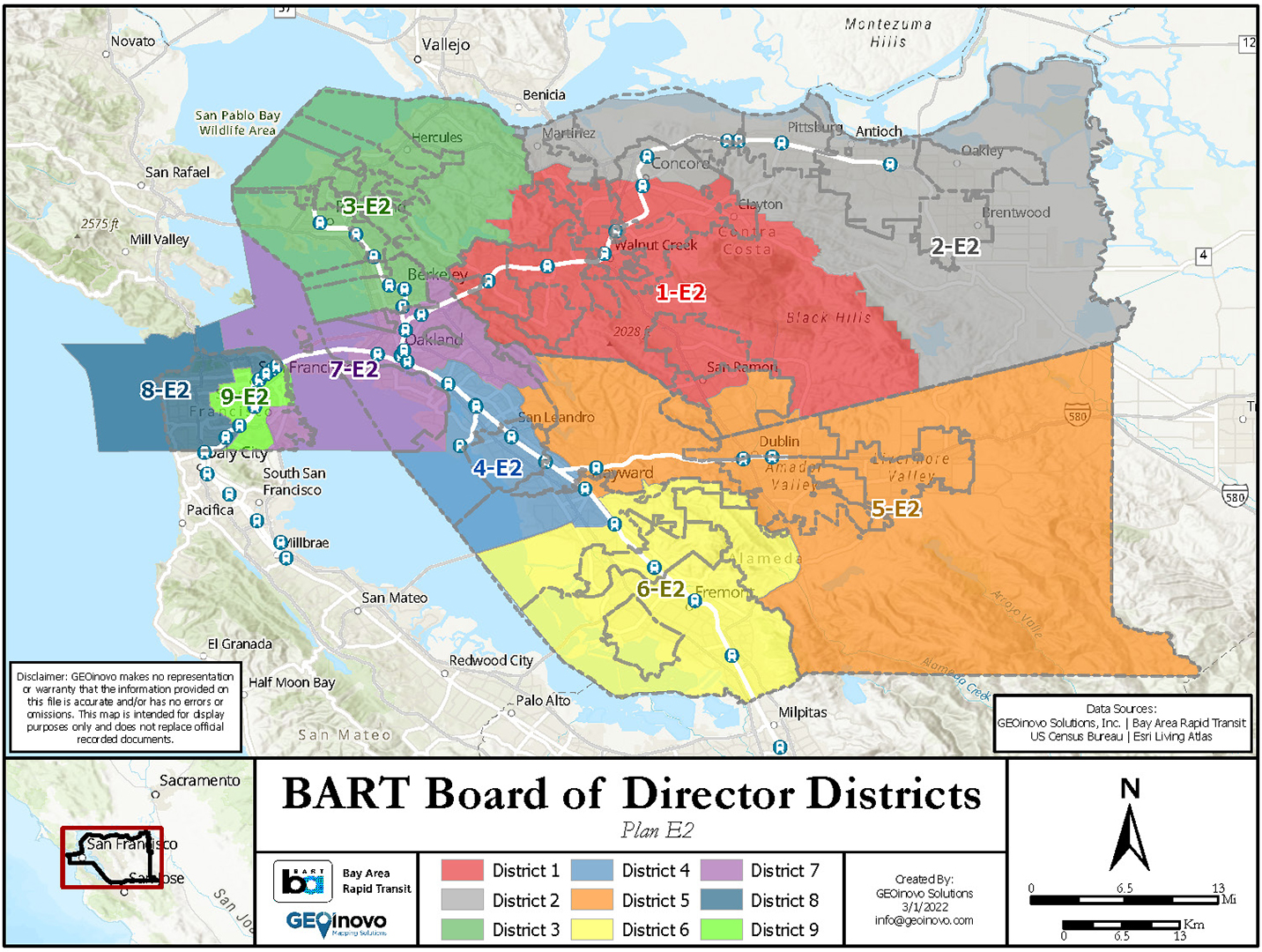
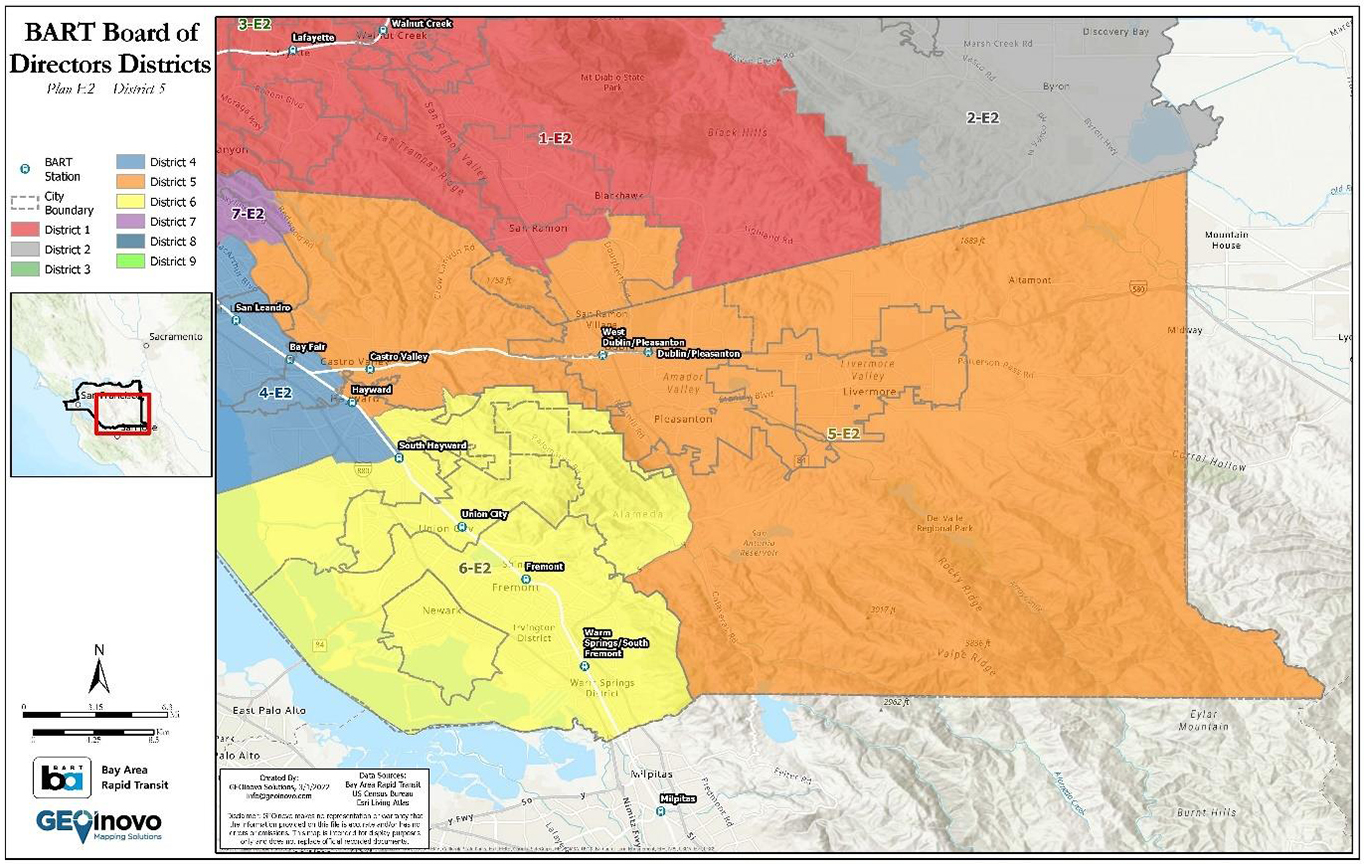
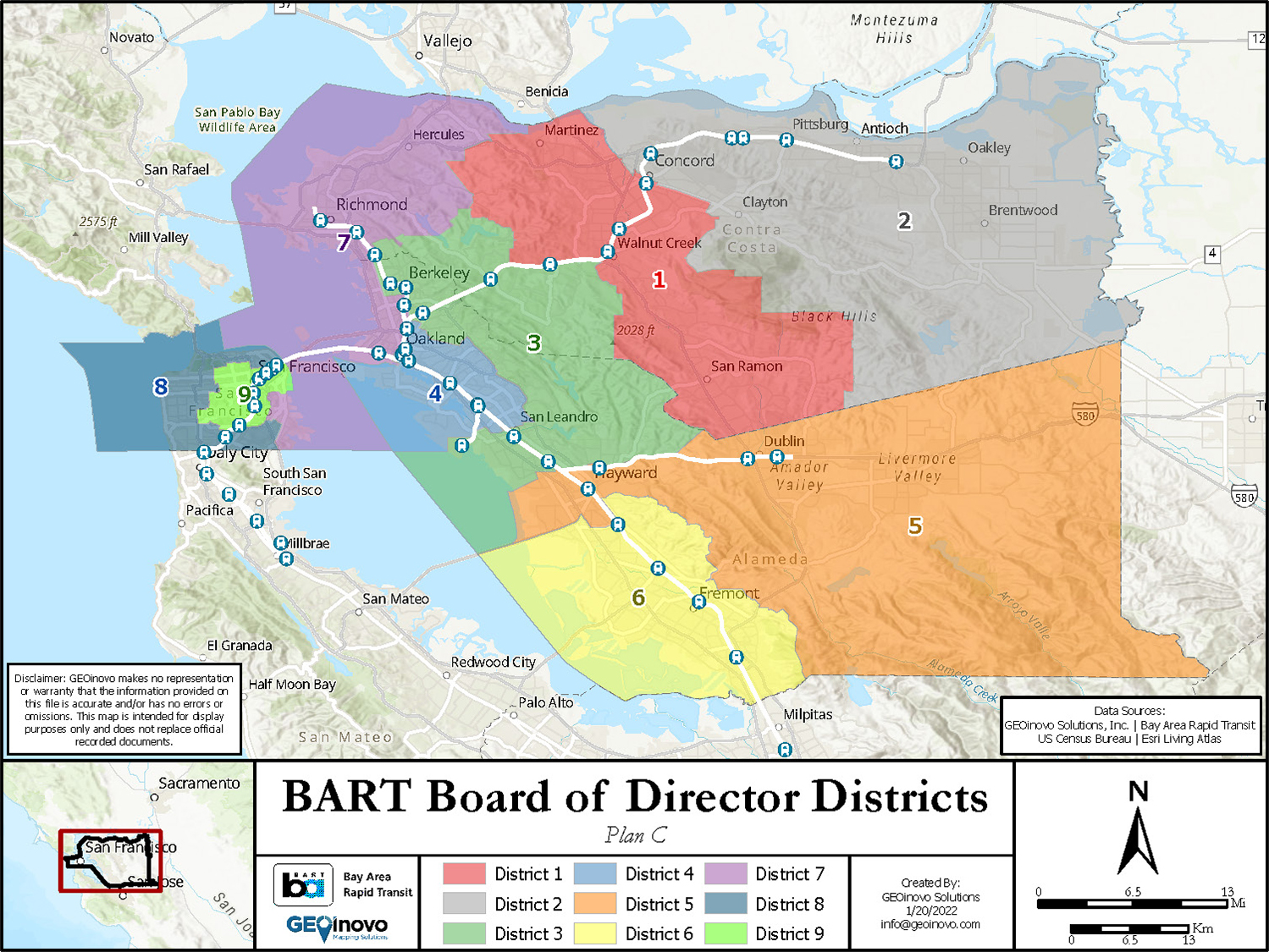
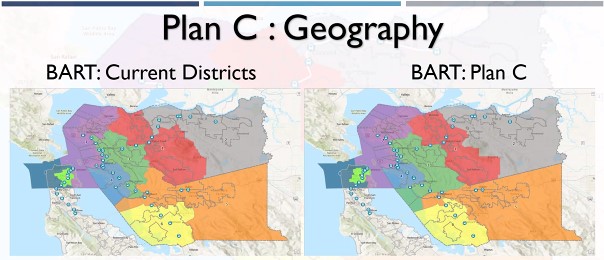
Proposed BART Districts 2022 Plan C.

Approaching critical phase – but few people seem interested, participating

The BART redistricting process is reaching a critical phase, with just one more virtual meeting for public outreach, scheduled for 6 pm on Wednesday, February 2nd. Few people seem interested in participating in the process in spite of the significant impact redistricting has on who will run for office and be elected over the next 10 years. Only two people offered public comments at the last BART meeting on redistricting, including the publisher of the Herald, Allen Payton.

Join the virtual meeting on 2/2/22 at 6pm on Zoom:

https://us06web.zoom.us/j/82168419186
Webinar ID: 821 6841 9186

Or Telephone US: +1 669 900 6833  (Toll Free) or 888 475 4499

BART election districts are redrawn every 10 years following the U.S. Census. The primary purpose of redistricting is to ensure population equality among districts.

Once the public outreach has concluded, the BART Board of Directors will continue to discuss the process and advance the work at upcoming Board meetings, including a special meeting of the Board of Directors. Meetings and agendas will be announced in advance. Sign up for Board meeting notices here.


BART has provided the following draft maps and census population and race/ethnicity data:

BART Board Districts Map Plan A

BART Board Districts Map Plan B

BART Board Districts Map Plan C

Census population and race/ethnicity data by District (Current, Plan A, Plan B, Plan C)

BART has rolled out mapping tools to enable public input for redistricting.

BART interactive mapping tool for redistricting: This tool gives residents the ability to create and share a Community of Interest and/or draft Board Member districts. Map submissions will appear in the gallery on the main landing page, enabling residents to view public input for redistricting.

BART Districts and Demographic Data: This web mapping tool is for visualizing BART districts and demographic data.
In addition to the interactive mapping tool, BART is providing a Community Input Map to allow residents to identify and provide supplemental information regarding their Community of Interest. This feature can be used on a mobile device and is offered in English and Spanish (Español), providing residents with an app that can be used to submit community information in their language of choice.

Community Input Map: English

Community Input Map: Spanish

Learn more about BART Redistricting at bart.gov/redistricting.

This process is guided by traditional redistricting principles as well as the U.S. Constitution, the California Constitution, the federal Voting Rights Act, the BART District Act, and the Fair and Inclusive Redistricting for Municipalities and Political Subdivisions (FAIR MAPS) Act.

Allen Payton contributed to this report.

Filed Under: BART, News, Politics & Elections

Nomination papers for candidates in April 5 special election for Assembly District 11 available Tuesday

January 22, 2022 By Publisher Leave a Comment

The current map of State Assembly District 11. Source: Statewide Data Base

Due to vacancy created by Jim Frazier’s resignation; winner will serve out remainder of term through December

By Dawn Kruger, Civic Outreach/Engagement Specialist, Contra Costa County Clerk-Recorder-Elections Department

The April 5th, 2022, special state election gets into full swing on Tuesday, January 25th as nomination papers will be made available for candidates running for the current California State Assembly District 11 office. The current district includes Antioch, Oakley, Brentwood, Discovery Bay, Bethel Island, Byron and Knightsen in Contra Costa County.

The special election is to fill the vacancy created by former Assemblyman Jim Frazier who announced his resignation, last month, effective Dec. 31. On Jan. 7, the day Gov. Newsom issued a proclamation calling for the special election.

If one candidate receives a majority of the votes (50% + 1), no special general election will be held. The winner will serve out the remainder of the two-year term through early December. If a special general election is needed it will be held June 7, the same day as the regular primary election and the candidate with the most votes in that election wins.

A separate election will be held during the June primary and November general elections for the new Assembly District 11, which now only includes Brentwood, Oakley, Discovery Bay, Bethel Island, Byron and Knightsen in Contra Costa County.

The nomination period runs through 5:00 p.m. Thursday, February 10, 2022.  Papers for the special California Assembly District 11 election are available at the Contra Costa Elections Office, 555 Escobar Street, Martinez.

For further information on this special election and key dates, go to https://www.cocovote.us/april-5-2022-special-primary-election-assembly-district-11/.

Source: Contra Costa Elections

“This special election was just announced by the governor earlier this month and we don’t want our constituents to be surprised,” said Deborah Cooper, Contra Costa Registrar of Voters. “If you are considering running for office, the Contra Costa County Elections Office provides a candidate manual with comprehensive information about the process and we are available to assist you.”

The Contra Costa Elections Division is offering appointments to interested candidates on weekdays from 8:30 am to 4:30 pm. Filing documents and information will be provided to interested constituents at their appointment.

The process takes 20 minutes. Due to the current surge in the pandemic/Covid-19, we are asking constituents to schedule an appointment through email at candidate.services@vote.cccounty.us or by calling us at 925-335-7800.

All visitors will be asked to check-in at the Elections lobby and will be required to wear a mask and observe social distancing guidelines.

For more information, visit www.cocovote.us or call (925) 335-7800.

Allen Payton contributed to this report.

Filed Under: East County, News, Politics & Elections

After 16 years in Congress McNerney won’t seek reelection clearing path for Rep. Harder to run in new CA-9

January 18, 2022 By Publisher Leave a Comment

Rep. McNerney official photo. Map of new California Congressional District 9. Source: www.wedrawthelinesca.org/final_maps

Newly redrawn 9th District viewed as more favorable for a Republican to win; three candidates in San Joaquin County pull papers to run for open seat; Congressman Harder from neighboring district announces candidacy, deletes Dec. tweet announcing run in CA-13

By Allen Payton

Eight-term Democratic Congressman Jerry McNerney (CA-09) issued the following statement announcing he will not run for re-election in 2022, making him the Democrat in the House of Representatives to make a similar announcement.

“Today I am announcing that I will not seek reelection in California’s newly created 9th Congressional District.

I am honored that the citizens of California’s 9th Congressional District chose me as their representative in the past five elections, and that those in California’s previous 11th Congressional District gave me the privilege of representing them for three terms.

I am very proud of the many accomplishments that my staff and I have achieved in Congress, including the creation of a major veteran’s health center facility in San Joaquin County, providing outstanding help for constituents with federal agencies, and securing major investments in infrastructure and public safety, broadband, education, childcare, and health care access. I have always fought tirelessly for those in need, and I will continue to do so.

I am grateful for the love and support of my family, who have been by my side throughout this journey. I could not have done this without them.

I will keep working for the people of my district throughout the remainder of my term and look forward to new opportunities to continue to serve.”

The current California 9th Congressional District map from 2011-21 which includes portions of Antioch. Source: Office of Congressman McNerney

Republicans Respond

Both the current and new 9th District maps encompass most of San Joaquin County, which added Tracy, Manteca and Ripon, and portions of Eastern Contra Costa County. That part of the district has shrunk to just include Discovery Bay and Byron, and no longer includes Brentwood, Oakley, Bethel Island, Knightsen and portions of Antioch. The new district is considered to be more favorable for a Republican to win.

National Republican Congressional Committee Spokeswoman Torunn Sinclair responded to McNerney’s announcement writing, “No one wants to run as a House Democrat. Jerry McNerney is making the smart decision to quit instead of watching Democrats lose their majority.”

“Any Democrat who runs in this district is vulnerable because their Party is responsible for higher prices, increased crime and the highest unemployment rate in the country,” she added.

According to Ballotpedia.org, McNerney is the 28th Democrat in the House to not seek re-election. So far, 13 Republicans have also announced they’re not running for re-election, this year.

McNerney’s Election History

The 70-year-old McNerney was first elected in 2006 defeating Pombo by 53 to 46%. In 2010, McNerney narrowly defeated David Harmer by 48 to 46.9% with a third-party candidate receiving 5.1% of the vote. Following redistricting in 2011, McNerney moved from Pleasanton to Stockton to run in the newly drawn district and ran in the new 9th District in 2012 defeating Ricky Gill by a margin of 55.6% to 44.4% of the vote.

Rep. Harder’s Twitter announcement on Dec. 22, 2021.

Four Candidates So Far, Filing Process Began Jan. 3

According to the Contra Costa Elections Division no candidate has pulled papers to run in the 9th District. But according to the San Joaquin County Registrar of Voters office, three people have pulled papers to run which include progressive Democrat Harpreet Singh Chima, San Francisco resident Karena Apple Feng, and Republican Khalid “Jeffrey” Jafri, an unsuccessful candidate for State Assembly in 2012 and 2020.

Congressman Josh Harder, a Democrat who represents the current CA-10 district, announced on his Twitter feed Tuesday morning that he’s running in the CA-9 congressional district. He had previously announcing last month he was running in neighboring district CA-13 in his “hometown” of Turlock, which is split between districts CA-5 and -13 and located over 20 miles outside of CA-9. But that tweet was deleted as of Tuesday morning. (See all CA congressional district maps)

Rep. Harder’s Twitter announcement on Jan. 18, 2022.

The Signatures In-Lieu of the Filing Fee Period began on Jan. 3 and ends Feb. 9. Each signature reduces the amount of filing fee candidates are required to pay to get on the ballot. That is followed by the Candidate Nomination Period which runs from Feb. 14 to March 11. But that will be extended another five days until March 16 since the incumbent is not running.

The Primary Election is on Tuesday, June 7. The top two candidates in the race will face each other in the General Election in November.

Filed Under: East County, News, Politics & Elections

Participate in democracy during BART’s remaining redistricting meetings

January 15, 2022 By Publisher Leave a Comment

Proposed BART Districts 2022 Plan A

For redrawing BART director districts; next meeting today at 9:00 a.m.

RELEASE DATE: 01/14/2022

Have a direct say in democracy by participating in BART’s redistricting meetings. The next virtual meeting is scheduled for January 15, at 9 am, followed by two 6pm meetings on January 22nd and February 2nd.

BART election districts are redrawn every 10 years following the U.S. Census. The primary purpose of redistricting is to ensure population equality among districts.  This process is guided by traditional redistricting principles as well as the U.S. Constitution, the California Constitution, the federal Voting Rights Act and the BART District Act.

Districts must be contiguous and should also be compact, minimize splitting cities, respect communities of interest and follow natural and man-made boundaries.

Proposed BART Districts 2022 Plan B

Key Points to Consider in Redistricting

Traditional Redistricting Principles

Since decennial redistricting began in the late 1960s, traditional criteria and principles have developed. While the equal population of election districts is the overriding principle there are accompanying goals. In varying degrees, the criteria are compactness, continuity, respect for communities of interest, preserving political subdivisions, and the core of previous districts. All are not of equal weight and all are subordinate to an equal population. Care must be taken not to dilute the voting strength of minorities.

Compactness

Compactness refers to a districts’ geographic shape and how its interior is dispersed within its boundaries. A circle is a perfectly compact shape. In redistricting, the notion of compactness is difficult to evaluate because one begins with irregularly shaped borders and the political subdivisions may be irregular in shape. Geometric measures of compactness are often misleading because geographic features and relationships are more complex than simple geometry. The principle of compactness should be considered functionally and must compete with other criteria.

Continuity

Continuity requires that all parts of a district be connected. Districts can be drawn that are contiguous by way of water or a bridge. While crossing water is allowed it should be minimized as it makes it more difficult to respect communities of interest.

Preserving Political Subdivisions

An attempt should be made to minimize splitting cities and well-defined neighborhoods.

Respect for Communities of Interest

Communities of interest are subjective and difficult to define. A community of interest has some common thread of shared interest. Those communities can be based on such diverse elements as geography, language, socio-economic-cultural interests, even transportation corridors. Race may be considered, but it may not be the sole reason for drawing a district in a particular manner.

Preserving the Core of Prior Districts

Preserving the core of a previous district is thought to be the least disruptive to the voters in each area. One, of course, would not seek to maintain a previous district that was legally objectionable.

New districts should be drawn deliberatively and with common sense. Adherence to traditional redistricting principles and the federal Voting Rights Act will ensure fair and reasonable districts.

Community participation is available via Zoom on January 15, 2022 starting at 9 am at https://us06web.zoom.us/j/88956838390

You may join the Committee Meeting via Zoom by calling 1-669-900-6833 and entering access code 889 5683 8390. Dial *9 to raise your hand when you wish to speak, and dial *6 to unmute when you are requested to speak.

Virtual Meetings of BART’s Redistricting Committee and Archived Video 

The BART Redistricting Committee consists of Directors Lateefah Simon (Chairperson), Elizabeth Ames and Mark Foley. Here is the remaining proposed redistricting outreach meeting schedule, materials, zoom information, and videos of previous meetings are provided below the list of meetings dates:

  • Meeting 4: Saturday, January 15, 2022, 9 am
  • Meeting 5: Saturday, January 22, 2022, 6 pm
  • Meeting 6: Wednesday, February 2, 2022, 6 pm

January 8, 2022 Meeting – A virtual meeting was held Saturday, January 8, 2022 from 12 to 2 pm. Watch the video of the 1/8/22 meeting.

December 15, 2021 Meeting – A virtual meeting was held Wednesday, December 15, 2021 from 6 to 8 pm. Watch the video of the 12/15/21 meeting.

December 1, 2021 Meeting – A virtual meeting was held Wednesday, December 1, 2021 from 1 to 3 pm. Watch the video of the 12/1/21 meeting.

Documents from the December 1 meeting:

BART Board Districts Map Plan A
BART Board Districts Map Plan B
Table of BART District’s Citizen Voting Age Population (CVAP) by Race/Ethnicity
Table of Population by BART District, 1990-2030(estimate)

November 10, 2021 Meeting – The first virtual meeting was held Wednesday, November 10, 2021 from 1 to 3 pm. Watch the video of the 11/10/21 meeting.

Current District Maps and Early Drafts of Potential (Not Final) New Maps

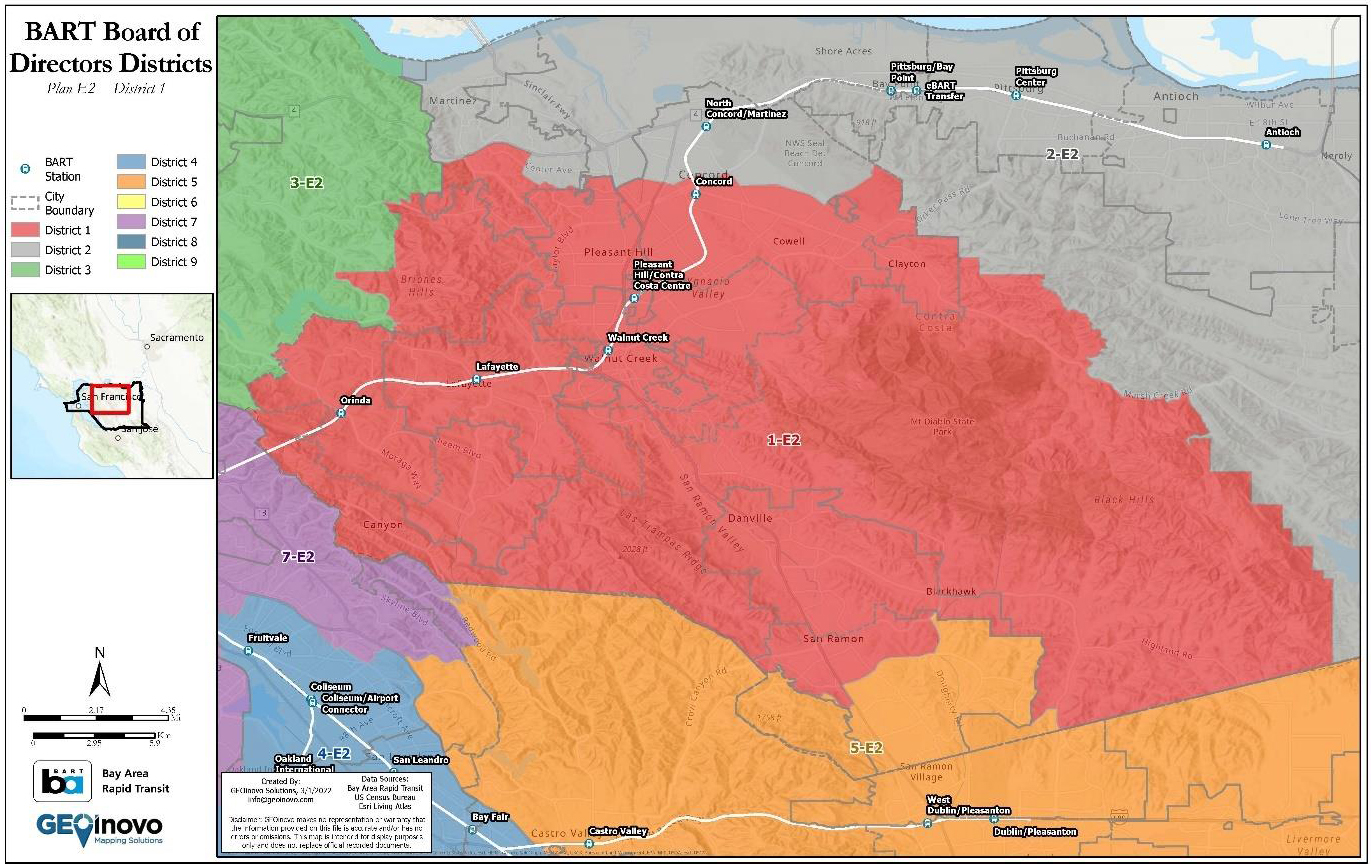
District 1
Current District 1 Map
Potential new maps (not final):
District 1 Plan A
District 1 Plan B

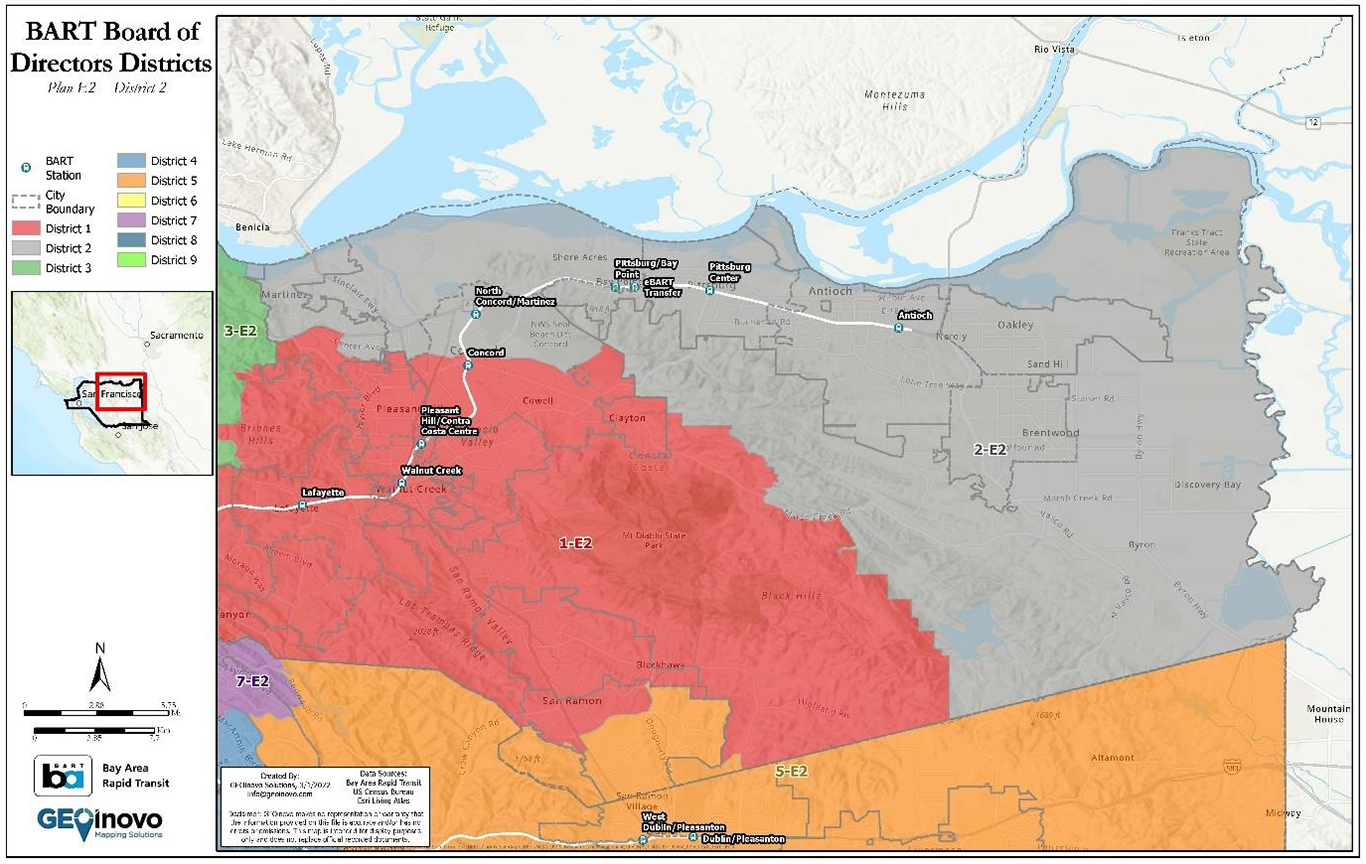
District 2

Current District 2 Map
Potential new maps (not final):
District 2 Plan A
District 2 Plan B

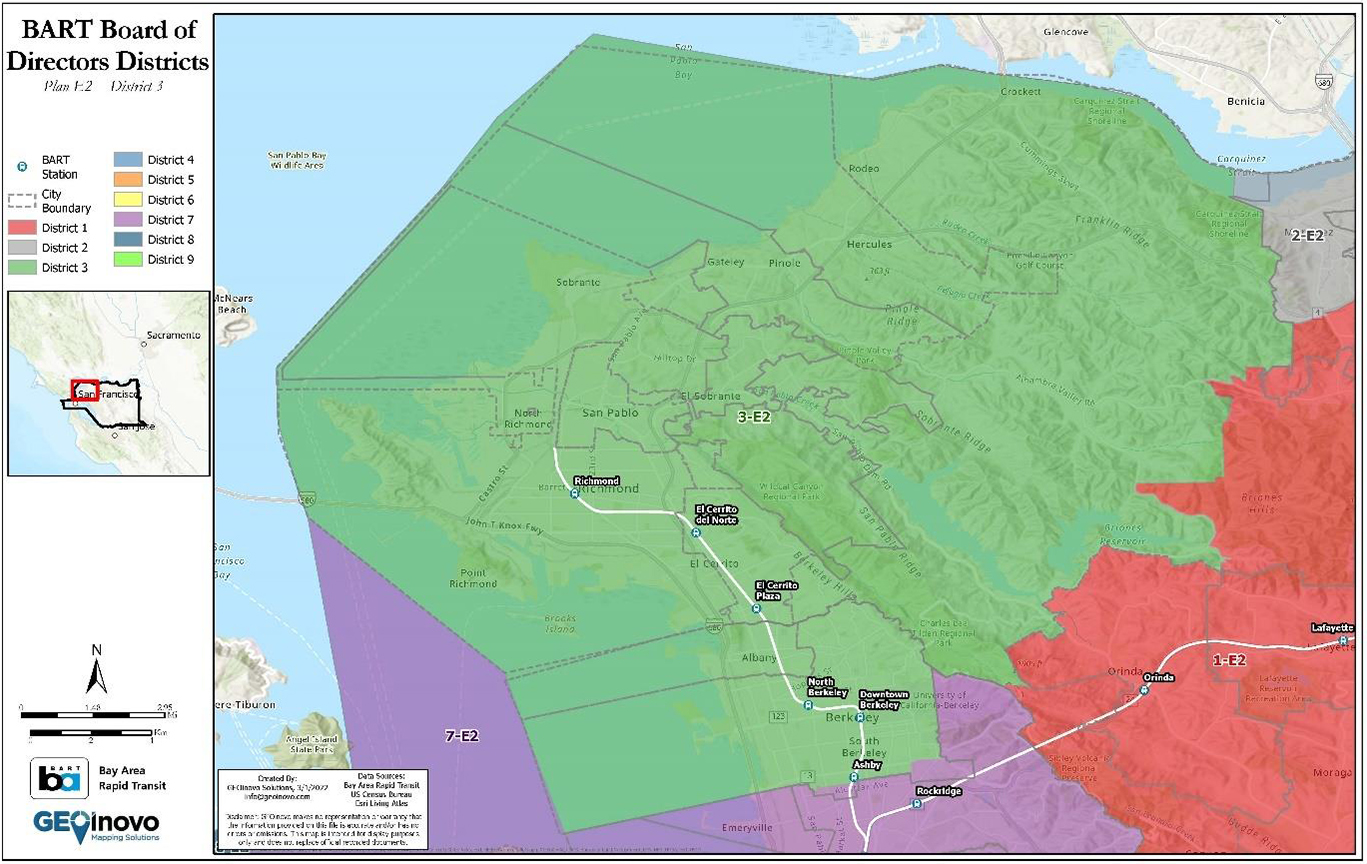
District 3

Current District 3 Map
Potential new maps (not final):
District 3 Plan A
District 3 Plan B

District 4

Current District 4 Map
Potential new maps (not final):
District 4 Plan A
District 4 Plan B

District 5

Current District 5 Map
Potential new maps (not final):
District 5 Plan A
District 5 Plan B

District 6

Current District 6 Map
Potential new maps (not final):
District 6 Plan A
District 6 Plan B

District 7

Current District 7 Map
Potential new maps (not final):
District 7 Plan A
District 7 Plan B

District 8

Current District 8 Map
Potential new maps (not final):
District 8 Plan A
District 8 Plan B

District 9

Current District 9 Map
Potential new maps (not final):
District 9 Plan A
District 9 Plan B

Mapping Tools for Public Engagement

BART has rolled out mapping tools to enable public input for redistricting.

BART interactive mapping tool for redistricting: This tool gives residents the ability to create and share a Community of Interest and/or draft Board of Director districts. Map submissions will appear in the gallery on the main landing page, enabling residents to view public input for redistricting.

BART Districts and Demographic Data: This web mapping tool is for visualizing BART districts and demographic data.

In addition to the interactive mapping tool, BART is providing a Community Input Map to allow residents to identify and provide supplemental information regarding their Community of Interest. This feature can be used on a mobile device and is offered in English and Spanish (Español), providing residents with an app that can be used to submit community information in their language of choice. Explore these tools using the links below.

Community Input Map: English

Community Input Map: Spanish

Information about current District boundaries

BART 2011 Election Districts Final Report – Adopted 12/1/2011 (10 Mb .pdf file)
All BART Districts
Counties Included: Alameda, Contra Costa, San Francisco
Map: All BART Districts (.pdf file)

District: 1
Counties Included: Contra Costa
Cities Included: Acalanes Ridge, Alamo, Alhambra Valley, Blackhawk, Camino Tassajara, Castle Hill, Clayton, Concord, Contra Costa Centre, Danville, Diablo, Lafayette, Martinez, Mountain View, Norris Canyon, North Gate, Pacheco, Pleasant Hill, Port Costa, Reliez Valley, San Miguel, San Ramon, Saranap, Shell Ridge, Vine Hill, Walnut Creek
Map: BART District 1 (.pdf file)

District: 2
Counties Included: Contra Costa
Cities Included: Antioch, Bay Point, Bethel Island, Brentwood, Byron, Clyde, Concord, Discovery Bay, Knightsen, Oakley, Pacheco, Pittsburg, Vine Hill
Map: BART District 2 (.pdf file)

District: 3
Counties Included: Alameda, Contra Costa
Cities Included: Albany, Ashland, Berkeley, Castro Valley, Cherryland, El Cerrito, Kensington, Lafayette, Moraga, Oakland, Orinda, Piedmont, San Lorenzo
Map: BART District 3 (.pdf file)

District: 4
Counties Included: Alameda
Cities Included: Alameda, Oakland, San Leandro
Map: BART District 4 (.pdf file)

District: 5
Counties Included: Alameda
Cities Included: Castro Valley, Cherryland, Dublin, Fairview, Hayward, Livermore, Pleasanton, Sunol
Map: BART District 5 (.pdf file)

District: 6
Counties Included: Alameda
Cities Included: Fremont, Hayward (partial), Newark, Sunol, Union City
Map: BART District 6 (.pdf file)

District: 7
Counties Included: Alameda, Contra Costa, San Francisco
Cities Included: Albany, Bayview, Berkeley, Crockett, East Richmond Heights, El Cerrito, El Sobrante, Emeryville, Hercules, Kensington, Montalvin Manor, North Richmond, Oakland, Pinole, Richmond, Rodeo, Rollingwood, San Francisco, San Pablo, Tara Hills
Map: BART District 7 (.pdf file)

District: 8
Cities Included: San Francisco
Counties Included: San Francisco
Map: BART District 8 (.pdf file)

District: 9
Cities Included: San Francisco
Counties Included: San Francisco
Map: BART District 9 (.pdf file)

Learn more at www.bart.gov/redistricting.

Filed Under: BART, News, Politics & Elections

Contra Costa College Board votes for gerrymandered redistricting map protecting incumbents, splitting more cities

January 13, 2022 By Publisher Leave a Comment

The approved new Contra Costa Community College Trustee Ward Boundaries Map showing the location of high schools in the county, except for Deer Valley High School in Antioch. The name of Dozier-Libbey Medical High School, also located in Antioch, is misspelled. Source: 4CD

4-0-1 vote approves staff drawn map keeping boundaries significantly the same as current, politically drawn wards map from 2011; leaves portions of East County in same ward with most of the San Ramon Valley; Crockett, Rodeo and portions of Hercules in same district with Walnut Creek, Alamo

By Allen Payton

The Contra Costa Community College board, on a 4-0-1 vote, approved a final redistricting, staff-drawn map that keeps the ward boundaries significantly gerrymandered, protecting each of the incumbents for re-election. Ward 5 Trustee Fernando Sandoval voted to abstain. During a public hearing on Ward Equalization Based on the 2020 Census at their regular meeting Wednesday night, the trustees reviewed three maps drawn by district staff, and only one member of the public, a former trustee, spoke. The new wards will go into effect for this year’s November elections, in which both Ward 3 Trustee Rebecca Barrett and Ward 4 Trustee Andy Li face re-election if they decide to run.

In addition, the board again discussed the “Public employee discipline/dismissal/release/complaint” of Chancellor Bryan Reece during a special meeting at 5:00 p.m. But no reportable action was taken during the closed session.

During the staff presentation on redistricting, Executive Vice Chancellor for Education and Technology Mojdeh Mehdizadeh said, “This is the fourth meeting we’ve held in order to achieve equalization” which was the main focus of the staff-drawn maps. Those include a Community Roundtable on Ward Redistricting on Jan. 6.

“You wanted to see more maps and interactive maps, you wanted to have the high school markers placed on the maps and more time for public input,” she continued. “We also asked the public for more input through an online survey…which went live on Dec. 17. We received a total of 12 responses.”

Three maps were offered to the public, two that are very similar to the current wards map, and one similar to the map that the county Board of Supervisors adopted, with a significantly gerrymandered Ward 2 which is very different than Supervisorial District 5. (See related article)

“Nearly 60% (7 people) indicated that Map 2 is the favored map. Map 3 was the least favored map. About 75% of respondents (8 or 9 people) said it was the least favorite,” Mehdizadeh stated. “We continue to offer Map 2 as the best map.”

That was the same map she and the district’s attorney recommended previously.

The three proposed maps show the locations of the high schools in the county except for Deer Valley High School in Antioch and misspelled the name of Dozier-Libbey Medical High School, also in Antioch.

Splits More Cities

While the new trustee ward map has a total population deviation of just 1.7% between wards – which is closer to the intent of the Constitution of ensuring one-person-one-vote – it keeps things pretty much the same as the 2011 map. It continues to split Antioch, Brentwood and Pittsburg in East County, Martinez, Concord, Walnut Creek and now, one of the county’s smallest cities, Clayton, in Central County, and in West County, instead of splitting Pinole, as the current map does, the new map splits Hercules.

Public Comments

Former board trustee Greg Enholm was the only person to speak during public comments saying, “as a trustee for 2012 to 2020 I did not participate in the ward equalization process for the 2000 and 2010 Census data. But I was affected as a candidate for the subsequent 2006 and 2010 Ward 3 elections created from the 2000 Census Data and the 2012, 2016, and 2020 elections created from the 2010 Census Data.”

“I have been a candidate in five contested elections being elected in two,” he continued. “I have had many opportunities to interact as a candidate with the approximately 200,000 4CD constituents each in Wards 3 and 5 as well as eight years being accountable to all one million 4CD constituents. I believe that the voters must select their representatives not the reverse. I hope that all five trustees agree with that statement and will ask that staff prevent or at least reveal any inappropriate effort by any current or prior trustee to use ward equalization to primarily improve their opportunity to be re-elected or affect any current or prior trustee’s opportunities to be a successful candidate using the 2000, 2010, and/or 2020 ward equalization process.”

Enholm provided each of the trustees with a copy of his comments on the three maps proposed by staff.

“Please read my comment below on all three proposed maps and ask staff if they have assured that the 2000 and 2010 ward maps were created in full compliance with all applicable laws, rules, and regulations in effect when they were adopted,” he said.

Trustee Comments

Ward 3 Trustee Fernando Sandoval was the only member of the board to speak, asking, “Can you tell me the implications for adopting each map? Can we respond to Mr. Enholm’s question…if the maps were created fairly.”

All three maps comply with population balance, Mehdizadeh pointed out.

“Map number 1 is a slight variation of the first one we presented you,” she said. “As it pertains to the second map, we attempted to keep as many cities as tight knit.”

However, both proposed Maps 1 and 2 split more cities than the current ward map.

“The third map was a request that came from the December meeting…that the Board of Supervisors had adopted their map…that was a consideration, as well,” Mehdizadeh stated.

In response to Sandoval she said, “Your question about the 2000 and 2010 process, I personally was not involved in the 2000 process.”

Mehdizadeh again spoke of population balance.

“In 2010 I can tell you I was directly involved,” she stated. “We worked closely with our legal counsel…we spent quality time with our governing board to get public input.”

“Our county Office of Education chose to adopt the same map,” Mehdizadeh added. “That showed a reduction in costs” for printing and mailing ballots during elections.

“I do know they have a meeting on the 19th,” Sandoval said referring to the county Board of Education. “But this year they hired their own demographer. I don’t know why. Is there a reason we wouldn’t wait for them to come back? We want to make sure the alignment is consistent. Would it be prudent to wait until they vote on a final recommendation?”

“That could be our challenge,” Mehdizadeh responded. “Our maps have to be approved by the end of February. It really is who ultimately who votes and makes a determination of their maps. They have been working closely with us, as staff. They are very well apprised of the timelines. It really is up to the board.”

With no other comments by the trustees Board President and District 2 Trustee Judy Walters closed the public hearing.

Board Adopts Map 2

Then later during the meeting, under NonConsent Agenda – Action Items – Miscellaneous, on a motion by Trustee Li and seconded by Ward 1 Trustee John Marquez, the board voted 4-0-1 to adopt Map 2. Sandoval voted to abstain. Student Trustee Austin Green also voted for the motion, but the vote is advisory, only.

However, the resolution signed by both Walters and Marquez, who is the Board Secretary, incorrectly shows Sandoval voted for the map and Marquez voted to abstain. 4CD adopted Ward Equalization Resolution 0122-20B-MI – incorrect

When reached for comment about the mistake Sandoval said “that’s wrong. I’ll call John Marquez.”

When informed of the mistake, Marquez said, “I’ll call the staff member who handles that, Pat (Kaya) and get it corrected, right away.”

Filed Under: Education, News, Politics & Elections

Rep. DeSaulnier announces re-election campaign for California’s new 10th Congressional District

January 9, 2022 By Publisher Leave a Comment

The newly drawn California 10th Congressional District. Source: wedrawthelinesca.org.  Rep. Mark DeSaulnier. Official photo.

Pledges to continue work in Congress for Contra Costa; lists his endorsements

CONTRA COSTA, CA – The DeSaulnier for Congress Campaign announced the launch of the congressman’s re-election effort for California’s newly drawn 10th Congressional district, as approved by the California Citizens’ Redistricting Commission (CCRC) on Monday, Dec. 20th. Mark DeSaulnier has represented Concord and Contra Costa County in Congress since 2015 and vows to continue to work hard for his constituents, fighting for working families.

Th 10th District encompasses most of Contra Costa County, including Lamorinda, the San Ramon Valley, Concord, Clayton, Clyde, Pacheco, Pleasant Hill, Walnut Creek, and portions of Martinez in Central County, and in East County, Brentwood, Oakley, Bethel Island, Knightsen and portions of Antioch, plus portions of Dublin in Alameda County.

“Throughout my time in Congress, my guiding principle has always been this: I work for you,” said Congressman DeSaulnier. “It’s been my honor to represent this area for nearly three decades, on the Contra Costa County Board of Supervisors, in the California State Legislature, and for the past six years as a Member of Congress. My priority has always been serving the people of Contra Costa and making our voices heard during the tough fights, when it matters most.”

DeSaulnier lives in Concord where he raised his two sons, Tristan and Tucker, and opened and operated a small business, TR’s restaurant.

He’s also spent three decades as a public servant: representing his community on the Concord City Council, as Mayor of Concord, as a three-term Contra Costa County Supervisor, in the California State Legislature, and currently as a Member of Congress.

As Supervisor, he served on the California Air Resources Board, the Association of Bay Area Governments, the Bay Area Air Quality Management District, and the Metropolitan Transportation Commission. He was elected to the State Assembly in 2006 where he served one term and received the distinction of being the first freshman in history to chair the Assembly Transportation Committee. DeSaulnier was elected to two terms in the California State Senate in 2008 and 2012 where he served as Chair of the California State Senate Transportation and Housing Committee. During his time in Congress, DeSaulnier has been honored to represent California’s 11th Congressional District including Richmond, El Cerrito, Kensington, and Pittsburg, now in the new 8th District, and looks forward to continuing to serve them in 2022.

Congressman DeSaulnier is running for re-election to fight against the reckless Republican agenda and move our nation forward by:

  • Ensuring every American has access to quality, affordable health insurance and care;
  • Confronting racial injustice;
  • Creating national common sense gun violence reforms;
  • Helping America’s students receive a quality education without being shackled by debt;
  • Protecting Medicare and Social Security;
  • Safeguarding the environment;
  • Overseeing the largest investment in our nation’s infrastructure in modern history, and
  • Ensuring government is accountable to the public.

The campaign is proud to announce the following endorsements:

  • Alex Padilla, United States Senator for California
  • Karen Bass, United States Representative (CA)
  • Jared Huffman, United States Representative (CA)
  • Barbara Lee, United States Representative (CA)
  • Doris Matsui, United States Representative (CA)
  • Eric Swalwell, United States Representative (CA)
  • Mike Thompson, United States Representative (CA)
  • George Miller, Former United States Representative (CA)
  • Rosa DeLauro, United States Representative (CT)
  • Betty T. Yee, California State Controller
  • Ricardo Lara, California Insurance Commissioner
  • Rob Bonta, Attorney General of California
  • Tony Thurmond, California State Superintendent of Public Instruction
  • Tom Torlakson, Former California State Superintendent of Public Instruction
  • Steve Glazer, California State Senator
  • Rebecca Bauer-Kahan, California State Assemblymember
  • Tim Grayson, California State Assemblymember
  • Diane Burgis, Supervisor, Contra Costa County
  • Federal Glover, Supervisor, Contra Costa County
  • John Gioia, Supervisor, Contra Costa County
  • Karen Mitchoff, Supervisor, Contra Costa County
  • Diana Becton, District Attorney, Contra Costa County
  • Lynn Mackey, Superintendent of Schools, Contra Costa County
  • Holly Tillman, Vice Mayor, City of Clayton
  • Julie Pierce, Former Mayor, City of Clayton
  • Dominic Aliano, Mayor, City of Concord
  • Carlyn Obringer, Council Member, City of Concord
  • Edi E. Birsan, Council Member, City of Concord
  • Tim McGallian, Council Member, City of Concord
  • Newell Arnerich, Mayor, Town of Danville
  • Teresa Gerringer, Mayor, City of Lafayette
  • Susan Candell, Council Member, City of Lafayette
  • Cameron Burks, Former Council Member, City of Lafayette
  • Rob Shroder, Mayor of the City of Martinez
  • Lara DeLaney, Council Member, City of Martinez
  • Mark Ross, Council Member, City of Martinez
  • Dennis Fay, Mayor, City of Orinda
  • Amy R. Worth, Council Member, City of Orinda
  • Inga Miller, Council Member, City of Orinda
  • Kevin Wilk, Council Member, City of Walnut Creek
  • Cindy Darling, Council Member, City of Walnut Creek
  • Michael Harris, Mayor, City of Pleasant Hill
  • Sue Noack, Council Member, City of Pleasant Hill
  • Matthew Rinn, Council Member, City of Pleasant Hill
  • Ken Carlson, Councilmember, City of Pleasant Hill
  • Merl Craft, Council Member, City of Pittsburg
  • Tom Butt, Mayor, City of Richmond
  • Gabriel Quinto, Mayor, City of El Cerrito
  • Lisa Motoyama, Mayor Pro Tem, City of El Cerrito
  • Janet Abelson, Council Member, City of El Cerrito
  • Paul Fadelli, Council Member, City of El Cerrito
  • Rita Xavier, Mayor, City of San Pablo
  • Abel Pineda, Council Member, City of San Pablo
  • Linda Mayo, Trustee, Mt. Diablo Unified School District
  • Mae Torlakson, Vice Chair, Ambrose Recreation and Park District in Bay Point
  • Judy Walters, Ph.D., President, Contra Costa Community College District Governing Board
  • Fernando Sandoval, Vice President, Contra Costa Community College District Governing Board
  • Rebecca Barrett, Board Trustee, Contra Costa Community College District Governing Board
  • Andy Li, Board Trustee, Contra Costa Community College District Governing Board
  • John E. Marquez, Board Trustee, Contra Costa Community College District Governing Board


Filed Under: Central County, Lamorinda, News, Politics & Elections, San Ramon Valley

So, you want to run for office? Contra Costa Elections to hold Candidate Workshops in Jan. and Feb.

January 5, 2022 By Publisher Leave a Comment

Have you ever considered running for office? Then consider checking out one of Contra Costa Elections Division’s Candidate Workshops.

This engaging workshop is designed to remove the mystery from running for office. Experts will cover what’s involved in running for office, including how to file and appear on the ballot, campaign finance disclosure requirements, strategies for spreading your message (including social media), and what happens when you’re in the public eye.

The first of three workshops will be held on January 18th at the Lafayette Library from 6 pm until 9 pm. Please reserve a free ticket here:  https://www.eventbrite.com/e/221010988817

The second of three workshops will be held on January 29th at the Richmond Civic Auditorium from 9 am until 12 pm. Please reserve a free ticket here:  https://www.eventbrite.com/e/219543840537

The last of three workshops will be held on February 2nd at the Antioch Community Center at Prewett Park from 6 pm until 9 pm. Please reserve a free ticket here:  https://www.eventbrite.com/e/221022543377

If you have any questions, please contact Karen Tedford at 925-335-7863 or by email at ktedford@cr.cccounty.us.


Filed Under: East County, Lamorinda, Politics & Elections, West County

Analysis: with redistricting Martinez has it best, Brentwood is a close second

December 30, 2021 By Publisher Leave a Comment

Source: City of Martinez

Both offer a citizen-driven, transparent process; Martinez council has no say, Brentwood council will only make final choice; Antioch and Richmond get honorable mentions for offering online mapping tools

By Allen Payton

Comparing the redistricting process used by the county supervisors, cities, education boards and special districts in Contra Costa County whose members are elected by district, ward or area, it’s clear that just like the slogan they’ve been using for the past few years, it really is better in Brentwood – than most. But Martinez offers the best process in the county. Both have independent redistricting commissions and offer the same, easy-to-use online mapping tool for the public to draw and submit their own maps. While Brentwood’s process ends with the council only choosing from already completed maps, the Martinez council has no say and takes what their commission gives them.

At least Brentwood’s doing it right, this time. That’s because when the initial districts were drawn and approved in 2019 for the 2020 election and based on the 2010 Census, the Brentwood city council map for Districts 2 and 4 was obviously gerrymandered to benefit one if not more incumbents. Just look at the section of District 2 on the southwest side of the BNSF railroad tracks and you’ll see, that’s surrounded on three sides by District 4. But it really had no effect since those two seats aren’t up for election until next November.

Section of current Brentwood City Council Districts 2 and 4.

Besides Martinez and Brentwood, the following cities and school districts elect their members by district and are undergoing a redistricting process:

Antioch City Council – District Elections – City of Antioch, California (antiochca.gov) – Antioch online mapping tool

Antioch School Board – Post Census Redistricting / 2020 Census Redistricting (antiochschools.net) – No online mapping tool.

Concord City Council – Redistricting | Concord, CA (cityofconcord.org) – No online mapping tool, yet. Process started Nov. 2.

Richmond City Council – Redistricting 2020 Census | Richmond, CA – Official Website – For online mapping tools click on “Draw Map”.

San Ramon City Council – Redistricting 2022 – City of San Ramon (ca.gov)  – No online mapping tool.  The council will consider final redistricting maps on Tuesday, March 22, 2022.

Contra Costa Water District – No redistricting page nor online mapping tool. The board was given a redistricting presentation during their Oct. 15 meeting. The next meeting will be held on Jan. 5 with expected completion by March 16.

Contra Costa Community College District – www.4cd.edu/gb/redistricting – No online mapping tool. See below for process information.

In 2010, both the college board and the Contra Costa County Board of Education adopted the same exact map. But their website doesn’t offer a very detailed map for the public to see in which district they live and which trustee is their representative.

Source: City of Oakley

Oakley Council Converts to District Elections

The Oakley City Council just completed the process of converting to district elections and adopted a five-member map during their meeting on Nov. 9.

Most Gerrymandered Current District Map

So far, the current map in the county with the most gerrymandered districts I’ve seen is for the Contra Costa Community College District, and as a result of the above, the county Board of Education, too. It combines Lamorinda with Hercules, Rodeo and Crockett in one ward and all of the San Ramon Valley, sans Alamo, in the same ward as Byron and Discovery Bay. Plus, it splits six cities, as well.  Those trustee ward lines were clearly drawn in 2011 to protect the incumbents, at that time.

This year, the college district staff tried to present their board with only one map to consider – drawn by staff and an attorney, with minor changes to the current map, continuing to protect incumbents. Where the current council or board members live is not a required consideration for redistricting. However, it’s understandable why that it would happen since staff members have a conflict of interest and inherent bias in wanting to please their bosses, instead of drawing maps to serve we the people.  (See related article)

Fortunately, the college board wisely directed staff to open up the process for more public input and offer two more proposed maps and an online survey about those choices, although they aren’t offering an online mapping tool.

Current Contra Costa Community College District ward boundaries map approved in 2011. Source: 4CD

Different Deadlines

While school boards have a deadline of March 1, 2022, to complete the process and submit an approved map, city councils have until April 17. The supervisors had to complete their process sooner, because filing for the June Primary election for Districts 1 and 4 opens mid-February and closes mid-March.

While some cities, like Antioch were trying to complete their process by the end of January – which the council just extended by a month – Brentwood’s process, which began Oct. 14 won’t be completed until March 3 and possibly not until March 10.

While congressional redistricting is the most difficult because it requires no more than a one person difference between districts, all other districts can have a maximum of a five percent population deviation from average, referred to as ideal, to be legally acceptable.

Process in Martinez Started First, Includes Independent Commission

Martinez, which began their redistricting process way back in January, has a seven-member independent redistricting commission, not chosen by the council. In August four commissioners were randomly drawn by the Deputy City Clerk from different quadrants in the city. Then those commissioners selected three additional commissioners from a designated pool of applicants. Finally, another random draw was undertaken to determine the two alternates from the remaining pool of qualified applicants.

The commissioners are responsible for drawing council districts in Martinez and held their first meeting on Sept. 22. So, the council has no say. They get what the people give them.

Martinez offers residents an online mapping tool to draw and submit alternative maps, just like the county supervisors’ did, and Brentwood and Antioch offer. While the supervisors’ online tool was easy to use, the tool offered by Martinez and Brentwood is easier. Each of the proposed maps and even the draft maps drawn by members of the public are on the site and can be viewed by anyone.

City of Brentwood 2021-22 redistricting schedule.

Redistricting in Brentwood Better Than Most

Brentwood’s redistricting process also offers residents an online mapping tool. Like Martinez, each of the proposed maps and even the draft maps drawn by members of the public are included on the City’s redistricting website for all to see and review to maximize public input.

The Brentwood city council established an independent, citizens redistricting commission, whose five members and four alternates volunteered and were selected by retired Judge Thelton Henderson – not the mayor and council members – following an application process. All but the last step of the redistricting process was transferred to them. The commission is leading the redistricting process by holding public hearings, reviewing all maps submitted by the public and gathering “community input to ensure everyone’s voice is heard”.

When the commission’s part of the process is complete, it will submit two or more potential boundary maps to the City Council and – here’s the best part – the Council must then select one of the submitted maps – wait for it – without modifying!

Interestingly enough, many of the publicly submitted maps in Brentwood look similar in how best to create new, common-sense districts – drawn based on the principals of compactness, Communities of Interest, using natural and man-made barriers for boundary lines and one-person-one-vote, with the smallest population percentage deviation from average as possible. Unfortunately, some of the maps submitted for the Brentwood City Council process don’t follow the aforementioned principles and can’t be considered because they don’t comply with the maximum population deviation percent requirement.

Honorable Mentions

Both Antioch and Richmond also offer online mapping tools and while Antioch’s has had glitches, it appears those have been worked out. Richmond was using the same tool as Martinez and Brentwood, known as DistrictR. But it has been replaced with Dave’s Redistricting App (DRA) because DistrictR uses population estimates while Dave’s Redistricting App uses the official population. Dave’s is difficult to use.

Richmond also offers Maptitude, which is the same software app used by the consultant to the state Citizens Redistricting Commission. But both require someone to sign up in order to use them. People can use Antioch’s online mapping tool as a guest, which requires the map be drawn all in one setting because it can’t be saved without signing up and logging in.

Other Councils and Boards Should Follow Example of Martinez and Brentwood

I can often be pretty tough on candidates and elected officials in my media role and responsibility of holding them accountable. But I also believe it’s good to praise those who are doing it right.

Neither the council members in Martinez nor Brentwood can make any changes to the final maps, thus, they won’t have any ability to gerrymander their districts to benefit themselves. They’ve empowered the people to have control over choosing who they will have represent them instead of the other way around. Representative government in our republic. Hey, what a concept!

Why don’t all the other boards of government agencies in our county do the same? Martinez and Brentwood are the example for the Board of Supervisors, other city councils, school and college boards to follow for the best way to handle the redistricting process.

The Brentwood City Council should be congratulated for doing it right and the best, when it comes to redistricting, this year.

Hopefully, all the other cities and districts, and the supervisors in Contra Costa will duplicate what Brentwood is doing, 10 years from now, the next time they will redistrict. Actually, they don’t have to wait. Once the current process is completed for the 2022 elections, the other councils and districts will have plenty of time for a redo by the 2024 elections.

Unless that happens, then remember, folks, the district lines approved this time will be in place for the next 10 years. So, while the redistricting process may be technical and dry, the decisions made now can and will affect who we have representing us during that time, and making decisions affecting our lives, homes, schools, businesses, and communities. So, stay informed, engaged and give your input on redistricting.


Filed Under: Government, Opinion, Politics & Elections

Congressman Garamendi announces re-election in California’s newly redrawn 8th District which includes northern Contra Costa

December 23, 2021 By Publisher Leave a Comment

The new 8th Congressional District and the location of Walnut Grove (right) where Garamendi lives. Source: WeDrawTheLinesCA.org

Former California State Assemblyman, State Senator, two-time Insurance Commissioner, and Lt. Governor

District includes Richmond, El Cerrito, San Pablo, El Sobrante, Pinole, Hercules, Rodeo, Crockett, Bay Point, Pittsburg and portions of Martinez and Antioch.

Rep. John Garamendi. Official photo.

Contra Costa and Solano Counties – Following the release of the final district maps by the California Citizens Redistricting Commission on Monday, Congressman John Garamendi (D-CA) announced, that day, he is running for re-election in the newly redrawn 8th Congressional District of California. The district now encompasses most of Solano County and the northern, waterfront portions of Contra Costa County including Richmond, El Cerrito, San Pablo, El Sobrante, Pinole, Hercules, Rodeo, Crockett, Bay Point, Pittsburg and portions of Martinez and Antioch.

Garamendi has served in Congress since 2009 and represented Contra Costa and Solano Counties during his tenure, which are included in CA-08. Prior to his election to Congress, Garamendi served in the California Assembly and Senate, twice as California’s elected Insurance Commissioner, as Deputy Secretary of the U.S. Department of Interior under President Bill Clinton, and as California’s Lieutenant Governor. Garamendi also served in the Peace Corps with his wife, Patti Garamendi. The two have raised six children who share their commitment to public service. They also have 13 grandchildren.

“The 760,000 residents of the 8th Congressional District want a proven progressive who will fight for them every single day. That’s exactly what I’ve done my entire tenure in Congress, and that’s what I’ll continue to do. That’s why, today, I’m kicking off my re-election campaign for Congress,” Garamendi said.

Although he lives in Walnut Grove, in the newly redrawn 7th Congressional District, where both Representatives Doris Matsui and Ami Bera also live, members of the House of Representatives aren’t required to live in the district they represent. They’re only required to live in the same state. The 76-year-old Garamendi currently represents most of Solano County in the 3rd Congressional District and previously represented Antioch and other portions of Contra Costa County in the then-10th District, from 2009 to 2013.

“When our economy is strong, America is strong. In Congress, I fight every day for a fairer economy that works for middle class families, not just those at the very top,” the congressman stated.

“We know the economy can’t move if people can’t move. That’s why I helped champion the Infrastructure and Jobs Act—the largest investment in our infrastructure ever—and secured an $86 million grant to expand lanes on I-80 and reduce traffic,” Garamendi continued. “We know that a strong middle class is the bedrock of our nation. That’s why I fought for the American Rescue Plan, which combatted the COVID-19 pandemic, created the largest tax cut for the middle class ever, put students safely back in school, and helped create over 6 million new jobs for hardworking families.”

The new 8th Congressional District map. Source: WeDrawTheLinesCA.org

First elected to public office in 1974 as a member of the State Assembly, then the State Senate in 1976, Garamendi was elected California Insurance Commissioner in 1990. From 1995 to 2003 he served as the Deputy Secretary of the Interior during the Clinton Administration. In 2002 he was elected, again as Insurance Commissioner, then Lieutenant Governor in 2006. Garamendi was first elected to Congress in a special election in 2009.

“We know that Americans deserve universal paid family leave, affordable housing, cheaper prescription drugs, universal healthcare, cleaner air and water, affordable education, and a free and just society. That’s why I’ve helped champion these efforts in Congress and voted to make this attainable for every American,” he shared.

“All of this and more is what we achieved in 2021 alone, and we are just getting started. I have devoted my life to public service, and I will continue fighting for you every day. That’s why I’m announcing my re-election campaign for Congress in the 8th district. I want to continue fighting for a bold, progressive, and transformative vision of America—and I would be honored to have your support,” Garamendi concluded.

The Antioch portion of the new 8th Congressional District. Source: WeDrawTheLinesCA.org

According to his Wikipedia page, Garamendi was born in 1945 in Camp Blanding, Florida, and was raised in Mokelumne Hill, California. His paternal grandparents were Basque immigrants from Spain and his mother was of half Irish and half Italian ancestry. Garamendi received a degree in business from U.C. Berkeley, where he was a football player and wrestler, and a Master of Business Administration degree from Harvard Business School. He served in the Peace Corps in Ethiopia from 1966 to 1968. Garamendi is an Eagle Scout and a member of Sigma Chi, as a brother of the Alpha Beta Chapter at Berkeley.

Below is an overview of Garamendi’s priorities and recent achievements in Congress. More information is available at Garamendi.org:

A Champion for Working Families

Congressman Garamendi believes that every American has a right to a good-paying job, and he fights every day in Congress to build a strong middle class. In 2021 alone, Garamendi fought for:

  • The Largest Middle Class Tax Cut in History: Congressman Garamendi secured an Expanded Child Tax Credit that cuts taxes for middle class families in our region by $3,000 per year on average and lifts half of all children out of poverty. This helps families put food on the table, purchase school supplies, cover rent, pay down debts, support the local economy, and make ends meet.
  • Universal Pre-K & Affordable College: Garamendi voted to establish a universal pre-K program for all children. He also successfully led the effort in Congress to expand the Pell Grant to help millions of students attend community college of a four-year university without significant student loan debt.
  • Paid Family Leave: America is the only major nation without a national paid family leave program, and Garamendi thinks this is unconscionable. That’s why Congressman Garamendi voted to create America’s first ever universal paid family leave program to ensure no family must choose between caring for their newborn or receiving their paycheck.
  • New Affordable Housing: We know that California’s housing prices are out of control and working families are losing more of their paychecks to rent or mortgage payments. Garamendi knows that this forces middle class families to make the impossible choice between paying their rent or supporting their healthcare and education. That’s why Garamendi voted to create 1 million new affordable rental homes and cut taxes for the middle class to help cover rent and mortgage payments.
  • A Fighter for Stronger, Climate-Resilient Infrastructure

Congressman Garamendi knows that the economy can’t move if people can’t move. As he works to represent us, he sees that traffic on I-80 is bumper-to-bumper, Highway 4 has too many potholes, and public transportation needs to be improved and expanded.

Many elected officials simply talk about rebuilding our infrastructure, but John Garamendi acts. In 2021, Congressman Garamendi helped design the new Infrastructure and Jobs Act and enact it into law. Through that, Garamendi helped secure:

  • $25 billion to rebuild California’s roads and bridges. This will create 1.5 million new jobs every year, which will go to middle class families and include strong wages and benefits.
  • $9.45 billion to improve California’s public transportation.
  • $86 million to expand lanes on I-80 and reduce traffic.
  • $65 billion to build a new power grid and provide affordable electricity and increase fire safety.
  • $50 billion for drought relief.
  • $55 billion to replace every lead water pipe in America.
  • Expand Make it in America and Buy America requirements to ensure we rebuild our infrastructure using American Materials and workers.

Additionally, Garamendi helped expand BART services into Contra Costa County. He also authored and passed the “Ocean Shipping Reform Act” in the U.S. House of Representatives to fight inflation, address the supply chain crisis, and support American businesses and jobs.

All the infrastructure improvements Garamendi helped secure will be built to withstand the impacts of climate change. They will also help reduce pollution to ensure the air we breathe and the water we drink is clean for all.

A Supporter of Medicare for All and a Green New Deal

Congressman Garamendi served as California’s first ever elected Insurance Commissioner. There, he

  • Introduced and passed the first universal healthcare plan anywhere in America. His plan was adopted by President Bill Clinton and used as a national.
  • Fought against redlining and other unfair insurance practices to protect consumers.
  • Now, in Congress Garamendi is a champion for Medicare for All. Congressman Garamendi believes healthcare is a basic human right, and he won’t stop fighting until every American has universal healthcare coverage.

Congressman Garamendi also believes that climate change is the defining issue of our time. We know that California’s fire season is now 12-months, droughts are more frequent and severe, and our coats are threatened by sea level rise. Garamendi has shown a lifelong commitment to saving our planet from the climate crisis and ensuring clean water and air is available for our children. In Congress he’s fighting for:

  • A Green New Deal that provides historic relief to combat the climate crisis, create millions of good-paying union jobs, and establish a renewable energy economy for the future.
  • $555 billion in clean energy and climate investments—the largest single investment in climate resiliency in American history.
  • Clean energy tax credits to promote wind and solar energy. Garamendi authored the first ever California renewable energy tax credit as a member of the California Assembly.

Allen Payton contributed to this report.

Filed Under: Central County, Concord, East County, News, Politics & Elections, West County

College board trustees ask for more public input on ward redistricting, staff offers workshop, two more gerrymandered maps, online survey

December 22, 2021 By Publisher 2 Comments

Proposed Contra Costa Community College District Ward Realignment Map 3 balances populations using the county Supervisor’s newly adopted map as a guide and includes the locations of the high schools (the name of Deer Valley High in Antioch added by the Herald). But Trustee Ward 3 in this proposed map is significantly different than the new Supervisorial District 5. See the other two proposed maps at www.4cd.edu/gb/redistricting/. Source: 4CD

Sandoval pushes for more community input, transparency; he and Barrett ask for more maps; Walters asks for informal, round table meeting; one new proposed map similar to Board of Supervisors’ new map; Community Roundtable on Ward Redistricting during special Zoom meeting Jan. 6 for community input; second public hearing on redistricting during regular board meeting Jan 12.

By Allen Payton

In response to public pressure, the Contra Costa Community College District (4CD) Governing Board is seeking additional community input to adjust trustee ward boundaries and ensure population balance based on county demographic changes identified in the 2020 Census. During the Dec. 8 board meeting, (see 36-minute mark) Ward 5 Trustee Fernando Sandoval and Ward 2 Trustee Rebecca Barrett pressed for more public input, and wanted to review more than just the one map provided by the district’s staff and attorney David Saldani. They only provided slight changes to the current, gerrymandered map. (See related article)

Board Calls for More Public Input

At their December 8, 2021, meeting, (see item 10.A.) the Board reviewed only one staff-recommended map that highlighted how trustee area boundaries could change and received community input on the proposed map before determining the need for additional community input. In 2010, both the college board and the Contra Costa County Board of Education adopted the same exact maps, according to Saldani. The 4CD staff is expected to collaborate with the board of education, again, this year.

Only two members of the public offered comments during the hearing, including former college board trustee Greg Enholm who said “I hope the trustees agree that voters should choose their representatives not the reverse.  He also said he agreed with this reporter “regarding his concerns about the proposed ward map,” referring to the current map being drawn based on political considerations to protect incumbents at the time it was adopted.

“I also hope that Board Vice President Walters and Board Secretary Sandoval will explain why they are not advocating for an independent redistricting body to redraw the wards as they pledged to do,” Enholm stated.

“The map must be the best one possible meeting all requirements,” he concluded and said he provided to the trustees a copy of the 1990 ward map.

“We support a good governance model which includes community meetings. We are a little surprised that…the college district did not engage in a community participation process,” said Maria Alegria, representing Latinx for Inclusion. “It looks like you’ve done this in-house for the past three decades.”

Barrett had questions about the process, including the FAIR Maps Act.

“Certainly, this year, more than ever, the politics surrounding redistricting is greater,” said Executive Vice Chancellor, Education and Technology Mojdeh Mehdizadeh. “This is the first year that the Census data was released six months later than usual.”

“Can you explain the California FAIR Maps Act of 2017 and how it impacts the way cities and counties conduct their post-Census redistricting?” Barrett asked.

“We don’t have to comply with the provisions. It gives more direction with the criteria,” Saldani responded. “The FAIR Maps Act requires cities and counties have…two pre-map hearings then two post-map hearings. It doesn’t apply to the college district.”

“We used traditional redistricting criteria,” he added.

Sandoval said “you spoke about population balance. You guys really didn’t talk about communities of interest. What Mr. Enholm stated…there was some work that was done for political boundary changes in the past and I’m concerned those still haven’t been addressed.”

“It’s not just population balance, it’s communities,” Sandoval continued. “We’re here to make sure the maps represent the communities of interest as they go forward.”

“The other thing I’m concerned about is, the map itself that we have in there, is not an interactive map. You should be able to show that,” he stated. “The fact that we only have one map says that we only have one option. I’m all about transparency. When I talked about the independent commission it’s really about transparency and making sure that the public has an opportunity to weigh in and put a comment…so the board can go ahead and try to understand what the concerns of the community are. We don’t know what they are, right now. I think we need to do more.”

“From my perspective there’s not have enough transparency and we need to ensure we go ahead and take care of the public interest,” he concluded.

“In fact, we heard public feedback, tonight,” said Saldani.

“I think we haven’t done enough,” Sandoval responded. “Give them more of an opportunity. Publicizing it and just having it on our website is not enough. We should have more than one map.”

Barrett then said, “I do have some concerns. I would like to have a more detailed map. Are the politicians giving feedback? Because it’s self-serving. The staff and demographer have worked to keep this away from board input. In some respects, I would hope the board and public could get a more detailed map with geographic markers…things to help identify. I would appreciate a little more detail and understanding. I think the board could give you more input that communities of interest don’t fit nicely…in your statistical analysis. I do think multiple maps would have been helpful. It would give the public a sense that there are choices.”

“I think most of us won’t be here, in 10 years on this board,” she continued. “So, one of the things we can do as a board is to codify our expectations around the redistricting process. Do we want to look at an independent redistricting commission or some kind of hybrid? But that’s a more long-term project.”

“Your free of the accusation that you’re trying to benefit yourself,” Barrett added.

“Would it be possible to have, I’ll use the word workshop, or gathering?” asked Board Vice President Judy Walters.

“Certainly. I thought that’s what we were doing, here, tonight,” responded Mehdizadeh.

Walters suggested a meeting that is “less formal…more of a roundtable kind of thing.”

“On a personal level, I’m happy with the work done, tonight,” she said. “I’m concerned that we have to meet our deadline and we don’t spend a jillion dollars doing stuff.”

“We’re happy to answer any additional questions and do a deeper dive from an interactive perspective,” Mehdizadeh responded. “While we would love to do that, we’re not resourced to do that.”

“We tried to keep it in-house. Let them do their independent work,” Board President Andy Li said. “I’m supportive of some open, community input.”

“The document…that’s…showing racial demographics is wonderful,” Walters added. But she didn’t call for an independent citizen redistricting commission as she committed to do during her campaign, last year.

“I heard some requests to follow the county in drawing our districts,” Li said. “But I found that there are three trustees in the same ward.”

However, where incumbents live is not a requirement that must be considered when redrawing ward boundaries.

“I appreciate the work done by the county. But they have different communities of interest than we do,” Barrett said. “We could be drawing our maps off of the school district boundaries.”

“We tried to keep as many as communities together as possible,” Mehdizadeh said.

Staff agreed to consider offering more public meetings and has since offered two more maps and post all three on the district’s website.

January 6 Community Roundtable on Ward Redistricting

The public can review three mapping options of how trustee boundaries could be balanced on the 4CD website located at www.4cd.edu/gb/redistricting. Community members can use a new interactive mapping feature that will help identify how each mapping option could change your trustee representation. The website also gives the public the opportunity to provide online comments and feedback that will be considered by the Board. In addition, 4CD will conduct a Community Roundtable on Ward Redistricting during a special Governing Board meeting via Zoom on Thursday, January 6, 2022, beginning at 5:00 p.m. to conduct a community roundtable to review the different mapping options and receive additional community input. Zoom details can be found in the official Governing Board meeting agenda for this community roundtable.

January 12 Second Redistricting Public Hearing

The Board will review the additional community input and hold a second redistricting public hearing at their regularly scheduled public meeting on January 12, 2022, beginning at 6:00 p.m. The public is invited to attend this meeting in-person at 500 Court Street, 2nd Floor Board Room, in Martinez or via Zoom. Zoom details for this meeting are contained in the official Board meeting agenda located on the 4CD website.

“Based on the community input we received so far, the Board decided it was prudent to expand the redistricting choices available and provide more opportunity for the public to weigh in on this important decision,” said Walters. “The additional steps we are taking, which are beyond what is legally required, are appropriate and convey to our community we are rebalancing our trustee wards in a transparent way, and is being completed in a fair, objective, and non-partisan manner.”

Special districts like 4CD are legally obligated to follow Education Code Section 5019.5, which highlights the process to follow, ensuring the population of trustee wards is balanced based on the changing demographics of the community. Legally, the population can be as great as 10% between districts. Despite receiving the 2020 Census data six months late, 4CD is still required to complete this process by February 28, 2022.

After receiving the 2020 Census data in September 2021, staff began working with legal counsel to analyze and prepare its ward redistricting recommendation. The Board received a report outlining the plan to rebalance the ward boundaries at their November 10, 2021, meeting, including a review of the population changes throughout Contra Costa County.

Public Participation

Should you wish to make public comment in person, please fill out the yellow public comment card (sample attached) that will be available at the meeting and give it to the Executive Coordinator.  For those attending remotely, the Governing Board President will ask for general comments or those specific to a certain agenda item.

  • Please note that submissions of public comments will be considered a public record under the Public Records Act and are therefore subject to public disclosure; submissions must either address an item on the agenda or be within the subject matter jurisdiction of the Governing Board.
  • If a translator for the speaker is needed, please contact the Executive Coordinator at pkaya@4cd.edu or leave a message at 925.229.6821, the Friday prior to the meeting so appropriate accommodations may be made.

According to Government Code Section 54954.2(a), when responding to public comment, Governing Board members and staff may respond as summarized below.

  • Briefly respond to statements made or questions posed by persons making public comment;
  • ask questions for clarification or make a brief announcement;
  • provide a reference to staff or other resources for factual information;
  • request staff to report back to the body at a later meeting; or
  • direct staff to place the matter on a future agenda.

Timothy Leong, 4CD Public Information Officer, contributed to this report.

Filed Under: Education, Government, News, Politics & Elections

  • « Previous Page
  • 1
  • …
  • 14
  • 15
  • 16
  • 17
  • 18
  • …
  • 45
  • Next Page »
Liberty-Tax-Jan-Apr-2026
Deer-Valley-Chiro-06-22

Copyright © 2026 · Contra Costa Herald · Site by Clifton Creative Web