• Home
  • About The Herald
  • Local Agencies
  • Daily Email Update
  • Legal Notices
  • Classified Ads

Contra Costa Herald

News Of By and For The People of Contra Costa County, California

  • Arts & Entertainment
  • Business
  • Community
  • Crime
  • Dining
  • Education
  • Faith
  • Health
  • News
  • Politics & Elections
  • Real Estate

Concord flight paramedic to be honored as one of 32 Stars of Life

October 5, 2023 By Publisher Leave a Comment

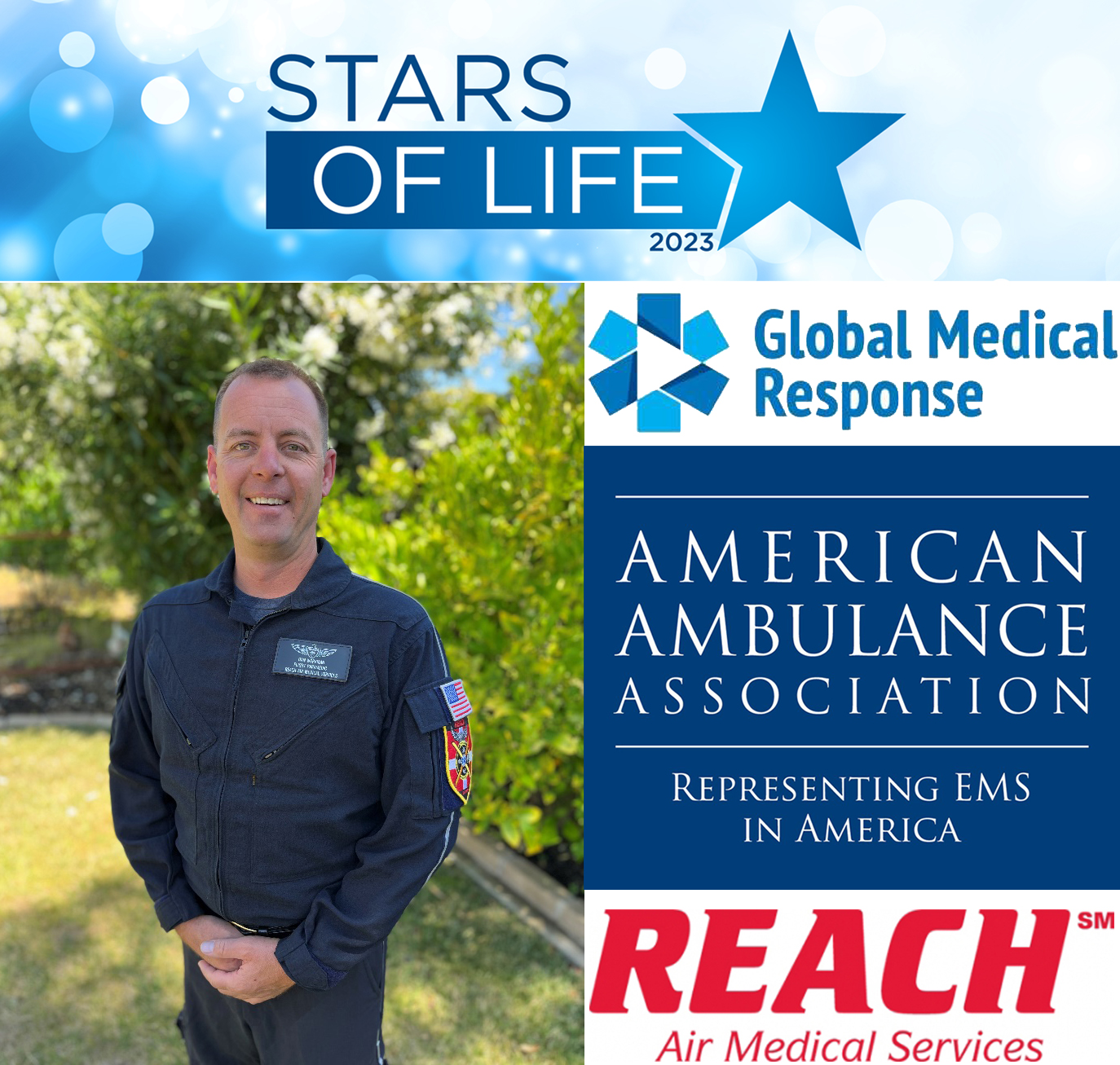
REACH Air Medical Services flight paramedic Danny Workman. Photo: Global Medical Response

At American Ambulance Association (AAA) Stars of Life Awards Ceremony in D.C.

By Amy Link, Global Medical Response

Danny Workman, flight paramedic with REACH Air Medical Services (REACH) in Concord, was named one of 32 Global Medical Response (GMR) Stars of Life. The Stars of Life program honors EMS first responders who have completed extraordinary acts of service for their patients, colleagues, communities or the EMS profession. Honorees from across the country will be recognized at the American Ambulance Association (AAA) Stars of Life Awards Ceremony, in Washington, D.C. November 5-8.

“This award is among the highest honors an EMS professional can receive,” said Joe Drago, program director for REACH. “In one of the deadliest hurricanes to strike the coast of Florida in recent years, Danny was an integral part of a neonatal team who helped evacuate neonates out of the danger zone.”

Workman said he is honored to be recognized as one of the 2023 Stars of Life. “Serving on a mission to save fragile newborns was a privilege and something I won’t soon forget.”

Each GMR Star of Life represents an incredible story of service and dedication in every area of the EMS industry and is selected by their peers in an extensive nomination process.

Nick Loporcaro, President and CEO of GMR said, “Our Stars are all exceptional EMS professionals who are very deserving of this important recognition. They represent the thousands of GMR first responders who have committed to a profession of service to others. On behalf of all GMR team members, we send our sincerest congratulations and appreciation to all our 2023 Stars.”

About REACH Air Medical Services

REACH Air Medical Services, headquartered in Sacramento, CA, provides critical care air and ground emergency medical services to communities throughout California, Oregon, Nevada, Alaska, Texas, Colorado and Hawaii. REACH employs hundreds of highly trained nurses, paramedics, pilots and aircraft maintenance technicians to provide service to patients using their fleet of medically equipped helicopters, airplanes and ground ambulances. REACH is accredited by the Commission on Accreditation of Medical Transport Systems (CAMTS), which is the gold standard for patient care and safety in the medical transport industry. For more information, visit www.REACHAir.com.

REACH is part of Global Medical Response. With nearly 38,000 team members, Global Medical Response delivers compassionate, quality medical care, primarily in the areas of emergency medical and patient relocation services in the United States and around the world. GMR was formed by combining the industry leaders in air, ground, mobile healthcare services, and community, industrial/specialty and wildland fire services. For additional information, visit us on LinkedIn or at www.GlobalMedicalResponse.com. 


Filed Under: Central County, Concord, News, People

BART intern’s mission to increase accessibility for BART’s blind and low-vision riders

October 5, 2023 By Publisher Leave a Comment

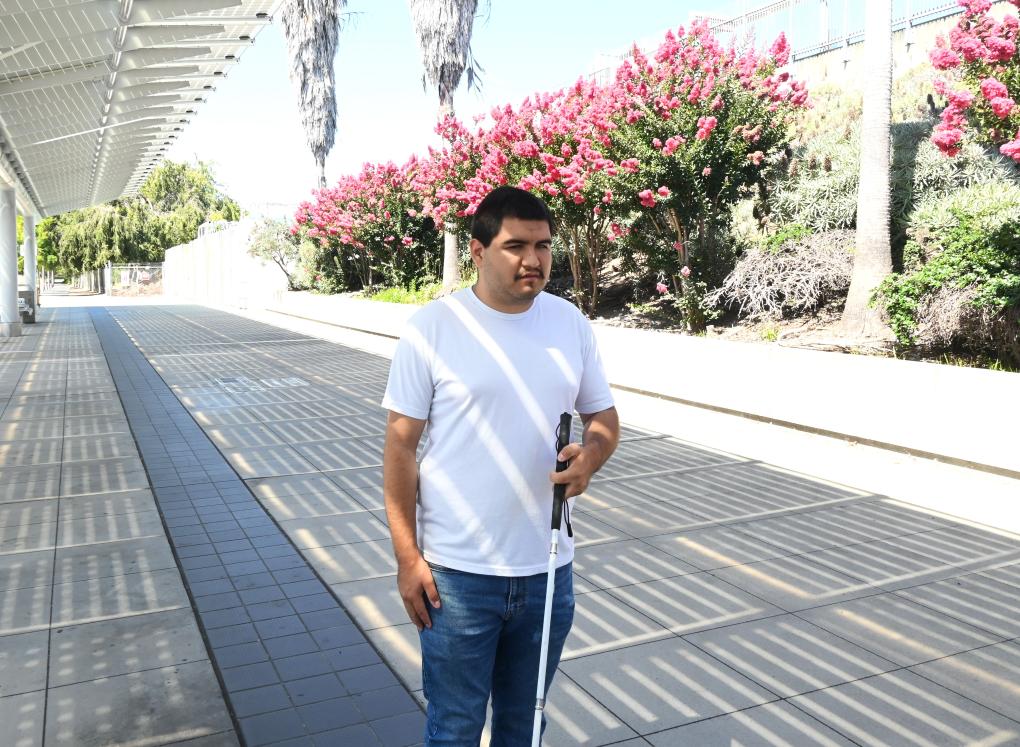
BART intern Erik Huizar poses for a portrait at Union City Station on Wednesday, Sept. 6, 2023. Photos: BART

“We need to be able to move freely and independently” – Erik Huizar

By BART Public Affairs

Erik Huizar has a large task ahead of him. Over the coming months, the 19-year-old college student is visiting – well, not just visiting, but walking, memorizing, sensing, pondering – twenty stations around the BART system to build descriptive reports of their tactile guideways. Some of these reports have been uploaded to the BART Low Vision or Blind Accessible Services webpage and more will be uploaded in the coming months.

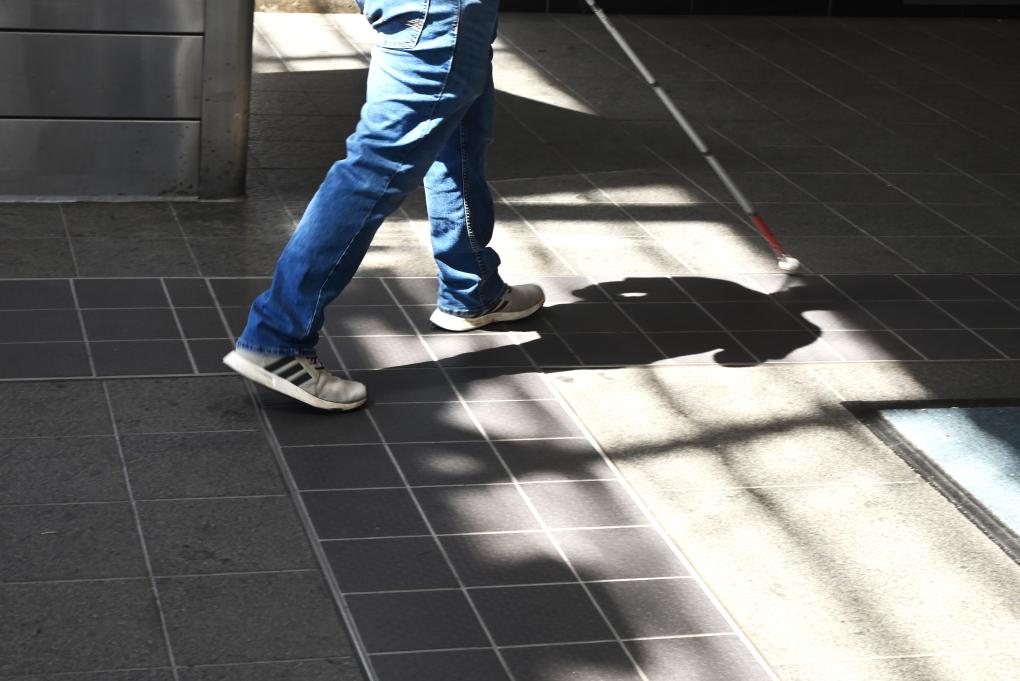
You might spot Huizar on one of his station visits, slowly and thoughtfully walking along one of these accessibility pathways with his white and red cane, tracing a pathway’s twists and turns, feeling its bumps and indentations, listening to the sound it makes when he taps its ridges, and noting down where it leads.

“I must look like such a weirdo,” he quipped on a recent information-gathering visit to Union City Station, as he walked back and forth over the pathways.

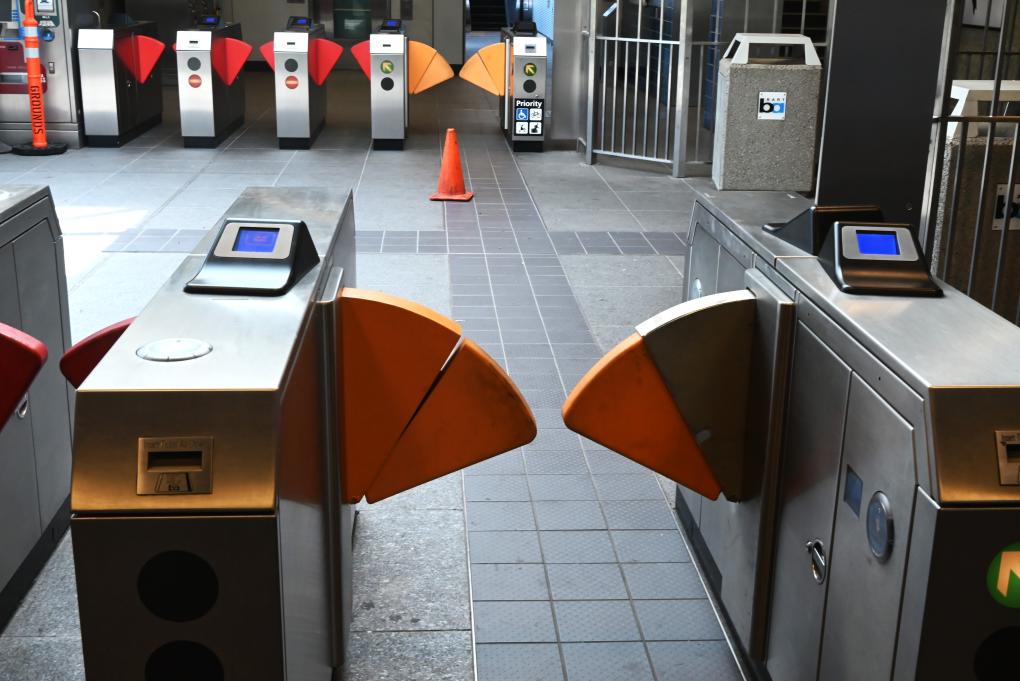
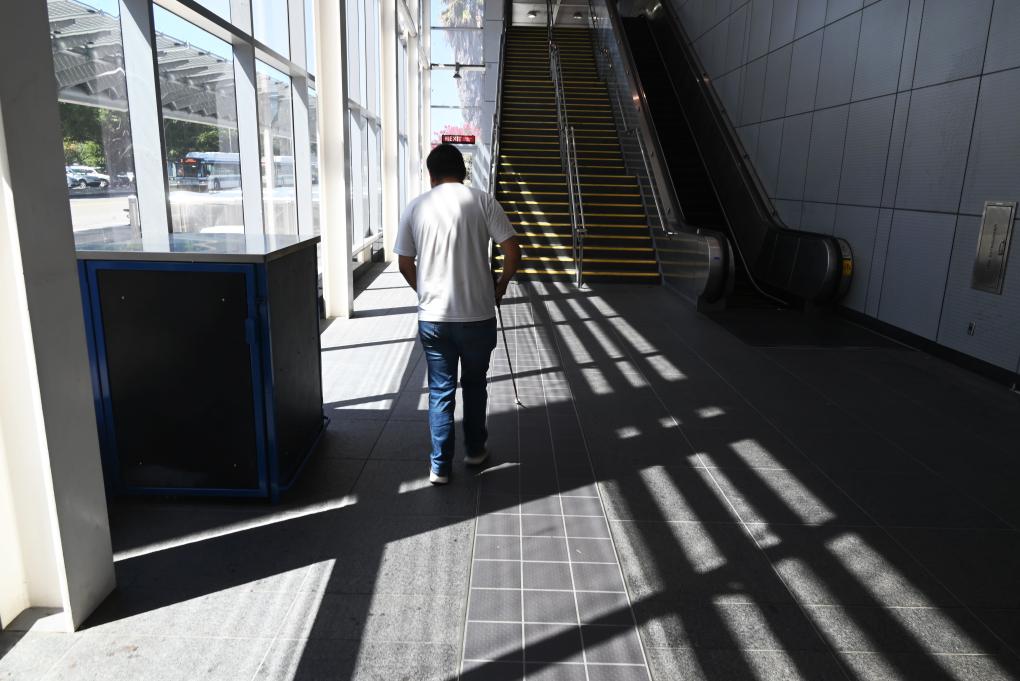
For blind and low-vision people like Huizar, tactile guideways are guide maps to station geography that enable them to independently travel from the bus intermodal area, into the station, through the accessible fare gates, then to the foot of the stairway to the platform. On the platform*, colored tactile strips denote the edge between the platforms and the trackway and mark where to board a train.

Tactile guideways often use a variety of cues for blind or low-vision riders to distinguish the pathways from the flooring around them. There is no national code or standard for these pathways, Huizar said, but typically, they are composed of materials and textures distinct from the station’s floor. Sometimes the pathways are yellow with truncated domes; other times, they may be gray and ridged; and sometimes, they are black with cones and bars.

The tactile guideway passing through the accessible fare gate at Union City Station on Wednesday, Sept. 6, 2023.

“Basically, the architect who designs the station decides what the pathways’ patterns will be, and that’s why we have stations where either there’s no detectable path or the detectable path is more decorative than useful,” Huizar said. “Many of these stations were built a long time ago, and no one really knows how to build these pathways correctly, or at least how to standardize the way to do it.”

Bob Franklin, BART’s Director of Customer Access and Accessibility, noted that in a national accessibility working group, the forty-plus public transit agencies involved “all do something different for their pathways.”

Huizar hopes his reports contribute to this still-budding body of knowledge and motivate decisionmakers to fund and improve them.

“These pathways are not as good as they can be,” said Huizar. “And this is a national issue.”

Huizar’s tactile guideway reports are highly detailed and descriptive. A typical report reads something like this: “All the paths are made of yellow six-inch-wide plastic tiles. When there is an intersection or direction change in the path, there is a block of truncated domes to indicate this. In multiple places, there are spurs, which split from a path, this indicates a direction change, or the end of a section of path.” (This excerpt comes from Huizar’s Milpitas Station report.)

He expects this information to be valuable to blind and low-vision BART riders, enabling them to get around a station without having to ask for help – a sometimes necessary annoyance when you’re just trying to get somewhere, Huizar said.

Tactile guideways support riders’ independence and right to affordable mobility, he added. BART riders rely on the system to travel from place to place – to appointments, to work, to social engagements. Seven percent of BART riders report having a disability, a percentage of which who are not able to operate automobiles.

BART intern Erik Huizar studies the tactile guideway at Union City Station on Wednesday, Sept. 6, 2023.

“BART is my way to get out and be independent and self-reliant,” said Sheri Albers, the Community Outreach Coordinator for The Lighthouse for the Blind, during a a Fleet of the Future safety orientation BART held this past winter for the blind and low-vision community. The orientation was followed by an online townhall BART hosted to gather input on upcoming projects and to hear directly from riders who are blind and low-vision about how it can improve accessibility services. BART plans to provide similar engagements for the deaf and hard-of-hearing and mobility-impaired communities.

“Information is powerful, and we want to ally the fear in our community of taking BART,” Albers said. “Once you eliminate the fear, the world is in your hands.”

To capture the necessary information for his reports, Huizar often spends hours in a station, tracing its pathways and scribbling detailed notes. He then takes his findings and drafts his report, describing things like how many sections compose the station’s pathway system, where those sections lead, and what color and material they are made of.

BART offers additional station resources for members of the blind and low-vision community, including Braille/tactile signs at station entrances and exits, at public restrooms, at the start of stairways, and at emergency exits, elevators, and escalators. Every fare machine in BART stations has earphone jacks, so you can listen to its message privately – “You have $200 on your Clipper card,” it might say. For every visual announcement in a station, there is a corresponding audio announcement. On fare gates, riders can activate a series of beeps that provide an audio code, denoting information such as whether they have enough balance on their Clipper card or if they need to tap again. You can read about additional accessibility services for blind and low-vision riders here.

“It’s a public transportation system, and it’s a federal law that we’re accessible to everyone,” Franklin said. “When we design it that way, it benefits everyone. The more universally we design something, the better it will be.”

BART intern Erik Huizar’s cane studying the metal ridge of the tactile guideway at Union City Station on Wednesday, Sept. 6, 2023.

Huizar is passionate about public transportation because he uses it to get most places. He’s working on a sociology degree and hopes to continue his studies to earn a master’s degree in orientation and mobility.

“I definitely want to focus on public transportation because that’s my favorite thing,” he said.

Huizar regularly rides BART to explore new spots – mostly in search of hidden gems and great food – or to hike with his girlfriend or friends. On days he doesn’t have schoolwork or anything important to do, “I’ll just ride the train and be absolutely entertained that whole day.”

“There’s a little boy inside me screaming for joy every time I get on a train because it’s just a lot of fun,” he said.

Huizar also acknowledged how essential public transportation is to the fabric of a well-functioning, equitable society.

“People rely on these trains, and not just people like me who can’t get around without them, but sighted people, too, who use them to visit friends and family or to get to work,” he said. “Without buses, without trains, many people wouldn’t be able to do that.”

Huizar secured his BART internship in a somewhat unusual fashion – he emailed General Manager Bob Powers directly after watching him and fellow transit leaders speak during a press conference for the April Transit CEO Ride-a-Long (Huizar said he watched the video scrolling YouTube while procrastinating on homework.)

“A bunch of the CEOs went up and talked about accessibility, and providing quality transportation is something I’m passionate about,” he said. “I thought, you know, I’d really like to be involved in that.”

So, he decided to email Powers and ask for a conversation, “because, like, who else?” Huizar figured he wouldn’t respond, so he hit send on the message before “chickening out.”

Two weeks later, he received an email from Alaric Degrafinried, Assistant General Manager of Administration at BART. The gist of Degrafinried’s reply was: “When can you meet?”

After an initial phone call, Degrafinried invited Huizar to BART Headquarters. “I was really excited; it was crazy to go to the place where everything happens,” he said. From there, Degrafinried connected Huizar with Franklin for a possible internship.

“And now, I’m here,” Huizar said, tying a bow on his road-to-BART story. “And I’m uniquely suited for this because I’m someone who uses, who needs, these pathways to navigate these stations, which can sometimes be very daunting and confusing for people.”

“It would be great,” he concluded, “if people would put the effort in so people like me can find things on our own – without having to ask for help.”

* BART is currently in the process of updating station platform-edge warning strips, which will soon be all bright yellow tiles with truncated domes, eliminating the black tiles, which had denoted car boarding areas. To mark platform waiting areas for door openings for the 3-door train cars, BART will be installing stickers adjacent to the warning strip. The train car’s middle door will be a blue-edged sticker, to denote the dedicated space for those who use wheelchairs and other mobility devices. Additionally, at the center of the platform, there will be 3’ x 4’ yellow directional bar tiles extending from the platform edge tiles, to let blind and low vision riders know of the guaranteed boarding area, regardless of the length of the train. There is an exception to this rule, when the train is in “manual mode” and stops at the end of the platform. 


Filed Under: BART, News, People

Kaiser eye doctor helps man see straight for first time since childhood

August 25, 2023 By Publisher 3 Comments

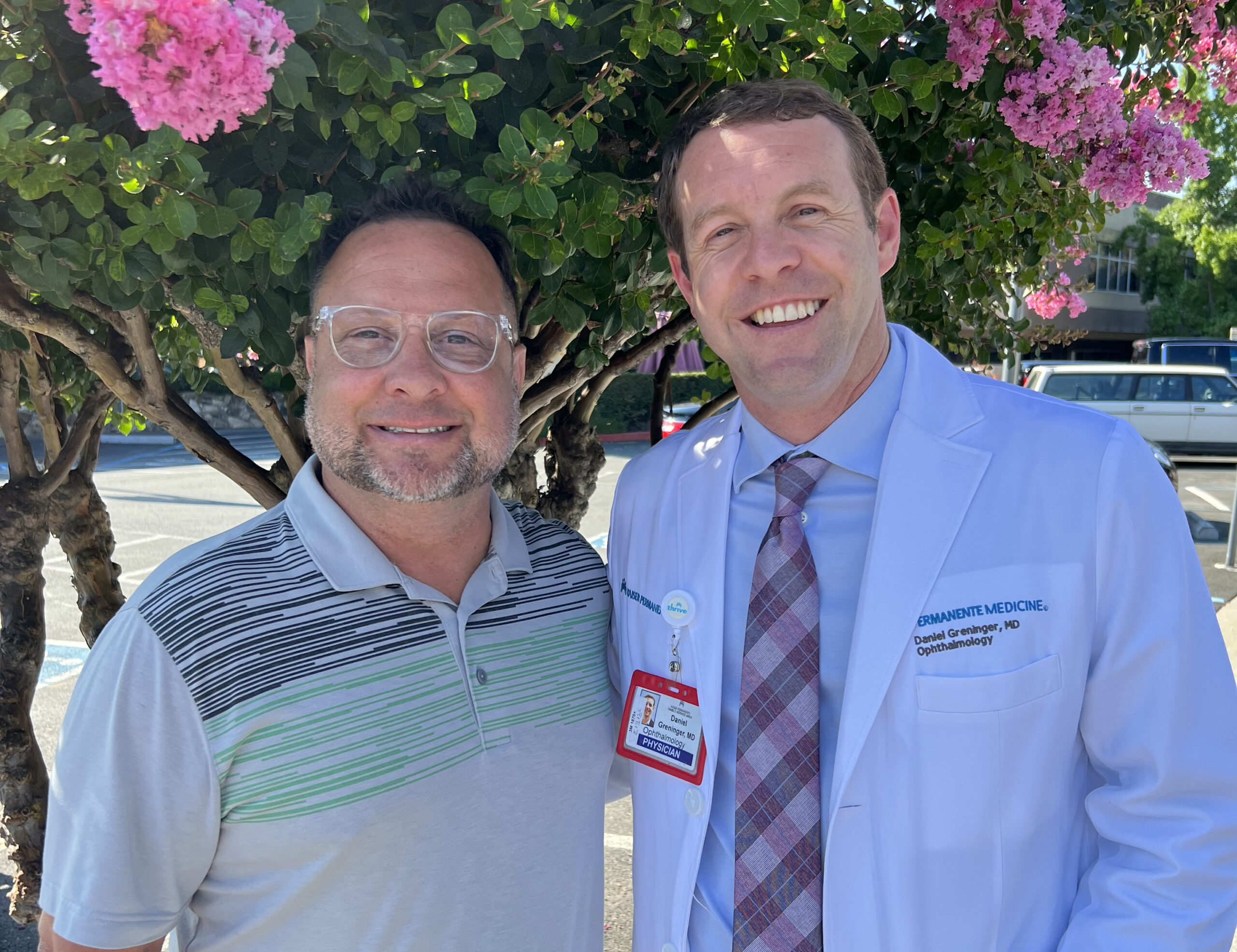
Patient Kyle Emard with Kaiser Permanente ophthalmologist Dr. Daniel Greninger. Photo by Allen D. Payton

“Strabismus” could affect as many as 30,000 people in Contra Costa and is correctable

“I look at the picture and go ‘wow’! I just feel good.” – patient Kyle Emard

“It’s an out-patient surgery. You go home the same day.” – Dr. Daniel Greninger

By Allen D. Payton

After living with being both cross-eyed and deaf for most of his life, 49-year-old Kyle Emard can now see straight thanks to the talent and skills of Kaiser Permanente ophthalmologist, Dr. Daniel Greninger, whose office is in Antioch. He corrected Emard’s vision impairment known as strabismus.

“After I was born my eyes would look straight ahead. But when I was five, my eyes started to go inward,” Emard shared through a sign language interpreter. “My mom asked me if I wanted surgery. I said, ‘no, no’.”

And he never did have the corrective surgery, until last year.

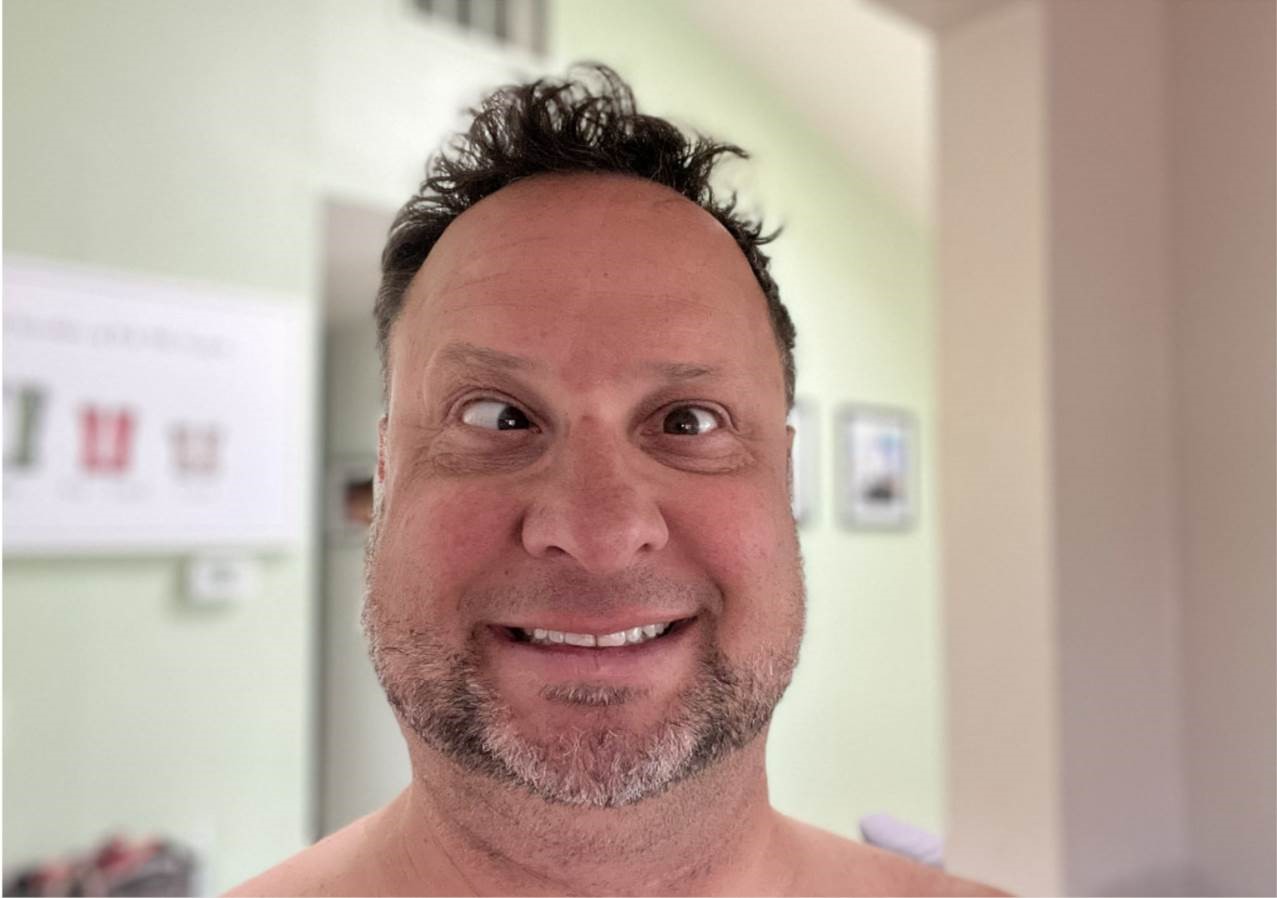
Kyle Emard before surgery. Photo Kaiser Permanente

“I never had any bullying,” Emard said. “I was playing football, wrestling and traveling all over the country. My grandfather had a travel agency. It didn’t bother me. People would ask me what was wrong with my eye. They thought I was blind in one eye. During conversations people would look past me, not sure which eye to look at. I’d think, ‘they’re not looking at me’. I’d say, ‘I’m looking at you’.”

“I graduated from high school. I got ready for college. Then I bought a house,” Emard continued. “My mom asked me, again if I wanted surgery, and I told her ‘no’.”

“Strabismus describes eye misalignment problems,” Greninger explained. “In Kyle’s case this is most likely attributed to accommodative esotropia. That’s a condition where a person’s eyes turn in excessively due to them trying to focus. Kyle is far sighted.”

“This is very common for eye misalignment problems,” the doctor added. “People have a hard time looking at those with strabismus.”

“Sometimes it would be a serious discussion and people would say, ‘look at me’, And I was,” Emard shared. “It was annoying.”

“For some people it’s more than annoying,” Greninger interjected. “For people with strabismus it’s a quality-of-life impact issue.”

“What is particularly unique for me from the doctor’s side of it is Kyle also has hearing impairment. He has to communicate visually,” he continued. “Sometimes people with strabismus and hearing impairment have double vision. Sometimes depth perception is affected.”

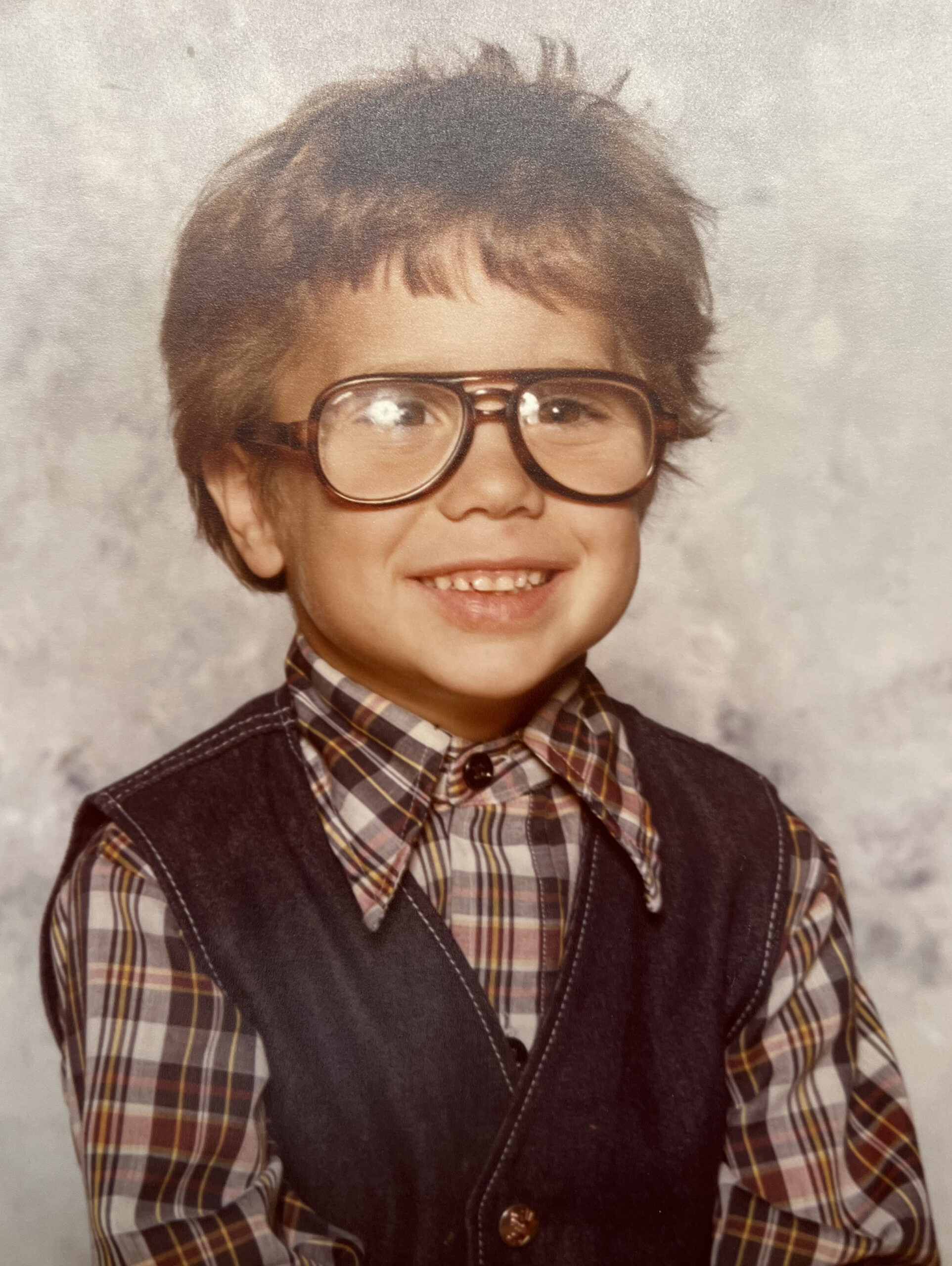
Kyle Emard wearing his first set of glasses at age 5. Photo courtesy of Kyle Emard.

Emard began wearing his first pair of glasses when he was five years old. But his vision progressively worsened, through the years.

“Kyle mainly looked out of one eye,” the doctor shared. “But surgery was done on both eyes. More on the right eye than the left.”

“For people with hearing impairment it’s called Usher Syndrome in which people have both hearing and vision impairment,” Greninger continued. “People assumed Kyle had that. Usher syndrome is a completely different genetic condition in which patients often have very significant hearing and vision deficits and are often functionally blind.  In Kyle’s case, I think people knew he was deaf, and then saw his eye drifting and assumed that he also couldn’t see due to Usher syndrome, which would be incorrect.”

“People assumed I was blind in one eye,” Emard shared.

Asked if it was difficult to read a book, watch TV or go to the movies, he said, “No.”

“His sight was fine. He could see 20/20 but he was only looking out of one eye,” the doctor replied. “If you have strabismus as a child, often the brain learns to ignore one eye to avoid seeing double.  In adults, acquired strabismus can often result in double vision. Kyle’s problem, accommodative esotropia, typically develops between 2-6 years of age, and is related to hyperopia, or far-sightedness.”

Emard said he continued to wear glasses, then mainly contacts in high school. He went snow skiing, snowboarding and dirt biking.

“I wouldn’t go up high places, just small hills,” he shared. “I played roller blade hockey, defensive end in football. That was all before.”

A graduate of Leigh High School in San Jose, Emard attended Gallaudet University in Washington, DC.

“It’s one of the best known colleges for the deaf. All the instruction is in ASL (American Sign Language),” Greninger added.

“It’s a muscle issue. There are six muscles that are attached to the eye that move it in different directions. Up and down, left and right, and torsion that twists the eye,” he explained. “In strabismus, sometimes it’s a disease of the eye muscles. More commonly it’s the brain not telling the eye to do something. Our brains are usually hardwired to know how much to turn to focus.”

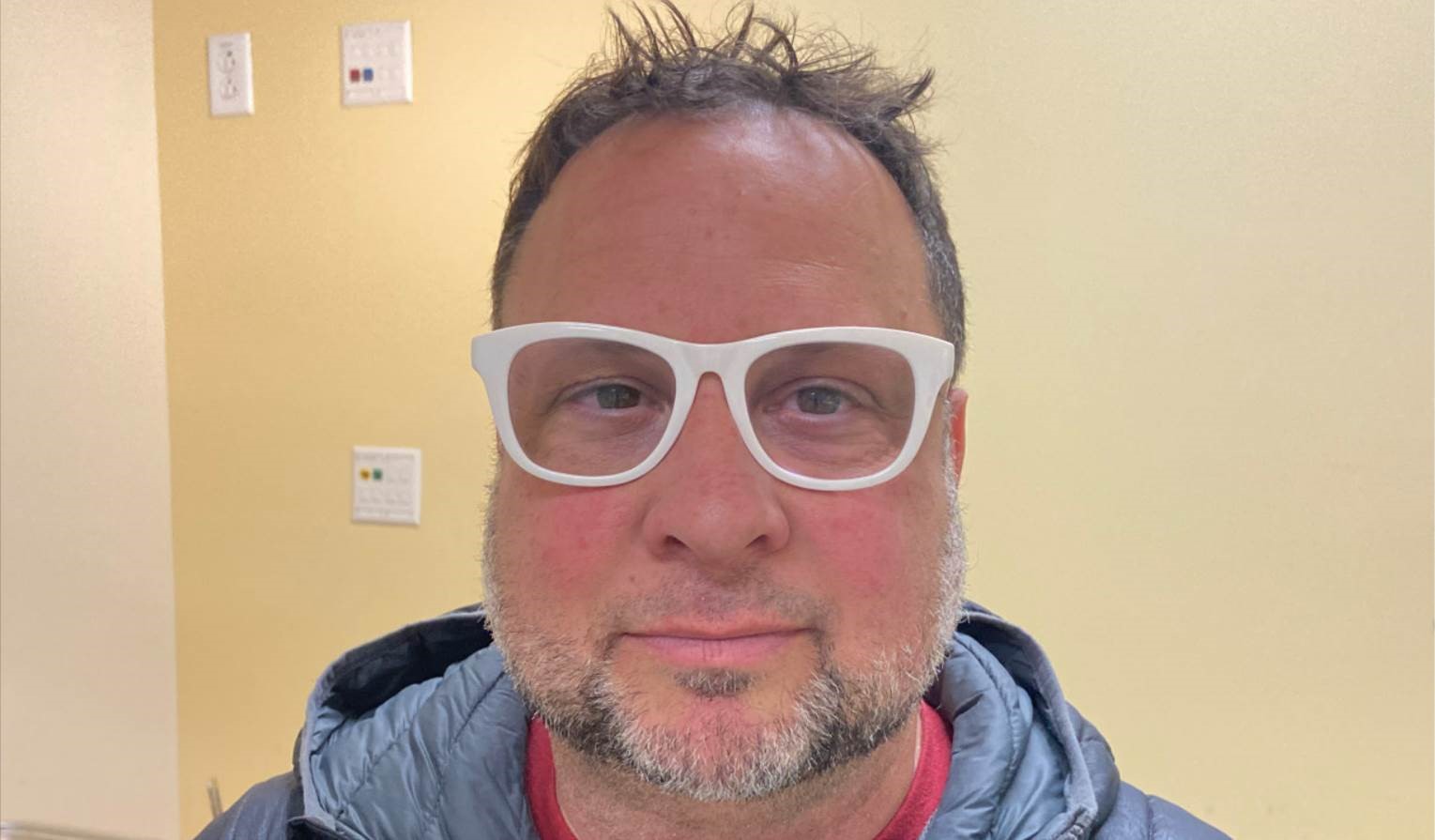
Kyle Emard post-surgery. Photo Kaiser Permanente

The Surgery

Asked when he decided to have the surgery Emard responded, “After my mom passed away three years ago. My family had money. Everything I was doing was done for the deaf organization. I felt it was the right time.”

The surgery took place last September.

“I met Kyle in 2022 after I had received a referral from one of my colleagues, a consult request. We set up a video chat with an interpreter,” Greninger shared. “We do video consults, first. For this condition it’s important for me to know the history of the condition.”

“We had that first video visit. We used some remote tools which allowed Kyle to take photos and videos at home,” the doctor continued. “We were able to use the components of technology that we didn’t have five years ago. I then had him come in for a complete eye exam to make sure his eyes were healthy.”

Asked if the technology is better, Grenginer said, “It’s safer, now. It’s about an hour-and-a-half surgery.”

“I can’t go into the brain and turn a screw a quarter inch to change how the brain controls the eye,” he explained. “In the surgery, we put in an eyelid speculum, make a small incision over the white part of the eye and find where the eye muscle is located. We put in a small suture where the muscle connects to the white of the eye. Then I detach the muscle with surgical scissors and move it to a new position.  If we move it back, this creates some slack and decreases the force on the eye for turning.”

“I wear special surgical loops to help me see. But it’s all done with hands no lasers,” the doctor stated. “The amount we move the muscles is determined by the measurements we take in the office. Deciding which muscles to move and in which pattern based on the person’s problem are the intellectual work of my specialty.”

“I don’t want to over-compensate or under do it,” he continued. “It’s done in millimeter precision. We’re measuring the half-millimeter. Each millimeter moves the eye three degrees.”

“I knew I was nervous out of fear of losing my eye,” Emard shared.

“Each time I saw you I was more comfortable,” he said to the doctor.

“I don’t remember the surgery. When I woke up, I thought, ‘I’m ready’. But I looked and was shocked,” Emard exclaimed.

“It’s general anesthesia surgery so you’re asleep the whole time,” Greninger said. “We were able to get a sign language interpreter to be there in Walnut Creek the whole day, which I think is very important to give people the same level of care. I was really happy the leadership and nursing staff were able to provide that.”

“We had to move three muscles on Kyle’s eyes. One muscle on his left eye and two muscles on his right eye,” the doctor explained. “First, we relaxed the muscle on the left eye. Then on the right eye we tightened the outside muscle and relaxed the inside muscle.”

“I remember the right eye was much more red than the left,” Emard explained. “After surgery I did have double vision for a little while but then it went away. I had full vision. I could see all the way around. It was strange.”

“After the surgery I felt the same,” he added.

He used eye drops for a few a days, “but the redness lasted a few weeks,” Emard shared.

Asked how long the recovery time is Greninger said, “About six to eight weeks. I usually tell patients in two months’ time people won’t be able to tell they had the surgery. Kyle came back to see me about six months later to see if everything was fine, about March of this year.”

“Sometimes I forgot. ‘Did I have surgery?” Emard stated. “I posted and let everyone know on Facebook and showed the before and after photos and got almost a thousand likes. After my surgery I cried a lot because my mom wasn’t around to see it. But she’s happy, now.”

Emard lives in Livermore, works in Fremont as a middle school counselor and has one child, a 15-year-old son.

Asked what his son thought Emard said, “He said ‘wow!’ He was shocked. He just kept looking around my eye, opening my eye. He was used to looking at me inward.”

Kyle Emard today. Photo by Allen D. Payton

“On the day of my surgery my son was at school, and he was all worried. He said my dad’s fine and the teacher said, ‘good’. The week after he had a football game and my friend drove me. I sat alone by the goal post. I told people I didn’t want to talk yet I’m still healing. But I had to be there.”

Asked if it has impacted his job Emard said, “It’s about the same” then spoke of the difference between the school pictures from last year compared to this year.

Asked if he feels different about himself, he said, “Oh, yes. I look at the picture and go ‘wow’! I just feel good.”

“After surgery my friends were gathering and said they missed my lazy eye,” Emard said with a laugh. “I’m happy every day.”

Asked if people who have the surgery get counseling after, Dr. Greninger said, “The psycho-social impact of strabismus has been well studied.  Characters in movies with strabismus often are portrayed with other disabilities, and people may wrongly assume that all people with eye misalignment have other intellectual handicaps.  Studies have shown that childhood strabismus can negatively impact a teacher’s perception of a student’s motivation or focus.  In addition, strabismus in adulthood can sometimes be a barrier to success in the workplace or finding a romantic partner.”

“Even the term lazy eye – we don’t use that term,” he continued. “Some people despite having strabismus they use the term lazy eye. It has a certain connotation to it. We think if it as a negative There’s a misunderstanding of people with strabismus.”

30,000 County Residents Have Correctable Vision Impairment

With offices at Kaiser Permanente Antioch Medical Center on Deer Valley Road, Dr. Greninger grew up in San Ramon, graduated from Cal High and earned his undergrad at Dartmouth College. He did his residency at UCSF Medical Center in Ophthalmology followed by a Fellowship in Pediatric Ophthalmology and Adult Strabismus at Oregon Health Science University in Portland.

“I started at the Antioch Medical Center in 2013. It’s been about 10 years of offering the surgery in Contra Costa County,” the doctor shared. “About half of my practice is adult strabismus and about half are children. We do about 100 to 150 surgeries like this each year.”

“We estimate we have about 15,000 with eye misalignment problems in our service area,” Greninger stated. “Sometimes people can have a medical problem like a stroke, thyroid eye disease, a neurological condition or facial trauma from an accident or assault. They can cause eye alignment problems. Probably half my adult patients had it as children and it either came back or it was never dealt with.”

He also estimates there are as many as 30,000 people in Contra Costa County suffering from strabismus which is correctable.

“Many people have this and don’t know something can be done or has been on the back burner for a long time,” Greninger stated. “Sharing stories like Kyle’s is good to let people know something can be done. I have patients come to me and say, ‘I wish I had come to you earlier’.”

“I try to put myself in the patient’s shoes to see how they’re thinking. It’s a leap of faith for a patient. It takes a lot of bravery to trust a doctor with your eyesight,” he said.

“It’s an out-patient surgery. You go home the same day. Most of the eye surgeries are done in Walnut Creek,” Greninger added.


Filed Under: Central County, East County, Health, News, People

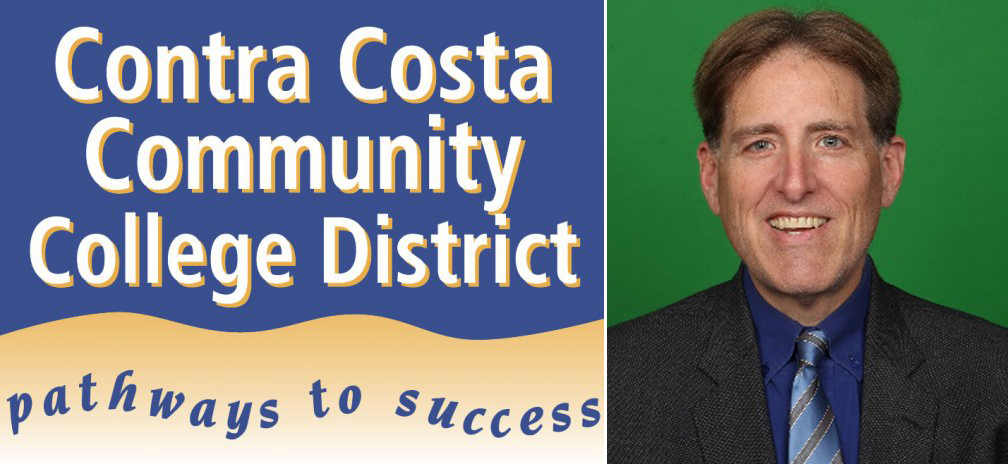
College District selects Dr. Tony Wold as Associate Vice Chancellor, CFO

August 8, 2023 By Publisher 1 Comment

By Marisa Greenberg, Marketing & Communications Coordinator, 4CD

MARTINEZ, California – The Contra Costa Community College District (4CD) has selected Dr. Tony Wold as the next Associate Vice Chancellor, Chief Financial Officer (AVC CFO). Following a nationwide search that began in May 2023, the 4CD Governing Board will vote on ratification of his contract at their August 9, 2023, meeting.

“We are excited to welcome Dr. Tony Wold to 4CD. He brings an impressive amount of experience in finance, public education, labor negotiations, and bond programs. He embodies a student-first approach, complementing our focus on student equity and success,” shared Executive Vice Chancellor of Administrative Services Dr. Micaela Ochoa.

For the past year, Dr. Wold served as Chief Business Officer in Residence for School Innovations & Achievement, where he focused on rebuilding systems to bring students back into schools while addressing the learning loss and changes in attendance behaviors resulting from the pandemic. He recently served as Associate Superintendent, Business Services, for West Contra Costa Unified School District (WCCUSD), where he oversaw the daily operations and management of accounting, budget, purchasing, payroll, employee benefits, labor relations, school operations, athletics, safety, warehouse, transportation, nutrition services, and risk management. He also helped lead the passage of WCCUSD’s $575 million Measure R Bond in March 2020, and overcoming a $49.9 million structural deficit to restore the WCCUSD budget certification.

“I am excited to join the 4CD team and support their vision of a college-going culture for its diverse student population,” said Wold. “Community colleges are essential in providing an affordable and quality higher education given the changing job market locally and across the world, and I look forward to helping 4CD successfully achieve that mission.”

Dr. Wold received his Bachelor of Science in Business Administration from the Marshall School of Business at the University of Southern California (USC), his School Business Management Certification and a Doctorate in Educational Leadership at USC. He also earned Chief Business Official certifications from the Council of Great City Schools, and Lead Negotiators certification from the School Employers Association of California (SEAC).

The Contra Costa Community College District (4CD) is one of the largest multi-college community college districts in California. The 4CD serves 1.2 million residents, and its boundaries encompass all but 48 of the 734-square-mile land area of Contra Costa County. 4CD is home to Contra Costa College in San Pablo, Diablo Valley College with campuses in Pleasant Hill and San Ramon, and Los Medanos College with campuses in Pittsburg and Brentwood. The District headquarters is located in downtown Martinez. Each college is individually accredited by the Accrediting Commission for Community and Junior Colleges. For more information visit www.4cd.edu.


Filed Under: Education, News, People

Walnut Creek senior living community celebrates resident BFFs on National Friendship Day Aug. 6

August 2, 2023 By Publisher Leave a Comment


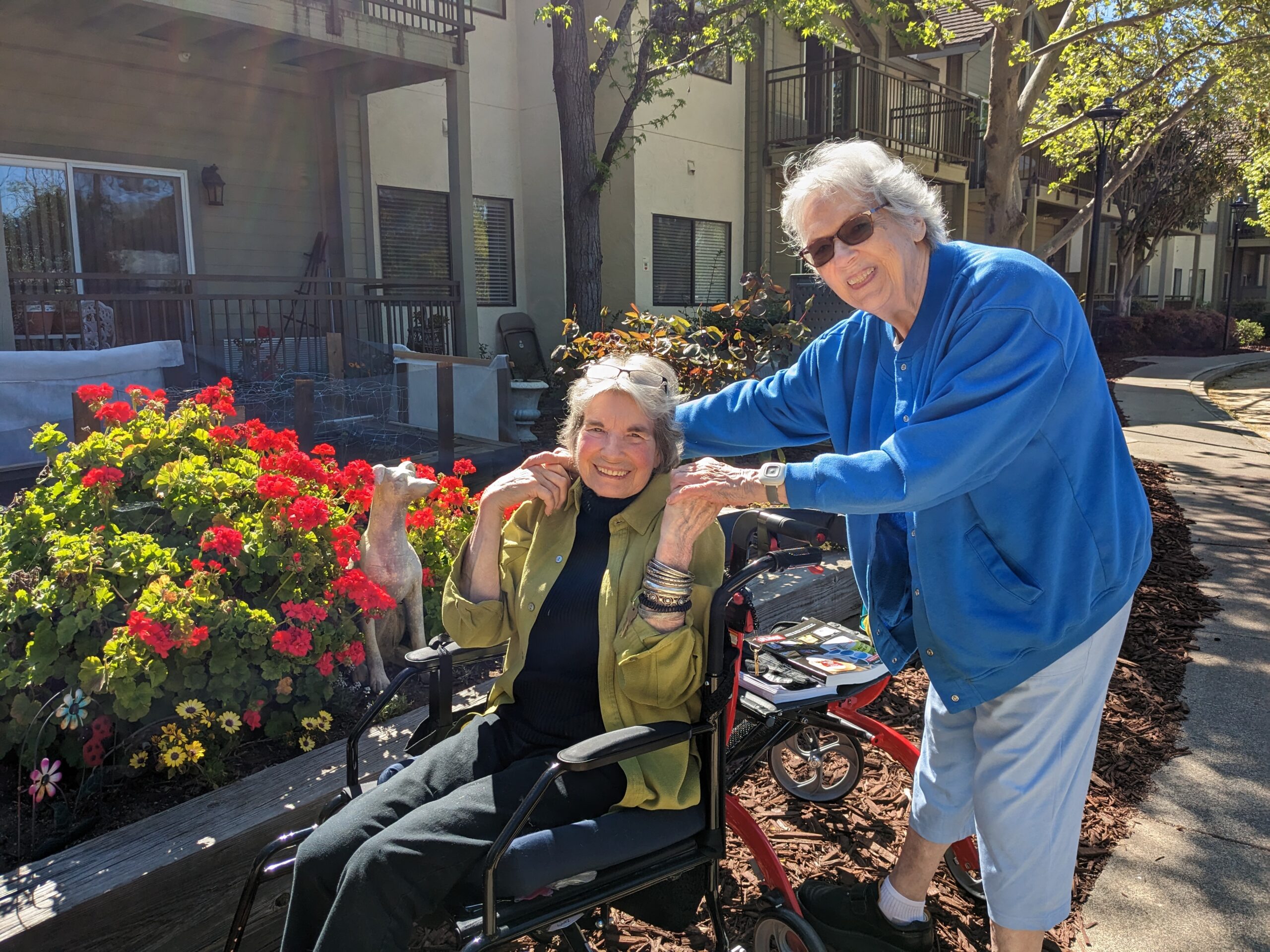
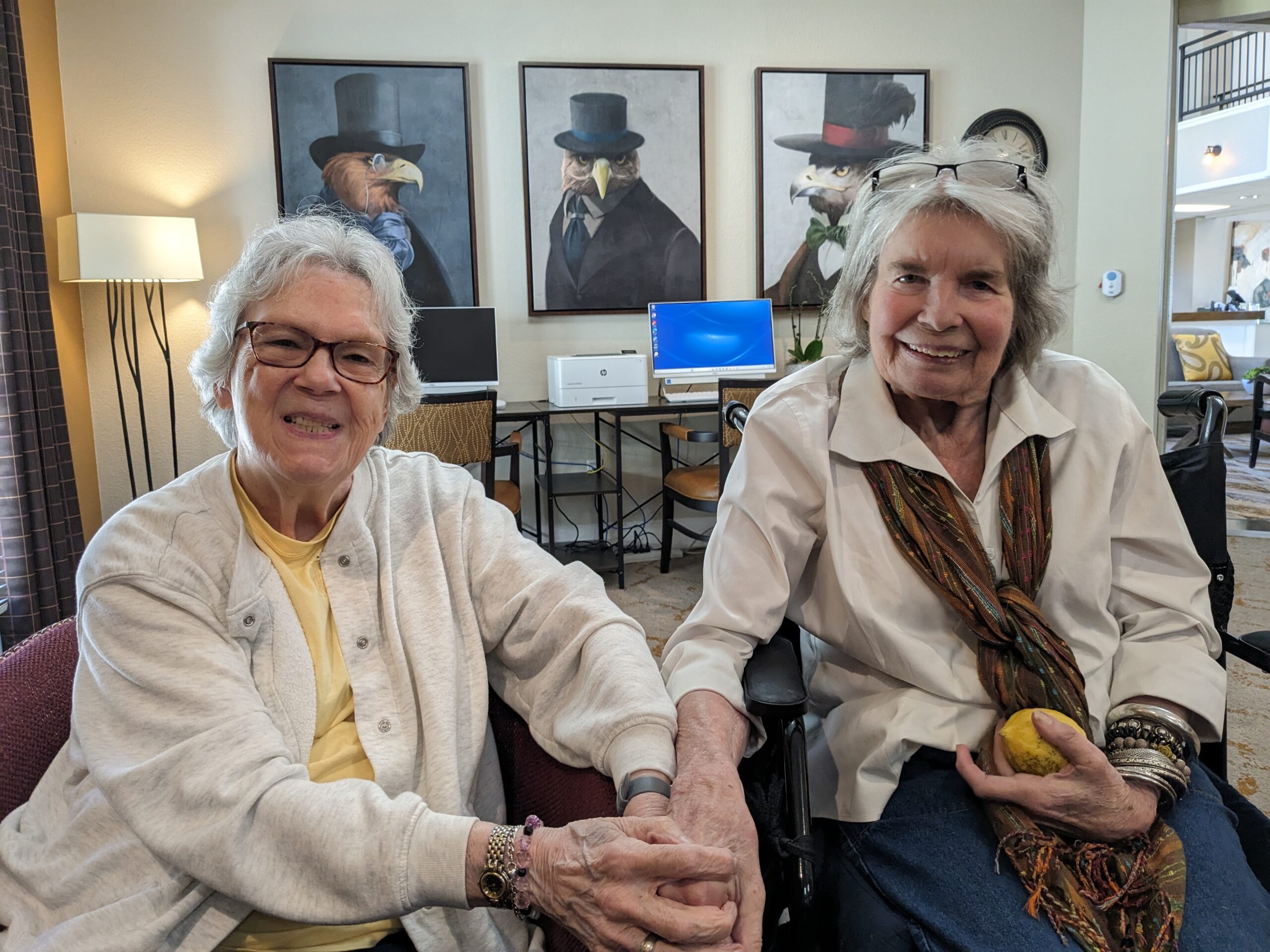
Residents Judy Watson and Katherine Himmelman enjoy spending time together. Photos: The Kensington at Walnut Creek

By Uniqua Williams

Friendship makes the world go round. At all ages, having the support and consistency of friends is important. In a senior living community, like The Kensington at Walnut Creek, having a friend not only makes life more fun but offers many health benefits. In honor of National Friendship Day, Sunday, August 6, 2023, The Kensington is highlighting one of the community’s most popular duos. Judy Watson (82) and Katherine Himmelman (73) instantly formed a lasting friendship when they both moved into the community in early 2020. Since their introduction, this inseparable pair have experienced improvements in both their mental health and social experiences.

Watson and Himmelman credit their friendship to resident physical therapist and ONR specialist, Gena McCormick, who saw the potential of a lasting connection and introduced the two residents to each other during one of Himmelman’s physical therapy sessions with McCormick. McCormick mentioned that there was a nice woman at the community she thought Himmelman would be great friends with. The nice woman in question was Watson, and the rest was history.

Since then, the duo have been inseparable. They have shared many special memories and tend to participate in activities within the community together. One of their favorite things to do and some of their best memories have come from their regular walks they used to take up and down The Kensington driveway.

“Walking along the community driveway is what really brought us closer together,” said Himmelman. “It allowed us a space to share our thoughts and feelings openly. Having someone to confide in has been so helpful for the both of us, offering support through life’s ups and downs.”

Although their daily walks are what aided in solidifying their unbreakable bond, the two also enjoy participating in other activities within the community together, including having breakfast together every morning, joining exercise classes and even attending Sunday Mass. Throughout their time together, their friendship flourished – transcending age and time. These simple walks and daily activities created a profound connection, making each day brighter and reminding them both that true friendship knows no bounds.

Nowadays, Himmelman’s physical limitations have hindered the pair from taking frequent walks, but they find no shortage of ways to interact with one another. Through these interactions, Watson and Himmelman offer each other their constant support.

“I never thought I’d find friendship at this age, but it’s been beautiful, with no stumbling blocks,” said Watson. “I’ve learned how to turn Katherine’s frown upside down, and we share a special bond that defies expectations. Age has brought wisdom, and our connection feels effortless. We are grateful for this unexpected and cherished friendship.”

Several studies have shown that finding friends that are compatible is beneficial to both mental and physical health as we age. The average person tends to be happier and healthier when participating in activities with friends they care about. Increased socialization can result in a sharper memory, low blood pressure, and boost motivation for daily activities. At any age, the aspect of friendship is vital to achieving happiness and longevity.

“Judy and I found trust and understanding that encouraged us to be more social, navigating health problems and aging together,” said Himmelman. “We assimilated into the whole group, supporting each other to participate in various activities happening in the community, fostering a sense of togetherness.”

Even now, the two are still in awe at how their friendship has grown and flourished over the years. Through their togetherness, they’ve been able to continue to encourage one another and rediscover the joy of connecting with someone who truly uplifts them. Two completely different people, from opposite sides of life, found a way to form an unbreakable bond at such a wise age. A bond that many from later generations still struggle to find. For those, no matter the age, still looking to cultivate relationships as strong as the Himmelman and Watson duo, can take the advice from these two who do it best.

“Most people that move into assisted care have a difficult time,” said Himmelman. “Judy and I were lucky enough to meet each other. It gave us something to hold on to. As you age, treasure friendships like Judy and mine. They become lifelines, supporting you through life’s challenges. True friends bring joy, understanding, and a sense of togetherness. Embrace these when you can. That is essential.”

“Finding a pair to honor during National Friendship Day was no struggle when you have witnessed the bond that Judy and Katherine have,” said Kayla Pierce, wellness director at The Kensington “They are constantly encouraging and supporting each other. Having a blossoming friendship is extremely important in senior living communities.”

“If Kayla could pick us out as two people who have a good friendship worth highlighting, we must be doing something right,” said Watson.

About the Kensington at Walnut Creek:  

Life at The Kensington is vibrant, fulfilling and as active or carefree as you desire. The community offers Assisted Living and Memory Care in a friendly environment where our residents and associates enjoy being served and serving others. Our caring team of associates will customize a care program that is right for you while you continue to enjoy your friends, hobbies, and new opportunities at The Kensington, surrounded by mature redwood trees and filled with the comforts of a modern resort. The Kensington is an oasis in Walnut Creek, tucked away from the bustle of the city, but close enough you could walk. To learn more, visit our website or call 925-693-7784.


For members of the media interested in covering this story, email Uniqua Williams at uwilliams@piercom.com.


Filed Under: Central County, People, Seniors

Jerry Marquez promoted to Relationship Manager at BAC Community Bank

July 31, 2023 By Publisher Leave a Comment

By Josef Britschgi, Marketing & Communication Administrator, BAC Community Bank

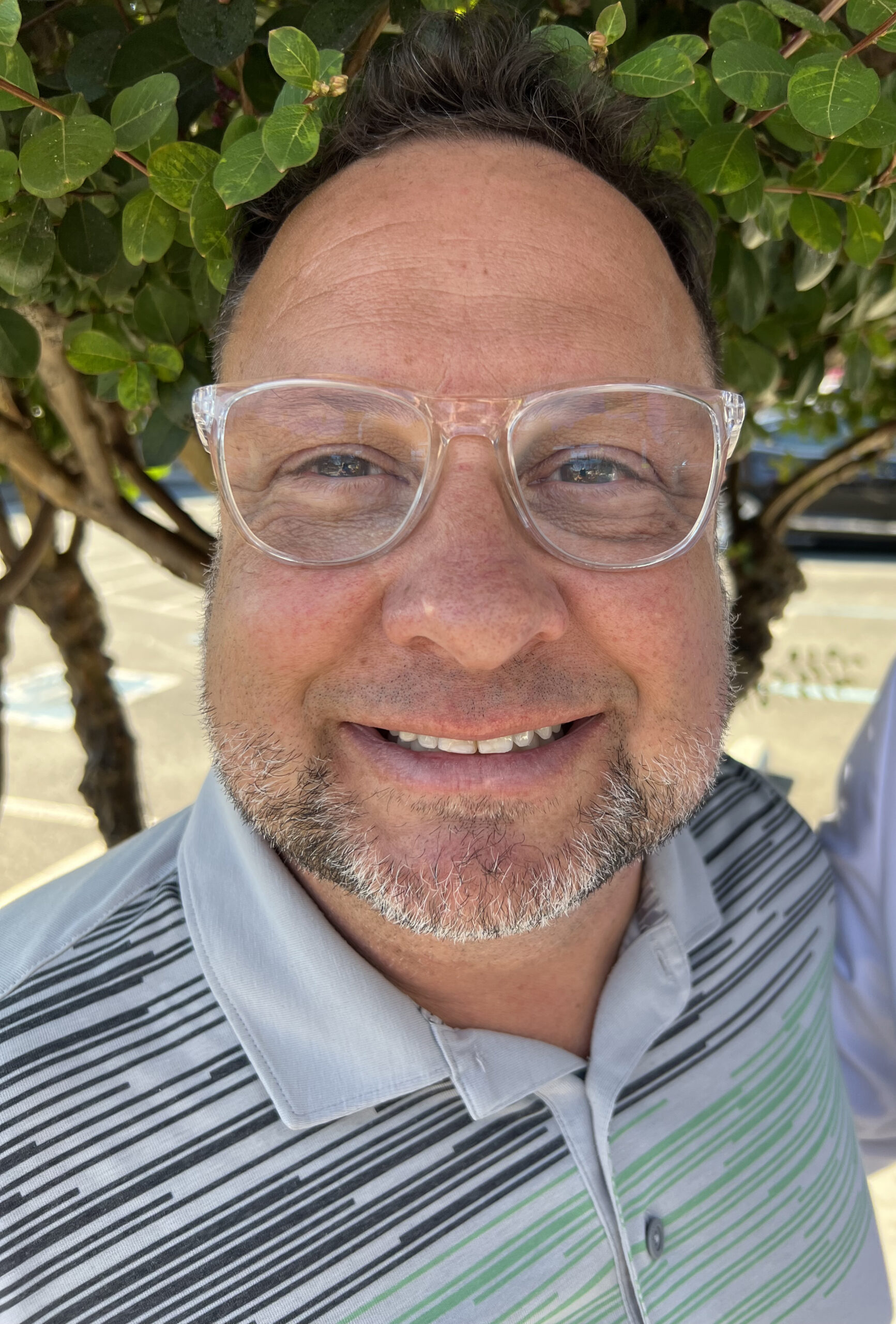
Jerry Marquez

BAC Community Bank is proud to announce the promotion of Jerry Marquez to the role of Relationship Manager, leveraging years of expertise in serving the bank’s valued customers.

As an integral part of the BAC family for over eight years, Marquez has excelled in various roles, including branch management and central banking operations. This promotion reflects his outstanding contributions and unwavering commitment to delivering exceptional service to the bank’s clients.

Marquez has a passion for building meaningful relationships within the community, a quality influenced by his growing up in a small farming town. He carries this spirit into his new role, embracing the small-town essence that has made BAC Community Bank a cornerstone of Brentwood and surrounding Contra Costa communities.

As a Relationship Manager, Marquez will draw upon his wealth of experience to cater to the diverse financial needs of both existing and new bank customers. The bank is confident that he will excel in this capacity, ensuring that consumer and commercial clients continue to receive the best products, technology, and service that have defined BAC Community Bank’s commitment to excellence.

“We are confident that the passion, expertise, and dedication Jerry Marquez demonstrates will continue to contribute to the success of our clients and reinforce the position of BAC Community Bank as a trusted community financial institution,” said Eddie Lira, Executive Vice President and Chief Commercial Banking Officer.

Marquez is excited to assume this new responsibility and looks forward to further strengthening the connections between BAC Community Bank and the communities it serves. “I am truly honored by this opportunity to serve as a Relationship Manager,” he shared. “My aim is to build enduring customer partnerships, providing each client with personalized financial solutions to help them achieve their goals.”

About BAC Community Bank

BAC Community Bank is California’s 10th oldest state-chartered bank. Established in 1965, BAC operates branch offices in Contra Costa, San Joaquin and Stanislaus counties and is identified as “one of the strongest financial institutions in the nation” by BauerFinancial, Inc.

The bank is centrally headquartered in Stockton, California, and is continuously recognized for banking excellence through local awards and banking industry accolades.

BAC Community Bank is an Equal Housing Lender and Equal Opportunity Employer. Member FDIC. More information is available online at www.bankbac.com.

Filed Under: Business, Central County, Concord, East County, News, People

Antioch priest appointed first ever volunteer Con Fire Chaplain

July 28, 2023 By Publisher Leave a Comment

By Contra Costa County Fire Protection District

First ever Con Fire Chaplain Fr. Robert Rien,

We are pleased to announce that Father Robert Rien has accepted the newly created position of volunteer Fire Chaplain – lead as part of the fire district peer support program. He is the first-ever official Fire Chaplain for Contra Costa County Fire Protection District. This appointment is effective immediately.

Father Robert Rien is a native of Oakland, California, and is a Priest of the Roman Catholic Diocese of Oakland for the past 50 years. Ordained in 1974, he served parishes in Alameda and Contra Costa County. Three years after ordination, he served as the Catholic Chaplain for the 349th Military Air Lift Wing, stationed at Travis Air Force Base for five years.

He has been the Pastor of St. Ignatius of Antioch Parish in Antioch for the last 18 years. During that time, he served as Chaplain for the Antioch Police Department and for the East Contra Costa Fire Protection District. He holds the distinguished Master Chaplain Certification from the International Conference of Police Chaplains.

Before being assigned to parishes in Contra Costa County in 2001, he served as Chaplain for the Oakland Fire Department. In addition to his other duties and responsibilities, he serves as Catholic Chaplain for both Sutter-Delta and Kaiser Deer Valley Hospitals.

Additionally, he serves as a Regional Chaplain for the East Bay Regional Park District and a Contra Costa County Peer Support Services Association member.

Father Robert currently resides in Antioch. When not tending to his parish, he enjoys reading, cooking, and watching the 49ers, Warriors, and Giants. He appreciates being with friends and loved ones.

Located in East County, Father Robert can be reached by email at Rrien@cccfpd.org. Please assist Father Robert in becoming familiar with the District and join us in making him a welcome part of the Con Fire team!

Filed Under: East County, Faith, Fire, News, People

Less than nine months in permanent position Antioch Police Chief Ford announces retirement

July 19, 2023 By Publisher 1 Comment

“…with a heavy heart” his last day will be August 11th; while 35 officers on paid leave due to two investigations

Antioch Police Chief Dr. Steven A. Ford. Source: APD

By Allen D. Payton

With rumors beginning to circulate in the community Antioch Police Chief Steve Ford announced his retirement on Wednesday afternoon, July 19, 2023. His last day will be August 11th.

After less than nine months in his permanent position as the leader of the department, Ford wrote to his staff, “Dear members of the Antioch Police Department,

It is with a heavy heart that I forward this email to inform that I will be retiring as of August 11th. My time here has been both a tremendous opportunity and quite challenging. What is most meaningful to me are the relationships I have forged. I’m grateful for the way you embraced me and the changes we made.

I firmly believe with your help and determination this organization is poised to move forward in a very meaningful way and evolve where anyone would want to work.

It’s been my privilege to have worked with all of you.

Sincerely,

Steve”

——–

Screenshot of Chief Ford’s resignation email sent Wednesday, July 19, 2023.

Although he had just started his tenure as interim police chief following a grand oath of office ceremony on April 27, 2022, Ford is named in a federal lawsuit regarding the Antioch officers’ racist text scandal which covered a time period ending that month. He is also scheduled to testify at a hearing this Friday, July 21, in a murder case involving four defendants whose attorneys claim officers violated their civil rights.

In addition, during their meeting on April 11, 2023, the council majority moved forward with an effort to directly hire the police chief instead of leaving it up to the city manager, as is done with all other department heads.

It will leave the City with an acting city manager, no assistant city manager, an acting public works director, currently no acting community development director as of Monday afternoon due to the departure of Forrest Ebbs last Friday, and no assistant city attorney. Unless the city council takes action to change who appoints the police chief, Acting City Manager Kwame Reed will be tasked with appointing an acting or interim chief. Captain Tony Morefield filled the position after former Chief Tammany Brooks left for a new job in Boise, Idaho in October 2021, until Ford came on board.

UPDATE 1: When reached for comment District 2 Councilman Mike Barbanica said, “this took us all by surprise. I learned of it this evening. I’ve worked with the chief closely during the time he has been here. Now, that he has made his decision, what we need to do is regroup and talk about who to appoint as acting or interim chief. Kwame is going to need the support of the city council. We cannot be without a chief.”

UPDATE 2: Chief Ford Issues Statement to Community

The following press release was issued Wednesday night:

July 19, 2023 – Antioch, California

The Antioch Police Department announces the retirement of Chief Steven A. Ford effective August 11, 2023. The following is a statement from Chief Ford to the Antioch Community.

To the Antioch Community,

I am writing to inform you of my decision to retire from the Antioch Police Department as of August 11, 2023. I am truly grateful for the opportunity to have served as your Chief. I have worked with some very talented and passionate people – it has been a great privilege to learn and grow from them.

I am proud of what we have accomplished and firmly believe the groundwork has been laid for organizational success. I know our work to align us with the tenants of Procedural Justice and Constitutional Policing will keep this Department headed in the right direction. I sincerely hope our engagement with the Community will continue and flourish.

I attribute our numerous accomplishments to support from the City Council, the tremendous Citizens of Antioch, and the talented members of this Police Department, who continue to embrace organizational changes with enthusiasm and dedication. Because of this, the Antioch Police Department has become more inclusive, equitable, and a better place to work.

Sincerely,

Steven A. Ford

Chief of Police

———-

Efforts to reach Ford for further comment and the other four council members for their responses were unsuccessful prior to publication Wednesday evening. Please check back later for any updates to this report.


Filed Under: East County, News, People, Police

Kaiser Permanente Richmond employees support daughter’s childhood dream to become a doctor

June 7, 2023 By Publisher 2 Comments

Bianca Silva with parents Letty and Martin Silva on graduation day. Photos: Kaiser Permanente

“Sí se puede! Dreams do come true!

Dr. Bianca Silva.

By Ronelle Scardina

Bianca Silva believed her grandfather’s words, “Sí se puede,” and her mother’s advice that “if you can think it, you can make it happen.” On May 20, Bianca graduated with a D.O. degree from Pacific Northwest University of Health Sciences College of Osteopathic Medicine. She is preparing for her first job in June as a family medicine resident physician at Kaiser Permanente Vallejo with the intention of serving the local community she once grew up in as a teen.

Bianca’s parents, Martin and Letty Silva, work at the Kaiser Permanente Richmond Medical Center. He is a gardener, and she is an administrative assistant. Both parents supported their daughter’s dream of becoming a doctor. After years of hard work, they are excited to see her dreams come true.

“When Bianca was in middle school, my husband would pick her up from school as he was getting off his shift and bring her to me at the pharmacy at the Kaiser Permanente Richmond Medical Center,” Letty recounted. “She had to wait for 30 minutes until my shift ended because he worked the night shift and I worked the day shift. Bianca enjoyed her visits. She got to know the team and had an opportunity to be exposed to so much about working in the medical field. One day, Bianca looked up at me and said that she wanted to become a doctor when she grows up.”

Bianca always demonstrated commitment to pursing her dream and working with medically underserved and vulnerable populations. She worked hard—something she learned at a young age. Growing up, she helped her father with landscaping side jobs by picking up sticks and leaves in return for treats at McDonald’s.

“We believed it was important to teach them responsibility and commitment,” Martin said. “We said that if they could think it, they could make it happen!”

It has been a long journey, but the family was always there to support and encourage Bianca along the way. She was especially close to her now deceased grandfather, Raul, who encouraged Bianca to pursue her dream of becoming a doctor — “Sí se puede, echale ganas . . . Yes, you can, give it your best!”

“He motivated her to achieve her goal,” Letty noted. “Bianca put in a lot of effort and never gave up. She’s looking forward to the day that she can visit his grave with her degree and let him know all about it. Although he won’t be at her graduation, Bianca knows deep in her heart that he will be there with her in spirit.”

Bianca was born at the Kaiser Permanente Oakland Medical Center. She grew up in Richmond with her older brother, Martin, Jr., and younger sister, Jessica. She later moved to Vallejo to attend Jesse Bethel High School. Bianca received most of her care at Kaiser Permanente Vallejo Medical Center, where she would eventually match for residency. She currently lives at home in Fairfield with her cat, Luna.

The family is looking forward to celebrating Bianca’s graduation and new job on June 10.

Letty, Bianca and Martin Silva.

Martin Silva has been employed at Kaiser Permanente Richmond since March, 1995. He spent seven years in Environmental Services before transferring to the Landscape Team as a gardener, where he has worked ever since. Letty has worked for Kaiser Permanente Richmond since 1987.

A Richmond native, Letty hoped to work at Kaiser Permanente since she was a little girl because she wanted to give back to the local community.

“We love our community,” she said. “We love to help our neighbors and our other family at Kaiser Permanente—it’s considered our home away from home. It took a lot of sacrifice and commitment, and it means everything. We are so proud of Bianca’s accomplishments. It was worth it!”

Filed Under: Education, Health, News, People, West County

Danville resident Alan Kalin among Bay Area 2023 Bike Champion of the Year Winners

April 29, 2023 By Publisher Leave a Comment

Danville cyclist Alan Kalin on the road up Mt. Diablo. Photo: MTC

Bike Month begins May 1, Bike to Wherever Days all month, Bike to Work Day is May 18

Bay Area Bike to Wherever Days (BTWD) organizers have named the winners of the 2023 Bike Champion of the Year (BCOY) awards. Given to individuals for inspiring bicycling in their Bay Area communities, this award recognizes riders in the nine San Francisco Bay Area counties for their commitment to cycling as the primary mode of transport.

Here are the 2023 Bike Champion of the Year award winners:

  • Contra Costa County: Alan Kalin, who almost single handedly made bicycling on Mount Diablo safer through a first-of-its-kind project that has become a model for biking safety across the nation.
  • Alameda County: Demorea “Truckie” Evans, part of Oakland’s Roll Out Crew, believes that “It’s going to take all of us to see the change that we desire to see.”
  • Marin County: Dave Rhoads actively volunteers with the Marin County Bicycle Coalition (MCBC) and advocated for safer bicycle infrastructure and the use of bicycles as a means of transportation.
  • Napa County (co-winners): Violet Grove, our youngest champions ever at age 13 and a great inspiration for the future, and Donal O’Briain, who started riding his bike for transportation just about the age of Violet and has never stopped pedaling or advocating for bicycles.
  • San Francisco County: Hansel Palarca-Reiva, who learned to bike as an adult during the pandemic. “I know that learning to ride as an adult can be terrifying, embarrassing, and intimidating,” he said. “But the joy that awaits you is truly worth the struggle, and I say all this from personal experience.”
  • San Mateo County: Marin Holt founded Coastside on Bikes, connecting people who need bikes to people who have bikes that need a new home – over 200 bikes to date!
  • Santa Clara County: April Beyersdorf is this year’s second youngest rider as a junior in high school, and the founder of her school’s Sustainable Commuting Club. The club’s mission is to encourage other students to feel confident biking and taking public transit, with a goal of reducing traffic congestion and protecting the environment.
  • Solano County: Robert “Bob” Haran, who was inspired by the kids in “Spanky and Our Gang” at age 10 to start riding and hasn’t looked back since.
  • Sonoma County: Bill Petty says his morning bike commute is better than coffee, and he brings that enthusiasm to his participation as a Climate Rider with Sonoma County Bicycle Coalition’s Green Fondo fundraising team and weekly rider with the Santa Rosa Taco Tuesday Ride.

About the Contra Costa County Winner

Alan Kalin’s passion for cycling isn’t just about the ride. “My story is one of dogged determination to prevent collisions and save lives on the roads of Mount Diablo,” says Alan. A Danville resident and Bay Area native, he started riding Mount Diablo three days a week in 2010 after he retired. He grew alarmed by the ambulances and medivac helicopters that were too often seen transporting cyclists off the mountain. Seeing that little was being done to prevent bike vs. car collisions, he set to work.

Alan started by first establishing the Mount Diablo Cyclists and analyzing hundreds of traffic reports.

Using the data and his own experiences on the mountain, he recognized that the accidents were largely occurring on or near blind curves. Picturing an old county road with car turnouts, Alan envisioned a solution that would separate cyclists from the cars with bike turnouts. He became a driving force behind the now 45 turnouts that give bicyclists safe harbor as they ride the 11-mile Summit Road on Mount Diablo. With its resulting 80% reduction in collisions, the first-of-its-kind project has become a model for biking safety across the nation.

But he isn’t done yet. Alan continues his advocacy and fundraising efforts to finish Phase II of the Bike Turnout Project in honor of friend and fellow cyclist Joe Shami who was killed in a collision in 2021. This phase will add the final 43 turnouts called for in the safety plan. He’s also working to redesign the Lafayette roundabout that was the site of his friend’s death and is involved in numerous projects as the Chairman of the Bike Danville Bicycle Advisory Commission.

“Cycling is about the people you meet and the journey,” Alan says. He loves that every ride is different, and that he is part of an ever-growing community of cyclists in Contra Costa County that take care of each other. He still loves riding today as much as he did when he was a kid, remembering fondly that back then “Mount Diablo felt like just a big hill,” and a train still ran on the Iron Horse Trail.

Full details about the winners can be found here.

Each winner will receive a Public Bikes handlebar bag from Mike’s Bikes, a $50 gift card from Sports Basement, a laminated, boxed set of San Francisco Bay Trail map cards from the Association of Bay Area Governments (ABAG)/Bay Trail, and a picnic/stadium blanket from the Metropolitan Transportation Commission (MTC).

Photo by Noah Berger

Don’t miss Bike to Wherever Days during the entire month of May, as well as Bike to Work Day on May 18! Details can be found online at Bayareabiketowork.com. Follow us on Facebook at @biketoworkday, Twitter @BikeToWorkSFBay, and Instagram @biketoworkday_bayarea.

Bay Area Bike to Wherever Days is presented by MTC (the transportation planning, financing and coordinating agency for the nine-county San Francisco Bay Area), 511 (the region’s traveler information system), Amazon, and Stanford Medicine. BTWD 2022 also receives regional support from the Bay Area Air Quality Management District (BAAQMD), and Bay Area Rapid Transit (BART), as well as from many sponsors at the local level. Prizes for the Bike Champion of the Year winners were donated by the Association of Bay Area Governments (ABAG), MTC, Sports Basement, and Mike’s Bikes.

Filed Under: Bay Area, News, People, Recreation, San Ramon Valley, Transportation

  • « Previous Page
  • 1
  • …
  • 4
  • 5
  • 6
  • 7
  • 8
  • …
  • 14
  • Next Page »
Liberty-Tax-Jan-Apr-2026
Deer-Valley-Chiro-06-22

Copyright © 2026 · Contra Costa Herald · Site by Clifton Creative Web