• Home
  • About The Herald
  • Local Agencies
  • Daily Email Update
  • Legal Notices
  • Classified Ads

Contra Costa Herald

News Of By and For The People of Contra Costa County, California

  • Arts & Entertainment
  • Business
  • Community
  • Crime
  • Dining
  • Education
  • Faith
  • Health
  • News
  • Politics & Elections
  • Real Estate

Writer, MCE manager, clarifies details on Community Choice Energy

May 12, 2017 By Publisher Leave a Comment

Dear Editor:

My name is JR Killigrew and I’m a community development manager at MCE, the CCE which the County, Danville and Oakley recently joined. I have worked with the City of Antioch on their climate action plan in my previous role. I did want to follow up and thank you for following the CCE movement in Contra Costa County. MCE is always happy to serve as a resource to media to help provide accurate information. We recently saw May 4th article about community choice  and the County’s decision to join MCE. We wanted to clarify a few items in the article.

1) Feeling the heat from environmentalists, residents, and politicians, Contra Costa County supervisors took the big step Tuesday of picking a solar power plant developer that could potentially help consumers on average cut monthly bills up to 55 percent.

MCE strives to keep its rates competitive with PG&E and MCE has lowered its rates twice in the last 12 months. Since MCE launch, MCE has been less expensive 70% of the time compared to PG&E. MCE’s actual generation rate is much lower than PG&E’s but with additional CCE fees that are collected by PG&E, MCE normally is around the same cost as PG&E.

2) Other supervisors were more impressed with MCE’s seven-year track record, financial stability and $25 million in reserves and capability of generating good paying union jobs.

MCE has $50 million in reserves.

3) Some 285,000 residents residing in unincorporated Contra Costa County could see electricity rates decline in comparison to PG&E rates.  For a large solar power project generating 5 megawatts per hour, the average monthly bills could potentially decline from $105 per Megawatt Hour (MWH) to $85 per MWH.

We believe the point that was trying to be addressed was the difference between PG&E’s Feed-In-Tariff rates and MCE Feed-in Tariff rates. MCE currently offers solar developers $115/MWh which we purchase the electricity from the developer. This program is an opportunity to catalyze the local solar market place to create local jobs and ensure energy resilience. There is no correlation with our Feed-In Tariff program and our customers’ rates.

I hope this is helpful and please let us know if you have any questions.

J.R. Killigrew

Community Development Manager, MCE

San Rafael

Filed Under: Letters to the Editor, Opinion

Writer says ban on plastic shopping bags was a lie

March 30, 2017 By Publisher 1 Comment

Dear Editor:

The local taxpayers have been lied to, again, by big business, special interests and corrupt politicians. Save the ecology was the cry. Stop the over pollution of landfills with non-biodegradable materials they shouted. Help to save the earth was their mantra. All very noble causes, indeed.

However, when one uses these tactics just to reap a much larger profit, there is something that gnaws at the back of my mind, eats away at my common sense, irritates me to no end. They got their way by tugging at the heart strings of decent people and shaming the rest into falling in line. All done in the name of greed cleverly disguised as a god send to the ecology minded.

I am talking about plastic shopping bags and the fact that they were not banned as promised when pushing this law down our throats (like so many others).

They actually banned the retail outlets from providing these bags “free of charge”. One can get as many of these “demon bags” as one desires for a fee. Let me get this straight. I don’t get them free but I still get them, they end up in the same location and the only difference is that the consumer pays for them directly. Prices have not reflected the retailer’s gain but the profit margin certainly has. As I said, lied to again.

Thanks for listening.

Steve Payne

Antioch

Filed Under: Letters to the Editor, Opinion

Guest Commentary: East Contra Costa Fire district funding, what is cost of not participating?

March 24, 2017 By Publisher Leave a Comment

By Bryan Scott

Here’s something that should scare East County government agency managers:  Losing 9.2% of their property tax funding.

That is one of many potential outcomes possible if a rational outsider, an uninvolved third party, were asked to adjust the East County property tax funding levels to meet the needs of the current community.

The East Contra Costa Fire Protection District (ECCFPD) provides fire and emergency medical services to 110,000 residents of 250 square miles of eastern Contra Costa County.  Fire districts throughout California are primarily funded by property taxes, disbursed according to an allocation rate set 35 years, ago.

When the allocation rate was set, there were maybe 8,000 people living in eastern Contra Costa County, and the area was served by four volunteer fire departments.  Back then only about 7.5% of the property tax money collected was spent on fire services.

Today the cities of Brentwood and Oakley alone have about 100,000 residents, with more arriving every month.  The total number of residents within the ECCFPD jurisdiction has been estimated at between 110,000 and 120,000.

And the fire district is losing ground.  As more people move into the area and the cost of providing services increases, the district is able to provide less and less of its essential services.  Area friends and neighbors are dying, and houses are burning down.   A multi-fatality incident is just around the corner as the fire district lacks the resources to respond to calls for help.

Last Summer ECCFPD hired Citygate Associates, a well-credentialed industry consulting firm, to determine how many fire stations the area would ultimately need.  The answer was nine fire stations.  There are now three permanent fire stations.  Only nine firefighters are on duty at any point in time, and 15 are required to fight a structure fire.

The nine-station model is a rational definition of the community’s needs, arrived at after in-depth analysis of travel times, population locations and growth trends, and firefighting resource requirements.  It is also future-oriented, taking into account the urban and rural development planning now occurring at the two cities and the county.

To pay for adequate fire services using property taxes would require shifting 9.2% of today’s property tax money, collected within its jurisdiction, to the fire district.  This is what’s necessary to correct the structural funding deficiency that has been getting worse for the last 15 years.

A group of concerned citizens has put forth a proposal to gradually shift 5.2% of the area’s future property tax money to the fire district, over a period of four years so that no current funding is affected.  Government agency managers have opposed this program, denying any willingness to voluntarily participate in solving this community problem.

This grass roots proposal would bring the ECCFPD funding rate up to about the average of fire district funding rates in Contra Costa County.  It could provide for potentially six fire stations.

Refusing to participate in solving this community problem is dangerous for local government entities.  There is no guarantee that an outside decision maker, perhaps in Sacramento, would make the same decision that locals would make.

By not participating in solving the fire district’s funding problem local government entities run the risk that a solution imposed from afar would cost them much more of their future funding.

Scott is a Brentwood resident and Co-Chair of East County Voters for Equal Protection, a non-partisan citizens action committee whose aim is to improve funding for the ECCFPD.  He can be reached at 925-418-4428. or scott.bryan@comcast.net.  The group’s Facebook page is  https://www.facebook.com/EastCountyVoters/.  

Filed Under: Fire, Government, Opinion

Writer says sanctuary states, counties, cities and facilities are illegal, should be prosecuted

March 24, 2017 By Publisher Leave a Comment

Editor:

I believe that publicly financed “Sanctuary” States, Counties, Cities, and facilities for illegal immigrants are illegal, and they all should be prosecuted. In law one cannot harbor, assist, aid and abet, etc., anyone who has committed any criminal act – including of illegal immigrants. Those doing so are criminal “principals” under law, according to both state and federal laws.

The whole nonsense of allowing them to do so, under the guise of humanitarian and social necessity, are but criminally disguised acts that need to be brought to justice asap! We can no longer allow or justify the ‘bleeding hearts’ and illegal immigrants everywhere to dictate to us what is or is not legally right. They have to entirely be cut off from any related public funding, and now. And, any public cfficial criminally involved should immediately forfeit their position, and forever be barred from ever holding public office again.

Sure, give them their claimed “rights” to a prosecution and court system that America still has in place. Then they each should pay the ‘price’ for their violating our laws, to include incarceration, fines, and dispatching the illegals out of the USA. We must insist on upholding the laws against those who commit the crimes.

Ralph A. Hernandez

Antioch

Filed Under: Letters to the Editor, Opinion

Payton Perspective: Officials must listen to the people and stop the Delta Tunnels

March 23, 2017 By Publisher Leave a Comment

After watching and listening to the variety of East County and Bay Area residents speak out against the Delta Tunnels at the meeting of the Delta Stewardship Council in Brentwood on Thursday, March 23, 2017, one thing is clear, we don’t want them. All they will do is damage the Delta and the region in which we live. So how is that good stewardship of the Delta?

The proposed tunnels are referred to as conveyances. Well we already have two water conveyances, they’re called the San Joaquin River which flows north into and through the Delta and the Sacramento River which flows south. The two natural, God created conveyances we call rivers, meet at Antioch whose current slogan is the “Gateway to the Delta.”

Plus, there’s another man-made conveyance, known as the California Aqueduct that’s been sending water from Northern California and the Central Valley to Southern California for decades.  We don’t need another two, huge water conveyances to move the water from, around or under the Delta to Southern California.

Speaker after speaker who stood in line in the standing room only meeting – from residents, to activists, to Realtors, to those who fish and others who earn a living off the Delta – opposed the tunnels as the solution to water supply in the state. Instead they suggested more storage, such as maximizing the use of existing reservoirs and building more, and desalination.

One speaker, who said he is a native Californian with three daughters, offered the definition of stewardship which includes “the responsible overseeing of something worth preserving.” Two more speakers challenged the council members on the meaning of stewardship, as well.

“Tell the governor the people in this room know the difference between fresh water and salt water,” said another speaker. “For every gallon of fresh water we divert south, a gallon of salt water comes up the Delta.”

Salt water has encroached all the way to and past Antioch, which has the lowest intakes on the Delta and last year had to purchase 95% of its raw water from the Contra Costa Water District. The city has pre-1914 rights to the river allowing it to pump pretty much whatever amount of water needed for use by residents and businesses in the city. But, during the drought, and it’s believed if the tunnels are built, those rights no longer mean anything as there was, and will no longer be, enough or any fresh water to pump. So, if the salt water has already reached Antioch before the tunnels have been built, it can easily reach other parts of the Delta, if they are.

Assemblyman Jim Frazier had a representative read a letter from him at the meeting, in opposition to the conveyance system, or tunnels.

His letter mentioned the 2009 Delta Reform Act which established co-equal goals of “providing a more reliable water supply for California and protecting, restoring, and enhancing the Delta ecosystem” and that the proposed conveyance system barely touches on protection of the Delta.

A former Orange County, CA resident said “do the right thing. We want to preserve the Delta for our children.”

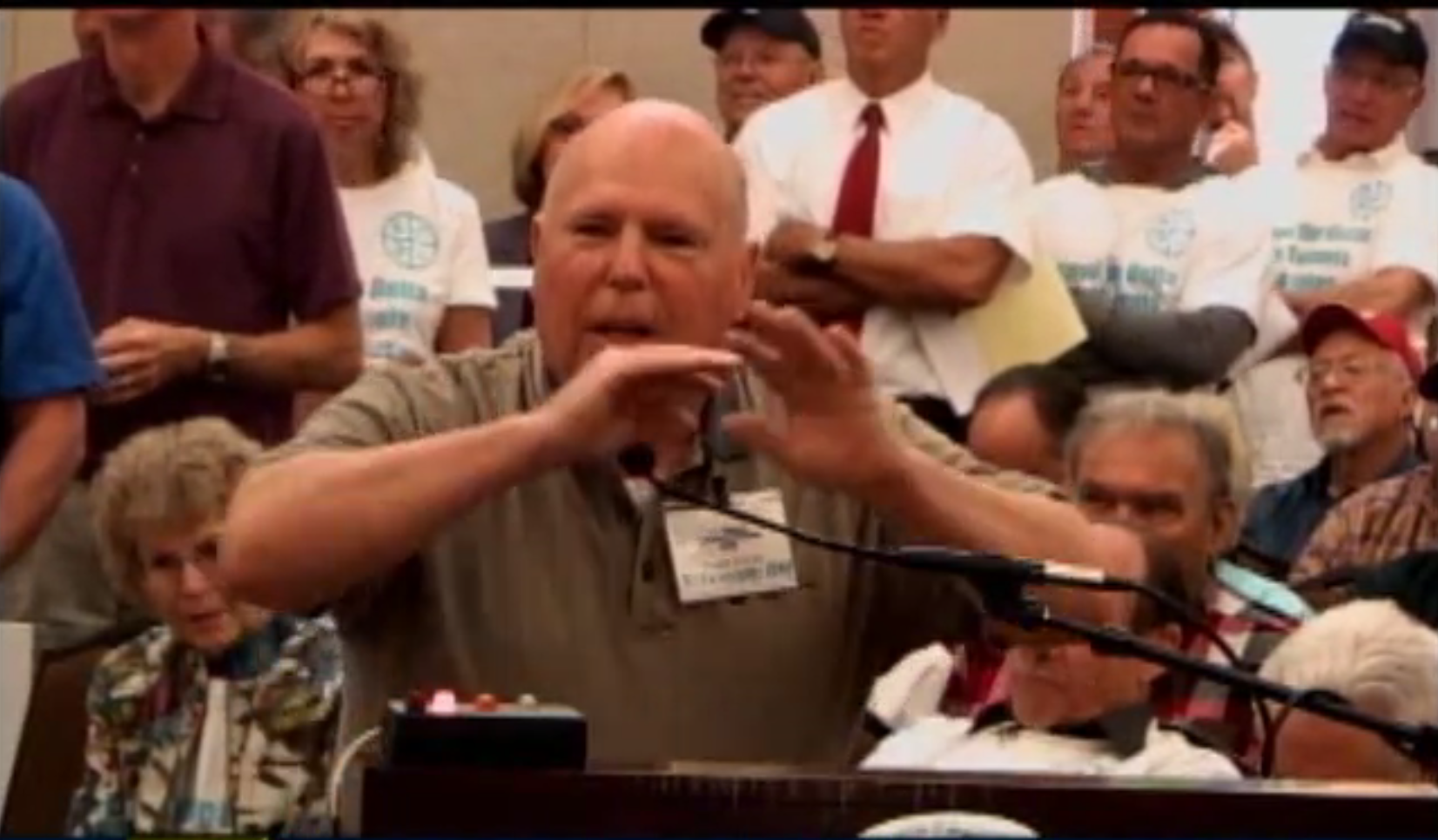
One speaker at the meeting got a bit animated. Screenshot of Cal-Span.org website

The final speaker asked “does anyone in this room want the tunnels?”

“No” was the loud reply.

The Council hasn’t yet made their final recommendation on whether the twin tunnels will be the solution to the conveyance of our water. So, there’s still time for the public to give input.

You can provide your comments using the online form at http://deltacouncil.ca.gov/contact-us. All written submissions will be posted on the website at www.deltacouncil.ca.gov. If you were unable to watch or attend the Thursday meeting in Brentwood, the webcast will be available on the website, as well.

Meetings of the Delta Stewardship Council in Sacramento on April 27 and 28th will be the next opportunity to give live, in-person input to the Council and for them to review the progress on the process. It will be held at Park Tower Plaza, 980 Ninth Street, 2nd Floor Conference Center, Sacramento, CA 95814

As was said by council member and Solano County Supervisor Skip Thomson, the Council needs to hold their meetings for the public at night. They can also be held on a Saturday and in a larger venue, so more people can attend.

We must stand united and continue to fight the Delta Tunnels to keep them from being built and damaging the ecosystem of the Delta and the adjacent region where we call home. Hopefully those charged with the stewardship of the Delta will hear us and recommend against the tunnels.

Filed Under: East County, Opinion, The Delta

Guest Commentary: Elected leaders must take action, reallocate funds for East County fire district

February 17, 2017 By Publisher Leave a Comment

By Bryan Scott

The East County Voters for Equal Protection (ECV), a non-partisan citizens action committee, is organizing a workshop later this month to discuss a proposal to correct the structural funding deficiency that is afflicting the local fire services agency, the East Contra Costa Fire Protection District (ECCFPD).

Twenty-two local government entities have been invited, including the county, the cities of Brentwood and Oakley, special districts and schools.

The proposal ECV is advocating will improve ECCFPD funding by about $7.8 million, and potentially provide for three additional fire stations, bringing the district’s total to six.  There are now just three permanent stations serving 110,000 people spread over 249 square miles.

The proposal relies on the traditional growth in property tax revenues to avoid any cuts in current funding.  If the proposal is adopted the increased property tax revenues that  22 government entities can expect would grow a little slower over a three or four year program implementation period.

This proposal is a significant one.  It is the type of policy decision that elected officials, the chosen representatives of the public, need to make because it is the general public who will benefit from this program.

Government administrators are naturally opposed to this proposal.  City Managers, schools administrators, the county administrator, have all gone on record opposing the solution because their specific government entity would lose future funds.

These government workers are not looking at the big picture.   All government funds come, in one manner or another, from the public taxpayers.  The money ought to be used to meet the needs of today’s taxpayer population.

That’s why the elected representatives of the people need to make this decision, not those who are paid to operate pieces of the people’s business.

The Ghost Ship Fire occurred in Oakland several months ago.  It was a tragedy that took the lives of 36 people at a warehouse in the city’s District 5.  Noel Gallo is the City Councilmember who represents District 5, and he stepped forward visibly during the crisis.  He is a former school board member who understands the importance of fire and emergency medical response services to a community.  Gallo will speak at the fire district funding workshop.

The structural funding problem that has increased response times and reduced the number of firefighters is not a new phenomenon. It has grown as East County’s population has grown, dramatically since the late 1990’s.  Attempts to solve the problem with new tax measures have failed three times.

This proposal, if adopted, will address this structural funding problem.  It will provide money to East County fire and emergency medical services so that ECCFPD receives an allocation rate closer to the rate that other parts of the county receive for their fire and emergency medical services.  The funding allocation rate will then be at about the average for the county’s fire districts.

Shifting public money to a higher-priority service, in many cases a life-sustaining service, is the right thing to do.  Three lives have been lost due to inadequate response capability, a fire department official has said.

The proposal being brought forth is not new.  It has been talked about for over 15 months.

ECV was formed in January of 2016.  The leaders of this group have made 19 formal presentations to public agencies, civic and social groups.  They have attended over 46 meetings with elected, hired, or appointed officials, and conducted 10 public committee meetings.  Over 75 articles and opinion pieces have been published in local periodicals, online, and in social media by ECV.

It is time for our elected representatives the people to do what’s best for the people.

Bryan Scott is a Brentwood resident and Co-Chair of East County Voters for Equal Protection, a non-partisan citizens action committee whose aim is to improve funding for the ECCFPD.  He can be reached at scott.bryan@comcast.net, or 925-418-4428.  The group’s Facebook page is  https://www.facebook.com/EastCountyVoters/.
 

Filed Under: East County, Fire, Opinion

Writer says Community Choice Energy alternative will create jobs in the county

February 16, 2017 By Publisher Leave a Comment

Editor:

Contra Costa County will be in direct coalition to Community Choice Energy (CCE) a sustainable choice to cleaner energy usage. They are pleased to announce their plans to bring more unionized jobs that will benefit the CCCounty.

This local renewable build out scenario, would involve a significant number of mostly unionized and non-union hires.  Also, a potential for 40% of the local build out will be near the Northern Waterfront in Concord area. In return this will be a huge deal for those looking to get hired in today’s economy. As the plans are underway to figure out the details there will be more to come on this future project.

Keep posted for more information regarding the Community Choice Energy (CCE) unionized jobs for hire and their announcements.

Lynette Robinson

San Pablo

Filed Under: Environment, Jobs & Economic Development, Letters to the Editor, Opinion

Coalition upset County Supervisors eliminated Community Choice Energy option

January 30, 2017 By Publisher Leave a Comment

Following is the letter submitted by a coalition of supporters of the Community Choice Energy program:

The CCE Draft Technical Study and the Need for Fuller Consideration of All Studied Options

Dear Members of the Contra Costa Board of Supervisors:

We, the undersigned, represent organizations that have been following the progress made by the cities and County of Contra Costa as they decide how to implement Community Choice Energy. We do not share a preference for any one of the three options outlined in the Draft Technical Study, but we do share the following concerns about the adequacy of that study and the public process that has unfolded in its aftermath.

1) We are highly critical of the current Draft Technical Study prepared by MRW, as well as the very cursory presentations made by the county and the consultants. Neither the study nor the presentations include enough necessary information or the specificity of detail required in order for the cities and the County to make fully informed decisions with lifelong consequences. To cite one such example, when addressing the very basic question of risks associated with the startup costs, the study actually neglects to mention that to date, all CCEs in California have paid back their loans in less than a year.

2) We are, moreover, extremely troubled by the premature decision of the Board of Supervisors on January 17, 2017, to eliminate the stand-alone Community Choice Energy option, which the draft study identified (in Table ES-5) as offering the “greatest” amount of local governance and local economic benefit. The decision to exclude the in-county (stand-alone) option unnecessarily limits the choices offered to residents and businesses in unincorporated areas of the County, and preempts input from leaders, residents, and businesses in the incorporated cities before they have had the opportunity to question and comment on the study. Seven cities contributed to the study’s cost and are entitled to one that fully addresses the impacts to their respective cities—e.g., what amount of buildout is reasonably possible in the Concord Naval Weapons Depot over a ten-year period, and what its economic impact would be. We therefore urge you to reconsider your decision to remove the in-county option from consideration.

3) We would like to know why neither the Contra Costa study nor the presentations have answered this fairly simple question: Why did the study for Alameda County done by the same MRW Consulting firm give a much more robust analysis of the economic benefits of local buildout?

4) We would also like to know why, if the technical studies of six other Bay Area counties (Sonoma, San Francisco, San Mateo, Santa Clara, Alameda, and Yolo) show the stand-alone option to be superior, this would not also be the case in Contra Costa.

5) Unfortunately, the Draft Feasibility Study does not enable the reader to determine which option, in the choice between MCE and EBCE, might result in the greater buildout and job development within Contra Costa. In fact, the study does not indicate that any such buildout or job development will occur by joining either MCE or EBCE. We strongly encourage the county to communicate with both MCE and EBCE about these issues.

Attached is a letter from Scott Rafferty addressing in much more detail some additional concerns about missing or misrepresented facts in the current Contra Costa Draft Technical Study, including the paucity of current information about MCE. This is not an attempt to indicate that MCE is a bad choice, but rather to point out that relevant information about MCE that is available to the public is not included in the draft study. We understand that information about both a stand-alone option and EBCE is necessarily limited because neither yet exists.

Here are some of the points that Scott Rafferty makes:

  1. a) He agrees with MCE’s criticisms that the analyst provides “scant analysis of MCE’s operational program,” and “no analysis” of MCE’s local renewable program, customer-sited solar, job creation, and other benefits. But despite some impressive claims about past performance, MCE doesn’t really provide much insight into its forward-looking plan. He suggests that MCE may bring more legacy costs than synergies to our county.
  2. b) MCE wants credit for $4.6m in subsidies from the CPUC for energy development (that have already been fully committed to programs in Richmond or outside CCC). An independent CC-CCE program would probably be better positioned to seek equivalent subsidies from CPUC than MCE would be in getting them increased proportionally, which MCE does not suggest is likely.
  3. c) He argues that the Supervisors have relied too heavily on the consultant’s analysis of the more obvious “first order” effects of piggybacking on MCE—less “effort” and greater risk on “start-up costs,” which the consultant concedes are small. The risk to which the BOS is averse, therefore, might be political. If things go awry, they can share responsibility with the existing local bodies.
  4. d) He also rejects MCE’s notion that El Cerrito and Richmond have an identity of interests with the rest of CCC or that there will be brand confusion. On the contrary, they share the climate and rate structure of Marin and Oakland, which is very different from the rest of Contra Costa County and Alameda east of the I-680.
  5. e) Neither MCE nor, at this stage, our BOS has clear direction on how to weigh competing objectives—low electric rates, GHG mitigation, progressive rate design (including low-income and residential preferences), job creation and economic benefits, worker and public safety and service reliability. MCE is self-regulating and subject to very significant shifts in voting power.
  6. f) The jury is still out on MCE’s effectiveness in dealing with regulators. It settled very quickly with PG&E in a pending rate case, with limited concessions for clean energy or consumer rate relief. At the state level, two voices will likely have more clout than one—a statement MCE itself has made.
  7. g) As the Governor’s attempts at CAISO regionalization have made clear, larger geographic scale does not always increase the GHG benefits. Neither MCE nor the consultants have yet developed a measure of environmental benefit that accurately accommodates displacement to PG&E and other utilities.

For all the above reasons, we strongly urge the Board of Supervisors to reconsider what we believe was a premature narrowing of the choices. We request that more complete information be shared in future presentations, especially as regards the potential for local buildout and the economic benefits of each of the three proposed CCE choices, and that the final technical study include far more concrete information which the cities will need to make a truly informed choice.

Very sincerely yours,
Peter Ericson
Contra Costa Clean Energy Alliance

Lynda Deschambault
Generation Green / Contra Costa County Climate Leaders (4CL)

Peter Dragovich
Contra Costa Progressives

Bill Pinkham
350 Bay Area

Shoshana Wechsler
Sunflower Alliance

Péllo Walker
Pleasant Hill Chamber of Commerce Green Group

Carol Weed
Contra Costa Chapter Organizing for Action

Jan Warren
Interfaith Climate Action Network of Contra Costa County

Filed Under: Opinion

Op-Ed: County’s Urban Limit Line threatened

January 26, 2017 By Publisher Leave a Comment

Contra Costa’s Urban Limit Line was established in 1990 and strengthened in 2004.  Its purpose was to prevent urban sprawl into virgin agricultural land and preserve for the county’s citizens open space for their enjoyment.

A developer is now petitioning the county’s supervisors to approve a so called 30-acre development that breaks the ULL and will build 125 homes in rural Tassajara Valley. In 2006, Contra Costa voters approved Measure L that further strengthened the ULL by requiring an election and a majority vote of the county’s voters to approve any development outside the ULL.  An exception was granted to allow the supervisors to approve developments not exceeding 30 acres and if one of seven named exceptions could be cited.

It is very important that this development be stopped.  The developer is offering the county a check for $4 million and to dedicate another 500 acres for non-urban use.  While enticing, this offer should be rejected by our supervisors.  If the county accepts this “deal”, it will establish a precedent for other developers to “break the line”.  The blueprint of a $4 million check and land donation will have been established.

Measure L required five year reviews by the county’s Department of Conservation and Development to determine if the ULL needed to be adjusted for reasons that included population growth and the availability of land for development within the ULL.  This department concluded in their December 20, 2016 report to the supervisors that there was sufficient developable land within the ULL through the year 2036, i.e., no need to build outside the ULL.

Our supervisors, Federal Glover of District 5 and Diane Burgis of District 3 have good environmental records.  Indeed, supervisor Glover has consistently supported the ULL.  In a May 2016 interview by another news source, Glover stated: “I have always contended that the Urban Limit Line was necessary so that our region would not grow more than what our infrastructure could handle.  Traffic, police services and schools are the main services that suffer when growth happens too fast.”The recently elected District 3 supervisor, Diane Burgis, has strong environmental credentials having established them in her position as executive director of Friends of Marsh Creek Watershed.

The proposed development, “Tassajara Parks”, will be coming soon before the Board of Supervisors for a vote.  While this development is not in the eastern portion of our county, the precedent that this development would set will make all lands outside the ULL susceptible to development.  Write or E-mail your supervisor and make your voices heard.  Tell them not to compromise, reject this development project and protect the ULL.  Our supervisors will listen to us, the voters.  E-mail supervisors Glover and Burgis at district5@bos.cccounty.us and dist3@bos.cccounty.us.   More information is available at tassajaravalleypa.org.

Gretchen Logue

Richard Fischer

Tassajara Valley Preservation Association

Tassajaravalleypa.org

Filed Under: Growth & Development, Opinion

Letter writer: Obamacare must be saved or people will die

January 12, 2017 By Publisher Leave a Comment

Dear Editor:

For forty years I have dedicated my professional life to helping the mentally ill, the homeless, substance abuse addicts and low income families with children.

ACA – Affordable Care Act has saved thousands of lives.  I know because many of those lives are my clients. Without ACA, those with drug addictions will be on the streets, trying to survive through stealing, breaking in to homes or stores, and other criminal acts that make our community unsafe. With ACA, my clients are in residential treatment programs and practicing full recovery.  My homeless or mentally ill clients have full medical support, getting their prescriptions so they are not delusional or dangerous.  Our clinics and hospitals need ACA to keep their doors open to our citizens, our families and the children. People will die without ACA.

Please contact your Congressman or Senator and urge them to vote to keep ACA or comparable health care for our citizens. You can contact Daily Action call 1-844-241-1141 (user friendly and free) and you will be directly connected with your Representative.

Jerri Curry, PhD Forensic Psychologist 27385, Licensed Family Therapist 19776, Certified Drug Addiction Specialist, Formerly with Contra Costa County

Benicia

Filed Under: Letters to the Editor, Opinion

  • « Previous Page
  • 1
  • …
  • 15
  • 16
  • 17
  • 18
  • 19
  • …
  • 23
  • Next Page »
Antioch Juneteenth 2026
RepublicServices-Antioch-ad (1)
Furniture-Clrnc-Outlet-0626
Monica's dinner 05-26 CCH
Celia's-06-26
Delta-RC-A (2)
Deer-Valley-Chiro-06-22

Copyright © 2026 · · Contra Costa Herald · All Rights Reserved