• Home
  • About The Herald
  • Local Agencies
  • Daily Email Update
  • Legal Notices
  • Classified Ads

Contra Costa Herald

News Of By and For The People of Contra Costa County, California

  • Arts & Entertainment
  • Business
  • Community
  • Crime
  • Dining
  • Education
  • Faith
  • Health
  • News
  • Politics & Elections
  • Real Estate

Shared autonomous vehicles make U.S. debut at Bishop Ranch as part of pilot program

March 8, 2017 By Publisher Leave a Comment

EasyMile @ Bishop Ranch. Photo by Noah Berger

San Ramon, CA – Bishop Ranch, EasyMile, GoMentum Station and the Contra Costa Transportation Authority (CCTA) announced Monday that two EZ10 Shared Autonomous Vehicles (SAV) will begin operation at Bishop Ranch, northern California’s premier business park in San Ramon. This marks the beginning of the second phase of testing for a pilot demonstration project authorized as part of California Assembly Bill 1592, which enables testing of electric, low-speed, multi-passenger, autonomous vehicles that are not equipped with a steering wheel, brake pedal, accelerator or operator. This is the first such pilot program in California.

“We are excited to be at the cutting edge of innovation in driverless technology with the United States’ first pilot demonstration for EasyMile shuttles here at Bishop Ranch,” said Alexander Mehran Sr., Chairman and Chief Executive Officer of Sunset Development Company. “We’re continuously striving to find ways to elevate the customer experience at Bishop Ranch and deliver innovative and valuable amenities. Autonomous shuttles have the ability to improve safety, benefit the environment, reduce congestion and make existing roads more efficient.”

http://contracostaherald.com/wp-content/uploads/2017/03/Easy-Mile-515_8289_01.mp4

“The Contra Costa Transportation Authority and GoMentum Station look forward to partnering with Bishop Ranch and EasyMile to test the next generation of transportation in Contra Costa County. This technology offers an innovative new approach to helping travelers get to transit stations, business districts, and other local amenities without the hassle of driving and parking. We expect that EasyMile SAVs will solve the so-called “first-and-last-mile” challenge — a solution that could be replicated by many urban and suburban communities across the United States,” said Randell Iwasaki, CCTA’s Executive Director.

“At EasyMile, we are proud of our work to transform the way people move through cities around the world. Our shuttles allow commuters to quickly, easily, and safely get where they need to go, without having to depend on a car. We are excited to partner with Bishop Ranch, GoMentum Station and First Transit as our operating partner in bringing this technology to the United States,” said Gilbert Gagnaire, EasyMile President.

Founded in 2014, EasyMile is a high-tech company specialized in developing software for the automatization of all kind of transportation systems, powering autonomous vehicles for both goods transportation and smart mobility solutions. They have already successfully deployed SAVs in Finland, France, Spain, Norway, Australia, Germany, Sweden, Japan, Dubai, Singapore, and Switzerland. The Bishop Ranch pilot program marks the U.S. debut of the EasyMile SAVs, which if successful, is poised to become the first publicly accessible SAV technology for Mobility-on-Demand (MOD) in the country.

About EasyMile

EasyMile is a high-tech company specialized in developing software for the automatization of all kind of transportation systems. The company provides shared driverless transportation for the last mile that complement mass transportation solutions, the EZ10. This ‘green’ service addresses short distances that are too long to walk to, from a transport hub to a final destination where cars are either ‘off limits’ or where parking space is limited or non-existent. It also provides a service for short distances within confined sites. EasyMile autonomous vehicles operate either on demand or follow a set route calling at all stations.

About GoMentum Station

GoMentum Station in Concord, California is where the Contra Costa Transportation Authority leads and facilitates a collaborative partnership among multiple automobile manufacturers; original equipment manufacturers and Tier 1 suppliers; communications suppliers; technology companies; researchers and academia; public agencies and other partners. At GoMentum Station, technology, innovation and commercialization will converge to define the next generation of transportation network infrastructure. More information about GoMentum Station is available at gomentumstation.net

About Bishop Ranch

Bishop Ranch, owned and operated by Sunset Development Company, is built on a legacy of sound planning and smart growth. Located on 585 acres in the San Ramon Valley, it is the largest mixed-use business community in Northern California. For nearly four decades, Bishop Ranch has continually, carefully grown to become a dynamic center for the modern business. Today, the prosperous surrounding communities — 192,000 residents within a six-mile radius — enjoy an average household income of $162,000.

We are home to 30,000 employees at 600 companies in more than 30 industries. Among the tenants are many Fortune 500 companies including AT&T, Chevron, General Electric, IBM, PG&E, Robert Half, Bank of the West, Toyota and Berkshire Hathaway. Numerous small businesses in high tech, bio/clean tech, and social software, such as Affiliated Computer Services, Aon eSolutions, Cognizant Technology Solutions and AGIS Network have chosen to locate in this diverse and thriving business environment. Bishop Ranch offers a unique flexibility for the space requirements of companies large and small, and its tenants occupy spaces from 150 square feet to more than 1 million square feet.

Employees at Bishop Ranch enjoy a wide range of amenities and on-site services, including award-winning transportation programs, high-end food options, professional seminars and networking opportunities, special offers and discounts, gourmet food trucks and a farmers market.

About The Contra Costa Transportation Authority

The Contra Costa Transportation Authority (CCTA) is a public agency formed by Contra Costa voters in 1988 to manage the county’s transportation sales tax program and oversee countywide transportation planning efforts. CCTA is responsible for planning, funding and delivering critical transportation infrastructure projects and programs that connect our communities, foster a strong economy, increase sustainability, and safely and efficiently get people where they need to go. CCTA also serves as the county’s designated Congestion Management Agency, responsible for putting programs in place to keep traffic levels manageable. More information about CCTA is available at ccta.net.

Filed Under: News, San Ramon Valley, Technology

Movie filmed in Antioch last summer by director from Antioch to premier Sunday on TV

March 8, 2017 By Publisher Leave a Comment

Forgotten Evil starring Kyle McKeever and Masiela Lusha shot in Antioch, will air this Sunday night on LMN. photo courtesy of LMN

By Allen Payton

A film shot in Antioch, last fall by Antioch High School graduate and director Anthony C. Ferrante – of Sharknado fame – will premier on Lifetime’s LMN TV channel, this Sunday night at 8:00 p.m.

Director Anthony C. Ferrante and crew shooting outside scenes at Antioch’s historic El Campanil Theatre in downtown Rivertown in August, 2016. photo by Allen Payton

Entitled, “Forgotten Evil” the movie was filmed in various locations in Antioch for a few weeks in August, including Antioch High School and the historic El Campanil Theatre in downtown Rivertown and included Antioch residents as extras. (See related Herald article.)

The movie synopsis is, as follows: Renee awakens, sinking underwater inside a tightly tied sack. Struggling, she somehow breaks out from her underwater coffin. When she awakens again, she remembers nothing. Without a past, she is released from the hospital and forced to start a life anew. Amongst the new faces that enter her life, there is an old one, one that she does not recognize–her husband. As he grows closer and closer, those around her fall victim to deadly accidents. Now Renee must remember her past if she is to have a future.”

The film stars Masiela Lusha and Kyle McKeever in the leading roles, as well as Angie Teodora Dick, Adrian Bustamante and Jeff Marchelletta. To learn more about the full cast and crew, click here.

It is scheduled to show again at Midnight from For more information about the film, visit http://www.mylifetime.com/movies/forgotten-evil and for show times, click here.

Filed Under: Arts & Entertainment, Community, East County, News, People

Oakley Council discusses reallocating property tax funds for East County fire district

March 6, 2017 By Publisher 2 Comments

By Bryan Scott

At their February 28th meeting, the Oakley City Council discussed the community’s inadequate funding of fire and emergency medical services and decided to advance a reallocation program that has a goal of transferring $7.8 million of area property tax funds to the fire district.

“I believe we need to do something now,” said Vice Mayor Randy Pope towards the end of the spirited discussion.

The council agreed to have City Manager Bryan Montgomery draft a letter endorsing the need for improved fire and emergency medical services and supporting reallocating area property tax funds as a solution.

The group also discussed setting aside a 1% share of the city’s growth in property tax funding, approximately $45,000, to be transferred to East Contra Costa Fire Protection District (ECCFPD).  ECCFPD is the local fire department that is struggling to provide adequate services with a funding level set 35 years ago when services were provided by volunteers.

Taking action was argued against by City Manager Montgomery.  He said that even though the reallocation program sounds simple, it is not workable because so many government entities need to participate, and that the area school district superintendents have gone on record opposing their participation in the program.  He also said Oakley residents need to chime in on the issue, and that action needs to come from elsewhere, at the state or county level.

“You won’t be popular with our partners (if you do this); the schools are not going to like this,” he told the Council towards the end of the discussion, appealing to the human instinct to be loved.

Also discussed by the Council was a meeting Councilmember Kevin Romick attended that was also attended by Contra Costa County Supervisors Diane Burgis (Dist. 3) and Karen Mitchoff (Dist. 4).  The meeting’s purpose was to discuss last-minute strategies to keep the fourth ECCFPD fire station open beyond this June, when its temporary funding runs out.

Current ECCFPD funding provides for three fire stations to cover a service area of 250 square miles where over 110,000 people live.

Councilmember Romick said that the agency most involved in providing fire and emergency medical services, ECCFPD, did not attend the meeting.  Consequently, the same group will come together again on March 21st to review the fire district’s plans and budget.

Scott is Co-Chair of East County Voters for Equal Protection, a non-partisan grass roots citizens action committee formed to address the unequal funding of fire and emergency medical services existing in 249 square miles of Eastern Contra Costa County.  About 110,000 residents, as well as those who work and play in Eastern Contra Costa, have services funded at a level one-fourth to one-third of those levels in other parts of Contra Costa County.  For more information contact committee Co-Chairs Hal Bray at hal.bray@pacbell.net or Bryan Scott scott.bryan@comcast.net.    Connect with them and learn more on their Facebook page at  https://www.facebook.com/EastCountyVoters/

Filed Under: East County, Fire, News

McNerney introduces bill to strengthen Internet of Things security, protect consumers

March 3, 2017 By Publisher Leave a Comment

Washington, D.C. – On Thursday, March 2, 2017, Rep. Jerry McNerney (CA-09) introduced H.R. 1324, the Securing IoT Act, which requires that Internet of Things (IoT) devices be certified to be in compliance with cybersecurity standards. The bill directs the Federal Communications Commission, in consultation with the National Institute of Standards and Technology, to develop standards that address cybersecurity throughout the lifecycle of the IoT device.

“The proliferation of IoT devices creates immense opportunities for our society, including new jobs and efficiencies in all aspects of our everyday lives. However, the security of these devices has not kept up with the rapid pace of innovation and deployment,” said Rep. McNerney. “Security vulnerabilities in IoT devices are likely to pose threats to our national security and endanger our nation’s economy. This is especially concerning given that at least 20 billion devices are anticipated to be in use by 2020. My legislation, the Securing IoT Act, helps to address this issue by requiring that security standards be established for IoT devices and that these devices be certified to meet those standards. The legislation will help strengthen this market and protect consumers, business, and all the benefits that IoT devices offer.”

Last fall, McNerney raised concerns about the distributed denial-of-service attack on Dyn’s servers, which resulted from security weaknesses in IoT devices, and he joined his Democratic colleagues on the House Energy and Commerce Committee in calling for a hearing to examine the matter.

Filed Under: Legislation, News

California Superior Court judges send letter to Gov. Brown asking for more money

February 21, 2017 By Publisher Leave a Comment

By Allen Payton

In a strongly worded letter, judges from 49 of the 58 superior courts in California, including Contra Costa County, informed Governor Jerry Brown last week, of their displeasure with the amount of funding for the state’s judicial branch in his proposed budget. They believe the lack of an increase in their budget will have an impact on the communities they serve and are asking for an increase of $158.5 million to the $3.6 billion Brown has proposed in his budget. Courts Letter to Gov Brown 02-16-17

Each of the 58 counties in the state have a trial court, known as a superior court. The judges added their efforts to those by California “Chief Justice Cantil-Sakauye and the Judicial Council of California…and support their efforts to seek additional funding for the judicial branch.”

Brown’s proposed budget projects a $1.6 billion deficit. According to an L.A. Times article, Brown told reporters at the state Capitol…as he unveiled the state’s budget, that “The trajectory of revenue growth is declining.” As a result his “$179.5-billion plan seeks to resolve the budget shortfall by slower-than-expected growth in public school funding and through rolling back a series of one-time expenses discussed during last year’s budget negotiations.”

All the members of the State Senate and Assembly were copied on the letter from the judges, which states: “We, the undersigned courts, have had the opportunity to review your proposed budget for the judicial branch for Fiscal Year 2017-18. We are seriously concerned with the lack of additional funding proposed for trial court operations and our ability to provide adequate access to justice for those in need of California’s court system,” and “…we wish to inform you and the Legislature about the impact this proposed budget will have not only on the many trial courts throughout the state but, more importantly, on the communities that we serve.”

According to Brown’s budget summary, “the Budget includes total funding of $3.6 billion ($1.7 billion General Fund and $1.9 billion other funds) for the Judicial Branch, of which $2.8 billion is provided to support trial court operations.” That is $200 million less than the $3.8 billion Brown proposed in his budget and $100 million less than was approved for the current fiscal year, which was an increase of $300 million over the previous fiscal year.

The letter cites increases in costs and changes in laws will mean Brown’s budget will have the effect of a “net decrease” to the budget for the superior courts.

“This is due to, among other things, the rising cost of doing business in California (e.g., utility costs, rents, vendor expenses, employee salaries). It also results from governmental actions such as elimination of Proposition 47 funding, additional workload from voter-approved initiatives such as Propositions 57 and 64, legislative changes such as AB 2839 that considerably increase workload without accompanying offsetting funding,” the letter stated.

“The proposed elimination of a court’s ability to place a hold on a traffic defendant’s driver’s license for failure to pay or appear, the latter of which appears to have the unintended consequence of reducing revenues to the trial courts, counties and the state. In Solano and Contra Costa, two courts that have imposed a moratorium on driver’s license holds, both courts have seen an approximate 25% reduction in collections.”

The letter concludes with the requested increase in the proposed state budget for the superior courts.

“We respectfully request that the trial courts be treated in an equitable fashion with the Executive Branch and that the trial courts be funded with a modest annual increase.  An increase of $158.5 million—which is the amount requested by the Judicial Council to address baseline cost increases, but which was not included in the Governor’s Budget for next fiscal year—would allow us to keep pace with rising costs of doing business in California and, more importantly, allow courts to preserve the public’s access to justice.”

The budget is expected to be approved by the state legislature and sent to Brown for his signature by the end of June.

To see Gov. Brown’s proposed budget summary for the judicial branch, click here.  To learn more about California’s superior courts, click here.

Filed Under: Government, News

Antioch sex offender receives four years in state prison for possession of child porn

February 17, 2017 By Publisher Leave a Comment

On Tuesday February 14th, 2017, Jason Judkins was convicted of possession of child pornography. He was sentenced to four years in state prison.

The conviction stems from an investigation by the Contra Costa County Internet Crimes Against Children Task Force and the Antioch Police Department. On January 6th, 2016, Judkins created an internet posting that he was willing to trade his son for sex.  The posting was reported to law enforcement and an immediate search for Judkins was started.  He was arrested later that day in Antioch, and it was determined he did not have a child, nor did he have access to children.  A search of his cell revealed images of child pornography, as well as e-mails in which Judkins distributed the images to others. The evidence indicated Judkins made the online posting to reach others who would exchange child pornography with him.

Prior to this offense Judkins had sustained two prior convictions for possession and distribution of child pornography. Judkins has been a registered sex offender since 2012 and was living as a transient in Antioch at the time of his arrest. The sentence was handed down by the Honorable John T. Laettner, after Judkins entered into a plea agreement with the District Attorney’s Office. Judkins will begin serving his sentence immediately.

“This office will hold accountable those individuals who possess and distribute these types of images over the internet,” said District Attorney Mark Peterson. “With National Victims’ Rights Week coming up in April, it is important to remember that when images of a child being sexually assaulted are distributed across the internet, the child is re-victimized each time.”

The prosecution is a result of an investigation by a multi-agency Internet Crimes Against Children Task Force, which is managed by the San Jose Police Department.  In Contra Costa County, detectives and investigators from the Walnut Creek, Antioch, Martinez, San Ramon, Concord and Moraga Police Departments, the Sheriff’s Office, Probation Department and District Attorney’s Office participate in the task force. 

Filed Under: Crime, District Attorney, East County, News

Glazer introduces $2 billion bond bill to improve facilities at CSU, UC campuses

February 16, 2017 By Publisher Leave a Comment

Sacramento, CA – For the first time in more than a decade, California voters would have the opportunity to approve higher education bonds to improve facilities on California State University and University of California campuses under legislation introduced Thursday by joint authors Sens. Steve Glazer, D-Orinda, and Ben Allen, D-Santa Monica.

The bill, SB 483, would authorize the statewide sale of $2 billion in general obligation bonds earmarked for higher education facilities at CSU and UC campuses. The bonds would go before voters in the 2018 general election.

“For many generations, California taxpayers have been proud supporters of the greatest higher education system in America,” Glazer said. “Unfortunately, we have allowed classrooms and libraries to deteriorate, affecting our ability to educate our students. Without public support, the burden of financing facilities will be borne by students and their families through higher tuition and fees.

The most recent such bond, which provided $1.6 billion to improve higher education facilities at CSU and UC, was approved by voters in 2006. All those funds have since been depleted. The last higher education-specific bond was passed in 1994.

“California’s public colleges and universities are a source of great pride to our state, but unfortunately we’ve allowed their physical facilities to fall into disrepair,” said Allen, who chairs the Senate Education Committee. “This bond measure will provide a much-needed and overdue investment in our higher education infrastructure.”

According to CSU and UC, the two systems have capital needs of $7 billion and $10 billion, respectively, for short-term and long-term projects. The CSU and UC are able to provide their own funding for some construction programs through system-wide revenue bonds, though only half of their capital needs are met.

“We appreciate Senator Glazer’s work to secure funding for necessary repair and replacement of aging higher education buildings and infrastructure,” said CSU Chancellor Timothy P. White. “More than $2 billion in deferred maintenance – due to lack of investment during the previous recession – left our campuses vulnerable to potential failures of critical systems. Safe and up-to-date classrooms, research labs and work spaces are essential to the success of our students, faculty and staff.”

SB 483 would require universities or colleges to submit five-year capital outlay plans that prioritize seismic retrofitting needed to reduce seismic hazards in buildings identified as high priority.

David Lopez, president of the California State Student Association, said the legislation addresses the issues about needed classroom repairs that students have been talking about for years.

“We keep hearing stories of students in classrooms that need major repair,” Lopez said. “Buildings that need to be closed for safety reasons. Our campus infrastructure needs have never been greater than they are today.”

Spending choices will emerge through recommendations from governing boards for both CSU and UC systems and will be reviewed in public hearings during the legislative process, Glazer said.

“The state has failed to provide the funds needed for public higher education faculty, student services and infrastructure,” said Mel Levine, Co-chair of the California Coalition for Public Higher Education. “We can’t take in more California students without restoring and improving our classrooms and labs.”

Last November, voters approved Proposition 51, a $9 billion education facilities bond, but did not include any money for the CSU or UC.

“This measure provides important financial backing for critical upgrades to our libraries and classrooms on college campuses,” Glazer added. “And I believe voters should be given a chance to continue the proud legacy of supporting our universities and colleges.”

A December 2016 survey on higher education by Public Policy Institute of California showed broad support – 65 percent – for higher education construction projects. It represented an 11 percentage point increase in support since December, 2014 and was the highest level of support since PPIC first began asking the question in 2007. http://www.ppic.org/content/pubs/survey/S_1216MBS.pdf

Filed Under: Education, Legislation, News

New bill to combat understaffing in California dialysis clinics, 15 in Contra Costa County

February 16, 2017 By Publisher Leave a Comment

By Sean Wherley

State Sen. Ricardo Lara (D-Bell Gardens) introduced legislation, on Wednesday, to improve staffing at more than 550 dialysis clinics in California.

SB 349, the Dialysis Patient Safety Act, would mandate annual inspections of dialysis clinics and safer staffing levels. Current law requires inspections of dialysis clinics every six years, while nursing homes in California must be inspected every year, and hospitals every two years.

This legislation would affect 15 dialysis clinics in Contra Costa County: three each in Antioch and Walnut Creek; two each in Pittsburg and San Pablo; and one each in Brentwood, Concord, El Cerrito, Pleasant Hill and Richmond.

“Dialysis patients are grandparents, children and siblings not numbers on a balance sheet,” said Lara. “It’s time to fix the dialysis industry and improve patient care for the more than 63,000 Californians who rely on this life-saving treatment in clinics daily.”

Dialysis is necessary for people with kidney failure, who must have their blood removed, cleaned, and put back into their bodies. A typical treatment lasts three hours, and must be conducted three days a week for the rest of the patient’s life.

The two largest dialysis corporations – DaVita and Fresenius – make $2.9 billion a year in profits from their dialysis operations in the United States, but workers say the companies pocket the money rather than improve patient care or provide adequate staffing in their clinics.

Dialysis workers regularly report staffing levels so low that it threatens patient care. One worker cited an incident last March at a dialysis clinic in Anaheim, Calif. in which a patient collapsed in the parking lot. The worker said it could have been prevented if more staff were onsite at the time. Seven states already have minimum staffing levels in dialysis clinics: Georgia, Maryland, Massachusetts, Oregon, South Carolina, Texas and Utah.

Dialysis workers in California have been organizing into a union, SEIU-United Healthcare Workers West (SEIU-UHW), for safer working conditions and stronger worker and patient protections. To learn more about the campaign, visit www.morethannumbers.org.

Wherley is the Media Relations Specialist with SEIU-United Healthcare Workers West.

Filed Under: Health, Legislation, News

Storm Update: County preparing for next storm surge

February 16, 2017 By Publisher Leave a Comment

Morgan Territory Road open to local traffic only, expected to reopen Feb. 23; Alhambra Valley Road remains closed

Contra Costa County Public Works crews have been working steadily during the break in the rain to clear mud-covered roads and make repairs where flood and storm damage caused problems.  On Thursday, January 26, the Board of Supervisors ratified a proclamation of local emergency stemming from storm damage that took place during the first two weeks of January.  High winds coupled with continued rains over a short timeframe led to an estimated $18 million in damage in a number of unincorporated areas of the County, within our cities, and at water, park and sanitation district facilities.  The proclamation, along with the State’s declaration of a State of Emergency, will put the County and local jurisdictions in line for potential recovery funding.

The Federal Emergency Management Agency, (FEMA,) and the State Office of Emergency Services have made site visits throughout the County.  It will take several months for the County, working with State and Federal authorities, to get a more firm total on the damages and what costs can be covered.

Two road closures are still in effect in Contra Costa County:

  • Morgan Territory Road is closed between Marsh Creek Road and Manning Road. The road is open to local traffic and emergency vehicles only and is anticipated to reopen to through traffic on Thursday, February 23.
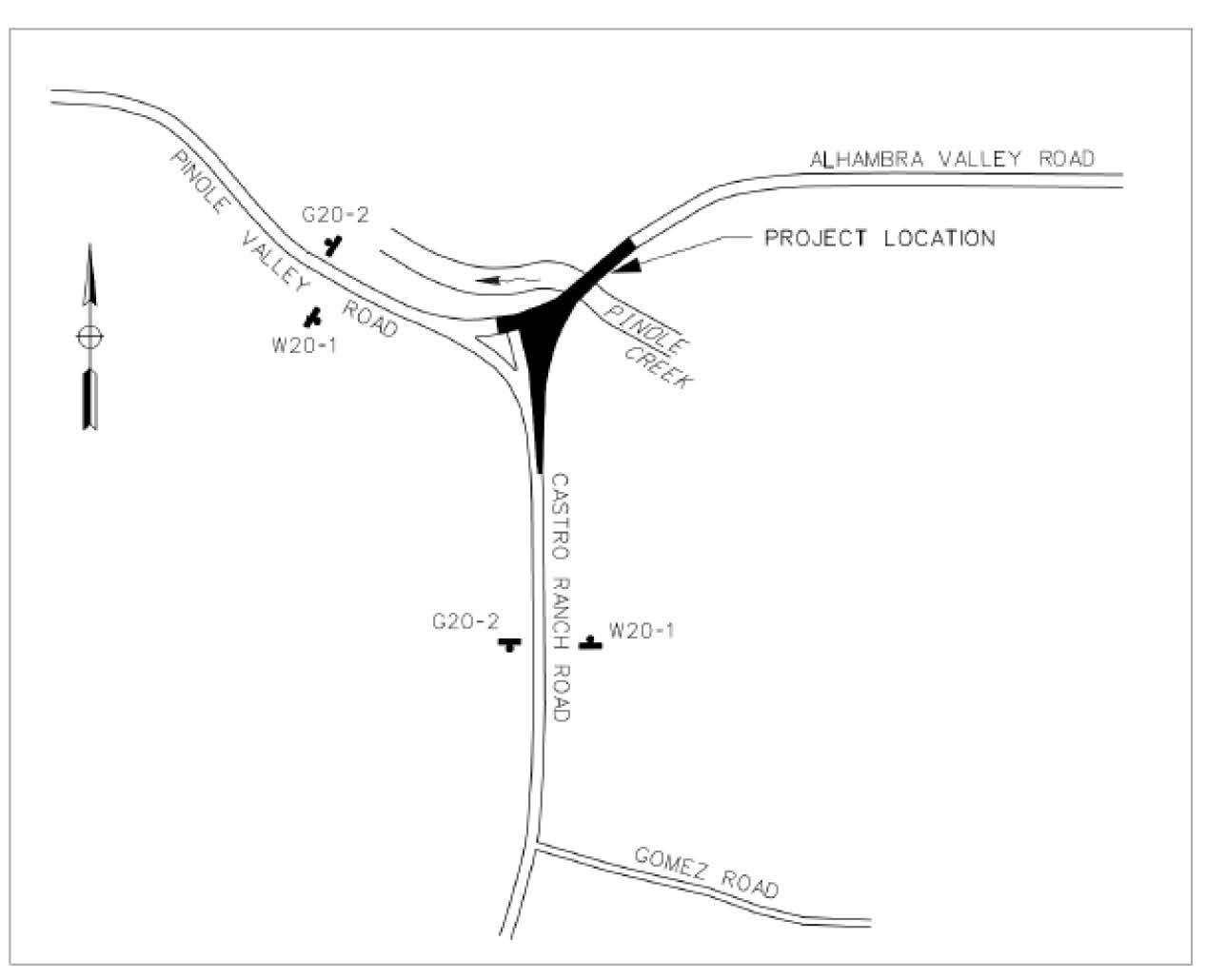
  • Alhambra Valley Road between Bear Creek and Castro Ranch Roads is closed indefinitely.

On Tuesday, the Board of Supervisors declared an emergency for the repair of Alhambra Valley Road washout and authorized the Public Works Director to proceed with emergency repairs. The emergency authorization allows the Public Works Department to expedite the repair of this road. The Board of Supervisors also adopted a new resolution to proclaim a local emergency arising out of the damage caused by the series of storms in January and February 2017. This allows the County to potentially seek funding relief for response and damage repairs for emergency responses to the continuing storms during this time period.

Alternate routes for closure of Alhambra Valley Road

With more rain expected late this week, this is a good time to prepare for the next wave, checking rain gutters and storm drains for blockage.  If you’re concerned about potential flooding at your home or business, it’s not too late to visit one of the sandbag stations located throughout the county.  Please note that you’ll need to bring a shovel, but bags and sand are available for free.   Find out details regarding County sandbag sites at www.cccounty.us/sandbags.

County Public Works Maintenance road crews maintain the storm drain inlets through a program of annual inspection and cleaning.  To report a clogged catch basin or drainage inlet please call the Public Works Maintenance Division at 925-313-7000 during work hours and after hours call Sheriff’s Dispatch at 925-646-2441.

Filed Under: News, Transportation, Weather

Frazier introduces “Jeff Belle” bill to increase penalties for ballot statement lies

February 16, 2017 By Publisher Leave a Comment

In a move that would take a major step forward in addressing accountability for cases of election fraud perpetrated by candidates, Assemblymember Jim Frazier (D – Discovery Bay) announced on Thursday the introduction of AB 894, which will increase penalties in cases that determine a willful misrepresentation was made on a candidate statement.

“I introduced AB 894 in an effort to make sure voters are not deceived by candidates fabricating their accomplishments and misleading the public,” said Frazier. “We saw this occur in Contra Costa County. It is not fair and I will do everything in my power to make sure the residents I represent are protected from this injustice in the future.”

Frazier is referring to the case of Contra Costa County School Board Member Jeff Belle, who was prosecuted by the Contra Costa District Attorney’s Office for lying on his ballot statement during his 2014 campaign, about earning a college degree. The DA settled the case in December, with Belle agreeing to perform community service, in order to avoid facing trial and a maximum penalty of $1,000. (See related article, here).

Currently, the penalties for a candidate lying on his or her nomination papers, which are not public documents and remain within a county’s elections office, are much greater at a maximum of $1,000 and three years in prison. Frazier became aware of that fact last year, didn’t think it made sense and decided to do something about it.

AB 894 will strengthen penalties for candidates who misrepresent facts on a ballot statement, which is public and is sent out to all the voters in a district. Specifically, this bill raises penalties to include forfeiture of office and reimbursement of all costs for the election.

“Misleading the voters about a candidate’s background on ballot statements has been a problem in our county in recent years,” said Joe Canciamilla, Contra Costa County Clerk-Recorder-Registrar. “Assemblymember Frazier’s bill is a good start in helping to ensure transparency and accountability to the voters.”

This bill is currently awaiting assignment to policy committee in the California State Assembly.

Frazier represents the 11th Assembly District, which includes the communities of Antioch, Bethel Island, Brentwood, Byron, Discovery Bay, Knightsen,, Oakley and portions of Pittsburg in Contra Costa County, as well as Birds Landing, Collinsville, Fairfield, Isleton, Locke, Rio Vista, Suisun City, Travis AFB, Vacaville and Walnut Grove in Solano County.

Allen Payton contributed to this report.

Filed Under: Crime, News, Politics & Elections

  • « Previous Page
  • 1
  • …
  • 347
  • 348
  • 349
  • 350
  • 351
  • …
  • 366
  • Next Page »
Liberty-Tax-Jan-Apr-2026
Deer-Valley-Chiro-06-22

Copyright © 2026 · Contra Costa Herald · Site by Clifton Creative Web