• Home
  • About The Herald
  • Local Agencies
  • Daily Email Update
  • Legal Notices
  • Classified Ads

Contra Costa Herald

News Of By and For The People of Contra Costa County, California

  • Arts & Entertainment
  • Business
  • Community
  • Crime
  • Dining
  • Education
  • Faith
  • Health
  • News
  • Politics & Elections
  • Real Estate

Supervisors pass third COVID-19 era ordinance prohibiting residential and small business evictions, rent hikes over landlords’ protests

October 1, 2020 By Publisher Leave a Comment

Approve consent decree for enhanced psychiatric and medical services for county jail inmates

By Daniel Borsuk

With the COVID-19 pandemic having caused 16,896 cases and 209 deaths in Contra Costa County since March, the Contra Costa County Board of Supervisors on Tuesday passed its third temporary ordinance banning evictions of commercial and residential tenants on Tuesday, the same day the county’s Public Health Department quietly announced its promotion from Purple ranking to Red, allowing more businesses to open.

According to the staff report on the agenda item, the urgency ordinance authorizes a temporary prohibition on certain “at-fault” evictions of residential tenants in the county and continues a temporary prohibition on certain evictions of small-business commercial tenants in Contra Costa County impacted by the COVID-19 pandemic.

Supervisors had previously approved similar temporary ordinances on April 21 and July 14 and voted unanimously to enact a new ordinance that would stay in effect through January 31, 2021.  On a separate vote, 4-1, supervisors rejected inserting additional protections to tenants that Supervisor John Gioia wanted to be included in the ordinance.

“I wanted broader protections,” said Supervisor Gioia of Richmond who cast the one dissenting vote.  “I wanted to limit evictions to health and safety.  There are landlords who don’t exercise good faith behavior.”

But Supervisor Karen Mitchoff, speaking on behalf of both landlords and tenants. wanted to monitor properties that have tenants who don’t put out trash for collection or keep unsafe rental property.

“I am willing to go through January 31, but I am tired of accommodating the bad actors. I won’t support an ordinance that bars landlords from entering property for any reason,” said Mitchoff.

At the same time, the supervisor from Pleasant Hill scolded landlords who do not accept a tenant’s payment for rent. “That is not OK,” she said.

While supervisors listened to a number of renters encouraging the supervisors to provide necessary protections during the ongoing pandemic, the elected officials for the first time heard more landlords loudly object to the residential and commercial ordinance under review.

“You’re taking away property owners’ rights,” Concord property owner Blaine Carter protested. “The sky is not falling.  We don’t need to strip away individual property owner rights.”

Concord homeowner Ed White said he could live with the ordinance.  “I work with my tenant,” said White, whose long-term tenant of his three-bedroom house, has been a good occupant even though the tenant had lost their job due to the pandemic.  The tenant has recently been reemployed and is back making monthly rental payments, White said.

“For someone who has been on both sides of this issue, I can support the proposed ordinance,” said District 5 Supervisor Federal Glover of Pittsburg, who is up for re-election Nov. 3 against Contra Costa County Assessor Gus Kramer.

“This is another way to get property into the hands of government,” said landlord Marilyn Blander.  The long-term economic effects will be terrible because government is a terrible way to provide housing.”

PLO Consent Decree for County Jail Inmates OK’d

In another action, supervisors unanimously approved an agreement with the Prison Law Office that will enhance psychiatric and medical services for inmates held at the Martinez Detention Facility and the West County Detention Facility in Richmond.  Four years in negotiations, the PLO-Contra Costa County consent decree will be in effect for five years.  The consent decree can be mutually ended.

It will cost the county $43.7 million a year to provide improved mental and medical care and pharmaceutical services to prisoners housed in the two county detention facilities.  Those costs reflect the addition of the eventual hiring of 125 fulltime Health Services Department employees and 63 fulltime equivalent Sheriff’s Department employees.

So far, the county has hired 42 fulltime equivalent Health Department and 41 fulltime Sheriff’s Department employees.

“This is a roadmap for positive change, one that moves the county forward in further improving the physical space and services provided” said Board Chair Candace Andersen.  “We want to stop those with mental illness from repeatedly cycling through our jails.  If we can provide them with much needed treatment while incarcerated and ensure that they have supportive services upon re-entry to the community, their lives will substantially improve.”

Prison Law Office Executive Director Donald Spector called and thanked the supervisors for approving the five-year consent decree.


Filed Under: Business, Health, News, Supervisors

Contra Costa COVID: Indoor dining, churches, theaters up to 25% capacity or 100 people whichever is less

September 29, 2020 By Publisher Leave a Comment

Gyms up to 10%; indoor retail and malls up to 50%; thanks to improving situation; nail salons, massage services back indoors

Thanks to recent progress being made in the fight against COVID-19 in Contra Costa, indoor restaurants, gyms, movie theaters, massage parlors and places of worship may now open with restrictions in the county.

The changes come after the county qualified to move into the less restrictive red tier (“substantial”) of the state’s four-tiered, color-coded reopening system today. Contra Costa had been in the state’s purple or “widespread” tier, the most restrictive tier.

Moving into the red tier means the following sectors can reopen with modifications:

  • Places of worship, restaurants, movie theaters and museums can be operated indoors at 25% capacity or 100 people, whichever is less
  • Gyms can reopen indoors at 10% capacity
  • All personal care services, including massage, can move indoors
  • Indoor shopping malls can operate at 50% maximum occupancy (instead of 25%). Food courts can also open following the state’s guidelines for restaurants.
  • Indoor retail stores can now operate at 50% capacity (instead of 25%)

“The credit really belongs to the residents of Contra Costa, who have adapted to the new normal and modified their lifestyles to reduce the spread of COVID in the county,” said Dr. Chris Farnitano, the county’s health officer.

Elementary and secondary schools can reopen for in-person instruction on Oct. 13 if the county remains the red tier for two more weeks. Currently, elementary schools can apply for a waiver from the health officer to reopen.

In order to move into the more permissive red tier, the county had to see average case rates drop below 7 per 100,000 people and testing positivity rates dip below 8%. For the past two weeks, Contra Costa has met those benchmarks. As of Tuesday, the case rate was 6.7 per 100,000 people and the testing positivity rate was 3.7%.

Dr. Farnitano noted that Contra Costa continued to see its COVID numbers improve or remain steady even after the Labor Day weekend, suggesting fewer people engaged in risky behaviors like large social gatherings compared to the previous holiday weekends.

Health officials caution that COVID is still circulating in the community and people should continue to take all the same precautions health officials have been advising for months: wear face coverings in public, maintain physical distancing, wash hands frequently and stay home if you’re sick.

In addition, health officials encourage essential workers and people with lots of close contacts outside their own household to get tested for COVID at least monthly.

Businesses and other organizations should review their applicable industry guidance for reopening safely from the state. For more information about COVID-19 in Contra Costa, visit cchealth.org/coronavirus.


Filed Under: Business, Faith, Health, News

Frazier to introduce bill to combat major cause of greenhouse gas emissions in California – wildfires

September 23, 2020 By Publisher Leave a Comment

Challenges CA Air Resources Board to “pause and think” about effectiveness of Cap and Trade program

Assemblyman Jim Frazier

SACRAMENTO – Assemblymember Jim Frazier (D-Fairfield) announced today that he plans to introduce legislation in the upcoming session to fundamentally change the way California reduces greenhouse gas emissions.

  “While I believe the work the California Air Resources Board (CARB) has been doing is laudable, we need to shift gears and address the main cause of carbon emissions in California, and right now, that is unquestionably wildfires,” said Frazier. “The data is undeniable and staggering.”

  According the U.S. Geological Survey, in 2018 alone, the wildfires in California were estimated to have released emissions equivalent to roughly 68 million metric tons of carbon dioxide. By contrast, after seven years of reduction efforts from Cap and Trade funded projects to date, is estimated to be 45 million metric tons – at the cost of billions of dollars.

  Frazier went on to say that he believes CARB needs to “pause and think” carefully about their programs and overall efficacy of the resources devoted to them, and reprioritize Cap and Trade dollars to address the immediate threat and environmental devastation that wildfires are causing. In addition to the further advancement of global warming, these fires result in property damage, loss of life, economic peril, and long-term health issues.

  “The science and statistics of the devastation that wildfires are causing are not just limited to the land. These fires are pumping more pollution – far more toxic – than the burning of fossil fuels, and we must take a critical look at how we dedicate our precious financial resources to their reduction.  As we know, wildfires are a major contributor to the advancement of global warming.”

  Frazier will introduce a bill this December.

Filed Under: Economy, Environment, Fire, Health, Legislation, News

Supervisors extend ban on evictions, rent increases through January 31

September 23, 2020 By Publisher Leave a Comment

Provide additional protections; retroactive to Sept. 1

By John Fout, Community & Media Relations Specialist, Contra Costa County Office of Communications & Media

At their meeting on Tuesday, September 22, 2020, the Contra Costa County Board of Supervisors unanimously passed an urgency ordinance that continues a moratorium on certain evictions for residential tenants in the County through January 31, 2021. Urgency Ordinance No. 2020-25 also continues a moratorium on certain residential rent increases through January 31, 2021. The Ordinance is retroactive to September 1, 2020.

Contra Costa County’s urgency ordinance provides additional protections to the state’s COVID-19 Tenant Relief Act of 2020 (the Act), which passed and took effect immediately on August 31, 2020. The Act extends eviction protections for residential tenants experiencing financial hardship related to COVID-19.

“The urgency ordinance demonstrates the Board’s continued commitment to protect residents struggling with the unexpected economic hardship caused by the COVID-19 pandemic,” said Supervisor Candace Andersen, Board Chair. “We continue to seek ways to support renters and landlords, and hope that all parties will resolve to work together during this challenging time.”

This law applies to properties in all 19 cities in the County and in all unincorporated areas. To the extent that a city has adopted a law on the same subject matter, then the city’s provisions would apply in that city.

Protections granted to residential renters:

  • Ban on No-Fault Evictions – A property owner cannot evict a residential tenant for any “no-fault” reason except to protect the health and safety of the owner or another tenant, to allow the owner or their immediate family to move into the residential unit or to remove the unit from the rental market.
  • Prohibits a landlord from terminating a residential tenancy on the basis that a tenant allowed an unauthorized occupant to live in the dwelling unit, if the occupant is the tenant’s immediate family member living in the dwelling unit as a result of the COVID-19 pandemic.
  • Moratorium on Residential Rent Increases – A property owner may not increase rent on a residential property through January 31, 2021. State law prevents this freeze from applying to commercial tenancies and to certain residential properties, including residences built within the last 15 years and single family
  • These prohibitions and the specified exceptions last through January 31, 2021.

Read the full document Ordinance No. 2020-25 (PDF). Answers to Frequently Asked Questions (FAQs) regarding this ordinance will be available and updated on the County website soon.

For information and resources, visit Contra Costa County at www.contracosta.ca.gov. For COVID-19 updates, visit Contra Costa Health Services at https://cchealth.org/coronavirus. If you have questions about the coronavirus, contact the multilingual Call Center at 1-844-729-8410, open daily from 8 am to 5 pm. For assistance after hours in multiple languages, please call 211 or 800-833-2900 or text HOPE to 20121.

Filed Under: Health, News, Supervisors

Quarantine 15? Not in Contra Costa – 12 cities rank in Top 50 fittest in California study reveals

September 23, 2020 By Publisher Leave a Comment

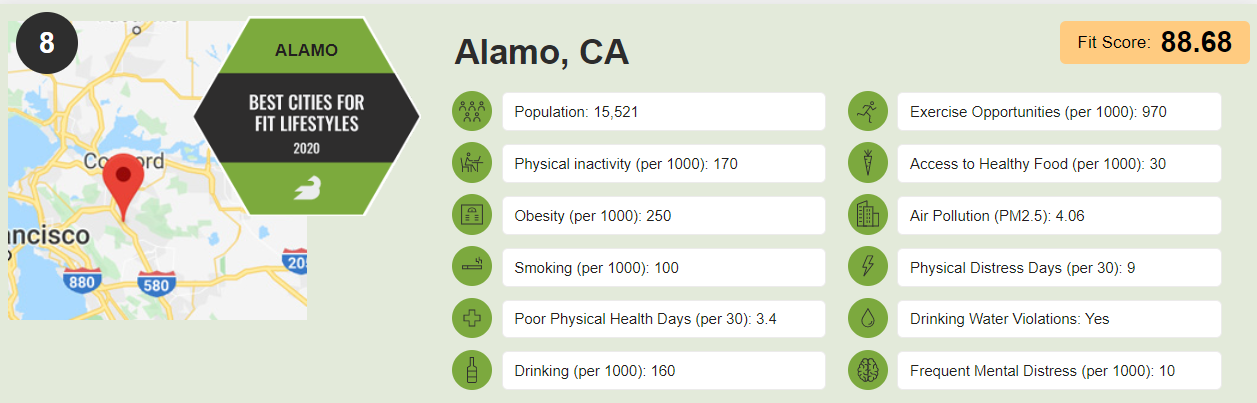
  • Alamo ranks 1st in county, 8th in state with overall fitness score of 88.68, out of 300 cities and communities
  • Contributing factors to fitness scores include exercise opportunities, access to healthy food, air pollution and drinking water quality.
  • Infographic showing top cities in California according to overall fitness score.

With the pandemic restricting our usual exercise regimes due to social distancing regulations, many Americans have had to adapt their fitness goals and align them with at-home workouts. Combined with the fact that many of us are comfort eating while in the midst of a global health crisis, this may have led some to gain the so-called, ‘Quarantine 15’ without even realizing. However, the good news about working or studying from home is not having to worry about your daily commute taking up too much time that could be used to achieve your at-home fitness goals for the day. But what happens if you don’t have adequate space in your home and don’t live near an open outdoor area in order to work out?

BarBend.com, the world’s leading strength training resource and news outlet, compiled a comprehensive list of the top fittest cities across California, using data backed by studies based on a variety of factors. These were combined to create an overall fitness score out of 100 for each city on the list. Fitness factors in this study include exercise opportunities, access to healthy food, air pollution, drinking water violations, physical inactivity, obesity and smoking, amongst others.

The cities and communities in Contra Costa County have a high rate of exercise opportunities at 970 (per 1,000 people) suggesting that the surrounding environment can play a key role in determining people’s fitness level.

Statewide 8th ranked Alamo was the most fit in the county with a score of 88.68, followed by Orinda #11 – 87.9, Blackhawk #13 – 87.57, Lafayette #22 and Danville #23 tied at 86.66, Clayton #27 – 86.42, San Ramon #28 – 86.29, Kensington #29 – 86.19, Moraga #30 – 86.15, Saranap (an unincorporated area between Lafayette and Walnut Creek) #38 – 85.58, Discovery Bay #41 – 85.3, Hercules #47 – 84.97, Pleasant Hill #52 – 84.76, Contra Costa Centre (Pleasant Hill BART Station area) #55 – 84.64, Martinez #56 – 84.63, El Cerrito #57 and Brentwood #58 which tied at 84.59, Oakley #65 – 84.31, Rossmoor (in Walnut Creek) #66 – 84.23, Walnut Creek #68 – 84.21, Pinole #69 – 84.12, Concord #78 – 83.83, El Sobrante #81 – 83.75, Antioch #87 – 83.58, Rodeo #90 – 83.48, Tara Hills (between Pinole and El Sobrante) #91 and Pittsburg #92 tied with 83.47, Richmond #101 – 83.25, San Pablo #115 – 82.75, and Bay Point #118  with a score of 82.71.

According to the CHR’s county health ranking model, “individuals who live closer to sidewalks, parks and gyms are more likely to exercise”, therefore access to exercise opportunities is crucial in maintaining a healthy population. Additionally, residents who live in neighborhoods with access to grocery stores that allow them to obtain healthy foods, such as fresh fruit and vegetables, are more likely to have healthier diets than those who do not have access to these kinds of supermarkets. Considering the Golden State is abundant in national parks and natural landscapes, the great outdoors provides the perfect background for recreational activities, such as rock climbing, hiking, swimming and cycling. Additionally, Antioch was found to have low air pollution, low rates of physical inactivity, obesity and smoking.

View the top cities for fitness across California (including Antioch data)
“As you can see, there are a variety of external factors that can have an impact on a town’s overall fitness, which can be detrimental to the population’s health, especially where some don’t have access to sufficient space for their at-home workouts,” says Max Whiteside from BarBend.com. “If this is the case, you can still try and keep fit while going about your work for the day by standing, instead of sitting in front of your laptop, taking frequent breaks in which you can complete some lunges and squats, making mobility work a part of your daily routine. Remember your own bodyweight can also be a useful workout tool!”

Allen Payton contributed to this report.


Filed Under: Health, News

Kelly-Moore Paint agrees to $1.43 million settlement with 10 DA’s for illegal dumping of hazardous waste

September 15, 2020 By Publisher Leave a Comment

Violated state environmental protection laws

By Scott Alonso, Public Information Officer, Contra Costa County District Attorney

Martinez, Calif. – Contra Costa County District Attorney Diana Becton announced Monday, a $1.43 million settlement against Kelly-Moore Paint Company (Kelly-Moore) to resolve allegations that the company violated California state laws governing hazardous waste by routinely and illegally disposing of paint colorants, paint, electronic devices, aerosol products, and other hazardous wastes into company waste bins destined for municipal landfills not authorized to accept hazardous waste. The lawsuit also resolves allegations that Kelly-Moore failed to shred customer records containing confidential information before disposal.

“My office will always strive to protect the environment and public health by holding companies accountable for violating our environmental laws. This settlement not only acts as a deterrent against other potential violators but more importantly contains injunctive provisions to ensure Kelly Moore will maintain environmental compliance into the foreseeable future.,” stated Contra Costa County District Attorney Diana Becton.

Kelly-Moore is a retail paint company in North America. In California the company owns or operates approximately 106 retail stores, including nine stores in Contra Costa County as part of this settlement.

The investigation of Kelly-Moore was initiated by the California Department of Toxic Substance Control (DTSC). From March 2016 through December 2018, inspectors from the DTSC, and investigators from other district attorney offices statewide, conducted a series of undercover inspections of waste bins originating at 29 separate Kelly-Moore locations. These inspections found numerous instances of unlawful disposal of hazardous waste paint colorants, paint, electronic devices, aerosol products, and other hazardous wastes. Kelly-Moore also violated laws meant to protect vulnerable confidential consumer information by unlawfully disposing of customer records without having rendered personal information unreadable.

When Kelly-Moore officials were notified by the prosecutors of the unlawful disposals, they immediately agreed to cooperate with the People and promptly implemented measures and dedicated additional resources towards environmental compliance at its stores. Stores are required to properly manage hazardous waste and to retain their waste in segregated, labeled containers to minimize the risk of exposure to employees and customers and to ensure that incompatible wastes do not combine to cause dangerous chemical reactions. Hazardous waste produced by Kelly-Moore stores through damage, spills, and returns is being collected by state-registered haulers, taken to proper disposal facilities, and properly documented and accounted for.

The settlement requires a monetary payment of $1.43 million. This consists of $825,000 for civil penalties, $178,750 for supplemental environmental projects, and $425,000 for reimbursement of investigative and enforcement costs. Kelly-Moore gets a credit of $125,000 against the penalties if it undertakes at least $250,000 in environmental enhancement work not required by law. In addition, the settlement includes provisions requiring Kelly-Moore to employ a California-based compliance employee to oversee Kelly-Moore’s hazardous waste compliance program and to undergo a trash receptacle audit to ensure hazardous wastes and confidential consumer information is properly disposed of at all stores. The results of the audit must be shared with the public. The company must also comply with 28 injunctive requirements pertaining to environmental and confidential consumer information protection laws.

Joining District Attorney Becton in this lawsuit are the District Attorneys of Alameda, Monterey, Placer, San Francisco, San Joaquin, San Mateo, Santa Clara, Sonoma and Yolo Counties.

Filed Under: Crime, District Attorney, Health, News, State of California

Contra Costa Hazardous Materials Commission seeks applicants 

September 15, 2020 By Publisher Leave a Comment

WHAT: The Contra Costa County Hazardous Materials Commission seeks applicants for four open seats.

The commission is a voluntary body appointed by the Contra Costa Board of Supervisors that makes policy recommendations to the board and county staff regarding hazardous materials and hazardous waste.

WHO: The commission’s 14 members and alternates serve four-year terms and include representatives of industry, labor, civic groups, environmental organizations, environmental engineers, the public and the Contra Costa Mayors Conference.

The current openings are for a representative from an environmental organization and one alternate, and the Environmental Justice seat, for a member of a county community disproportionately impacted by hazardous materials releases, and one alternate.

All candidates must live or work in Contra Costa County, have a demonstrated interest in hazardous materials issues and an understanding and commitment to the principles of environmental justice as defined in county policy. Candidates must be able to commit to one to two meetings per month, or to fill in as needed for alternates.

Candidates for the Environmental seat must be nominated by an environmental organization.

WHEN: Mail completed applications to the Clerk of the Contra Costa Board of Supervisors, 651 Pine St., First Floor, Martinez, CA 94553. Applications must be received by September 30.

Interviews for qualified applicants will take place from 10 a.m. to 2 p.m. on October 9, by Zoom or telephone.

HOW: For an application form or more information, contact Michael Kent, the executive assistant to the commission at 925-250-3227. Applications are also available online or from the Clerk of the Contra Costa Board of Supervisors, 651 Pine Street, First Floor, in Martinez.


Filed Under: Government, Health

Contra Costa updates health order to match state’s COVID-19 Blueprint – nail salons, massage can reopen indoors

September 14, 2020 By Publisher Leave a Comment

Even card rooms can open, again – outdoors, but not piercing, tattooing or non-medical electrolysis (you’ll still have to keep plucking out those hairs, yourself!)

Contra Costa County today aligned its COVID-19 social distancing health order with California’s Blueprint for a Safer Economy, so the county no longer has different reopening rules for businesses and activities beyond what the state requires or allows.

The change, effective at 8 a.m. Wednesday, Sept. 16, simplifies the plan for reducing the spread of COVID-19 in Contra Costa so that residents and local businesses can better understand and identify the steps we all need to take to keep ourselves, our families, workers and customers safer during the pandemic.

The update to Contra Costa’s health order does allow some additional businesses to reopen, following the state health guidelines for their industries:

  • Personal care services that involve close contact with the face may begin operating outdoors, except for tattooing, piercing and nonmedical electrolysis
  • Racetracks and cardrooms may operate outdoors
  • Music, television and film production may resume
  • Professional sports without live audiences may resume

These changes are consistent with Contra Costa’s placement in the purple tier of the state’s blueprint, indicating that COVID-19 is widespread in the county. When the data tracked by the state show sustained improvement for two weeks, the county will move into the red tier, allowing more businesses and activities to reopen.

Information about the state’s blueprint, including health guidelines for businesses and activities, which business sectors are not currently safe to operate in Contra Costa, and how the guidelines will change as the county makes progress against COVID-19, are all available at covid19.ca.gov/safer-economy.

Contra Costa’s current health orders retain health guidelines for social bubbles and structured contact between people from different households, face coverings and physical distancing. The FAQ and Safer Social Interactions pages at cchealth.org/coronavirus have information about keeping safer during the pandemic.

Contra Costa Health Services (CCHS) continues to monitor data that show how the virus is spreading through our community, including hospitalizations and how the pandemic is impacting the county’s healthcare system. If there is a sudden surge in COVID-19 transmission in the future, the county may need to temporarily impose more restrictions to protect the public health.

One way Contra Costans can help keep our county’s healthcare system running smoothly is to get a flu vaccine – talk to your health provider about getting one. CCHS is also planning community vaccination clinics beginning in October.

Anyone who lives or works in Contra Costa can help make the county safer from COVID-19 and reopen more quickly is to get a fast, free COVID-19 test at a community testing site. The state has reduced the requirements for moving into less restrictive tiers for counties that test many people every day, and other Bay Area counties have already qualified for this benefit.

Make a COVID-19 testing appointment today by calling 1-844-421-0804 or booking online at cchealth.org/coronavirus – hit the “Get Tested” button. This site is also an official source for local information regarding the COVID-19 pandemic.


Filed Under: Business, Economy, Health, News

Virtual Grand Opening ceremony for Richmond residential treatment, detox program Monday

September 12, 2020 By Publisher Leave a Comment

25 bed facility for people with substance use disorders 

WHAT: County leaders and health officials will hold a virtual ribbon cutting ceremony on Sept. 14 for the opening of the new Richmond Health & Wellness Center, a residential treatment and detox center for people with substance use disorders.

The Health & Wellness Center will primarily serve Medi-Cal eligible patients who live in Contra Costa County.

The facility, which is funded by Contra Costa Health Services through state and federal dollars and the implementation of the Drug Medi-Cal Organized Delivery System, will have 10 detox beds dedicated to safe withdrawal from alcohol or drugs, as well as 15 residential beds for longer-term treatment. It will be operated by Westcare, a private nonprofit organization and it has been made possible through the advocacy of the Alcohol and Other Drugs Advisory Board and people in recovery.

WHEN: The ribbon cutting and a virtual tour of the site will be held on Monday, Sept. 14 at 10 a.m. The center will open to clients on Sept. 16.

WHERE: The public can view the event online at WestCare’s YouTube channel. The facility itself is located at 208 23rd Street in Richmond.

Filed Under: Health, News, West County

Gov. Newsom signs statewide COVID-19 tenant and landlord protection legislation, extended through Jan. 31, 2021

September 4, 2020 By Publisher Leave a Comment

New law includes targeted protections for tenants to shield them from evictions due to COVID-19-related back rent through February 1, 2021 

Extends anti-foreclosure protections in the Homeowner Bill of Rights to small landlords

SACRAMENTO — Governor Gavin Newsom on Monday announced that he had signed legislation to protect millions of tenants from eviction and property owners from foreclosure due to the economic impacts of COVID-19. These protections apply to tenants who declare an inability to pay all or part of the rent due to a COVID-related reason.

Under the legislation, no tenant can be evicted before February 1, 2021 as a result of rent owed due to a COVID-19 related hardship accrued between March 4 – August 31, 2020, if the tenant provides a declaration of hardship according to the legislation’s timelines. For a COVID-19 related hardship that accrues between September 1, 2020 – January 31, 2021, tenants must also pay at least 25 percent of the rent due to avoid eviction.

“COVID-19 has impacted everyone in California – but some bear much more of the burden than others, especially tenants struggling to stitch together the monthly rent, and they deserve protection from eviction,” said Governor Newsom. “This new law protects tenants from eviction for non-payment of rent and helps keep homeowners out of foreclosure as a result of economic hardship caused by this terrible pandemic. California is stepping up to protect those most at-risk because of COVID-related nonpayment, but it’s just a bridge to a more permanent solution once the federal government finally recognizes its role in stabilizing the housing market. We need a real, federal commitment of significant new funding to assist struggling tenants and homeowners in California and across the nation.”

On Friday, the Governor, Senate President pro Tempore Toni G. Atkins and Assembly Speaker Anthony Rendon announced an agreement on the legislation, AB 3088, co-authored by Assemblymembers David Chiu (D-San Francisco) and Monique Limón (D-Santa Barbara) and Senators Steven Bradford (D-Gardena) and Anna Caballero (D-Salinas).

Tenants are still responsible for paying unpaid amounts to landlords, but those unpaid amounts cannot be the basis for an eviction. Landlords may begin to recover this debt on March 1, 2021, and small claims court jurisdiction is temporarily expanded to allow landlords to recover these amounts. Landlords who do not follow the court evictions process will face increased penalties under the Act.

The legislation also extends anti-foreclosure protections in the Homeowner Bill of Rights to small landlords; provides new accountability and transparency provisions to protect small landlord borrowers who request CARES-compliant forbearance; and provides the borrower who is harmed by a material violation with a cause of action.

Additional legal and financial protections for tenants include:

  • Extending the notice period for nonpayment of rent from 3 to 15 days to provide tenant additional time to respond to landlord’s notice to pay rent or quit.
  • Requiring landlords to provide hardship declaration forms in a different language if rental agreement was negotiated in a different language.
  • Providing tenants a backstop if they have a good reason for failing to return the hardship declaration within 15 days.
  • Requiring landlords to provide tenants a notice detailing their rights under the Act.
  • Limiting public disclosure of eviction cases involving nonpayment of rent between March 4, 2020 – January 31, 2021.
  • Protecting tenants against being evicted for “just cause” if the landlord is shown to be really evicting the tenant for COVID-19-related nonpayment of rent.

Existing local ordinances can generally remain in place until they expire and future local action cannot undermine this Act’s framework. Nothing in the legislation affects a local jurisdiction’s ability to adopt an ordinance that requires just cause, provided it does not affect rental payments before January 31, 2021.

The legislation builds on the state’s strongest-in-the-nation rent cap and eviction protections passed by the Legislature and signed into law by the Governor last year. The Governor also signed major legislation last year to boost housing production, remove barriers to construction of accessory dwelling units and create an ongoing source of funding for borrower relief and legal aid to vulnerable homeowners and renters. Last year’s budget made a historic $1.75 billion investment in new housing and created major incentives – both sticks and carrots – to incentivize cities to approve new home construction. In the first weeks of his administration, Governor Newsom signed an executive order that created an inventory of all excess state land and has launched partnerships with California cities to develop affordable housing on that land. This year, the Governor prioritized $550 million in federal stimulus funding to purchase and rehabilitate thousands of motels around the state for use as permanent housing for people experiencing homelessness and provided an additional $350 million in general fund support to California’s cities and counties for homeless services and housing.

Local leaders and advocates welcomed the signing of the Act:

Los Angeles Mayor Eric Garcetti: “No one should lose their home due to this public health crisis — and while cities like Los Angeles have strong tenant protections in place, there is no substitute for a clear, statewide framework that keeps hard-hit Californians under a roof. With the state legislature’s action and Governor Newsom’s signature, tenants and landlords can rest easier tonight, but the fight continues for every dollar in federal assistance to help struggling families survive the choppy waters of COVID-19 and navigate the economic destruction left in its wake.”

Sacramento Mayor Darrell Steinberg: “The COVID-19 pandemic has devastated low-income families across the state and right here in the City of Sacramento. The eviction protections signed into law today will protect some of the most vulnerable – those who have lost income or suffered other unimaginable hardships in these past few months — from falling into homelessness. I appreciate the work of the Legislature and the Governor to provide this meaningful relief.”

San Francisco Mayor London Breed: “Protecting people from eviction has been critical from Day One of the COVID crisis, when it became clear that this pandemic was going to threaten our residents and our economies like nothing we have ever seen. People are living in fear of losing their homes because they have lost their jobs, seen their wages cut, or have been forced to close their businesses. I want to thank Governor Newsom for working with our Legislative leaders to pass AB 3088, especially our own Assemblymember David Chiu who has been an early and tireless fighter for tenants on this issue.”

UC, Berkeley Terner Center Faculty Director Carol Galante: “California is taking a big step forward today to protect the most vulnerable tenants at this moment of acute crisis. As our research has shown, more than one million California renters households have experienced job loss during COVID-19, and this directly impacts their housing security. While today’s new laws are necessary, more must be done – and this means the Congress and the President stepping into their rightful role as provider of a meaningful renter relief package as part of the next stimulus. California deserves credit for acting, and now we must demand the Federal government follow suit.”

The Governor also announced that he has signed the following bills:

  • AB 2782 by Assemblymember Mark Stone (D-Scotts Valley) – Mobilehome parks: change of use: rent control.
  • AB 3364 by the Committee on Judiciary – Judiciary omnibus.

Additional information on the Tenant, Homeowner, and Small Landlord Relief and Stabilization Act can be found here. For full text of the bills signed today, visit: http://leginfo.legislature.ca.gov


Filed Under: Government, Health, Legislation, News

  • « Previous Page
  • 1
  • …
  • 29
  • 30
  • 31
  • 32
  • 33
  • …
  • 53
  • Next Page »
Liberty-Tax-Jan-Apr-2026
Deer-Valley-Chiro-06-22

Copyright © 2026 · Contra Costa Herald · Site by Clifton Creative Web