• Home
  • About The Herald
  • Local Agencies
  • Daily Email Update
  • Legal Notices
  • Classified Ads

Contra Costa Herald

News Of By and For The People of Contra Costa County, California

  • Arts & Entertainment
  • Business
  • Community
  • Crime
  • Dining
  • Education
  • Faith
  • Health
  • News
  • Politics & Elections
  • Real Estate

Gov. Newsom signs exec order phasing out gas-powered cars, passenger trucks sold in state by 2035

September 23, 2020 By Publisher Leave a Comment

To “drastically reduce demand for fossil fuel in California’s fight against climate change”

Transportation currently accounts for more than 50 percent of California’s greenhouse gas emissions   

Zero-emission vehicles are a key part of California’s clean, innovation economy – already California’s second largest global export market  

Order also directs state to take more actions to tackle the dirtiest oil extraction and support workers and job retention and creation as we make a just transition away from fossil fuels  

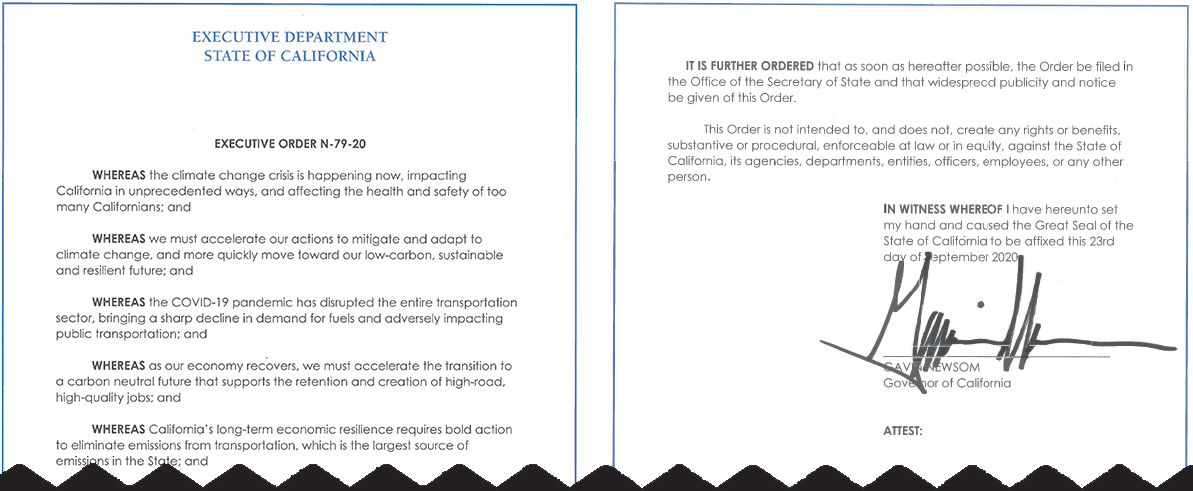
SACRAMENTO – Governor Gavin Newsom announced Wednesday that he will aggressively move the state further away from its reliance on climate change-causing fossil fuels while retaining and creating jobs and spurring economic growth – he issued an executive order requiring sales of all new passenger vehicles to be zero-emission by 2035 and additional measures to eliminate harmful emissions from the transportation sector. (The text of today’s executive order can be found here and a copy can be found here.)

The transportation sector is responsible for more than half of all of California’s carbon pollution, 80 percent of smog-forming pollution and 95 percent of toxic diesel emissions – all while communities in the Los Angeles Basin and Central Valley see some of the dirtiest and most toxic air in the country.

“This is the most impactful step our state can take to fight climate change,” said Governor Newsom. “For too many decades, we have allowed cars to pollute the air that our children and families breathe. Californians shouldn’t have to worry if our cars are giving our kids asthma. Our cars shouldn’t make wildfires worse – and create more days filled with smoky air. Cars shouldn’t melt glaciers or raise sea levels threatening our cherished beaches and coastlines.”

Following the order, the California Air Resources Board will develop regulations to mandate that 100 percent of in-state sales of new passenger cars and trucks are zero-emission by 2035 – a target which would achieve more than a 35 percent reduction in greenhouse gas emissions and an 80 percent improvement in oxides of nitrogen emissions from cars statewide. In addition, the Air Resources Board will develop regulations to mandate that all operations of medium- and heavy-duty vehicles shall be 100 percent zero emission by 2045 where feasible, with the mandate going into effect by 2035 for drayage trucks. To ensure needed infrastructure to support zero-emission vehicles, the order requires state agencies, in partnership with the private sector, to accelerate deployment of affordable fueling and charging options. It also requires support of new and used zero-emission vehicle markets to provide broad accessibility to zero-emission vehicles for all Californians. The executive order will not prevent Californians from owning gasoline-powered cars or selling them on the used car market.

California will be leading the nation in this effort – joining 15 countries that have already committed to phase out gasoline-powered cars and using our market power to push zero-emission vehicle innovation and drive down costs for everyone.

By the time the new rule goes into effect, zero-emission vehicles will almost certainly be cheaper and better than the traditional fossil fuel powered cars. The upfront cost of electric vehicles are projected to reach parity with conventional vehicles in just a matter of years, and the cost of owning the car – both in maintenance and how much it costs to power the car mile for mile – is far less than a fossil fuel burning vehicle.

The executive order sets clear deliverables for new health and safety regulations that protect workers and communities from the impacts of oil extraction. It supports companies who transition their upstream and downstream oil production operations to cleaner alternatives. It also directs the state to make sure taxpayers are not stuck with the bill to safely close and remediate former oil fields. To protect the health and safety of our communities and workers, the Governor is also asking the Legislature to end the issuance of new hydraulic fracturing permits by 2024.

The executive order directs state agencies to develop strategies for an integrated, statewide rail and transit network, and incorporate safe and accessible infrastructure into projects to support bicycle and pedestrian options, particularly in low-income and disadvantaged communities.

This action continues the Governor’s commitment to strengthening California’s resilience while lowering carbon emissions – essential to meeting California’s air quality and climate goals. In the last six months alone, the California Air Resources Board has approved new regulations requiring truck manufacturers to transition to electric zero-emission trucks beginning in 2024 and the Governor signed an MOU with 14 other states to advance and accelerate the market for electric medium- and heavy-duty vehicles. Last fall, California led a multi-state coalition in filing a lawsuit challenging the U.S. Environmental Protection Agency’s attempt to revoke portions of a 2013 waiver that allows the state to implement its Advanced Clean Car Standards.

Last September, Governor Newsom took action to leverage the state’s transportation systems and purchasing power to strengthen climate mitigation and resiliency and to measure and manage climate risks across the state’s $700 billion pension investments. To mitigate climate threats to our communities and increase carbon sequestration, the Governor invested in forest health and fuel reduction and held utilities accountable for building resiliency. The Governor also directed state agencies to develop a comprehensive strategy to build a climate-resilient water system and made a historic investment to develop the workforce for California’s future carbon-neutral economy.
 

Filed Under: Business, Economy, Environment, Government, News, State of California

Frazier to introduce bill to combat major cause of greenhouse gas emissions in California – wildfires

September 23, 2020 By Publisher Leave a Comment

Challenges CA Air Resources Board to “pause and think” about effectiveness of Cap and Trade program

Assemblyman Jim Frazier

SACRAMENTO – Assemblymember Jim Frazier (D-Fairfield) announced today that he plans to introduce legislation in the upcoming session to fundamentally change the way California reduces greenhouse gas emissions.

  “While I believe the work the California Air Resources Board (CARB) has been doing is laudable, we need to shift gears and address the main cause of carbon emissions in California, and right now, that is unquestionably wildfires,” said Frazier. “The data is undeniable and staggering.”

  According the U.S. Geological Survey, in 2018 alone, the wildfires in California were estimated to have released emissions equivalent to roughly 68 million metric tons of carbon dioxide. By contrast, after seven years of reduction efforts from Cap and Trade funded projects to date, is estimated to be 45 million metric tons – at the cost of billions of dollars.

  Frazier went on to say that he believes CARB needs to “pause and think” carefully about their programs and overall efficacy of the resources devoted to them, and reprioritize Cap and Trade dollars to address the immediate threat and environmental devastation that wildfires are causing. In addition to the further advancement of global warming, these fires result in property damage, loss of life, economic peril, and long-term health issues.

  “The science and statistics of the devastation that wildfires are causing are not just limited to the land. These fires are pumping more pollution – far more toxic – than the burning of fossil fuels, and we must take a critical look at how we dedicate our precious financial resources to their reduction.  As we know, wildfires are a major contributor to the advancement of global warming.”

  Frazier will introduce a bill this December.

Filed Under: Economy, Environment, Fire, Health, Legislation, News

Contra Costa updates health order to match state’s COVID-19 Blueprint – nail salons, massage can reopen indoors

September 14, 2020 By Publisher Leave a Comment

Even card rooms can open, again – outdoors, but not piercing, tattooing or non-medical electrolysis (you’ll still have to keep plucking out those hairs, yourself!)

Contra Costa County today aligned its COVID-19 social distancing health order with California’s Blueprint for a Safer Economy, so the county no longer has different reopening rules for businesses and activities beyond what the state requires or allows.

The change, effective at 8 a.m. Wednesday, Sept. 16, simplifies the plan for reducing the spread of COVID-19 in Contra Costa so that residents and local businesses can better understand and identify the steps we all need to take to keep ourselves, our families, workers and customers safer during the pandemic.

The update to Contra Costa’s health order does allow some additional businesses to reopen, following the state health guidelines for their industries:

  • Personal care services that involve close contact with the face may begin operating outdoors, except for tattooing, piercing and nonmedical electrolysis
  • Racetracks and cardrooms may operate outdoors
  • Music, television and film production may resume
  • Professional sports without live audiences may resume

These changes are consistent with Contra Costa’s placement in the purple tier of the state’s blueprint, indicating that COVID-19 is widespread in the county. When the data tracked by the state show sustained improvement for two weeks, the county will move into the red tier, allowing more businesses and activities to reopen.

Information about the state’s blueprint, including health guidelines for businesses and activities, which business sectors are not currently safe to operate in Contra Costa, and how the guidelines will change as the county makes progress against COVID-19, are all available at covid19.ca.gov/safer-economy.

Contra Costa’s current health orders retain health guidelines for social bubbles and structured contact between people from different households, face coverings and physical distancing. The FAQ and Safer Social Interactions pages at cchealth.org/coronavirus have information about keeping safer during the pandemic.

Contra Costa Health Services (CCHS) continues to monitor data that show how the virus is spreading through our community, including hospitalizations and how the pandemic is impacting the county’s healthcare system. If there is a sudden surge in COVID-19 transmission in the future, the county may need to temporarily impose more restrictions to protect the public health.

One way Contra Costans can help keep our county’s healthcare system running smoothly is to get a flu vaccine – talk to your health provider about getting one. CCHS is also planning community vaccination clinics beginning in October.

Anyone who lives or works in Contra Costa can help make the county safer from COVID-19 and reopen more quickly is to get a fast, free COVID-19 test at a community testing site. The state has reduced the requirements for moving into less restrictive tiers for counties that test many people every day, and other Bay Area counties have already qualified for this benefit.

Make a COVID-19 testing appointment today by calling 1-844-421-0804 or booking online at cchealth.org/coronavirus – hit the “Get Tested” button. This site is also an official source for local information regarding the COVID-19 pandemic.


Filed Under: Business, Economy, Health, News

Regional agencies seek input on the future of the Bay Area

July 10, 2020 By Publisher Leave a Comment

For transportation, housing, economy and environment for next three decades

Plan Bay Area 2050’s Draft Blueprint is available for public comment through August 10, 2020

SAN FRANCISCO, July 10, 2020 . . . The Metropolitan Transportation Commission (MTC) and the Association of Bay Area Governments (ABAG) are inviting the Bay Area public to provide input on the newly released Plan Bay Area 2050 Draft Blueprint, a 30-year regional vision that seeks to create a more affordable, connected, diverse, healthy and vibrant Bay Area for all. The Draft Blueprint is being released today for a public comment period that will run through August 10, 2020.

Given the myriad challenges the COVID-19 pandemic poses to the Bay Area, MTC and ABAG will hold virtual workshops and telephone town halls through August 7, 2020. Both organizations want to hear from all Bay Area residents in order to incorporate diverse voices from across our region. Input received by the agencies will be used to further refine the Final Blueprint to create a more resilient and equitable Bay Area for future generations. The Final Blueprint is slated for approval in late 2020 and will be integrated into Plan Bay Area 2050 prior to its adoption in 2021.

The Plan Bay Area 2050 Draft Blueprint weaves together transportation, housing, economic and environmental strategies, alongside an expanded set of growth geographies, to advance critical climate and equity goals. Designed to accommodate the 1.5 million new homes necessary to house future growth and address overcrowding, as well as 1.4 million new jobs, the Draft Blueprint integrates critical strategies to address our severe and longstanding housing crisis. With infrastructure investments in walking, biking and public transportation – as well as sea level protections designed to keep most Bay Area communities from flooding through 2050 – the Draft Blueprint makes meaningful steps towards the adopted Plan Bay Area 2050 Vision.

Plan Bay Area 2050 is a joint initiative of MTC and ABAG. For more information on Plan Bay Area 2050 or to provide comments on the Draft Blueprint, visit: www.planbayarea.org. The entire list of public events can be found here: www.planbayarea.org/meetings-and-events/upcoming-public-events.

See previous plans here – Plan 2040  Plan Bay Area

MTC is the transportation planning, financing and coordinating agency for the nine-county San Francisco Bay Area. ABAG’s mission is to strengthen cooperation and collaboration across local governments to build healthier, stronger communities.

Filed Under: Economy, Environment, Government, Growth & Development, Jobs & Economic Development, News, Transportation

More reopening in Contra Costa effective Friday at 5 p.m. – outdoor dining, pools, religious services with strict limits

June 5, 2020 By Publisher 2 Comments

From Contra Costa Health Services

Contra Costa County residents may again enjoy outdoor swimming pools, outdoor seating at restaurants and dog parks under a new health officer order released today.

The order, effective 5 p.m. today, also allows for outdoor religious services of up to 100 people, indoor religious services of up to 12 people, use of outdoor picnic and barbecue spaces, and overnight camping for people belonging to the same household.

Because of the progress made in the fight against COVID-19, Contra Costa health officers feel confident opening additional businesses and activities. The State of California has determined that while counties can move slower than state in reopening, they cannot move more quickly. The openings announced today bring Contra Costa County in closer alignment to state guidelines. It also aligns with other Bay Area counties taking similar steps.

“We have made great progress slowing COVID-19 in our county,” said Candace Andersen, chair of the Contra Costa Board of Supervisors. “I want to offer a heartfelt thank you to all who suffered and sacrificed to follow these health orders throughout this pandemic. I know it has not been easy. But you have helped save lives.”

This order follows a modification earlier this week that allowed offices and many retail businesses to reopen and created guidance for small gatherings including people from different households.

Previous health orders requiring physical distancing and face coverings in public spaces remain in effect. Contra Costa residents should also continue to emphasize handwashing and other hygiene measures in their daily lives to reduce their risk of becoming infected.

“COVID-19 is still circulating in our community, and we need to take precautions to prevent outbreaks,” said Dr. Chris Farnitano, the county health officer. “Another way we can keep ourselves and our families safe is to get tested, even if we feel well.”

The new order includes guidance for safely conducting the newly permitted activities, including requirements for businesses. Details, including the full text of the order, are available at cchealth.org/coronavirus.

Filed Under: Business, Dining, Economy, Faith, Government, Health, News, Recreation

COVID-19 Good News: Contra Costa County now allows curbside retail as of today

May 19, 2020 By Publisher 1 Comment

Thanks to progress made in containing the spread of COVID-19, Contra Costa County has relaxed restrictions in its shelter-in-place order to allow retail stores and their suppliers to reopen on Tuesday.

As of May 19 at 6 a.m., retail stores in Contra Costa County may now offer curbside sales or other outdoor pickups of orders as long as they abide by certain safety measures to prevent the spread of COVID-19.

Stores may not display merchandise for sale on tables or otherwise outside the stores. Customers may not enter the store or interior of any indoor shopping mall. Stores must also employ reasonable measures to require customers to comply with social distancing requirements at the pickup areas, including marking locations at six-foot intervals for customers to stand while waiting in line.

“While this is not a return to normal, it is one step in that direction” said Dr. Chris Farnitano, Contra Costa County’s health officer. “We will be closely monitoring the effects of allowing curbside retail on the spread of COVID-19 in the community.”

Contra Costa will also allow businesses that manufacture retail goods and provide warehousing or logistical support to retail stores to operate, but they must limit the number of staff in enclosed areas so that personnel can comply with social distancing requirements.

The changes mark a shift from allowing people only to shop at essential businesses, such as grocery stores and pharmacies. Dr. Farnitano said encouraging progress has been made in the two weeks since the most recent shelter-in-place order in reaching five goals or “indicators” went into effect:

  • The number of new cases of COVID-19 has been stable or decreasing, even with increased testing
  • The number of hospitalized patients with COVID-19 is stable, and we have adequate hospital capacity. As of May 17, there were 19 COVID-positive patients in Contra Costa hospitals – down from a high of 44 in mid-April.
  • More COVID-19 tests are being performed in our region each day
  • Hospitals are reporting improved supply of Personal Protective Equipment (PPE), though shortages continue in other healthcare settings
  • There is increased capacity for case investigation and contact tracing.

Residents are still required by health order to stay home as much as possible, wear face coverings when they leave home, and to follow the precautions that have helped Contra Costa make progress to slow the spread of COVID-19, such as regular handwashing and social distancing. COVID-19 continues to pose a very significant risk to our communities, and continued vigilance is necessary to ensure that we do not see an increase in spread as more activities resume.

Filed Under: Business, Economy, Health, News

Gov. Newsom taps all former California governors and other leaders for new Business and Jobs Recovery Task Force

April 17, 2020 By Publisher Leave a Comment

Governor appoints business and civic leader, and former Democratic presidential candidate Tom Steyer Chief Advisor and as task force co-chair with governor’s Chief of Staff Ann O’Leary

All of California’s former governors and California’s legislative leaders across both political parties join the task force

Brings together Californian government, business, labor, health care and community leaders from across diverse range of the state’s economy to develop recommendations for a plan that works for all Californians, with a focus on the regions and communities hardest hit by the pandemic

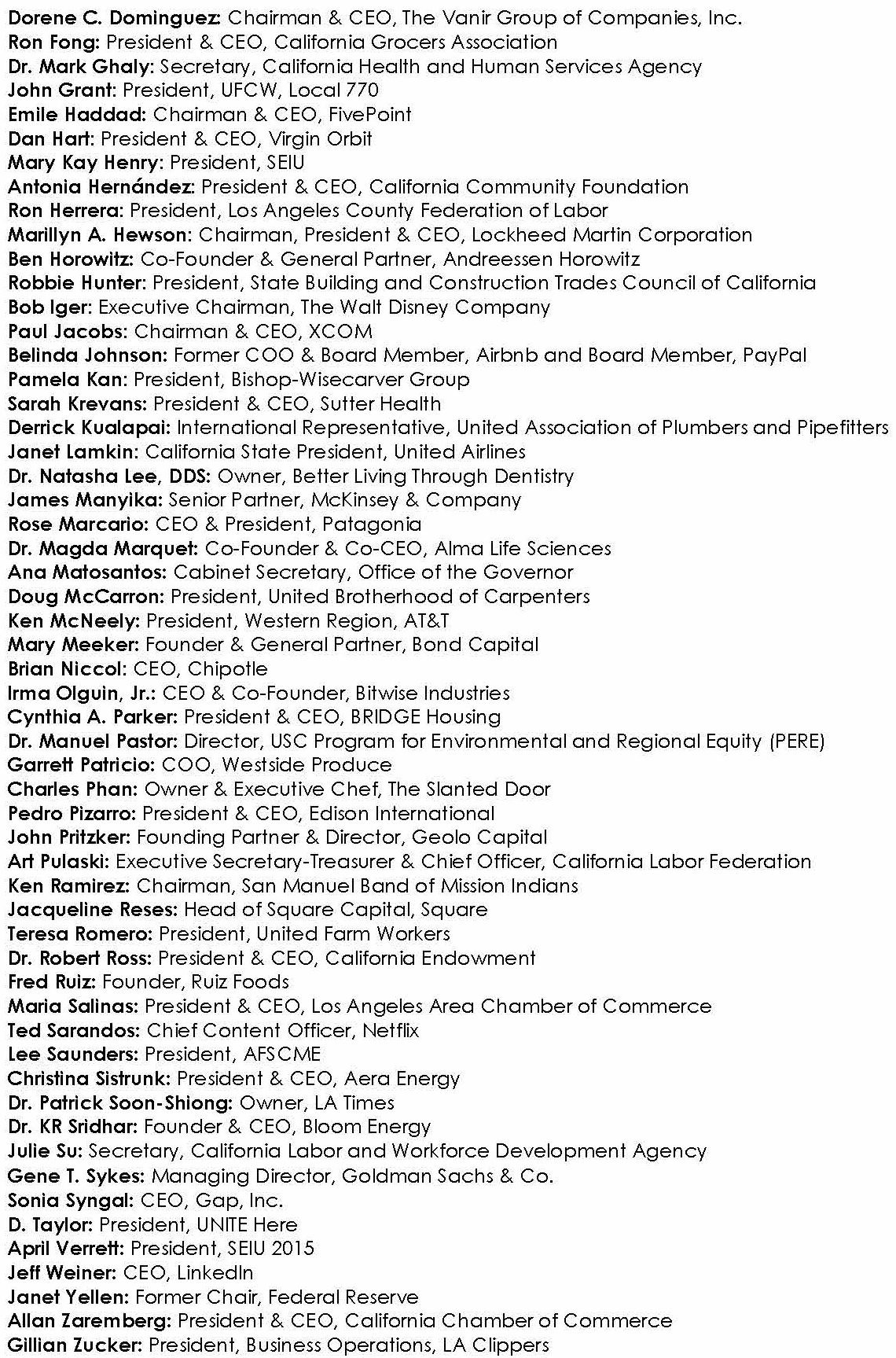
Former Federal Reserve Chair Janet Yellen, Disney Executive Chairman Bob Iger, ILWU President Willie Adams, President and CEO of the California Community Foundation Antonia Hernandez, former head of the Small Business Administration Aida Álvarez and Apple CEO Tim Cook will be part of the task force stepping up to help California pave the way toward a fast, safe recovery of jobs

SACRAMENTO (April 17, 2020) – Bringing together leaders across California’s diverse, innovative economic and social sectors to chart a path forward on recovery in the wake of COVID-19, Governor Gavin Newsom today announced the formation of a state Task Force on Business and Jobs Recovery. The Task Force will be co-chaired by Governor Newsom’s Chief of Staff Ann O’Leary and philanthropist, environmentalist and businessman Tom Steyer, who was also appointed Chief Advisor to the Governor on Business and Jobs Recovery. He will receive no compensation for his service.

Members of the Task Force include Senate President pro Tempore Toni Atkins, Assembly Speaker Anthony Rendon, Senate Minority Leader Shannon Grove, Assembly Minority Leader Marie Waldron, former Federal Reserve Chair Janet Yellen, Walt Disney Company Executive Chairman Bob Iger, former head of the Small Business Administration Aida Álvarez and dozens of prominent leaders in business, labor, health care, academia and philanthropy.

Read the full list of Task Force members here.

“This pandemic has forced millions of Californians out of jobs – with the most vulnerable hit the hardest,” said Governor Newsom. “While we have made significant progress in flattening the curve and increased preparedness of our health care delivery system, the actions taken have also impacted the economy, poverty and overall health care in California. We will use a gradual, science-based and data-driven framework to guide our re-opening timing while planning our economic recovery. I am honored that dozens of leaders in business, labor, health and philanthropy are stepping up to meet this moment by committing their time and talent to lift up all Californians. Through their leadership, and the leadership of California’s 40 million residents, I have no doubt we will emerge stronger from this crisis.”

The Task Force will work to develop actions government and businesses can take to help Californians recover as fast as safely possible from the COVID-19 induced recession and to shape a fair, green, and prosperous future. They will meet twice a month throughout 2020 to develop options that would work for all Californians, with a particular focus on those hardest hit by the pandemic.

“Governor Newsom has been a steady hand and shining example of how to lead during a crisis, and I am thrilled to help in this critical way,” said Tom Steyer. “In the coming weeks and months, we will bring together the public and private sectors, outside experts, organized labor, environmental groups, and activists to develop recommendations for a recovery plan that works for all Californians, with an emphasis on those communities hardest hit by the pandemic. Our goal is to present Governor Newsom with tangible actions that leverage the task force’s expertise to rebuild California, emphasize smart, green technologies and provide a model for just economic development for our country.”

The Task Force will craft ideas for short, medium, and long-term solutions that reflect communities across the state, and emphasize a fair and equitable recovery. There will be significant emphasis of the state’s strengths, including diversity and innovation. The Task Force will not only focus on our immediate recovery, but on actions to support a cleaner, more equitable and prosperous future for all Californians. It will build on the important work of other groups including the Governor’s Council of Economic Advisors, the Higher Education Council and the Commission on the Future of Work. Both co-chairs of the Future of Work Commission, President of SEIU Mary Kay Henry and Senior Partner of McKinsey & Company James Manyika, will serve on the new Task Force.

The governor formed the Business and Jobs Recovery Task Force just days after he announced a multi-state Task Force with Oregon and Washington to coordinate the reopening of our regional economy. Governor Newsom outlined a road map to recovery with six indicators that should be met before California’s stay-at-home orders are modified.

The COVID-19 pandemic has had a devastating effect on California’s economy. The state has seen more than 2.8 million unemployment claims since March 12, 2020 – not including undocumented residents or independent contractors. The impact has been particularly devastating for California’s small businesses.

Filed Under: Business, Economy, News, State of California

  • « Previous Page
  • 1
  • 2
Furniture-Clearance-02-26B
Celia's-3-26-A
Delta-RC-A
Deer-Valley-Chiro-06-22

Copyright © 2026 · Contra Costa Herald · Site by Clifton Creative Web