• Home
  • About The Herald
  • Local Agencies
  • Daily Email Update
  • Legal Notices
  • Classified Ads

Contra Costa Herald

News Of By and For The People of Contra Costa County, California

  • Arts & Entertainment
  • Business
  • Community
  • Crime
  • Dining
  • Education
  • Faith
  • Health
  • News
  • Politics & Elections
  • Real Estate

CHP seeks public help ID’ing suspects in Hwy 24 freeway shooting near Caldecott Tunnel Thursday

September 18, 2021 By Publisher Leave a Comment

By CHP – Oakland

OAKLAND, CA. – On September 16, 2021, at 3:30 p.m., the California Highway Patrol (CHP) received a call of a road rage incident which led to a freeway shooting on eastbound State Route 24 (SR-24), west of the Caldecott Tunnel. CHP officers responded to the scene and located the victim stopped on the right shoulder. The victim vehicle sustained multiple bullet strikes. No injuries were reported.

Traffic was impacted from 3:30 p.m., to 6:00 p.m. while the shooting investigation was being conducted. This remains an ongoing investigation. The CHP asks that any person with information contact the CHP Golden Gate Division tip line at (707) 917-4491, or by email at 30specialinvestigations@chp.ca.gov.


Filed Under: Bay Area, CHP, Crime, News

Acting U.S. Attorney announces major law enforcement initiative to combat violence, drug distribution by La Nuestra Familia gang

September 17, 2021 By Publisher Leave a Comment

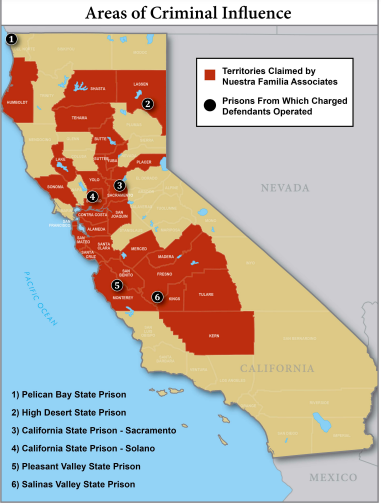
Map of La Nuestra Familia’s Areas of Criminal Influence. Source: FBI San Francisco

“Operation Quiet Storm was one of the largest gang takedowns in FBI San Francisco division’s history,” charges 55 defendants, some from Contra Costa

Acting U.S. Attorney Hinds emphasizes focus on community engagement to root out drivers of violent crime

SAN FRANCISCO – Acting United States Attorney Stephanie M. Hinds held a press conference Thursday to announce the unsealing of federal charges filed against 55 defendants, many of whom were members of, or affiliated with, the Nuestra Familia prison gang and its subservient street gangs.  Acting U.S. Attorney Hinds was joined in making the announcement by Federal Bureau of Investigation Special Agent in Charge Craig D. Fair, Drug Enforcement Administration Special Agent in Charge Wade R. Shannon, California Department of Corrections and Rehabilitation Chief Office of Correctional Safety Derrick Marion, Santa Clara Sheriff Laurie Smith, and San Jose Deputy Chief of Police Elle Washburn.

The focus of the press conference was the unsealing of 17 charging documents, including 14 indictments and 7 criminal complaints, setting out a broad array of charges against the defendants.  DOJ NF indictment 082521 DOJ SJG indictment 081221 DOJ EHP indictment_081221

According to an FBI San Francisco tweet on Thursday, “Operation Quiet Storm was the culmination of more than 5 years of complex investigative work. The gangs targeted in this case are responsible for much of the illicit drug distribution and violent crime that has plagued areas throughout CA.”

“No single defendant is responsible for all the conduct I am describing,” said Hinds. “The charges against each defendant are described in a charging document that is unique to each defendant. By disrupting gang leadership, we reduce violence on our streets.  By removing violent actors and crime drivers from the streets, we make our neighborhoods safer.”

According to the documents unsealed today, La Nuestra Familia – Spanish for “Our Family”– was a prison gang operating in the California state prison system. Falling under the gang’s supervision are Norteño street gangs established in numerous cities and counties, and in jails and prisons, throughout Northern California and elsewhere. Several of the charging documents unsealed Thursday describe various aspects of the gang.  For example, one indictment (here (Leadership)) describes the largely-incarcerated leadership, while another (here (SJG)) describes the activities of a street gang called the San Jose Grande and yet another (here (EHP)) describes a group referred to as El Hoyo Palmas Street Gang. The picture that emerges is one of a violent and structured organization that finances its activities through crime and encourages its members to visit violence upon anyone who threatens the gang’s existence, including members who break gang rules, members who attempt to leave the gang, and rival gang members.

According to the documents unsealed Thursday, of the 55 defendants, 28 individuals were charged with racketeering crimes, while the remaining individuals were charged with drug trafficking and firearms offenses. Conspiracies alleged in the indictments include agreements to distribute drugs including heroine, methamphetamine, and cocaine; to commit armed robberies; and to commit murder.  Additional defendants were charged with other related crimes ranging from drug distribution to armed robbery.

According to a San Diego Union-Tribune report, “Prosecutors said 36 of the defendants were already in state prison and have been moved to federal holding facilities. Authorities have not said how many of the 19 remaining defendants were arrested in law-enforcement sweeps this week.”

Acting U.S. Attorney Hinds emphasized the goal to “fish with a spear, not a net.”

“Working with our federal and state, local, and tribal law enforcement partners, as well as impacted communities, our law enforcement efforts have focused on addressing violent crime-driven by gangs,” said Hinds.  “We will continue to work with our law enforcement partners, as well as members of our community, to identify and address the drivers of crime in our neighborhoods.  We intend to continue to deliver results by focusing on the needs of our communities.”

“Operation Quiet Storm was one of the largest gang takedowns in FBI San Francisco division’s history,” said FBI San Francisco Special Agent in Charge Fair.  “The coordinated efforts of this operation were done with one goal in mind: to disrupt the communications and organizational structure of a criminal network who has terrorized our neighborhoods for far too long.”

“Today’s operation strikes a substantial blow to Nuestra Familia leadership. This investigation revealed the wide-ranging influence of the gang that extends far beyond prison walls. It is clear they have hard and fast rules, and those who run afoul are met with intimidation and violence that spills into our communities,” said DEA Special Agent in Charge Shannon. “We will continue to look at these organizations structurally to disrupt and dismantle them.”

An indictment merely alleges that crimes have been committed, and the defendants are presumed innocent until proven guilty beyond a reasonable doubt.

This case is being prosecuted by the Organized Crime Strike Force of the United States Attorney’s Office for the Northern District of California.  The prosecution is the result of an investigation by the FBI (San Francisco, Sacramento, and Phoenix Divisions) and the DEA, with the assistance of the Santa Clara County Sheriff’s Office, the California Department of Corrections and Rehabilitation, the U.S. Bureau of Alcohol, Tobacco, Firearms, and Explosives, the Santa Clara County District Attorney’s Office, and the San Jose Police Department, as well as the support of the Alameda County Sheriff’s Office, Antioch Police Department, Campbell Police Department, Fremont Police Department, King’s County Sheriff’s Office, Monterey County Sheriff’s Office, Mountain View Police Department, Sacramento Police Department, Salinas Police Department, Menlo Park Police Department, Santa Clara County Parole Department, Santa Clara County Probation Department, Santa Clara Police Department, Santa Cruz County District Attorney’s Office, Santa Cruz County Sheriff’s Office, Modesto Police Department, San Francisco Police Department, and Stanislaus County Sheriff’s Department, and Sunnyvale Department of Public Safety.

This investigation and prosecution are part of the Organized Crime Drug Enforcement Task Force (“OCDETF”), which identifies, disrupts, and dismantles the highest-level drug traffickers, money launderers, gangs, and transnational criminal organizations that threaten the United States by using a prosecutor-led, intelligence-driven, multi-agency approach that leverages the strengths of federal, state, and local law enforcement agencies against criminal networks.


Filed Under: Bay Area, Crime, East County, News, Police, U S Attorney

Mexican prison gang Nuestra Familia’s leaders, members, associates charged with racketeering including some from Contra Costa

September 17, 2021 By Publisher Leave a Comment

Description of indictment by USDOJ against Nuestra Familia leaders, members and associates on Aug. 25, 2021.

Indictment describes the gang’s nexus of power overseeing thousands of members throughout California; Antioch Police Department assist in investigation

Involved in plots to murder 14 victims, plus robbery, drug trafficking and money laundering

SAN JOSE – A federal grand jury returned an indictment charging 17 defendants with racketeering conspiracy, including acts involving murder, robbery, drug trafficking, and money laundering, and charging five others with drug trafficking-related crimes.  The indictment handed down on August 25, 2021, and unsealed Thursday, September 16, 2021 catalogues a litany of crimes allegedly directed by the Nuestra Familia’s command structure incarcerated in California prisons.  The charging announcement was made by Acting United States Attorney Stephanie Hinds, Federal Bureau of Investigation Special Agent in Charge Crag D. Fair, and Drug Enforcement Administration Special Agent in Charge Wade R. Shannon at a press conference this morning. Also appearing at the press conference were Chief of the Office of Correctional Safety for the California Department of Corrections and Rehabilitation Derrick Marion, Santa Clara Sheriff Laurie Smith, and San Jose Deputy Chief of Police Elle Washburn. DOJ NF_indictment 082521

“The indictment charges all seven of the members who make up the Nuestra Familia’s ruling body: the General Council,” said Acting U.S. Attorney Hinds. “While the physical movement of this leadership was restricted by prison walls, the indictment alleges their power and influence were not so constrained. By disrupting gang leadership, we reduce violence on our streets.  By removing violent actors and crime drivers from the streets, we make our neighborhoods safer.”

“The arrests made yesterday, most significantly the arrests of the Nuestra Familia leadership, will severely cripple the ability of this criminal enterprise to continue to facilitate crimes in communities throughout the state and help break a decades-old cycle of violence,” said FBI San Francisco Special Agent in Charge Fair.

“Today’s operation strikes a substantial blow to Nuestra Familia leadership. This investigation revealed the wide-ranging influence of the gang that extends far beyond prison walls. It is clear they have hard and fast rules, and those who run afoul are met with intimidation and violence that spills into our communities,” said DEA Special Agent in Charge Wade R. Shannon. “We will continue to look at these organizations structurally to disrupt and dismantle them.”

According to the indictment, the 17 racketeering defendants were members and associates of the Nuestra Familia (“NF”) prison gang, a violent and lucrative organization formed in the 1960s.  The NF is alleged in the indictment to be a criminal enterprise that was created to organize, protect, discipline, profit from, and maintain the allegiance of gang members on the streets of and within custodial facilities in California.  As outlined in the indictment, membership in the NF involved a process of sponsorship, approval, and indoctrination.  The perpetration of violence and other crimes was ordinarily a prerequisite to entrance, continued membership, and advancement in the organization.  Once membership was achieved, this membership was for life.  The indictment alleges an NF oath provides: “If I lead, follow. If I stumble, push me. If I fall, avenge me. If I betray you, kill me.”

The indictment also describes the NF’s organizational structure and, in particular, the gang’s governing body: a seven-member “General Council,” made up of three Generals and a four-member Inner Council, which makes significant decisions and oversees the activities of the NF and its subservient gangs.  The indictment outlines each position according to the NF Constitution.  According to the NF Constitution, the Street Regiment General oversees the NF’s “overall street operations.”  The General of the Prisons is responsible for the NF’s “overall pinta [prison] functions,” and the General Advocates Office is the NF’s “justice department.”  Tiered just below these three NF Generals was the Inner Council, which consisted of four senior NF members who served as “advisors” to the Generals and provided a system of checks and balances.  All seven members of the NF’s General Council led the NF organization while incarcerated in the California prison system.  Each is charged in this indictment.

Further, the indictment describes the appointment by these leaders of NF members to positions of power over hierarchical and paramilitary structures called “regiments,” imposed on its gang members operating on the streets in California.  While the NF was composed of a relative few, it exercised control and wielded influence over thousands of subordinate gang members in counties and prisons throughout Northern California using such regiments.  These regiments primarily guaranteed the NF’s vast influence and control over its own and its street gang members, ensured avenues to direct violence and other illicit activity, and secured means for the NF to make money through the commission of criminal activity.

The NF oversaw such regiments in Contra Costa County, Santa Clara County, Monterey County, Santa Cruz County, San Benito County, San Francisco County, San Mateo County, Alameda County, Solano County, San Joaquin County, Fresno County, Kings County, Tulare County, Madera County, Merced County, Kern County, Sacramento County, Yolo County, Humboldt County, Shasta County, Lassen County, Tehama County, Butte County, Yuba County, Sutter County, Lake County, Placer County, and Sonoma County, as well as in Salinas Valley State Prison, Pelican Bay State Prison, Pleasant Valley State Prison, California State Prison – Solano, California State Prison – Sacramento, and High Desert State Prison.

According to the indictment, NF members and associates were involved in plots to kill 14 victims between April 2013 and July 2019 as part of the charged racketeering conspiracy.  The defendants charged in the alleged racketeering conspiracy include the following:

Defendant Age Charges Maximum Statutory Penalty
DAVID CERVANTES aka “DC” 73 18 U.S.C. § 1962(d) – Racketeering Conspiracy Life
ANTONIO GUILLEN aka “Chuco” 55 18 U.S.C. § 1962(d) – Racketeering Conspiracy Life
JAMES PEREZ aka “Conejo”


67 18 U.S.C. § 1962(d) – Racketeering Conspiracy Life
SAMUEL LUNA aka “Sammy”


46 18 U.S.C. § 1962(d) – Racketeering Conspiracy Life
GUILLERMO SOLORIO aka “Capone”


42 18 U.S.C. § 1962(d) – Racketeering Conspiracy Life
TRINIDAD MARTINEZ aka “Trino”


41 18 U.S.C. § 1962(d) – Racketeering Conspiracy Life
GEORGE FRANCO aka “Puppet”


56 18 U.S.C. § 1962(d) – Racketeering Conspiracy Life
STEVEN TRUJILLO aka “Esteban”


56 18 U.S.C. § 1962(d) – Racketeering Conspiracy Life
SALVADOR CASTRO aka “Gangster”


51 18 U.S.C. § 1962(d) – Racketeering Conspiracy Life
BRYAN ROBLEDO aka “Turtle” 48 18 U.S.C. § 1962(d) – Racketeering Conspiracy Life
ALEX YRIGOLLEN aka “Sleepy”


52 18 U.S.C. § 1962(d) – Racketeering Conspiracy Life
JUAN SOTO aka “Drifter”


38 18 U.S.C. § 1962(d) – Racketeering Conspiracy Life
EDGARDO RODRIGUEZ aka “Big Evil”


41 18 U.S.C. § 1962(d) – Racketeering Conspiracy Life
ROBERT MALDONADO aka “KJ”


46 18 U.S.C. § 1962(d) – Racketeering Conspiracy Life
ERIC ZARATE aka “Baby G”


43 18 U.S.C. § 1962(d) – Racketeering Conspiracy Life
ROCKY BRACAMONTE aka “Fox”


37 18 U.S.C. § 1962(d) – Racketeering Conspiracy Life
JOSHUA CORTEZ aka “Buddah”


28 18 U.S.C. § 1962(d) – Racketeering Conspiracy 20 years

Also charged in the indictment are defendants who allegedly participated in two conspiracies to possess and distribute methamphetamine, one in May of 2019 and the other in September 2020 to March 2021.  The charges pending against these defendants are as follows:

Defendant Age Charges Maximum Statutory Penalty
WILLIAM RODRIGUEZ aka “Negro” 34 21 U.S.C. §§ 846, 841(a)(1), (b)(1)(B) – Conspiracy to Distribute and Possess with Intent to Distribute Methamphetamine At least 5 years, up to 40 years
MARVIN RODRIGUEZ 34 21 U.S.C. §§ 846, 841(a)(1), (b)(1)(B) – Conspiracy to Distribute and Possess with Intent to Distribute Methamphetamine


At least 5 years, up to 40 years
CRISTIAN MORA aka “C-Fresh” 28 21 U.S.C. §§ 846, 841(a)(1), (b)(1)(B) – Conspiracy to Distribute and Possess with Intent to Distribute Methamphetamine


At least 5 years, up to 40 years
MARTIN JOSEPH RUPPEL JR. 42 21 U.S.C. §§ 846, 841(a)(1), (b)(1)(B) – Conspiracy to Distribute and Possess with Intent to Distribute Methamphetamine


At least 5 years, up to 40 years
ANAELISA CUEVAS 35 21 U.S.C. §§ 846, 841(a)(1), (b)(1)(B) – Conspiracy to Distribute and Possess with Intent to Distribute Methamphetamine At least 5 years, up to 40 years

The court also may order additional terms of supervised release, fines, and restitution.  Nevertheless, any sentence following conviction would be imposed by the court only after consideration of the U.S. Sentencing Guidelines and the federal statute governing the imposition of a sentence, 18 U.S.C. § 3553.

An indictment merely alleges that crimes have been committed, and the defendants are presumed innocent until proven guilty beyond a reasonable doubt.

The defendants are scheduled to make initial federal court appearances before U.S. Magistrate Court Judge Nathanael Cousins and U.S. Magistrate Court Judge Sallie Kim today.

This case is being prosecuted by the Organized Crime Strike Force of the United States Attorney’s Office for the Northern District of California.  The prosecution is the result of an investigation by the FBI (San Francisco, Sacramento, and Phoenix Divisions), the DEA, the U.S. Bureau of Alcohol, Tobacco, Firearms, and Explosives, and the U.S. Marshal Service, with the assistance of the Santa Clara County Sheriff’s Office, the California Department of Corrections and Rehabilitation, the Santa Clara County District Attorney’s Office, and the San Jose Police Department, and with support from the Alameda County Sheriff’s Office, Antioch Police Department, Campbell Police Department, Fremont Police Department, King’s County Sheriff’s Office, Monterey County Sheriff’s Office, Mountain View Police Department, Sacramento Police Department, Salinas Police Department, Menlo Park Police Department, Santa Clara County Parole Department, Santa Clara County Probation Department, Santa Clara Police Department, Santa Cruz County District Attorney’s Office, Santa Cruz County Sheriff’s Office, Modesto Police Department, San Francisco Police Department, the Stanislaus County Sheriff’s Department, and Sunnyvale Department of Public Safety.

This investigation and prosecution are part of the Organized Crime Drug Enforcement Task Force (“OCDETF”), which identifies, disrupts, and dismantles the highest-level drug traffickers, money launderers, gangs, and transnational criminal organizations that threaten the United States by using a prosecutor-led, intelligence-driven, multi-agency approach that leverages the strengths of federal, state, and local law enforcement agencies against criminal networks.


Filed Under: Bay Area, Crime, East County, News, Police, U S Attorney

San Quentin prison guard from Pittsburg, two others charged in Death Row contraband smuggling scheme

September 9, 2021 By Publisher 4 Comments

San Quentin State Prison. Photo by CA Dept. of Corrections.

“The charge carries a maximum sentence of 20 years in prison and a $250,000 fine.”

SAN FRANCISCO – Keith Christopher and Isaiah Wells appeared in federal court today to face the charge of conspiracy to commit honest services fraud using interstate wires, announced Acting United States Attorney Stephanie M. Hinds and Federal Bureau of Investigation Special Agent in Charge Craig D. Fair.  A third co-defendant, Tanisa Smith-Symes, will appear tomorrow in federal court in Las Vegas, Nevada, where she was arrested today.

According to the complaint, Christopher, 37, of Pittsburg, California, Smith-Symes, 45, of Las Vegas, Nevada, and Wells, 32, of Tracy, California, conspired to smuggle cell phones into San Quentin State Prison’s East Block, where condemned inmates are housed.  Cell phones create safety and security risks for prison employees and other inmates, and state law deems them contraband and prohibits their possession by inmates.  Christopher is a Corrections Officer at San Quentin State Prison in Marin County.  The complaint alleges that Smith-Symes worked with a Death Row inmate with whom she had a relationship to obtain the contraband phones and ship them to Wells, who then provided the phones to Christopher, who in turn smuggled them into the prison.  Using this scheme, the complaint alleges that the conspirators successfully smuggled at least 25 phones into the prison and that the inmate working with Smith-Symes sold the phones inside the prison for up to $900 each.  Smith-Symes sent bribery payments to Christopher through Wells and others whom Christopher had appointed to receive the money.  The complaint further alleges that Christopher charged $500 as payment for each phone he smuggled into the prison.

The complaint filed against Christopher, Smith-Symes, and Wells charges each defendant with one count of conspiracy to commit honest services fraud using interstate wires in violation of 18 USC §§ 1343, 1346, and 1349.  The charge carries a maximum sentence of 20 years in prison and a $250,000 fine.  Any sentence following conviction, however, is imposed by a court only after the court’s consideration of the United States Sentencing Guidelines and the federal statute governing the imposition of a sentence, 18 USC § 3553.

Christopher and Wells appeared today on the charges before United States Magistrate Judge Sallie Kim, who sits in San Francisco.  They were released on bond and are scheduled to next appear in federal court on September 17, 2021.

Charges contained in a criminal complaint are mere allegations.  As in any criminal case, the defendants are presumed innocent unless and until proven guilty in a court of law.

The prosecution is the result of an investigation by the FBI and the California Department of Corrections and Rehabilitation’s Office of Internal Affairs.

Filed Under: Bay Area, Crime, East County, News, U S Attorney

Contra Costa, Bay Area health officials issue orders requiring indoor masking beginning Tuesday

August 2, 2021 By Publisher 8 Comments

Graphic by State of California from Gov. Newsom’s Wear a Mask campaign.

Also includes Counties of Alameda, Marin, San Francisco, San Mateo, Santa Clara, and Sonoma, and the City of Berkeley; Napa and Solano Counties not included

With the COVID-19 Delta variant now infecting a small percentage of vaccinated people as well as many unvaccinated people, eight Bay Area health officers have issued health orders requiring masks indoors in public places.

The orders require all individuals, regardless of vaccination status, to wear face coverings when indoors in public settings, with limited exceptions, starting at 12:01 a.m. on Tuesday, August 3rd.

Vaccines remain the most powerful tool in the fight against COVID-19, including the Delta variant. Nonetheless, the Delta variant is infecting a small percentage of the vaccinated in the Bay Area — who still remain strongly protected against severe illness, hospitalization, and death. In those instances of infection in a vaccinated person, a face covering prevents further spread. Bay Area health officials urge all unvaccinated residents 12 and older to get vaccinated as soon as possible.

“We must act now to protect ourselves, our loved ones and our community. If you are eligible to get a COVID-19 vaccine and have not yet done so, please do not wait any longer,” said Dr. Chris Farnitano, health officer for Contra Costa. “During July the number of hospitalized COVID-19 patients in our county increased 400%. Four out of five of the COVID patients we see are not vaccinated, even though only one out of five Contra Costa adults are not vaccinated.”

These health orders aim to reduce community transmission of COVID-19 and protect everyone. Health officials are very concerned by the substantial levels of community transmission now found across the Bay Area, especially among unvaccinated people. In part, this is due to the widespread COVID-19 Delta variant, which is substantially more transmissible than previous forms of the virus. Recent information from the Centers for Disease Control and Prevention also indicates that even fully vaccinated individuals can in some cases spread the Delta variant to others, and so indoor use of face coverings provides an important added layer of protection.

The new Health Orders require wearing a well-fitting mask indoors in public settings. Indoor settings, whether public or private, are higher risk for COVID-19 transmission, especially when you are with people you do not live with. Health officials also recommend that all employers make face coverings available to individuals entering their businesses, and businesses are required to implement the indoor face covering order.

Today’s Health Orders are consistent with guidance from the Centers for Disease Control and Prevention and the California Department of Public Health, which recommend that fully vaccinated individuals wear masks while in indoor public settings. Bay Area Health Officers will continue to monitor data, including increasing vaccination throughout the region, to determine when the Orders can be adjusted or lifted.

For more information about COVID-19, and how to get a free vaccine near you, visit cchealth.org/coronavirus.


Filed Under: Bay Area, Government, Health, News

New state budget includes funding for five Bay Area affordable housing pilot programs

July 14, 2021 By Publisher Leave a Comment

Photo: BAHFA

The fiscal 2021-22 state budget signed into law Monday by Gov. Newsom includes a $20 million appropriation for the Metropolitan Transportation Commission (MTC) to underwrite the work of the Bay Area Housing Finance Authority (BAHFA). BAHFA, which is jointly managed by MTC and the Association of Bay Area Governments (ABAG), plans to use this money to seed five new pilot programs designed to ease the Bay Area’s housing affordability and homelessness crises.

“BAHFA was established to transform how the Bay Area delivers on housing affordability and stability,” explained Napa County Supervisor Alfredo Pedroza, who also serves as Chair of both MTC and BAHFA. “We appreciate the Legislature investing some of the state’s budget surplus in BAHFA so we can start working immediately on the five pilot projects that take a comprehensive approach to solving the crisis. The state’s commitment will support many of the Bay Area’s most vulnerable residents today and put us firmly on the path to long-term change.”

The five BAHFA pilot programs include an online platform known as Doorway to connect residents with affordable housing opportunities throughout the Bay Area; financing and technical assistance to support and increase the acquisition and preservation of affordable housing to help combat the displacement of low-income residents; a database to track the development or “pipeline” of affordable homes across the region to help match available funding with projects in areas with the most urgent needs; establishment of an anti-displacement services network to link service providers focused on keeping tenants housed, share best practices and ensure the efficient and equitable distribution of rent-relief dollars; and a partnership with San Francisco-based nonprofit All Home to design and implement a regional homelessness prevention system.

Berkeley mayor and ABAG Executive Board president Jesse Arreguin emphasizes BAHFA’s regional approach to solving the Bay Area’s chronic housing affordability problems through what are known as the Three Ps: producing more new housing at all income levels, protecting current residents from displacement, and preserving existing affordable housing.

“The crisis is a combination of complex and inter-related problems that has been growing for decades. But by working together at a regional scale, our nine counties and 101 cities and towns no longer have to try to solve every problem on their own,” he said.

Established in 2019 by state Assembly Bill 1487, BAHFA is the first regional housing finance authority in California. While BAHFA is comprised of the same membership as MTC, its procedures also are managed by the ABAG Executive Board; and both boards must approve any decision to put a regional housing finance measure on a future ballot. Oakland mayor and MTC Commissioner Libby Schaaf serves as Chair of MTC’s BAHFA Oversight Committee.

ABAG is the council of governments and the regional planning agency for the 101 cities and towns, and nine counties of the Bay Area. MTC is the transportation planning, financing and coordinating agency for the nine-county San Francisco Bay Area.

Filed Under: Bay Area, Growth & Development, Homeless, News, State of California

Public workshops, hearings announced for Draft Plan Bay Area 2050

May 26, 2021 By Publisher Leave a Comment

Regional plan for transportation, housing, the economy, and the environment

Interested agencies, organizations and individuals are invited by the Metropolitan Transportation Commission (MTC) and the Association of Bay Area Governments (ABAG) to comment on the Draft Plan Bay Area 2050. As required by state and federal law, MTC and ABAG have jointly developed this regional plan for transportation, housing, the economy, and the environment, which will serve as the San Francisco Bay Area’s Regional Transportation Plan (RTP) and Sustainable Communities Strategy (SCS) upon its adoption. Draft Plan Bay Area 2050 is defined by 35 integrated strategies designed to advance the region towards a more equitable and resilient future.

A Draft Environmental Impact Report (DEIR) prepared on the Draft Plan Bay Area 2050 will be subject to public review pursuant to a separate notice.

The following online public workshops have been scheduled to receive comment on the Draft Plan Bay Area 2050:

ONLINE PUBLIC WORKSHOP

East Bay Workshop
Contra Costa and Alameda Counties
Monday, June 14, 5:00 to 6:30 p.m.
https://bit.ly/33uXj0y
Passcode: 179826
Webinar ID: 862 3482 0389

ONLINE PUBLIC HEARINGS

Additionally, MTC and ABAG will hold three (3) public hearings to receive oral testimony and written comments about the Draft Plan Bay Area 2050. Copies of the draft plan are on file with the Secretary of the Board of MTC and open to public inspection at planbayarea.org/learnmore. Should you require a hard copy of the draft plan, please submit your request to info@bayareametro.gov or call 415-778-6757 and one will be mailed to you.

The first public hearing will be held during the regular meeting of the Joint MTC Planning Committee with the ABAG Administrative Committee on:

Friday, June 11, 2021 at 9:40 a.m. (Remotely)
https://bit.ly/33xhpav
Webinar ID: 874 2787 4017
Bay Area Metro Center
Board Room, 1st Floor
375 Beale Street, San Francisco, CA 94105

In light of Governor Newsom’s State of Emergency declaration regarding the COVID-19 outbreak and in accordance with Executive Order N-29-20 issued by Governor Newsom on March 17, 2020 and the Guidance for Gatherings issued by the California Department of Public Health, the meeting will be conducted via webcast, teleconference, and Zoom for all participants. Detailed instructions on participating via Zoom are available at: https://mtc.ca.gov/how-provide-public-comment-board-meeting-zoom. The meeting accessibility instructions also will be posted to: https://mtc.ca.gov/whats-happening/events/public-hearings no less than 72 hours prior to the hearing.

Two additional online public hearings have been scheduled for:

Hearing 2
Tuesday, June 22, 5:30 p.m.
https://bit.ly/3y0ZiYp
Passcode: 177176

Webinar ID: 812 0345 4209

Hearing 3
Wednesday, July 7, 1:30 p.m.
https://bit.ly/2SIduFK
Passcode: 908706

Webinar ID: 854 5833 8822

The Draft Plan Bay Area 2050 will be available for public review beginning Wednesday, May 26, 2021, online at https://mtc.ca.gov/whats-happening/events/public-hearings,  https://abag.ca.gov/meetings-events/public-hearings, and planbayarea.org. In an effort to reduce printing costs and conserve paper and in accordance with EO N-29-20 and the Guidance for Gatherings issued by the California Department of Public Health, you are urged to review the Draft Plan Bay Area 2050 on the website listed above. Should you require a hard copy of the Draft Plan Bay Area 2050, please submit your request to info@bayareametro.gov or call 415-778-6757 and one will be mailed to you.

The public comment period for the Draft Plan Bay Area 2050 begins on Wednesday, May 26, 2021 and ends on Tuesday, July 20, 2021 by 5:00pm. All written comments must be received no later than Tuesday, July 20, 2021 by 5:00pm. All written comments on the Draft Plan Bay Area 2050 are being accepted via mail to MTC Public Information, Attn: Draft Plan Comments, 375 Beale Street, Suite 800, San Francisco, CA 94105; via e-mail to info@planbayarea.org; and online at planbayarea.org/learnmore. Comments also are being accepted by phone by leaving a voicemail at (415) 778-2292.

Public comment on the Draft Environmental Impact Report (DEIR) for the Draft Plan Bay Area 2050 will be sought pursuant to a separate notice. After considering public comment, MTC and ABAG are slated to adopt Plan Bay Area 2050 in fall 2021. For more information, call the MTC Public Information Office at (415) 778-6757.

Do you need an interpreter or any other assistance to participate? Please call 415-778-6757. We require at least three working days’ notice to accommodate assistance requests. For TDD or hearing impaired, call 711, California Relay Service, or 1-800-735-2929 (TTY), 1-800-735-2922 (voice) and ask to be relayed to 415-778-6700.

您需要口譯員或任何其他幫助才能參加嗎?請致電415-778-6757。我們要求至少提前三個工作日通知,以便滿足您的請求。對於TDD或聽障人士,請致電711,加州中繼服務,或1-800-735-2929(TTY),1-800-735-2922(語音),並要求轉接到415-778-6700。

¿Necesita un intérprete o cualquier otra ayuda para participar? Llame al 415-778-6757. Requerimos un aviso de al menos tres días hábiles para atender las solicitudes de asistencia. Para personas con discapacidad auditiva o TDD, llame al 711, California Relay Service, o al 1-800-735-2929 (TTY) o al 1-800-735-2922 (voz) y pida que lo comuniquen al 415-778-6700.

Filed Under: Bay Area, Economy, Environment, Growth & Development, News, Transportation

Oakland A’s president informs fans MLB has told them “consider other markets”

May 11, 2021 By Publisher Leave a Comment

Rendering of proposed Oakland A’s waterfront stadium. Source: Oakland A’s

By Allen Payton

In an email today, Tuesday, May 11, 2021, to fans and supporters of the Oakland A’s efforts to build a privately finances, $1 billion+ waterfront stadium in Oakland, president Dave Kaval announced Major League Baseball has instructed the team to “begin exploring other markets” at the same time it pursues plans to remain in the East Bay’s largest city. (See related article)

The American League West leading A’s want to remain in Oakland, but their proposal requires city approval and “it is unclear to us and MLB whether there is a path to success for the A’s in Oakland,” Kaval wrote. His letter was in response to the following statement issued by MLB on Monday:

“MLB is concerned with the rate of progress on the A’s new ballpark effort with local officials and other stakeholders in Oakland. The A’s have worked very hard to advance a new ballpark in downtown Oakland for the last four years, investing significant resources while facing multiple roadblocks. We know they remain deeply committed to succeeding in Oakland, and with two other sports franchises recently leaving the community, their commitment to Oakland is now more important than ever.

The Oakland Coliseum site is not a viable option for the future vision of baseball. We have instructed the Athletics to begin to explore other markets while they continue to pursue a waterfront ballpark in Oakland. The Athletics need a new ballpark to remain competitive, so it is now in our best interest to also consider other markets.”

Oakland A’s waterfront stadium location night view. Source: Oakland A’s

Today, Kaval wrote the following to fans and supporters:

May 11, 2021

A’s Fan,

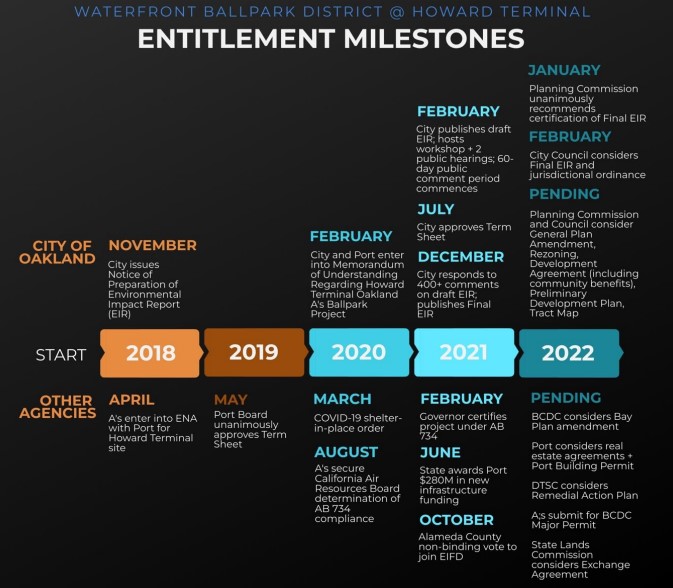
Today, Major League Baseball instructed the A’s to begin exploring other markets while we continue to pursue the Oakland waterfront ballpark project. This is not an easy directive for our fans to hear. We believe in the vision we have presented for a waterfront ballpark; it is a project that will create jobs, housing, open parks, and countless community benefits for Oakland residents, and it will set the stage for more World Series titles for our fans. After four years of work, MLB is concerned with the rate of progress with local officials and other stakeholders on our new ballpark efforts. The time is here for a decision on our future, and it is unclear to us and MLB whether there is a path to success for the A’s in Oakland.

A new ballpark is needed for the A’s continued success. We agree with MLB’s position that the Coliseum location is not a viable option for the future of the franchise. While we remain committed to succeeding in Oakland and will continue to work toward our waterfront ballpark, we will also follow MLB’s direction and immediately begin the process of exploring a new home for the A’s.

Please know that one of our top priorities is continuing to create the best experience possible for our fans this season and beyond. We have the best fans in baseball. Your passion for this franchise is truly unmatched, and we are deeply grateful for your continued support of our organization.

Play ball,

Dave Kaval”

Oakland A’s waterfront stadium site map. Source: Oakland A’s

According to Martin Gallegos, Oakland A’s beat reporter for MLB, “The A’s proposed project at Howard Terminal includes a plan for 3,000 new homes in addition to a new 34,000-seat stadium, 18 acres of new parks and open spaces all around the area. A’s president Dave Kaval has urged Oakland City Council to vote on the new stadium project before summer recess, which begins July 28 and runs through Aug. 31.

The current lease on the Oakland Coliseum, where the A’s have called home since 1968, expires in 2024. Though some view the Coliseum grounds as an acceptable site to build a new facility, the A’s and MLB have both taken the position that the location is not a viable option for the future of the club. Kaval cited a recent issue at the Coliseum on April 20 in which a light tower went out in the upper deck of the stadium — causing a 25-minute delay — as evidence that the A’s need to find a new home sooner rather than later.”

In response to the latest developments, Oakland Mayor Libby Schaaf issued the following statement:

“We share MLB’s sense of urgency and their continued preference for Oakland. Today’s statement makes clear that the only viable path to keeping the A’s rooted in Oakland is a ballpark on the waterfront. We have made great strides with the Governor’s certification and release of the EIR [Environmental Impact Report]. Now, with the recent start of financial discussions with the A’s, we call on our entire community — regional and local partners included — to rally together and support a new, financially viable, fiscally responsible, world-class waterfront neighborhood that enhances our city and region, and keeps the A’s in Oakland where they belong.”

For more information visit Oakland Ballpark | Oakland Athletics (mlb.com).


Filed Under: Bay Area, News, Sports

Smitty Ardrey is Contra Costa’s 2021 Bike Champion of the Year

April 27, 2021 By Publisher 2 Comments

Bay Area Bike to Wherever Days (BTWD) organizers have named the winners of the 2021 Bike Champion of the Year awards. Given to individuals for inspiring bicycling in their Bay Area communities, this award recognizes an individual (or in one case, a whole family) from each of the nine San Francisco Bay Area counties for their commitment to bicycling as the primary mode of transport.

Smitty Ardrey. Photo: MTC

The 2021 winners include Smitty Ardrey, from Contra Costa County, who can be found every Thursday in the summer fixing bikes at Bike Concord’s Bike Tent at the Concord Farmers Market in Todo Santos Plaza. Nominator Claire Linder says: “He has organized bike rodeos, pop-up bike repair clinics, and since 2019, a bike education class at Olympic High School in Concord. His drive, foresight and commitment have made biking more accessible in central Contra Costa County, bringing to life [Bike Concord’s] mission of MBOB (More Butts on Bikes)!”

Daniel Wood and his triplets – Hazel, Alden, and Malia – from Santa Clara County, who can be seen riding their bikes to and from school each day. According to nominator Sharlene Gee, “I am so proud of them for using their own power to get to school on time, in good moods and ready to learn. I’ve seen their road skills and awareness rapidly and organically grow. They set a powerful example for everyone at the school.”

2021 MTC Bike Champions of the Year

Here is the complete list of 2021 Bike Champion of the Year award winners:

  • Contra Costa County: Smitty Ardrey helped organize advocates passionate about cycling in Concord into Bike Concord, which is now an integral part of the bicycle movement in the city and surrounding areas.
  • Alameda County: Lionel McNeely first taught himself how to ride when he was 7, and his work with bikes hasn’t stopped since. He laughs, “I took my first bike apart when I was 10 years old and got it back together when I was 12.” An 11-year volunteer with youth empowerment program Trips for Kids in Marin, he leads monthly art rides with Oakland collective Rock Paper Scissors and has ridden and fundraised with AIDS/LifeCycle three times, among other achievements.
  • Marin County: Hilary Noll has a vision of bicycling in the future: “People from ages 8 to 80 feeling comfortable biking for everyday needs. More women riding, especially as commuters. More women- and minority-owned bike shops. A cycling culture in which everyone – from elite riders to everyday folks getting started – are welcomed and empowered.”
  • Napa County: Kate Miller started bike commuting in the mid-1980s when she lived in Seattle and never stopped. She recalls being mistaken for a bike messenger, because in major cities like Seattle, those were the only people found riding around the city.
  • San Francisco County: Lydia Francis moved to the city in 2018 and took up cycling at the start of the pandemic. Getting a bike transformed her perspective of San Francisco, encouraging her to explore new neighborhoods and master the geography of the city. “Overall, biking has given me a deeper sense of belonging here in San Francisco,” said Lydia, “both to the literal geography of this place and the people I meet while exploring on two wheels.”
  • San Mateo County: Sonia Elkes, avid bicyclist and founder of the advocacy group San Carlos Bikes, is referred to as “the voice for bicyclists in San Carlos.” She is constantly working to improve the state of biking in San Carlos and increasing the number of people who bicycle for their health and the environment.
  • Santa Clara County: Daniel Wood and family (see above) encourages other parents to get their kids out on bikes and set an example, while making sure everyone knows and follows the rules of the road. “I think with everything it just starts with changing one mind and then that person hopefully changes one other,” says Daniel.
  • Solano County: Cande Medrano, now 71, rides everywhere: from dental appointments to grocery stores, even all the way to Berkeley for doctor appointments. In 2020, Cande logged more than 14,000 miles.
  • Sonoma County: Sherry Adams is not just a passionate cyclist, but a champion of social justice. She volunteered at local nonprofit Community Bikes – a reuse and repair training program and worked as a bike mechanic at the ReCyclery Bike Thrift Shop operated by Trips for Kids. Her biggest and most recent achievement has been the creation of Changing Gears, an educational program for inmates at the Sonoma County jail.

Each winner will receive a Tailgator Brake Light and water bottle from Mike’s Bikes, a bicycle-only membership for 24/7 roadside assistance from Better World Club, a laminated, boxed set of San Francisco Bay Trail map cards from the Association of Bay Area Governments (ABAG), and a cycling jersey from the Bay Area Air Quality Management District (BAAQMD). Read all about the winners here.

Details about Bike to Wherever Days can be found online at Bayareabiketowork.com. Follow us on Facebook at @biketoworkday, Twitter @BikeToWorkSFBay, and Instagram @biketoworkday_bayarea.

Bay Area Bike to Wherever Days is presented by MTC (the transportation planning, financing and coordinating agency for the nine-county San Francisco Bay Area), and 511 (the region’s traveler information system). BTWD 2021 also receives regional support from the Bay Area Air Quality Management District (BAAQMD), and Bay Area Rapid Transit (BART), as well as from many sponsors at the local level. Prizes for the Bike Champion of the Year winners were donated by the Association of Bay Area Governments (ABAG), Better World Club and Mike’s Bikes.

Filed Under: Bay Area, News, Recreation

Richmond man one of two alleged Bay Area gang members charged by Feds with 2018 San Francisco murder

April 21, 2021 By Publisher Leave a Comment

Alleged Sureños also charged with attempting to murder 5 additional victims

SAN FRANCISCO – A federal grand jury indicted Jonathan Escobar (aka Wicked, aka Rico) and Jose Aguilar (aka Slim), charging both defendants with firearms violations in connection with crimes including murder and attempted murder committed to enhance the defendants’ position in the Sureño criminal street gang, announced Acting United States Attorney Stephanie M. Hinds and Homeland Security Investigations (HSI) San Francisco Special Agent in Charge Tatum King. (See indictment document)

“Street gangs resort to violence to assert control over peaceful neighborhoods, expecting to create safe havens for drug trafficking, robberies, and other violent crimes,” said Acting U.S. Attorney Hinds. “In this case, the indictment describes how firearms are deliberately used to achieve these goals through murder and attempted murder.  This office will continue to partner with local and federal law enforcement agencies to wrest control of our streets from the gangs who threaten our residents.”

“Our communities have the right to be safe and not succumb to senseless violence. I am proud of the dedicated agents who have duly executed their duties in our collective pursuit of law, order and justice,” said Special Agent in Charge King, who oversees HSI operations in Northern California. “Gang violence will not be tolerated, and law enforcement’s collaborative efforts are key to disrupting the lawless activities that threaten public safety.”

The indictment, filed April 15, 2021 and unsealed this morning, alleges that Escobar, 24, of Richmond, Calif., and Aguilar, 32, of San Francisco, were members of a racketeering enterprise referred to in the indictment as “the 19th Street/16th Street Sureños.”  The street gang was the amalgamation of two gangs, one that claimed “territory” bounded by 19th Street to the South, 16th Street to the North, Folsom Street to the East, and Dolores Street to the West and the other that generally operated around 16th Street and Mission Street, in the Mission District of San Francisco.  The enterprise also operated in Dolores Park and Franklin Square Park (also known as Bryant Park).  The indictment describes how the gang sought to maintain control of drug distribution in the areas that it sought to claim and how gang members engaged in numerous illegal acts to meet its aims including narcotics sales, robberies, and other violent crimes, including murder.

According to Count One of the two-count indictment, on August 11, 2018, in San Francisco, Escobar and Aguilar used a firearm during the commission of a murder in aid of racketeering and committed the murder for the purpose of maintaining and increasing their position in the criminal enterprise.  The indictment also alleges that the murder was premeditated, deliberate, and willful, and therefore “murder in the first degree” under California law.

In addition to the murder allegations, the indictment alleges in Count Two that Escobar and Aguilar used a firearm during the commission of attempted murder in aid of racketeering.  In this count of the indictment, the document alleges that the defendants willfully and with deliberation and premeditation attempted to murder five additional victims, again for the purpose of maintaining and increasing position in the 19th Street/16th Street Sureños.

Both defendants are charged with use or carrying of a firearm resulting in death during and in relation to a crime of violence (murder in aid of racketeering), in violation of 18 U.S.C. §§ 924(j)(1) and 2 and use or carrying of a firearm during and in relation to of a crime of violence (attempted murder in aid of racketeering), in violation of 18 U.S.C. §§ 924(c) and 2.  If convicted of the murder count, both defendants are eligible for the death penalty. If convicted of the attempted murder count, both defendants can be sentenced to a maximum prison term of life and a minimum term of not less than ten years.  In addition to a prison term, the court may also order a term of supervised release, restitution, and fines; however, any sentence following conviction would be imposed by the court only after consideration of the U.S. Sentencing Guidelines and the federal statute governing the imposition of a sentence, 18 U.S.C. § 3553.

The defendants were arrested on April 20, 2021 and made their initial federal court appearance this morning before U.S. Magistrate Judge Jacqueline S. Corley. Magistrate Judge Corley ordered the defendants to remain in custody pending trial.  The next federal court appearance for the defendants is scheduled for May 12, 2021, before United States Magistrate Judge Thomas S. Hixon for appointment of counsel.

The case is being prosecuted by the Organized Crime Strike Force of the United States Attorney’s Office for the Northern District of California. The prosecution is the result of an investigation by Homeland Security Investigations with assistance from the San Francisco Police Department’s Gang Task Force and Homicide Unit.

Filed Under: Bay Area, Crime, News, U S Attorney, West County

  • « Previous Page
  • 1
  • …
  • 8
  • 9
  • 10
  • 11
  • Next Page »
Monica's-Riverview-Jan-2026
Liberty-Tax-Jan-Apr-2026
Deer-Valley-Chiro-06-22

Copyright © 2026 · Contra Costa Herald · Site by Clifton Creative Web