• Home
  • About The Herald
  • Local Agencies
  • Daily Email Update
  • Legal Notices
  • Classified Ads

Contra Costa Herald

News Of By and For The People of Contra Costa County, California

  • Arts & Entertainment
  • Business
  • Community
  • Crime
  • Dining
  • Education
  • Faith
  • Health
  • News
  • Politics & Elections
  • Real Estate

BART recruiting for Police Citizen Review Board and Transit Security Advisory Committee open positions

May 25, 2023 By Publisher Leave a Comment

Applications due 6/1/23

BART is currently recruiting to fill positions in two civilian advisory committees critical for public safety and accountability.

The BART Police Citizen Review Board (BPCRB) is a civilian advisory committee with the authority to provide BART riders and the public with transparency and input into BART’s policing services. We are seeking a District 2 position candidate who will be appointed by BART Director Mark Foley.

The BART Transit Security Advisory Committee (TSAC) is the citizen and community oversight committee that works to ensure Assembly Bill 716 — which allows BART Police Officers the authority to issue prohibition orders to offenders who are cited or arrested for certain offenses — is implemented as the Legislature intended. BART is currently looking to fill several open positions.

Below are full announcements for both BCPRB and TSAC positions.

The BART Board of Directors is currently in the process of recruiting for the BART Police Citizen Review Board (BPCRB) for the District 2 position to be appointed by BART Director Mark Foley. 

Applicants don’t need to reside in District 2, however they must be a resident of Contra Costa, Alameda, San Mateo, or San Francisco.

Members of the BPCRB work to increase the public’s confidence in BART’s Policing services by:

  • Reviewing, recommending and monitoring the implementation of changes to police policies, procedures and practices
  • Receiving citizen allegations of on-duty police misconduct
  • Advising Board of Directors, General Manager, Independent Police Auditor and Police Chief
  • Participating in recommending appropriate disciplinary action
  • Meeting periodically with representatives of the BART Police associations
  • Participating in community outreach

Read more about the BPCRB and  download the District 2 Application

Application period closes on Thursday, June 1, 2023

Call (510) 464-6083 or email CitizenReviewBoard@bart.gov with any questions.

BART’s Transit Security Advisory Committee (TSAC) is currently looking to fill several open positions and is accepting applications until June 1, 2023. 

TSAC is the citizen and community oversight committee that works to ensure Assembly Bill 716 (Dickinson) — which allows BART Police Officers the authority to issue prohibition orders to offenders who are cited or arrested for certain offenses — is implemented as the Legislature intended. The oversight group, comprised of at least five citizens, serves as a volunteer review body for the implementation of BART’s prohibition policy.

Board-appointed members of TSAC are professionals in the areas of mental health, homelessness, public safety and youth advocacy and cultural awareness. Drawing from their private and public sector experiences, the committee brings a diverse set of skills to the review and execution of the prohibition policy. The advisory committee reports directly to the BART Board of Directors.

BART Transit Security Advisory Committee is currently looking for the following Open Seats:

  • One (1) Alternate Committee Member for the Mental Health, Youth Advocate, or Law Enforcement Representative Seat
  • Two (2) Public at Large Representative Seats
  • One (1) Mental Health Representative Seat
  • One (1) Law Enforcement Representative Seat
  • One (1) Youth Advocate Representative Seat

Final Filing Date – Application Deadline Thursday, June 1, 2023, at 5:00 P.M. (PST)

Please download the application here and return the application form and relevant attachments to the BART Office of the District Secretary at:

2150 Webster Street, 10th Floor, Oakland, CA 94612

Applicants may email to TransitSecurityAdvisory@bart.gov

Feel free to call (510) 464-6083 with any questions. Learn more about the TSAC here.

Filed Under: BART

Fire in Antioch BART station parking lot damages six vehicles

May 12, 2023 By Publisher Leave a Comment

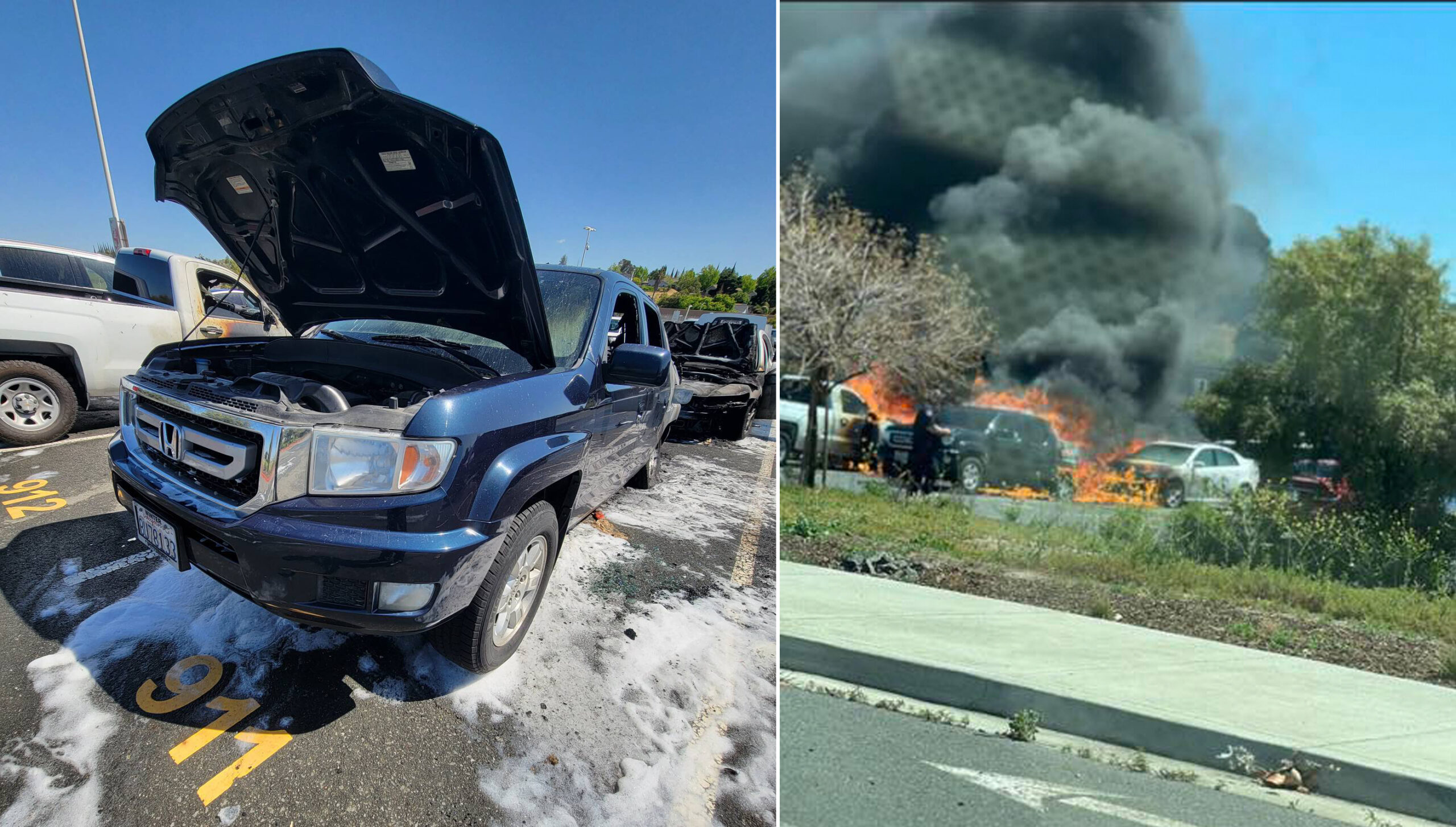
A fire in the Antioch BART Station parking lot damaged six vehicles on Thursday, May 11, 2023. Photos: (L) ConFire, (R) Denise Cantrell

During possible attempted gas theft

By Allen D. Payton

According to the Contra Costa Fire Protection District (Con Fire), a fire in the Antioch BART parking lot on Thursday was extinguished after a total of six vehicles were extensively damaged. Con Fire crews, along with Antioch and BART police, responded. The fire appears to have been caused during an attempted gasoline theft. The incident remains under investigation.

Photos: Con Fire


Filed Under: BART, Crime, East County, Fire, News

New Poll: Overwhelming support for more police on BART, greater focus on cleanliness, stronger enforcement of rules 

May 10, 2023 By Publisher Leave a Comment

Source: Bay Area Council

San Francisco—BART riders and others who have stopped using the system or reduced their use dramatically say they would return in significant numbers if crime, safety and cleanliness issues are addressed, according to new polling released today by the Bay Area Council. Concerns about crime far outweigh remote work as the reason they are not riding. The findings offer an encouraging path forward for a system that is teetering on the brink of a fiscal cliff as BART ridership hovers at historic lows following the pandemic.

A Bay Area Council analysis of the poll findings suggests that by taking a much stronger and swifter approach to crime, safety and cleanliness, BART could see up to 300,000 more trips over the course of the workweek, pushing ridership above 50% of pre-pandemic levels.

Key Findings 

  • 79% say they feel more comfortable riding BART when there is a uniformed police officer or security present
  • 73% say BART should prioritize adding more uniformed police on trains and in stations
  • 62% say BART should improve fare gates to prevent fare evaders; 66% want fare gates to fully enclose station entrances
  • 79% say BART should eject people from the system that violate the passenger code of conduct, which prohibits drugs, smoking, drinking and other illegal or unacceptable behavior
  • 65% say BART should focus on core operations and leave social service issues to other public agencies
  • 90% put high priority on more frequent cleaning
  • 74% feel things in the Bay Area have gotten pretty seriously off on the wrong track

Riders and residents overall are crystal clear about what the main barriers are for them to returning to BART. Among all respondents, including those that never or rarely ride BART, 78% said they would ride BART more often if it was significantly cleaner and safer. This number is particularly striking when compared to the far fewer 46% of respondents who stated they would ride BART more often if they had to commute to work or school more frequently.

There is similar enthusiasm for returning to BART among the 37% of respondents who were regular BART riders before the pandemic but have since dramatically curtailed their use of the system or dropped off completely. These riders may represent BART’s best opportunity to bring more riders back to the system more regularly, with 59% saying they would ride BART a lot more often with safety and cleanliness improvements. But they also generally harbor much stronger levels of dissatisfaction with the system than others who are not BART riders.

“There can be no higher priority for BART and the future survival of the system than to direct every ounce of energy and resources into making the system safer and cleaner,” said Jim Wunderman, President and CEO of the Bay Area Council, which was instrumental in the creation of BART in the 1950s and has long been a champion for the system. “We specifically call on BART to immediately and significantly increase police and security personnel on trains, vigorously enforce the rider code of conduct, and install new fare gates within a year. BART must treat this like a crisis, because it is a crisis. BART is the mass transit backbone of our region and there’s too much at stake for BART and our region not to be more aggressive in addressing the reasons legions of riders are staying away. BART deserves credit for recent moves to increase police presence and ramp up cleaning, but riders and others are saying they must do more and they must do it now.”

See the BART poll findings>> 

Read the full BART poll questionnaire>> 

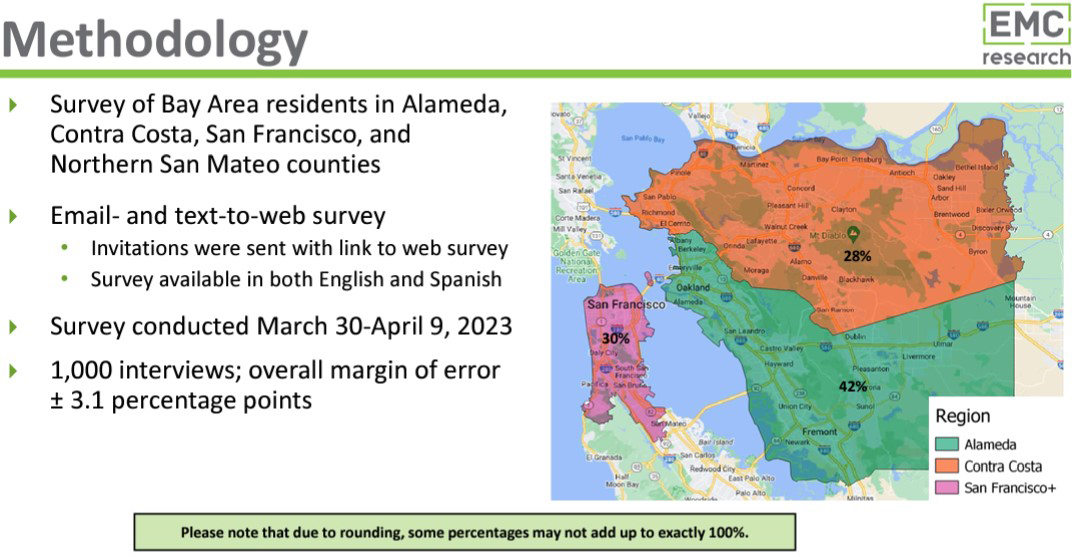
The concerns about safety and cleanliness are reflected in overall sour views of the system, with 49% giving BART an unfavorable rating compared to 30% for SF MUNI, 23% for AC Transit and 15% for Caltrain. The poll by EMC Research surveyed 1,000 residents in Alameda, Contra Costa, San Francisco and northern San Mateo counties encompassing BART’s service area. The poll has a margin of error of +/-3.1 percentage points.

Having a more visible police presence across the system is critical to bringing riders back. A vast majority of all those surveyed say they want more police officers on trains and in stations, they want more frequent cleaning of train cars and stations, and they want BART to strictly enforce an existing code of rider conduct which outlaws gate-hopping fare cheats, drinking and smoking, drug use and other illegal and dangerous behaviors.

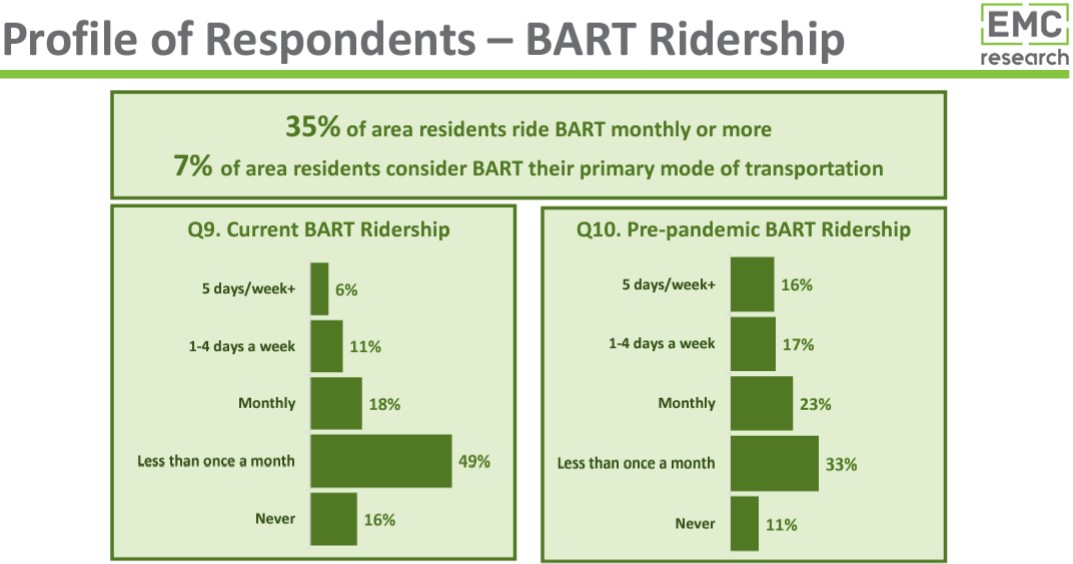
These attitudes shouldn’t come as a big surprise. According to the poll, 53% of residents know of someone who has been a victim of crime on BART, 46% say they have witnessed crime on BART, and 18% say they personally have been a victim on crime on BART. Meanwhile, 44% of BART riders said they have never or rarely seen a police officer.

Filed Under: BART, News, Transportation

Overnight Hwy 4 (bypass) closure for Mokelumne Trail overcrossing postponed until May 12 & 13

May 5, 2023 By Publisher Leave a Comment

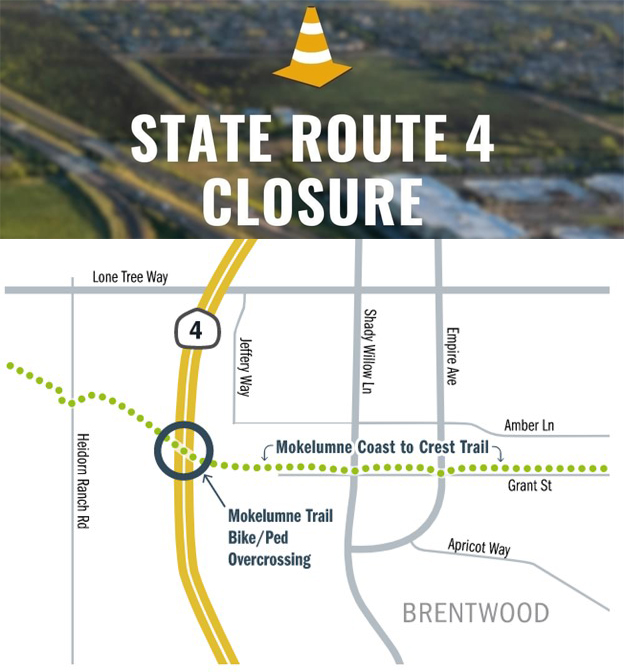
Between Lone Tree Way and Sand Creek Road

The overnight closure of State Route 4 between Lone Tree Way and Sand Creek Road in Brentwood originally planned for Friday, May 5 through Saturday, May 6, 2023 has been postponed one week to Friday, May 12 through Saturday, May 13, 2023.

In partnership with the City of Brentwood, the Contra Costa Transportation Authority (CCTA) is constructing the Mokelumne Trail Bicycle and Pedestrian Overcrossing to provide safe access to cyclists and pedestrians for commuting and recreational travel, reconnecting two sides of the trail that were separated by the expansion of State Route 4.

When completed, the overcrossing will provide access to the future East County Intermodal Transit Center and BART Station in Brentwood, as well. It is part of the larger Mokelumne Coast to Crest Trail which also includes the Delta de Anza Regional Trail that runs through Antioch and Oakley,  that will, when completed, connect six counties across California from the East Bay to the Sierra Nevada Mountains.

The overnight closure will facilitate final adjustments to the falsework as part of the construction work installing the pedestrian and bicyclist crossing over State Route 4. This closure will impact State Route 4 in both the Eastbound and Westbound directions. CCTA and the California Department of Transportation (Caltrans) have scheduled the closure during the early morning hours in order to minimize impacts to the motoring public.

In order to ensure crew and public safety during the planned construction work, a temporary nighttime freeway closure in both directions of State Route 4 will occur in both Eastbound and Westbound lanes of Highway 4 from midnight on Friday, May 12 until 6:00am on Saturday, May 13, 2023 (weather permitting).

Detours
Detours will be in place to reroute drivers around the closure and are planned as follows: Eastbound traffic will be directed to exit at Lone Tree Way, go eastbound to Shady Willow Lane, then southbound on Shady Willow Lane to Sand Creek Road, before proceeding westbound on Sand Creek Road to the eastbound State Route 4 on-ramp.

Westbound drivers having to detour will exit on Sand Creek Road and go eastbound on Sand Creek Road to Shady Willow Lane, then northbound on Shady Willow Lane to Lone Tree Way, and proceed westbound on Lone Tree Way to the westbound State Route 4 on-ramp.

Future Freeway Closures

Additional overnight closures will be needed over the course of the next eight weeks (weather dependent) to facilitate concrete pours for the stem and soffit and deck of the future Mokelumne Trail Bicycle and Pedestrian Overcrossing. Additional information regarding dates and detours will be provided once the schedule is confirmed. This project is anticipated to be complete in late summer or early fall of 2023.

Filed Under: BART, East County, News, Recreation, Transportation

Local transit CEOs take BART, buses, even an electric trolley during Earth Day ride-along event

April 28, 2023 By Publisher Leave a Comment

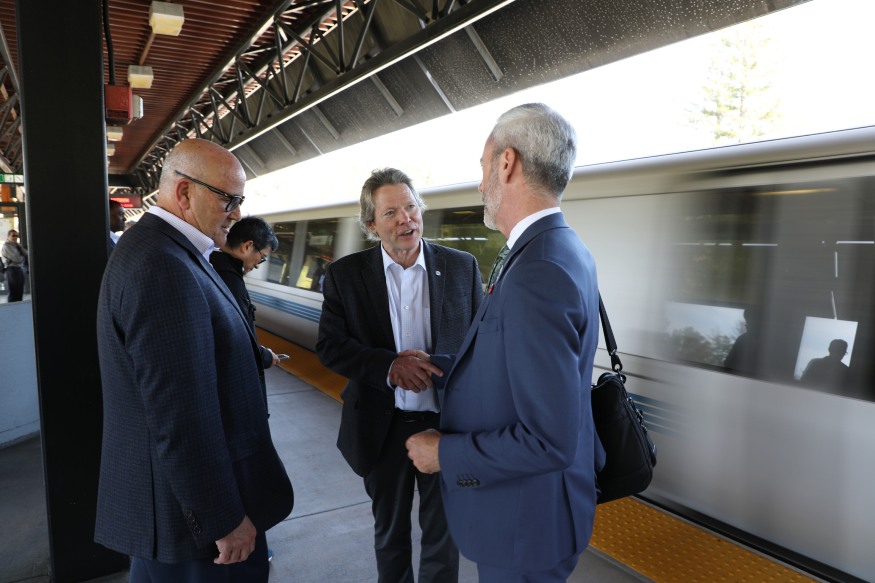
Bay Area Council President and CEO Jim Wunderman (left), BART General Manager Robert Powers (center), and Director of Transportation for the San Francisco Municipal Transportation Agency Jeffrey Tumlin are pictured at Orinda Station. Source: BART

“Our systems are more aligned now than ever”

By BART Communications Staff

On Friday, April 21, ten transit CEOs from across the Bay Area gathered for a multimodal, three-hour-long voyage that carried them from the green hills of Orinda to the dry heat of Pittsburg.  The “All Aboard with Transit CEOs” event was held in celebration of Earth Day as well as the ongoing coordination and collaboration of local transit agencies in the face of immense financial challenges.  Members of the public were invited to join the ride-along to meet and ride with the CEOs.

Following the success of the first “All Aboard” event in September, which carried the CEOs from Oakland to San Francisco and back, the second ride-along saw the travelers ride a bevy of East Bay transit operators, including BART, Tri-Delta Transit, and County Connection. Leaders in attendance included BART General Manager Robert Powers, Metropolitan Transportation Commission (MTC) Executive Director Andy Fremier, Bay Area Council President and CEO Jim Wunderman, Director of Transportation for the San Francisco Municipal Transportation Agency Jeffrey Tumlin, SamTrans General Manager/CEO April Chan, County Connection General Manager Bill Churchill, Tri Delta Transit CEO Rashidi Barnes, WestCAT General Manager Robert Thompson, Napa Valley Transportation Authority Executive Director Kate Miller, and  Contra Costa Transportation Authority Executive Director Timothy Haile.

Ride-along attendees and transit riders fill a County Connection Route 14 bus. Source: BART

The ride-along kicked off with a press conference at BART’s Orinda Station, where regional leaders stressed the importance of securing long-term sustainable funding for public transportation.

“At the heart of any region’s economy is public transit. As goes public transit goes the economy,” said BART General Manager Robert Powers, who noted that regional transportation systems “are more aligned now than ever.”

MTC Executive Director Andy Fremier urged the state legislature to “pass a new budget that supports transit operations … to keep us going so we have a multi-year transit recovery program we can count on.” (Reference this handy Twitter thread to learn more about the distinction between transit agencies’ operating and capital budgets.)

“California cannot meet its climate goals unless we do something about getting people on transit,” Fremier added, acknowledging the Earth Day holiday. “Part of that involves advocating aggressively to keep transit operating.”

Filed Under: BART, Lamorinda, News, Transportation

New BART fare gates to be installed systemwide to enhance safety, improve access

March 24, 2023 By Publisher Leave a Comment

Source: STraffic

$90 million Next Generation Fare Gate project

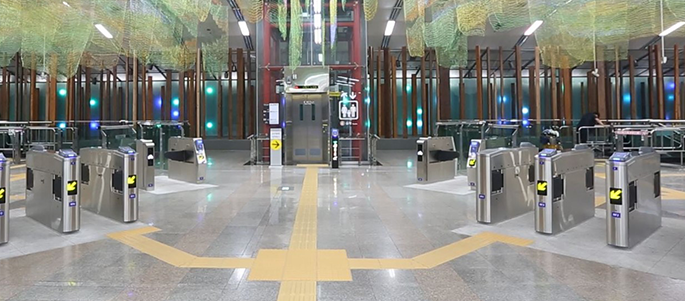
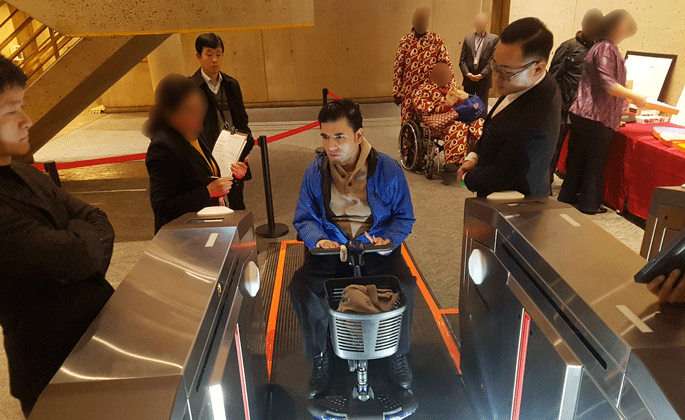
BART is moving forward with a historic purchase of brand-new fare gates to be installed systemwide as part of its latest effort to win riders back and overhaul safety in the system. The new fare gates will bring a new look and improved experience, offering state-of-the-art technology that will boost safety by reducing fare evasion, enhancing access for people in wheelchairs and those who bring bikes and strollers on BART, and optimizing the reliability and maintenance needs of the fare gates.

At the March 23, 2023, BART Board of Directors meeting, staff recommended the Board move forward with the first purchase of the $90 million Next Generation Fare Gate project. Staff recommended awarding up to $47 million to STraffic America to implement the project. BART staff will develop an installation timeline with STraffic and will stress-test the new fare gate design at a yet-to-be-determined station later this year. The project calls for all stations to have new fare gates by 2026.

“We want to deter fare evasion, modernize our aesthetic and reduce maintenance,” explained Sylvia Lamb, BART’s assistant general manager of infrastructure delivery, at Thursday’s BART Board of Directors meeting.

The transit agency’s board of directors received an update Thursday on the fare-reliant agency’s long quest to implement new gates that prove harder to jump and prove more reliable.

“There’s an appetite out there to go ahead and get this thing done,” said Bob Powers, BART’s general manager, adding the agency will soon be on a “path that’s going to get us to a systemwide replacement very, very quickly.”

Thursday’s presentation was informational only. At the second presentation, to be made on April 13, BART directors will seek the board’s approval for the $47 million fare gate contract.

“This is a very happy day, and I can’t wait to vote next month,” said BART Director Bevan Dufty.

Source: STraffic

To inform the endeavor, BART built and installed prototypes that it deployed in several stations in its system beginning in 2020, particularly around elevators, in an effort to make it easier for elevator users to tag in and out of the system. It has also retrofitted some of the older gates in an attempt to make them more resistant to fare evasion.

The agency has estimated that fare evasion could cost as much as $15-25 million in lost revenue every year, although the exact figure is difficult to pin down.

The new fare gates will look unlike any other of the current 700 fare gates in the BART system. While the new design has not yet been finalized, the gates will have clear swing barriers that will be very difficult to be pushed through, jumped over, or maneuvered under.

The next generation fare gates will not have the orange fins riders have become accustomed to. They will also be different than the new swing-style fare gates designed by BART staff and recently installed to enclose elevators into the paid area.

The new gates will be able to handle large crowds without slowing people down as they move in and out of stations while processing their Clipper cards. The gates will have advanced 3D sensors that are able to detect if someone is in a wheelchair or has a bike, stroller, or luggage with them, allowing for more time before the swing barrier closes. The gates will have LED lighting on the swing barriers and the pathway through the gate to help visually impaired riders. STraffic has worked extensively with members of the ADA community and is committed to continue this work while designing the BART gates.

“New fare gates will transform the rider experience and will deliver immediate improvements to safety and reliability,” said BART Board President Janice Li. “BART researched world-wide best practices in fare gate designs to help guide this pivotal purchase. I want to thank the local, state, and federal funding sources who have stepped up to support this impactful project. I am committed to seeing this project fully funded and fully implemented without delay.”

To date, BART has secured $73 million of the $90 million project, with funding from:

  • BART Funds (Operating-to-Capital Allocations and Measure RR) $23M
  • County Transportation Agency Funds $28M
  • Federal Funds $15M
  • State Funds $6.5M

In recommending the vendor, BART staff evaluated proposals from industry leaders and scored each proposal on their technical approach, qualifications, experience in delivering similar projects, and price. STraffic America, LLC offered the best value to BART and committed to subcontracting 11% of the work to Disadvantage Business Enterprises.

Allen D. Payton contributed to this report.


Filed Under: BART, News, Transportation

Bus Bridge Alert: Major BART track work between Orinda & Rockridge weekends April 1-June 11

March 14, 2023 By Publisher Leave a Comment

Source: BART

On five non-consecutive weekends

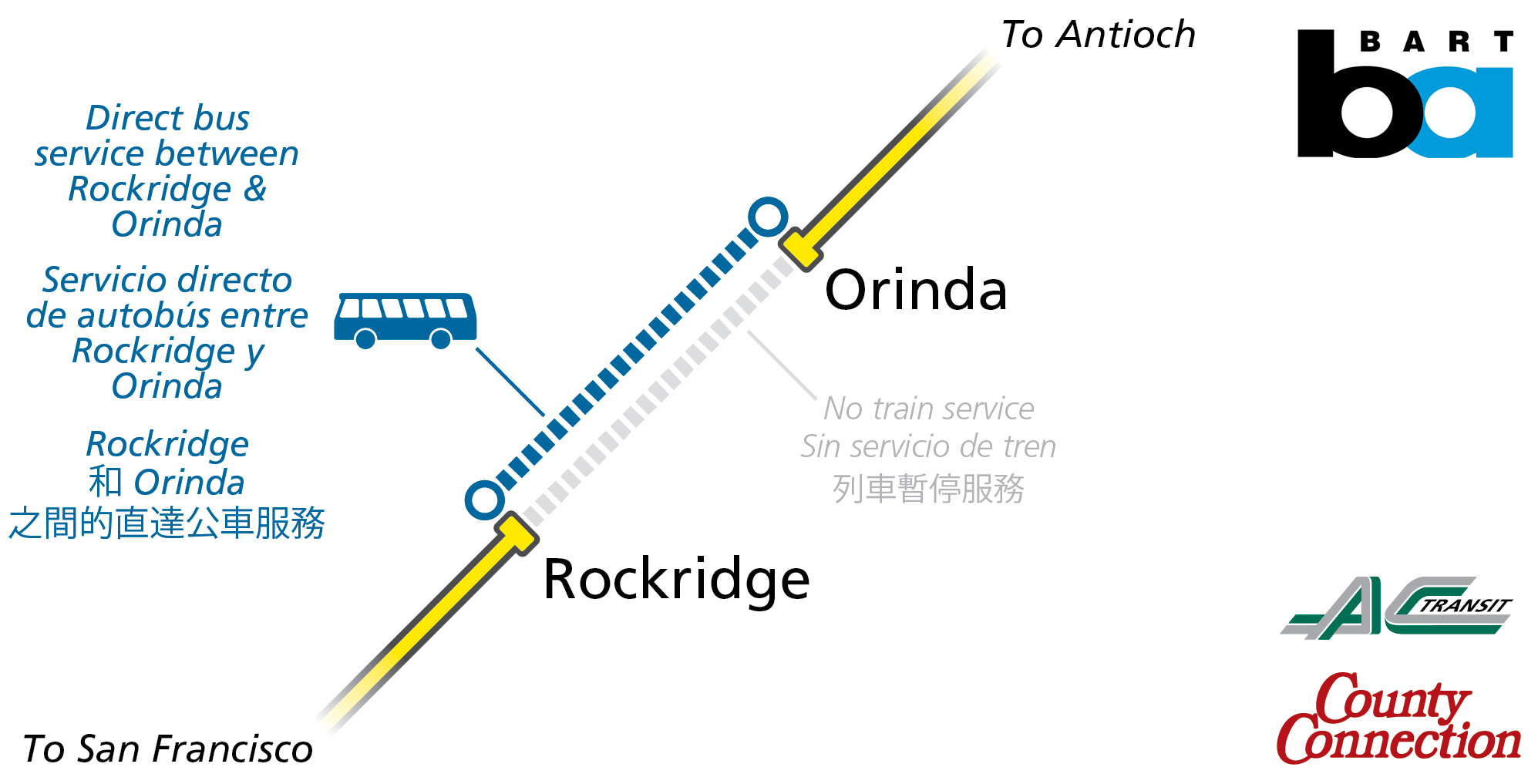
BART’s next major track improvement project will focus on a portion of the Yellow Line. On five non-consecutive weekends in April, May, and June workers will replace an interlocking between Rockridge and Orinda stations. Interlockings allow BART to safely move trains from line to line and are an essential part of the system. Free buses will replace train service between Rockridge and Orinda stations on all five weekends.

The weekend dates for this project are April 1-2, April 15-16, May 13-14, May 27-29 (Memorial Day weekend), and June 10-11. Riders can expect delays of 30 minutes in the work area on shutdown weekends.

Yellow Line trains will run every 30 minutes on shutdown weekends. On each night of the weekend shutdowns the last scheduled departure from Antioch to Orinda that normally leaves at 11:44pm will be cancelled. Riders traveling westbound from Antioch must catch the earlier train at 11:14pm each night.

The equipment being replaced is decades old and has outlived its design life. Riders will enjoy a smoother, safer, more reliable, and quieter ride once the projects are complete. The Yellow Line is the busiest in the BART system.

This upcoming work is part of BART’s overall effort to improve the safety and reliability of the 131-mile, 50 station system. There are now more rebuilding projects happening across BART than at any point in its 50-year history. You can learn more about the progress of this work by reading the 2022 Measure RR Annual Report published by the independent Measure RR Bond Oversight Committee.

You can keep up with the latest updates for trackway repair projects that impact service by going to our Alerts and Advisories page. BART’s Trip Planner has been improved to show the full customer journey including bus bridges.

Learn more about the work happening between Rockridge and Orinda stations on our Frequently Asked Questions (FAQ) page and Fact Sheet for the project.

Filed Under: BART, News, Transportation, Travel

BART Police, CA DOJ to hold online Community Listening Session March 9

March 7, 2023 By Publisher Leave a Comment

To evaluate reforms, in coordination with state Department of Justice

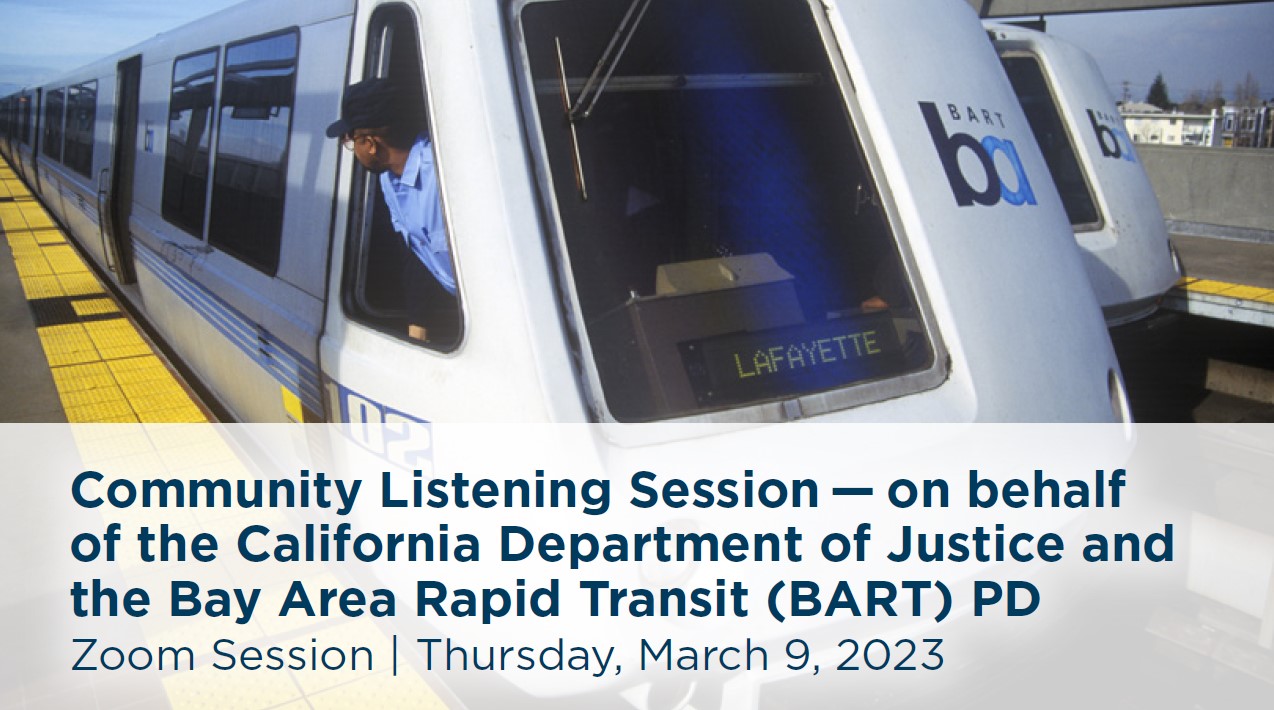
The BART Police Department and the California Department of Justice (Cal DOJ) have entered into a Memorandum of Understanding (“MOU”) to work with BART PD to independently evaluate the reforms put in place by BART PD and the BART Board of Directors, with the goal of improving BART PD policies where applicable and providing documented reports of BART PD’s progress to the community.

BART riders and community stakeholders are invited to register for and participate in a Zoom session this Thursday, March 9 at 6:30 pm where members of the evaluation team will hear the perspectives of community members on their relationships with BART PD. The listening session will include a virtual community meeting with breakout sessions.

Visit here to register for the event.

Sesión de escucha de la comunidad: convocada por el Departamento de Justicia de California y el Departamento de Policía de Bay Area Rapid Transit (BART)


Filed Under: BART, Police

Senator Glazer resigns from Bay Area Transit panel

February 28, 2023 By Publisher Leave a Comment

State Senator Steve Glazer wants greater fiscal oversight of BART.

Says “Bay Area leaders have not stepped up to fix the fiscal oversight problems with BART…”

BART Board Vice Chair Foley responds, Director Allen applauds Glazer

By Allen D. Payton

SACRAMENTO – Senator Steve Glazer, D-Contra Costa, announced that he resigned today, Tuesday, Feb. 28, 2023 from his position as a member of the Senate Select Committee on Bay Area Public Transit, saying Bay Area leaders have failed to support fiscal oversight of BART.

Senator Glazer is a longtime supporter of public transit and is concerned about the financial problems facing Bay Area transit systems, which are essential to the health of the regional economy. But, he said, the status quo is unacceptable.

“Bay Area leaders have not stepped up to fix the fiscal oversight problems with BART, as well as the underfunding of the Inspector General’s office,” Glazer said. “When these problems are addressed, I will join with my colleagues and support greater transit funding.”

In June 2022, an Alameda County Grand Jury found that BART’s leadership has repeatedly blocked the Inspector General’s authority and autonomy.

Just two months later, former State Auditor Elaine Howle found that the BART office “lacked the authority and independence necessary to do its job…”

The BART inspector general was created by Senator Glazer as part of a transportation bill in 2017. Senator Glazer advanced legislation (SB 827) to the governor’s desk last year that enhanced independence for the IG, conforming its auditing standards and investigations with other transportation IGs. At the request of the BART Board, Governor Newsom vetoed the bill.

Senator Glazer’s letter reads as follows:

Dear Senator Wiener,

I hereby resign from the Senate Select Committee on Bay Area Public Transit, effective immediately. The failure of Bay Area leaders to hold BART financially accountable makes my participation in this transit support committee incompatible.

I recognize and support the pressing need for the state to invest in public transit agencies throughout the Bay Area given the financial uncertainty that looms over these systems. However, there is no guarantee that these agencies will spend taxpayer dollars sensibly without adequate oversight of their expenditures. I point to the recent alarming reports from BART’s Inspector General regarding BART’s financial mismanagement and brazen defiance of voter-mandated oversight.

In June 2022, an Alameda County Grand Jury found that BART’s leadership has repeatedly blocked the Inspector General’s authority and autonomy. Specifically, the Grand Jury found that BART’s board of directors and management engaged in a “pattern of obstruction” that has impeded the Inspector General’s ability to conduct independent oversight and “stymied OIG independence and the confidentiality of investigations.”

Just two months later, former State Auditor Elaine Howle, comparing the powers and responsibilities of the BART IG to other, similar offices, found that the BART office “lacked the authority and independence necessary to do its job according to the best practices recommended by national professional organizations that set standards in the accountability field.’ She also asserted in a letter to Governor Newsom that ‘(e)nsuring the independence of the BART Inspector General is critical to the credibility and effectiveness of the office.”

As BART and other regional transit systems seek additional state funding to stave off upcoming fiscal problems, the Legislature must ensure that the same systems spend public resources responsibly.

I wish you well with your important work.

———————

BART Directors Respond

When reached for comment about Glazer’s resignation from the committee and reason for it the four BART Board directors who represent Contra Costa County, including Vice Chair and District 3 Director Mark Foley, District 1 Director Deb Allen, District 3 Director Rebecca Stutzman and District 7 Director Lateefah Simon.

Foley responded writing, “I’d like to thank Senator Glazer for his continuing support of BART and public transit. I look forward to partnering with the senator on matters of mutual interest, including strengthening the Office of the Inspector General and helping support BART’s efforts to provide safe, world-class transit, invest in infrastructure renewal and address societal issues such as unhoused individuals within the BART system. I’m eagerly anticipating Chair Wiener’s appointment to this vacancy on the Senate Select Committee on Bay Area Public Transit.”

Allen responded writing, “I applauded CA Senator Glazer for standing up to Bay Area elected leaders to insist on accountability to transit riders and taxpayers. They deserve answers about how BART spends $2.5B plus annually and those answers aren’t easy to come by.

Senator Glazer and I have worked for over six years together to get answers and still continue to meet resistance in making meaningful independent oversight a permanent part of the BART culture. We have worked tirelessly over last 4 years on strengthening the role of the Office of Inspector General we created and built, while the majority of BART board directors, unions and executive staff continue to focus on the ‘more money please!’ approach. We saw it last week in BART’s annual Board Workshop and it seems Senator Glazer is seeing the same approach evolving from the Senate select Committee on Bay Area Public Transit. That will only produce more of the same failed policies we see now for BART.

I believe BART executive management and a majority of directors will continue to fight proper oversight. Unless our state leaders like Senator Glazer attach oversight strings to new funding at the state level to keep transit agencies accountable to the people who are paying for it, transit will continue to fail the riders, workers and the Bay Area.”

Filed Under: BART, Finances, Government, News

Bay Area transportation agency adopts landmark policy to promote housing, commercial development near transit stations

September 29, 2022 By Publisher Leave a Comment

TOD projects adjacent to a BART station. Source: MTC. Credit: Karl Nielsen

The Metropolitan Transportation Commission (MTC), yesterday, Wednesday, Sept. 28, 2022, adopted a new Transit-Oriented Communities (TOC) Policy designed to boost the overall housing supply and increase residential densities in transit-rich areas throughout the Bay Area; spur more commercial development near transit hubs served by multiple agencies; promote bus transit, walking, biking and shared mobility in transit-rich areas; and foster partnerships to create transit-oriented communities where people of all income levels, racial and ethnic backgrounds, ages and ability levels can live, work and thrive. The newly adopted policy applies specifically to transit priority areas within a half-mile of BART, Caltrain, SMART, Capitol Corridor and ACE stations; Muni and VTA light-rail stations; Muni and AC Transit bus rapid transit stops; and ferry terminals.

Studies show people are more likely to ride transit if they live within half a mile of a rail station, ferry terminal or bus line. And jobs that are within a quarter-mile of transit often are more attractive to the Bay Area’s workforce.

The TOC Policy is the update to MTC’s 2005 Transit-Oriented Development (TOD) Policy. That set minimums for the average number of housing units (both existing and/or permitted housing units) within a half-mile of each new rail station funded through Regional Measure 2. However, according to MTC spokesperson Rebecca Long the new policy applies to any all existing and future transit priority areas.

“The Transit-Oriented Communities Policy is truly groundbreaking,” explained MTC Chair and Napa County Supervisor Alfredo Pedroza. “Using transportation funds as an incentive, the policy encourages cities and counties to upzone transit-rich areas so transit, walking and biking can be viable travel choices for more people, and so we can generate maximum value from the billions of taxpayer dollars that have been invested in our transit network over the years as well as new transit lines that will be built in the years to come. The policy specifically encourages the development of affordable housing and protects current residents from being displaced by new development.”

The TOC Policy links all four of the themes — transportation, housing, the economy and the environment — of Plan Bay Area 2050, the long-range transportation plan and sustainable communities strategy adopted by MTC and the Association of Bay Area Governments in 2021. Minimum residential density requirements range from 25 units per acre for locations within a half-mile of ferry terminals; SMART, ACE and Capitol Corridor stations; and Caltrains stations south of San Jose’s Tamien station up to 100 units per acre within a half-mile of BART stations in downtown San Francisco and Oakland, and within a half-mile of San Jose’s Diridon Station. The policy also eliminates minimum parking requirements in many transit-rich areas, allows for shared parking between residential and commercial uses, and mandates at least one secure bike parking space for each new dwelling unit.

MTC is the regional transportation planning, financing and coordinating agency for the nine-county San Francisco Bay Area.

Allen D. Payton contributed to this report.


Filed Under: BART, Growth & Development, Jobs & Economic Development, News, Transportation

  • « Previous Page
  • 1
  • …
  • 3
  • 4
  • 5
  • 6
  • 7
  • …
  • 13
  • Next Page »
Furniture-Clearance-02-26B
Liberty-Tax-Jan-Apr-2026
Deer-Valley-Chiro-06-22

Copyright © 2026 · Contra Costa Herald · Site by Clifton Creative Web