• Home
  • About The Herald
  • Local Agencies
  • Daily Email Update
  • Legal Notices
  • Classified Ads

Contra Costa Herald

News Of By and For The People of Contra Costa County, California

  • Arts & Entertainment
  • Business
  • Community
  • Crime
  • Dining
  • Education
  • Faith
  • Health
  • News
  • Politics & Elections
  • Real Estate

BART’s February schedule change will impact weekdays and Sundays

January 17, 2019 By Publisher Leave a Comment

BART is making major schedule changes beginning February 11th to accommodate Measure RR funded improvements to our infrastructure to keep BART safe and reliable. Projects to upgrade our electrical power system in downtown San Francisco and the Transbay Tube Seismic Retrofit require adjustments to our schedules. The Fleet of the Future roll out is also allowing us to expand some service and run longer trains.

Riders are encouraged to check before you go. Download the official BART app or check the Trip Planner to see how these changes impact your trip.

Weekday Changes

To retrofit the Transbay Tube, we need to open at 5am on weekdays- that’s one hour later. Visit www.bart.gov/earlybirdexpress for bus service alternatives during the 4am hour. We will also be single-tracking trains through the Tube on weeknights for this project. Impacts from this project include:

  • Weekdays after 9pm, trains will run every 24 minutes instead of 20 because of single tracking.
  • On Friday evenings, trains will be added to the schedule after 8pm to the Green, Red, and Yellow lines to reduce wait times and increase capacity.
  • The first train from Daly City (5:03 am) to Antioch will skip from MacArthur directly to Pittsburg/Bay Point. The train will not pick up or drop off passengers between these stations. The next train from Daly City (5:11 am) will make all stops.

·         Weekday service improvements include:

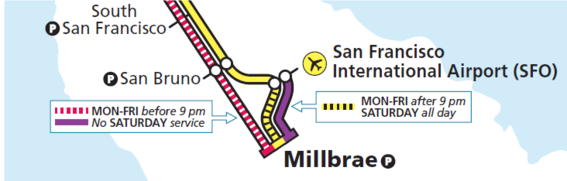
  • New direct Millbrae to SFO service on weekdays from 6:30 am to 9 pm every 30 minutes.
  • Early morning/late-evening trains will now be longer.
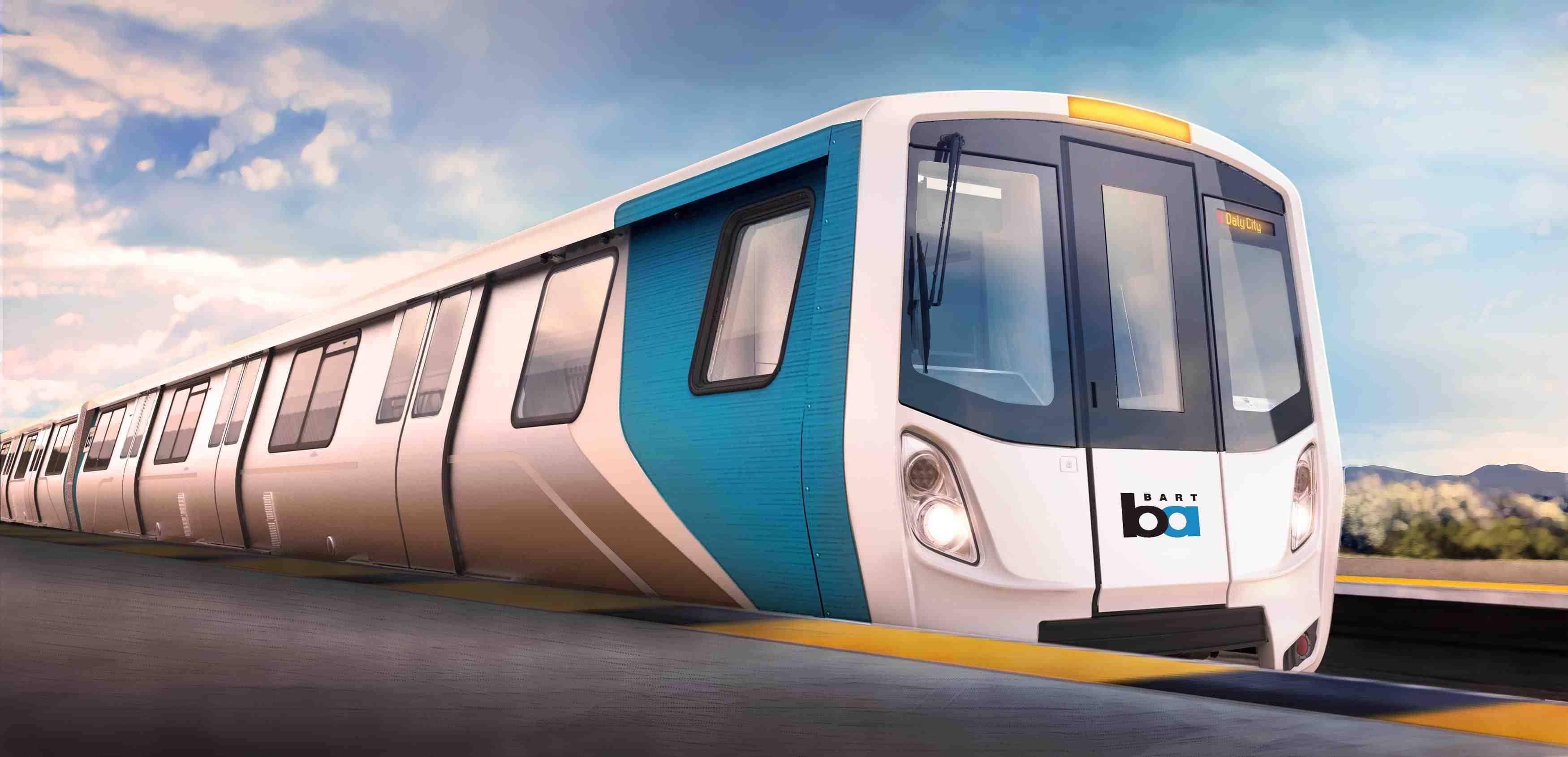
  • A Fleet of the Future train will run as part of the schedule on each transbay line and some trains will be lengthened thanks to the arrival of the new fleet.
  • We are adding an additional Yellow Line train to the morning commute and we will extend one late afternoon train from Pleasant Hill to Pittsburg Bay Point.
  • New Richmond-Daly City (Red) and Warm Springs-Daly City (Green) trains on Friday evenings at select times.

Sunday Changes

To upgrade the electrical power system in Downtown San Francisco from 8am-6pm, we need to single track trains in San Francisco on some Sundays. We will maintain 20-minute headways, but impacts include:

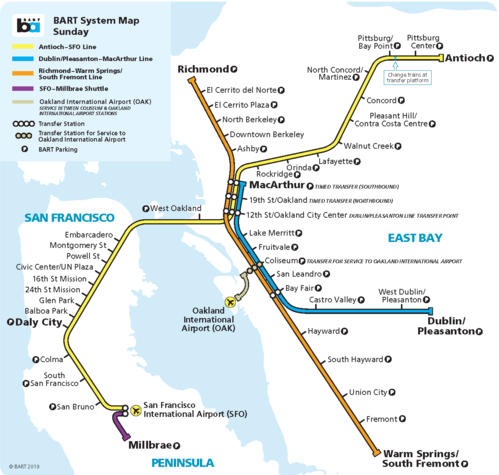
  • For the most part, only one line (the Antioch/Yellow Line) will provide service through the Transbay Tube (some direct Red and Green line trains will be part of the schedule at select times).
  • Sunday service changes vary week to week and riders are encouraged to check the Trip Planner or the official BART app before each trip to see the service plan.
  • Dublin/Pleasanton/Blue Line service will operate between Dublin/Pleasanton and MacArthur.
  • All Lake Merritt-Dublin/Warm Springs Transbay riders must transfer at 12th Station—go downstairs one level.
  • All Millbrae riders must transfer to/from a San Francisco/Antioch train at SFO.

·         Sunday service improvements include:

  • Yellow Line passengers transferring to an East Bay line should transfer at MacArthur and will now have increased service with both a Blue and Orange Line train depending on destination.
  • Additional trains/train length will be added to the Orange/Richmond/Warm Springs service.
  • New direct Red and Green line trains added to the schedule on Sundays at select times.

There are no changes to Saturday service.

Check Before You Go

The new schedule has been loaded into the Trip Planner on bart.gov as well as the official BART app. Select a date Feb. 11th and beyond to see how these changes impact your trip. 

Sunday riders are encouraged to check the Trip Planner or the app before each trip as it varies week by week based on single tracking weekends.

The extra Friday service will be reflected in the Trip Planner and in Real Time Departures.  However, these extra trains are not listed in the Schedule by Station or Schedule by Line sections of bart.gov or the printed brochures. 

Sunday’s new Red and Green line trains will be reflected in the Trip Planner, and Schedules by Station, Schedules by Line and Real Time Departures. They are not listed in the printed brochures because they vary week by week.

Sunday Service Map:  Millbrae Shuttle Service weekdays and Saturday

Filed Under: BART, News

Glazer calls on state political watchdog agency to levy maximum fine on BART

December 19, 2018 By Publisher Leave a Comment

State Sen. Steve Glazer (D-Orinda) today sent a letter to the Fair Political Practices Commission requesting the FPPC to levy the maximum possible fine against the Bay Area Rapid Transit district for its illegal use of public funds to campaign for Measure RR on the November 2016 ballot.

“The modest administrative penalty that the FPPC is considering would represent less than a slap on the wrist for BART after the district violated state law by using public funds to campaign for its bond measure,” Glazer said.

“In fact, this penalty is barely a tap on the wrist to BART. It would send a message to government officials in every agency in the state that they are free to break the law and use the public’s funds to wage political campaigns to sway public opinion.”

The commission, which meets Thursday in Sacramento, is considering a $7,500 penalty to punish BART for failing to properly disclose its illegal spending, which financed a video featuring Warriors star Draymond Green and text messages sent to thousands of Bay Area residents.

But the commission’s focus on the lack of disclosure ignores the far more serious offense that occurred when BART spent the money in violation of state law banning public agencies from engaging in political campaigns at public expense.

Glazer said that even if the FPPC believes its jurisdiction over illegal spending is limited, the commission could still levy a larger fine.

The $7,500 proposed penalty was based in part on the commission staff’s conclusion that BART’s text message campaign cost little because the list of residents who received the text was already in BART’s files.

But that list was compiled by BART as part of a years-long effort to build a public relations machine to further its interests. The FPPC should base its fine on the cost of that effort – not the cost of writing a mass text message and hitting the “send” button.

Even using its more limited valuation of the public funds BART spent illegally, the FPPC’s own staff acknowledged that the commission could levy a penalty of $33,375. But the commission’s proposed decision calls for a penalty of only a fraction of that amount.

“The people of California depend on the FPPC to be our watchdog over the practices of our politicians,” Glazer said. “But this proposed decision is so toothless that no government official or agency will ever again fear the consequences of spending the public’s money on a political campaign.”

Filed Under: BART, News, Politics & Elections

Payton Perspective: Re-elect Joel Keller to BART Board

November 3, 2018 By Publisher Leave a Comment

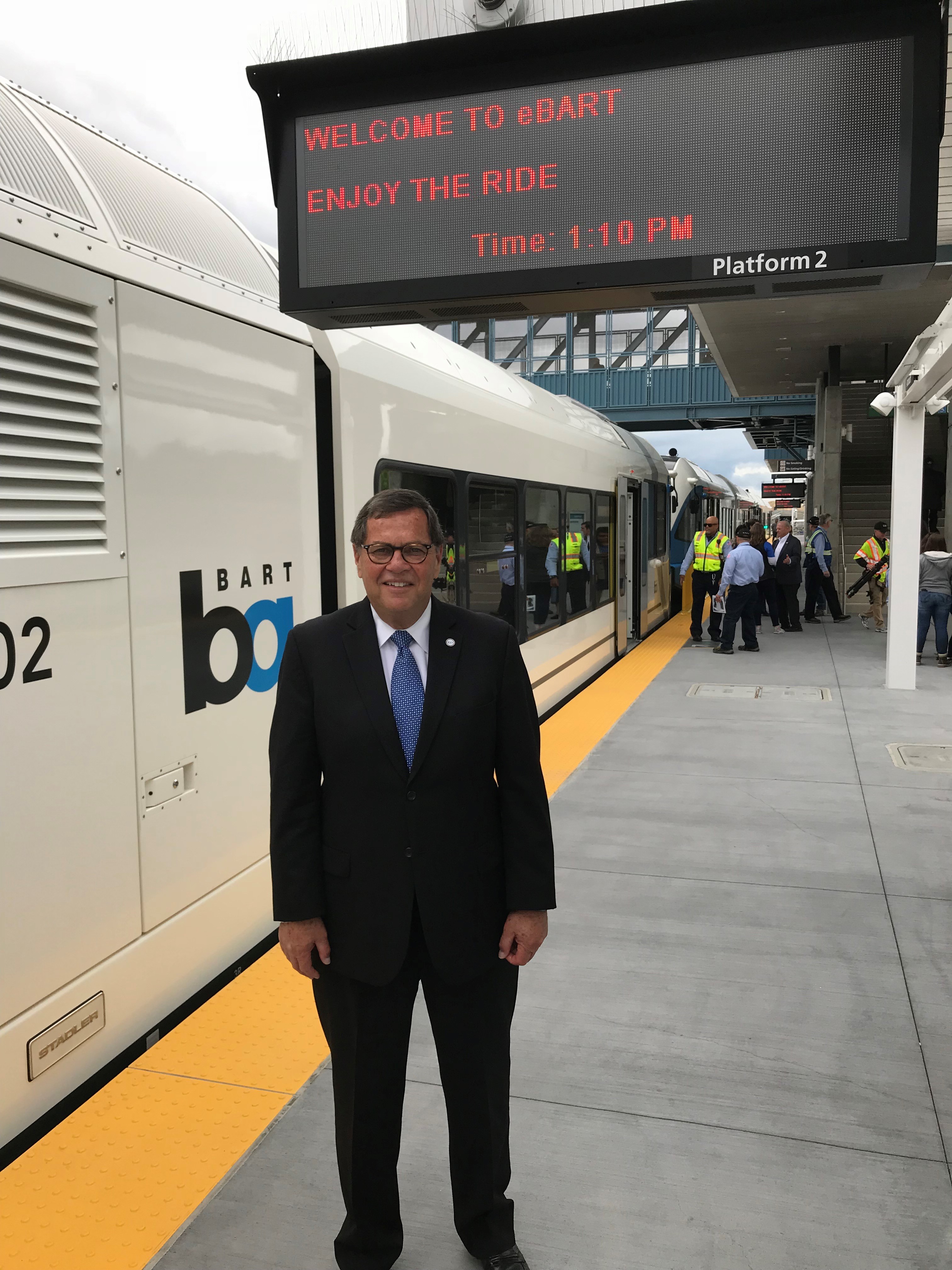
Joel Keller at Antioch BART Station opening 5-25-18. Photo by Allen Payton

Usually, I don’t recommend elected officials serving in the same office for 24 years, such as Joel Keller, who was elected to the BART Board on the same night in November 1994 that I was elected to the Antioch City Council. That’s because elected representatives tend to become complacent or arrogant in office and stop listening to their constituents, and end up doing the bidding of the powerful, special interests who support them and contribute to their re-election campaigns.

However, Joel is different. Having served on the Contra Costa Transportation Authority and three of the four transportation boards in East County, including as Chairman of the Bypass Authority in 1998 when we purchased the right-of-way for the State Route 4 extension (aka The Bypass) from Lone Tree Way to Balfour Road, I’ve learned the difficult lesson that infrastructure projects can take a long time. Too much time for most all of our liking. But, that’s another issue. My point is, it’s taken that time for Joel to get BART extended to Antioch.

Although it’s not full or “real” BART, as we Antioch residents would have preferred, the bottom line is Joel was able to wade through the funding limitations from BART and the federal government, as well as the opposition by other regions in the BART District and directors who represent those regions and make his promise and commitment a reality. Antioch has a BART station. During his next four years, if re-elected, I believe Joel will be able to help deliver further extensions in East County, first to Laurel Road – which will benefit Antioch’s economic development area for job creation and serve the residents of Oakley – then to Brentwood near Sand Creek Road.

Joel has done what he said he would do, and he listens to his constituents. Most recently, Joel heard the complaints about safety on the BART system. In order to ensure the rest of the board members heard the complaints from the people in his district who can’t attend their normal day time meetings in Oakland, had the board hold a night time meeting in Pittsburg. Then, due to the overwhelming response by riders to the opening of the Antioch BART Station, Joel heard the outcry for more parking spaces, and he delivered by getting the other BART Board Members to join him in voting to fund 800 more spaces.

I believe Joel has earned one more term on the BART Board, which most likely will be his last, and recommend we re-elect him.

Filed Under: BART, Opinion, Politics & Elections

Contra Costa riders invited to Sept 27th evening BART Board meeting in Pittsburg on system safety

September 6, 2018 By Publisher Leave a Comment

Rider safety will be the focus as the BART Board of Directors holds its Thursday, September 27th meeting at 5:00 P.M. at Pittsburg City Hall. The BART board voted in August to hold a special night meeting in a suburban location to further discuss General Manager Grace Crunican’s Safety and Security Action Plan.

“The special time and location of this board meeting will give more members of the public the chance to share their thoughts about public safety directly with board members,” said BART Board President Robert Raburn. “We need their input as we take action to make BART safer.”

The meeting will include an update on BART’s proof-of-payment strategy. There will be a presentation with citation data as well as a hearing on a request to hire more community service officers to expand the program, which was launched in January. Further, the board will get an update on station infrastructure efforts to deter fare evasion. That is likely to include a discussion on whether to replace BART’s fare gates.

BART Police Chief Carlos Rojas is scheduled to present a new report from the University of North Texas on the BART Police Department. The report includes recommendations for adequate police staffing levels at BART.

The board is moving towards adopting a district surveillance policy. A final vote on this policy could come at this meeting depending on actions that take place at the September 13th meeting. BART has already made clear that any boosts to system safety will not include the implementation of facial-recognition technology.

The board could also vote on a plan to provide alternative bus service for when the system moves to a 5am start time as part of the Transbay Tube seismic retrofit project. The switch to the 5am service start is expected to happen on February 11, 2019.

We also anticipate an update on efforts to increase parking around the new BART to Antioch line.

The meeting is open to the public. The public may comment at various points throughout the meeting- including the public comment period or during specific agenda items. The agenda will be posted the Friday before the meeting at https://www.bart.gov/about/bod/meetings/2018

Because this meeting is not taking place in the BART board room, we will record it and post it on our website several days later due to the post production time needed. It will not be livestreamed.

The meeting will be held in the Pittsburg City Council Chambers, which is on the third floor of the building. The council chambers are located at 65 Civic Avenue, which is a short walk from the Pittsburg Center Station on the new BART to Antioch line. Courtesy of Tri-Delta Transit, there will be a shuttle available in the pick-up lot at the corner of Railroad Avenue and California Avenue to transport attendees between the BART station and the City Council Chambers. The shuttle will run from 4:15 pm to 11:15 pm. There will be directional signs at the Pittsburg Center BART station and the shuttle pick-up and drop-off locations. See map below:

Pittsburg City Hall shuttle route

Driving Directions:

From all points west:

Take Highway 4 eastbound toward Pittsburg/Stockton

Exit Railroad Avenue (exit 23)

Turn left onto Railroad Avenue

Turn left onto Center Drive, drive past the Justice Center and the Library

There is a parking lot in front of City Hall

Parking is free.

From Antioch/Oakley/Brentwood:

Take Highway 4 westbound toward Martinez

Exit Harbor St/Railroad Avenue (exit 23)

Turn left onto California Avenue

Turn right onto Railroad Avenue

Turn left onto Center Drive, drive past the Justice Center and the Library

There is a parking lot in front of City Hall

Parking is free.

Editor’s Note: We need to pack the room and make sure our voices are heard, by letting the full BART Board know about our concerns with safety, so that they don’t just hear from the folks who live close to and/or were able to attend their day-time meeting during the summer the BART Headquarters in Oakland.

Filed Under: BART, News

BART’s Measure RR annual report: bond funded projects are on time, on budget and paying off

June 29, 2018 By Publisher Leave a Comment

Report cover from BART.

The first year of BART’s Measure RR Bond-funded rebuilding work is already paying off for our riders. BART’s on-time performance rate has increased to 93.6%. That’s BART’s highest on-time rate in four years and is thanks in part to the infrastructure improvements supported by RR along with several years of greater attention to incident management, quality maintenance, and system rehabilitation.  As we roll out more projects, we anticipate the on-time performance to improve exponentially.

Measure RR Spending and Projects

So far, BART has spent nearly $70 million from the $3.5 billion bond measure passed by voters in November 2016. Based on performance to date, the projects that are underway are on time and on budget.  Much of the initial effort has been heavily focused on engineering and issuing the first installment of bonds worth $300 million.  This early work isn’t very visible to the public but that will soon change.  The year ahead will bring the launch of multi-year projects that include new escalators and modernized stations that will have a big impact on our riders.  We will also continue to perform behind-the-scenes infrastructure upgrades that will further boost our reliability.  Staying one step ahead of maintenance troubles is at the heart of RR.

The Measure RR Bond Oversight Committee is keeping track of how funds are spent. The Committee’s mandate is to provide diligent oversight that all spending is authorized and that projects are completed in a timely, cost-effective, and high-quality manner. The Bond Oversight Committee is made up of community members with expertise in different disciplines from finance to engineering to project management.

Today, the BART Board of Directors is acknowledging the work of this volunteer committee and receiving its first annual report.  Click here to dig into the report and all its details.


Filed Under: BART, Finances, News

Op-Ed: BART parking – One size does not fit all

February 8, 2018 By Publisher Leave a Comment

BART Director Joel Keller. From BART.gov

At age 17, after interviewing hundreds of renowned thinkers, Nikhil Goyal wrote a book called, One Size Does Not Fit All.  It offers a prescription to transform the American educational system.

I don’t claim to be as smart as that young man. But I’d like to borrow the title to his book and apply it to BART parking.  Here’s why.

As a BART Director in Contra Costa County, most of my constituents depend on their cars.  They have a very different commute experience than my colleagues whose constituents live in more transit and pedestrian friendly areas.  Consequently, the solutions to help my constituents connect with BART may be different than those of some of my colleagues.

In January, BART staff made a presentation to the Board entitled “BART’s Parking Program: Update and Discussion.”

We board members learned that BART’s revenue from parking has increased from under $5 million in 2003 to $35 million in 2017. BART has a total of 48,000 parking spaces at 34 parking facilities. We have a systemwide waitlist total of 38,000 customers.   Staff presented some possible solutions to dealing with easing the overcrowding in our existing lots.  Those ideas included demand based pricing and variable pricing.  These are fine ideas for consideration, but what about parking expansion?

So, I decided to do what young Nikhil did and speak with some pretty smart thinkers in my district.  I contacted several local business owners about parking at BART.  They asked, “Why is BART just trying to manage the overcrowding, and not capturing the revenue that could be generated by creatively accommodating the people whose names are on the waitlist?”

As a director who represents auto dependent riders, I think they are right. Let’s assume that the 38,000 names on the waitlist contains duplications, and that there are, say, 16,000 potential riders who are willing to pay parking fees to get a spot. That could increase our parking revenue to as high as $54 million, or a $19 million/year increase.

So why aren’t we looking at solutions to find more places to park and charging for those additional spots along with better managing the existing spots that we have now?  Why not create satellite parking lots served by free shuttle buses?  Why not partner with area businesses, local governmental agencies and others to use adjacent and existing parking more efficiently?

I believe each of these ideas merits further discussion and I look forward to a robust exchange of ideas when this item returns to the Board. I am sure that there are other ideas that we should explore, but as I said at the Board meeting, the solution to overcrowded parking cannot be a “one size fits all.”

The needs of auto dependent stations are different than the needs of stations in more urbanized parts of the District. While the solutions may be different, the differences should be respected.

Director Keller represents the BART District 2, which includes Antioch, Brentwood, Concord (partial), Oakley, Pittsburg, Bay Point, Byron, Knightsen, Bethel Island, and Discovery Bay.

Filed Under: BART, Opinion

See new fares from Pittsburg Center and Antioch Stations

January 4, 2018 By Publisher Leave a Comment

Screenshot of the Pittsburg Center BART Station animation. From BART.gov

New fare information available now


By Allen Payton

According to the BART website’s East County Extension page, parking permits for the new Antioch Station which is planned to open in May along with the Pittsburg Center Station, will be available for purchase beginning January 16. According to BART Director Joel Keller there will be 1,000 parking spaces and about 124 reserved spaces available. However, he said the reserved permits don’t get you a specific spot, just one of the reserved parking spots in the lot.

New Fares

The BART Board adopted the parking fees and fares at the December 7, 2017 board meeting.

BART is applying its existing distance-based fare structure to calculate fares for the new service.  For the 9.1-mile trip between Pittsburg Bay/Bay Point and Antioch Station, the Clipper fare will be $2.00 (starting Jan 1, 2018 there will be a $.50 surcharge on all paper ticket trips).  All BART discount programs will be applied to these fares.

The table below shows 2018 BART to Antioch sample fares using the adult Clipper card, a fare paid for with a paper ticket will be an additional 50 cents.

1/5/18 UPDATE: On Tuesday, January 16, 2018 at 11 AM, BART will open up the waitlist for passengers that would like to sign up to reserve a monthly permit, which guarantees a parking space until 10am each weekday. There will be a limited number of these permits available and they will be available on a first-come/first-served basis. The cost for the monthly permit will be $105 per month. You will only be charged for the permit if you are offered one and not until the extension officially opens. You may sign up to join when the waitlist at www.Select-a-Spot.com any time after January 16, 2018 at 11am. This website is also available through a link on the www.BART.gov/Parking webpage.

Monthly reserved permits will only be available at the Antioch Station. The Pittsburg Center Station will not offer any reserved parking permits, due to a limited number of parking spaces at the station.

There will be other parking options available as well:

Daily Fee Parking

Both stations will offer daily unreserved parking for a fee of $3. This parking is first-come/first-served in any marked “Fee” lot. Look at signs to the entrance to each section of the lot to determine if it is a “Fee” or “Permit” area. After 10am, any unused Permit spaces are open to all parkers for the Daily Fee.

Permit Parking

The Antioch Station will offer “Permit” parking. Customers with permits will be allowed to park in the designated areas of the parking lot. Permit spaces are available until 10am each weekday morning. After 10am all unused Permit spaces are available to anyone for the Daily Fee. All permits will be available on the www.Select-a-Spot.com website. There also will be a link to that website on www.BART.gov/Parking

Types of Permits:

  • Single Day reserved permits will cost $6 a day.
  • Airport/Long-Term Permits will cost $7 a day.
  • Monthly reserved parking permits will cost $105


To view the animation of the Pittsburg Center BART Station, click here. To view the animation of the Antioch BART Station, click here.

Filed Under: BART, East County, News, Transportation

BART Board to hear from public on Pittsburg, Antioch extension ride costs and parking fees, Nov 16 & Dec 7

November 9, 2017 By Publisher Leave a Comment

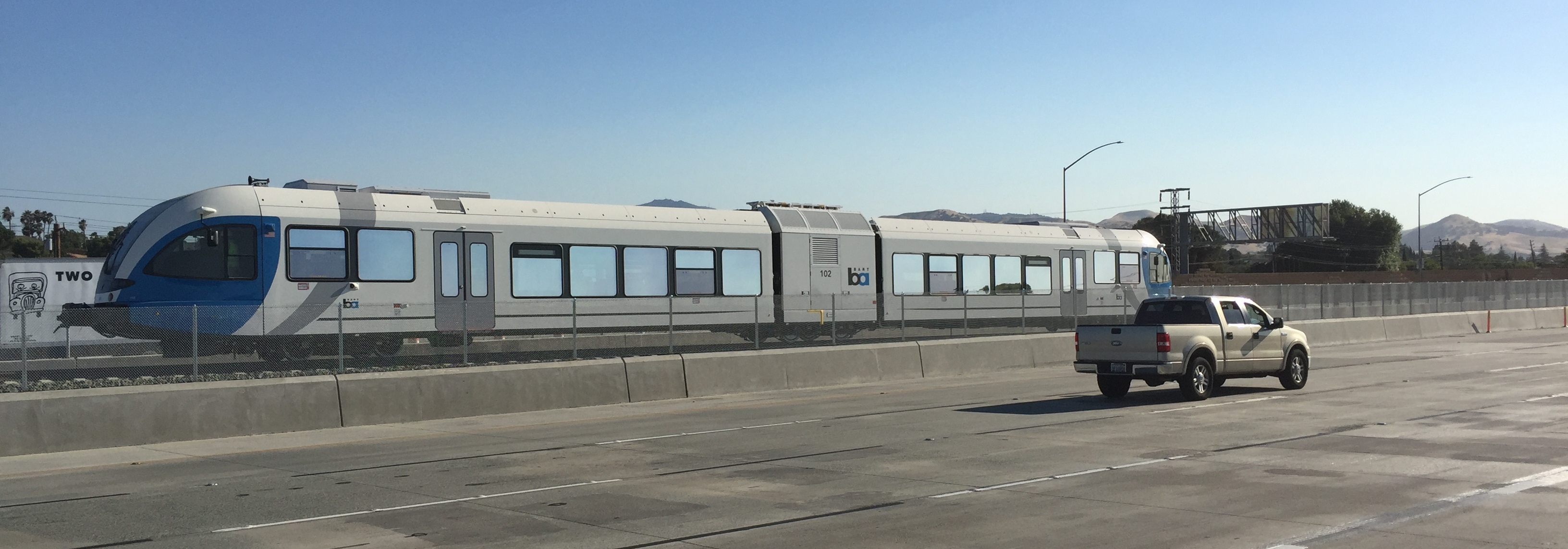
A two-car eBART train undergoes testing in the middle of Highway 4 between Hillcrest Avenue and A Street/Lone Tree Way on Friday evening, July 1, 2016 for the extension to Pittsburg and Antioch. Herald file photo by Allen Payton

BART Director Joel Keller. From BART.gov

By Joel Keller, District 2 Director, Bay Area Rapid Transit District

The BART Board will consider both BART to Antioch fares and BART to Antioch parking fees at a public hearing on November 16th meeting. On December 7th, the Board will be asked to approve the BART to Antioch fares and parking fees.

The proposal will extend BART’s distance-based fare structure for the Pittsburg Center Station and the Antioch station, resulting in a 15 cent increase at Pittsburg Center and an 80 cent increase at Antioch.

Sample BART to Antioch Fares:

Pittsburg/Bay Point to Embarcadero: $6.70

Pittsburg Center to Embarcadero: $6.85

Antioch to Embarcadero: $7.50

There will be 262 parking spaces on Bliss Avenue near Railroad Avenue serving the Pittsburg Center Station and 1012 parking spaces at the Antioch Station.

The parking fees are proposed to be effective upon commencement of operation of the Pittsburg Center and Antioch stations as follows:

Daily Fee Parking: $3.00 per day

Permit Fee Parking:

Monthly Reserved Permit: $105 per month

Single Day Reserved Permit: $6.00 per day

Airport/Long-Term Permit: $7.00 per day

Your opinion is valued and you can contact me directly at Joel.Keller@bart.gov or 510-915-7925 or you can let the entire Board know your thoughts by emailing BoardOfDirectors@BART.gov or calling 510-464-6095.

District 2 includes Antioch, Brentwood, Oakley, Pittsburg and portions of Concord and unincorporated Contra Costa County.


Filed Under: BART, News

Bridge toll increase bill includes Inspector General for BART proposed by Sen. Glazer

October 10, 2017 By Publisher Leave a Comment

SACRAMENTO – Gov. Jerry Brown on Tuesday signed a measure that will give Bay Area voters a chance to create an independent inspector general for BART to hold the sprawling transit district accountable for its spending, service to riders, and timely delivery of capital projects.

The inspector general was proposed by state Sen. Steve Glazer, D-Orinda, as part of a bill, SB 595, by Sen. Jim Beall (D-San Jose) that will ask voters to raise bridge tolls to fund transportation projects designed to relieve traffic congestion in the bridge corridors.

Glazer wanted voters to be given the option of creating the accountability czar as a condition of his support for placing the measure on the ballot. Other major transit agencies, including those in Washington D.C., New York, Chicago and Los Angeles, have long had inspector generals to serve as an independent check on the bureaucracy.

“If an independent check is good enough for transit systems in most of our major metropolitan areas, it should be good enough for BART,” Glazer said. “BART will get about one billion dollars from toll revenues generated by this measure, so it’s vital that riders and residents have someone who be the public’s eyes and ears and will hold BART’s administration accountable.”

If approved by voters, the inspector general would be appointed by the governor from a list of three finalists nominated by the BART board. The person could be fired only with a two-thirds vote of the board and the governor’s agreement.

The BART inspector general would be tasked with investigating fraud, waste and inefficiencies, conducting audits and recommending changes in the agency’s practices that will improve services to riders.

Glazer, who has been critical of management-union relations that resulted in eight days of strikes in 2013, required in the inspector general’s job description that they assess whether  management was using best practices to promote “positive and productive” relations with employees and their representatives.

“BART employees have as much to gain as the riding public by having an inspector general ensure that trains run on time, stations are safe and clean, and escalators and elevators work,” Glazer said. “They are hard-working, dedicated public servants who deserve an effective ally.”

Glazer also pushed for amendments to the bill that ensured Contra Costa and Alameda county commuters would see a fair share of congestion relief projects if the toll increases become a reality.

Projects to improve traffic flow on Interstate 680 and rebuild interchanges where 680 connects to state routes 4 and 84 were included in the final version of the proposed spending plan.

Glazer said he was proud of the collaborative process led by Sen. Beall, and Assemblymen David Chiu and Phil Ting of San Francisco and other members of the Bay Area legislative delegation. Members from throughout the region were able to provide input into the final proposal that included the crucial provision to oversee BART’s administration and spending.

“I look forward to voters determining whether to fund projects designed to relieve congestion throughout the entire region and providing independent oversight of BART,” Glazer said.


Filed Under: BART, Legislation, News

Contra Costa’s CyberTran awarded U.S. patent for Transportation Internet

October 2, 2017 By Publisher 3 Comments

Rendering of a CyberTran transit station. Renderings courtesy of CyberTran International, Inc.

Ultra-Light Rail Transit system vehicles travel throughout connected rail networks at low, medium and high speeds, direct to destination and at much lower capital deployment and maintenance costs

CONTRA COSTA COUNTY, CA – CyberTran International, Inc. (CTI) offers the most innovative approach to solving the world’s traffic congestion problems. The recent patent approval for fixed guideway transportation systems, with lower cost of ownership and optimized benefits, validates what they’re calling the Transportation Internet technology. This system can be thought of as the computer-controlled technology solution to the problems of mass transit cost overruns and inefficiency.

Artist rendering of a CyberTran vehicle and station with overhead solar panels generating the power to operate the system.

CTI’s Ultra-Light Rail Transit (ULRT) is a mass transit system with the ability to build out Urban Circulator systems, Commuter Rail systems and High-Speed Rail systems and connect them to one network where small rail vehicles carrying up to thirty passengers can travel throughout the network Direct-to-Destination (nonstop). This allows ULRT to serve three separate markets, low, medium and high speeds! Until today all three markets have been served by three separate distinct technologies that can only be connected at transfer points where passengers have to disembark one system only to transfer to another to reach their destination.

Currently, CTI is closing in on funding for the purpose of demonstration and deployment. “Everybody wants to be second, nobody wants to be first,” said Dexter Vizinau, President of CTI.

Transit officials are hesitant to take a chance on a small and innovative company. The BART system started out as a demonstration project and the technology was the first of its kind. Today, CTI has approximately ten cities that are willing to be first, he explained.

In every major metropolitan region of the world, people are stuck in traffic. Today’s solutions aren’t working.

“Expanding today’s transit systems are too costly to build and maintain, yet transit officials continue to approach this as a solution, with little result,” said Neil Sinclair, CTI Board Chairman. “There’s a $78 billion backlog in transit systems maintenance in the U.S. and the only way to pay for it is to raise taxes. In the meantime, we’re all stuck in traffic with no end in sight.” That is, until today.

Overview rendering of the offline CyberTran stations.

“Our patent validates everything we’ve already proven,” Vizinau continued. “Two full-scale prototype vehicles have already been built and tested. The test vehicles have achieved speeds of up to 60 mph and have climbed a 10% grade, which means ULRT can go over the Sepulveda Pass in Los Angeles and also travel up the Grapevine Summit in Southern California. Bullet train systems and L.A. Metro-like systems cannot climb steep grades and therefore either have to tunnel or go around.”

By building out ULRT networks in cities at 35 mph, and then connecting them together throughout a region at 80 mph, ULRT becomes a commuter rail system like BART and Metro in Los Angeles. ULRT can handle the same throughput as BART during rush hour via the Transbay Tube. CTI can then connect regions with a high-speed line. The ULRT System design is flexible and can expand easily. Guideways and civil structures are manufactured offsite and assembled onsite allowing ULRT systems to be constructed more efficiently. CTI can construct long-distance systems in up to a quarter mile per day. The system was designed to reach speeds of up to 150 mph. (See related article)

CyberTran’s ULRT system also operates from solar power. Canopies of solar panels above the guideway can generate more than one megawatt per mile and eight times more energy than the system consumes, and supply renewable energy to surrounding communities resulting in a net gain to CTI.

Rendering of a possible CyberTran station on the second floor of an office building and campus.

Transit officials currently purchase transit systems from foreign companies. CTI plans to manufacture ULRT transit systems for a global market in Contra Costa County. “We’ve been to China five times in as many years. There are six hundred cities in China that can use this,” says Sinclair. Councilmember Rich Kinney of the City of San Pablo states, “West Contra Costa County in particular has to solve the I-80 corridor congestion issue to attract more businesses and jobs to our cities. This is our opportunity to effectively address that issue. May we not continue to kick the proverbial can down the road – it’s time to embrace the full deployment of CyberTran right here at home.”

Earlier this year the city councils of Oakley, Brentwood and Antioch each voted unanimously to join the cities of Richmond and San Pablo to support efforts by CTI to obtain the needed funding for systems in both Western and Eastern Contra Costa County. (See related article) In addition, CTI has the support of U.C. Berkeley in their efforts to bring the technology to market. (See related article)

The next steps for CTI are to obtain funding to build two showrooms and a factory. This calls for one low-speed demonstration track up to 35 mph, and one rapid speed demonstration track up to 150 mph – in curves and with left and right banking. Both demo tracks and factory construction are to be done concurrently. There were no funding programs to support transit innovation, such as ULRT, at the federal level until CTI lobbied Congress to create one. Program legislation was created and approved in 2014 under a Republican-controlled Congress and Senate. CTI was hopeful that President Obama would release the program funding but it did not happen. CTI is hopeful about the President Trump’s infrastructure package and is encouraged by their reception in Washington, D.C.

Note: The publisher of the Contra Costa Herald has a financial interest in CyberTran International.

Filed Under: BART, Business, East County, News, Technology, Transportation, West County

  • « Previous Page
  • 1
  • …
  • 8
  • 9
  • 10
  • 11
  • 12
  • Next Page »
Monicas-11-25
Deer-Valley-Chiro-06-22

Copyright © 2026 · Contra Costa Herald · Site by Clifton Creative Web