• Home
  • About The Herald
  • Local Agencies
  • Daily Email Update
  • Legal Notices
  • Classified Ads

Contra Costa Herald

News Of By and For The People of Contra Costa County, California

  • Arts & Entertainment
  • Business
  • Community
  • Crime
  • Dining
  • Education
  • Faith
  • Health
  • News
  • Politics & Elections
  • Real Estate

Frazier proposes gas tax increase to fund new transportation plan

August 18, 2016 By Publisher Leave a Comment

By Allen Payton

State Assemblyman Jim Frazier (D-Oakley) and State Senator Jim Beall (D-San Jose) presented a $7.4-billion transportation plan late Wednesday, which includes an increase of 17 cents per gallon in the state gas tax, to help pay for it. The plan would also increase the tax on diesel by 30 cents per gallon and introduce a $165 annual fee on electric cars.

The Frazier-Beall plan also includes streamlining the environmental process for repairing existing transportation infrastructure and a new Office of Transportation inspector general to oversee spending.

The pair’s proposal is in response to a report about the condition of California’s roads, highways and bridges, also released on Wednesday. See the entire report, here – TRIP_Report_August_2016

Frazier issued the following statement about the report, on Thursday:

Yesterday, The Road Information Program (TRIP) released a report detailing the current status of California’s transportation system, confirming Assemblymember Frazier’s (D – Oakley) claims that road conditions will continue to worsen without passing a transportation funding plan.

“The information released in yesterday’s report further demonstrates the desperate need to repair California’s transportation system,” stated Frazier. “This cannot be accomplished without fixing the current, outdated funding structure.”

The report details the existing condition of California’s transportation infrastructure and examines future mobility needs with an increase in population and goods movement. Included in the study is the vital role our roads, highways and bridges have on economic growth and overall quality of life. The report uncovered that deteriorating roads cost Californians $56.6 billion annually in the form of additional vehicle operating costs, congestion-related delays and traffic crashes.

“I’ve spent the past year calling for a comprehensive funding fix. If we fail to act on this now, the condition of our roads will continue on this downward trajectory,” stated Frazier. “Our residents deserve a transportation system that works for all Californians. It’s time that the Legislature comes together to pass a thoughtful, sustainable plan. To that end, I’ve worked with Senator Beall to put forth a plan that will address these concerns.”

The report concluded that addressing these significant transportation issues is essential for California to remain competitive and accommodate the demands of a modern society.

Assemblymember Frazier represents the 11th Assembly District, which includes the communities of Antioch, Bethel Island, Birds Landing, Brentwood, Byron, Collinsville, Discovery Bay, Fairfield, Isleton, Knightsen, Locke, Oakley, Pittsburg (partial), Rio Vista, Suisun City, Travis AFB, Vacaville and Walnut Grove.

 

Filed Under: Legislation, News, Transportation

Debora Allen announces strong bi-partisan support in campaign for BART Director

August 17, 2016 By Publisher Leave a Comment

Debora Allen

Debora Allen

Challenging three-term incumbent Gail Murray

County pension board trustee Debora Allen announced, Wednesday morning, that she is running for District 1 BART Director, in the 2016 general election. The chief financial officer of East County Glass is challenging incumbent Gail Murray who is seeking her fourth term on the BART board. District 1 includes the Concord, Pleasant Hill/Contra Costa Centre, Walnut Creek and Lafayette BART stations, and the cities of Martinez, Lafayette, Walnut Creek, Concord, Danville, San Ramon and Clayton, as well as Alamo and Blackhawk.

“Over the last decade, the BART experience has deteriorated with increased crime, system delays, labor strikes, equipment malfunctions, fake security cameras, high fares, budget shortfalls and overall public dissatisfaction,” Allen said. “BART is so antiquated, their control system is from 1972 and they buy replacement parts on eBay.”

Allen’s campaign platform is focused on five primary objectives:

  • DEMAND accountability from management for the financial stability, affordability, and cost effectiveness of BART.
  • REBUILD the old infrastructure to provide a renewed, sustainable, and durable transportation system for future generations.
  • REPLACE obsolete, broken equipment with clean, innovative, modern replacements, and maintain them.
  • INTEGRATE the current system with our numerous other Bay Area transit systems to create greater accessibility and efficiency in our lives.
  • PROVIDE a better BART experience to the customer, the rider, and the workers.

In an email, last week, Allen stated “BART needs strong leadership that is willing to stand up for change and hold management accountable for its revitalization.”

Numerous, prominent East Bay leaders have joined in supporting Allen’s campaign, including California State Senator Steve Glazer, a Democrat who has been an outspoken critic of strikes by BART employees, as well as BART operations and finances.

“Debora Allen will bring an important voice and fiscally responsible vote into the BART boardroom.  She’s smart, she’s tough, and she’s a problem solver,” Glazer said. “She will stand up to special interests and management incompetence and fight to improve BART while protecting the interest of taxpayers.”

“Debora Allen brings a refreshing new energy and approach to getting BART’s fiscal house in order,” said Assemblywoman Catharine Baker, a Republican. “She will be a champion for the transit rider and taxpayer.”

President of the Association of Bay Area Governments (known as ABAG) and Vice Mayor of Clayton Julie Pierce also endorsed Allen, stating “Our BART system is incredibly important to the residents of Contra Costa County. I am confident that Debora Allen will be strong leadership on the Board of Directors and a loud voice for transparency and financial accountability to the stakeholders as we rebuild BART into a world class transportation system of which we can all be proud.”

Contra Costa County Supervisor Candace Andersen also offered her support.

“Debora Allen brings the business experience and financial acumen we need to lead BART in the right direction,” she stated.

Contra Costa County District Attorney Mark Peterson also endorsed Allen, stating “I trust Debora Allen to protect the taxpayers’ investment in BART, for the riders, the workers, and for the future of Bay Area living.”

Former California State Assemblywoman (1996-2002) Lynne Leach added her support.

“Debora Allen is a talented, trusted and experienced businesswoman,” Leach said. “Her background of working to stem the ever increasing growth of public pension costs prepares her well to serve on the BART Board.”

Also endorsing Allen are Mayor of Pittsburg Ben Johnson, Mayor of Clayton Howard Geller, Pittsburg City Council Member Sal Evola, Contra Costa Community College District Board President Vicki Gordon, Central Contra Costa Sanitary District Board Member and Past President Contra Costa Taxpayers Association Michael McGill, attorney and Contra Costa County Employees Retirement System Board Trustee Scott Gordon, Alamo Municipal Advisory Council Member Steve Mick, Former Mayor of Clayton Pete Laurence, former Walnut Creek School Board Member Dan Walden, and retired BART employee Robert Leach.

“I am an independent, thoughtful, outsider, willing to take on the challenges of the troubled BART system,” Allen said. “I have spent over 25 years in a career in various financial management and board level positions. I now want to use that experience and knowledge to help the BART stakeholders, the riders, the taxpayers, and the BART employees.”

This is Allen’s second run for public office. She ran for State Assembly in the 14th District in the June primary, but did not make the run-off, placing a close third in the race behind the top-two candidates. She has a college degree from Sac State in Business Administration with a concentration in Accounting, is married to Tim Allen and they have two adult sons. They live just outside of Clayton, next to Mt. Diablo State Park.

For more information visit www.deboraallen.com or www.facebook.com/deboraallenforbart, or email her at debora@fixourbart.com.

The election will be on Tuesday, November 8.

Allen Payton contributed to this report.

Filed Under: BART, Central County, Concord, Lamorinda, News, Politics & Elections, San Ramon Valley, Transportation

Contra Costa Transportation Authority adopts 30-year plan, places $2.9 billion sales tax measure on November ballot

July 28, 2016 By Publisher Leave a Comment

Half-cent sales tax in addition to Measure J

The Contra Costa Transportation Authority (CCTA) believes that the future success of Contra Costa County includes offering safe, reliable mobility for all. To provide funding for this goal, on Wednesday, July 20th, the Contra Costa Transportation Authority board – which includes representatives from all parts of the County – voted unanimously to put a tax measure on the November 8 ballot. If approved by voters, the ballot measure will fund transportation improvements throughout Contra Costa County, for the next 30 years. The details are outlined in CCTA’s Transportation Expenditure Plan. CCTA 2016 TEP for Ballot Measure

The measure, which will appear on the November 8 ballot, will ask Contra Costa voters to approve a new half-cent sales tax that will generate $2.9 billion in revenues over 30 years to continue to improve the transportation system in Contra Costa. The tax will be in addition to the current half-cent sales tax for transportation in the county.

The proposed Transportation Expenditure Plan (TEP) is the culmination of months of extensive public outreach, stakeholder engagement, and advocate input. The TEP has also been approved by all of Contra Costa’s 19 cities and towns, as well as the Contra Costa County Board of Supervisors. The plan focuses on innovative strategies and new technologies to promote a strong economy, protect the environment, and enhance the quality of life for all of Contra Costa’s diverse communities.

“The CCTA Board is incredibly proud of the TEP,” said Authority Board Special Meeting Chair Don Tatzin. “This is a transportation plan that reflects the values of our diverse region, has garnered broad support across the county, and will guide the next 30 years of transportation planning. If a super majority of voters approve the tax measure in November, the tax revenue will provide necessary funding for the transportation improvements included in the TEP.”
Contra Costa residents have made significant contributions to their transportation infrastructure since 1988, when voters passed Measure C, a half-cent sales tax dedicated to maintaining the ability of residents to travel safely and conveniently throughout the county. Measure C helped fund the BART extension to Pittsburg/Bay Point, built the Richmond Parkway, improved bicycle and pedestrian trails in the county, and invested more than $30 million in senior and disabled transit services.

In 2004, voters passed Measure J, which renewed the half-cent sales tax through 2034. Measure J has helped deliver the Fourth Bore of the Caldecott Tunnel, generated $1.3 billion dollars of investments to Highway 4 in Eastern Contra Costa County, including a BART extension to Antioch, and combined with Measure C has provided $286 million to Contra Costa’s cities and towns to maintain and repair local streets.

The TEP includes plans to reduce congestion and smooth traffic; improve BART, bus, ferry, and train service; and fix local streets and roads. It also dedicates unprecedented funding to new technologies and bicycle and pedestrian improvements in every part of the county, to give commuters viable alternatives to driving and in the process help get them out of traffic.

The TEP builds on CCTA’s strong record of fiscal responsibility and includes strong taxpayer protections and accountability. A public oversight committee will provide independent review of all funds raised and spent. It will ensure that funds are spent only in accordance with the voter-approved plan and only to benefit Contra Costa County.

“As we move into the future, Contra Costa’s economic strength is going to depend on people being able to travel quickly and conveniently throughout the county – to jobs, shopping and entertainment destinations, and everywhere else they need to go. This plan – and the measure that will fund the improvements it describes – helps make sure that is a reality in years to come,” said Tatzin.

To find out more information about the transportation improvements planned for the next 30 years – including projects in each of Contra Costa’s 19 cities and towns – and the tax measure, which will fund those plans if approved by voters on November 8, 2016, visit KeepContraCostaMoving.net.

About The Contra Costa Transportation Authority

The Contra Costa Transportation Authority (CCTA) is a public agency formed by Contra Costa voters in 1988 to manage the county’s transportation sales tax program and oversee countywide transportation planning efforts. CCTA is responsible for planning, funding and delivering critical transportation infrastructure projects and programs that connect our communities, foster a strong economy, increase sustainability, and safely and efficiently get people where they need to go. CCTA also serves as the county’s designated Congestion Management Agency, responsible for putting programs in place to keep traffic levels manageable. More information about CCTA is available at ccta.net.

Filed Under: News, Politics & Elections, Transportation

Highway 4 construction related lane closures, week of July 16-22, 2016

July 16, 2016 By Publisher Leave a Comment

HIGHWAY LANE CLOSURES:

There will be highway lane closures in the westbound direction of State Route 4 between Somersville Road/ Auto Center Drive and Railroad Ave. on Monday through Friday from 11:00 am to 7:00 pm.

There will be highway lane closures in the eastbound direction of State Route 4 between Bailey Road and the State Route 4 / State Route 160 connector ramp on Monday through Friday from 4:30 am to 12:00 pm.

There will be highway lane closures in the eastbound direction of State Route 4 between L Street / Contra Loma Boulevard and the State Route 4 / State Route 160 connector ramp on Monday through Friday from 11:00 pm to 6:00 am.

There will be highway lane closures in the westbound direction of State Route 4 between L Street / Contra Loma Boulevard and the State Route 4 / State Route 160 connector ramp on Monday through Friday from 9:00 pm to 4:00 am.

LOCAL STREET CLOSURES:

There will be lane closures in the eastbound and westbound directions of Larkspur Drive between Hillcrest Avenue and Wildflower Drive on Saturday through Friday from 9:00 am to 3:00 pm and 7:00 pm to 6:00 am.

There will be lane closures in the northbound and southbound directions of Hillcrest Avenue between Larkspur Drive and Sunset Drive on Saturday through Friday from 9:00 am to 3:00 pm and 7:00 pm to 6:00 am.

There will be lane closures in the northbound and southbound directions of A Street/Lone Tree Way between Rossi Avenue and E. Tregallas Road on Saturday through Friday from 9:00 am to 3:00 pm and 7:00 pm to 6:00 am.

There will be lane closures in the northbound and southbound directions of Somersville Road / Auto Center Drive between Delta Fair Boulevard and Century Boulevard on Saturday through Friday from 9:00 am to 3:00 pm.

For questions or comments please send e-mail to info@4eastcounty.org.

Filed Under: Transportation

BART unveils, begins testing new DMU train for upcoming service to Antioch

July 2, 2016 By Publisher Leave a Comment

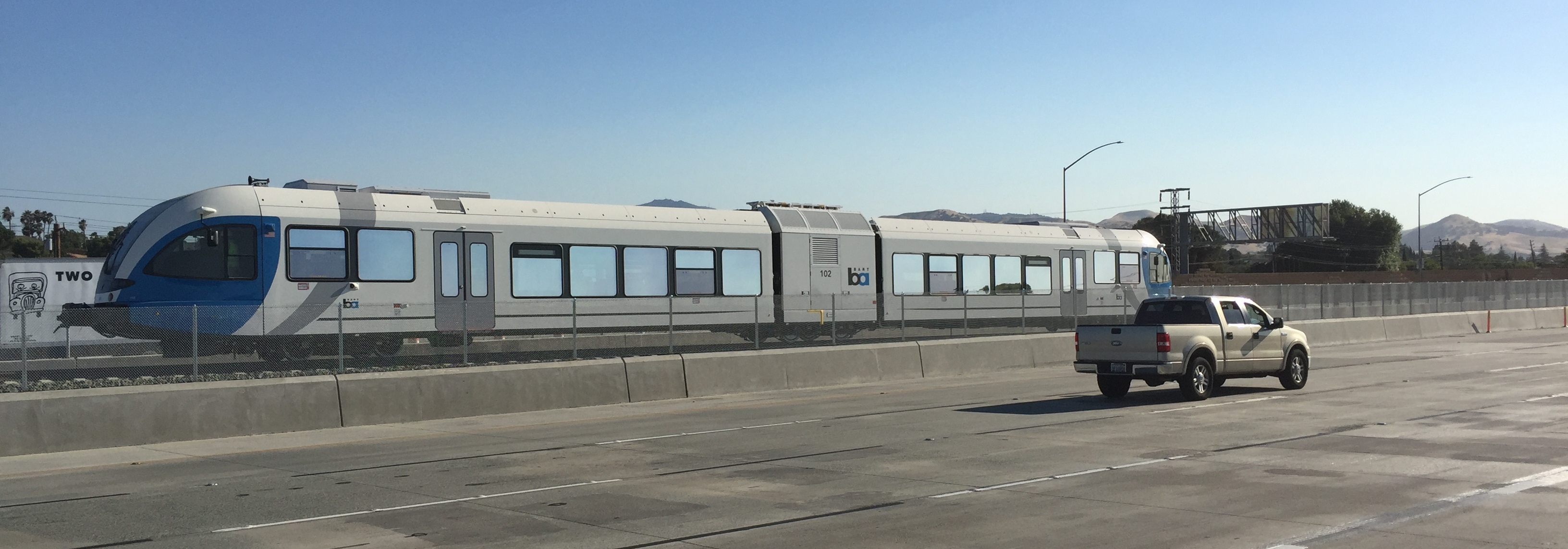
A two-car eBART train undergoes testing in the middle of Highway 4 between Hillcrest Avenue and A Street/Lone Tree Way on Friday evening, July 1st. photo by Allen Payton

A two-car eBART train undergoes testing in the middle of Highway 4 between Hillcrest Avenue and A Street/Lone Tree Way on Friday evening, July 1st. photo by Allen Payton

First of many tests over the next two years

The BART to Antioch Extension Project marked another important milestone Thursday morning, June 30th, with BART unveiling its sleek new diesel-powered trains, soon to be seen linking Pittsburg/Bay Point and Antioch down Highway 4’s median.

“We’ve been working on the arrival of BART to this part of the Bay Area for years, so it’s both thrilling and a bit surreal to finally be here aboard these amazing new vehicles,” said BART Director Joel Keller. “We couldn’t have made BART to Antioch happen without the long-term dedication of East County residents, and the commitment of the many leaders at the local, regional, state, and federal levels who came alongside us to help turn this visionary project into reality.”

The new train cars will run on separate tracks extending past the existing Pittsburg/Bay Point Station, and are a different type than those arriving in BART’s new Fleet of the Future.  This Diesel Multiple Unit (DMU) was chosen to bring rail service to East County residents while remaining cost-effective; the $525 million, 10-mile extension to Antioch is 60% less expensive than conventional BART. Stations for the new service will be located along Highway 4 near the Railroad Ave. intersection in Pittsburg and the Hillcrest Ave. intersection in Antioch, with all eight new vehicles set to arrive by this December prior to a year of state-mandated testing for safety and functionality.

A two-car eBART train could be seen undergoing testing in the middle of Highway 4 heading westbound from Hillcrest Avenue, about 6:15 p.m. Friday evening, July 1st.

“This is an exciting milestone with the first testing of the train on the tracks,” Keller added in a brief interview. “We’re still shooting for a May, 2018 opening, once we get the state approvals. This is the first of many tests.”

The new train cars, rated the most environmentally friendly out of all diesel-powered trains, will be able to move an estimated 2,400 people per hour during commute times, and boast a variety of amenities including six digital signs per vehicle (with multiple language support), automated audio announcements, clear station arrival / destination signage, and modern climate control systems.  Daily ridership of the BART extension to Antioch is expected to exceed 10,100 by 2030 through the Highway 4 corridor, with an initial expected daily ridership of 5,600.

BART to Antioch is part of the nearly-complete Highway 4 Widening Project, which expands Highway 4 from four to eight lanes between Loveridge Road in Pittsburg to just west of State Route 160 in Antioch, and from two to four lanes from Lone Tree Way in Oakley to Balfour Road in Brentwood.  The project provides greater mobility and access to multi-modal transportation, not only expanding lanes and building missing connector ramps at the State Route 160 interchange, but also providing funds for BART to Antioch.

The project has been carefully staged to keep the daily traffic of 130,000 cars moving, even as major construction and demolition work continue.

“The arrival of these new BART vehicles and the beginning of testing is a visible reminder of the progress being made to further economic growth and improve access to jobs and vital services for East County’s 250,000 residents,” said Dave Hudson, Chair of the Contra Costa Transportation Authority. “The Highway 4 Widening and BART to Antioch projects would not have been possible without either the backing of Contra Costa voters in 2004, or the help of partner agencies. We look forward to continued public support for additional innovations and improvements on the Highway 4 corridor in the future.”

Average travel time between stations is expected to be seven minutes between Antioch and Pittsburg Stations, and three minutes between Pittsburg and Pittsburg/Bay Point Stations.  The new stations will use the same BART fare collection machines and gates used elsewhere in the BART system, with full service set to begin winter 2017/2018.

For more information visit the project page.

Allen Payton contributed to this report.

Filed Under: BART, News, Transportation

Highway 4 construction lane closures and traffic information, June 11-17, 2016

June 11, 2016 By Publisher Leave a Comment

FULL FREEWAY CLOSURES:

There are no full freeway closures of State Route 4 planned for this week.

HIGHWAY LANE CLOSURES:

There will be highway lane closures in the westbound direction of State Route 4 between Hillcrest Avenue and Bailey Road on Monday through Friday from 11:00 am to 7:00 pm.

There will be highway lane closures in the eastbound direction of State Route 4 between Bailey Road and Hillcrest Avenue on Monday through Friday from 4:30 am to 12:00 pm.

RAMP CLOSURES:

There are no ramp closures of State Route 4 planned for this week.

LOCAL STREET CLOSURES:

There will be lane closures in the eastbound and westbound directions of Larkspur Drive between Hillcrest Avenue and Wildflower Drive on Saturday through Friday from 9:00 am to 3:00 pm and 7:00 pm to 6:00 am.

There will be lane closures in the eastbound and westbound directions of Sunset Drive between Hillcrest Avenue and Devpar Court on Saturday through Friday from 9:00 am to 3:00 pm and 7:00 pm to 6:00 am.

There will be lane closures in the northbound and southbound directions of Hillcrest Avenue between Larkspur Drive and Sunset Drive on Saturday through Friday from 9:00 am to 3:00 pm and 7:00 pm to 6:00 am.

There will be lane closures in the northbound and southbound directions of A Street / Lone Tree Way between Rossi Avenue and E. Tregallas Road on Saturday through Friday from 9:00 am to 3:00 pm and 7:00 pm to 6:00 am.

For questions or comments please send e-mail to info@4eastcounty.org.

Filed Under: East County, Transportation

I-680 Walnut Creek to San Ramon – Nighttime Ramp Closures, June 13 – July 1

June 11, 2016 By Publisher Leave a Comment

Summary 

Upcoming construction activity for the Express Lanes on I-680 between Walnut Creek and San Ramon requires temporary, nighttime ramp closures. The construction activity will include the excavation and paving of maintenance vehicle pullouts on the ramp shoulders. Once complete, the vehicle pullouts will create a safer environment for highway maintenance crews.

Due to the dynamic nature of this work, the ramp closures are scheduled to occur intermittently Monday, June 13 through Friday, July 1 from 8 p.m. to 5 a.m. The ramp closures will be intermittent and will alternate as work is completed.

The following ramp closures are scheduled:

  • The southbound Rudgear Road on-ramp
  • The northbound Stone Valley Road off-ramp
  • The northbound El Cerro Boulevard on-ramp
  • The southbound Bollinger Canyon Road on-ramp

What to Expect

  • In addition to the ramp closures, intermittent and alternating nightly closures will occur in the northbound and southbound directions in the lanes closest to the median, and in the lane closest to the shoulder from Martinez to Dublin. Approved construction work hours are: Monday through Thursday from 8 p.m. – 5 a.m., Friday from 8 p.m. – 7 a.m., Saturday from 7 p.m. to 10 a.m.
  • Construction crews will be present on some city streets during the day near I-680 from Martinez to Dublin with temporary and minor pedestrian detours to maintain public safety.
  • Construction lighting will be present and directed away from residential areas.
  • When traveling near construction activity
    • Always use caution
    • Be prepared to reduce speeds
    • Follow posted signs

Ramp Closure Detour Routes

  • Southbound Rudgear Road on-ramp:  Enter northbound I-680 from Rudgear Rd, continue on northbound I-680, exit at Olympic Blvd., head west on Olympic Blvd., and enter southbound I-680.
  • Northbound Stone Valley Road off-ramp: Continue on northbound I-680, exit at the Livorna Rd. off-ramp, head west on Livorna Rd., enter southbound I-680, and exit at the Stone Valley Rd. off-ramp.
  • Northbound El Cerro Boulevard on-ramp: Enter southbound I-680, continue on southbound I-680, exit at Diablo Rd., head east on Diablo Rd, and enter northbound I-680.
  • Southbound Bollinger Canyon Road on-ramp: Enter northbound I-680, continue on northbound I-680, exit at Crow Canyon Rd., head west on Crow Canyon Rd., and enter southbound I-680.

Construction is a dynamic process and information is subject to change without notice. Please use caution while traveling through the construction zone.


Filed Under: Central County, San Ramon Valley, Transportation

Contra Costa Transportation Authority releases draft 30-year transportation funding plan

May 19, 2016 By Publisher Leave a Comment

Board Unanimously Adopts Visionary Transportation Expenditure Plan; Business and Environmental Groups Declare Support

Walnut Creek, CA – The Contra Costa Transportation Authority (CCTA) Board unanimously adopted a transformative plan for the next 30 years at last night’s board meeting.

The proposed $2.9 billion Transportation Expenditure Plan (TEP) is the culmination of months of extensive public outreach, stakeholder engagement, and advocate input.  The plan focuses on innovative strategies and new technologies to promote a strong economy, protect the environment, and enhance the quality of life for all of Contra Costa’s diverse communities.

“We have moved from a Measure C, which started us on a path of tying transportation and development.  That was the first big step.  Then Measure J went further along that line,” said CCTA Commissioner and Danville Councilmember Newell Arnerich.  “That’s why we are sitting here tonight talking about trying to do something different.  We are putting more money than we ever have – in real dollars – into bike and pedestrian projects.  And we are going to do it in a smart way.  I know people want to define transformative in different ways – this is a big deal.

“This plan is the result of serious thought, care and effort to take into account the vast array of input that we’ve had, and to make compromises and stretch in areas that are uncomfortable,” said CCTA Commissioner and Pleasant Hill Councilmember David Durant.  “It’s an honor to be here with this group of people, working on something like this.  This process is the most inclusive that I’ve ever seen.”

The proposed plan contains unprecedented funding for new technologies and for bicycle and pedestrian improvements in every part of the county.  It commits substantial funding to improve BART service, increase access to BART stations, and add new BART cars.  It also significantly increases direct funding to local municipalities to maintain and repair local streets and roads.

At the meeting, advocates for the business, environment, and disabled communities spoke up in support of the plan and thanked the board for their leadership and inclusiveness in its development.

“The process has been very inclusionary and considerate,” said Debbie Toth, Executive Director of Rehabilitation Services of Northern California.  “I’m incredibly grateful for the support that we’ve had in the arena of accessible transportation for everyone.”

“We are in support of the proposed plan,” said Dave Campbell, Advocacy Director of Bike East Bay.  “Thank you for your support for better bicycling!”

“The goal of this measure is to improve transportation and to improve mobility – the movement of people and goods in Contra Costa County.  There are significant improvements [in the plan] that will be made by this measure across modes,” said Kristin Connelly, President and CEO of the East Bay Leadership Council.

The plan will now be presented to each of the cities for review and approval, before a final plan is adopted by the Board and then submitted to the Board of Supervisors for final approval and submission to the November 2016 ballot.

“There is $117 million for East County Corridor projects,” said Oakley Mayor Kevin Romick. “Right now there is a $17 million improvement for Vasco Road. We don’t have the money to build a brand new four-lane freeway. It’s about a $1 billion project.”

“Sure we can get some state and federal matching funds. But not unless we put in a whole lot ourselves,” he added. “It will help us eliminate the cul-de-sac feeling we’re experiencing, now.”

“The people who spoke to us said get the trucks off Camino Diablo and out of downtown Byron,” he added. “So that became the top priority. We will make safety improvements to Vasco Road and the Byron Highway.”

Chair of Transplan, the East County division of the CCTA, Doug Hardcastle said, “While the plan doesn’t include funds for Route 239 from Brentwood to Tracy, the $117 million is a very nice first step. It’s been something in the plans for over 40 years.”

“Armstrong to Vasco will be a new road and will be a catalyst for bringing jobs to the Byron Airport and area,” he added.

No other region in the county is collecting a developer fee for the state and federal highways, like East County has been for the past 25 years. Those funds have helped pay for the Highway 4 Bypass and other regional roads. It is currently $20,000 per new home. Suggestions have been made to Concord that they also collect a developer fee on the new homes that are planned for the reuse of the Concord Naval Weapons Station to help pay for improvements to Highways 4 and 242.

About The Contra Costa Transportation Authority

The Contra Costa Transportation Authority (CCTA) is a public agency formed by Contra Costa voters in 1988 to manage the county’s transportation sales tax program and oversee countywide transportation planning efforts.  CCTA is responsible for planning, funding and delivering critical transportation infrastructure projects and programs that connect our communities, foster a strong economy, increase sustainability, and safely and efficiently get people where they need to go.  CCTA also serves as the county’s designated Congestion Management Agency, responsible for putting programs in place to keep traffic levels manageable.  More information about CCTA is available at ccta.net.

Allen Payton contributed to this report.

Filed Under: Transportation

Sen. Glazer says BART union agreement is “positive step forward”

April 15, 2016 By Publisher Leave a Comment

State Senator Steve Glazer released the following statement, this week, about the agreement the BART has entered with its labor unions:

“About 60 days ago, 40 state and local elected leaders joined me in sending a letter to the BART Board and their unions calling on them to take steps to restore the public’s trust in the financial management of the BART system.

Specifically, we asked that BART negotiate an extension to its labor contract that would ensure that the trains would keep running without a work stoppage for the next five years and to do so in a financially responsible way.

Given what we know today, this proposed agreement takes a positive step forward in delivering on those requirements. If approved by the unions and the BART Board, we can be confident that there will be continuous train operations for the next five years without debilitating strikes.

The BART unions and management should be commended for doing this.

Strikes are too debilitating for BART riders and commuters. That is why transit strikes are banned in New York, Chicago, Washington DC, Boston and San Francisco.

There is still much more that BART should do to raise the level of confidence in the financial and operational management of the system. And I encourage them to continue the momentum with these confidence-building steps.

They are:

  1. Do not apply these cost of living raises to highly-paid managers. Their pay should be based on merit, not a “Me Too” clause.
  2. Commit to undertaking a salary study before the expiration of the next contract so that that we can closely examine each position’s compensation with the marketplace.
  3. Set up a capital depreciation fund so that savings for repair and replacement is funded every year rather than in a balloon payment through new bond proposals.
  4. Present clear projections of retirement costs and how they will be funded.
  5. Support legislation banning future BART strikes.
  6. Explore ways to train replacement managers to operate the system in the case of future work stoppages.

The financial elements of this proposed deal are not what I would have negotiated. BART workers are highly paid and system financial needs are great. However, I respect the collective bargaining process, and even if I disagree with some of the financial terms, I appreciate that compromise is required to bring all parties together.

This proposed contract represents the start of a turnaround for BART. We were going down the tracks, these past few years, in a very negative direction. The actions today have stopped that negative train and we are now heading in a positive direction. Let’s keep that momentum going with the confidence building steps that I have outlined.”

Glazer represents most of Contra Costa County in the California State Senate.

Filed Under: BART, Transportation

Rep. DeSaulnier, MTC Commissioner Amy Worth support BART labor agreement, Glazer will study it

April 13, 2016 By Publisher Leave a Comment

On Monday, Congressman Mark DeSaulnier (CA-11) issued the following statement on the agreement between Bart and the transit unions:

“I am grateful a tentative agreement has been reached between Bart and the transit unions. If approved, there will be no interruptions in services for  Bay Area commuters. I look forward to reviewing full details of the 5-year deal with an eye towards the long-term financial stability and sustainability of Bart. On the federal level, I will continue to advocate for meaningful performance standards for transit agencies to ensure the public is getting its value.”

Orinda City Councilmember Amy Rein Worth, who serves on the Metropolitan Transportation Commission (MTC) as the representative of the cities of Contra Costa County, on Monday issued this statement following the announcement of a tentative agreement between BART management and labor leaders:

“This morning BART announced a tentative agreement with its labor unions to extend BART labor contracts until 2021.I am pleased to support this financially prudent agreement that provides security to BART workers and service reliability to the BART riding public.

BART is a critical part of the East Bay economy and is relied upon by hundreds of thousands of East Bay commuters.I am hopeful that this agreement portends a future without service disruptions not just for the next five years, but sets a tone for the future beyond as well.

The critical role of BART service goes far beyond those who depend on it for a ride each day, as we have learned; the East Bay highway and transit network is not able to replace BART during a strike or a service disruption, which is why this agreement is so important.

BART, its workers and the public now can focus on the important shared task of rebuilding the system as its major priority.

I am grateful to state Senator Steve Glazer and the other local elected leaders in the East Bay who urged both BART’s management and labor to keep faith with the riding public by negotiating a new labor contract that recognizes the fiscal needs of the system and ensures that trains will keep running on schedule throughout the system.”

However, State Senator Steve Glazer, a critic of BART spending and strikes by BART employees issued the following statement on the tentative agreement:

“I have just been given an outline of the proposed 2017-21 labor agreement. I look forward to reviewing the details of the agreement and its implications to commuters and taxpayers,” he stated. “I will be consulting today with the 40 elected officials who co-signed my letter urging that BART rebuild its public trust with concrete, fiscally responsible actions before the November elections when BART is expected to ask voters for a multi-billion dollar bond.”

Filed Under: BART, Transportation

  • « Previous Page
  • 1
  • …
  • 28
  • 29
  • 30
  • 31
  • Next Page »
Furniture-Clearance-02-26B
Celia's-3-26-A
Delta-RC-A
Deer-Valley-Chiro-06-22

Copyright © 2026 · Contra Costa Herald · Site by Clifton Creative Web