• Home
  • About The Herald
  • Local Agencies
  • Daily Email Update
  • Legal Notices
  • Classified Ads

Contra Costa Herald

News Of By and For The People of Contra Costa County, California

  • Arts & Entertainment
  • Business
  • Community
  • Crime
  • Dining
  • Education
  • Faith
  • Health
  • News
  • Politics & Elections
  • Real Estate

Aggressive coyote that attacked five people in Contra Costa County caught, killed

March 12, 2021 By Publisher 1 Comment

Coyote on lawn. Photo: CDFW

By Ken Paglia

A coyote that bit five people in Contra Costa County has been caught by a multi-agency team of dedicated wildlife management professionals and local law enforcement and euthanized. The coyote attacked five people in the Moraga/Lafayette area of Contra Costa County, the California Department of Fish and Wildlife (CDFW) announced.

This unusually aggressive coyote attacked a small child on July 9, 2020, an adult male on Dec. 4, 2020, another adult male on Dec. 15, 2020, another small child on Feb. 16, 2021 and another adult male on Feb. 19, 2021. All the attacks occurred within two miles of one another in a north to south Lafayette/Moraga corridor. Personnel from CDFW, U.S. Dept of Agriculture – Wildlife Services, the Moraga and Lafayette police departments and Contra Costa County Animal Services have been working constantly to locate and remove the offending animal. On Thursday, evidence from CDFW’s wildlife forensics lab matched the DNA of this coyote to samples taken from each of the five victims.

A post on the CDFW Facebook page announced reads, “Personnel from the agencies involved are grateful to citizens in Contra Costa County for their overwhelming support of the effort to remove the dangerous animal. We sincerely hope that locals can recreate outdoors again with significantly reduced anxiety, and that the community knows that outdoor recreation is still very safe.”

U.C. Davis veterinary staff will conduct a rabies test. There is no current evidence to suggest the coyote is rabid but because of the severity of the disease it is standard operating procedure in an animal attack investigation such as this one. Rabies tests can only be done post-mortem.

Contra Costa County residents interested in learning more about living near coyotes can visit Keepmewild.org where there are helpful tips on how we can all better coexist with coyotes and other wild animals around us.

Personnel from the agencies involved in the operation wish to extend gratitude to the Contra Costa County citizens in the vicinity who have been overwhelmingly supportive of the effort to remove the dangerous animal. It is the sincere hope of the agencies that locals can recreate outdoors in the area again with significantly reduced anxiety and that the community knows that outdoor recreation is still very safe.

Allen Payton contributed to this report.

Filed Under: Lamorinda, News, State of California, Wildlife

California CASA releases 2019/2020 Impact Report: Stronger Together

March 12, 2021 By Publisher Leave a Comment

California CASA announced today, Friday, March 12, 2021, that it has published its 2019/2020 Impact Report, which reinforces the organization’s mission as it relates to helping serve the over 83,000 youth in California’s foster care system, local CASA programs, and Court Appointed Special Advocates. This year’s report also focuses on the unique actions the organization took in the wake of unprecedented challenges caused by the COVID-19 pandemic.

“During this exceptional year, the 44 CASA programs in our state experienced first-hand how difficult it was, at times, for children in foster care to get their basic needs met. California CASA also witnessed the dedication and resiliency of CASA staff, boards, and volunteers in their outstanding support of youth who have experienced abuse and neglect,” said CA CASA CEO Sharon M. Lawrence, Esq. “The 2019/2020 Impact Report showcases the strength of our network and the potential to serve even more children by recruiting, training, and overseeing a growing and more diverse group of volunteer advocates in each county.”

The title of this year’s report — Stronger Together— underscores the cooperative relationship of California CASA and the variety of community members that come together to care for children across the state. In the midst of these tumultuous times, California CASA’s flexibility enabled the organization to operate exceptionally in an environment where county and state guidelines shifted in unpredictable ways. This purposeful approach was enhanced by dedicated CASA staff and volunteers at individual CASA programs adapting to ever changing dependency court and public health requirements that impacted advocates and the youth they are connected to.

The report looks at the how California CASA managed a wide range of initiatives to strengthen the service, quality, and impact of Court Appointed Special Advocates around the state.

Summary of 2019/2020 Impact in California:

  • 14,150 children in California foster had the support of a CASA volunteer.
  • 8,798 Court Appointed Special Advocates worked on behalf of children.
  • $17.6M+ worth of volunteer service hours were provided by CASA volunteers to foster youth.
  • 6,628 hours of technical assistance were provided by California CASA to local CASA programs.
  • $8.5M+ in funding was facilitated by California CASA for local CASA programs.
  • 2500 local CASA staff and volunteers attended California CASA webinar training sessions.

California CASA is a 501(c)3 nonprofit organization ensuring that children and youth in California’s foster care system have both a voice and the services they need for a stable future. California CASA connects the 44 county CASA programs in the state in order to raise awareness of the need for Court Appointed Special Advocates and provides support, advice, resources, and oversight to maintain high-quality programs that serve children’s best interests. California CASA is a member of the National CASA/GAL Association for Children.

 More information about California Court Appointed Special Advocates Association can be found here: CaliforniaCASA.org.  


Filed Under: Children & Families, News, State of California

Newsom, state leaders agree to reopen schools by end of month, offer incentives, penalties

March 2, 2021 By Publisher Leave a Comment

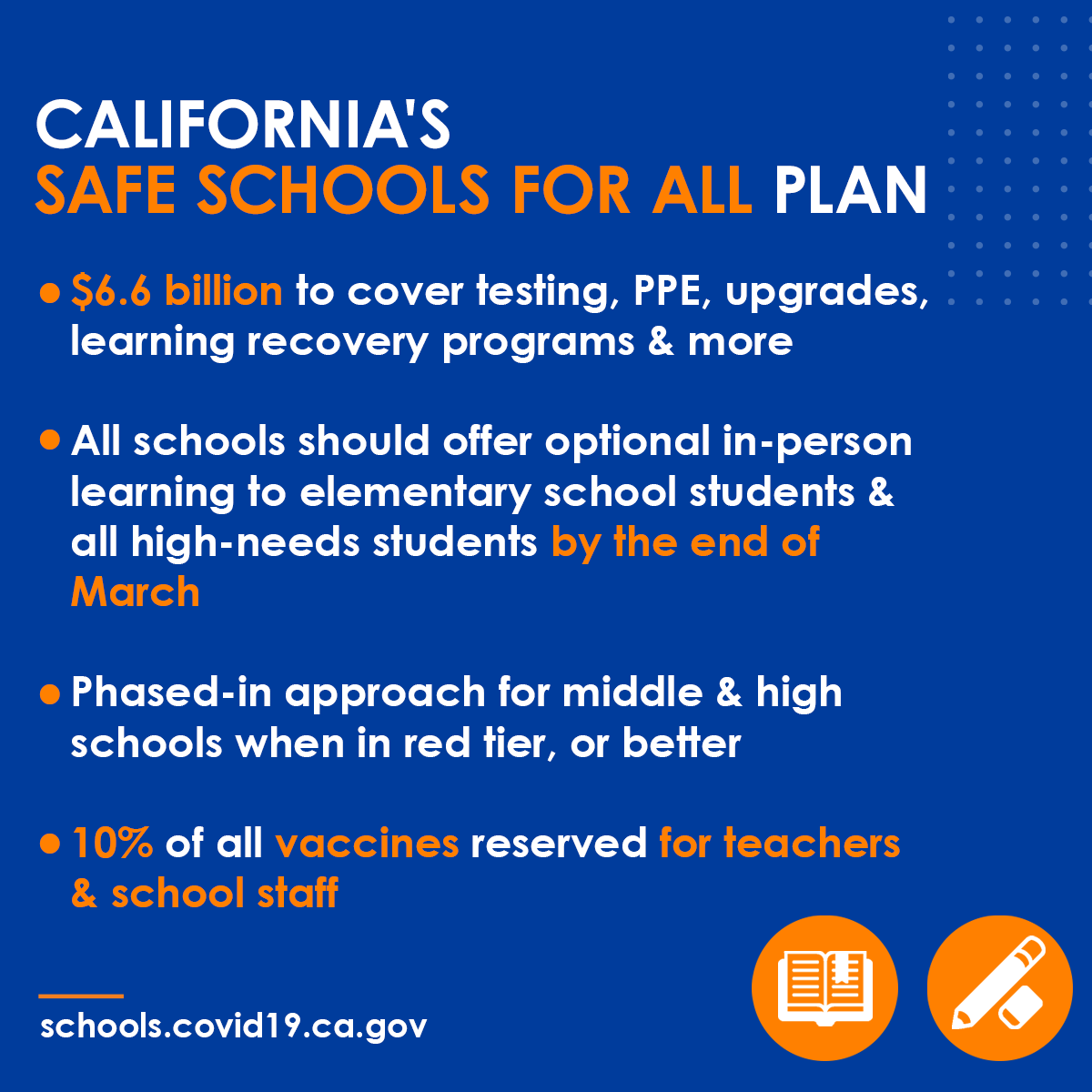
Governor, Senate Pro Tem Atkins and Assembly Speaker Rendon highlight new $6.6 billion package to reopen schools and deepen student supports

SACRAMENTO – Governor Gavin Newsom, Senate President pro Tempore Toni G. Atkins and Assembly Speaker Anthony Rendon today highlighted an agreement on a $6.6 billion budget package to accelerate the safe return to in-person instruction across California and empower schools to immediately expand academic, mental health and social-emotional supports, including over the summer.

“Since the height of the winter surge, we have successfully shifted the conversation from whether to reopen schools to when,” said Governor Newsom. “Now, our collective charge is to build on that momentum and local leadership, and – just as critically – do whatever it takes to meet the mental health and academic needs of our students, including over the summer.”

The Governor was joined by Senate President pro Tempore Toni G. Atkins, Assembly Speaker Anthony Rendon and other legislative leaders at Franklin Elementary School in the Elk Grove Unified School District. The state’s fifth largest public school district was among the first to close for in-person instruction last year. Last week, based on deep partnership between school staff and leaders, the district announced plans to reopen grades K-6 in mid-March and grades 7-12 in early April.

Elk Grove Unified and public schools throughout the state will be allocated $6.6 billion under the proposed budget package. $2 billion would fund safety measures to support in-person instruction, such as personal protective equipment, ventilation upgrades and COVID-19 testing. $4.6 billion would fund expanded learning opportunities, such as summer school, tutoring and mental health services. Together, the funds empower schools to develop and execute comprehensive strategies to both reopen and expand programs to address the social-emotional, mental health and academic needs of students.

All public schools would be required to offer in-person instruction to grades K-2 for all students and for high-needs students in all grades by the end of the month, losing 1 percent of eligible funds every day thereafter if they do not. Schools in the state’s Red Tier or better would be required to offer in-person instruction to all students in all elementary grades and at least one middle or high school grade, or risk the same penalty. Together, these requirements help ensure schools begin to reopen as soon as possible, in order to build trust and confidence to continue phased reopenings.

As students return to in-person instruction, all public schools would also be empowered to meet the needs of the whole child. The Expanded Learning Opportunities Grants allocate $4.6 billion to local educational agencies based on the equity-based Local Control Funding Formula, with an additional $1,000 for each homeless student. These funds would be for supplemental instruction and support for social and emotional well-being. Schools would be able to use the funds for providing more instructional time, such as summer school, and accelerating progress to close learning gaps through tutoring, learning recovery programs, mental health services, access to school meal programs, programs to address pupil trauma and social-emotional learning, supports for credit-deficient students and more.

The package would also codify multiple successful state programs to support safe school reopenings:

  • Vaccine Prioritization for K-12 School Staff. The package codifies the Governor’s commitment to set aside 10 percent of vaccines for education workers. This commitment ensures that the state prioritization of school staff, in place since January, is made real in all 58 counties. Since the Governor’s announcement two weeks ago, the state has collaborated with county health departments, the Biden Administration and providers such as Kaiser Permanente to accelerate vaccine access for K-12 school staff starting March 1.
  • Data Reporting. The package codifies data reporting requirements, including requirements for schools to report reopening status and COVID-19 safety measures. These statutory requirements will help build on efforts to increase transparency, including interactive geospatial maps displayed on the Safe Schools Hub.
  • State Safe Schools Team. The package also allocates $25 million to the State Safe Schools Team, which serves to provide technical assistance, oversight and accountability to the over 10,000 public schools in the state. The capacity will enhance the Team’s reach, and the Team will conduct a safety review of any school with two or more COVID-19 outbreaks.

The budget package is the result of months of work by the Governor’s Office, Senate and Assembly. The Governor, Senate Pro Tem Atkins and Assembly Speaker Rendon also thanked Senators Nancy Skinner (D-Berkeley), John Laird (D-Santa Cruz) and Connie Leyva (D-Chino), along with Assemblymembers Phil Ting (D-San Francisco) Patrick O’Donnell (D-Long Beach) and Kevin McCarty (D-Sacramento) for their tireless work and leadership on this effort.

The state’s efforts to accelerate safe school reopenings to date include delivery of three months of PPE and safety supplies to all schools at no cost, direct support to over 1,000 schools in 41 counties to implement COVID-19 testing and direct technical assistance to over 300 school districts.

For more information, please visit: https://schools.covid19.ca.gov/.


Filed Under: Education, Government, News, State of California

Contra Costa DA Becton supports California Supreme Court decision to prevent minors from being tried as adults

February 26, 2021 By Publisher Leave a Comment

By Allen Payton

Contra Costa County District Attorney Diana Becton issued a statement regarding Thursday’s California Supreme Court decision to uphold the constitutionality of Senate Bill 1391 (Lara).

Proposition 57, passed in the November 2016 general election, requires prosecutors to commence all cases involving a minor in juvenile court. Senate Bill No. 1391 enacted in 2018, amended Proposition 57 to prohibit minors under the age of 16 from being transferred to adult criminal court.

In the case of O.G. v. The Superior Court of Ventura County, the Court of Appeal held that Senate Bill 1391 is inconsistent with Proposition 57 and thus invalid. The state Supreme Court overruled the lower court’s decision.

“We agree with the majority view that Senate Bill 1391 was a permissible amendment to Proposition 57 and we reverse the judgment in this case,” the decision reads.

“Today’s unanimous decision by the Supreme Court is an important moment for the criminal justice system to give children a chance at rehabilitation for crimes they committed during their youth,” said Becton. “I have always believed this law was constitutional and should be followed. Our local judges in Contra Costa County have also agreed with me.”

“The juvenile justice system currently is not working,” she continued. “I established a task force to examine how to reform our juvenile justice system. We must think differently on how we treat children and ensure we strategically allocate resources to focus on prevention and rehabilitation efforts.”

The full Supreme Court decision is available here.

Scott Alonso, PIO, CCCDA contributed to this report.

Filed Under: Crime, District Attorney, News, State of California, Youth

CA Legislative Black Caucus endorses Contra Costa DA Becton as next state Attorney General

January 21, 2021 By Publisher Leave a Comment

To replace Xavier Becerra who was nominated as HHS Secretary in Biden Administration

Sacramento – The California Legislative Black Caucus (CLBC) announced, today that it unanimously endorses and supports Contra Costa District Attorney Diana Becton to serve as the next Attorney General of California. If appointed by Gov. Newsom, she would replace Attorney General Xavier Becerra who was nominated by President Joe Biden to be Secretary of the U.S. Department of Health and Human Services. If confirmed by the U.S. Senate, he will step down from his position creating the vacancy.

The CLBC issued the following statement about their endorsement:

“District Attorney Becton is a well-respected jurist and litigator with an exceptional statewide and national reputation among her colleagues, California’s law enforcement, and social justice communities. She is an experienced executive leader of large organizations, a strong supporter of progressive policies aligned with CLBC priorities, and has a track record of working with California’s diverse communities. In addition to her demeanor as a fighter for the people, District Attorney Becton has profound and abiding integrity. These unique qualities and experiences make her the best candidate for appointment as our state’s next Attorney General.

Diversity in our leaders is core to who we are in California. District Attorney Becton is the only African American woman serving as district attorney in the state of California, and we would all benefit from her variety in experience and perspective. Given her experiences, education and collegial connections, as well as her track record supporting progressive policies, District Attorney Becton is the transformative candidate for these turbulent times.

Without hesitation and with our highest recommendation, we respectfully urge Governor Gavin Newsom to appoint Diana Becton to serve as the next Attorney General of California.”

In response, Becton wrote, “It is an honor to be endorsed by the California Legislative Black Caucus. The Attorney General is one of the most important leadership positions of our democracy in California. As the leading lawyer for the state, the Attorney General should be experienced with the administration of justice, management of a large administration, and have experience with the implementation of criminal justice reforms. The responsibility also includes protecting the rights of victims, and other fundamental interests, as a champion of justice for the people.”

“Our next Attorney General’s upcoming appointment will be a monumental decision to advance reform and establish trust and transparency in our criminal justice system,” she continued. “We are in a fragile time in our democracy, and we must restore the faith of the people and protect the rights of all communities.”

“As a woman of color, I have broken many barriers during my career as a public servant,” Becton shared. “I have been recognized for my 30 years of experience administering justice, managing large departments, and implementing criminal justice reform that advances transparency and accountability to our criminal justice system.

“I clearly see the opportunities to partner with Governor Newsom to protect the rights of all communities,” she added.

Appointments of statewide officers require approval by vote of the California Legislature.

Allen Payton contributed to this report.


Filed Under: District Attorney, News, State of California

Bay Area Stay-At-Home order extended indefinitely

January 9, 2021 By Publisher 34 Comments

From www.cdph.ca.gov.

  • Until a region’s four-week ICU projection shows a capacity of greater than or equal to 15%

  • The extended order, directs residents to stay at home except for work, shopping or other essential activities, such as medical appointments. Gov. recommends no non-essential travel more than 120 miles from home.

  • Latest total numbers for Contra Costa County: 46,618 cases, 389 deaths

In announcing the most recent statistics on COVID-19, including data on intensive care unit (ICU) capacity across the state, today, Saturday, Jan. 9, 2021 the California Department of Public Health (CDPH) extended the Stay-At-Home order indefinitely. That’s based on the latest ICU data showing 3.0% of current available ICU capacity.

Once a region’s four-week ICU projection shows a capacity of greater than or equal to 15%, the order will be lifted for that area. The state will assess the region’s ICU projections in the coming days and announce a formal decision on whether Bay Area meets criteria to exit the order.

Current Available ICU Capacity by Region

  • Bay Area: 3.0%
  • Greater Sacramento: 6.4%
  • Northern California: 27.5%
  • San Joaquin Valley: 0.0%
  • Southern California: 0.0%

* Today’s current available ICU capacity is based on numbers reported as of January 8, 2021.

Current Status of Regional Stay at Home Order in Affected Regions

  • Bay Area: Remains under order; The region’s four-week ICU projections will be assessed in the coming days.
  • San Joaquin Valley: Remains under order; four-week ICU capacity projections do not meet criteria to exit order.
  • Southern California: Remains under order; four-week ICU capacity projections do not meet criteria to exit order.
  • Greater Sacramento: Remains under order; four-week ICU capacity projections do not meet criteria to exit order.

ICU capacity projections for regions that are eligible to exit the order are calculated daily based on four factors: current estimated regional ICU capacity available, measure of current community transmission, current regional case rates and the proportion of ICU cases being admitted. Decreasing community transmission and increasing the health system capacity can help a region’s projected ICU capacity so they can exit the order. Read the full Regional Stay Home Order, Supplement to the Order, and frequently asked questions.

Due to high rates of COVID-19 hospitalizations impacting the health care system, California is also under a Limited Stay at Home Order. The order applies to all counties that are currently under the Regional Stay at Home Order and those in Tier One (Purple) of the Blueprint for a Safer Economy. The Limited Stay at Home Order will expire after the Regional Stay At Home Order has been terminated in all regions of the state.

Hospital Surge Order

On January 5, CDPH issued a public health order to reduce pressure on strained hospital systems. To preserve services for the sickest patients, the hospital surge order requires some non-essential and non-life-threatening surgeries to be delayed in counties with 10% or less of ICU capacity under the Regional Stay at Home Order where the regional ICU capacity is at 0%. Examples of procedures that may be delayed include carpal tunnel release and non-urgent spine surgeries. Surgeries for patients who have serious and urgent medical conditions will continue. Examples of procedures that will continue include serious cancer removal and necessary heart surgeries. The order will remain in effect for at least three weeks and will continue until rescinded.

The order requires hospitals statewide to accept patient transfers from facilities that have implemented contingency or crisis care guidelines as long as those transfers can be done capably and safely. On December 28, 2020 CDPH provided guidance to health care facilities on implementing the Crisis Care Continuum Guidelines issued in June 2020.

Counties Currently Impacted by the Hospital Surge Order:

San Joaquin Valley: Fresno, Kern, Kings, Madera, Merced, San Benito, San Joaquin, and Stanislaus

Southern California: Imperial, Los Angeles, Orange, Riverside, San Bernardino, San Diego, and Ventura

Statewide COVID-19 Data as of Today

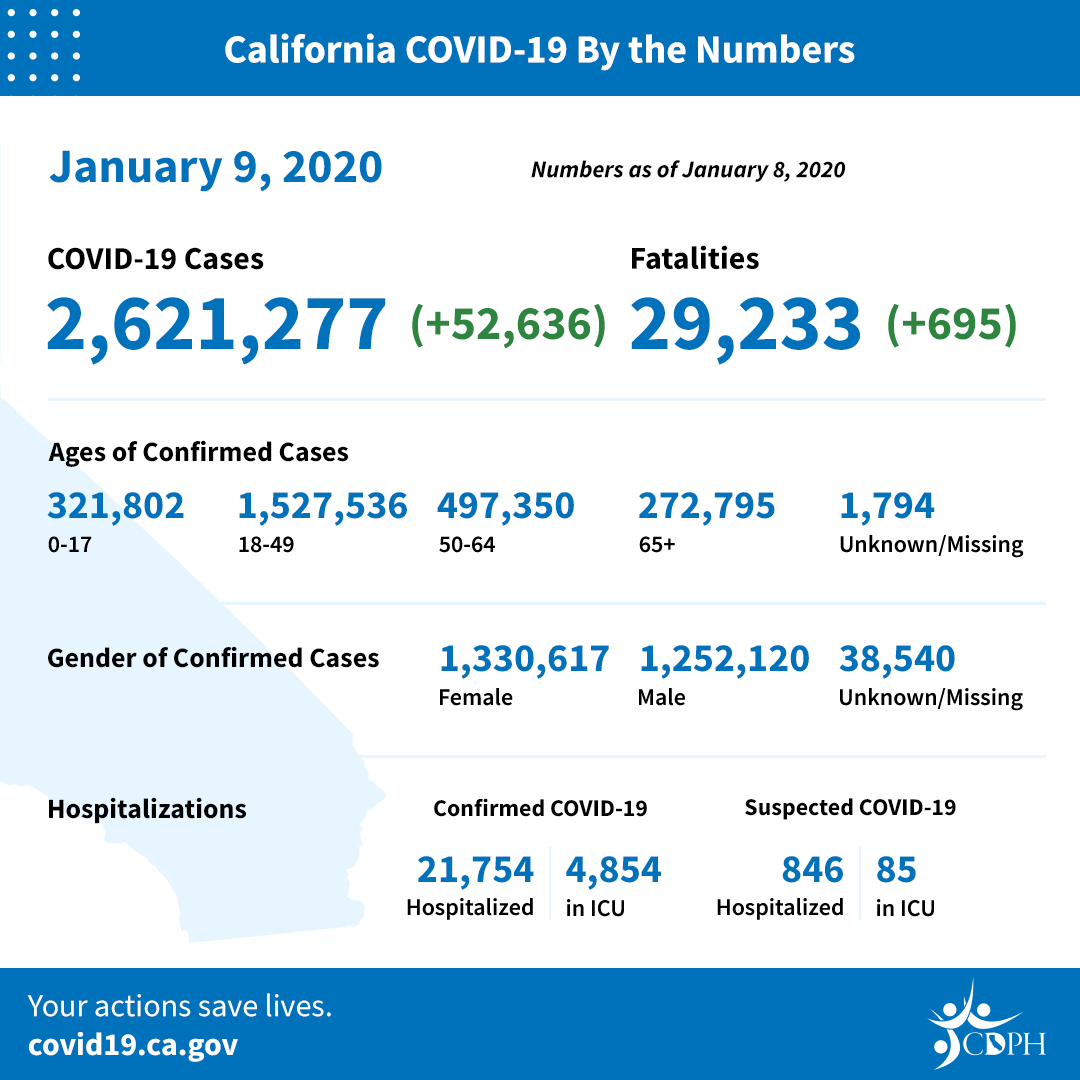
  • California has 2,621,277 confirmed cases to date. Numbers may not represent true day-over-day change as reporting of test results can be delayed.
  • There were 52,636 newly recorded confirmed cases Friday.
  • The 7-day positivity rate is 14.0% and the 14-day positivity rate is 14.0%.
  • There have been 35,353,748 tests conducted in California. This represents an increase of 326,418 during the prior 24-hour reporting period.
  • As case numbers continue to rise in California, the total number of individuals who will have serious outcomes will also increase. There have been 29,233 COVID-19 deaths since the start of the pandemic.
  • As of January 9, a total of 734,405 vaccine doses have been administered statewide. As of January 8, a total of 2,060,800 vaccine doses, which includes the first and second dose, have been shipped to local health departments and health care systems that have facilities in multiple counties.

Tracking COVID-19 in California

State Dashboard – Daily COVID-19 data
County Map – Local data, including tier status and ICU capacity
Data and Tools – Models and dashboards for researchers, scientists and the public
Blueprint for a Safer Economy – Data for establishing tier status

ADDITIONAL DATA & UPDATES

Updated Travel Advisory

CDPH has issued an updated travel advisory. Except in connection with essential travel, Californians should avoid non-essential travel to any part of California more than 120 miles from one’s place of residence, or to other states or countries. Avoiding travel reduces the risk of virus transmission, including by reducing the risk that new sources of infection and, potentially, new virus strains will be introduced to California. Postponing travel and staying home is the best way to protect yourself and others from COVID-19. Non-essential travelers from other states or countries are strongly discouraged from entering California and should adhere to the state’s self-quarantine procedures for 10 days

Safe Schools for All Plan

Governor Newsom released his California’s Safe Schools for All plan, California’s framework to support schools to continue operating safely in person and to expand the number of schools safely resuming in-person instruction.

Vaccinate All 58

The COVID-19 vaccination is one of the most important tools to end the pandemic. California will distribute a safe and effective COVID-19 vaccine in a fair way to everyone who wants it in all 58 counties. Visit the Vaccinate All 58 webpage.

Health Care Workers

As of January 8, local health departments have reported 74,589 confirmed positive cases in health care workers and 281 deaths statewide.

Health Equity

The COVID-19 pandemic has highlighted existing inequities in health that are the result of structural racism and poverty, and the disproportionate prevalence of underlying conditions such as asthma and heart disease among Latinos and African Americans. California is committed to understanding these inequities to help ensure the best health outcomes for all Californians. View COVID-19 Race & Ethnicity Data and Cases and Deaths by Age Group. Visit the new Health Equity Dashboard.

Testing Turnaround Time

The testing turnaround time dashboard reports how long California patients are waiting for COVID-19 test results. During the week of December 27 to January 2, the average time patients waited for test results was 1.4 days. During this same time period, 60% of patients received test results in one day and 87% received them within two days.

Multisystem Inflammatory Syndrome in Children (MIS-C)

As of January 4, 161 cases of Multisystem Inflammatory Syndrome in Children (MIS-C) have been reported statewide. MIS-C is a rare inflammatory condition associated with COVID-19 that can damage multiple organ systems. MIS-C can require hospitalization and be life threatening.

Your Actions Save Lives

Protect yourself, family, friends and your community by following these prevention measures:

  • If you are experiencing symptoms of COVID-19 (fever, cough, shortness of breath, fatigue, muscle or body aches), call your health care provider.
  • If you believe you have been exposed, get tested. Free, confidential testing is available statewide.
  • Stay home except for essential activities and follow local public health guidance.
  • Keep interactions to people who live in your household.
  • Wear a cloth face mask when out in public.
  • Avoid non-essential travel and stay close to home; self-quarantine for 10 days after arrival if you leave the state.
  • Wash hands with soap and water for at least 20 seconds.
  • Avoid close contact with people who are sick and stay home from work, school or other people if you feel ill.
  • Add your phone to the fight by signing up for COVID-19 exposure notifications from CA Notify.
  • Answer the call if a contact tracer from the CA COVID Team or local health department tries to connect.

Filed Under: Health, News, State of California

Ring in the new year with new California traffic safety laws January 1

December 24, 2020 By Publisher Leave a Comment

By Jaime Coffee, Information Officer, California Highway Patrol

SACRAMENTO, Calif. – As 2020 comes to a close, the California Highway Patrol (CHP) wants to highlight some new roadway safety laws that take effect in 2021.

License points for distracted driving (AB 47, Daly; 2019):  Using a cell phone in a handheld manner while driving is currently punishable by a fine.  Beginning July 1, 2021, violating the hands-free law for a second time within 36 months of a prior conviction for the same offense will result in a point being added to a driver’s record.  This applies to the violations of talking or texting while driving (except for hands-free use) and to any use of these devices while driving by a person under 18 years of age.

Unattended children in motor vehicles (AB 2717, Chau):  Exempts a person from civil or criminal liability for trespassing or damaging a vehicle when rescuing a child who is 6 years old or younger and who is in immediate danger from heat, cold, lack of ventilation, or other dangerous circumstances.  The law takes effect January 1, 2021.

“Move Over, Slow Down” amendments (AB 2285, Transportation Committee):  Extends the provisions of the “Move Over, Slow Down” law currently in place on freeways to also apply to local streets and roads so drivers approaching a stationary emergency vehicle displaying emergency lights, including tow trucks and Caltrans vehicles, must now move to another lane when possible, or slow to a reasonable speed on all highways, not just freeways.  The law is effective January 1, 2021.

Emergency vehicles (SB 909, Dodd):  Allows authorized emergency vehicles to use a “Hi-Lo” warning sound.  This distinctive sound, different than a siren, would be used to notify the public of an immediate need to evacuate an area in an emergency.  The CHP is currently developing regulations to standardize the Hi-Lo warning sound statewide.  Until the regulations are adopted, law enforcement agencies can use the Hi-Lo warning sound by obtaining a permit from the CHP.  The law went into effect September 29, 2020.

The mission of the CHP is to provide the highest level of Safety, Service, and Security.

Filed Under: CHP, News, State of California, Transportation

U.S. Supreme Court sides with California church overturns Newsom’s ban on indoor services, Bible studies

December 4, 2020 By Publisher 1 Comment

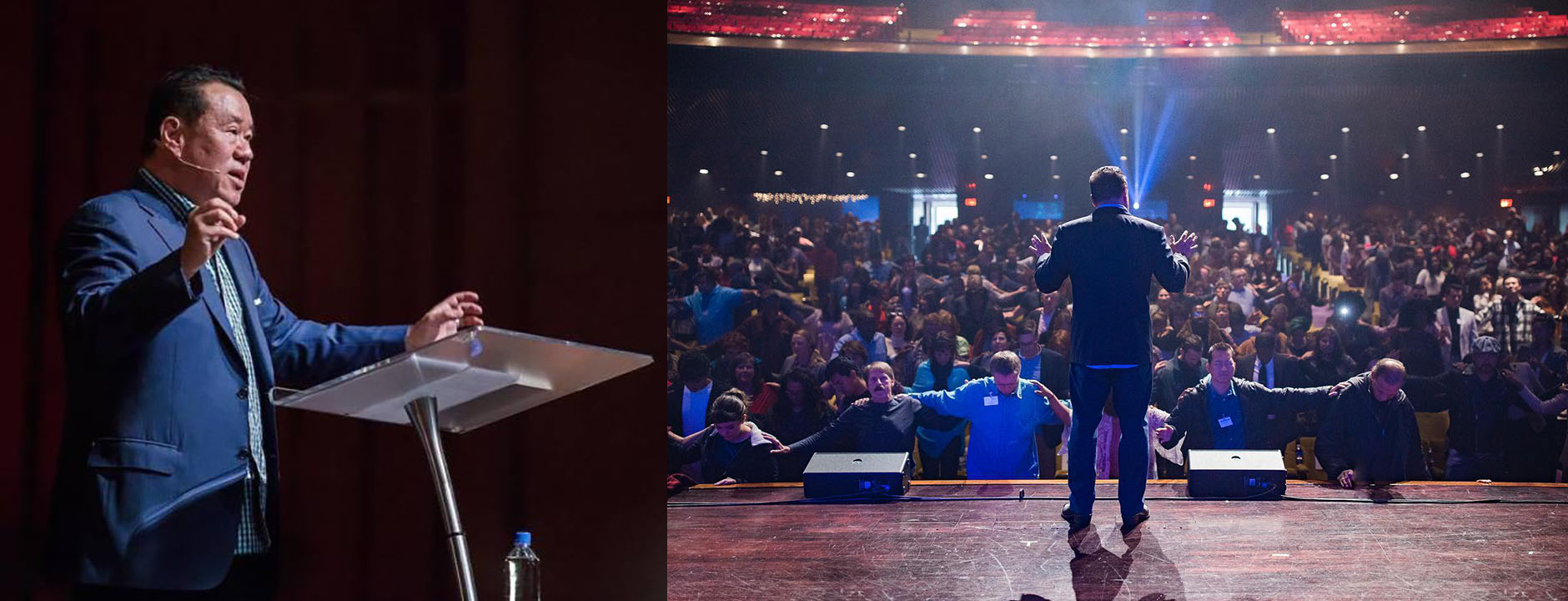
Pastor Ché Ahn speaks at Harvest Rock Church in Pasadena, California in 2019 (left) and on Feb. 28, 2020. Photos: Harvest Rock Church Facebook page.

“This order frees up churches in all of California to have indoor services, again.” – Liberty Counsel

By Allen Payton

In the lawsuit by Pasadena-based Harvest Rock Church and Harvest International Ministry against Governor Gavin Newsom over his ban on all worship services and Bible studies in California, the U.S. Supreme Court ruled, yesterday, Thursday, Dec. 3, 2020, in favor of the church. The decision vacates the September 2 order by the U.S. Ninth Circuit Court of Appeals and directs that court to the Supreme Court’s recent 5-4 decision in favor of the Roman Catholic Diocese of Brooklyn in their lawsuit against New York Governor Andrew Cuomo.

The U.S. Supreme Court granted cert and vacated the lower court orders involving the emergency petition of Harvest Rock Church and Harvest International Ministry. The Court stated in its order:

“The application for injunctive relief, presented to Justice Kagan and by her referred to the Court, is treated as a petition for a writ of certiorari before judgment, and the petition is granted. The September 2 order of the United States District Court for the Central District of California is vacated, and the case is remanded to the United States Court of Appeals for the Ninth Circuit with instructions to remand to the District Court for further consideration in light of Roman Catholic Diocese of Brooklyn v. Cuomo, 592 U. S. ___ (2020).”

Tuesday, Liberty Counsel filed the final reply brief to the U.S. Supreme Court regarding its request for an injunction pending appeal in the churches’ federal lawsuit against California Governor Gavin Newsom’s unconstitutional worship ban and discriminatory treatment. The emergency petition also requested the extraordinary relief that the Court alternatively consider it as a petition for writ of cert before judgment. Today, the Supreme Court granted the petition, vacated the lower court orders, and remanded the case for further consideration in light of its ruling last week that granted an injunction pending appeal for churches and synagogues in New York.

According to the complaint by the church and ministry, referred to as the plaintiffs, “On July 17, 2020, Plaintiffs filed their complaint against Defendant California Governor Gavin Newsom. (“Complaint,” Dkt. No. 1.) The Complaint alleges six causes of action: (1) Violation of Free Exercise Clause of First Amendment to U.S. Constitution; (2) Violation of First Amendment Freedom of Assembly Clause; (3) Violation of Free Speech Clause of First Amendment to U.S. Constitution; (4) Violation of Establishment Clause of First Amendment to U.S. Constitution; (5) Violation of Equal Protection Clause of Fourteenth Amendment to U.S. Constitution; and (6) Violation of the Guarantee Clause of the U.S. Constitution.”

Then, “On July 18, 2020, Plaintiffs filed a Motion for Temporary Restraining Order and Preliminary Injunction.”

According to Liberty Counsel, the firm representing the church and ministry, they then appealed the case to the Ninth Circuit Court of Appeals regarding Governor Gavin Newsom’s unconstitutional orders. The governor’s orders prohibit all indoor worship, including home Bible studies and fellowship with anyone who does not live in the home. Yet, Gov. Newsom continues to encourage mass gatherings of protestors throughout the state.

Following the argument on August 12, Judge Jesus G. Bernal orally denied the request for a preliminary injunction. However, he waited until September 2 to release the written order. The appeal was filed, but it could not be effective until a written order was issued.

Once the order had been issued, the appeal was able to proceed. Liberty Counsel also filed for an injunction pending appeal. That is what the Supreme Court granted.

Background

On August 13, the Pasadena Assistant Prosecutor in the Criminal Division sent Harvest Rock Church and Pastor Che’ Ahn a letter demanding that all, indoor, in-person worship services cease. The letter threatens daily criminal charges and fines to Pastor Ahn, the church, staff, and parishioners. The letter states that each criminal charge is punishable by up to one year in prison.”

The lawsuit challenges both the total ban on indoor, in-person worship (including in private homes) in the counties on the “County Monitoring List,” and the ban on singing and chanting in the remaining counties. In addition to in-person worship at Harvest Rock Church, the church also has many “Life Groups,” which are home Bible studies and fellowship groups. These too are prohibited under Gov. Newsom’s July 6 (no singing and chanting) and July 13 (no worship) orders. Yet while he discriminates against churches, home Bible studies and fellowship meetings, the governor continues to encourage thousands of protestors to gather throughout the state. Like Gov. Newsom, Pasadena has allowed hundreds and thousands of protestors. Neither the Pasadena Public Health Department nor the Pasadena Prosecutor have attempted to stop the protests in which people are crowded together, many of them not wearing masks.

In Governor Newsom’s response to the motion for the temporary restraining order and preliminary injunction, he argues that churches are not “essential.” Regarding feeding, counseling and housing people in the same building where worship services occur, Newsom argues that only the worship services should be prohibited while the other non-religious services should be allowed.

Concerning home Bible studies, Newsom argues that he has authority to prohibit home fellowship groups. As to protests, Newsom publicly encourages them, saying “God bless you. Keep doing it.”

The restrictions against places of worship in California are more severe than those in New York. Governor Gavin Newsom’s orders ban all indoor, in-person worship for 99.1 percent of Californians.

Harvest Rock Church has multiple campuses in California, including in Pasadena, Los Angeles, Irvine and Corona. Harvest International Ministries (HIM) has 162 member churches throughout the state. Irreparable harm is being suffered every day as the churches remain subject to the unconstitutional restrictions, coupled with daily criminal threats, fines, and closure.

The Code Enforcement Division for the City of Pasadena and the Criminal Prosecutor have threatened criminal charges, fines, and closure for being open for worship against the governor’s orders and local health orders. The letters threaten up to one year in prison, daily criminal charges and $1,000 fines against the pastors, staff, and parishioners.

The discrimination has become more obvious and severe in Gov. Newsom’s new “Blueprint” issued on August 28, 2020, which established a system of four Tiers. The “Blueprint” discriminates against religious meetings in churches and places of worship in every Tier. The chart attached to the petition makes this discrimination very clear. For example, the consequence of the sea of purple in the “color-coded executive edict” is that indoor worship services are completely prohibited for 99.1 percent of Californians, including most of Harvest Rock and HIM churches. However, warehouses, big box centers, shopping malls, liquors stores, family entertainment and destination centers, gyms, fitness centers, and museums receive preferential treatment with either no capacity limits or no numerical limits.

Liberty Counsel Founder and Chairman Mat Staver said, “Today’s ruling by the Supreme Court provides great relief for churches and places of worship. The handwriting is now on the wall. The final days of Governor Gavin Newsom’s ‘color-coded executive edicts’ banning worship are numbered and coming to an end. It is past time to end these unconstitutional restrictions on places of worship.”

This order frees up churches in all of California to have indoor services, again.


Filed Under: Faith, Health, Legal, News, State of California

Newsom: more restrictions for Bay Area counties in December based on hospital ICU bed availability

December 3, 2020 By Publisher 1 Comment

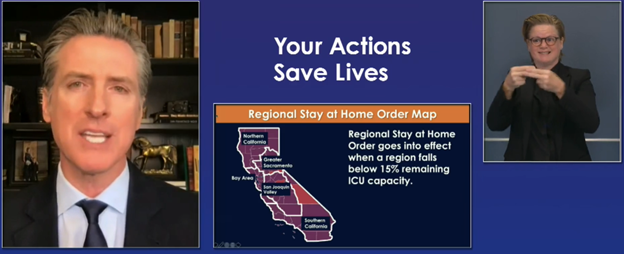
Screenshot of Gov. Newsom’s press conference announcing the Regional Stay-At-Home order on Thursday, Dec. 3, 2020.

Hair salons, barber shops, personal services, bars, wineries will be closed temporarily

All non-essential travel temporarily restricted statewide

By Allen Payton

Governor Gavin Newsom announced, during a press conference, Thursday a more restrictive Stay-At-Home order on a regional basis in the state based on hospital intensive care unit (ICU) bed space when it falls below 15 percent. In the nine Bay Area counties, including Contra Costa, the new restrictions are expected in mid-to-late December. The restrictions in the other four regions, Northern California, Greater Sacramento, the San Joaquin Valley and Southern California, are expected to go into effect sooner.

Regions where the ICU capacity falls below 15% will be placed into this Stay-At-Home order for three weeks.

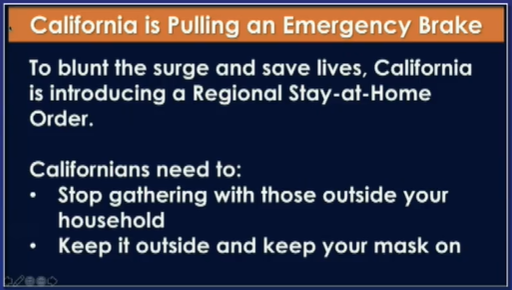
Newsom said “California is pulling an emergency break” and his order directs Californians to “stop gathering with those outside your household” and “Keep it outside and keep your mask on.”

Sectors that will be temporarily closed when a region is placed into the Stay-At-Home include bars, wineries, personal services, hair salons and barber shops. Sectors that will remain open include schools that have received a waiver, critical infrastructure, retail (20% capacity to reduce exposure), and restaurants for take-out and delivery.

All non-essential travel is temporarily restricted statewide, as well, Newsom said.

“The bottom line is if we don’t act now our hospital system will be overwhelmed,” Newsom said. “If we don’t act now, we will continue to see a death rate climb.”

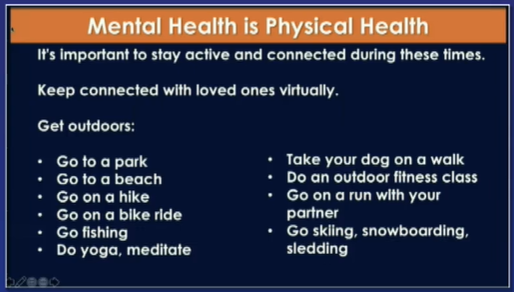
However, the governor encouraged residents to get outdoors and exercise to offset “the mental distress we’re under.”

“This is not a permanent state,” Newsom said to reassure residents. “We had predicted the final surge in the pandemic. There’s light at the end of the tunnel. We are a few months away from truly seeing real progress with the vaccine. We do not anticipate having to do this, once again. But we really all need to step up…and we need to do everything we can to stem the tide, to bend the curve, to give us the time…to get those vaccines in the hands of all Californians across the state.”

Filed Under: Business, Health, News, State of California

CHP Commissioner asks Californians to “self-regulate” during governor’s curfew order

November 19, 2020 By Publisher Leave a Comment

By Fran Clader, Director of Communications, California Highway Patrol

California Highway Patrol Commissioner Amanda Ray today issued the following statement regarding the Governor’s limited stay at home order: 

“The health and safety of our employees and the public we serve is our highest priority. In an effort to preserve public health and safety of all Californians and stop the surge of COVID-19 cases, the Governor has instituted a limited stay at home order from 10 p.m. to 5 a.m. with the goal that people will self-regulate their behavior, protect themselves, and go about only the ‘essential’ activities during those hours.

“The mission of the CHP is unchanged.  CHP officers will continue to patrol throughout California and use their sound professional judgment to conduct enforcement stops for violations of the law based upon probable cause.  The CHP does not make arrests based on race, ethnicity, gender, political affiliation, sexual orientation, religious beliefs, or for any reason other than violations of the law based on probable cause.  As always, CHP officers will have the discretion to take appropriate action when a violation is observed.”


Filed Under: CHP, Health, News, State of California

  • « Previous Page
  • 1
  • …
  • 18
  • 19
  • 20
  • 21
  • 22
  • 23
  • Next Page »
Furniture-Clearance-02-26B
Celia's-3-26-A
Delta-RC-A
Deer-Valley-Chiro-06-22

Copyright © 2026 · Contra Costa Herald · Site by Clifton Creative Web