• Home
  • About The Herald
  • Local Agencies
  • Daily Email Update
  • Legal Notices
  • Classified Ads

Contra Costa Herald

News Of By and For The People of Contra Costa County, California

  • Arts & Entertainment
  • Business
  • Community
  • Crime
  • Dining
  • Education
  • Faith
  • Health
  • News
  • Politics & Elections
  • Real Estate

South Gate Road to Mt. Diablo closed weekdays for 5 weeks starting May 28

May 24, 2024 By Publisher Leave a Comment

Source: CA State Parks

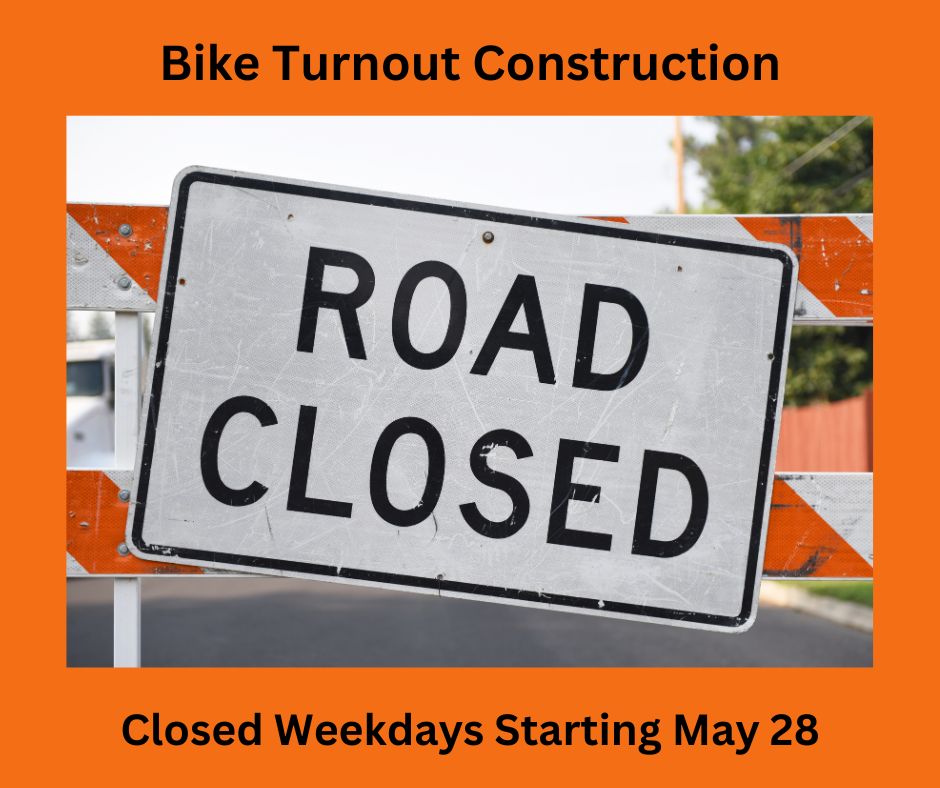
ROAD CLOSURE STARTS TUESDAY for construction of new bike turnouts

By CA State Parks

Starting Tuesday, May 28 South Gate Road will be closed weekdays to all traffic including cars, bicyclists, and pedestrians. Each week for approximately five weeks, the road will be closed from Monday 8 a.m. through Friday 2 p.m. It will be open weekends.

All trails and fire roads will remain open, and visitors who walk or cycle to the park will be able to access Summit Trail at the South Gate Entrance.

During the road closure period, camping at Live Oak Campground, and the Buckeye, Wildcat, and Barbecue Terrace Group Camps will only be available Friday and Saturday nights.

This closure is for the construction of additional bike turnout lanes to enhance road safety. This latest phase of the project was made possible by fundraising coordinated by our partner organization California State Parks Foundation.

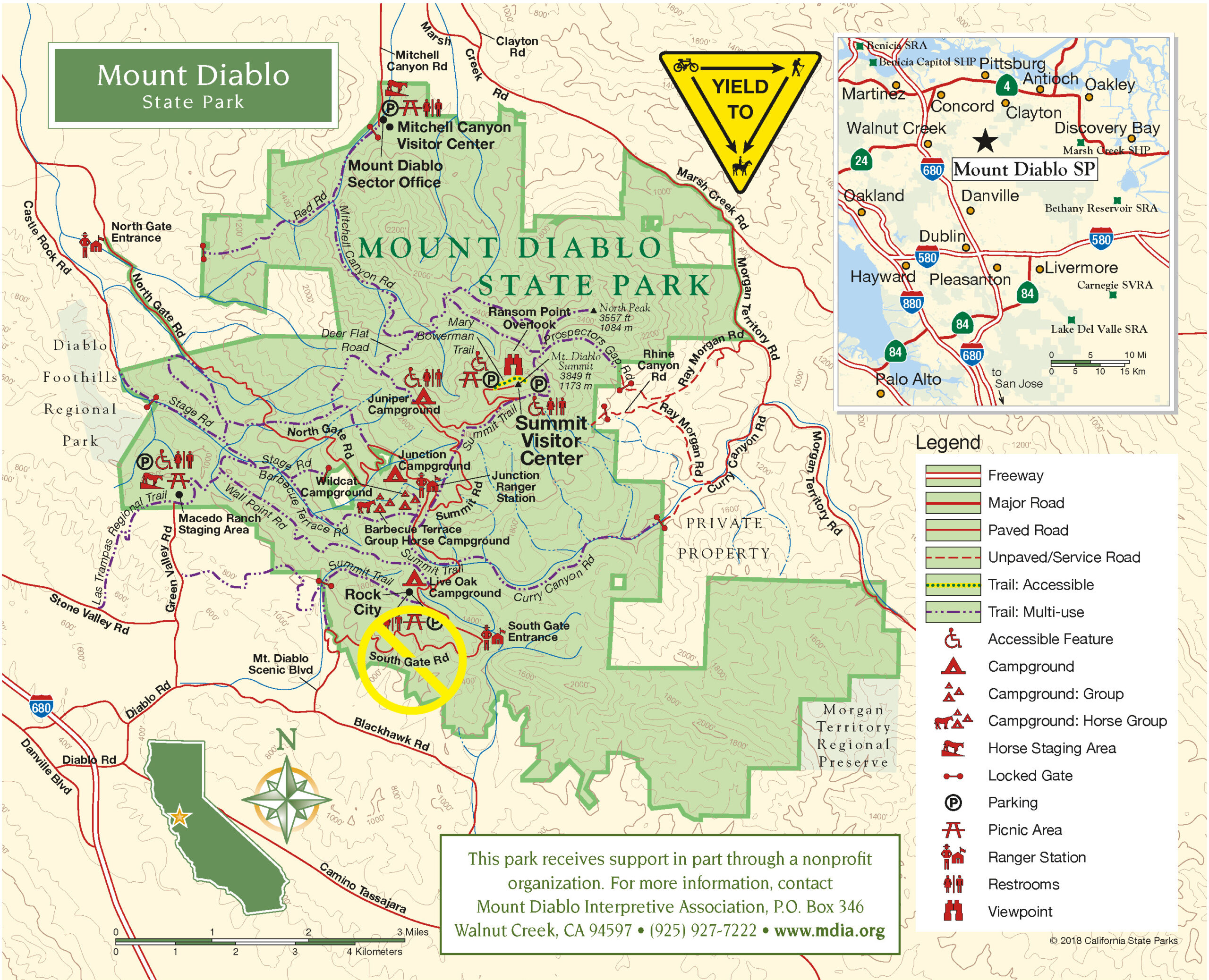
Yellow circle indicates South Gate Road entrance. Map source: CA State Parks

There are three other entrances to Mount Diablo State Park: Mitchell Canyon Road, North Gate Road and Green Valley Road (Macedo Ranch). Please check under Brochures/Campground Map for more details. There is no vehicle access to the Summit from Macedo Ranch or Mitchell Canyon.

Thank you for your cooperation during this temporary closure.

For more information about Mt. Diablo click, here.

Allen D. Payton contributed to this report.


Filed Under: News, Parks, Recreation, San Ramon Valley, State of California, Transportation

Martinez: Briones Trails Pilot Project Community Dig Day Saturday, June 1

May 23, 2024 By Publisher Leave a Comment

Source: EBRPD

Briones Regional Park, Alhambra Creek Staging Area 9 AM – 2 PM

By East Bay Regional Park District

The Briones Trails Pilot Project is a unique opportunity to give back to the parks you love! Help us maintain and enhance Briones Regional Park and create exciting new recreational opportunities on single-track trails and repair impacted natural resources during our Dig Days. The next one will be on Saturday, June 1, 2024. We will make improvements to the P9 Trail (AKA the Desert Hiking Trail) including establishing a more sustainable trail route and restoring a steep and eroding segment.

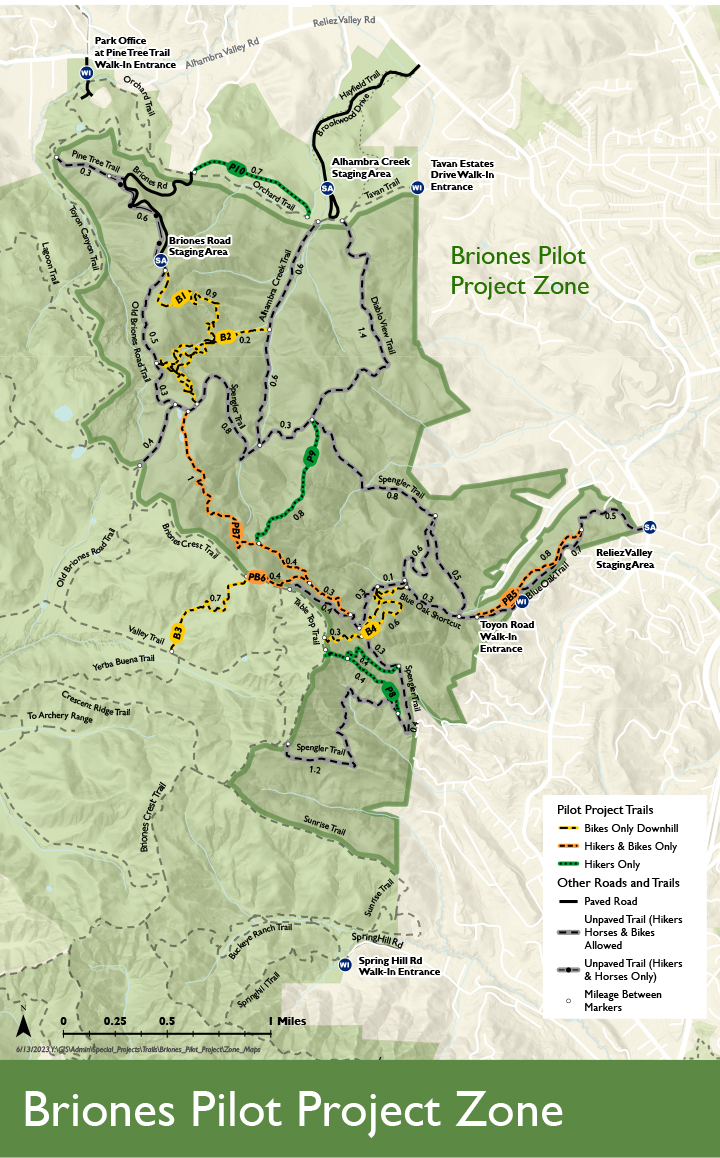
The two-yearpilot project is intended to test a variety of trail management strategies. The pilot project is limited to a portion of Briones Regional Park in the northeast corner of the park. See Project Map (or below). The pilot project was launched on Friday April 21, 2023.

The Briones Pilot Project establishes specific rules limiting trail use within the Pilot Project Zone and for two trail segments adjacent to the Pilot Project Zone, such as hiking only, biking only, or biking/hiking only and direction of travel. On weekends, trail use within the Pilot Project Zone will alternate days between bicycle and equestrian use based on even and odd calendar dates (see table). A key component of the Project is the restoration of illegally built “bootleg” trails to protect natural habitat for wildlife.

Please make sure to bring a water bottle and be prepared to work! There is poison oak in the area, so please wear work pants, long sleeves and good close-toed work shoes.

You are welcome to ride in, but you will need to provide your own bike and helmet.

June 1st Dig Day – 9:00 AM meet-up and post-dig lunch at Alhambra Creek Staging Area, 273-181 Brookwood Drive in Martinez.

Registration and Info: ebrpd.samaritan.com/custom/501/opp_details/6729

  • Age Restrictions: Youth under the age of 18 must have a signed permission by parent or legal guardian. Youth under the age of 13 must be accompanied by an adult.
  • Description: Join us to maintain and improve select trails and restore habitat! Learn the basics of restoration and trail work during our dig-days lead by Regional Parks staff.
  • What to Bring: water bottle, helmet, mountain bike, gloves, and PPE.
  • What is Provided: Necessary tools. We will have work gloves and protective eye wear for participants.
  • Weather: Heavy rain or unsafe wildfire smoke conditions cancel the program. Please wear layers as Bay Area weather can be unpredictable.

The Briones Pilot Project reached its one-year mark on April 21, 2024. The two-year pilot project was planned and created to test new ways to safely share trails and improve the trail experience for all users while protecting habitat, wildlife, and watersheds. The pilot project is limited to a portion of Briones Regional Park in the northeast corner of the park. Share your thoughts and feedback on the past year of progress at the next in-person check-in meeting on June 15. Members of the community are invited to Briones to discuss the pilot project’s progress and share ideas with District staff and other trail users.

Briones Pilot Project Zone Map. Source: EBRPD

Why a Pilot Project?

Over the last decade, the number of visitors to District parks has increased significantly. The rise in numbers of visitors getting out onto trails has increased the potential for conflict between different types of trail users. Although the Park District is seeking to open new parks and provide more trails to reduce crowding on trails, the trail development process takes time. The pilot project will test some new ways to safely share trails and improve the trail experience for all users while protecting habitat, wildlife, and watersheds.

Project Objectives:

  • Protect Resources, Habitat, Wildlife, and Watersheds: The expansion of illegal bootleg trails is a significant issue for Briones and other East Bay regional parks. These user-built trails are often not built to sustainable trail standards with appropriate drainage and avoidance of sensitive natural habitats. Illegal trails can have negative impacts on wildlife and watersheds. The project will include a robust monitoring and patrol program to document and prevent the expansion of bootleg trails in the pilot project zone.
  • Restore Natural Habitat by Closing Illegal Bootleg Trails in the Pilot Project Zone: A primary objective of the project is to engage with the trail user community to join park staff in restoring natural habitats already impacted by illegal bootleg trails.
  • Enhance the Trail User Experience: The trail management strategies being tested during the two-year pilot project are intended to allow users to safely enjoy trails by providing specific days when certain user types are limited to create more space on trails.
  • Increase Volunteer Engagement in Trail Maintenance and Habitat Restoration: Community volunteers play an important role in helping park staff monitor and maintain park trails. The pilot project provides volunteer opportunities for trail users to join in trail maintenance and habitat restoration activities.

For more information visit Briones Trails Pilot Program or call Volunteer Services at (510) 544-2229.

Filed Under: Central County, Community, East Bay, News, Parks, Recreation

Orinda: Grand Opening of Alder and Leatherwood Creek Restoration and Public Access Project & Eastport Staging Area Thursday

May 22, 2024 By Publisher Leave a Comment

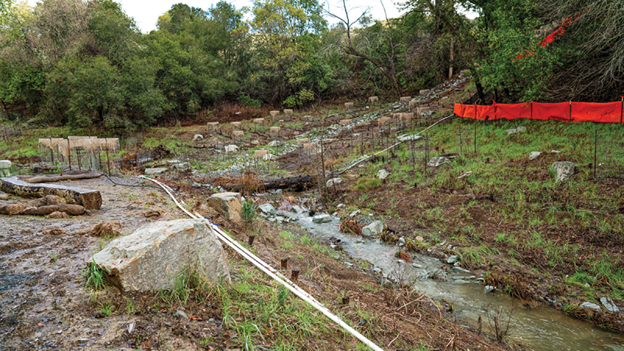
The newly restored and daylighted Alder Creek flows through the former McCosker property in Sibley Volcanic Regional Preserve. Photo: EBRPD

Ribbon cutting for largest creek restoration project in East Bay Regional Park District’s history.

At Sibley Volcanic Regional Preserve

By Flora Csontos, Acting Public Information Specialist, Public Affairs, East Bay Regional Park District

Join East Bay Regional Park District on Thursday, May 23, 2024, at 11 A.M. to celebrate the completion of the Alder and Leatherwood Creek Restoration and Public Access Project at Sibley Volcanic Regional Preserve – the largest creek restoration project in the Park District’s history. The Alder and Leatherwood Creek Restoration and Public Access Project removed several culverts and opened up 3,000 linear feet of creek to a more natural run. The event will include a ribbon cutting ceremony to celebrate the restoration project and the reopening of the Eastport Staging Area.

Speakers will include East Bay Regional Park District General Manager Sabrina Landreth, Board President Ward 1 Member Elizabeth Echols and Ward 2 Board Member Dee Rosario.

The Alder and Leatherwood Creek Restoration and Public Access Project, previously referred to as the McCosker Project, provides natural habitat for special status or protected species, including the California red-legged frog, California foothill yellow-legged frog, Alameda whipsnake, San Francisco dusky-footed wood rat, golden eagle, Cooper’s hawk, loggerhead shrike, northern harrier, and white-tailed kite. Water quality and streamflow were also improved by the project, providing new habitat for rainbow trout.

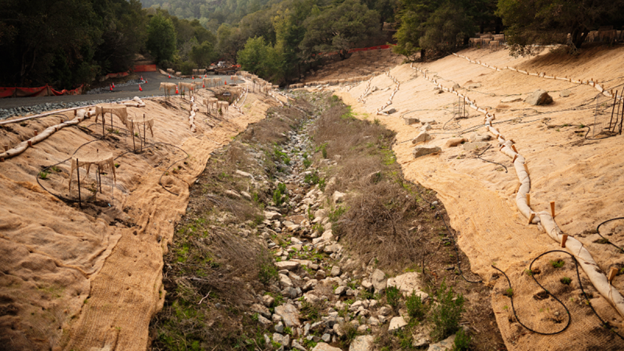
Stabilizing jute protects the creek’s soil while plants begin to grow in December 2022. Photo: EBRPD

The project (Alder Creek Project), which began construction in 2020, daylights, or opens up and restores to natural conditions, approximately 2,900 linear feet (approximately half a mile) of previously culverted, or buried, creek and restores riparian habitat along portions of Alder, Leatherwood, and San Leandro creeks. The 250-acre site is situated within a deep canyon of dense oak woodland at the bottom of a ridgeline of rolling grassland hills.

The restoration also created habitat for the rainbow trout (a native salmonid species) by creating stream corridors, using a step-pool system that incorporates a mix of cascades and resting and pocket pools in steeper areas. This newly created stream channel with riparian vegetation and pool riffle complexes, allows sediment transport, slows flows and helps reduce erosion to provide benefits to aquatic organisms and provide spawning sites for rainbow trout. In fact, a young-of-year (juvenile) rainbow trout was observed in the channel in spring 2021. Engineers designed the restoration project using fundamental concepts in fluvial geomorphology and engineering principles to meet the goal of creating a dynamically stable and self-maintaining creek channels that require a low level of adaptive management and maintenance practices.

Plants sprout along the newly daylighted creek in January 2023. Photo: EBRPD

The restoration project also increased the carbon sink, flood capacity on site, removed invasive species, enhanced habitat, and added revegetation. In support of inclusive public access, additional enhancement work included new nature trails and future amenity areas.

The restoration area within Sibley Volcanic Regional Preserve is now opened to the public. It includes an 11-car staging area along Pinehurst Road, with trail connections for a loop trail (the McCosker Loop Trail) and trails that follow the creeks on the property.

The project was made possible through $4 million in funding secured by Assemblymember Rebecca Bauer-Kahan in the 2019 state budget. Additional funding came from the Park District’s voter-approved Measure WW and other state and federal grants from the U.S. Environmental Protection Agency, CA Natural Resources Agency, Wildlife Conservation Board, Coastal Conservancy, California State Parks and voter-approved Propositions 1, 84 and 50 allocated by the California Natural Resources Agency.

Source: EBRPD

The Sibley Volcanic Regional Preserve and Eastport Staging Area are located at 920 Pinehurst Road in Orinda.

The East Bay Regional Park District is the largest regional park system in the nation, comprising 73 parks, 55 miles of shoreline, and over 1,330 miles of trails for hiking, biking, horseback riding, and environmental education. The Park District receives an estimated 30 million visits annually throughout Alameda and Contra Costa counties in the San Francisco Bay Area.
Allen D. Payton contributed to this report.

Filed Under: East Bay, Environment, Lamorinda, News, Parks, Recreation

California State Parks encourages visitors to recreate safely, responsibly during Memorial Day Weekend

May 22, 2024 By Publisher Leave a Comment

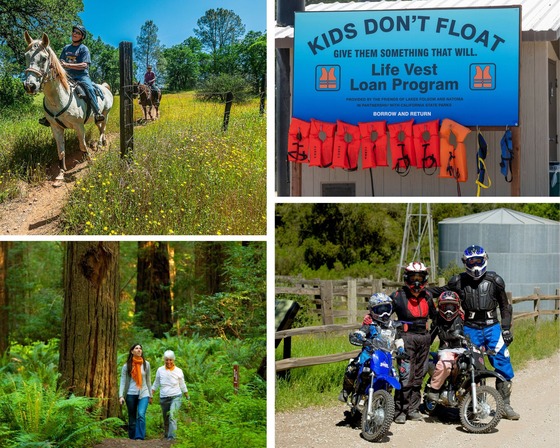
Photos from top left: Riders wear helmets while on horseback in Auburn State Recreation Area. Life jacket loaner programs are available in many state parks and other recreation areas. A family practices safe riding in Hollister Hills State Vehicular Recreation Area. Hiking with a buddy amongst the big trees on a trail in Humboldt Redwoods State Park. Source: CA Department of Parks and Recreation

SACRAMENTO, Calif. – California State Parks invites Californians and visitors from around the world to recreate responsibly during the upcoming Memorial Day weekend, one of the busiest outdoor holiday weekends of the year. California’s diverse landscape has recreational activities for everyone, from swimming in lakes, rivers, and oceans to hiking among giant redwoods or sequoias to off-highway vehicle riding in deserts and mountains to camping along the coastline. Following simple safety precautions, such as wearing a properly fitted life jacket or proper riding gear, avoiding alcohol, and knowing one’s limits while engaged in aquatic activities, can help save lives.

With 280 state parks, California State Parks manages over 340 miles of coastline, 970 miles of lake and river frontage, and 5,200 miles of trails. There are plenty of outdoor opportunities to spend time with family and friends, reconnect with nature and enjoy the benefits state parks offer to your mental and physical health. But keep in mind, preparing for recreational activities should include simple precautions for safe recreation.

Safety around water is important as people seek cool activities during hot weather, as demonstrated by this swimmer wearing a life jacket at Caswell Memorial State Park. ©2009, California State Parks photo by Brian Baer

Here are some helpful tips to stay safe during this holiday weekend:

  • Wear a Life Jacket Around Water: Water-related accidents can happen suddenly and rapidly. Make sure you and those with you wear properly fitting, U.S. Coast Guard-approved life jackets, especially children. Wearing a life jacket is the best way to increase your chances of survival during an incident. View locations where public agencies and private organizations offer to loan life jackets to the public.
  • Prepare an Itinerary: No matter what type of recreational activity you are planning, leave an itinerary of your trip with a family member or friend with information such as the names and ages of all participants, your travel destination, and your expected return date. This will provide law enforcement personnel with essential information if an emergency response may be needed.
  • Know Before You Go: Prior to leaving home, check the statusof the state park you want to visit to find out what current restrictions and guidelines are in place. Have a back-up plan in case your destination is crowded. On arrival, park only in designated spaces.
  • Check the Weather:
    • Plan activities based on temperatures throughout the day.
    • Dress in proper clothing for the activities you are planning.
    • Shield yourself from the sun with a hat, sunglasses, and sunscreen.
    • Drink plenty of water and avoid alcoholic and caffeinated fluids.
  • Protect Your Loved Ones Around Water:
    • Always supervise children by appointing a designated “water watcher,” taking turns with other adults. Never assume someone is watching your children.
    • Know your limits. Swimming in a lake, ocean, or river is different than swimming in a pool. Waves, tides, strong rip currents, and other water hazards can appear quickly and provide little time to act.
    • If someone is in distress, seek help from a lifeguard or call 9-1-1 if one is not available.
    • Obey posted warnings and swim in designated areas or near a lifeguard tower, if available.
  • Avoid Alcohol: Operating a recreational vehicle, including a boat or an off-highway vehicle (OHV), with a blood alcohol concentration (BAC) of 0.08% or more is against the law. Impaired boaters can be arrested even with a lower BAC if the conditions are not safe and your boat can be impounded. Some parks do have alcohol bans. Check each specific park website to determine if there are local ordinances concerning alcohol.
  • Ocean Rip Currents:If you get caught in a rip current, stay calm and do not fight the current. Swim or float parallel to the shore until you are out of the current and then swim toward the shore.
  • Learn the Rules of Recreating in Boats and OHVs: There are laws specific to operating OHVs on public lands and boats on California’s waterways. Learn about these laws by visiting the webpage of your state park destination. For boating laws, please visit com. OHV regulationsare also available to review online.
  • Trails: Whether you are hiking, horseback riding, or operating an OHV, stay on designated trails. This includes boardwalks in sensitive ecological areas. You are not only protecting natural resources, but also ensuring you do not get lost. Check with State Park staff or volunteers about trails best suited for your abilities. Make sure to hike with a buddy.
  • Leave No Trace: Leave areas better than you find them by packing out all trash. Put food waste and other waste in the bags until it can be disposed of properly. For human waste, the use of waste alleviation (WAG) gel bags or other portable toilet options is recommended. WAG bags can be safely disposed of in regular trash. Do not disturb wildlife or plants.

You can find additional safety tips and information on backpacking, biking, camping, horseback trails, and laws at parks.ca.gov/SafetyTips.

California State Parks is honoring the service of veterans, and active and reserve military members, by offering free admission to 143 participating state park units on Memorial Day – Monday, May 27, 2024. The list of participating park units can be found at State Parks Memorial Day 2024.

About CA State Parks

The California Department of Parks and Recreation, popularly known as State Parks, and the programs supported by its Office of Historic Preservation and divisions of Boating and Waterways and Off-Highway Motor Vehicle Recreation provide for the health, inspiration and education of the people of California by helping to preserve the state’s extraordinary biological diversity, protecting its most valued natural and cultural resources, and creating opportunities for high-quality outdoor recreation. Learn more at parks.ca.gov.

Filed Under: Holiday, News, Parks, Recreation, State of California

Parks district issues tick season advisory

May 22, 2024 By Publisher Leave a Comment

Source: EBRPD

It’s better to be ticked off than ticked on

By East Bay Regional Park District

Whether you’re hiking in East Bay Regional Parks, venturing into nearby open spaces, or simply relaxing in your own yard, it’s important to be wary of ticks, which are often present in tall grass, brush, and wooded areas. Visitors are encouraged to keep tick safety precautions in mind when visiting East Bay Regional Parks throughout the spring, summer, and fall seasons.

Ticks carry germs that can cause a number of diseases, including Lyme disease. Lyme disease is an infectious disease transmitted by the bite of a tick. It may be treated and cured with early diagnosis, but if not properly treated, it may persist in the body for years. Visit www.bayarealyme.org for more information.

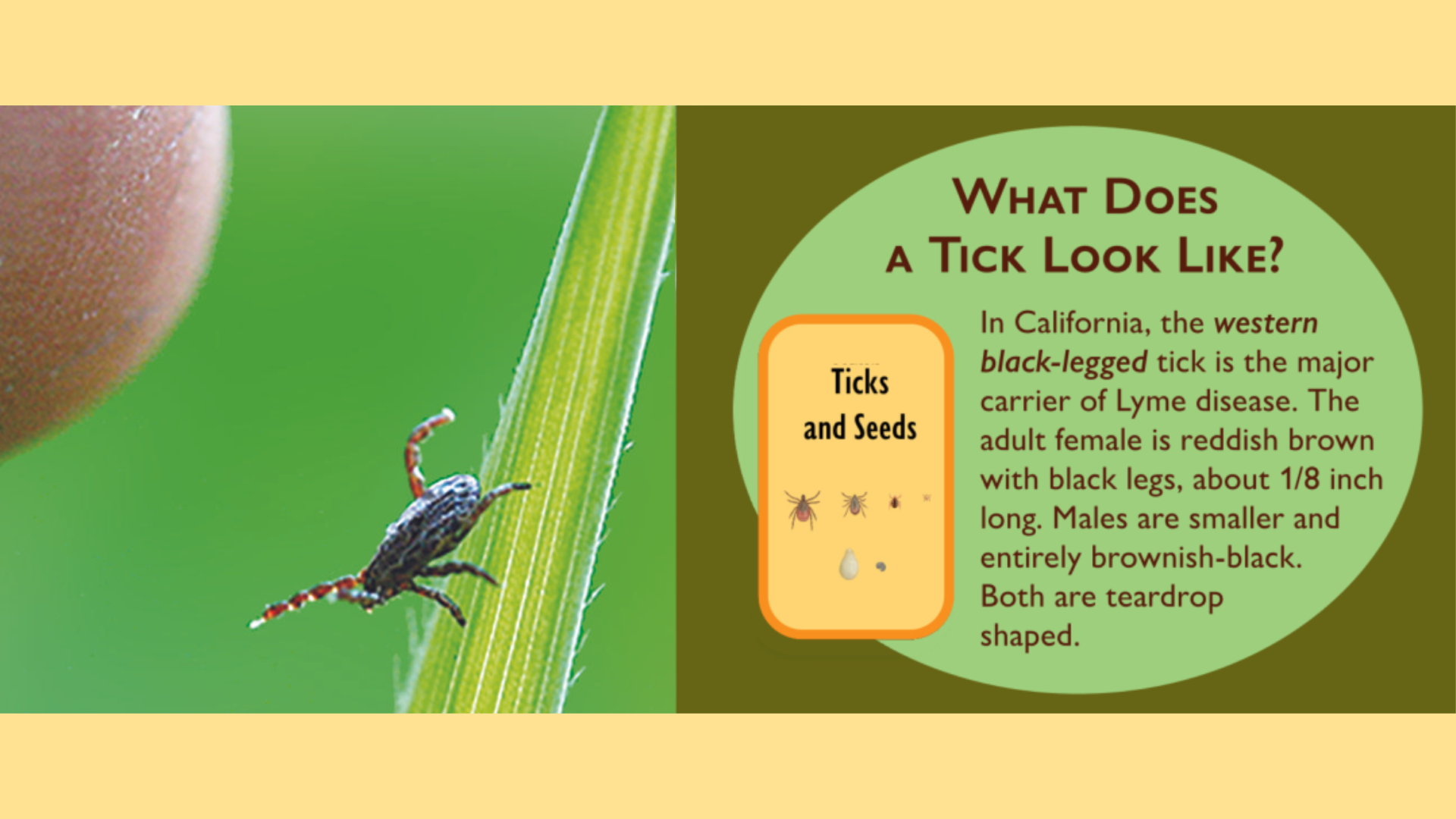
What Does a Tick Look Like? In California, the western black-legged tick is the major carrier of Lyme disease. The adult female is reddish brown with black legs, about 1/8 inch long. Males are smaller and entirely brownish black. Both are teardrop shaped. Most ticks can’t fly or jump. They wait on the tips of grasses and in shrubs along well-used paths. With their front legs outstretched, they easily climb aboard unsuspecting hosts when they brush by.

Tick Safety Tips

  1. Wear long pants, long sleeves, and closed-toe shoes.
  2. Tuck shirt into pants, and pants into socks.
  3. Use insect repellent on shoes, socks, and pants.
  4. Check yourself, your children, and your pets for ticks thoroughly and frequently.
  5. Keep children and pets nearby. For maximum safety, consider keeping your dog on a leash.
  6. Stay on trails. Avoid brush and grassy areas.

What To Do If Bitten By A Tick

  1. Pull the tick gently from the skin using a tissue or tweezers (not with bare hands).
  2. Scrape to remove any mouthparts left behind. An item such as a credit card can be used.
  3. Wash hands and the tick bite with soap and water; apply antiseptic to the bite. Prompt removal of ticks may prevent disease transmission.
  4. See a physician immediately if you think you have found a tick attached to your skin and you have any of the above symptoms. Early symptoms may include a spreading rash accompanied by fever, aches, and/or fatigue.

Download the Park District’s Living with Ticks brochure. Additional information is available at ebparks.org/safety/wildlife-encounters.

The East Bay Regional Park District is the largest regional park system in the nation, comprising 73 parks, 55 miles of shoreline, and over 1,330 miles of trails for hiking, biking, horseback riding, and environmental education. The Park District receives an estimated 30 million visits annually throughout Alameda and Contra Costa counties in the San Francisco Bay Area.
Filed Under: East Bay, News, Parks, Recreation

Park Happenings for March

March 2, 2024 By Publisher Leave a Comment

News from the East Bay Regional Park District

By Dave Mason, Acting Community Relations Manager, East Bay Regional Park District

Before logging in the mid-1800s, the East Bay had expansive redwood forests with huge trees. Ship captains sailing near the Golden Gate wrote about two redwoods at the top of a ridge in the Oakland hills that towered over others. At the time, they used the tall redwoods as landmarks to navigate their ships around the treacherous Blossom Rock, hidden just beneath the surface of the bay between Alcatraz and Yerba Buena Islands. Today, redwoods in the East Bay are mostly second and third-growth – still tall and magnificent.

Where you can see redwoods in the East Bay:

  • Tilden Regional Park, Berkeley– Walk the meandering paths through redwoods in the Regional Parks Botanic Garden.
  • Roberts Regional Recreation Area, Oakland– Walk Roberts Ridge Trail to find the Old Growth Redwood Heritage Viewing Deck and Interpretive Exhibit. Have a picnic in Redwood Bowl.
  • Reinhardt Redwood Regional Park, Oakland– Stroll past ferns and along Redwood Creek on the paved Stream Trail. You will see the descendants of the original Blossom Rock forest.

Source: EBRPD

March is Women’s History Month, a time to celebrate and honor the accomplishments and contributions of the groundbreakers and trailblazers who have improved and advocated for parks, nature, and the environment. There are two naturalist-guided programs scheduled that celebrate women in parks, including Wonderful World of Women Naturalists on Saturday, March 16, at 6:30 p.m. at Big Break in Oakley, and Bay Area Women in Botany on Sunday, March 17, at 9:00 a.m. at Huckleberry Botanic Regional Preserve in Oakland. Both programs are drop-in; no registration required. For more information or to learn more about the contributions of women to the Park District and its mission, visit the District’s Women’s History Month page at www.ebparks.org/we-celebrate/womens-history-month.

Special 90th Anniversary “Explore Your Parks” Adventure Programs

Explore nature at your own pace and in your own way at Big Break’s All Abilities Day on Tuesday, March 26, from 10 a.m. to 1 p.m. A special 90th Anniversary presentation will kick off the fun! This free drop-in program is inclusive and for all abilities, offering something for everyone. American Sign Language and Spanish interpreters will be on site.

Other March “Explore Your Parks” Adventure Programs include Day by the Water at Del Valle Regional Park in Livermore on Saturday, March 23, from 10:00 a.m. to 3:00 p.m., and 90th Anniversary Sunday Stroll and Picnic at Temescal Regional Recreation Area in Oakland on Sunday, March 24, from 9:30 a.m. to 11:00 a.m. For more information, visit the Park District’s 90th Anniversary webpage at www.ebparks.org/celebrating-90-years.

Spring Means Wildflower Season in Regional Parks

Each year, from the end of March to the beginning of May, a rich diversity of wildflowers bloom throughout the Regional Parks. Visit Sunol Wilderness Regional Preserve, Ohlone Wilderness Regional Preserve, or Black Diamond Regional Preserve, where the hillsides and meadows come alive with a kaleidoscope of colors, from the cheerful orange of California poppies to the delicate purple of lupines. These floral displays delight the eye and provide essential nectar for native pollinators like bees and butterflies. To see these impressive displays of flowers and celebrate the season, visit a park or join a variety of naturalist programs, including wildflower walks and hikes, videos, and art activities. For more information, visit www.ebparks.org/calendar and search “wildflowers.”

The East Bay Regional Park District is a major employer of youth in Alameda and Contra Costa counties, with seasonal employment opportunities ranging from lifeguards to park gate attendants. The Park District is a great place to work for those who care about parks, nature learning, and enjoy outdoor recreation. The District is currently hiring lifeguards, recreation leaders, interpretive student aides, public safety student aides, and student laborers/gate attendants. For more information, visit www.governmentjobs.com/careers/ebparks and search for “seasonal.”

The East Bay Regional Park District is the largest regional park system in the nation, comprising 73 parks, 55 miles of shoreline, and over 1,330 miles of trails for hiking, biking, horseback riding, and environmental education. The Park District receives an estimated 30 million visits annually throughout Alameda and Contra Costa counties in the San Francisco Bay Area.


Filed Under: East Bay, News, Parks

Impressive spring wildflower blooms anticipated in desert state parks

March 2, 2024 By Publisher Leave a Comment

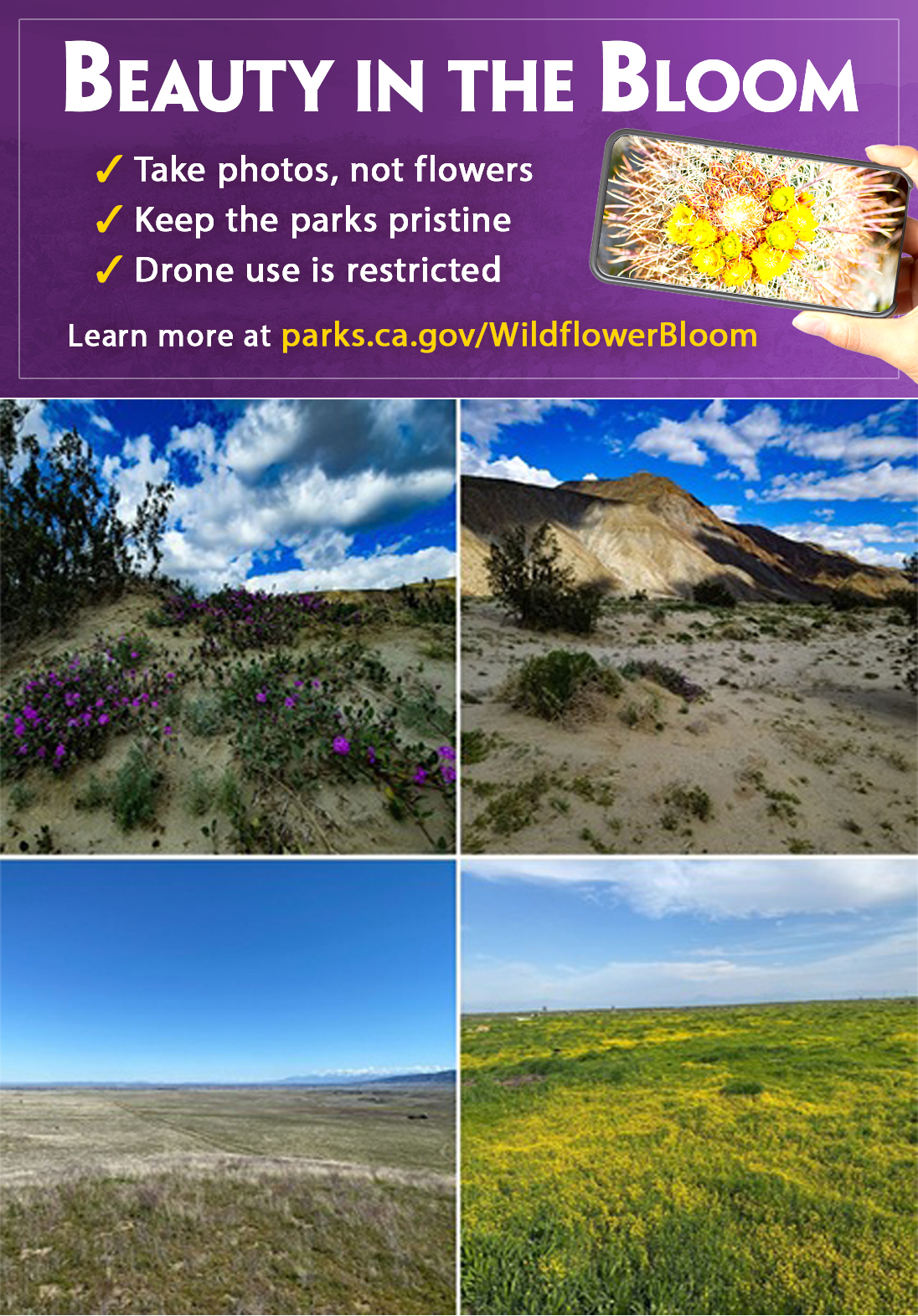
Cutline: Top: Current wildflower bloom at Anza-Borrego Desert SP. Bottom left: Sparse flowers are starting to show at Antelope Valley California Poppy Reserve State Natural Reserve (SNR). Bottom right: Goldfields currently adorn the Tule Elk SNR. Source: CA State Parks

Public asked to keep the beauty in the bloom by staying on designated trails and taking only photos, not flowers.

SACRAMENTO, Calif. – This spring, California’s desert state parks could potentially be adorned with a sea of rainbow colors as the wildflower season is expected to be an impressive one, and California State Parks is asking all visitors to enjoy them responsibly.

“In recent years, California has been lucky to see spectacular wildflower blooms in many public lands, including in state parks,” said State Parks Director Armando Quintero. “We welcome all Californians and visitors from around the world to experience this natural phenomenon and ask all to keep the ‘Beauty in the Bloom’ by staying on designated trails and taking only photos, not flowers.”

Current Bloom Situation

Depending on the park, visitors may see colorful lupine, coreopsis, desert sunflowers, evening or brown-eyed primroses, desert bells, desert poppies or desert lilies.

  • Anza-Borrego Desert State Park: Blooms are arriving in the heart of Borrego Springs along Henderson Canyon Road, the lower sandy dune portions of Coyote Canyon and in the southern portion of the state park along Highway S2 southeast of Agua Caliente County Park. Additionally, areas near June Wash moving northeast toward Fish Creek and Arroyo Tapiado are beginning to show the early bloomers like primrose, phacelia, and wooly sunflower. If moving south along the Highway S2, four-wheel-drive vehicles are recommended on any unpaved park road.
  • Antelope Valley California Poppy Reserve State Natural Reserve: Sporadic individual poppies are already starting to bloom. From mid-March to May, this park expects a variety of wildflowers to bloom. Poppies, fiddleneck, and red stem filaree have sprouted throughout the Poppy Reserve in large, dense quantities. Live updates from this park are available through the PoppyCam live feed. If the weather remains mild, the bloom is expected to be better this year compared to last year. If the weather turns hot, this could affect the bloom in the next few months.
  • Red Rock Canyon State Park, Eastern Kern County Onyx Ranch State Vehicular Recreation Area, Chino Hills State Park, Hungry Valley State Vehicular Recreation Area, Fort Tejon State Historic Park: These parks are expected to have good wildflower blooms from mid-March to May, and into the spring season.

Detailed information, in Spanish and English, on this year’s potential wildflower blooms and park rules is available at parks.ca.gov/WildflowerBloom.

Recreate Responsibly

For those wishing to visit areas where the blooms are popping, State Parks is providing visitors with tips on how to explore safely and responsibly, especially in the desert parks where the landscapes may have changed due to recent storms.

Understand the Area

  • Cell coverage can be spotty or nonexistent in some parks—be prepared.
  • Read about your state park destination online and download a map prior to your visit, especially if you are visiting a desert. Many GPS and map apps will take you to dirt roads requiring four-wheel drive vehicles.
  • Know your vehicle’s limits. Know which areas allow off-highway vehicle recreation.
  • Visit the parks during the week and arrive early to beat the crowds.
  • Remember to pull off the roadway when viewing wildflowers, wildlife or to take photos. Please leave roadways clear for vehicle traffic.
  • Leave an itinerary of your trip with a family member or friend with information such as time of departure and expected return, site visit location and names of everyone in your group. This will ensure law enforcement personnel have a better understanding of your location in the event of a rescue.

Check the Weather

  • While planning your trip, check weather conditions. Be prepared and plan for all types of weather.
  • Make sure your equipment and clothing are appropriate for the expected weather.

Respect the Landscapes

  • Each park has unique landscapes. Stay on designated trails whenever possible. Tread lightly in the desert. Do not trample flowers.
  • When viewing the blooms, take only pictures. Flower picking is prohibited.
  • If dogs are permitted, they must remain on leash, on designated roads, in campgrounds and in picnic areas. Dogs are not allowed on hiking trails, in the backcountry or in the wildflower fields. Do not leave dogs unattended in your vehicles—temperatures can reach lethal levels.
  • Drone use may be prohibited. If drone use is allowed, a filming permit from individual state park units must be requested.
  • Help keep the landscapes pristine, leaving it better than when you arrived by packing out anything you packed in—pack it in, pack it out.

Know Your Body Limitations

  • Bring plenty of food and water. There are often no restaurants, gasoline stations or stores near the bloom areas.
  • Drink plenty of water prior to your visit to remain hydrated and avoid heat-related emergencies.
  • Outdoor conditions can change quickly, especially in the desert. Bring sunscreen, a hat, layers of clothing and closed-toe shoes to avoid injury.
  • Walk at a pace that allows you to talk easily. If you are too out of breath to speak, you are probably working too hard. Take a rest or stop exercising.
  • In the event of an emergency, call 911.

Background

In 2017, 2019 and 2023, wildflowers carpeted state parks like Antelope Valley California Poppy Reserve SNR, Anza-Borrego Desert SP and Ocotillo Wells State Vehicular Recreation Area (SVRA), attracting hundreds of thousands of people from around the world to view this rare occurrence in nature. These wildflower blooms vary from year to year based on multiple factors: Precipitation levels, the timing of that precipitation, amount of sunlight, humidity levels and seasonal temperature patterns can all affect both the bloom timing and number of flowers seen across the region. Since California was fortunate to receive more rain last fall and this winter, public land managers are expecting a “good” to “better-than-average” wildflower blooms in spring, depending on the continued weather conditions.

Filed Under: News, Parks, State of California

California State Parks releases Strategic Plan to further strengthen system, recreational programs

February 13, 2024 By Publisher Leave a Comment

Source: CA State Parks

SACRAMENTO, Calif. — The California Department of Parks and Recreation (State Parks) has developed a five-year strategic plan to help shape the future direction of the state park system and the many recreational and conservation programs that serve California’s communities.

Named Path Forward, the strategic plan aligns with Governor Gavin Newsom’s Equity Executive Order N-16-22, 30X30 and Outdoor Access for All initiatives and will guide State Parks in strengthening operations to focus on key priorities and directing energy and resources toward meeting the goals and objectives. The themes, goals, and objectives in the plan are based on the foundational elements of access, inclusivity, and equity to provide optimal public service, strengthen partnership development, and empower the department’s workforce.

“The Path Forward strategic plan is about resilience and focusing on how we prepare the department for the century ahead,” stated State Parks Director Armando Quintero. “California needs these natural and cultural resources for everyone’s wellbeing. State Parks leadership, employees, and partners are committed to caring for your California. This is where you live.”

An employee workgroup composed of more than 100 frontline staff, managers, and supervisors representing all field regions, headquarters, and all program areas, was assembled to develop the Path Forward Plan. The vision, themes, goals, objectives, and core values were created and refined over several virtual meetings and reviewed by a partner and stakeholder advisory committee, employees, commissions, and executive staff along the way.

The input and perspective of stakeholders and partners helped to inform the final version of the plan and to ensure that the future of State Parks reflects the diverse experiences and priorities represented in the State of California.

Two factors set Path Forward apart from previous change efforts. Department staff from all levels developed the plan with input from partners, rather than an executive team taking a top-down approach. The second factor will begin in winter 2024 and involves an actionable implementation plan led by a committee made up of key leaders representing all program areas. The implementation plan includes interdisciplinary teams to carry out and manage projects tied to the goals and objectives of the plan. These teams will use a designated project management tool to develop specific plans, timelines, and evaluation metrics to achieve each goal. The teams will provide regular progress and status updates.

By using this strategic plan as a guide, a course of action has been developed to support State Parks in meeting challenges. The plan will also create new strategies for institutional growth and optimization.

With 280 park units, California’s State Park System is a world-class network of incomparable lands, waters, and features vitally important to the well-being of the state’s environment, economy, and people. State Parks manages these precious natural and cultural resources while providing hundreds of recreational and conservation programs and services for millions of Californians and visitors from all over the world.

The Path Forward Plan is available in English and is translatable to several other languages at parks.ca.gov/PathForward.

Filed Under: News, Parks, State of California

East Bay parks district adds 20 new trails for annual Trails Challenge program

January 24, 2024 By Publisher Leave a Comment

By Jen Vanya, Public Information Specialist, East Bay Regional Park District 

For the past 31 years, the East Bay Regional Park District has encouraged the public to explore their Regional Parks through its annual Trails Challenge program. The free program connects people with nature and healthy recreation by providing 20 designated trails for each year’s challenge.

The 2024 Guidebook includes 20 trails available for all levels of fitness, ranging from easy and moderate to challenging. There are trails open to hikers, bicyclists, dogs, and equestrians. Trails Challenge 2024 also offers increased accessibility with trails that have been evaluated and identified as usable by persons with mobility limitations.

To complete the challenge, hike five of the 20 trails, or 26.2 miles (the distance of a marathon) of trails within East Bay Regional Park District. You can submit your log, online or by mail, by December 1, 2024, and receive a commemorative pin, while supplies last.

Trails Challenge is made possible in partnership with the Regional Parks Foundation and Kaiser Permanente, who have both sponsored Trails Challenge since 2005.

Download the 2024 Trails Challenge and learn more at ebparks.org/TC.

Tips for the Trails

East Bay Regional Parks are popular with hikers, bikers, equestrians, and nature viewers, among others. Help keep trails enjoyable for all by following these tips for the trails:

  • Hikers:Stay to the right and stay alert
  • Bikers:Slow down around others and call out or ring your bell when passing
  • Equestrians:Keep to the right around other trail users and let them know how to pass your horse safely

More tips for trail safety can be found on our Trails are for Everyone webpage: www.ebparks.org/about-us/whats-new/news/trails-are-everyone.

The East Bay Regional Park District is the largest regional park system in the nation, comprising 73 parks, 55 miles of shoreline, and over 1,300 miles of trails for hiking, biking, horseback riding, and environmental education. The Park District receives an estimated 30 million visits annually throughout Alameda and Contra Costa counties in the San Francisco Bay Area.
Filed Under: East Bay, News, Parks, Recreation

Park Happenings for January

January 19, 2024 By Publisher Leave a Comment

News from the East Bay Regional Park District

By Dave Mason, Public Information Supervisor, East Bay Regional Park District

Welcome to the East Bay Regional Park District’s 90th Anniversary year. Established in 1934, the Park District has grown to be the largest regional park district of its kind in the nation, with 73 regional parks available for hiking, biking, swimming, horseback riding, boating, fishing, picnicking, camping, and nature discovery. Wherever you live in the East Bay, there is a beautiful regional park close to you.

We will be hosting numerous special events and programs throughout the year to commemorate our anniversary, including a community birthday celebration on May 11 and monthly naturalist-led “Explore Your Parks” adventure programs. Join us for the next “Explore Your Parks” adventure program, Community Science Bio Blitz at Sunol Wilderness Regional Preserve in Sunol on Saturday, January 27, from 10:00 a.m. to noon. For more information about the Park District’s 90th Anniversary, including events and activities, visit www.ebparks.org/celebrating-90-years.

The East Bay Regional Park District’s 2024 Trails Challenge program is underway, offering 20 new trails for the new year. In its 31st year, the annual Trails Challenge program encourages the public to explore and enjoy their Regional Parks. The free guide provides 20 designated trails for all levels, ranging from easy and moderate to challenging and is open to hikers, bicyclists, dogs, and equestrians. The 2024 Trails Challenge program also offers increased accessibility with trails that have been evaluated and identified as usable by persons with mobility limitations. The trail guide is available online at www.ebparks.org/TrailsChallenge

To complete the challenge, hike five of the 20 trails, or 26.2 miles (the distance of a marathon) of trails within the East Bay Regional Park District. The Trails Challenge program is made possible with help from the Regional Parks Foundation and Kaiser Permanente. To get started, visit www.ebparks.org/TrailsChallenge.

Celebrate the fruits of winter at the Tilden Fungus Fair! View hundreds of local mushroom specimens, mingle with the mycological community, and enjoy presentations by guest speakers at this two-day special event, Saturday, January 20, and Sunday, January 21, from 10:00 a.m. to 4:30 p.m. at Tilden Nature Area. For more information, visit www.ebparks.org/events/tilden-fungus-fair.

Black Diamond Mines has begun offering weekend Mining History Tours and Hazel-Atlas Mine Tours again, in addition to their Coal Mine Experience tours. From the mid-1920s to the mid-1940s, the Hazel-Atlas Mine produced silica sand to make jars, bottles, and other glass items. Tour participants can now take a walk into the mine to see mine workings, ore chutes, the shifter’s office, and ancient geological features. For safety reasons, you may tour the mine only as part of a guided tour, and all participants must be at least seven years old. For more information, visit www.ebparks.org/calendar and search “Mine Tours.”

Water’s Amazing Journey at Coyote Hills! Water surrounds Coyote Hills, but where does it come from, and where does it go? In winter, we expect rain to fall from the clouds (precipitation) and land on mountains, lakes, and rivers. Some of this water is soaked up by plants and seeps into the ground, replenishing groundwater. Explore the Coyote Hills watershed, discover where your water comes from, and learn how we are connected and responsible for our watersheds at the Water, Water, Everywhere program on Saturday, January 27, from 10:30 a.m. to noon at Coyote Hills Visitor Center. For more information, visit www.ebparks.org/calendar and search “Water, Water, Everywhere.”

The East Bay Regional Park District is the largest regional park system in the nation, comprising 73 parks, 55 miles of shoreline, and over 1,330 miles of trails for hiking, biking, horseback riding, and environmental education. The Park District receives an estimated 30 million visits annually throughout Alameda and Contra Costa counties in the San Francisco Bay Area

Filed Under: East Bay, News, Parks

  • « Previous Page
  • 1
  • …
  • 4
  • 5
  • 6
  • 7
  • 8
  • …
  • 15
  • Next Page »
Monicas-11-25
Deer-Valley-Chiro-06-22

Copyright © 2026 · Contra Costa Herald · Site by Clifton Creative Web