• Home
  • About The Herald
  • Local Agencies
  • Daily Email Update
  • Legal Notices
  • Classified Ads

Contra Costa Herald

News Of By and For The People of Contra Costa County, California

  • Arts & Entertainment
  • Business
  • Community
  • Crime
  • Dining
  • Education
  • Faith
  • Health
  • News
  • Politics & Elections
  • Real Estate

Frazier’s “Jeff Belle bill” on candidate accountability passes Assembly committee

May 12, 2017 By Publisher Leave a Comment

Increases maximum fine from $1,000 to $10,000

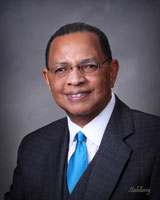
Jeff Belle, source Contra Costa County Board of Education

Sacramento, CA – On Wednesday, May 10th, legislation by Assemblymember Jim Frazier (D – Discovery Bay) that will raise penalties for candidates for office who make willful misrepresentations on their candidate statements passed the Assembly Elections committee on an unanimous 7-to-0 vote.

“We can’t allow candidates to dupe the voters…to lie their way into office when tax dollars or the education of our children are at stake,” Frazier stated. “When the public’s trust is in question, the public deserves to know the truth when reading an official candidate statement. This bill holds candidates accountable by increasing the fine for any willful misrepresentation.”

AB 894 would increase the current fine for a willful misrepresentation in a candidate statement to $10,000. The current fine is set at a maximum of $1,000, which has not been an effective deterrent and has not kept up with inflation.

In August 2015, the Contra Costa District Attorney filed a suit in court, The People of the State of California vs. Jeffrey Belle, against a candidate for the Contra Costa Board of Education for knowingly making a false statement of fact in a candidate statement with the intent to mislead voters. In this particular case the candidate falsified his education credentials, his residence, and his criminal record. Instead of a punishment including a fine, he received only entry into a diversion program for offenders, despite the injustice perpetrated upon the voters. Anecdotal evidence suggests that this remains a problem in other jurisdictions.

AB 894 now heads to the Assembly Floor.

Filed Under: Crime, Legislation, News, Politics & Elections

Sen. Glazer explains vote against transportation bill, gas tax hike

April 7, 2017 By Publisher 1 Comment

Cites failure to ensure reliable transit & ineffective use of funds

Senator Steve Glazer (D-Orinda) who represents most of Contra Costa County in the California State Senate, issued the following statement today, regarding his vote against SB-1, the transportation funding bill which included a 12 cents per gallon gas tax increase, as well as increases to the Vehicle License Fee. He was the only Democrat in the Senate and only one of two in the entire legislature to vote no.

“I want to thank Senate President Pro Tem Kevin de León, Sen. Jim Beall and Gov. Jerry Brown for their hard work in addressing the problem of crumbling roads and aging transportation systems.

My constituents are particularly dependent on good roads and highways and reliable transit systems, so I agree we need additional transportation investments.

But this transportation package did not have the support of my district, for good reasons. Even after a multi-million dollar lobbying effort supporting the $52 billion bill, sentiment in my district ran two-to-one opposing these new gas taxes and car registration fees.

My constituents have told me loud and clear that they want any new taxes to be spent more wisely and effectively. For instance, it doesn’t make sense to spend billions of dollars on an unpopular High Speed Rail system that backers claim might be completed by 2029 when it could go for transportation improvements today.

Beyond the issues of setting better spending priorities and taxes, I also believed this bill could have been improved. We need to be more forward thinking, where we recognize the role technology can play in allowing us to use our roads and highways more efficiently.

And we need a plan that provides commuters with the confidence and assurance that reliable transit will be there for them every day of the year.

This bill also failed to ensure that any new transportation funding given to local transportation agencies be used only for the purposes intended and not diverted to other uses.

I was also concerned about last-minute amendments to this bill that the environmental community and air quality regulators say will unwisely limit our ability to control diesel pollution from trucks. These changes have never been fully vetted and deserve more scrutiny.

I look forward to continued discussions with the governor in which we take into account the need to modernize our approach to transportation in an efficient and reliable manner.”

The bill passed both the State Senate and Assembly and awaits the signature of Governor Brown. To learn more about the bill, click here.

Filed Under: Legislation, News, Taxes, Transportation

Following planned sale of Richmond Post Office, DeSaulnier offers amendment to Postal Reform Bill

March 23, 2017 By Publisher Leave a Comment

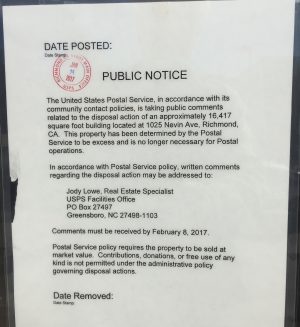
Closure notice on window of Nevin Avenue Post Office in Richmond. Photo courtesy of Richmond Standard

In January, a note was posted on the Richmond Main Post Office window announcing the building would be sold and the post office closed, according to an article by the Richmond Standard. Augustine Ruiz, a USPS spokesperson, confirmed the planned closure. The post office is located at 1025 Nevin Avenue.

In response, a measure authored by Congressman Mark DeSaulnier (CA-11) was unanimously adopted by the Oversight and Government Reform Committee as a part of the bipartisan Postal Service Reform Act (H.R. 756), which has been years in the making. Congressman DeSaulnier’s amendment would require the United States Postal Service (USPS) to provide Congressional offices with at least 10-days of advance notice regarding any closure, sale, movement, or reduction of operations of a post office in their district. H.R. 756 is expected to be voted on in the House of Representatives in the near future. This amendment, which was praised by both Chairman Jason Chaffetz (R-UT) and Ranking Member Elijah Cummings (D-MD) along with other Republican and Democratic members of the committee, was the only modification included to this landmark piece of legislation in the markup.

“Currently there is no requirement for USPS to notify Members of Congress when changes to a postal facility are made in their district. I discovered this missing link in January when residents from Richmond saw a notice posted on the door of the Nevin Avenue Post Office, but USPS had not advised my office of the pending sale,” said DeSaulnier.

“USPS has an obligation to keep Congress updated on any plan to sell, close, or alter facilities and operations so Congressional representatives can share this information with their constituents. Proper and expedient notification is critical as the comment period for the public to share thoughts and concerns is 15-days for the sale of a building and 60-days for a full postal closure. USPS is responsible for processing and delivering over 500 million pieces of mail a day and changes in operations can negatively impact people and businesses. My amendment will help ensure the public has advance notice to make their voices heard,” he concluded.

“Residents here and across the country care about the decisions made by the federal government that impact important local community facilities,” said Richmond Mayor Tom Butt. “I was shocked to learn about the proposed closure of the historic downtown post office over social media without having been notified by the postal service. Residents expect federal and local government officials to coordinate to avoid significant impacts; this measure does just that. Congressman DeSaulnier took the steps needed to ensure transparency around important postal service decisions. We are thankful for the Congressman’s leadership to pass this measure and represent the community’s best interests.”

Allen Payton contributed to this report.

Filed Under: Government, Legislation, News

McNerney introduces bill to strengthen Internet of Things security, protect consumers

March 3, 2017 By Publisher Leave a Comment

Washington, D.C. – On Thursday, March 2, 2017, Rep. Jerry McNerney (CA-09) introduced H.R. 1324, the Securing IoT Act, which requires that Internet of Things (IoT) devices be certified to be in compliance with cybersecurity standards. The bill directs the Federal Communications Commission, in consultation with the National Institute of Standards and Technology, to develop standards that address cybersecurity throughout the lifecycle of the IoT device.

“The proliferation of IoT devices creates immense opportunities for our society, including new jobs and efficiencies in all aspects of our everyday lives. However, the security of these devices has not kept up with the rapid pace of innovation and deployment,” said Rep. McNerney. “Security vulnerabilities in IoT devices are likely to pose threats to our national security and endanger our nation’s economy. This is especially concerning given that at least 20 billion devices are anticipated to be in use by 2020. My legislation, the Securing IoT Act, helps to address this issue by requiring that security standards be established for IoT devices and that these devices be certified to meet those standards. The legislation will help strengthen this market and protect consumers, business, and all the benefits that IoT devices offer.”

Last fall, McNerney raised concerns about the distributed denial-of-service attack on Dyn’s servers, which resulted from security weaknesses in IoT devices, and he joined his Democratic colleagues on the House Energy and Commerce Committee in calling for a hearing to examine the matter.

Filed Under: Legislation, News

Three Congressmen to host joint town hall meeting in Martinez, Saturday

February 16, 2017 By Publisher Leave a Comment

Congressmen Mark DeSaulnier (CA-11), Mike Thompson (CA-5) and Jerry McNerney (CA-9) who each represent  portions of Contra Costa County in the U.S. House of Representatives, will host a joint town hall meeting in Martinez, this Saturday, February 18 from 10:30 a.m. to 12:00 p.m. The special topic will be Protecting the Affordable Care Act (Obamacare), Medicare and Medicaid.

Those who attend will hear a presentation and legislative update. Constituents will also have an opportunity to ask questions and share thoughts on key policy issues and actions taken by the new Administration.

Joint Town Hall with Representatives DeSaulnier (CA-11), Thompson (CA-5) and McNerney (CA-9)

Special Topic: Protecting the Affordable Care Act, Medicare, and Medicaid
Saturday, February 18, 2017

10:30 a.m. to 12:00 p.m.

County Board of Supervisors Chambers, Room 107

651 Pine Street

Martinez, CA 94553

Filed Under: Government, Legislation

Glazer introduces $2 billion bond bill to improve facilities at CSU, UC campuses

February 16, 2017 By Publisher Leave a Comment

Sacramento, CA – For the first time in more than a decade, California voters would have the opportunity to approve higher education bonds to improve facilities on California State University and University of California campuses under legislation introduced Thursday by joint authors Sens. Steve Glazer, D-Orinda, and Ben Allen, D-Santa Monica.

The bill, SB 483, would authorize the statewide sale of $2 billion in general obligation bonds earmarked for higher education facilities at CSU and UC campuses. The bonds would go before voters in the 2018 general election.

“For many generations, California taxpayers have been proud supporters of the greatest higher education system in America,” Glazer said. “Unfortunately, we have allowed classrooms and libraries to deteriorate, affecting our ability to educate our students. Without public support, the burden of financing facilities will be borne by students and their families through higher tuition and fees.

The most recent such bond, which provided $1.6 billion to improve higher education facilities at CSU and UC, was approved by voters in 2006. All those funds have since been depleted. The last higher education-specific bond was passed in 1994.

“California’s public colleges and universities are a source of great pride to our state, but unfortunately we’ve allowed their physical facilities to fall into disrepair,” said Allen, who chairs the Senate Education Committee. “This bond measure will provide a much-needed and overdue investment in our higher education infrastructure.”

According to CSU and UC, the two systems have capital needs of $7 billion and $10 billion, respectively, for short-term and long-term projects. The CSU and UC are able to provide their own funding for some construction programs through system-wide revenue bonds, though only half of their capital needs are met.

“We appreciate Senator Glazer’s work to secure funding for necessary repair and replacement of aging higher education buildings and infrastructure,” said CSU Chancellor Timothy P. White. “More than $2 billion in deferred maintenance – due to lack of investment during the previous recession – left our campuses vulnerable to potential failures of critical systems. Safe and up-to-date classrooms, research labs and work spaces are essential to the success of our students, faculty and staff.”

SB 483 would require universities or colleges to submit five-year capital outlay plans that prioritize seismic retrofitting needed to reduce seismic hazards in buildings identified as high priority.

David Lopez, president of the California State Student Association, said the legislation addresses the issues about needed classroom repairs that students have been talking about for years.

“We keep hearing stories of students in classrooms that need major repair,” Lopez said. “Buildings that need to be closed for safety reasons. Our campus infrastructure needs have never been greater than they are today.”

Spending choices will emerge through recommendations from governing boards for both CSU and UC systems and will be reviewed in public hearings during the legislative process, Glazer said.

“The state has failed to provide the funds needed for public higher education faculty, student services and infrastructure,” said Mel Levine, Co-chair of the California Coalition for Public Higher Education. “We can’t take in more California students without restoring and improving our classrooms and labs.”

Last November, voters approved Proposition 51, a $9 billion education facilities bond, but did not include any money for the CSU or UC.

“This measure provides important financial backing for critical upgrades to our libraries and classrooms on college campuses,” Glazer added. “And I believe voters should be given a chance to continue the proud legacy of supporting our universities and colleges.”

A December 2016 survey on higher education by Public Policy Institute of California showed broad support – 65 percent – for higher education construction projects. It represented an 11 percentage point increase in support since December, 2014 and was the highest level of support since PPIC first began asking the question in 2007. http://www.ppic.org/content/pubs/survey/S_1216MBS.pdf

Filed Under: Education, Legislation, News

New bill to combat understaffing in California dialysis clinics, 15 in Contra Costa County

February 16, 2017 By Publisher Leave a Comment

By Sean Wherley

State Sen. Ricardo Lara (D-Bell Gardens) introduced legislation, on Wednesday, to improve staffing at more than 550 dialysis clinics in California.

SB 349, the Dialysis Patient Safety Act, would mandate annual inspections of dialysis clinics and safer staffing levels. Current law requires inspections of dialysis clinics every six years, while nursing homes in California must be inspected every year, and hospitals every two years.

This legislation would affect 15 dialysis clinics in Contra Costa County: three each in Antioch and Walnut Creek; two each in Pittsburg and San Pablo; and one each in Brentwood, Concord, El Cerrito, Pleasant Hill and Richmond.

“Dialysis patients are grandparents, children and siblings not numbers on a balance sheet,” said Lara. “It’s time to fix the dialysis industry and improve patient care for the more than 63,000 Californians who rely on this life-saving treatment in clinics daily.”

Dialysis is necessary for people with kidney failure, who must have their blood removed, cleaned, and put back into their bodies. A typical treatment lasts three hours, and must be conducted three days a week for the rest of the patient’s life.

The two largest dialysis corporations – DaVita and Fresenius – make $2.9 billion a year in profits from their dialysis operations in the United States, but workers say the companies pocket the money rather than improve patient care or provide adequate staffing in their clinics.

Dialysis workers regularly report staffing levels so low that it threatens patient care. One worker cited an incident last March at a dialysis clinic in Anaheim, Calif. in which a patient collapsed in the parking lot. The worker said it could have been prevented if more staff were onsite at the time. Seven states already have minimum staffing levels in dialysis clinics: Georgia, Maryland, Massachusetts, Oregon, South Carolina, Texas and Utah.

Dialysis workers in California have been organizing into a union, SEIU-United Healthcare Workers West (SEIU-UHW), for safer working conditions and stronger worker and patient protections. To learn more about the campaign, visit www.morethannumbers.org.

Wherley is the Media Relations Specialist with SEIU-United Healthcare Workers West.

Filed Under: Health, Legislation, News

Frazier introduces bill to reduce teen driving accidents

December 14, 2016 By Publisher Leave a Comment

Sacramento, CA – Today, Assemblymember Jim Frazier (D – Oakley) introduced AB 63, legislation to reduce vehicle collisions and fatalities among teen drivers by strengthening California’s provisional driver’s license program.

“This bill will help significantly decrease accidents among newly licensed drivers,” stated Frazier. “Increasing the age for a provisional license will ensure that California’s most vulnerable motorists go through proper training to become safe, responsible drivers.”

AB 63 would increase the maximum age to receive a provisional license to 21 years old guaranteeing that less experienced drivers have appropriate protections during this crucial learning period, by amending Section 12814.6 of the California Vehicle Code.

According to the Legislative Counsel’s Digest, “The bill would expand the scope of the provisional licensing program by extending the applicable age range for the program to 16 to under 21 years of age. By expanding the scope of the provisional licensing program, the violation of which constitutes an infraction, the bill would impose a state-mandated local program. The bill would authorize a licensee who is 18, 19, or 20 years of age to keep in his or her possession a copy of his or her class schedule or work schedule as documentation to satisfy the exceptions for a school or school-authorized activity and employment necessity, respectively, and would provide that a signed statement by a parent or legal guardian is not required if reasonable transportation facilities are inadequate and the operation of a vehicle by a licensee who is 18, 19, or 20 years of age is necessary to transport the licensee or the licensee’s immediate family member. The bill would make other technical and conforming changes. The bill would also include specified findings and declarations.”

“We are thankful that Assemblymember Frazier has taken on this critically important issue,” said Doug Villars, President of the California Association of Highway Patrolmen. “Traffic collisions are the number one killer of young people in America. We are proud to be sponsors of this bill and look forward to working together toward a common goal—saving young drivers’ lives and making roadways safer for all of us.”

It is estimated that one in three drivers do not receive their license before the age of 18, making them ineligible to participate in the provisional license program. A recent report from the Governors Highway Safety Association discovered that improvement in fatal crash rates among 18- to 20-year-old drivers was far less than their 15- to 17-year-old counterparts.

Policy expanding this program is essential to building safe driving skills for this at risk population. “We applaud Assemblymember Frazier for introducing this vital legislation,” stated Cathy Barankin, Executive Director CA Coalition for Children’s Safety and Health. “First time teen drivers are 45 percent more likely to be involved in a vehicle crash. This bill will stop teens from prematurely losing their lives.”

To read the complete text and Legislative Counsel’s Digest of the bill, click here.

Filed Under: Legislation, News, Transportation, Youth

McNerney’s bipartisan bill to improve broadband access for veterans passes House

December 10, 2016 By Publisher Leave a Comment

Senators Blumenthal, Booker applaud passage, introduce companion bill

Earlier this week, the U.S. House of Representatives passed Congressman Jerry McNerney’s (D, CA-09) bipartisan bill, H.R. 6394, the Improving Broadband Access for Veterans Act of 2016.  Congressman Adam Kinzinger (D, IL-16) was the lead Republican co-sponsor. A companion bill has been introduced in the U.S. Senate by Senator Richard Blumenthal (D-CT) and Senator Cory Booker (D-NJ).

“Having broadband internet service is important for the more than 20 million veterans across our nation, with the highest population residing in California,” said McNerney. “A broadband internet connection helps veterans apply for jobs more easily, communicate with family and friends, keep up with current events, and obtain health care services. Veterans face many challenges when they return home; being without broadband access should not be one of those challenges. I commend my colleague Rep. Kinzinger for his efforts on this bill and the House for passing it with overwhelming support.”

Low-income veterans and veterans residing in rural areas are at a higher likelihood of not having broadband internet service. The U.S. Census Bureau and the Pew Research Center both report that broadband adoption rates are significantly lower among Americans who live at or below the federal poverty level. Analysis by the National Telecommunications and Information Administration at the U.S. Department of Commerce further finds that broadband adoption rates in rural areas of the country are lower than in urban areas

H.R. 6394 directs the Federal Communications Commission to produce a report examining the current state of broadband internet access for veterans and what can be done to increase access, with a focus on low-income veterans and veterans residing in rural areas. The report must include findings and recommendations for Congress and be completed within one year of the bill’s enactment.

“The findings and recommendations from this report will be key for paving the way to get more veterans connected and help close the digital divide,” McNerney added.

“I am proud to co-lead H.R. 6394, which aims to improve broadband access for our veterans – especially those in rural areas, or those unable to afford it. After serving tirelessly to protect our country, veterans face many challenges when they return home. This bill is the first step towards alleviating one piece of the transition back into civilian life through the benefits afforded by broadband access – from connecting with family and friends, applying for jobs, accessing information on benefits and health services, and much more. Thanks to Congressman Jerry McNerney for working with me to introduce this legislation.” said Rep. Kinzinger.

H.R. 6394 passed the House by 411-4.  A companion bill, S. 3501, has been introduced by Senators Blumenthal and Booker.

“This important legislation will bring to light the key hurdles hindering veterans’ access to broadband, and pave the way for meaningful action to ensure veterans have the information and tools they need to successfully navigate the transition from the armed services to civilian employment. Access to broadband is essential to conduct daily activities, pursue job and housing opportunities, obtain quality health care services, and stay in touch with family members,” said Blumenthal.

“In the digital age, broadband access is not a luxury — it’s a necessity. The Improving Broadband Access for Veterans Act will help close the digital divide and will ensure that the men and women who have sacrificed so much for our country have access to tools for communication and future success,” said Booker.

McNerney represents California’s 9th Congressional District that includes most of Antioch and other portions of Contra Costa and Sacramento Counties, and most of San Joaquin County. For more information on Rep. McNerney’s work, follow him on Facebook and on Twitter @RepMcNerney.

Filed Under: East County, Legislation, Technology, Veterans

Frazier introduces new transportation funding bill, AB1, with 6.7% gas tax, vehicle registration fee increases

December 7, 2016 By Publisher Leave a Comment

On Monday, Assemblymember Jim Frazier (D – Oakley) introduced AB1 a bill to fund transportation improvements in California. He calls it “a sensible and realistic approach to tackling California’s crumbling transportation infrastructure,” which is similar to the transportation funding bill he co-sponsored, earlier this year.

“My commitment to passing a comprehensive funding plan that addresses California’s failing transportation system will not waiver,” stated Frazier, who is the Chairman of the Assembly Transportation Committee. “This proposal dedicates billions to road and highway repairs that our state so desperately needs while also creating tens of thousands of good paying jobs.”

According to the bill’s text, “This bill would create the Road Maintenance and Rehabilitation Program to address deferred maintenance on the state highway system and the local street and road system. The bill would require the California Transportation Commission to adopt performance criteria, consistent with a specified asset management plan, to ensure efficient use of certain funds available for the program. The bill would provide for the deposit of various funds for the program in the Road Maintenance and Rehabilitation Account, which the bill would create in the State Transportation Fund, including revenues attributable to a $0.012 per gallon increase in the motor vehicle fuel (gasoline) tax imposed by the bill with an inflation adjustment, as provided, an increase of $38 in the annual vehicle registration fee with an inflation adjustment, as provided, a new $165 annual vehicle registration fee with an inflation adjustment, as provided, applicable to zero-emission motor vehicles, as defined, and certain miscellaneous revenues.”

Frazier claims that AB1 represents an adult-in-the-room approach to meeting the vital, long-term needs of California’s transportation system. The proposal if approved will raise an additional $6 billion in annual funding to repair state and local roads, improve trade corridors and support public transit. Also included are measures related to accountability and streamlining of project delivery

“The transportation crisis in California affects each and every part of our state. If we don’t step up and solve it, our economy will decline and the people we represent will suffer,” said Assembly Speaker Anthony Rendon (D-Paramount). “Transportation funding has traditionally been a bipartisan issue and our goal is to work across the aisle to come to a comprehensive solution.”

“We have been working closely with Assemblyman Frazier for more than two years on a variety of concepts to provide the resources local governments need to fix our roads and bridges,” said Kiana Valentine, Legislative Advocate for the California State Association of Counties. “It’s no secret that our vital infrastructure is crumbling and we’re at a tipping point. We urge the Governor and Legislative Leadership to keep their promise to advance this vital legislation early in the 2017 session.”

Once the 2017-18 Legislative Session begins, AB1 will be referred and heard in policy committee.

Frazier represents the 11th Assembly District, which includes the communities of Antioch, Bethel Island, Birds Landing, Brentwood, Byron, Collinsville, Discovery Bay, Fairfield, Isleton, Knightsen, Locke, Oakley, Pittsburg (partial), Rio Vista, Suisun City, Travis AFB, Vacaville and Walnut Grove.

Allen Payton contributed to this report.

Filed Under: Legislation, News, Transportation

  • « Previous Page
  • 1
  • …
  • 10
  • 11
  • 12
  • 13
  • 14
  • Next Page »
Monica's-Riverview-Jan-2026
Liberty-Tax-Jan-Apr-2026
Deer-Valley-Chiro-06-22

Copyright © 2026 · Contra Costa Herald · Site by Clifton Creative Web