• Home
  • About The Herald
  • Local Agencies
  • Daily Email Update
  • Legal Notices
  • Classified Ads

Contra Costa Herald

News Of By and For The People of Contra Costa County, California

  • Arts & Entertainment
  • Business
  • Community
  • Crime
  • Dining
  • Education
  • Faith
  • Health
  • News
  • Politics & Elections
  • Real Estate

Advocates, County Supervisors bash popular Laura’s Law mental health program report

October 18, 2017 By Publisher Leave a Comment

Advocates, Supervisors bash popular Laura’s Law mental health program report

By Daniel Borsuk

A popular county mental health program was on the receiving end of criticism from supervisors, mental health advocates and parents of persons afflicted with mental health disease who cited how the $2.25 million a year Assisted Outpatient Treatment Program needs to be repaired.

On a 5-0 vote, supervisors Tuesday approved the July 1, 2016 to June 30, 2017 annual report from Mental Health Services officials on the county’s Assisted Outpatient Treatment Program, even though Mental Health Services Administration Program Manager Warren Hayes attempted to put a positive spin on the five-year old program that generated an ample amount of criticism from supervisors and mental health watchdog advocates alike.

The popular AOT program is a product of the implementation of Laura’s Law about 5 years ago.   While AOT has gained its fair share of advocates, it has been tagged with criticism mostly associated with its bureaucratic regulations and time delays.

Antioch resident Douglas Dunn blasted the way county “unnecessarily duplicates” activities for applicants needing AOT services.  This limits the number of people admitted to receive mental health services, said Dunn, who also serves as a commissioner on the Contra Costa County Mental Health Commission.

In the 2016-17 year, county mental health officials had 177 individuals referred to the AOT, 42 persons were determined to meet program eligibility and were referred to Mental Health Services for inclusion in the program.

The department reported that 25 AOT cases are still pending.  In addition, 91 cases are closed because they are not AOT eligible due to several factors such as mental health officials are unable to contact the prospective client or the client is unwilling to cooperate with county mental health workers.

The bureaucracy involved in getting persons potentially admitted into AOT drove Sharon Madison, a parent who also serves on the National Alliance on Mental Illness, to plead with supervisors “Let’s get our loved ones into treatment.  It’s taking way too long to get people into the program.”

The county report indicates it takes more than 120 days per case to reach resolution.

“A number of individual cases are taking much longer than 120 days from referral to service,” the report stated. “The program may wish to consider utilizing the court petition sooner as a means to encourage participation in mental health care.”

District 1 Supervisor John Gioia criticized the AOT report for not adequately addressing the county’s mental health problems with the homeless population.

“I want a special report on the homeless population to be prepared,” Gioia demanded. But the likelihood that such a report will materialize is doubtful because few of the supervisor’s colleagues supported his request at least publicly.

District 2 Supervisor Candace Andersen said the program needs to take into consideration those who might be eligible for AOT services are held in county’s jails.

2018 Board Calendar Approved

Without batting an eye, supervisors approved a 2018 calendar, a schedule that calls for 36 regularly scheduled board meetings and 17 canceled board meetings due to a variety of reasons such as major holidays like Christmas Day, because it will be celebrated on Tuesday, Dec. 25, 2018.

So far, this year, supervisors are scoring a solid 96 percent attendance record when it comes to conducting county business.   Supervisors have canceled one regularly scheduled board meeting, the Oct. 10 meeting, mainly because there were not enough items to place on the agenda, according to Board Chair Federal Glover.

Another factor, but not necessarily an overriding reason why the Oct. 10 meeting was canceled was because Glover was in Atlanta, Georgia attending an American Public Transportation Association conference.  District 3 Supervisor Diane Burgis of Brentwood was also supposed to attend the transit conference, but the Contra Costa Herald learned, Burgis decided not to attend the confab at the last minute.

Other Business

In other business, supervisors unanimously approved as a consent item for $585,000 of private foundation grant funds for the Stand Together CoCo Project that the supervisors recently approved to provide legal services for undocumented residents of Contra Costa County. (See related article)

The county public defender’s office is spearheading the program on behalf of the county, but the five private foundations that are stepping up to the plate in doling out funds to support the program in its initial year’s rollout requested that the county pony up $500,000 to jump start the first year of the ambitious program.

Private donations include a $275,000 grant for 24 months from the Y&H Soda Foundation, a 12-month $100,000 SF Foundation grant, a $100,000 grant from The California Endowment, a $50,000 East Bay Community Foundation grant to go into effect July 1, 2018 through June 30, 2019, a $50,000 Firedoll Foundation grant, and a $10,000 Richmond Community Foundation grant.

In another consent action, supervisors approved the Public Defender’s Office request to fill the $94,956 a year administrative analyst position to manage cases associated with the Stand Together CoCo program.

Filed Under: Health, News

Community college district reopens campuses in Contra Costa County

October 13, 2017 By Publisher Leave a Comment

Contra Costa College, Diablo Valley College-Pleasant Hill Campus, Diablo Valley College-San Ramon Campus, Los Medanos College-Pittsburg Campus, Los Medanos College-Brentwood Center, will resume a regular class schedule and student services beginning today, Friday, October 13.  Outdoor sport activities will continue to be limited until further notice, but indoor activities including theater performances will still be held as scheduled.

The weather forecast for this weekend calls for increasing winds that may hamper firefighting efforts and contribute to poor air quality.  We encourage students and staff to continue monitoring email, website and social media over the weekend for any updates.

Filed Under: Education, Health, News

County college district closes schools due to poor air quality

October 11, 2017 By Publisher Leave a Comment

Contra Costa College, Diablo Valley College, Los Medanos College, and centers at Brentwood and San Ramon, will be closed tomorrow, Thursday, October 12, due to poor air quality as a result of the fires in Solano and Sonoma counties.

The District will evaluate the situation and provide an update as new information becomes available.  We encourage students and staff to continue monitoring email, website and social media.

Filed Under: Education, Health, News

McNerney asked to oppose bill to gut restaurant menu health labeling requirements

September 11, 2017 By Publisher Leave a Comment

By Colin Schwartz, Nutrition Policy Associate,  Center for Science in the Public Interest (CSPI)

On Friday, Aug. 25, Food and Drug Commissioner Scott Gottlieb made it clear that calorie labels on menus are here to stay for all Americans. As Politico put it, “In the era of President Donald Trump’s war on regulations, one Obama-era rule — menu labeling — appears to be surviving.”

Unfortunately, a bill (H.R. 772) is working its way through Congress that would gut these menu labeling requirements, and undo recent progress toward giving Californians the information they need to make healthy choices about what to eat and what to feed their families. Now that the Trump Administration has affirmed it won’t delay menu labeling any further, it’s time for Congress to abandon this misguided effort. We are asking Rep. Jerry McNerney, who represents portions of Eastern Contra Costa County in the House of Representatives, to take a strong stand for informed consumer choice by opposing H.R. 772.

California’s adult and childhood obesity rates have steadily increased every decade since 1990, despite having the fifth lowest adult obesity rate in our nation. The rate also varies by community – currently, 77 percent of Latino adults are obese or overweight. California’s Department of Health Care Services has recognized that despite California’s best efforts, “obesity is clearly a significant driver of health problems and healthcare costs.”

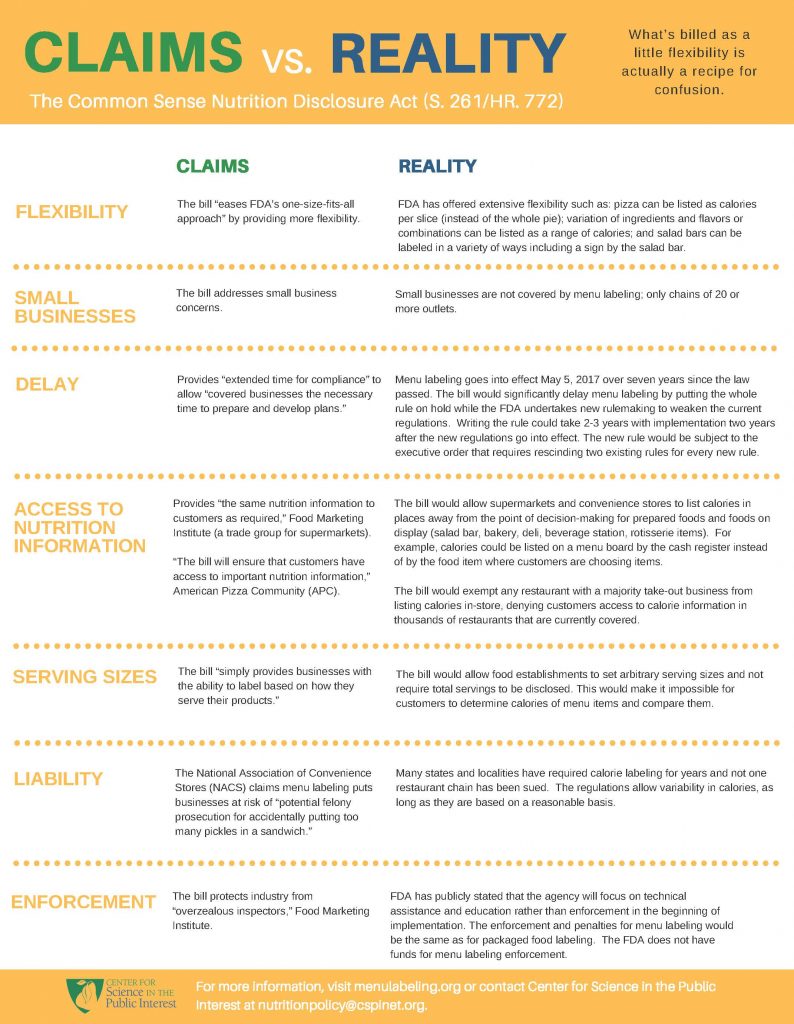
Every Californian should have the information they want and need to choose healthy food for their families. Unfortunately, Congress is intent on curbing the freedom of consumers by denying them basic information about what they are ordering in restaurants. They also seem set on undoing California’s progress by scuttling the menu labeling law through the so-called Common Sense Nutrition Disclosure Act (H.R. 772). – Please see the comparison chart by the CSPI below. This bill ignores the reality that our nation’s top 50 restaurant chains have already committed to empowering consumers by including calorie counts at their locations across the country. Additionally, an independent economic analysis already found that the FDA’s decision to delay the enactment of the rule by one-year could already cost consumers an astounding $15 for every $1 saved by industry. Now imagine the damage H.R. 772 could have on consumers and our economy if signed into law.

This bill is contrary to Californians’ preferences. California passed the first state menu labeling law in our nation in 2008 to support and protect consumer choice. Since the signing of the legislation, California-based chains from California Pizza Kitchen to Taco Bell have shown that menu labeling can be accomplished without sacrificing customer satisfaction.

As Adam Russell of Santa Cruz, CA wrote in response to the FDA delaying implementation of the final menu labeling rule: “People deserve to be able to make informed choices.”

We all must remain vigilant not just about congressional efforts, but the FDA’s final guidance on the menu labeling rule later this year to ensure that the consumer-choice spirit of the rule remains intact. Unfortunately, anti-consumer industry groups and some corporate interests are lobbying Congress hard and against public will to deny Americans choice on a host of critical nutrition issues, including this one. It will only get worse now that the FDA didn’t decide in their favor.

The bill is moving quickly. It has already passed out of the House Energy and Commerce Committee with Rep. McNerney voting in favor of it and is headed to the House floor (and possibly to the Senate) for a vote, possibly this or next week.

The Center for Science in the Public Interest has been providing advice and advocacy toward a healthier food system since its founding in 1971. They publish Nutrition Action Healthletter and NutritionAction.com and lead action across the country on nutrition, food safety, and health.

Filed Under: East County, Health, Legislation, Opinion

Writer supports increase in funding for Alzheimer’s research

September 2, 2017 By Publisher Leave a Comment

Dear Editor:

The Alzheimer’s Association estimates there are more than five million Americans living with Alzheimer’s disease and more than 15 million Alzheimer’s caregivers. As an Alzheimer’s Ambassador, it is my honor to represent them to our elected officials – Congressman Jerry McNerney and Assemblyman Jim Frazier.

In California, over 630,000 people live with Alzheimer’s dementia, over 19,000 in Contra Costa County.  Since 2000, deaths from Alzheimer’s dementia have increased 186%, making it the fifth leading cause of death in the state. And, we’re spending $3.464B in Medicaid caring for people with Alzheimer’s and other dementias.  Today, Alzheimer’s dementia is the only disease that we can’t prevent, cure or even slow its progression.

Gladys Jarvie, my mother-in-law, suffered for years with Alzheimer’s dementia. This funny, sharp, loving woman was oh-so-slowly consumed by Alzheimer’s dementia and eventually lost her life.

The Alzheimer’s Association’s most recent study predicts that by 2025, 840,000 Californians 65 and older will have Alzheimer’s dementia – that’s a 33% increase. Plus, the report predicts that Medicaid costs will increase even faster at 47%.

We need to support research to find a cure.  That’s why I am urging Congressman Jerry McNerney to support a $414 million increase for federal Alzheimer’s research funding for FY2018.

It is only through adequate funding and a strong implementation of the National Plan to Address Alzheimer’s Disease that we will meet our goal of preventing and effectively treating Alzheimer’s by 2025.

To learn more about this disease and how you can help combat it, please visit alz.org.

Pamela Jarvie

Discovery Bay

Filed Under: Health, Letters to the Editor, Opinion, Seniors

Contra Costa Regional Medical Center recognized for commitment to improving healthcare

September 1, 2017 By Publisher Leave a Comment

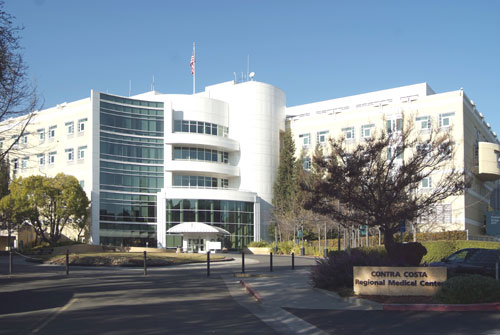
Photo courtesy of cchealth.org.

NRC Health has selected Contra Costa Regional Medical Center, of Martinez, California, as a recipient of its 2017 Excellence Award. Contra Costa Regional Medical Center was recognized at the 23rd Annual NRC Health Symposium for Patient-Centered Care in Boston on Sunday, August 6, 2017. 

For nearly four decades, NRC Health has helped healthcare organizations illuminate and improve the moments that matter most to patients, residents, physicians, nurses, and staff. Today, NRC Health is honored to recognize top-performing hospitals and health systems that have exhibited an exceptional commitment to understanding each individual’s complete care journey. Their desire to better understand the people they care for, and their aspiration to design experiences that inspire loyalty, is the embodiment of the NRC Health mission of human understanding. The Excellence Awards recognize these elite organizations, which have received the highest ratings in overall satisfaction by patients and their families.

The winners were selected from the extensive database of NRC Health hospital clients for their performance over the last four quarters. Contra Costa Regional Medical Center (CCRMC) was selected as in the category of Most Improved Facility in the ranking of Overall Hospital Rating for medium-size hospitals.

“Each year our partners inspire us with their commitment to service,” says Helen Hrdy, Senior Vice President of Client Service at NRC Health. “The individuals at these organizations show a genuine understanding for their patients, which is revealed in their extraordinary, compassionate care. It is always a special pleasure for us to honor and recognize these efforts with the Excellence Award. We congratulate Contra Costa Regional Medical Center for embodying human understanding and demonstrating a commitment to patient-centered care.”

“We’re honored to receive this Excellence Award. We believe our system belongs to the patients. Their voices and perspectives are essential ingredients that can bring about powerful change when we work side by side,” Anna Roth, Chief Executive Officer, Contra Costa Regional Medical Center and Health Centers.

“We sincerely appreciate NRC Health for recognizing our accomplishments,” said Lynnette Watts, Health Service Administrator, Patient Family Advisory / Patient Experience at CCRMC. “Our goal is to provide an exceptional, welcoming care experience to everyone that enters the doors of our health care system.”

CCRMC’s Dr. James Rael added, “We recognize the inherit value of including the voices and shared experiences of patients, their family members and loved ones. Integrating the voices of patients and family members can influence organizational culture and improve the overall health care experience.”

About NRC Health

NRC Health (NASDAQ: NRCIA and NRCIB) has helped healthcare organizations illuminate and improve the moments that matter to patients, residents, physicians, nurses, and staff for 35 years. Our empathetic heritage, proprietary methods, and holistic approach enable our partners to better understand the people they care for and, in turn, design experiences that inspire loyalty and trust. For more information, call 800-388-4264, write to info@nrchealth.com, or visit www.nrchealth.com.

Filed Under: Central County, Health, News

New County Sustainability Commission to help Supervisors make Contra Costa cleaner, healthier

August 26, 2017 By Publisher Leave a Comment

Next meeting Monday, August 28

The Contra Costa County Sustainability Commission will hold its second meeting on Monday, August 28, 2017, 5-7 p.m., at 30 Muir Road, Martinez. The Board of Supervisors created the Sustainability Commission earlier this year to advise the Board and County staff on how to make Contra Costa County healthier and reduce pollution, important goals of the County’s Climate Action Plan.  The agenda for the meeting can be found here.

Thirty-five people applied for the 10 seats on the Sustainability Commission. Given the high level of interest and the opportunity to include more voices, the Board of Supervisors created an additional At-Large seat and allowed each Supervisor to appoint an alternate from his or her district. The 15 members and alternates of the Sustainability Commission appointed to date come from across the County and represent a range of interests and professional experience.  The members include:

Nick Despota, Member, District 1. Nick Despota, a longtime resident of Richmond, has served on numerous commissions and non-profit boards. His professional career has included video production, writing for educational media, and web design. After retiring in 2016, he began volunteering with an environmental organization to develop its online media presence. Nick currently leads the communication team for the Alameda Chapter of the Citizens’ Climate Lobby. 

Victoria Smith, Member, District 2. Victoria Smith is the former Mayor of Orinda and longtime City Council Member. Victoria served as Chair of the Central Contra Costa Solid Waste Authority, RecycleSmart, which provides recycling, reuse and garbage services to the cities of Orinda, Lafayette, Moraga, Walnut Creek, Danville, and central Contra Costa County.  Victoria is a graduate of UC Berkeley and UC Hastings College of the Law, and practices real estate law.

Reid Edwards, Alternate, District 2. Reid Edwards is a retired senior public affairs executive who worked for many years on all aspects of energy and environmental issues, both locally and in Washington, D.C. He resides in Lafayette and has lived in Contra Costa County, with short interruptions, since 1963. He currently volunteers with a number of local institutions including White Pony Express and the Food Bank of Contra Costa and Solano. 

John Sierra, Member, District 3. John Sierra teaches AP Environmental Science and was the Freedom High School teacher of the year in 2013.  He is actively involved with multiple community organizations and frequently takes his students on adventures near and far including Yosemite and Nicaragua.  John is dedicated to protecting natural resources while creating a healthy living environment for all.

Gretchen Logue, Alternate, District 3. Gretchen Logue is dedicated to community civic engagement, and has a lifelong passion for environmental sustainability.  She is the co-founder of the Tassajara Valley Preservation Association, an organization dedicated to the sustainability of Contra Costa County.  In addition to serving as a board member on the Tassajara Hills Foundation, fundraising for educational programs, this mother of three is also a California Naturalist.

Wes Sullens, Member, District 4. Wes Sullens, LEED Fellow, is the Director of Codes Technical Development at the US Green Building Council.  Prior to joining USGBC, Mr. Sullens worked for a local government agency in Alameda County, California (StopWaste), where he provided green codes advocacy, building and product standards development, and green building policy support. Previous to StopWaste, he was an energy and sustainability consultant at a prominent firm in the US.

Travis Curran, Alternate, District 4. A lifelong environmentalist, Travis Curran has spent the past 11 years working in adult mental health.  The Administrator at Crestwood Healing Center in Pleasant Hill, Travis led a sustainability project that transformed facility practices, saving over 2 million gallons of water, and earning a green certification and multiple green awards in the process.  Travis is passionate about waste reduction, and the preservation and protection of our state and national parks.

Charles Davidson, Member, District 5. Charles was the lead community organizer for MoveOn East Bay during the housing crisis. He then became involved with 350BayArea and helped found the Sunflower Alliance, organizing for climate and environmental justice issues, opposing multiple planned large-scale toxic tar sands refinery expansion projects, and lobbying for Community Choice Energy and a fossil-free and inexpensive clean energy future.  Charles has studied cancer biology and medical physics at the graduate school level and holds a US patent in advanced medical imaging. 

Mark Thomson, Alternate, District 5.  Long-time Martinez resident Mark Thomson is Co-President of the John Muir Association, which works closely with the National Park Service to share the legacy of John Muir.  Mark is also Co-Facilitator of Thousand Friends of Martinez, an organization dedicated to defending parks, creeks, wetlands, open space and historic elements in the Martinez area. Mark has previously volunteered with the Boy Scouts, Mt. Diablo Peace and Justice Center, and other organizations. His professional background is in Information Technology.

Howdy Goudey, At-Large, Community Group.  Howdy Goudey has an Engineering Physics degree from UC Berkeley and has worked for 24 years in the research and development of energy efficient buildings, particularly windows, at the Lawrence Berkeley National Laboratory. He has also been a member of the City of El Cerrito Environmental Quality Committee for 9 years, as well as a volunteer with community gardens and native habitat restoration.

Harry Thurston, At-Large, Community Group.   Antioch resident Harry Thurston is committed to furthering sustainable resource usage by Contra Costa County and the municipalities within. He received formal training in sustainable resource usage from Humboldt State University, receiving a BS in Forestry. He put this knowledge into practice as a Peace Corps volunteer, followed by 10 years of Commercial Forestry practice, receiving California certification as a Registered Professional Forester.  Most recently, over the last several years, he has been leading the East Contra Costa effort to implement a Community Choice Energy program for the County’s unincorporated area and for the incorporated municipalities within the County. Harry is a member of the Contra Costa Clean Energy Alliance.

Kathy Cutting, At-Large, Business.  Kathy Cutting is a Bay Area native, settling in Oakley in 1989, where she raised her family.  Over the last 20 years she has enjoyed working as a residential landscape designer promoting sustainable land options for homeowners.  As an alumna of Cal State East Bay, Kathy now works at the University’s Concord Campus, where she is a liaison for all sustainability programs within the Concord campus community. 

Nicholas Snyder, At-Large, Business. Nicholas Snyder is a Senior Analyst at Tierra Resource Consultants, an energy and natural resource consulting firm in Walnut Creek.  Most recently, he has served as a lead on the funding and financing of energy efficiency, renewables, and energy storage.  Before joining Tierra, he interned at Contra Costa County Climate Leaders and the Energy Division of the California Public Utilities Commission, where he supported regulatory oversight of the Energy Watch, Regional Energy Network, and Community Choice Energy programs.

Doria Robinson, At-Large, Environmental Justice.  Doria is third generation resident of Richmond, California and the Executive Director of Urban Tilth, a community based organization rooted in Richmond dedicated to cultivating urban agriculture to help the community build a more sustainable, healthy, and just food system. Doria is trained as a Watershed Restoration Ecologist, and is a Certified Permaculture Designer, Certified Bay Friendly Gardener, a Certified Nutrition Educator, and a Certified Yoga Instructor and the founder of Sanctuary Yoga. She was recognized as Environmental Advocate of the Year for Contra Costa County and as Woman of the Year for Contra Costa County in 2010. In 2011, she was presented with a Community Resiliency Leadership Award from Bay Localize.

Scott Warfe, At-Large, Education.  Scott Warfe is an Assistant Professor of English and Developmental Education Lead at Los Medanos College. In addition to work in the English Department, Scott is also one of the founders of the LMC Food Pantry and volunteers with The Trinity Center, which serves homeless and working poor people in East Contra Costa County. 


Filed Under: Environment, Government, Health, News, Supervisors

Health officials remind residents not to touch bats after rabid bat is found in Clayton park

July 31, 2017 By Publisher Leave a Comment

Contra Costa Public Health and Animal Services are reminding the community not to touch bats after a bat found at a local park tests positive for rabies.

The bat was found on a pathway at The Grove Park, 6100 Main Street in Clayton the morning of Sunday, July 16. The bat was immediately removed from the park and was being rehabilitated but died several days later. Test results came back positive on the afternoon of July 27.

Rabies is spread from animals to humans mainly through bites. People who did not touch the bat that morning are not at risk of developing rabies. The bat was not found in the play structure area and there is no information that the bat was touched by any children.

“Although we think it is highly unlikely anyone was exposed to this bat we feel it’s important to remind the community that it’s never ok to touch bats,” said Paul Leung, Contra Costa Public Health Communicable Disease Programs Chief.

To prevent the spread of rabies, the community should make sure their pets are up to date with their rabies vaccines and avoid handling wildlife.

“Although most bats pose no risk of rabies a bat that behaves unusually, such as lying on the ground or being active during the daytime is concerning and people should not attempt to handle it but instead should contact us right away,” said Cpt. Jane Andreotti of Contra Costa Animal Services.

Anyone who has touched a bat or has been bitten by wildlife should contact their health care provider. More information about rabies is available at http://cchealth.org/rabies.

Filed Under: Health, News

Potentially harmful blue-green algae blooms detected in Discovery Bay

July 20, 2017 By Publisher Leave a Comment

Contra Costa health officials and the Central Valley Regional Water Quality Control Board advise people and pets in the Discovery Bay community to avoid contact with local bodies of water because of blue-green algae blooms.

Contra Costa Health Services Environmental Health Division (CCEH) received results this week for several water samples taken in late June from the southwestern section of Discovery Bay. Results found elevated levels of a natural toxin produced by blue-green algae blooms.

“We are advising residents to stay out of the water and keep their pets out of the water in the southwestern portion of Discovery Bay,” said CCEH Director, Dr. Marilyn C Underwood, “However, water circulates throughout the community, so the algae can also move and spread and therefore it is prudent to be cautious and to stay out of the water if you see scum or algae blooms.”

Exposure to the toxin can cause rashes, skin and eye irritation, allergic reactions, gastrointestinal upset and other symptoms.

“It’s important to know that dogs are especially vulnerable to getting sick from this toxin. There have been reports from past incidents of dogs dying after drinking the water or licking algae from their fur after swimming in water with blue-green algae blooms.  If your pet gets ill after swimming in water with an algae bloom, take them to the vet immediately,” said Christine Joab, Cyanobacteria Coordinator for the Central Valley Water Board.

For a fact sheet to help veterinarians diagnose illness related blue-green algae exposure, visit www.mywaterquality.ca.gov/habs/what/vet_habs_factsheet.pdf

Blooms of blue-green algae, also known as cyanobacteria, can look like green, blue-green, white or brown foam or scum floating on top of water, or suspended in the water. Warm water temperatures and nutrients contribute to blooms, but these will eventually subside under cooler conditions.

CCEH will regularly test bodies of water throughout Discovery Bay and update the community while these conditions persist.

“Anyone who had contact with blue-green algae and has now developed symptoms or believes they may have consumed contaminated water should contact their healthcare provider immediately or call California Poison Control at 1-800-222-1222,” said Underwood.

No illnesses linked to Discovery Bay algae blooms have been reported in 2017. A child became sick after swimming in Discovery Bay during a similar event in 2016. Only recreational water areas are affected. Tap water in Discovery Bay is unaffected by the algal bloom.

FAQs

Is it safe for me to go in the water in Discovery Bay?

It depends where you are and if there are advisories posted in the area.

A CAUTION sign means:

Do not swim or wade near algae or scum

Keep your children away from algae in the water or on the shore

Do not drink the water or use it for cooking

Do not let pets or livestock go into or drink the water or eat scum on the shoreline

Do not eat shellfish from the water

A WARNING sign means:

No swimming

Stay away from scum, and cloudy or discolored water

Do not use these waters for drinking or cooking

Do not let pets or livestock go into or drink the water, or go near the scum

Do not eat shellfish from these waters

For fish caught here, throw away guts and clean fillets with tap water or bottled water before cooking

A DANGER sign means:

Stay out of the water until further notice. Do not touch scum in the water or on shore.

Do not let pets or livestock drink or go into the water or go near the scum

Do not eat fish or shellfish from these waters

Do not use the water for drinking or cooking. Boiling or filtering will not make the water safe.

Exposure to blue-green algae can cause rashes, skin and eye irritation, allergic reactions, gastrointestinal upset, and other effects. At high levels, exposure can result in serious illness or death, according to the California Department of Public Health.

What about my pets?

Keep pets out of water with blue-green algae blooms. Dogs are especially vulnerable to getting sick and there have been reports through the years of dogs dying following exposure associated with drinking the water and licking algae from their fur after wading/swimming in water with blue-green algae blooms.

Is there an issue with drinking water?

No, contamination only affects recreational water areas, not drinking water from the tap in Discovery Bay.

Who should I contact if I swam in the water and now have symptoms?

If you think you or someone else is displaying symptoms of blue-green algae poisoning, contact your health care provider or the California Poison Center Help Hotline at 1-800-222-1222.

What can I do to get rid of blue-green algae in Discovery Bay?

We do not recommend attempting to treat or remove the algae. Blue-green algae blooms are natural to the environment’s food chain, and eventually dissipate on their own. Chemical treatment is often ineffective and can result in more toxins being released into the water as algae cells die, as well as unintended effects on other species in the area.

Algae blooms result from changes in water conditions that encourage sudden growth of the species. The best way to reduce and prevent blooms is to reduce water pollution, particularly from runoff containing fertilizers or pesticides. Pick up trash dumped in waterways, and make sure all household sewer systems are working properly.

Treating aquariums with a hydrogen peroxide solution is a common way to get rid of some kinds of algae. But the Delta is not a closed system like an aquarium, so the results would be unpredictable, both in terms of efficacy and impact on the environment.

For updates, detailed explanations of posted advisories, a map of sampling sites and other information, visit cchealth.org/eh/blue-green-algae.

Filed Under: East County, Environment, Health, News, Water

Tackling the Taboo II, symposium on Black men’s mental health in Antioch, Saturday, July 15

July 14, 2017 By Publisher Leave a Comment

By Dr. Lawrence A. Rasheed

In observance of Black Mental Health Awareness Month, we are continuing our series of symposiums, “Tackling the Taboo.” In this series, we touch on issues that often go ignored within the Black community, especially issues related to Black males.

Young Black men in America are the most despised, most stereotyped, most disregarded, most policed and most feared people in this country; more likely to be poor, more likely to be undereducated, more likely to be unemployed, more likely to be discriminated against, more likely to live without their fathers, more likely to suffer from mental health issues, more likely to be locked up in prisons, and more likely to be murdered than any others in America.

Usual and easy responses to the plight of Black males in America always include historic indignation, protest and demands that raise public awareness – the stuff “moments” and not “movements” are made of. However, what is lacking is a comprehensive, well-conceived, sustained response, which requires massive community building efforts, direct-actions with and on behalf of young Black men and boys, and redirecting dollars from incarcerating Black men to educating and developing Black youth. Together, these actions will develop and support Black men and boys to become strong, positive, powerful, contributing, compassionate and courageous citizens.

Finally, there is a proper response. G.R.I.O.T. (Greatness Rediscovered In Our Time) and P.O.W.E.R. (Providing Optimal [W]holistic Educational Resources) are the much-needed, missing and best response to the issues of Black men and boys in East Contra Costa County and America.

On Saturday, July 15th, 2017 from 5:30 – 7:30 p.m. at Delta Bay Church of Christ, located at 913 Sunset Drive in Antioch, we will be discussing Black Mental Health issues facing our Black Male Community. This free event is being moderated by Dr. Richard Hanzy, who will be joined by several black male thought leaders such as Dr. Lamont Francies, former SF Police Captain Cornelius Johnson, and Author LeRon Barton.

Please register by clicking here, or call Dr. Lawrence Rasheed at (925) 726-6162. The best way to improve the conditions of young Black men and boys in America is not simply to protest them, but to invest in them – https://gofund.me/tacklingthetaboo.

Filed Under: Community, East County, Health, Youth

  • « Previous Page
  • 1
  • …
  • 48
  • 49
  • 50
  • 51
  • 52
  • Next Page »
Monicas-11-25
Deer-Valley-Chiro-06-22

Copyright © 2026 · Contra Costa Herald · Site by Clifton Creative Web