• Home
  • About The Herald
  • Local Agencies
  • Daily Email Update
  • Legal Notices
  • Classified Ads

Contra Costa Herald

News Of By and For The People of Contra Costa County, California

  • Arts & Entertainment
  • Business
  • Community
  • Crime
  • Dining
  • Education
  • Faith
  • Health
  • News
  • Politics & Elections
  • Real Estate

Gov. Newsom signs exec order phasing out gas-powered cars, passenger trucks sold in state by 2035

September 23, 2020 By Publisher Leave a Comment

To “drastically reduce demand for fossil fuel in California’s fight against climate change”

Transportation currently accounts for more than 50 percent of California’s greenhouse gas emissions   

Zero-emission vehicles are a key part of California’s clean, innovation economy – already California’s second largest global export market  

Order also directs state to take more actions to tackle the dirtiest oil extraction and support workers and job retention and creation as we make a just transition away from fossil fuels  

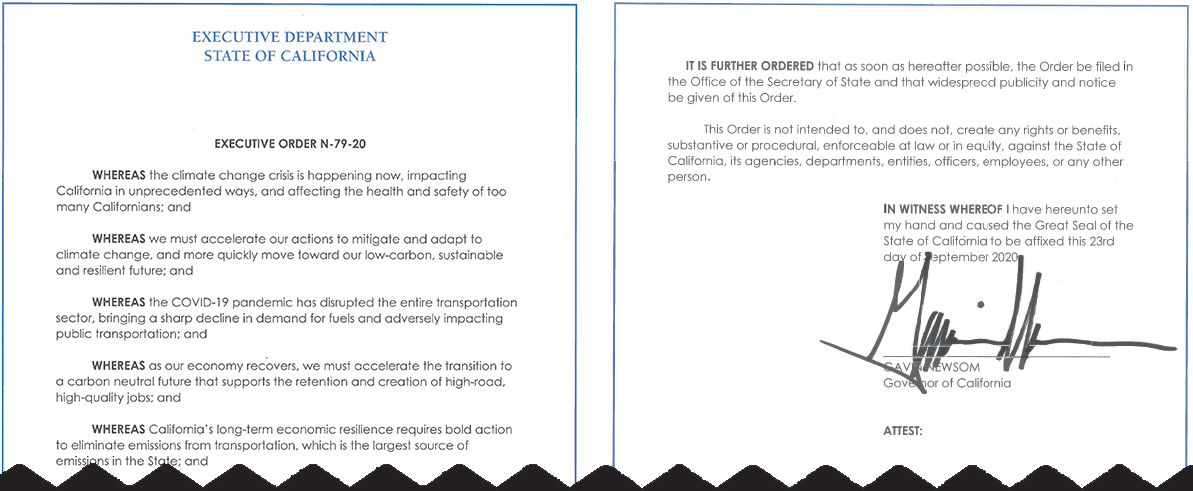
SACRAMENTO – Governor Gavin Newsom announced Wednesday that he will aggressively move the state further away from its reliance on climate change-causing fossil fuels while retaining and creating jobs and spurring economic growth – he issued an executive order requiring sales of all new passenger vehicles to be zero-emission by 2035 and additional measures to eliminate harmful emissions from the transportation sector. (The text of today’s executive order can be found here and a copy can be found here.)

The transportation sector is responsible for more than half of all of California’s carbon pollution, 80 percent of smog-forming pollution and 95 percent of toxic diesel emissions – all while communities in the Los Angeles Basin and Central Valley see some of the dirtiest and most toxic air in the country.

“This is the most impactful step our state can take to fight climate change,” said Governor Newsom. “For too many decades, we have allowed cars to pollute the air that our children and families breathe. Californians shouldn’t have to worry if our cars are giving our kids asthma. Our cars shouldn’t make wildfires worse – and create more days filled with smoky air. Cars shouldn’t melt glaciers or raise sea levels threatening our cherished beaches and coastlines.”

Following the order, the California Air Resources Board will develop regulations to mandate that 100 percent of in-state sales of new passenger cars and trucks are zero-emission by 2035 – a target which would achieve more than a 35 percent reduction in greenhouse gas emissions and an 80 percent improvement in oxides of nitrogen emissions from cars statewide. In addition, the Air Resources Board will develop regulations to mandate that all operations of medium- and heavy-duty vehicles shall be 100 percent zero emission by 2045 where feasible, with the mandate going into effect by 2035 for drayage trucks. To ensure needed infrastructure to support zero-emission vehicles, the order requires state agencies, in partnership with the private sector, to accelerate deployment of affordable fueling and charging options. It also requires support of new and used zero-emission vehicle markets to provide broad accessibility to zero-emission vehicles for all Californians. The executive order will not prevent Californians from owning gasoline-powered cars or selling them on the used car market.

California will be leading the nation in this effort – joining 15 countries that have already committed to phase out gasoline-powered cars and using our market power to push zero-emission vehicle innovation and drive down costs for everyone.

By the time the new rule goes into effect, zero-emission vehicles will almost certainly be cheaper and better than the traditional fossil fuel powered cars. The upfront cost of electric vehicles are projected to reach parity with conventional vehicles in just a matter of years, and the cost of owning the car – both in maintenance and how much it costs to power the car mile for mile – is far less than a fossil fuel burning vehicle.

The executive order sets clear deliverables for new health and safety regulations that protect workers and communities from the impacts of oil extraction. It supports companies who transition their upstream and downstream oil production operations to cleaner alternatives. It also directs the state to make sure taxpayers are not stuck with the bill to safely close and remediate former oil fields. To protect the health and safety of our communities and workers, the Governor is also asking the Legislature to end the issuance of new hydraulic fracturing permits by 2024.

The executive order directs state agencies to develop strategies for an integrated, statewide rail and transit network, and incorporate safe and accessible infrastructure into projects to support bicycle and pedestrian options, particularly in low-income and disadvantaged communities.

This action continues the Governor’s commitment to strengthening California’s resilience while lowering carbon emissions – essential to meeting California’s air quality and climate goals. In the last six months alone, the California Air Resources Board has approved new regulations requiring truck manufacturers to transition to electric zero-emission trucks beginning in 2024 and the Governor signed an MOU with 14 other states to advance and accelerate the market for electric medium- and heavy-duty vehicles. Last fall, California led a multi-state coalition in filing a lawsuit challenging the U.S. Environmental Protection Agency’s attempt to revoke portions of a 2013 waiver that allows the state to implement its Advanced Clean Car Standards.

Last September, Governor Newsom took action to leverage the state’s transportation systems and purchasing power to strengthen climate mitigation and resiliency and to measure and manage climate risks across the state’s $700 billion pension investments. To mitigate climate threats to our communities and increase carbon sequestration, the Governor invested in forest health and fuel reduction and held utilities accountable for building resiliency. The Governor also directed state agencies to develop a comprehensive strategy to build a climate-resilient water system and made a historic investment to develop the workforce for California’s future carbon-neutral economy.

 

Filed Under: Business, Economy, Environment, Government, News, State of California

Contra Costa updates health order to match state’s COVID-19 Blueprint – nail salons, massage can reopen indoors

September 14, 2020 By Publisher Leave a Comment

Even card rooms can open, again – outdoors, but not piercing, tattooing or non-medical electrolysis (you’ll still have to keep plucking out those hairs, yourself!)

Contra Costa County today aligned its COVID-19 social distancing health order with California’s Blueprint for a Safer Economy, so the county no longer has different reopening rules for businesses and activities beyond what the state requires or allows.

The change, effective at 8 a.m. Wednesday, Sept. 16, simplifies the plan for reducing the spread of COVID-19 in Contra Costa so that residents and local businesses can better understand and identify the steps we all need to take to keep ourselves, our families, workers and customers safer during the pandemic.

The update to Contra Costa’s health order does allow some additional businesses to reopen, following the state health guidelines for their industries:

  • Personal care services that involve close contact with the face may begin operating outdoors, except for tattooing, piercing and nonmedical electrolysis
  • Racetracks and cardrooms may operate outdoors
  • Music, television and film production may resume
  • Professional sports without live audiences may resume

These changes are consistent with Contra Costa’s placement in the purple tier of the state’s blueprint, indicating that COVID-19 is widespread in the county. When the data tracked by the state show sustained improvement for two weeks, the county will move into the red tier, allowing more businesses and activities to reopen.

Information about the state’s blueprint, including health guidelines for businesses and activities, which business sectors are not currently safe to operate in Contra Costa, and how the guidelines will change as the county makes progress against COVID-19, are all available at covid19.ca.gov/safer-economy.

Contra Costa’s current health orders retain health guidelines for social bubbles and structured contact between people from different households, face coverings and physical distancing. The FAQ and Safer Social Interactions pages at cchealth.org/coronavirus have information about keeping safer during the pandemic.

Contra Costa Health Services (CCHS) continues to monitor data that show how the virus is spreading through our community, including hospitalizations and how the pandemic is impacting the county’s healthcare system. If there is a sudden surge in COVID-19 transmission in the future, the county may need to temporarily impose more restrictions to protect the public health.

One way Contra Costans can help keep our county’s healthcare system running smoothly is to get a flu vaccine – talk to your health provider about getting one. CCHS is also planning community vaccination clinics beginning in October.

Anyone who lives or works in Contra Costa can help make the county safer from COVID-19 and reopen more quickly is to get a fast, free COVID-19 test at a community testing site. The state has reduced the requirements for moving into less restrictive tiers for counties that test many people every day, and other Bay Area counties have already qualified for this benefit.

Make a COVID-19 testing appointment today by calling 1-844-421-0804 or booking online at cchealth.org/coronavirus – hit the “Get Tested” button. This site is also an official source for local information regarding the COVID-19 pandemic.


Filed Under: Business, Economy, Health, News

Owner, bartender of Pittsburg bar charged for violating county health order, unlicensed sale of alcohol

September 14, 2020 By Publisher Leave a Comment

Open in June when not allowed to be, ABC suspended license for not paying taxes, unlicensed sale of alcohol

By Scott Alonso, Public Information Officer, Office of the District Attorney, Contra Costa County

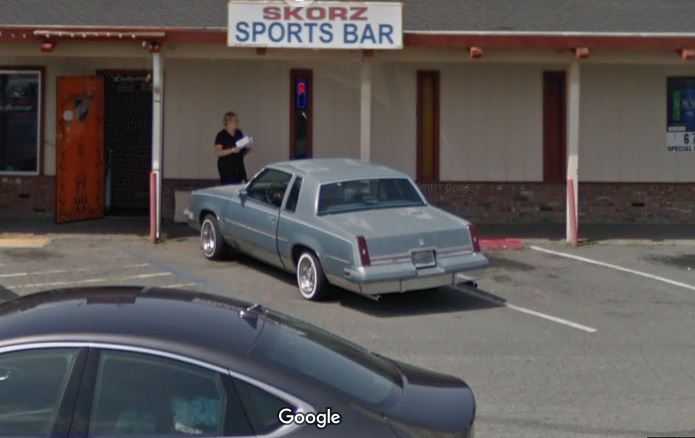
Martinez, Calif. – Kimberly Beatrice Dixon of Pittsburg (52-years-old) was charged today by the Contra Costa County District Attorney’s Office for a violation of the Contra Costa County Health Officer Order related to COVID-19. In addition, Dixon was charged for operating her bar with a suspended alcohol license. The case was investigated by the state Alcoholic Beverage and Control agents. The bar is located at 3742 Railroad Avenue in Pittsburg.

Dixon is the owner of Skorz Sports Bar in Pittsburg. Earlier this summer on June 11, the bar was open, and patrons were inside drinking alcohol. The bar was not deemed an essential business and therefore not allowed to be open. Currently, bars are not allowed to be open to the public. Further, earlier this year, ABC suspended Dixon’s license for the failure to pay taxes.

“Our office has received hundreds of complaints from the public reporting non-essential businesses operating during the COVID-19 pandemic,” stated District Attorney Diana Becton. “These businesses are putting the public’s health in jeopardy by violating the health officer orders. These orders are necessary to stop the spread of the deadly COVID-19 virus. We will continue to investigate reports of violations of the health officer order.”

The bartender at Skorz, Carla Kacprzak, was also charged with a misdemeanor violation for the unlicensed sale of alcohol.

Anyone with information about possible COVID-19 violations can report that information to the District Attorney’s Office via email at DA-ReportFraud@contracostada.org.

Case information: People v. Kimberly Beatrice Dixon and Carla Kacprzak, Docket Number 04-200281-4.

Filed Under: Business, Crime, District Attorney, East County, News

Travis Credit Union hosting virtual Back-to-School Rally Sept. 16

September 4, 2020 By Publisher Leave a Comment

Online event to celebrate the start of 2020-2021 School Year for local youth

Travis Credit Union invites students and their families to attend a free virtual ‘Back-to-School Rally,’ scheduled for Wednesday, September 16 from 4-5 p.m. The Zoom event is also the culmination of TCU’s month-long ‘Back to School Challenge,’ where students who complete the weekly online financial education activities are entered into a drawing to win the grand prize, a new laptop.

“Starting a new school year is an exciting time. Since this year is unlike any other, we are proud to introduce a digital financial education program to compliment distance learning to help families and guardians,” said Damian Alarcon, Director of Community Relations for Travis Credit Union. “The Back-to-School rally is our way of helping to bring youth together to celebrate financial education and all the new opportunities that this school year will bring.”

The rally will feature guest speakers from across the 12 counties served by TCU, including:

  • Edgar Lampkin, Superintendent of the Williams Unified School District, will provide a welcome to students.
  • Youth leaders from the Woodland Teen Advisory Board, the San Pablo Youth Commission, RYSE Center (in Richmond) and the Fairfield Police Activities League will share teen projects they are launching to support the return to schools.
  • The grand prize winner of the Back-to-School Challenge will be announced live

Woodland Teen Advisory Board, https://woodlandpubliclibrary.com

City of San Pablo Youth Commission, https://www.sanpabloca.gov/881/Youth-Commission

Fairfield Police Activities League, https://www.fairfield.ca.gov/gov/depts/police/pal_matt_garcia_youth_center/

RYSE Center, https://rysecenter.org

Williams Unified School District, http://www.williamsusd.net

To register for this free event, click here

Youth aged 13 to 18 have until September 9 to complete the contest requirements to be eligible for the giveaway. More information is available at traviscu.org/back-to-school.

Headquartered in Vacaville, California, Travis Credit Union is a not-for-profit cooperative financial institution serving those who live, work, worship, or attend school in Alameda, Colusa, Contra Costa, Merced, Napa, Placer, Sacramento, San Joaquin, Solano, Sonoma, Stanislaus, and Yolo Counties. Currently, Travis Credit Union is the 13th largest credit union in California with more than 214,000 members and more than $3.9 billion in assets. As one of the leading financial institutions in Solano, Contra Costa, Napa, Yolo and Merced Counties, Travis Credit Union’s strength lies in its faithful commitment to its members and the community; its solid, secure history; and its long-standing track record of dedicated service.


Filed Under: Business, Education, News

More Contra Costa businesses open following updated state recommendations

August 31, 2020 By Publisher Leave a Comment

Includes hair salons & barber shops indoors, gyms & fitness centers outdoors, and indoor shopping malls at 25% capacity

By Contra Costa Health Services

The California Department of Public Health on Friday announced new statewide guidelines to make regulations and community re-openings more standardized throughout the state. Contra Costa and most other counties are now in the purple (most restrictive) tier.

According to these new state rules, hair salons and barber shops can now operate indoors in Contra Costa County with safety guidelines in place. Indoor shopping malls may also reopen at 25% maximum occupancy as long as public congregation points and food courts are closed and the mall has approved a COVID-19 safety plan from Contra Costa Health Services (CCHS). Gyms and fitness centers may begin operating outdoors in accordance with their own state guidelines and checklist.

These new state rules do not change the restrictions on in-person education, or the state’s school waiver process in Contra Costa.

We continue to evaluate the State’s new framework and its impact on our county, and we will provide additional information as it becomes available.

CCHS encourages businesses to adjust reopening plans as needed in response to changes in air quality in the county from Northern California wildfires. The county has issued a health advisory about smoke, encouraging all residents to stay inside when possible with doors and windows shut. For air quality updates and forecasts, visit the Bay Area Air Quality Management District website. Contra Costa Health Services urges residents to continue wearing face coverings when they go out or are near people outside their households, observe physical distancing, stay home from work or school when they do not feel well and wash their hands thoroughly and often.


Filed Under: Business, Health, News

Leveling of COVID-19 transmission in Contra Costa allows some businesses to reopen Friday

August 26, 2020 By Publisher Leave a Comment

Hair salons, gyms, fitness centers may begin operating outdoors, hotels and short-term rentals may open

From Contra Costa Health Services, Office of the Director

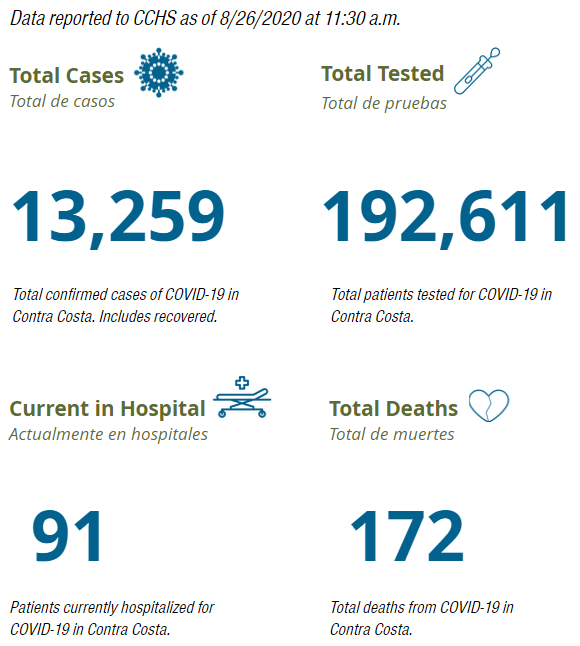
Daily hospitalizations due to COVID-19 and the percentage of COVID-19 tests returning positive remained steady or fell slightly in Contra Costa County during early August, reflecting recent local progress in slowing the spread of a deadly virus. The seven-day rolling average number of patients hospitalized with COVID-19 in Contra Costa dropped slightly, from 103 on Aug. 5 to 96 on Aug. 24. The average percentage of tests administered in the county that come back positive, meanwhile, has fallen from 8.8% on Aug. 6 to 7.4% on Aug. 24.

These key data indicators for the pandemic remain at dangerously high levels in Contra Costa, which remains on the California Department of Public Health’s county monitoring list, but are not currently increasing as they did in June and July.

Given the improvement, Contra Costa County today makes small changes to its social distancing health order to allow certain business sectors to begin operating again outdoors. The changes align Contra Costa’s policy with recently updated state health guidelines:

— Personal care services that do not involve close contact with the face, such as nail salons and massage, may begin operating outdoors in accordance with the state-issued industry guidelines and checklist.

— Gyms and fitness centers may begin operating outdoors in accordance with their own state guidelines and checklist.

— Hotels and short-term rentals in the county may open for personal or recreational travel, not just for essential business purposes.

These updates to the health order are effective Friday, August 28. Hair salons and barbers have already been permitted to perform limited work outdoors in the county, with no reported outbreaks.

Contra Costa Health Services (CCHS) does encourage businesses to adjust reopening plans because of poor air quality in the county from Northern California wildfires. The county has issued a health advisory about smoke, encouraging all residents to stay inside when possible with doors and windows shut. For air quality updates and forecasts, visit the Bay Area Air Quality Management District.

While recent issues at the state level skewed local testing data in late July and early August, Contra Costa Health Services (CCHS) has confidence in data related to hospitalization and number of new positive cases because they are directly reported to the county by local health providers and clinics.

“Based on what we are able to see, we can be cautiously optimistic that there is a gradual downward trend in county cases, testing positivity rates and hospitalizations,” said Dr. Chris Farnitano, county health officer. “We need everyone to understand this is a reason to keep up what we are doing and not let down our guards.”

Previous health orders remain in effect. Contra Costa Health Services urges residents to continue wearing face coverings when they go out or are near people outside their households, observe physical distancing, stay home from work or school when they do not feel well and wash their hands thoroughly and often.

Details of the update, including the full text of the order, are available at cchealth.org/coronavirus.

Filed Under: Business, Health, News

Discovery Builders partners with Pittsburg to construct youth center

August 24, 2020 By Publisher 4 Comments

Long sought athletic facility closer to reality

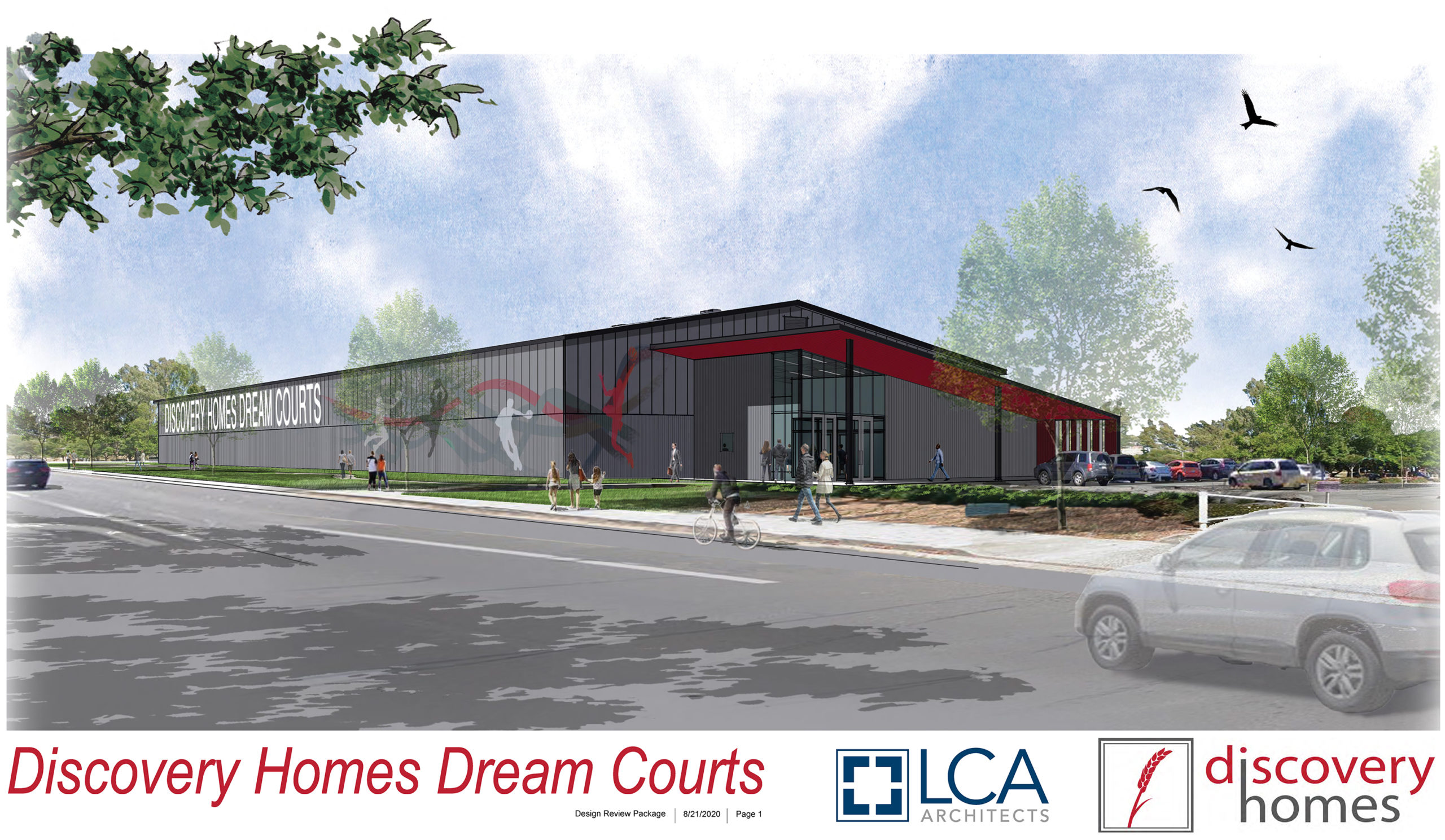
Discovery Builders, Inc. has entered into an agreement with the City of Pittsburg to design and build an approximately 45,000-square-foot youth center that will include basketball and volleyball courts, among other uses. (See presentation slide show, here – DBI Pittsburg Youth & Sports Facility)

The proposed $3 million facility will be located at John Henry Johnson Park, directly north of West Leland Road in Pittsburg, California. City staff determined this site was best suited for a facility of this nature.

Community leaders have long expressed a need that more public amenities be made available to the local youth of Pittsburg. Meeting this need and providing recreational opportunities for young people has been an ongoing challenge in Pittsburg, since previous youth and community centers closed many years ago.

Public testimony from diverse groups of people and organizations has consistently centered around building a robust youth center, specifically, providing quality athletic facilities. The city currently lacks some of the infrastructure needed to provide ongoing recreational services. As a result of this direct need, Discovery Builders, Inc. and the City of Pittsburg have partnered to lay the groundwork for a future youth center.

While still in the design phase, the yet-to-be-named youth center is a culmination of years of listening and research done on the part of the Discovery Builders leadership team.

As noted by Louis Parsons, president of Discovery Builders, Inc., “As a community builder, we have decades of listening and local knowledge under our belts. We hear what the community wants and needs, and we said building this youth center makes sense for Pittsburg. One of the community benefits we bring is we can use our core building strengths to make Pittsburg and nicer place to live. I’m personally excited to see these basketball and volleyball courts get built.  Obviously, this is contingent on a longtime project moving forward.”

Parsons added, “What’s nice about this agreement is we get to support the city and staff by saving them time and resources that are better served running the day-to-day operations of the city. With the pandemic and recent furloughs, a partnership like this is required to create the major public amenities people want.”

The agreement states this facility will begin construction within the next 18 months, contingent on a pending application being approved by the Pittsburg City Council on Monday, Aug. 24.


Filed Under: Business, East County, News, Recreation, Youth

New Name. Same Game. Delta Conveyance Project – tunnel moves forward – Part 2: Stakeholders & Opposition

July 20, 2020 By Publisher 3 Comments

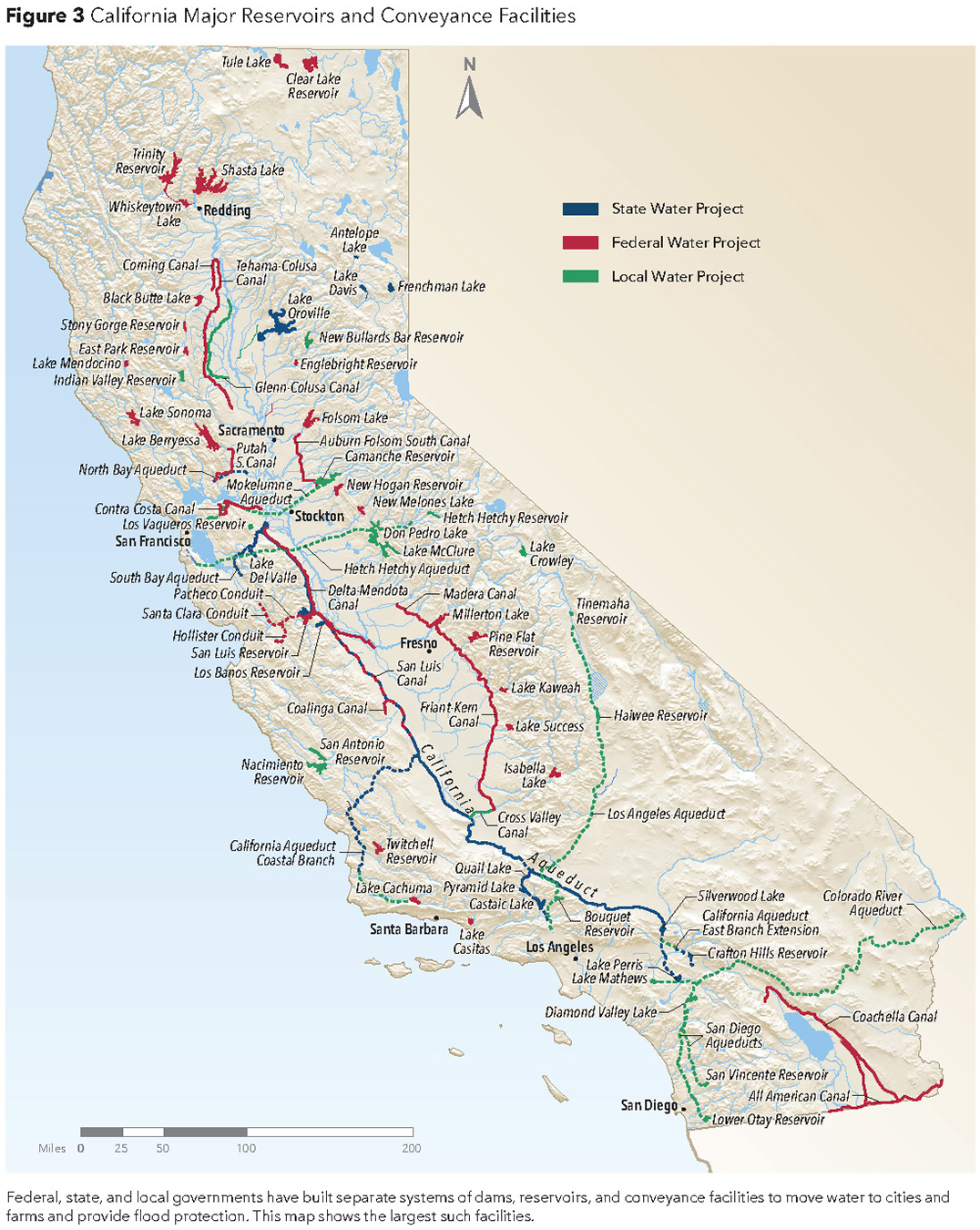
From California Water Resilience Portfolio 2019 Final.

County residents opposed to project work to limit impact and secure benefits if it is built

“We want to make sure they don’t screw anything up,” – David Gloski, Stakeholders Engagement Committee Member

By Allen Payton

What was planned as two tunnels beneath the California Delta to divert fresh water from north of the Delta to areas south, is now a single tunnel plan that is referred to as the Delta Conveyance Project (DCP). The effort is being led by the Delta Conveyance Design and Construction Authority (DCA) which was formed by and makes recommendation to the California Department of Water Resources (DWR).

In the first part of this two-part series, you read about the background and latest efforts to move the project forward. In this part, you will hear from local voices who serve on the Stakeholders Engagement Committee (SEC) and what they are doing to both fight the tunnel, and if it is built to limit its impact and to secure any benefits for our county and the Delta.

Stakeholders Engagement Committee – Local Voices

Because Contra Costa County and the water districts in the county either oppose or are neutral on the Delta tunnel project, no agency from the county is part of the DCA. But there are three people who live and one who works in Contra Costa County and serve on the Stakeholder Engagement Committee. They are Bethel Island resident and retired engineer David Gloski, Discovery Bay resident and real estate appraiser Karen Mann, Antioch resident Jim Cox, a retired fishing boat captain, and Oakland resident Michael Moran, who works for the East Bay Regional Park District as Supervising Naturalist at Big Break Regional Shoreline Visitor Center at the Delta in Oakley.

David Gloski, The Engineer – At Large Member

“I don’t want to understate that I’m against it and I appreciate the people fighting it,” said Gloski, who volunteered to be part of the SEC at the urging of others who also oppose the tunnel. “But I, having a home on the water and having an engineering background – and this DCA SEC group is more engineering focused – we want to make sure they don’t screw anything up.”

“The majority of the people on the stakeholder committee are probably against the tunnel,” he stated. “It includes the lady (Barbara Barrigan-Parrilla) from Restore the Delta. We’ve been effective in preventing them from doing things that don’t make sense and would negatively affect people in Contra Costa.”

“To me, they walk and chew gum at the same time. They’re working on designs and plans without having the permits. They have to do some of it or they don’t know what they’re asking to permit,” Gloski explained. “Similarly, we aren’t doing ourselves any benefit by just opposing it. Because if it does go through, we can get a lot of things done, like new roads, and parks. But you have to participate.”

“I’ve raised my hand to say, ‘if you’re going to build it, let’s get good things out of it, and make sure they don’t screw things up,” he reiterated. “I think the county is mistaken for not being more involved. The DCA made changes because of our inputs. Unfortunately, I’m not sure the inputs are the best from the county’s perspective. For example, an original plan included road and bridge improvements which were eliminated when we were successful in having a maintenance shaft moved further away from Discover Bay. So, you might have won the battle but lost the war.”

“I think we might benefit from more representatives. But right now, the county is just fighting it,” Gloski added.

To give your input to David Gloski, you can join his Facebook page, David Gloski DCA Stakeholder.

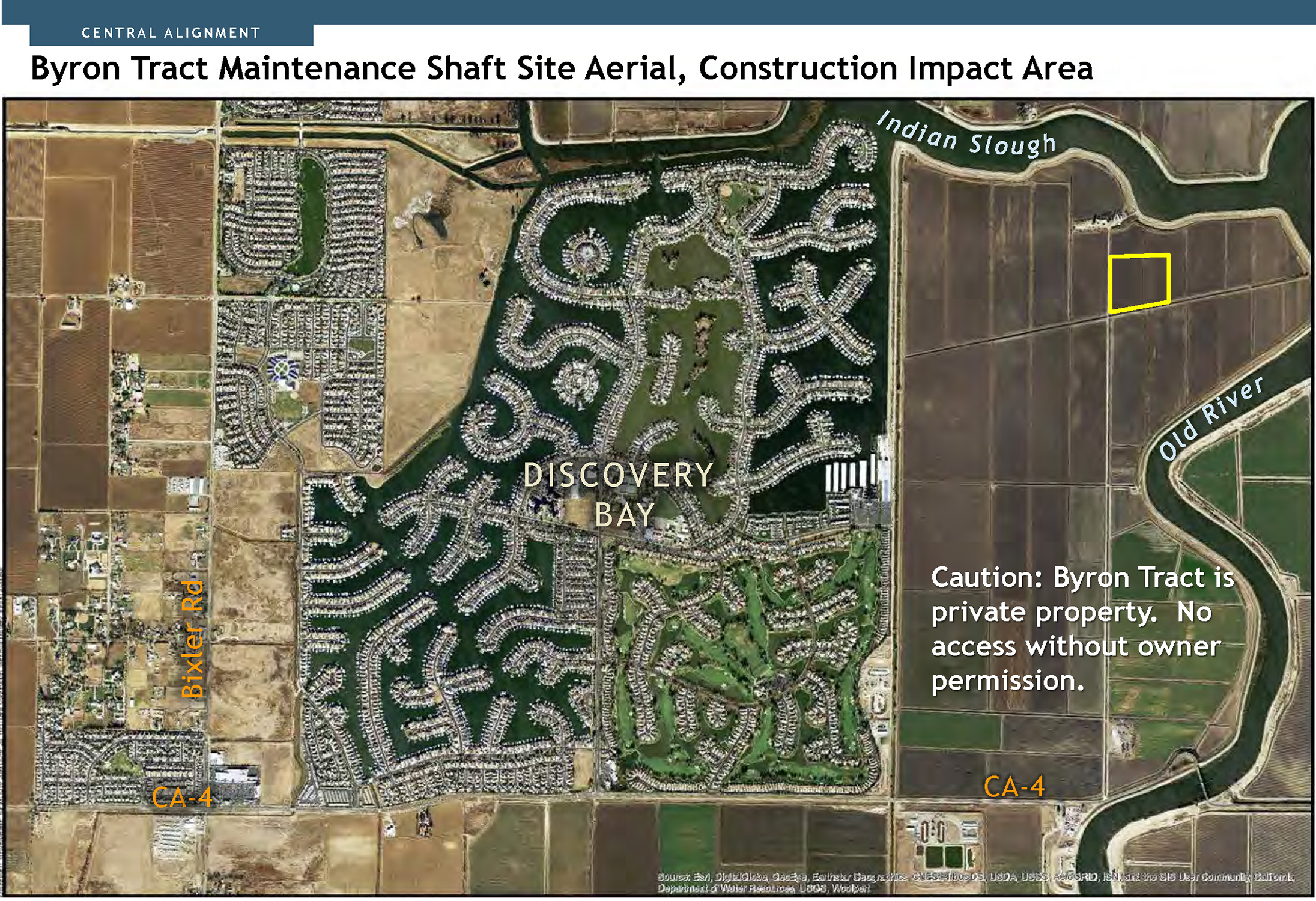
Mann expressed her concerns for the location and proximity to Discovery Bay of one potential Maintenance Shaft. From DCA 2020-05-27-UpdatedMapBooks.

Karen Mann – South Delta Local Business

Mann, an appraiser in Discovery Bay, is another member of the stakeholders committee who opposes the tunnel, as the issue literally hits close to home for her like Gloski.

“I’m fighting for our Delta,” she said. “As I’m talking to you my grandchildren are loading the boat, because that’s what we do as a family. We spend time on the Delta.”

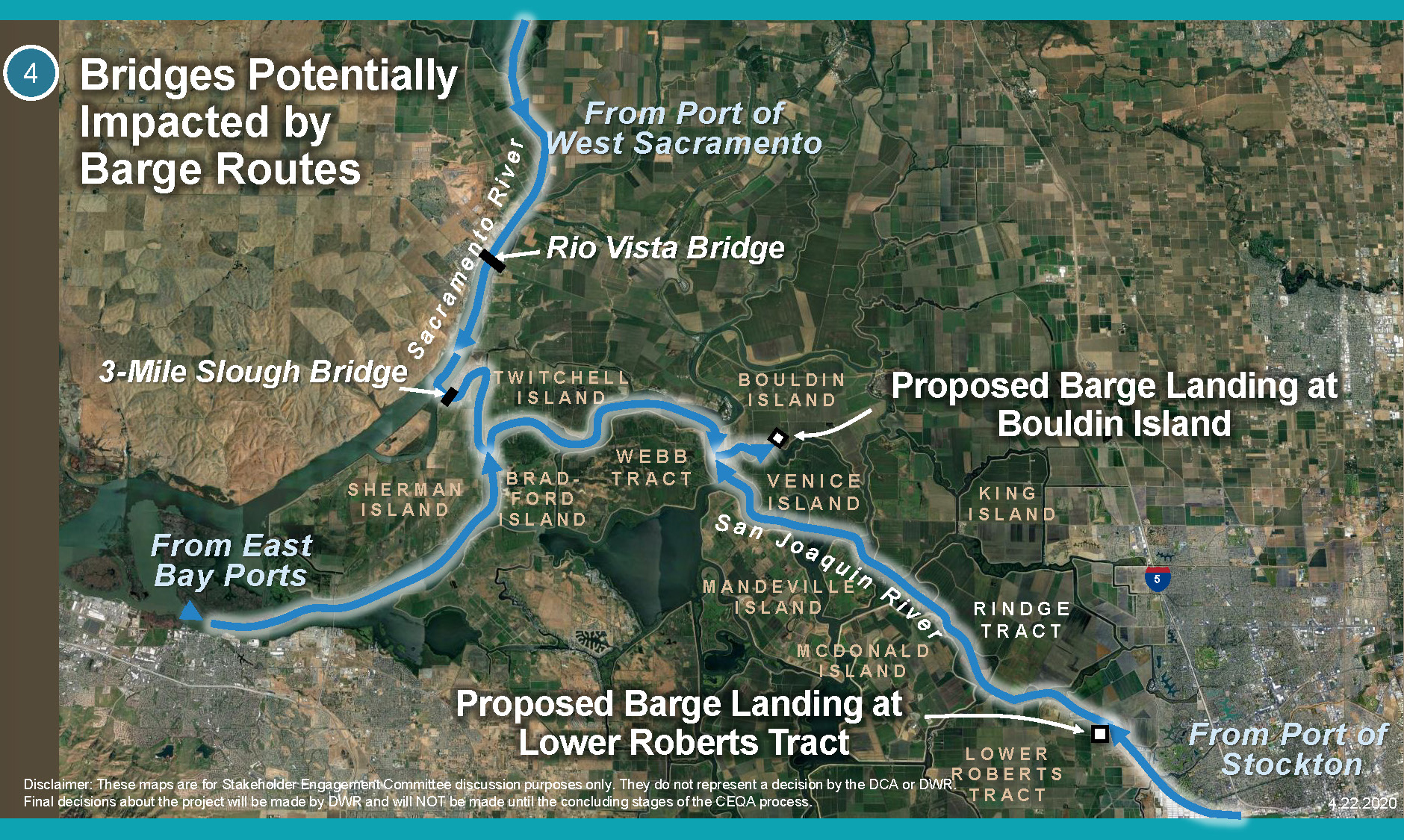
“I’m an active boater. I skipper my own 37-foot boat. I’m a very able-bodied skipper. My dad had me at the helm since I was 9 or 10 years old in San Pablo Bay,” Mann explained. “So, I’ve described to this group the terror that I had when I encountered a barge in the middle of Old River. That left me about 25’ (to get by it). My boat is 12-feet-wide. I could feel the propellers of the tugboat drawing me toward that barge. My boat weighs 22,000 lbs. Imagine if that was a ski boat with inexperienced skiers or a family with a father and his kids on board.”

“The number of barges every day that they were talking about loading, I told them ‘you better think twice. You will have lives of families and boaters on your hands,’” she continued.

From 2020-04-22-SECMeetingPresentation.

Effort to Postpone Meetings & Work Due to COVID-19 Unsuccessful

“Through this whole pandemic thing, myself and a bunch of others have said ‘let’s hold off on these meetings’ because we can’t meet with our people,” Mann stated. “The chief engineer said, ‘we’re going to move forward, and we hate to leave you behind. But that’s how it goes. Governor Newsom wants this going.’”

“I piped up and said ‘it appears to me Gov. Newsom his been very busy with this pandemic thing and his three-hour-long press conferences each day, and the Delta tunnel is probably not at the forefront of his thinking,” she shared.  “For us to be told, ‘no, that’s out of the question, we’re on a timeline’, this is just not right.”

According to a report by the Sacramento News & Review, the effort to postpone the committee meetings and the work got a Sacramento County Supervisor and the Delta Protection Commission involved.

“The dust-up has caused Sacramento County Supervisor Don Nottoli to challenge one state official about transparency, while the Delta Protection Commission has officially asked California planners to halt their work on the tunnel during the virus outbreak. So far, that hasn’t happened,” reported the SN&R.

Contra Costa County Supervisor Diane Burgis serves on the Delta Protection Commission, which  “is supposed to safeguard the environmental and community health of the estuary as part of California’s landmark 1992 Delta Protection Act.”

But the committee meetings are continuing, just online for now, as most if not all other government meetings are currently throughout the state.

No Project Funding or Route, Yet

“I asked them where are we getting the money from? Apparently, there’s no checkbook. There’s no limit. There’s no talk about expenses. It’s like carte blanch. Money is no object,” Mann stated. “There isn’t an official route, yet. Because they’re trying to decide if there is going to be a central corridor which would be within 600 feet of the Discovery Bay water treatment plan and homes on the golf course.”

“That’s not the best of it,” she continued. “The best of it is they’re using their maps of that central location they would have taken that tunnel underneath the only waste treatment plant in the area.”

“They would also be going through our artesian wells,” Mann added.

“If there were any problems, “they would shut off the water and waste treatment for Discovery Bay. How could we live here? We’re not a third world country,” she said with a laugh.

“I’ve been very passionate about those two items,” Mann stated.

She, Cox and Moran all expressed concerns about trucks on Highway 4 east of Discovery Bay and how the committee’s efforts got that stopped.

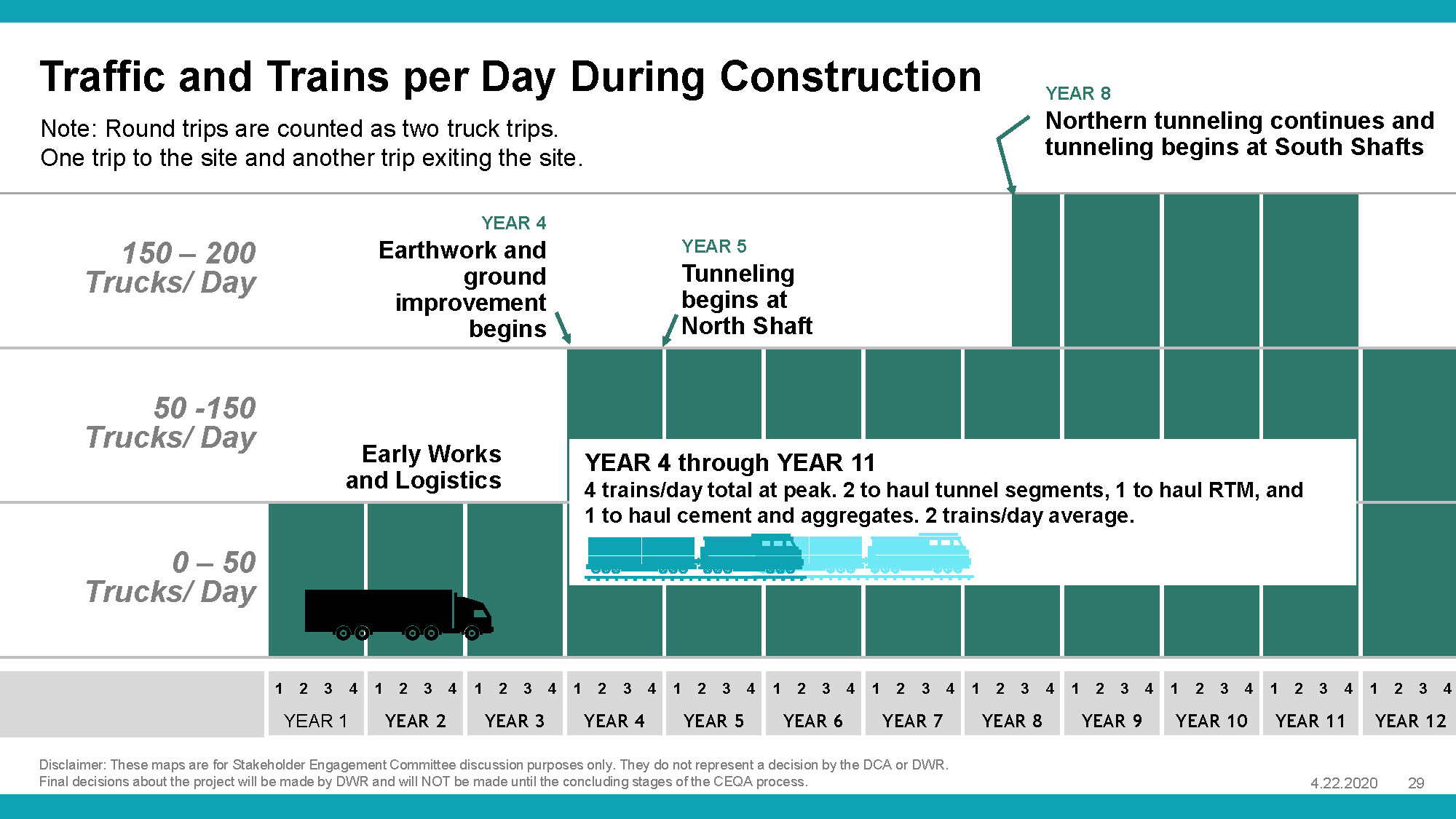
“There was also going to be a maintenance shaft near Discovery Bay which would require truck traffic on Highway 4. Heavy duty trucks carrying the muck and dirt. Those bridges are old and couldn’t handle it,” she explained.

“Now they’re talking about using the eastern corridor closer to Stockton. But they told us ‘don’t get too excited. Nothing is decided. We’ll take your recommendations, but we will make our own decisions.’” That didn’t sit well with Mann.

“Is this how government is supposed to work?” she asked. “I will say they did listen on the barge issue. I think health and safety got them.”

From 2020-04-22-SECMeetingPresentation.

Fire Marshal, DB Town Manager Shocked

“We took that information to the fire marshal and Discovery Bay Town Manager and they were shocked,” Mann shared. “Neither one of them knew about any of it. They both wrote impassioned letters. We have three fire stations that serve 128 square miles. The engineers thought we had nine stations.”

“So, who’s going to handle the issues…with a project like this?” she asked. “Someone’s going to get hurt and they’re going to need EMT’s. I guarantee you one of their trucks will have an accident and block traffic for hours, if not kill someone.”

“I’ve been sending the chief engineer photos of truck accidents and concerns that we have for our health and safety,” she continued. They had no idea of traffic count. They’re using traffic counts from five years ago from San Joaquin County and they don’t keep track of traffic on Highway 4 and the bridges in our county. So, their traffic counts are completely inaccurate.

“So, I’m wondering who’s really in charge here,” Mann said. “We’re supposed to trust them with building a tunnel 150 feet under ground? If they don’t have this basic information how can they handle the bigger issues?”

“The Delta has been something in my family since I was a child,” she shared. “It’s a way to keep families together. So, when you say Delta you’re talking about families. This life is too short, and you have to enjoy it while it lasts.”

Mann is both a residential and commercial appraiser, which is why she represents the business community on the committee.

She’s also the president of Save the California Delta Alliance.

“We have an attorney that got them to back out of the other tunnel project,” Mann shared.

“It’s just a bunch of homeowners. This is our home. The waterway is our backyard. Our playground. Don’t mess with it,” she concluded before heading out into the Delta for the weekend on the family boat.

From 2020-04-22-SECMeetingPresentation.

“Same Old Song and Dance” on Fish Protections Says a Frustrated Jim Cox – Sports Fishing

Antioch resident Jim Cox ran a six-pack, sport fishing charter boat for 23 years and has been in the Delta since the early 1980’s and is now retired.

“I’m there representing fishing interests,” he shared. “It’s been a very frustrating thing to be involved in. They want us to come back with input from our constituents. The most common thing I hear is ‘what’s going to happen with Clifton Court?’”

The Clifton Court Forebay is where the water is collected south of the Delta before being pumped further south.

Delta Smelt. Photo from DCA SEC.

“When the current is flowing in there, it’s so strong the fish can’t get out,” Cox explained. “The screens on the pumps are not designed that well. Estimates are anywhere from 15-50,000 striped bass that are trapped in there. They’re only 8 or 9 inches but they’re fully matured fish.”

“They say Clifton Court Forebay is a separate project,” he continued. “I’ve had conversations with Terry Buckman from DWR. The Delta Improvement Act of 2009 has the two goals of habitat restoration and less reliance for water supply. They’re definitely focused on the water supply.”

“They call it EcoRestore, which is part of DWR and the ironic thing is they say ‘we’re not working on that for another year or so.’ This committee will be disbanded before then,” Cox stated.

“This is the same song and dance that fishermen have been told for the past 25 years,” he complained. “In 1994 there was the CalFed agreement. The water contractors were supposed to build state of the art screens across Clifton Court so fish couldn’t get in. But it’s still never been built. “

‘Most of these DWR folks are in their 40’s so they weren’t around…and they’re taking the word for it from others at DWR,” said Cox.

“The real problem is predation (preying of one animal on another), primarily for striped bass,” he continued. “It is a problem because the current flows in there, year-round, 24 hours a day. Larger fish just stick around at the entrance and pick off the smaller fish. They try to make it sound like it’s the striped bass. It’s not. It’s the fact they never built the screens.”

“We were told Fish and Game have plans to remove predators. They have no plans for any such thing. They say it’s a useless idea. Once you get rid of one predator another species will move in,” Cox shared. “Then they said the problem is the outer screens. There aren’t any outer screens. It consists of rabbit wire fence to keep boats and floating logs out of Clifton Court. It has nothing to do with fish.”

“They won’t say anything of how they’re going to make it better. This is why it’s becoming a frustrating endeavor for me,” he stated. “On the one hand they are being responsive to some complaints. But it all revolves around building the tunnel.”

From 2020-04-22-SECMeetingPresentation.

“They won’t even listen to the fishermen. I’ve been tempted to resign a couple times over this. But, if I’m not there who’s going to bring this up?” Cox asked, rhetorically. “First, they talked about having the committee a year. But now they’re talking about extending it.”

“It’s very frustrating trying to get them to listen,” he added.

On finances Cox said “we get told things in bits and pieces. The plan is for all of this to be paid for by the water users, the water contractors. The fine print is they’ve agreed to this in theory, but not in reality. They’re not going to agree to anything until they see the final plan. Over the last year, they’ve been trying to do what took them three years originally on the twin tunnels, to finalize this plan, to be able to move forward.”

“When this COVID thing hit, they said everyone wants to continue to work on this. That’s BS,” he said echoing Karen Mann’s comments. “No one wanted to continue to do this. But they kept pushing on this because they have financing deadlines. So, nope. They’re going to keep on going.”

“I feel in a lot of ways this committee is just going through the motions. I’m starting to feel like a pawn in a chess game,” he said with a chuckle.

Another financial issue Cox shared about was the pay for the DCA’s executive director Kathryn Mallon, who is earning $47,000 per month in her role. That’s in spite of the $54 billion deficit the state is projecting due to the impacts of the COVID-19 pandemic.

Another report by the Sacramento News & Review covers that issue and the opposition from the water agencies that are expected to reimburse the state for her compensation.

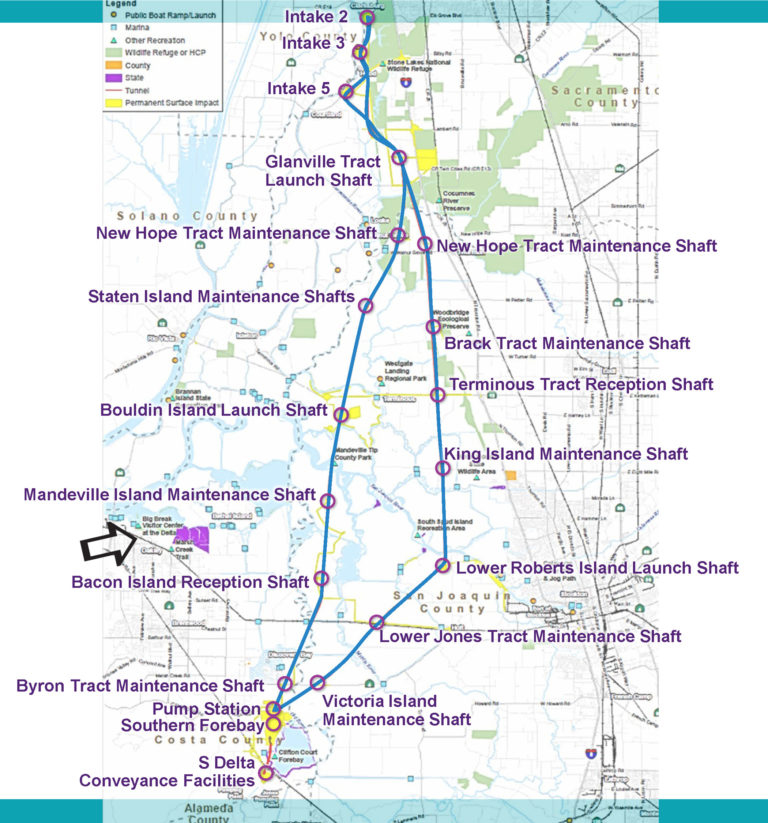
Proximity of proposed sites to existing recreation facilities. Arrow points to Big Break in Oakley. From 2020-04-22-SECMeetingPresentation.

Parks District Employee Offers Different Perspective: Mike Moran – Ex-Officio

Mike Moran, although an Oakland resident, represents Contra Costa County interests on the SEC, having worked in Eastern Contra Costa County for 26 years, as of August 1st. He works for the East Bay Regional Park District at the Big Break Regional Shoreline in Oakley.

“Big Break was an asparagus farm that flooded in 1927,” he shared. It’s a 1,688 acre park that’s mostly under water. The East County trail runs through there. Plus, they have a 1,200 square foot model of the Delta on the ground.

“In my position at the park commission and the SEC, we don’t take a pro or a con on this issue. We try to interpret this thing and why it’s being proposed, why it’s being opposed, and not just build it or don’t build it,” Moran explained. “I’m an ex-officio giving folks’ perspective from the East Bay Regional Parks point of view. There’s not a direct correlation on the tunnel.”

“We have land out here and we have folks paying taxes to get access to that land. So, what does this mean? What is the impact going to be where our constituents live?” he asked.

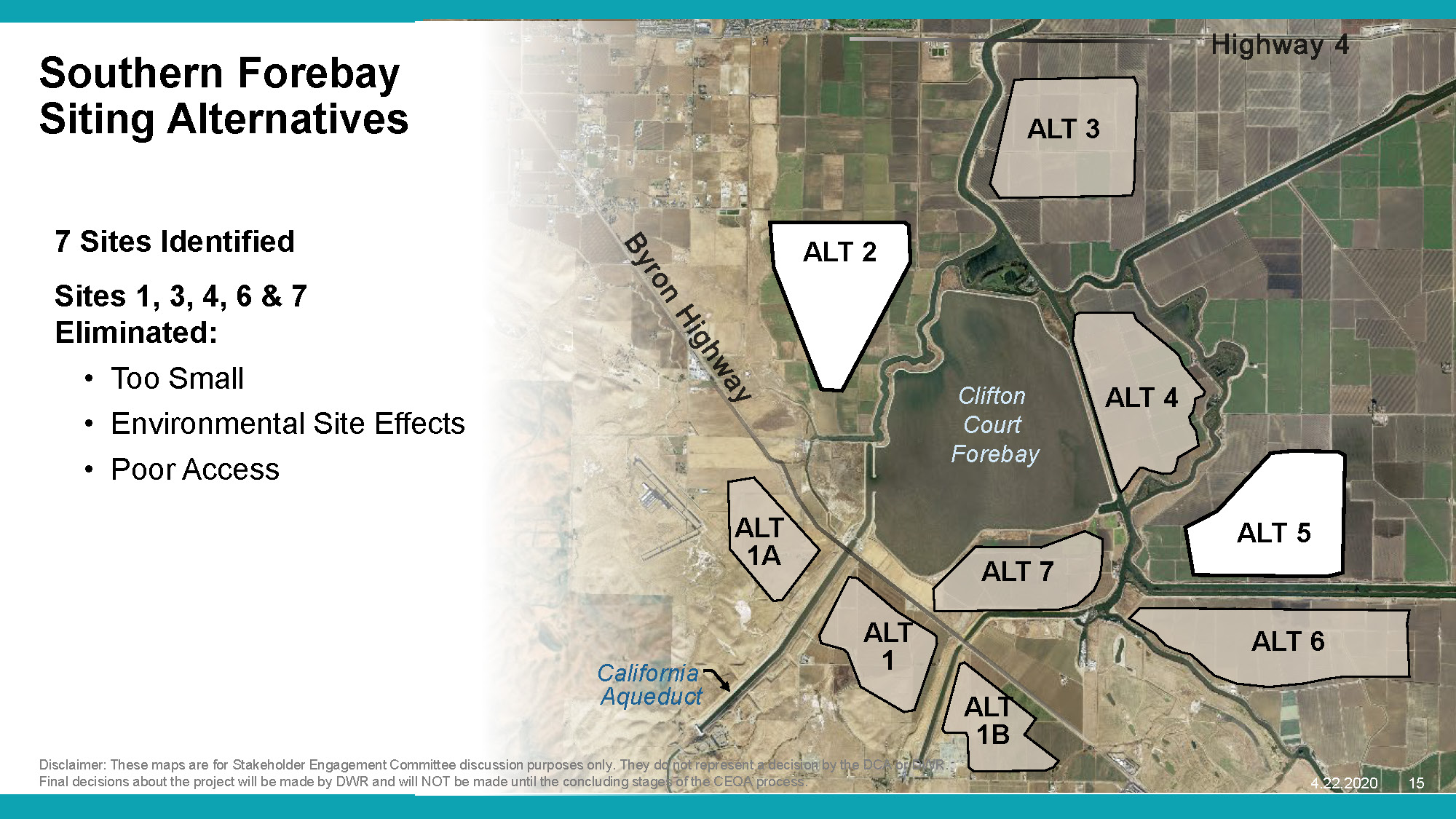
Proposed new Southern Forebay adjacent to Clifton Court Forebay. From 2019-12-11-DeltaConveyanceSystemOverview.

Moran also studied fisheries in grad school. Asked about the fish and Clifton Court Forebay that Jim Cox is concerned about, he said, “It’s part of the state water project, right now. The new forebay would be right next to Clifton Court, built to the west.”

However, Cox responded with, “The fact is that they still intend to use Clifton Court fifty-percent of the time. If the tunnel water was the only water heading into the canal then it would be fine, but that is not the case. Clifton Court will still be part of the water system and that is why I feel improvements to it should be part of the project, not a separate project.”

“The Harvey Banks Pumping Plant is part of the State Water Project. That water is sent through the California Aqueduct and the South Bay Aqueduct serving Alameda and Santa Clara Counties,” Moran explained.

“The feds will require an Environmental Impact Study on the project because it affects federal waters. That’s the Jones Pumping Plant, which is part of the federal water project. That water is pumped through the Delta Mendota Canal,” he shared.

“At the Clifton Court Forebay, as the water is drawn in, there’s a screen that screens out the fish. But it’s old school. It’s an old screen,” Moran explained. “Jim’s saying if we’re going to put in these high-tech screens north of the Delta, let’s do it at Clifton Court.”

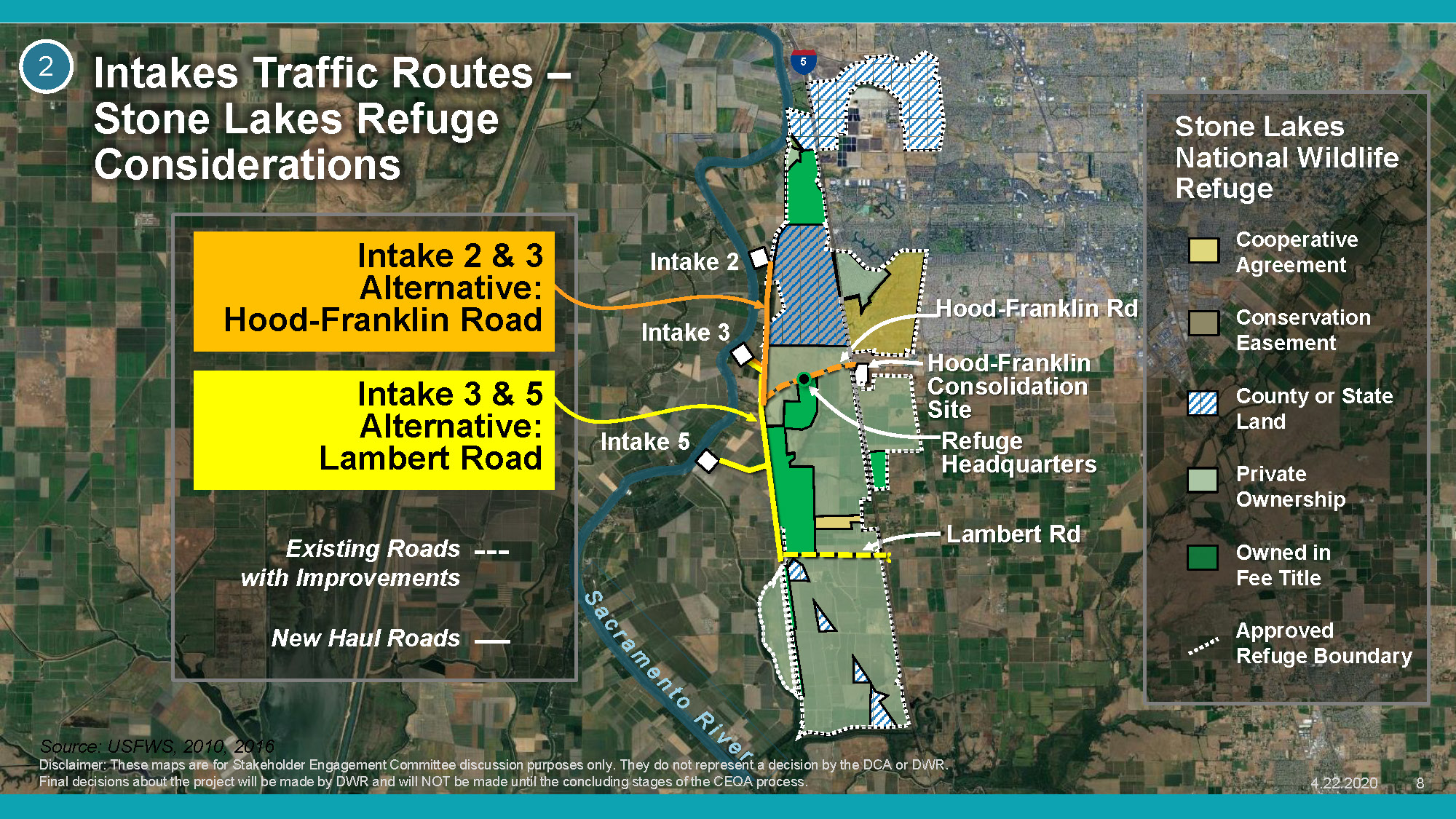
Proposed intakes near Hood. From 2020-04-22-SECMeetingPresentation.

“The screening for the proposed tunnel will be located in Hood (north of Elk Grove) on the eastern side of the Sacramento River. There will be three intakes and those would have brand new, top of the line fish screens,” he continued. “So, no fish will be put in that tunnel beyond those screens.”

“That’s one of the selling points for this whole project,” Moran stated. “What we have now, is the diversion is over the surface across the Delta. So, we’re bringing in both water and fish.”

He provided some history to the diversion of Delta water.

“The idea of diverting water, moving water from the north and east, through the Delta is from the 1910’s,” Moran shared. “A lot of the facilities we have now, are not the same thing, but they’re based on Robert Marshall’s plans. He ran the national parks and was pushing this big project of moving water around California. So, that’s part of the rationale of what we have, now.”

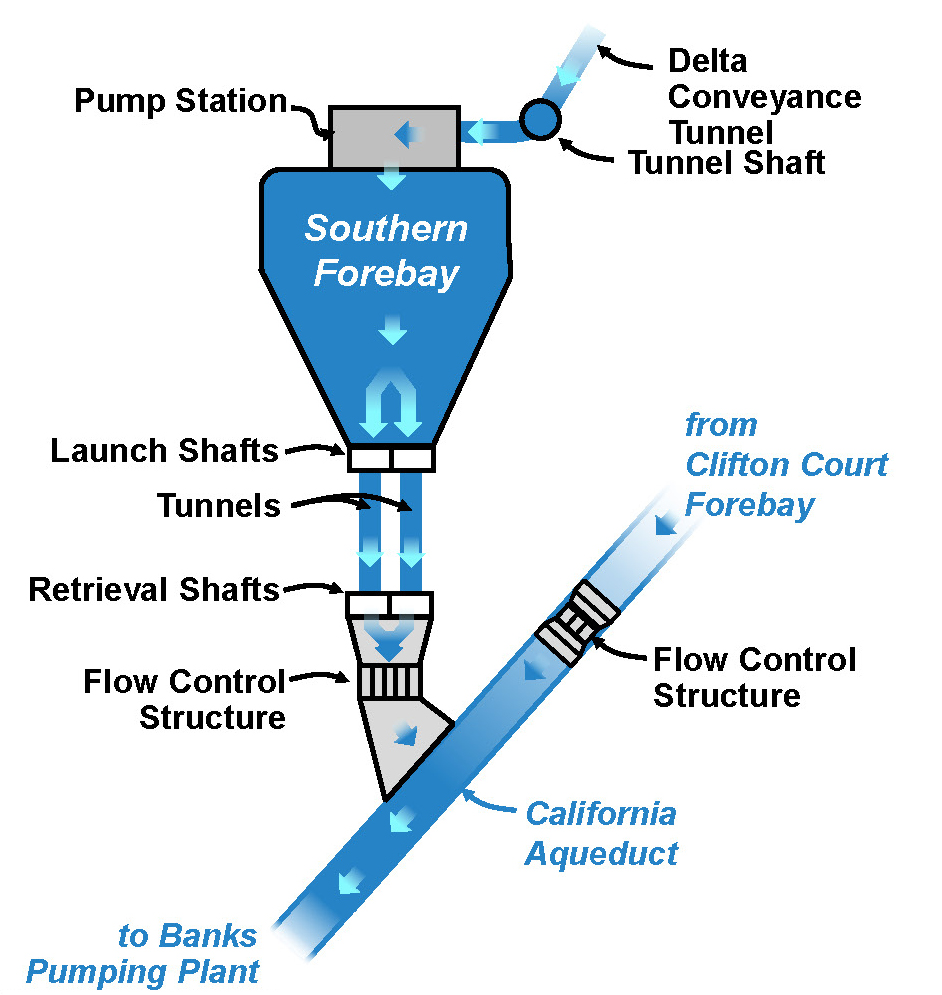
Proposed South Delta Facilities. From 2020-04-22-SECMeetingPresentation.

He also shared that “Antioch sued upstream water users in 1921 because of too much saltwater. So, this is nothing new.”

“Antioch is way ahead of the game putting in a brackish water plant. That’s a big, bold move,” Moran state. “But what are we going to do with saltwater intrusion up to CCWD?” (See related article)

Asked how the tunnel is a solution to the saltwater intrusion he answered, “It’s coming. If we divert or not, saltwater is coming. How do we prepare for that? In Antioch we build a desal plant. For those south of the Delta it’s a tunnel.”

“The way we’re doing things now, is water flows from the Sacramento River to the rest of the Delta. The pumps in Byron then pump it south,” Moran continued. “This water used to flow down the river and out into the Bay. Sometimes during the year, we have reverse flow, with the water from both the Sacramento and San Joaquin Rivers. When folks started taking water out in the Central Valley, less water comes out of the San Joaquin River. It was dry for 60 miles as recently as 1994. That was rectified through a court case.”

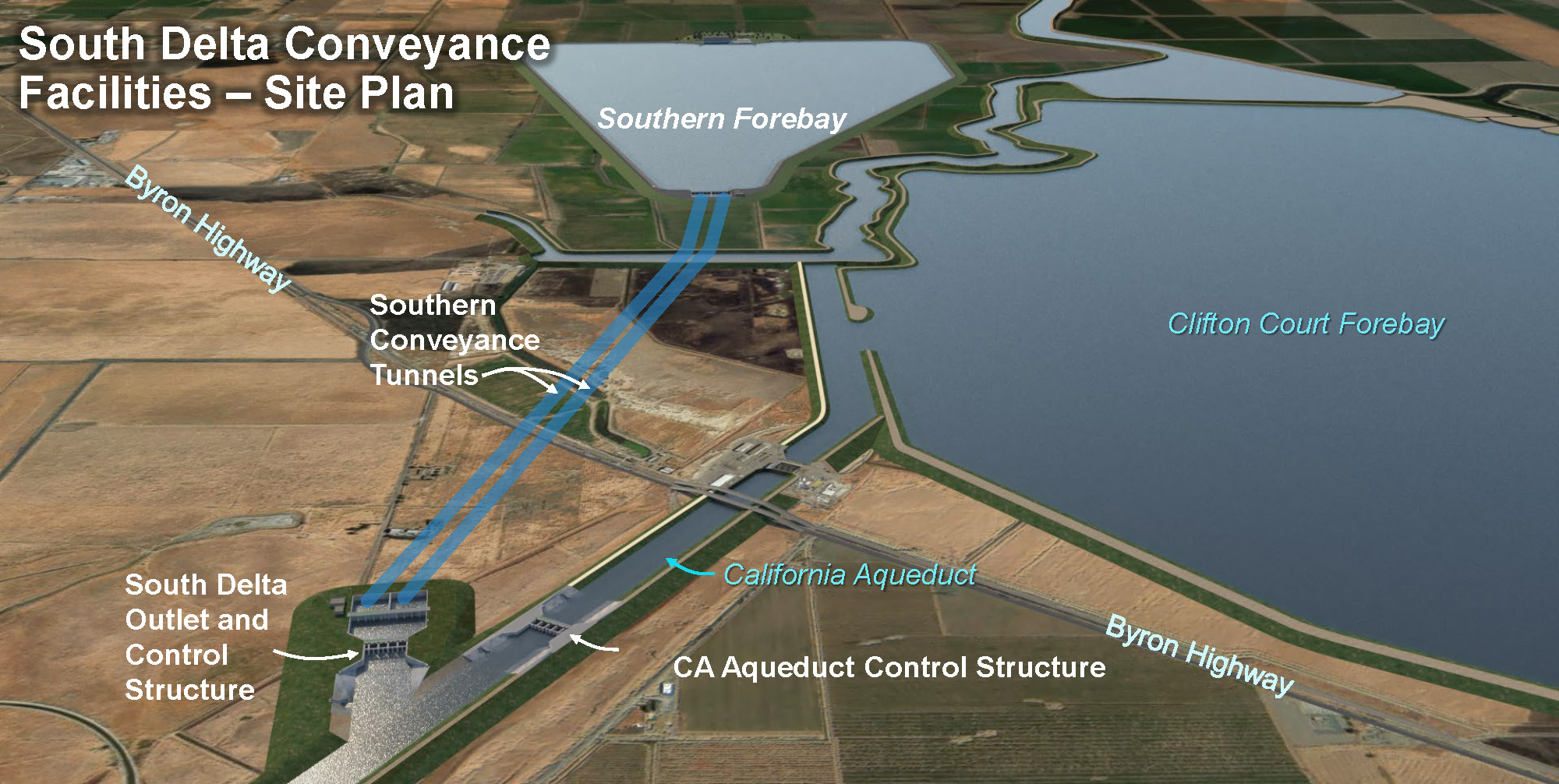
Proposed South Delta Conveyance Facilities Site Plan. From 2020-04-22-SECMeetingPresentation.

Because the San Joaquin River is diverted before it reaches and “punches through the Delta”, farmers in the Delta have been relying on Sacramento River water.

“The Sacramento River, high quality, great water, it’s pulled down to the pumps. Not all the water, it’s less than half,” he said. “That goes against the natural flow and messes up the ecology.”

“We’ve gotten a lot of benefit over the past 100 years,” with the current system, Moran shared.

“So, if we don’t do something, if saltwater comes up, or if a levee breaks or a beaver chews through, that’s going to stop the flow of water.”

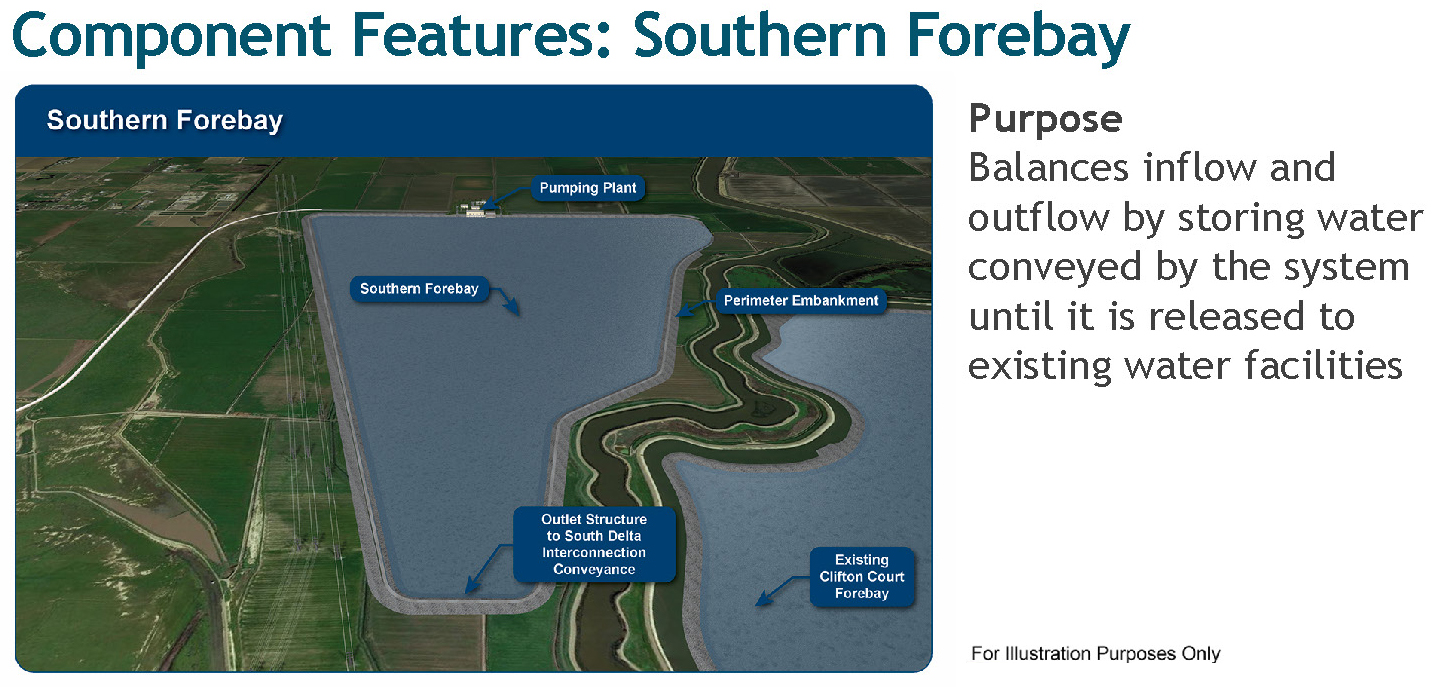
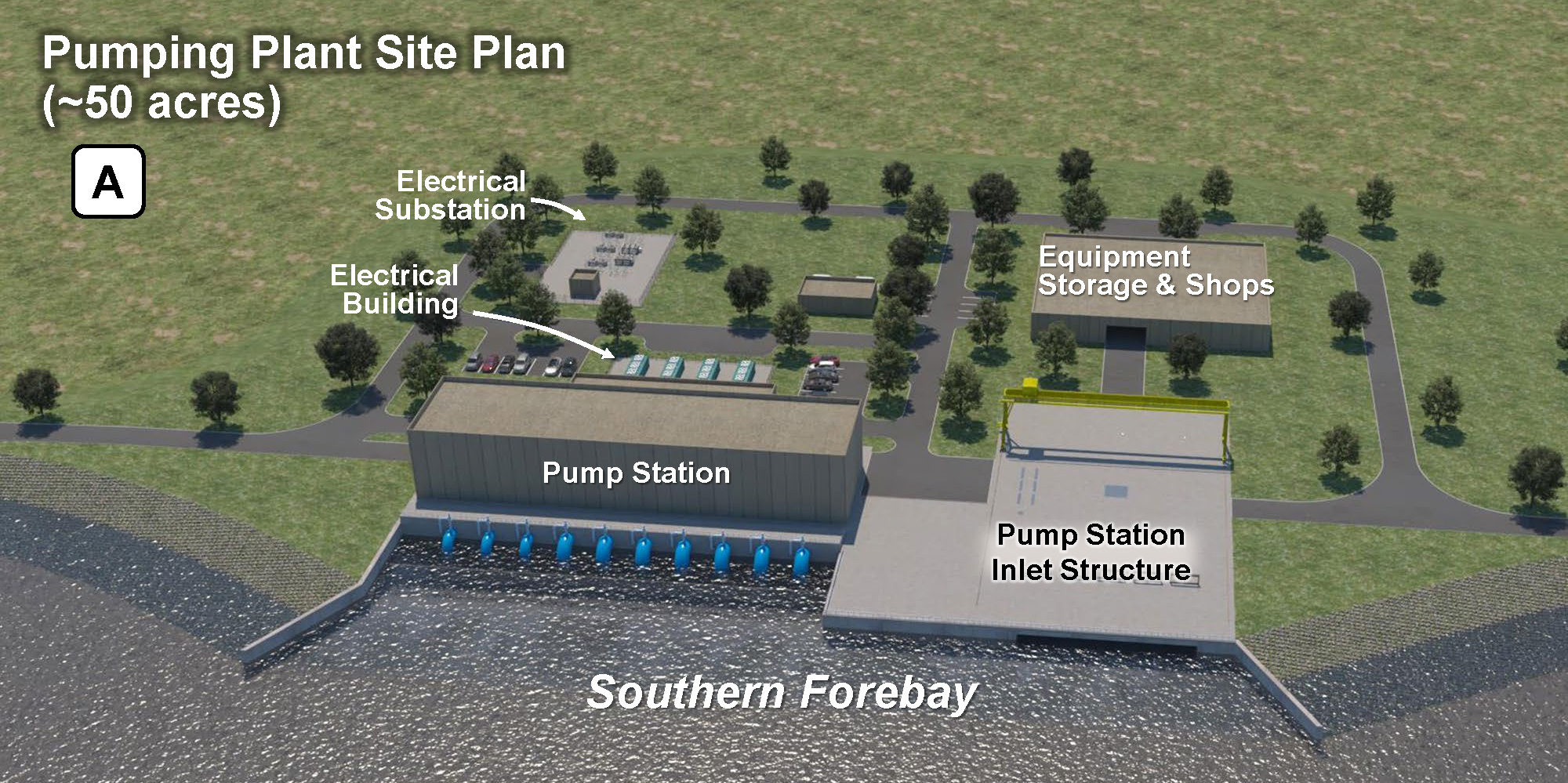
Rendering of proposed Pumping Plant Site Plan at the Southern Forebay. From 2020-04-22-SECMeetingPresentation.

“Much of the land in the Delta is under sea level because of that peat soil, which is great for farming,” he explained. “But because of decisions made over 100 years ago, because people in the Delta communities and economies, and their way of life, it’s not sustainable.”

“We’re only taking water out when there’s enough to come through,” said Moran. “Like we’re doing, now when there’s Delta Smelt at the pumps, and we have water quality going down the tubes, the feds tell them to stop pumping.”

“It’s these local folks who are members of the committee saying, ‘wait a minute, we have lives that will be affected, too,’” he shared about his fellow SEC members. “The premise is let’s pretend this is getting built. If that’s the case, all you folks around the Delta who have this local experience and expertise, to advise the experts from the DWR.”

“So, that the water can be used all year round. That’s the point of it,” Moran continued. “Is there enough storage south of the Delta? If you’re going to pump water out of the Delta where are you going to store it? There’s the San Luis Reservoir, are we going to raise the height?”

Rendering of proposed Pumping Plant at the Southern Forebay. From 2020-04-22-SECMeetingPresentation.

“Every governor has dealt with it, but Newsom is getting more traction,” he shared. “They have this portfolio plan which includes storage, moving water and ground water restoration. Not just sticking straws in the Delta and sucking it.”

“When it’s a common pool and we all have to drink out of the Delta and we all have to be responsible for it including maintaining the levees, and agriculture in the Delta,” Moran concluded.

No Committee Member Supports the Tunnel

Asked about the members of the stakeholders committee and how they were chosen, Nazli Parvizi, the Stakeholder Engagement lead for the DCA, said, “There is not a single member on the committee who supports this project. That’s based on what they wrote in their applications and others, what they’ve said over and over during the meetings.”

“It was an individual application. Not everybody represents their area of work. The requirement was if you live, work or recreate in the Delta in certain categories,” she explained. “If you have an ag person you balance it out with an environmental person. So, I think we have a good broad representation.”

“What we’re excited about Karen…she’s as reliable a source on waterways and boating as Jim Cox would be,” Parvizi shared.

“It’s not a voting body. We don’t make decisions as the DCA,” she explained. “We try to come up with the best engineering and design, the concepts and drawings and give them to Department of Water and it’s up to them.”

“We’re doing our best to take into account the Delta as place,” Parvizi continued. “So, they don’t just make sense from an engineering standpoint, but also as Delta as place. The folks who lead the DCA are representatives from DWR and the agencies that are members of the DCA. Kathryn Mallon, the Executive Director of the DCA is listening and took into consideration the Delta as place. The SEC is the result of that.”

About the committee members’ involvement, she said, “It’s trying to make the best of the worst, while at the same time trying to make sure it doesn’t happen. Karen has done a great job for Discovery Bay and boaters.”

“So, fight on your own time, protest, sue us, whatever and we’re OK with that and several are suing us,” said Parvizi. “We do want to make sure we are respectful of what you care about. They give us incredibly valuable feedback.”

“They fight their war, but on the battles they’re very collaborative,” she stated. “We give them all this information, being transparent as possible and half of them send it to their lawyers, which is fine. But they tell us which is better, A, B or C, and we make our recommendations to DWR.”

“We haven’t seen two groups fight it out,” Parvizi said, and explained how the members of the SEC work collaboratively. “If you move it (the tunnel) this way, it’s good for fish, but if you move it here, it’s good for birds. Or it’s good for animals. But if you put it here, it’s good for business.”

“We can come up with the pros and cons and I think that’s very valuable,” she added.

Opposition Efforts Continue

Efforts continue to stop the new Delta tunnel by groups such as Restore the Delta that have been fighting since the twin tunnels plan was first proposed. They along with Contra Costa County and the other members of the Delta Counties Coalition, Delta residents, Delta business owners, tribal representatives, fishing and non-governmental organizations and other Delta community-based organizations have all asked the Department of Water Resources (DWR) to pause Delta tunnel planning processes that require public participation due to the impact of the coronavirus pandemic. The Department of Water Resources has refused.

Contra Costa is represented on the DCC by County Supervisor Karen Mitchoff.

In their letter dated April 7, 2020, the DCC wrote California Natural Resources Agency Secretary Wade Crowfoot, “The Delta Counties Coalition (DCC) respectfully requests that you direct the Department of Water Resources (DWR) to pause all Delta Conveyance Project planning and engineering design processes that require Delta stakeholder engagement during the COVID-19 crisis, until the public can fully participate. We request that you ask the Delta Conveyance Design and Construction Authority (DCA) to pause its processes that require public participation, including Stakeholder Engagement Committee meetings, so that the Delta tunnel engineering design can be informed by meaningful public input. We also ask that you direct DWR and other resource agencies to extend public comment periods by at least 45 days beyond the end of the declared emergency.” 2020-04-07-Delta Counties Coalition-Letter-to-Secty-Crowfoot-re-Stay

The Secretary Crowfoot and the Department of Water Resources has refused, but have instead allowed the DCA and SEC to hold their meetings online.

Upcoming Meetings

The next meeting of the 20-member DCA Stakeholder Engagement Committee will be held on Wednesday, July 22, 2020 from 3-6 PM. Topics are expected to include: Scoping Update (DWR), Rehabilitation of construction impacted land, Final temporary and permanent boundaries, and Intakes Update (*subject to change). Ring Central Video Conference. Information Join from PC, Mac, Linux, iOS or Android: https://meetings.ringcentral.com/j/1489140415;  iPhone one-tap: US: +1(916)2627278,,1489140415#; or Telephone: US: +1(623)4049000 Meeting ID: 148 914 0415.

Ways to Stay Informed

To stay informed of plans and progress on the Delta Conveyance Project visit https://water.ca.gov/Programs/State-Water-Project/Delta-Conveyance; Twitter @CA_DWR; email DeltaConveyance@water.ca.gov; or call the Project Hotline at 866.924.9955.

Filed Under: Agriculture, Business, East County, Environment, News, Recreation, The Delta

Contra Costa off state’s COVID-19 watch list as of Friday night

July 3, 2020 By Publisher 35 Comments

Check marks indicate a county has fallen below the monitoring level for that criteria.

County health officials evaluating local data to determine any further business reopening

By Allen Payton

As of Friday night, according to the California Department of Public Health (CDPH) COVID-19 website, Contra Costa County is no longer on the state’s Watch List for monitoring cases.

The state monitors three criteria, which includes elevated disease transmission with a case rate of more than 100 or a case rate of greater than 25 and positivity of more than 8%; increasing hospitalization of more than 10%, and limited hospital capacity with less than 20% of ICU beds available or less than 25% of ventilators available.

Contra Costa has fallen below the criteria which flags counties for inclusion on the watch list.

Asked if there had been an announcement about this new information since our county was included in the list as of Governor Newsom’s announcement on Wednesday, July 1, Contra Costa Health Services spokesman Karl Fischer responded, “No. Counties go on and off the watch list with some regularity, including ours.”

Asked if those businesses that were supposed to reopen on Wednesday would now be allowed to reopen on Monday, Fischer responded, “No determination has been made about changing the reopening timeline. We are evaluating the local data.”

A description of the data being monitored can be found in the Understanding the Data Being Monitored section. The data chart is updated and posted daily.

Filed Under: Business, Health, News, State of California

Governor allows local governments to extend renter protections through Sept. 30, marriage licenses via videoconferencing, more

July 1, 2020 By Publisher Leave a Comment

SACRAMENTO — On Tuesday, June 30, 2020 California Governor Gavin Newsom issued an executive order extending authorization for local governments to halt evictions for renters impacted by the COVID-19 pandemic, through September 30. Currently Contra Costa County’s urgency ordinance preventing evictions and rent increases expires on July 15.

The order also addresses a variety of issues in response to the pandemic, by extending provisions in earlier orders which allow adults to obtain marriage licenses via videoconferencing rather than in-person during the pandemic; waive eligibility re-determinations for Californians who participate in Medi-Cal, to ensure they maintain their health coverage; suspend face-to-face visits for eligibility for foster care; and permit In-Home Supportive Services (IHSS) program caseworkers to continue caring for older adults and individuals with disabilities through video-conferencing assessments.

The order also extends waivers temporarily broadening the capability of counties to enroll persons into the California Work Opportunity and Responsibility to Kids (CalWORKs) program, allowing for self-attestation of pregnancy and conditions of eligibility, and waiving in-person identification requirements.

In addition, the order extends provisions allowing for mail-in renewals of driver’s licenses and identification cards, to limit in-person transactions at the Department of Motor Vehicles, and extends timeframes related to the payment of real estate license application and renewal fees and continuing education requirements for licensees.

The text of the Governor’s executive order can be found here and a copy can be found here.

Filed Under: Business, Families, Health, News, State of California

  • « Previous Page
  • 1
  • …
  • 18
  • 19
  • 20
  • 21
  • 22
  • …
  • 28
  • Next Page »
Deer-Valley-Chiro-06-22

Copyright © 2026 · · Contra Costa Herald · All Rights Reserved