• Home
  • About The Herald
  • Local Agencies
  • Daily Email Update
  • Legal Notices
  • Classified Ads

Contra Costa Herald

News Of By and For The People of Contra Costa County, California

  • Arts & Entertainment
  • Business
  • Community
  • Crime
  • Dining
  • Education
  • Faith
  • Health
  • News
  • Politics & Elections
  • Real Estate

Parking and circulation improvements at Antioch BART Station in January

December 31, 2020 By Publisher 1 Comment

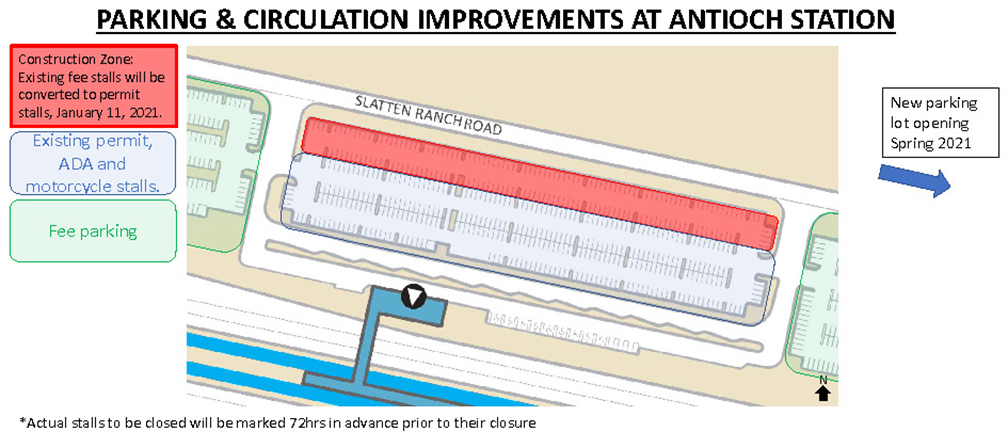
Graphic: BART

As we expand parking at Antioch Station, we will be making some modifications to the existing parking lot to increase permit parking. Effective January 11, 2021, Lot B, which is the parking area directly in front of Antioch Station, will be converted to all permit parking. The only exceptions are that the ADA stalls will remain fee parking and the motorcycle stalls will remain free. These modifications require adjustments in signage and pavement markings.

All parking stalls that are to be closed temporarily for construction will be signed at least 72 hours in advance. Please look out for barricades and signage to guide you around the work areas during this time.

Please see the attached map of work areas and the final parking lot configuration. Be advised that the final configuration will require customers parking in the solar panel covered lot (Lot B) to display a BART parking permit, available from Select-a-Spot.com. Fee parkers may park in the adjacent parking lots. Additional fee parking (roughly 850 parking stalls) will also be available Spring 2021.

We apologize for this inconvenience and appreciate your patience during this construction.

During the current COVID-19 pandemic, some BART projects, including Antioch Station Parking Expansion Project, have been designated as essential. For this reason, construction activities on the Antioch Station Parking Expansion Project will continue for the time being. BART and Contractors will ensure that workers comply with all CDC guidelines including the social distancing requirement. BART and Contractors will make adjustments as updates to the current situation are provided.


Filed Under: BART, East County, News

Senator Glazer calls BART labor contract extension “premature”, “big mistake”, Director Allen one of two to oppose

December 4, 2020 By Publisher 1 Comment

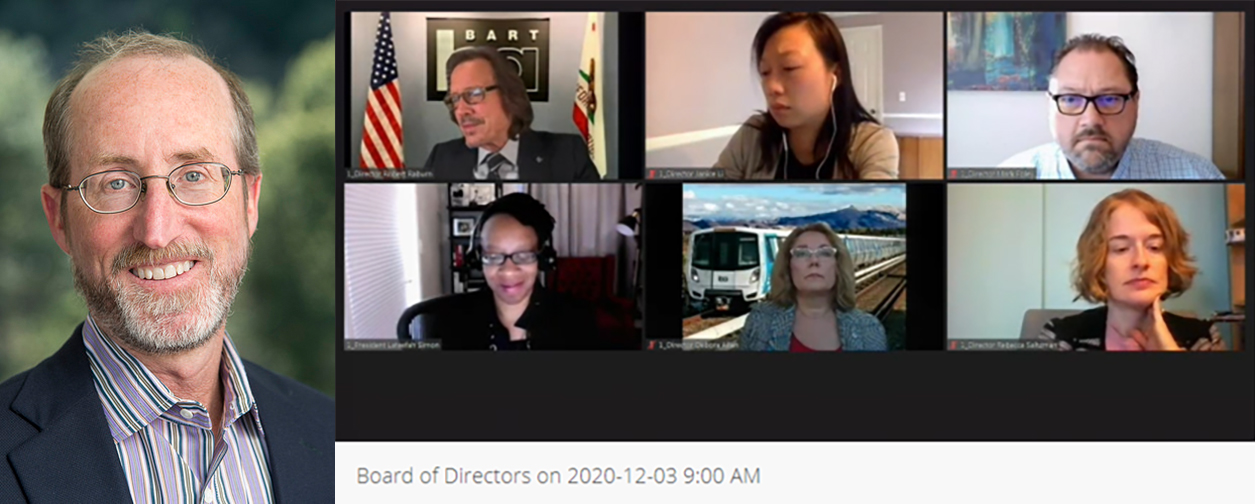
State Senator Steve Glazer and screenshot of BART Board meeting, Thursday, Dec. 3, 2020.

Board approves contract “after secret negotiations were held during BART Directors’ campaign elections” he said.

“…giving space to someone who can’t pronounce our past GM’s name or spell eBART correctly and someone who makes false claim after false claim is a disservice to the public and spreads lies.” – BART Director Li

“These agreements offer BART budgetary stability as we plan our recovery from COVID-19.” – Board V.P. Foley who voted in support.

“The contract extensions come seven months before the contracts are due to expire, locking in employee costs at pre-pandemic levels…at the level that it was when we were carrying 410,000 riders each week day and now we carry about 50 (thousand).” – BART Director Allen

By Allen Payton

In an attempt to get them to reconsider the proposed labor contract with employee unions, State Senator Steve Glazer challenged the BART Board during their meeting on Thursday, Dec. 3. He asked why they were considering the contract long before it’s set to expire, and more is known about the impacts of COVID-19 next year. In response, he was called a liar by one director.

Nevertheless, the BART Board voted 7-2 in favor of the contract, with Directors Debora Allen from Contra Costa County and Liz Ames from Alameda County casting the votes against. Board Vice President Mark Foley who represents other portions of Contra Costa County voted in favor of the contract extension.

Glazer issued a statement earlier this week about BART’s announcement “on Thanksgiving eve…(about) a tentative labor contract with their represented groups, after secret negotiations were held during BART Directors’ campaign elections.”

“Along with other specific contract changes, this tentative agreement is premature and a big mistake and will likely harm BART riders, commuters and taxpayers through fare hikes and service erosion,” his statement continued.

Glazer read most of the statement during the Thursday meeting, but offering additional comment.

“I want to be clear what I have to say reflects my views of accountability and trust that the public expects from all of us,” he said. “I think we all agree that BART is in a financial meltdown due to the pandemic and it’s not clear to me that you have a clear plan for recovery. The district’s own financial analysis projects a shortfall of tens of millions of dollars by next summer amidst the steepest decline in ridership in your agency’s history. My view, the district needs all the flexibility it can to avoid a financial disaster. Yet, BART is tying its hands with this agreement.”

“In the first half of 2021 BART will have a clearer idea about the COVID-19 vaccine availability, ridership improvements, any potential financial bailout assistance from the federal government, and the results of your early retirement incentives that have already been offered to existing employees,” Glazer explained. “All of these potential outcomes will provide important budgetary insight that should shape any new contract terms. But instead of waiting for that information, you are now rushing to approve a contract, negotiated behind closed doors, with no public notice and it will prevent you from making any kind of targeted salary reductions if your revenues do not recover. This will likely lead to service reductions and fare increases which will hurt the very people you are here to serve.”

His statement issued on Monday adds, “BART is leaving few options but to lay off employees and curtail the number of trains, which would further depress ridership and deepen the agency’s financial crisis.

“So, I come here with a question,” Glazer continued during the meeting. “The current labor contract with your representative employee groups doesn’t expire until July 1st, 2021. So, why did the district make an early agreement with so many economic unknowns?”

“It’s my understanding that BART has not even done a salary survey of other transit districts and public agencies to determine if the current salaries called for in this agreement are needed to recruit and retain qualified employees, basic data needed to inform any effective negotiation,” he said. “I question whether the failure to conduct a salary survey is keeping with board policy and procedures.”

“Now, the public was never told when your negotiations started. I’m told these negotiations were initiated by the Board in September and October. If true, that means that directors were negotiating with BART unions on their salaries and benefits on one hand, while asking the same unions for campaign contributions with the other hand. This is an outrageous injection of politics in a hugely consequential employer-employee agreement. And by setting the terms of the agreement at three years rather than four years based on past contract durations, the future contract will be negotiated during another election year.”

“You know that, Board members, before you came to this board for the most of you, had worked for a long time to ensure the contract negotiations would not be immersed in politics and election year circumstances. So, that four-year duration was done purposely. You unravel that in this proposed contract before you.

“In this agreement, for the most part, you’ve abandoned any of the work rule changes that were central to the 2013 contract negotiations. Where have those work rules been laid out, publicly disclosed and discussed, so that we can understand why they’ve been abandoned in this agreement.”

“You know, when the strike happened in 2013, BART management was clear that the work rules were probably more important than the salaries and benefits being negotiated. It had that kind of consequence and impact on the agency. But there’s a complete void of understanding or knowledge about what efforts were made to negotiate those work rules.”

It reversed important e-BART reforms that were instituted by former General Manager Grace Crunican. Again, BART, the board members, and the management (were) very involved in establishing those eBART reforms which you’re throwing out in this proposed contract.”

So, it’s not surprising to me, that you are moving forward with due haste to approve these negotiations and rush this contract through with very little public review, and I think that it’s because the details and the consequences are uncomfortable.

“I would hope that you will reconsider what you are doing, today and take a more deliberate and cautious approach to these negotiations as you consider the full impact of the pandemic on our economy. It would be best for your financial well-being and more importantly for BART riders throughout the Bay Area.”

“In conclusion, let me just say that the foundation of your service as board members is to ensure that this transportation system is able to function during good times and bad times. This contract continues the limitation against training management to run the trains during a work stoppage. So, all of BART riders, many of them low-income people who can’t afford to stay home, will be prevented from getting to work under this contract provision. We’re talking about teachers and nurses, social workers, grocery clerks and other essential workers, who will all be left stranded if your trains stop running because you created this self-inflicted problem.”

“This strike protection provision is an abdication of your sacred duty and will limit future boards from helping the commuters when matters cannot be worked out at the bargaining table. And listen, we all would strongly hope that all matters can be worked out at the bargaining table.”

In  his issued statement, Glazer included, “BART’s management doesn’t want the public to see what they are doing because they know that BART riders and other Bay Area residents would not support this agreement if they understood its details and its consequences.”

The BART Directors then took up the issue of the labor union contract.

General Manager Robert Powers responded to Glazer, saying, “I was the one…negotiating these tentative agreements with our labor partners. There were no elected officials in those discussions. I was supported primarily by our chief labor negotiations officer as well as our AGM of Operations. I wanted to be…crystal clear that it was me leading these negotiations under the authorization granted to me by the BART Board.”

During public comments, Sal Cruz, president of AFSCME Local 3093 said, “Our work has accelerated during this pandemic at great risk to our employees, as we position ourselves for the recovery we know will come. Proper positioning will be critical for the survival of all transit and for the Bay Area economy that is now linked to BART. Thank you for your leadership during these challenging times. Every transit agency in the country is in the same position as you are, now. The decision before you, today, is not an easy one. But it allows us to focus on rebuilding o ur system, continuing to provide safe transportation for our essential workers and preparing for the return of our riders. The workforce is behind you, the riders are behind you and the Bay Area is behind you.”

Li Calls Out Glazer

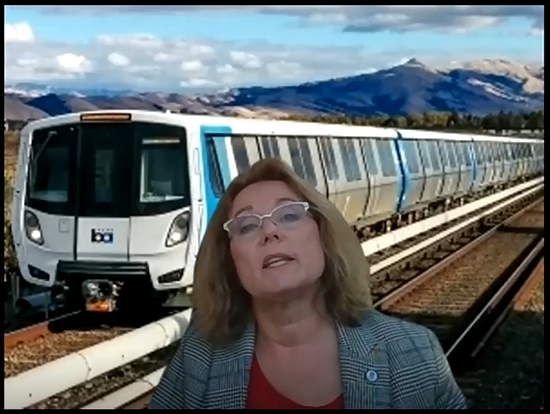
BART Director Li speaks in favor of the contract. Video screenshot of board meeting, Dec. 3, 2020.

BART Director Janice Li, who represents District 8 which includes portions of San Francisco, spoke next calling out Glazer for lying, mispronouncing the past general manager and misspelling eBART (it was spelled “e-Bart” in his statement from earlier in the week.

“I am proud to vote yes on this action, today. A yes vote, today is a yes vote for BART, is a yes for our riders and a very, very important yes for our workers,” she said. “Voting no makes BART an enemy to our workers and our riders.”

“There has been a lot of talk about this decision coming forward as too early or as a result of private meetings. I just want to be very clear that this claim is factually not true,” she stated. “First, I’m a member of the board’s labor negotiations review committee. We have been meeting since May of this year, then again in July, then again in August. These meetings are open to the public. They are publicly noticed and at subsequent board meetings we always give updates during board reports.”

“Second, we have held multiple closed session meetings regarding labor relations in recent months, and once again they have always been noticed as part of our board agenda,” Li continued. “Third, people who are saying that this is too early are saying that because the financial situation ahead is so unclear and that the board should wait until more is known. The truth is that things will inevitably change. But our staff has been doing excellent work in scenario planning and being transparent about all the potential futures, both good and bad. Furthermore, this contract is not one in the same as our budget revisions. In fact, this does not mean layoffs can’t or won’t happen. So, saying that by voting, yes it ties our hands or limits our options is incorrect.”

“And fourth, respectfully, I strongly refute the false claims made by Senator Glazer. Honestly, giving space to someone who can’t pronounce our past GM’s name or spell eBART correctly and someone who makes false claim after false claim is a disservice to the public and spreads lies. The idea that this was timed with elections is wrong and I will speak for myself, I was not up for election, re-election and I have not raised a cent for re-election, this year and I was not even endorsed by unions when I first ran in 2018.”

“So, what we actually have before us is a result of an incredible collaboration between BART management and labor unions and at the end of the day, who benefits?” she asked. “It’s our riders.”

She then thanked “the entire BART team for rebuilding trust with our labor unions and of course I want to thank our labor union partners for being collaborative at an incredibly difficult time.”

“As a board member I’m incredibly grateful that this decision is coming to us sooner rather than later so we can get back to focusing on running a safe system for our essential workers and implement a successful recovery plan during and through the pandemic that has raged every public transit agency, every public institution and every aspect of our lives. Let’s vote yes on this, today and if you remember our new slogan from the board workshop, earlier this year which, I know feels like years ago, ‘Let’s Go,’” she concluded.

Allen Offers Arguments Against Contract

BART Director Debora Allen speaks during the board meeting on Thursday, Dec. 3, 2020. Video screenshot.

Director Allen spoke against the contracts and supported what Glazer said.

“First, I want to touch on the private meetings because that seems to be a contentious little dialogue. I believe that is absolutely how these contracts come to be,” she said. “It is unfortunate the board discussion about these agreements doesn’t happen in public session. I believe we shouldn’t be discussing the contract extensions in closed door sessions where board members may say things that they would not say in public. In addition, I really do believe not enough of our own closed board discussion has occurred prior to this day of ratification.”

“There’s so much operational uncertainty, right now for BART and I’m not comfortable that the financial projections and plan give us the data we need for this decision,” Allen continued. “It’s really hard to say whether these are fair contracts. But despite having received $377 million in federal CARES Act subsidies already, this year, BART  projects another $210 million deficit over the next 18 months and that is the case after we slashed the capital and pension funding allocations from the Fiscal Year ‘21 budget, along with the load shedding to the capital budget that has occurred throughout this year.”

“From my view we should be receiving regular updates of projected deficits for three years…and that information should be part of any decision by this board to extend labor contracts for three years out. They go together. Labor is 80% of our budget,” she stated.

“So, now we are all hopeful that another $377 million will come to us from D.C. and we’re hopeful that the retirement incentive will induce enough people to retire from exactly the right positions that we can afford to eliminate which we know is not really a reasonable assumption. We already know that some people are retiring from positions that we are going to have to turn around and refill,” Allen said. “We shouldn’t be budgeting to hopeful or aspiration. This is what we did back in June when we passed the budget, and it didn’t work out. We really projected far more revenue than we have. But, if even if those other things come true…it will likely only fund another three-quarters to one year of operating deficits. And it won’t do anything to make up for the lack of capital funding and pension funding that we put aside in ’21 and are likely to do, again in Fiscal Year ’22.”

“The contract extensions come seven months before the contracts are due to expire, locking in employee costs at pre-pandemic levels even as revenue projects remain wildly uncertain well into the next couple of years,” she explained. “Costs will be locked in at the level that it was when we were carrying 410,000 riders each weekday and now, we carry about 50 (thousand).”

Foley Speaks in Support

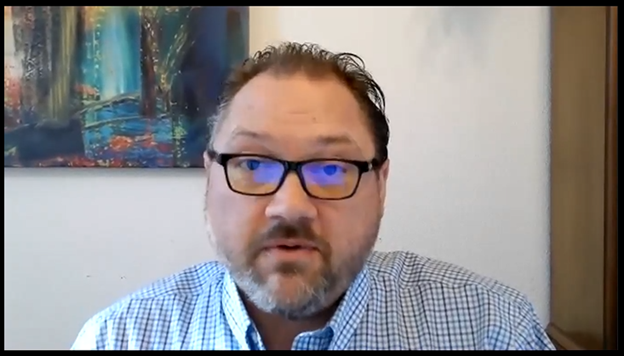
Board Vice President Mark Foley speaks on the matter during the meeting on Thursday, Dec. 3, 2020. Video screenshot.

Foley shared his thoughts in support of the contract.

“There was a lot of hard work that went in to making this happen. I am fully in support of this prudent approach to labor negotiations during the pandemic,” he said. “These agreements offer BART budgetary stability as we plan our recovery from COVID-19. A wage freeze, next year, coupled with two years, of at most, very modest increases, increases that are directly tied to returning ridership and BART’s financial recovery, is a responsible course of action to take.”

“More importantly, you know these contracts provide language to allow us to reopen negotiations, a necessary safety net during these challenging times,” Foley continued. “These proactive steps are being taken to hopefully avoid further service cuts, like closing stations, eliminating weekend service or laying off employees, employees that will be needed when we ramp up service.”

“And to those employees I say thank you. You are BART’s most important asset,” he stated. “We wouldn’t have been successful if not for the collaboration of your union leadership and union partners.”

“And lastly, I’d like to thank the district secretary’s office for bringing this item, publishing this agenda to the board, two days early rather than publishing it during the Thanksgiving holiday. This gave us additional transparency around this action. I urge my fellow board members to vote in support of these tentative agreements and I fully support this motion,” Foley concluded.

Other board members spoke, mainly in favor of the contract extension and they then voted 7-2 to approve.

Filed Under: BART, Finances, Labor & Unions, News

Op-Ed: BART-Board Director Debora Allen deserves re-election

October 27, 2020 By Publisher Leave a Comment

Publisher’s Note: This is in response to an Op-Ed published on August 28. There have been challenges with our email account info@contracostaherald.com and although sent on Sept. 4 this Op-Ed was not seen until recently. For both the Contra Costa Herald and Antioch Herald, please for now, use editor@antiochherald to submit letters to the editor or opinion pieces. Thank you and apologies for any inconvenience.

By Michael Arata

Joshua Anijar says the Bay Area “deserves leadership that doesn’t divide us” (Op-ed, Aug. 28).

But as executive director of Contra Costa County’s AFL-CIO Labor Council, Anijar’s stock in trade is division.  In the present case, that involves a cynical campaign to replace BART-Board incumbent Director Debora Allen in BART’s District One (South County and much of Central County).

Allen has been a voice of fiscal and regulatory sanity on the nine-member BART Board.  So she’s appreciated by sensible BART passengers and attentive citizens at large whose taxes subsidize BART operations and capital projects — but not by Anijar and some other special-interest activists.

Allen’s rationality is particularly needed during the time of COVID-19 restrictions and outright shutdowns.  As she wrote in July, BART has lost 88 percent of its ridership during the pandemic, with a resultant $35 million drop per month in farebox revenue.

But over Allen’s objections, the BART Board majority’s new budget foolishly increases operating expenses by 6 percent anyway, including a $32.5 million labor-cost increase.

Anijar’s breezy reference to “400,000 trips per day” represents merely an historical artifact; present reality is only 48,000 trips per day.  Allen speaks for the grownup position: “BART’s failure to cut operating expenses will continue to worsen its grave financial condition and cause irreparable harm to the long-term sustainability of the system.”

Last year, following the fatal stabbing of a BART passenger, Allen wrote about BART’s obligation to insure safety on the system’s trains and in its stations.  She noted insufficient police presence, rampant fare evasion, and aggressive panhandling as contributing factors in a widespread perception of unsafe conditions.

The 2018-19 Alameda County Civil Grand Jury documented similar concerns:   “Violent crime on BART, including robberies and aggravated assaults, increased by 115% over the last five years…. Rider satisfaction with BART fell from a high of 84% in 2012 to a low of 56% in 2018…. [S]ince at least 2012, cleanliness has been a top concern for riders who responded to the survey.”
The Grand Jury report continued: “Respondents… cite ‘personal security in BART system’ as the second largest service rating decline…, just after fare evasion.  Lack of visible police presence on trains and in stations has long been a concern of riders…. News reports of the three homicides in July 2018 and video in October 2018 of a man swinging two chain saws while riding BART reinforced worries among Bay Area residents about their safety on BART.”

So, Anijar’s assertion that Debora Allen’s Bart Board record “shows her to be unresponsive to public wishes and hostile to public input” is false.  And her real-world track record is exemplary, not “shameful.”

Anijar’s primary interest, meanwhile, is presumably the next round of increases in BART-employee salaries, current benefits, and pensions.  As is, nearly 1,000 BART employees receive total annual compensation already exceeding $200,000 (2019 figures, available at TransparentCalifornia.com).

Anijar has been busy on another front as well.  He’s a principal coordinator and ballot-argument signer for Measure X, a regressive half-percent sales-tax increase for all of Contra Costa County, lasting 20 years, at a time of pandemic-driven financial distress for much of the County’s population.

The measure, appearing on this November ballot, advertises specific purposes — but it’s framed officially as a general tax instead, “solely for general governmental purposes and not for specific purposes.”

Representatives of County employee organizations demanded such a tax measure 15 months ago.   And as a general tax, its proceeds could be used to “free up” current general-fund expenditures to pay for compensation increases, while backfilling the general fund with new Measure X dollars.

Arata is a co-founder of the Alliance of Contra Costa Taxpayers, and a signatory to ballot arguments opposing Measure X.   


Filed Under: BART, Opinion, Politics & Elections

Op-Ed: Union leader opposes Allen for re-election to BART Board over her support for more police

August 28, 2020 By Publisher 3 Comments

By Joshua Anijar

In the Bay Area, BART connects us all, and it deserves leadership that doesn’t divide us.

One of the best things about the Bay Area is the way its people live their beliefs. Hardly an election goes by without residents voting to support the places, institutions and services that matter most to them, whether those are schools, parks or libraries, or public transit. BART in particular is a beloved symbol of the region. It knits together our diverse communities, and allows more than 400,000 trips per day, day after day, helping people work, shop, play, visit friends and family, and more.

While BART faces real challenges, from capacity and cost issues to reduced ridership in the age of coronavirus, it stands as a truly unifying institution. That’s why it deserves leadership that doesn’t divide the communities it serves.

Since 2016, (former) Republican Debora Allen has been BART director for District 1, which includes Contra Costa County. During her time on the board of directors, she has promoted aggressive policing policies for BART, pursuing a crackdown agenda the community has roundly rejected. In the face of white officers shooting Black riders, Allen has repeatedly insisted that the answer is more officers, and more enforcement of petty crimes like fare evasion and panhandling. In a recent discussion, she strenuously objected to public comments criticizing BART police, and said the following: “I get that we can’t silence the public, but, I think it’s important we address some of these statements that are made that aren’t true. BART PD murders people? That’s not true. The definition of murder is the unlawful premeditated killing of one human being by another.”

Her behavior at recent meetings proves that Debora Allen is more interested in arguing about the dictionary definition of the word “murder” than in preventing further violence. Allen’s history on the BART board of directors further shows her to be unresponsive to public wishes and hostile to public input. Instead of effectively advocating for expanded service hours or reduced fare costs or improved car cleanliness, Allen has tried to double the number of BART police, extending the politics of resentment and repression, and signaling clearly to the community that she rejects their preferences wholesale.

No one who rides BART would call it a perfect system. However, its challenges can only be solved by people whose priorities are to make it cleaner, faster, friendlier, and, yes, safer. None of those goals are obviously served by spending the system’s few dollars on more armed officers. The community, including Oscar Grant’s family, is correct when it calls for Debora Allen’s ouster and a transit system that is fair, friendly, safe, and welcoming for all. Other BART directors are correct when they go on the record to “completely disavow” Allen’s public comments, or call them “vicious, toxic, and racist.”

BART serves the entire area. That is what is wonderful about it. Debora Allen’s shameful track record clearly indicates that she believes BART should serve only the rich and those who agree with her. Our community deserves better, and in November, we should vote accordingly to replace Debora Allen on BART’s Board of Directors.

Anijar is the Executive Director of the Contra Costa County Labor Council, AFL-CIO, a federated body of more than 85 unions representing more than 85,000 members who live, work, and build their families in Contra Costa County.

Editor’s Note: Debora Allen is no longer a Republican. She left the party a few years ago and is now a registered independent.

Filed Under: BART, Opinion, Politics & Elections

BART launches Text BART Police initiative

August 28, 2020 By Publisher Leave a Comment

The BART Police Department is launching a new initiative that gives riders another way to request assistance from officers while they’re in the system.  Text BART Police allows riders, employees, and others to directly contact the BPD Dispatch Center.  The launch builds on the success of the BART Watch app, which has been downloaded 89,000 times.

“I want to give our riders as many ways as possible to reach us while they’re on our trains and in our stations,” said BART Police Chief Ed Alvarez.  “Text BART Police makes it easy for anyone to use their phone to discreetly contact us if a need should arise.”

The number for Text BART Police is 510-200-0992.  Text BART Police is operational 24 hours a day, seven days a week and can also be used to send pictures to BPD.  Much like the BART Watch app, the number should be primarily used for non-emergency reports.  Anyone with an emergency is still urged to call 911 or contact their Train Operator.

Filed Under: BART, News, Police

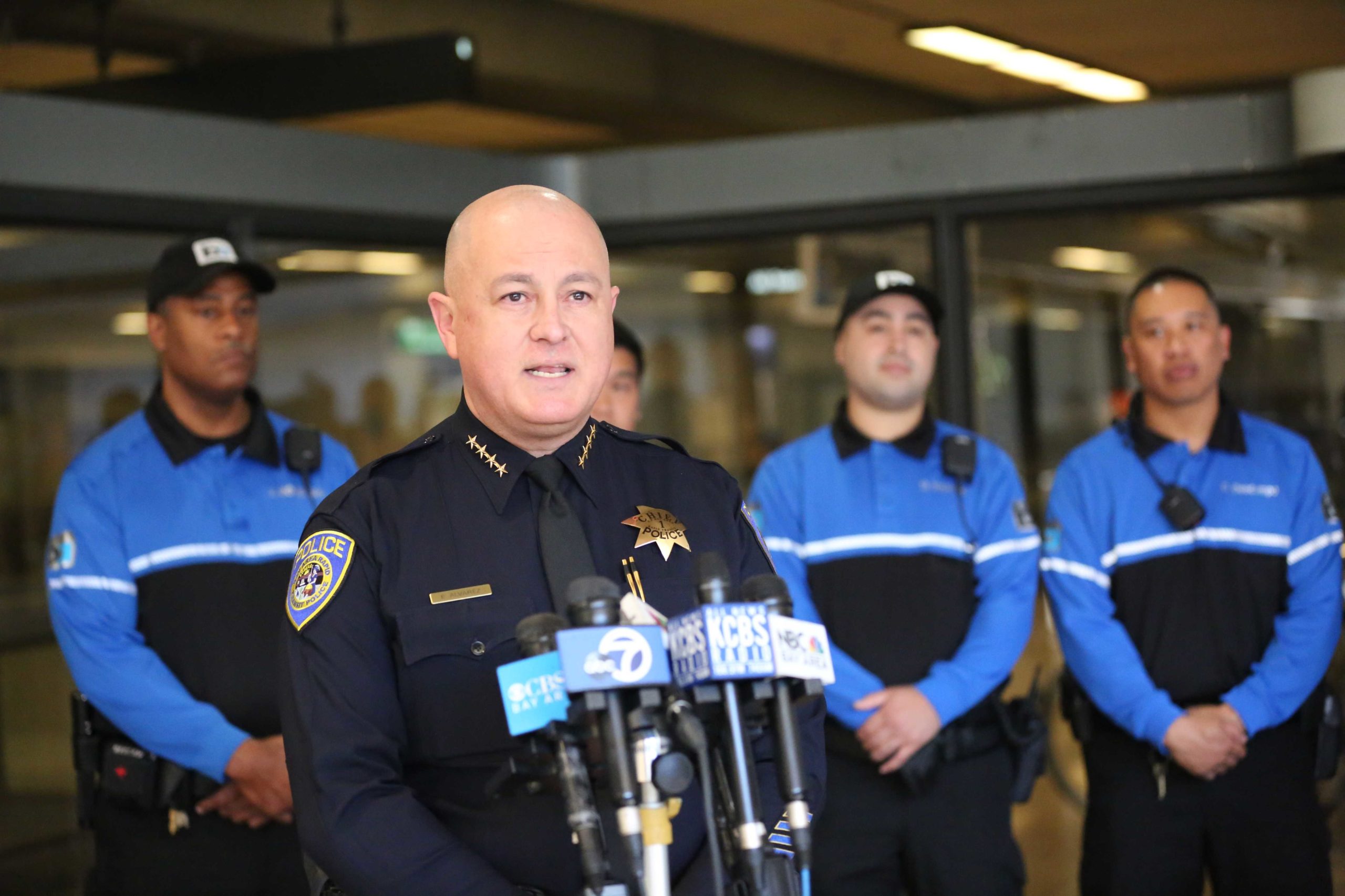
BART Police Chief Ed Alvarez talks police reform with Latinos in Transit group

August 25, 2020 By Publisher 1 Comment

BART Police Chief Ed Alvarez. Photos courtesy of BART.

By MELISSA JORDAN, BART Senior Web Producer

BART Police Chief Ed Alvarez told the group Latinos in Transit how his experience as an immigrant has shaped his policing philosophy, most recently when he created a new Bureau: the Progressive Policing and Community Engagement Bureau.

“They’re going to continue the work we’ve done to make connections with the communities we serve,” he said in the discussion on Friday.  “It’s the message that we teach and train constantly. If you treat people with respect, you’re going to get it in return.”

Alvarez, who has spent his entire career rising through the ranks at BART, talked about how the organization has changed over his 23 years there. He addressed the killing of Oscar Grant by a BPD officer in 2009, which presaged the nationwide reckoning over policing that disproportionately affects minority communities, and which BART itself has improved through numerous changes.

You could hear the emotion in his voice as Alvarez called that time over a decade ago as “rock bottom. It was hard to come to work. I care about this place and these people.”

In the intervening years, he said, BPD has made groundbreaking reforms, becoming one of the first departments to use body-worn cameras, and the role of BART’s Citizen Review Board and Independent Police Auditor in implementing other checks and balances.  “Now I’m proud and happy to come to work,” he said.

Alvarez became chief only nine months ago, a trial by fire with the coronavirus pandemic, the economic devastation it wrought, and the outpouring of demonstrations for the Black Lives Matter movement sparked by events in Minneapolis in May 2020.

“We denounced the murder of George Floyd,” Alvarez said, of the man who lost his life when a police officer, now charged with murder, kneeled on his neck for nearly nine minutes. “It shouldn’t have happened. And a lot of departments are changing how they operate because of it, because of him and the other individuals before and after him. It’s been a call to action.”

Alvarez shared a bit of his life story and the experiences that formed his character.

“I was born in Mexico in the state of Jalisco,” he said. “My parents migrated from Mexico to the United States and they built a life for us. I’ve lived in the East Bay my whole life, and my mom still lives there.”

Alvarez said that as a young boy he had to learn English, benefiting from ESL classes, and that his parents emphasized education as a way to get ahead, a principle he lives by to this day.
“I’m really proud of where I came from,” he said. “We persevered. I lost my father to a tragic accident when I was 10 years old, and my mom had to step up. My mom is a very strong Mexican woman. She had to learn how to drive, how to get a job to support our family.”

Ed Alvarez at age seven.

She went to work at the American Licorice Company in Union City (you may know them as the maker of Red Vines candy). “My mom never called in sick one day in 25 years, ever,” Alvarez said. “She made sure we were in school every day. On Sunday mornings, when we’d stayed out late on Saturday nights, she would kick open the door of our bedrooms, open up the blinds, and tell us we’re going to church. I appreciate that now. It helped make me the person I am today.”

Alvarez joined the force with a junior college degree then went back to school in his 40s to get his bachelor’s degree. “It was really hard, to be working, going to school and raising a family,” he said. “That’s why I tell Latino kids when I speak at schools, take care of your education before you have a lot of other commitments. I tell the kids to keep working on learning English, keep at it, the language will come.”

“We as immigrants have to take advantage of the opportunities that this country affords us,” Alvarez said.  He said he never dreamed that one day he would be chief of the BART Police, with more than 400 personnel under his watch.

Ed Alvarez far left (in 6th grade) with his mother and siblings.

“We’re out there handing out face coverings, working on the mental health piece, connecting the homeless with services. In some ways this pandemic has been a good opportunity for us to hit a reset, tighten up a few things, so that when our ridership goes up we’re in a better place than we were pre-pandemic.”

“Our message right now is that BART is safe, reliable and clean. We’re ready to welcome everybody back to our system.”

Alvarez spoke at a monthly meeting (held virtually for now) of Latinos in Transit, a national organization that promotes the advancement and development of Latinos and other minorities in the transportation industry. The “Café Con LIT” networking meetings let members share a coffee break to connect with others and learn from their experiences.

At the talk with Alvarez on Friday, participants said his story resonated with many who had similar upbringings, and inspired pride in members of the Latino community.

“I’m humble to be one of many,” Alvarez said. “We’ve got to keep being role models, keep grinding, show people that it can be done. This country gives us many opportunities. You have to take them and give back.”

Filed Under: BART, News, Police

Parking changes at Antioch BART Station for new lot opening next year

July 6, 2020 By Publisher 1 Comment

850 more stalls; construction to be completed in multiple stages

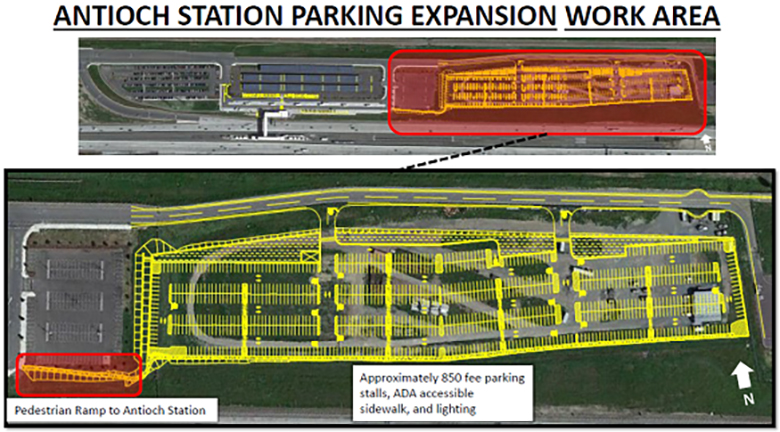
As we expand parking at Antioch Station, we will also be making some modifications to the existing parking lot and access roads to comply with codes and improve traffic circulation and curbside operations. These modifications include: relocating permit parking, bike lockers, and the passenger loading zone; relocating and increasing ADA and motorcycle parking, designating spaces for future electric vehicle (EV) charging stations, providing a dedicated bus lane, and other access improvements.

Construction of the Antioch Station Parking Expansion Lot Project began on May 21. The project, located just east of and adjacent to the existing lot, includes:

  • Construction of approximately 850 fee parking stalls
  • Dedicated ADA accessible sidewalk to the Antioch Station
  • Lighting
  • Landscaping surrounding the new parking lot

We anticipate the opening of the new parking lot in early 2021.

All parking stalls that are to be removed or closed temporarily for construction will be signed at least 72 hours in advance. Please look out for barricades and signage to guide you around the work areas during this time.

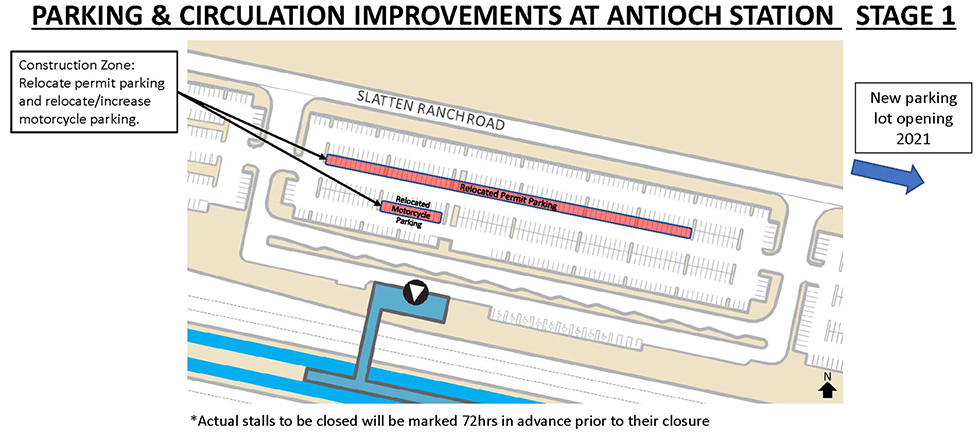
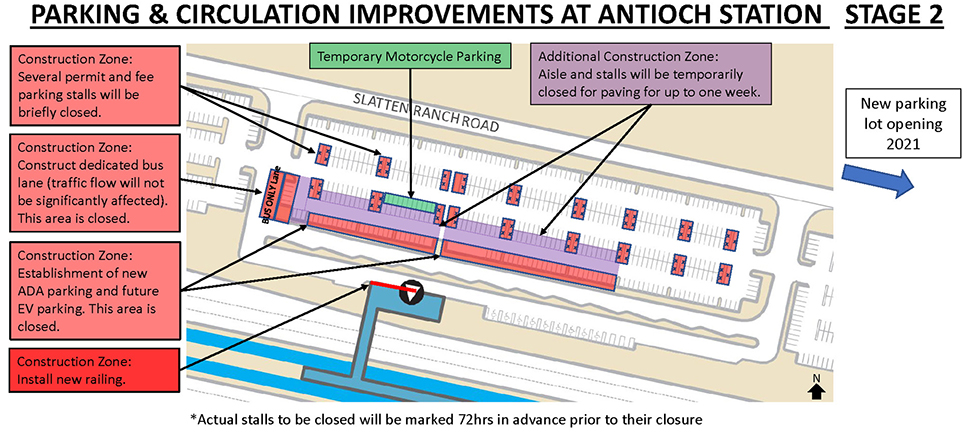
Construction will occur in multiple stages to ensure that ADA parking, permit, and motorcycle stalls remain available at all times. At this time, Stages 1 and 2 are shown below. An update will be provided for Stages 3 and 4 which are anticipated to occur during September.
– Stage 1: Relocate permit parking; relocate and increase motorcycle parking.
– Stage 2: Construct dedicated bus lane (traffic flow during construction will not be significantly impacted); establish new ADA parking and future EV charging stations; motorcycle parking will be temporarily relocated as shown; install new railing to enhance station access.

Please see the maps of work areas for each stage of construction.

We apologize for this inconvenience and appreciate your patience during this construction.

During the current COVID-19 pandemic, some BART projects, including the Antioch Station Parking Expansion Project, have been designated as essential. For this reason, construction activities on the Antioch Station Parking Expansion Project will continue for the time being. BART and Contractors will ensure that workers comply with all CDC guidelines including the social distancing requirement. BART and Contractors will make adjustments as updates to the current situation are provided.

Allen Payton contributed to this report.

Filed Under: BART, East County, News, Transportation

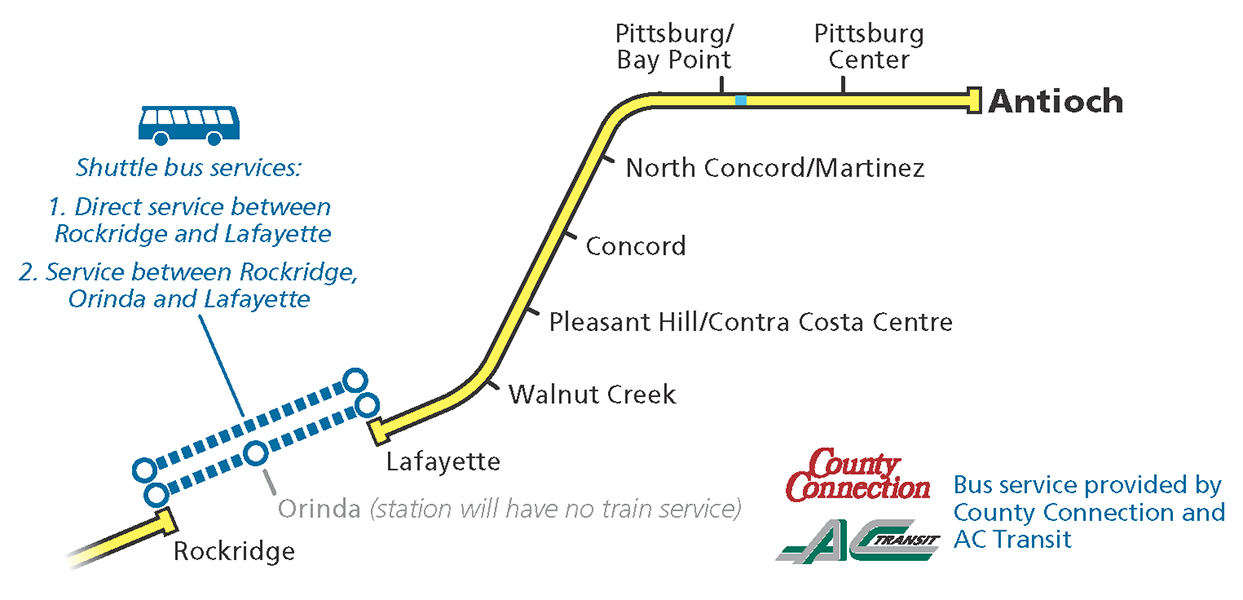
Critical rail replacement coming at Orinda BART Station; first track shutdown weekend May 9-10

May 1, 2020 By Publisher Leave a Comment

BART is moving forward with a track replacement project near the Orinda Station, which will require five weekend track shutdowns between the Lafayette and Rockridge stations.  Preliminary work is already underway on the effort to replace critical track components that in many cases date back to when BART first started service on its main Contra Costa line in 1973. This replacement effort has been designated as an essential public works project per the region’s public health orders issued in response to the coronavirus.  The project is being conducted for the safety of BART passengers and employees.

The shutdown weekends are May 9-10, May 23-25 (Memorial Day weekend), June 6-7, June 20-21, and July 4-5.  Free buses will replace trains on those weekends and riders should expect delays of 20-25 minutes.

BART closely examined the possibility of moving up the track shutdown weekends to minimize impacts to the public.  However, it was determined this wasn’t possible because BART couldn’t acquire needed materials for the project ahead of schedule. BART is prioritizing the safety of its workers and contractors by following social distancing guidelines for all critical infrastructure projects that are allowed to proceed under state and regional stay-at-home orders.

The work will require temporary, late night and early morning lane closures of Highway 24 in Orinda to make way for construction equipment.  Periodic overnight lane closures in Orinda begin in mid-April. These overnight lane closures will involve no more than two lanes and are expected to have minimal impact on Highway 24 drivers.  Unlike similar work completed last year in Lafayette, this project will NOT require weekend daytime lane closures on Highway 24.

BART crews will work around-the-clock on shutdown weekends to replace critical railway components.

Project highlights include:

  • Replacing four track switches that are at the end of their useful lives. These are large track components that can measure up to 200 feet in length and allow trains to move from line to line.
  • Installing approximately 3,000 feet of new rail.
  • Replacing approximately 300 badly worn wooden ties with longer-lasting, concrete ones.
  • Replacing 600 to 800 tons of rock ballast, which is essential for stabilizing the rail.

Many of the components being replaced are more than 40 years-old and have reached the end of their design life.  Once the project is complete BART customers will experience a more comfortable ride and trains will be quieter for riders and neighbors.

BART making gains on capital work during the stay-at-home order

While BART was unable to accelerate the timeline of this project, the agency is continuing work to improve the system and rebuild aging infrastructure.

Extremely low ridership and the new 9 pm service closure are allowing new opportunities for progress on capital projects.  Several projects are being advanced during this period including the 19th Street Station Modernization, El Cerrito Del Norte Station Modernization, Rail Grinding, Rail Replacement, and Transbay Tube Cathodic Protection.

Capital projects are not paid for by operating funds, which means the huge revenue loss from the ridership decline isn’t delaying infrastructure work.  Many capital projects are supported by Measure RR, which was approved by BART District voters in 2016.  The bond measure provides BART with $3.5 billion in funding for infrastructure work. The rail replacement project near the Orinda Station is funded by RR.

Track revitalization to begin this summer in Hayward

A second major track replacement project is scheduled to begin this summer on the weekend of July 18-19 near the Hayward Station.  The work is expected to require five weekend track shutdowns between the Bay Fair and South Hayward stations.  Free buses will replace trains on those weekends and riders can expect delays of 20-40 minutes.  The track shutdown weekends are scheduled to be July 18-19, August 1-2, August 22-23, September 5-7 (Labor Day weekend), and September 19-20.  More details will be announced closer to the start of work.

Filed Under: BART, Lamorinda, News

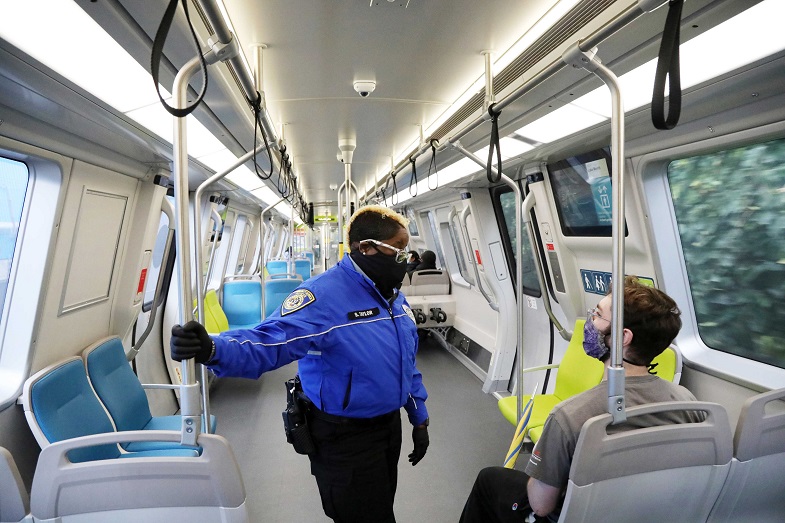
Face coverings now required on BART

April 22, 2020 By Publisher Leave a Comment

County health orders in Contra Costa, Alameda, San Francisco, and San Mateo now require all riders to wear face coverings inside BART stations and on-board trains.  The orders also require BART to take reasonable measures to remind the public that they need facing coverings and “must take all reasonable steps to prohibit any member of the public who is not wearing a face covering from entering and must not serve that person if those efforts are unsuccessful and seek to remove that person.” Failure to comply with the emergency health order is a misdemeanor.  Enforcement begins on Wednesday, April 22.

Prior to the order, most BART riders were already wearing face coverings while riding. BART will take the following steps to be compliant with the new orders:

Public Communication

  • Signs with pictograms and translations will be posted in all stations.
  • PA announcements will be made inside stations and on-board trains.
  • Platform digital signs will rotate a message.
  • Website and social media posts will be made.

BART Police Deployment and Enforcement Strategies 

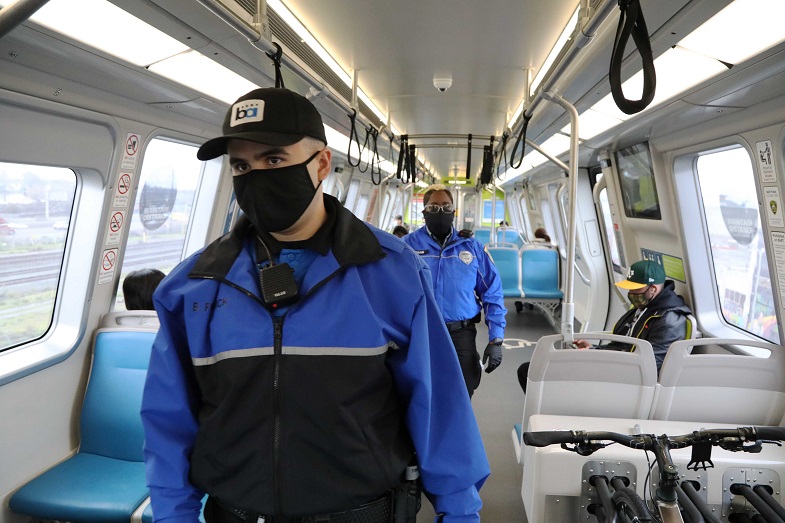
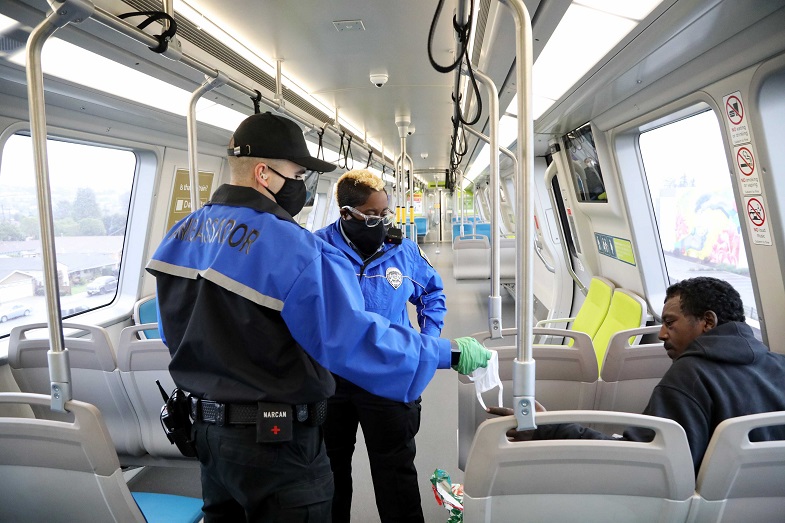
BART Police Chief Ed Alvarez recently shifted deployment to focus police resources to the entrances of stations and near the faregates. This strategy was put into place to improve safety for our employees and riders and to prevent illegal behavior from occurring.  Continuing this deployment will help BART enforce the new orders.

BART Police will be responsible for reminding riders of the new requirement.  Consistent with BART’s current operating procedures, Station Agents will not be used to enforce the new public health emergency orders as they are not trained law enforcement personnel.
BART Police will give verbal reminders of the requirement to riders without face coverings when police encounter someone not covering their mouth and nose.  Police personnel will remind the rider they have the option to use any material to cover their face. Only upon refusal to cover their face with any material will an officer ask the person to leave the system.

Riders should not confront others without a face covering.  If someone isn’t wearing a face covering, riders should move away from the individual.

CDC recommends wearing cloth face coverings that can be fashioned from household items or made at home from common materials.  The cloth face coverings recommended are not surgical masks or N-95 respirators.  Those are critical supplies that must continue to be reserved for healthcare workers and other medical first responders, as recommended by current CDC guidance.

Filed Under: BART, Health, News, Transportation

BART to run every 30 minutes Monday-Friday starting Wednesday April 8

April 6, 2020 By Publisher Leave a Comment

Ridership down 93% – “Ridership is now at 7% of what is usual” – General Manager Bob Powers

As the Bay Area counties have now extended mandatory shelter in place orders, BART service needs to be reduced to match demand, increase essential rebuilding projects, save costs, and maintain reliable service based on staffing levels. Starting Wednesday, April 8, Monday-Friday service will run every 30 minutes until further notice.  Ridership data shows social distancing remains possible on all trains with this change.  Effectively, every other train is being cancelled Monday-Friday.

Reducing service also allows greater flexibility to maintain stable service should BART employees need to take time off due to illness or to care for children and family members.

This move will potentially save the operating budget $3-7 million per month. The savings is realized by shifting employees to capital improvement projects that are not funded by the operating budget. BART is using this time of historically low ridership to focus on essential infrastructure projects that typically are very disruptive to riders or can only be accomplished during overnight hours. These rebuilding efforts have been designated as essential public works projects per the region’s public health orders issued in response to the coronavirus.

3-line service will start earlier in the evening

Starting Wednesday, BART will move up the time the Warm Springs-Daly City (Green) and Richmond-Millbrae (Red) lines that provide direct service to/from San Francisco end and 3-line service begins.  This will allow for a longer work window for power cable replacement in San Francisco.  The last two train dispatches in both directions on these lines will be cancelled and single tracking in San Francisco will begin around 8pm.

  • The last Warm Springs-Daly City (Green) line train departs Warm Springs at 5:16pm and arrives at Daly City at 6:26pm.  It then departs Daly City at 6:43pm and arrives at Warm Springs at 7:54pm.
  • The last Richmond-Millbrae (Red) line train departs Richmond at 5:41pm and arrives at Millbrae 6:51pm. It then departs at Millbrae at 7:18pm and arrives at Richmond at 8:24pm.

There is only one hole in the new 30-minute schedule.  It is on the Red line departing from Millbrae at 6:18pm. To avoid this gap, customers should board the SFO shuttle from Millbrae at 6pm and connect with the Antioch line train at SFO at 6:26pm and then transfer at MacArthur at 7:10pm to the Richmond train.

Plan your trip to avoid waiting

PDFs of the new schedule will be available on bart.gov tomorrow (Tuesday). Riders can use the PDF schedule to start planning their trips and what time they should arrive at the station to avoid a long wait.  Riders can also check real time departures before heading to the station.   Staff is updating the online Trip Planner to reflect the new service plan and to show every other train as cancelled.
For personalized trip planning assistance, call the Transit Information Center at 510-465-2278 from 8am-6pm, Monday-Friday.

“Ridership is now at 7% of what is usual, and these changes allow us to increase essential rebuilding projects while also ensuring we can provide reliable and predictable service,” said BART General Manager Bob Powers. “With so many unknowns about the length of the shelter in place orders and the timing of recovery, we must take steps to protect the operating budget while also protecting our ability to run service every 30 minutes.”

A change in the BART schedule can only be implemented by doubling headways (train frequency) because the service plan is tied to operational patterns such as timed transfers and train operator reporting times and locations.  This is the reason why we can’t go to 20 or 24 minute headways Monday-Friday.

Weekend service unchanged

Weekend service will remain unchanged.  The decision to not change weekend service at this time is to avoid doubling weekend headways. Reducing service on the weekend would mean Saturday service would need to go to 40-minute headways and Sunday service would go to 48-minute headways. At this time, that level of service reduction is not something BART is ready to implement but may need to do so in the future if circumstances change.

Shifting workers to rebuilding projects

Running fewer trains means crews can be redeployed to other projects.  Maintenance and Engineering staff can now increase the hours of cable replacement in San Francisco and begin work on cable replacement in the East Bay and crews can perform relighting work in the Caldecott BART Tunnel. Train car mechanics can now be put into Fleet of the Future training.
This plan calls for up to 400 employees to be shifted to capital projects. However, this number can change if employees are pulled off a project to prioritize passenger service if staffing levels reduce.
Early FY21 budget estimates show a bleak scenario of possible budget shortfalls of $258 million to $452 million.  The federal stimulus funds will help bridge some of the gap, but it is not expected to fill all of it moving forward.

Summary of temporary service cuts to date

  • Extra commute trains on the Antioch-SFO (yellow) line were eliminated on Thursday March 19.
  • Monday-Friday service is 5am-9pm (previously 5am-Midnight) began on Monday, March 23.
  • Saturday-Sunday service is 8am-9pm (previously Saturday service started at 6am) began on Saturday, March 28.
  • Starting Wednesday, April 8, Monday-Friday service will run every 30 minutes systemwide all day, with 3-line service beginning earlier in the evening and single tracking in San Francisco starting at around 8pm.


Filed Under: BART, News, Transportation

  • « Previous Page
  • 1
  • …
  • 6
  • 7
  • 8
  • 9
  • 10
  • …
  • 13
  • Next Page »
Furniture-Clearance-02-26B
Liberty-Tax-Jan-Apr-2026
Deer-Valley-Chiro-06-22

Copyright © 2026 · Contra Costa Herald · Site by Clifton Creative Web