• Home
  • About The Herald
  • Local Agencies
  • Daily Email Update
  • Legal Notices
  • Classified Ads

Contra Costa Herald

News Of By and For The People of Contra Costa County, California

  • Arts & Entertainment
  • Business
  • Community
  • Crime
  • Dining
  • Education
  • Faith
  • Health
  • News
  • Politics & Elections
  • Real Estate

Art at BART: 15 years after its installation, a mural at Richmond Station continues to inspire

July 12, 2022 By Publisher Leave a Comment

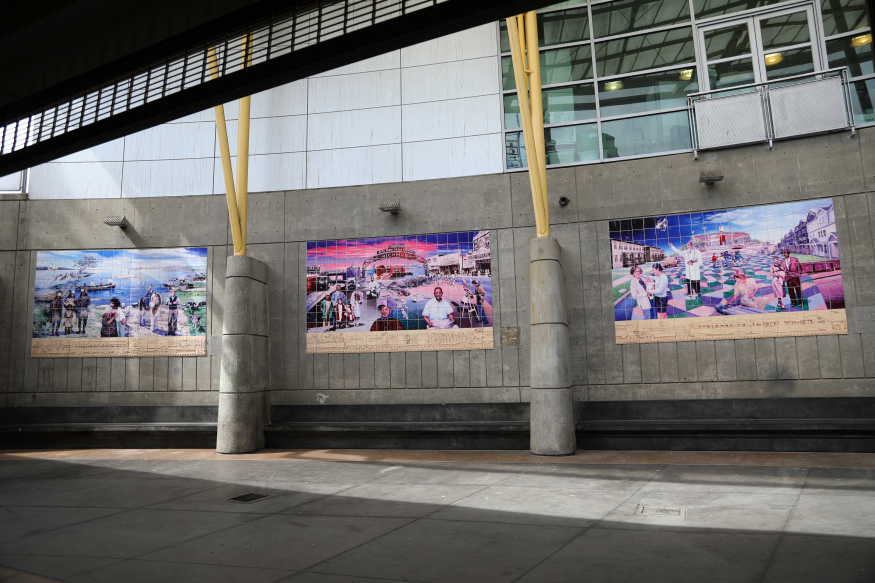
Artists Jos Sances (left) and Daniel Galvez (right) in front of their three-panel mural. Photos: BART

When creating an art installation in a highly trafficked public space, duration matters. While some artworks are intended to celebrate the ephemeral and the fleeting, BART often looks for the permanent and the durable when adding another mural to its portfolio.

Given this constraint, Bay Area artists Daniel Galvez and Jos Sances set out to create a mural that would stand the test of time and speak to its community for years to come. Galvez primarily works with paint. Sances is the “high-tech guy,” said Galvez, his longtime friend and collaborator. It was up to Sances to take Galvez’s original oil painting and create something monumental – and long-lasting.

In 2007, the duo joined forces to create a large-scale mural at Richmond Station. Fifteen years later, the mural’s colors are nearly as vibrant as the day it was installed.

BART recently joined Galvez and Sances at the foot of the mural, which is owned by the City of Richmond, to reflect on its creation and its impact. The two artists, whose works blanket the region (you can spy their joint mural, “Future Roads,” at BART’s 16th St. Station), spoke as candidly as you would expect of two old pals. The pair met in San Francisco in the early 1980s, and they’ve been collaborating on giant works of public art ever since.

“It’s been up for 15 years, and the mural hasn’t been graffitied,” Sances said of the Richmond Station mural, titled “On the Right Track.” Graffiti, after all, is the bane of muralists’ creations.

Galvez thinks he knows why no graffiti artists have dared touch the mural. An artwork that “engages the community, is reflective of its history, honors their culture and their work” has a profound impact on community members.

“People respond to that intimately,” Galvez said, “because it’s about them.”

The mural features three eight-by-twelve-foot panels of durable tile. Each panel spotlights a different aspect of Richmond history, from its original native inhabitants – the Ohlones – to current residents.

Galvez described the mural like “a movie.”

“You can move into one scene from the next,” he said. “People are sucked into it; they follow the story. They want to know more.”

The mural began in the Richmond library, where Galvez and Sances researched local history and major events and figures. With ideas swirling in their minds, the artists then hosted a series of community meetings, in which they met with locals bearing photographs of themselves and family. Some of the photographic imagery was incorporated into the mural (you may even catch the smiling face of Sances’ grandson as a baby. He’s now 16).

To create the strikingly colorful tiles, Sances had to get creative. He decided to tap into new techniques that enabled him to print Galvez’s painting directly onto the tile in a process known as sublimation.

“It’s a heat transfer process,” Sances said. “You make a print on transfer paper, then put that on a raw tile that’s receptive to ink. Then it gets sublimated onto the tile. You peel off the paper, and there’s the image.”

Sublimation is now ubiquitous, but Galvez and Sances continue to find new ways to utilize it. A recent co-mural used the sublimation process to print a painting onto stainless steel.

If you can look past the colorful tiles and lower your gaze a few feet, you’ll notice a series of beige, hand-carved ceramic pieces that depict a railroad, carrying everything from a mariachi band to a bear cub and his mom. The handcrafted tiles spotlight Richmond culture and history, while adding a certain playfulness and tactility for children passing through.

“I like the fact that it was Jos’s idea to introduce the lower ceramic pieces because it’s more children’s height,” Galvez said. “If they’re really curious, they could stand on the bench and look at the mural and feel it.”

The goal of the mural, ultimately, is to engage people. Galvez’s painting philosophy derives from “Los Tres Grandes” – Mexican muralists who painted on a grand scale throughout the twentieth century.

“The point of [Los Tres Grandes’] work was for people to see art daily and enrich their lives and see their history,” Galvez said. “It’s art that’s integrated into people’s lives.”

Painting actual Richmond residents was a major component of integrating the artwork into the fabric of Richmond culture.

“When people see images of themselves done in such a particular way, it’s really elevating,” Sances said. “I think the whole community gets a lift from that.”

Filed Under: Arts & Entertainment, BART, West County

50 years of service: BART could have been an elevated monorail and other fascinating facts from the Parsons-Brinckerhoff report

May 19, 2022 By Publisher Leave a Comment

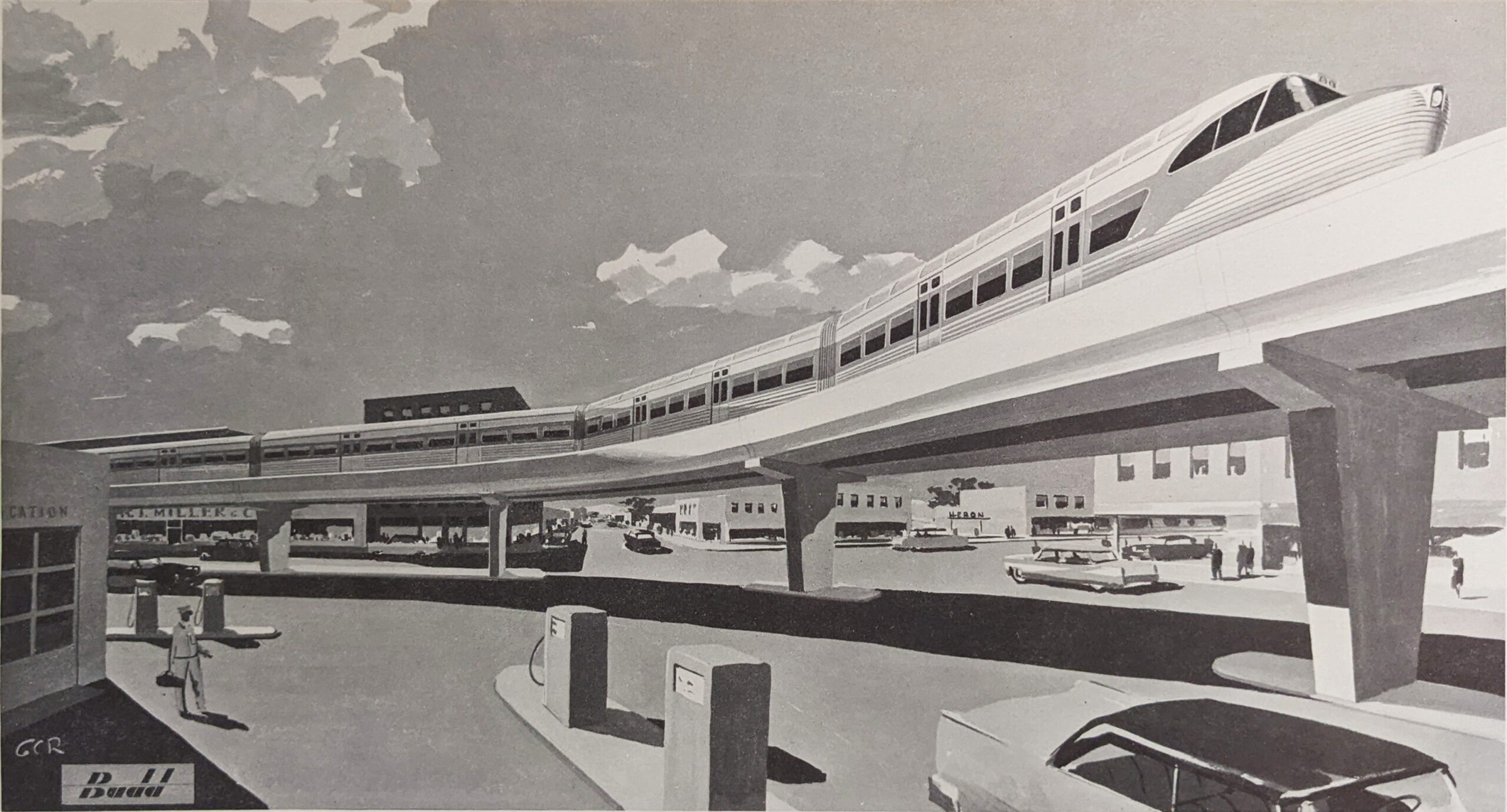
A rendering of a “basic supported system” train from the Parsons-Brinckerhoff report of 1956.

In celebration of BART’s 50th anniversary this year, we’re looking back at the transit system’s five decades of service and innovation in a new series of stories. BART celebrates 50 years on Sept. 11, 2022.

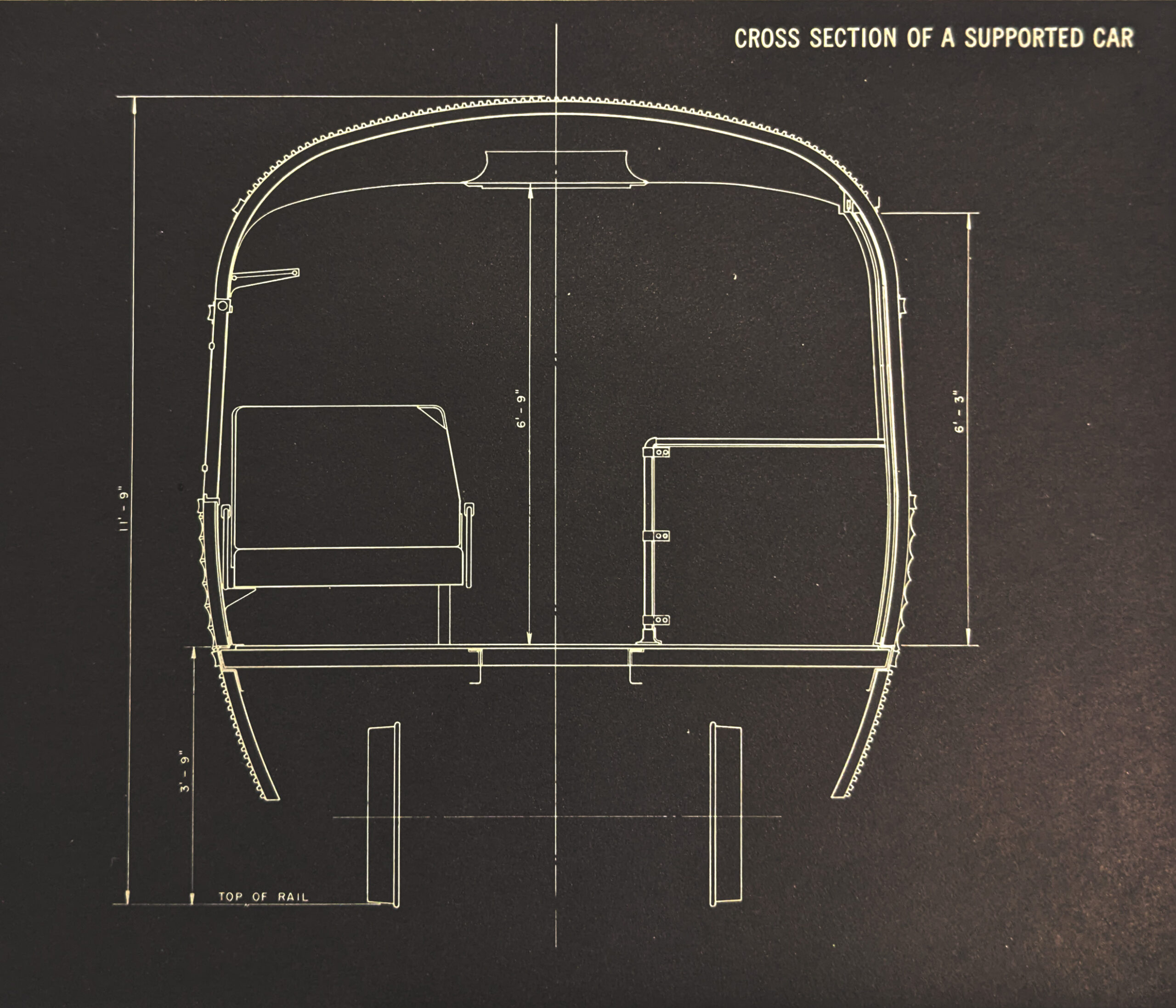
Rendering of a BART car cross section.

Deep in the BART archives at Lake Merritt Station, an unassuming large format book has been gathering dust. Just over 100 pages, the green cover has now faded, the pages yellowed. The cover title reads: “Regional Rapid Transit: A Report to the San Francisco Bay Area Rapid Transit Commission.”

Published in January 1956, the report is a crystal ball, peering into an idealized future of BART and the Bay Area of the 21st century. The New York-based engineering consortium Parsons, Brinckerhoff, Hall and Macdonald researched the report from 1953 to 1955. Within its pages emerges a portrait of a burgeoning Bay Area – population ~3 million– in desperate need of a high-speed, grade-separated regional transit system.

“We are firmly convinced that the answer to ever-increasing traffic congestion in the Bay Area lies in the utilization of … interurban rapid transit,” the report’s cover letter reads.

Since 1956, the Bay Area has more than doubled in population, with an estimated 7 million people now residing in the region’s nine counties and 101 municipalities – many of which are now served by a BART system born of the forward-looking Parsons-Brinckerhoff report.

The report is a significant document as it was the first major publication to envision what BART could be. In the 1950s, many were keenly following this yet-to-be-built mass transit system, according to Liam O’Donoghue, a local historian and the host of the podcast “East Bay Yesterday.”

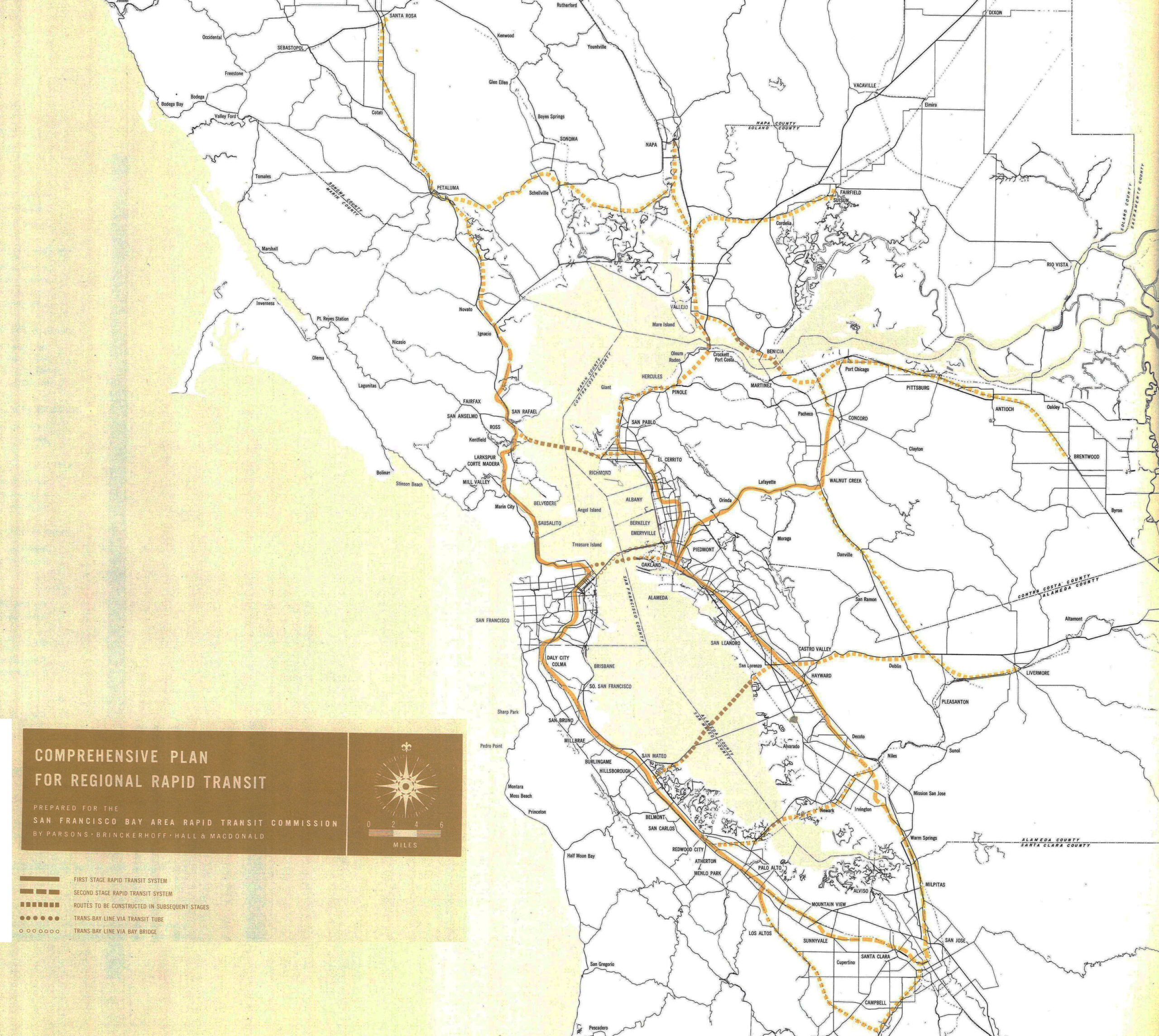
Comprehensive Plan for Regional Rapid Transit, prepared for the San Francisco Bay Area Rapid Transit Commission by Parson Brinckerhoff Hall & MacDonald from 1956 shows extensions to Brentwood in East County and Crockett in West County and beyond, as well as to Livermore in Alameda County. Source: Erica Fischer | Flickr

“One of the reasons there was so much national attention on BART is because it was the first mass transit rail system to be constructed in the U.S. for 60 years,” O’Donoghue said. “It was not only a milestone for public transit, harkening to a new era, it was also a test case for urban mass transit rail systems moving forward.”

O’Donoghue said the report is significant for multiple reasons. For one, it provided a blueprint for one of the biggest construction projects in California in half-a-century. It also helped “sell” the transit system to a skeptical, tax-paying public.

“The report really had to make the case for BART to the public,” O’Donoghue said. “BART came very close to not happening, so the people promoting BART needed the informational ammunition.”

Devin Smith, a volunteer at the Prelinger Library in San Francisco, recently got a shock when a Parsons-Brinckerhoff report from 1956 was donated from the private collection of Jay Bolcik, a former BART Manager of Schedules and Services. The library contains many trade periodicals, including plentiful materials on transportation, so the donation fit well with the library’s existing collection.

Smith said he found the report “incredibly fascinating,” and was especially impressed by its size and scope.

“It’s always interesting to look at reports like these and contextualize why this one proposal got picked over other,” he said. “Seeing the BART system at such an early stage…it’s just amazing.”

The Bay Area, the Parsons-Brinckerhoff report concludes, required a rapid transit system to complement the area’s already-established network of highways. Traffic, even in the 1950s, proved a sore spot for the region.

“Today’s age of automobiles has brought with its miracles a level of travel discomfort, cost, and hazard that is critical,” the Parsons-Brinckerhoff report summary reads. “In the Bay Area, home now for some 3 million people, traffic problems are aggravating.”

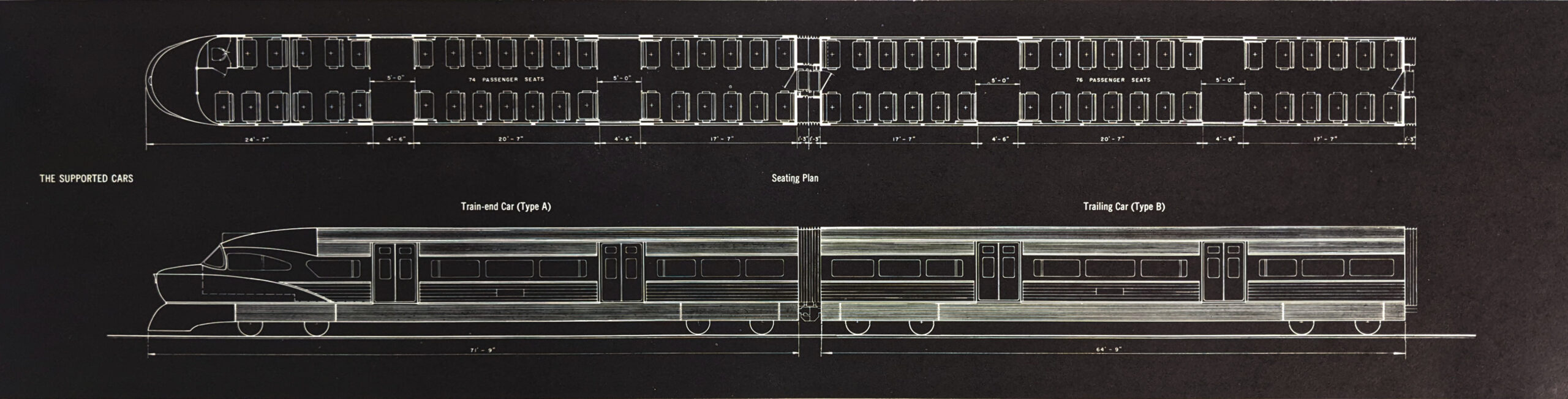
Renderings of a supported car from the Parsons-Brinckerhoff report.

The report uses a series of phrases to stress the car problem: “heavily burdened,” “chaos,” “ever-mounting barrier.” Interurban transit would serve as a balm to soothe the Bay’s gridlock headache, while also facilitating urban development.

“The report is important now because the problem that BART was meant to deal with then – traffic – is still a problem here,” O’Donoghue said. “We need to keep expanding on projects like BART, whether it’s additional lines or some sort of connectors. We need to keep building these public transit systems because individual car use is really a dead end.”

The Parsons-Brinckerhoff engineers specify in the report that the new trains needed to travel at speeds of at least 45 miles per hour (BART trains now travel an average of 35 miles per hour with stops and can reach speeds up to 70 miles per hour). The report also states the new BART system needed to contain “comfortable seats for all passengers” on trains, provide service at short intervals, and construct stations at conveniently located and strategically positioned areas.

One fascinating aspect of the report is its portrait of a BART that could have been. BART as a monorail? BART trains with pneumatic tires? Nothing, at this stage in the transit system’s development, was overruled or overlooked.

Some train models the report examined include the suspended monorail in Wuppertal, Germany, the oldest elevated railway with hanging cars in the world; the Talgo Train, with its in-between carriage bogies; and a “Carveyor,” or continuous conveyer belt with cars atop. BART eventually nixed all these ideas for various reasons, including cost, feasibility, and reliability. The transit system settled on self-propelled cars that draw power from an electrified third rail and operate – perhaps notoriously — on a non-standard gauge width.

The report also puts forth four options for constructing the system with the following keep the system low cost, attractive, and as unobtrusive as possible.

“Low cost is always predominant and in the public interest; the aesthetics of the rapid transit structures is a major factor in determining general public acceptance of its form and its impact upon the value of adjacent properties,” the report states. “These basic objectives are often in conflict, however. The ideal combination of invisible structures at zero cost is impossible, and we must therefore make compromises.”

Construction options included surface transit, open-cut transit, subway transit, and elevated structure transit. Today, BART uses a combination of all four options.

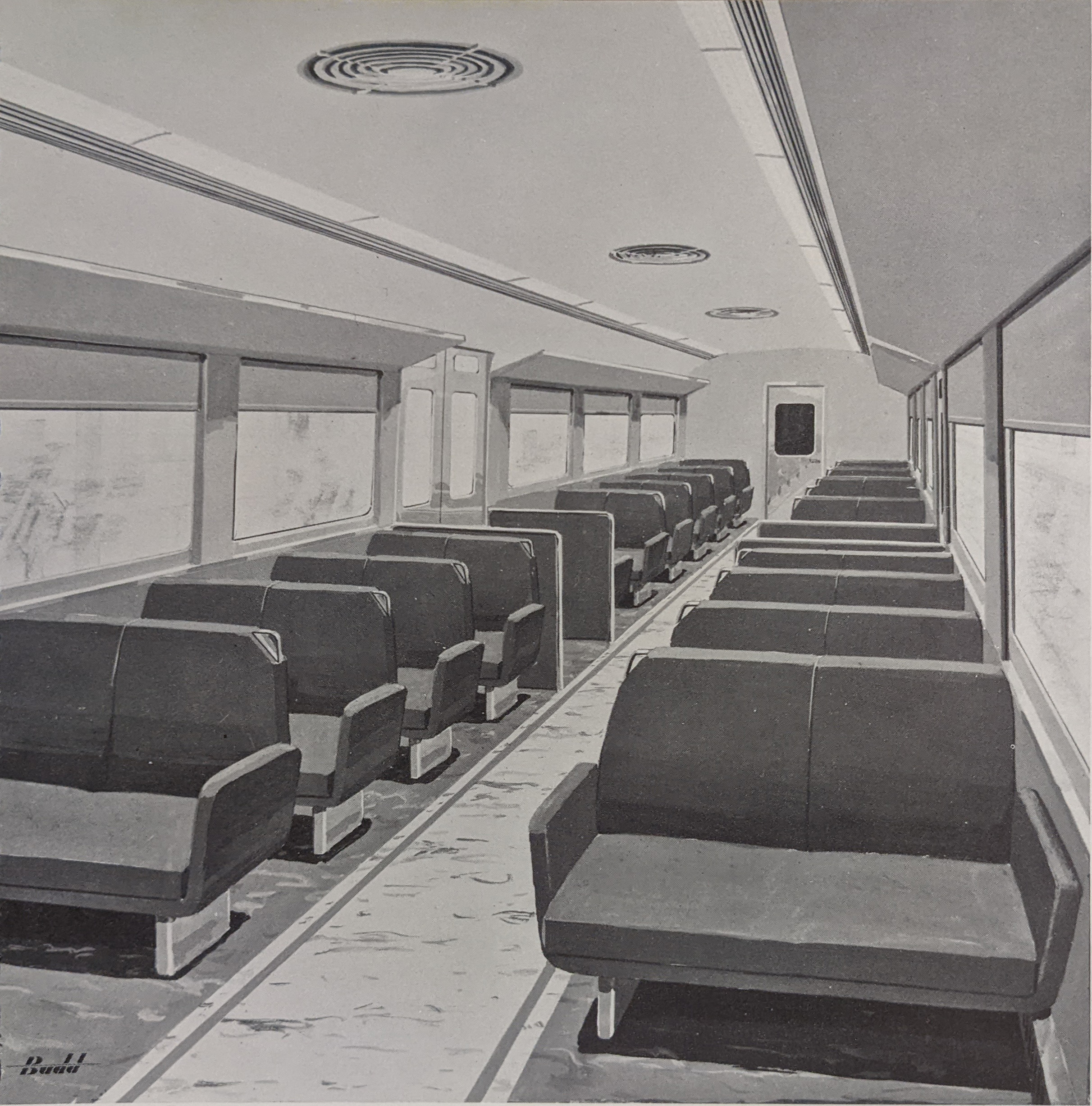
As for the trains, the Parsons-Brinckerhoff report outlines that the system most likely to serve the Bay Area would be a “basic supported system,” with high-speed, lightweight cars featuring steel wheels on steel rails, powered by electricity. But the report didn’t write off alternative systems, such as suspended trains or rubber tires. It included renderings of some alternatives, which you can view above.

A potential design for the interior of the cars.

“The question of appearance,” the report notes, “always involves personal taste.” Future reports would outline in greater detail the look and feel of BART, but the renderings the report does provide depict transit specifically born out of the Space Age, with sleek and futuristic-looking bodies.

The report concludes with a simple thesis: “Some form of interurban transit [for the Bay Area] is necessary.”

“Unless it is willing to accept sustained congestion and the retardation of economic growth that would result, the Bay Area has no choice but to accelerate its transportation planning and construction,” the report concludes, continuing, “Concepts of large metropolitan cities served only by private automobiles are in the realm of physical and economic fantasy.”

Just under two decades later, many of the Parsons-Brinckerhoff report’s findings and recommendations would be put into action. Some of the original concepts continue to serve the Bay Area and its transit riders today.

According to O’Donoghue, the report serves as a reminder of what is possible.

“If we’re going to solve the Bay Area’s problems, like traffic, we have a whole playbook from BART history about how people were approaching these same issues in previous generations,” he said. “And that matters.”

If you’d like to read the report yourself, you can access a hard copy at a handful of libraries and historical societies around the Bay Area. You can view them on WorldCat by clicking here.

Filed Under: BART, News

Take the BART System Expansion Policy update survey

May 3, 2022 By Publisher Leave a Comment

Comprehensive Plan for Regional Rapid Transit, prepared for the San Francisco Bay Area Rapid Transit Commission by Parson Brinckerhoff Hall & MacDonald from 1956 shows extensions to Brentwood in East County and Crockett in West County and beyond, as well as to Livermore in Alameda County. Source: Erica Fischer | Flickr

Current Policy was adopted in 1999

To best serve the needs of an evolving Bay Area, BART is revisiting our System Expansion Policy. The updated policy will guide us as we consider new ways to expand and improve our system.

As part of these efforts, BART has developed a brief survey to help us understand your priorities for system development. Please take a few minutes to complete this survey. Your valuable input helps us plan future projects and continue to provide the best service for Bay Area riders and residents.

We want to hear from you! Make your voice heard by taking the survey: http://s.alchemer.com/s3/BART-System-Expansion-Policy-Survey

Expansion & Capacity Enhancement

BART’s System Expansion Policy states goals and strategies for expanding the system including criteria for evaluating expansion opportunities. This updated policy will serve as a guide as we evaluate proposed projects. The current Policy was adopted in 1999.

The Planning Department at BART assesses strategic opportunities for system expansion by conducting corridor studies for future BART services, assessing alternative methods for expanding transit services in the region, completing assessments of environmental impacts of proposed projects, and analyzing opportunities for new stations within the existing system (infill stations).

To learn more about BART’s expansion planning and policy update, visit us at: https://www.bart.gov/about/planning/strategic

Lo invitamos a compartir sus opiniones en una encuesta sobre la política de expansión del sistema de BART. Puede acceder a la encuesta haciendo clic en el enlace anterior o cortando y pegando todo el enlace en su navegador. ¡Gracias!

誠邀您填寫問卷調查,分享您對舊金山灣區捷運系統擴展政策的意見。只要按一下以上連結或將整個連結剪貼至您的瀏覽器,即可開始填寫這項問卷調查。謝謝您

Filed Under: BART

Masks once again required on BART

April 28, 2022 By Publisher Leave a Comment

After judge in Florida tossed out federal mask mandate for public transit systems and airlines

The BART Board of Directors at its meeting today, Thursday, April 28, 2022, approved a temporary amendment to the District’s Code of Conduct to require riders to wear masks in paid areas of the system with limited exceptions. This requirement applies to trains and all portions of stations beyond the fare gates. Children ages two and under as well as people with medical conditions that prevent them from wearing masks are exempt from the mandate. The rule is effective until July 18, 2022, unless it is extended by the BART Board.

“I strongly support requiring a mask to ride BART to keep all our riders safe,” said BART Board President Rebecca Saltzman. “I’m especially concerned for our riders who are immunocompromised, people with underlying health conditions, and children under the age of five who are not yet eligible for vaccination.”

The update to the Code of Conduct comes after a federal judge in Florida earlier this month tossed out a federal mask mandate for public transit systems and airlines. Like other Bay Area transit agencies, BART’s previous mask mandate had been based on the now former TSA directive.

“It is essential the BART Board take action to protect our riders and employees after the surprising ruling that threw out the federal mandate,” said BART Board Vice President Janice Li. “Wearing masks helps to protect everyone, which is especially important now as COVID cases rise in the Bay Area.”

Free masks are available at station agent booths and from all safety staff for those who need one. As with the previous federal mandate, BART PD will continue its education-based enforcement of the mask requirement by offering free masks to anyone who needs one before taking any enforcement action which could include a citation up to $75 or being ejected from the paid area.

Throughout the pandemic BART has prioritized the safety of riders. BART has installed MERV 14 (Minimum Efficiency Reporting Value) air filters on all train cars new and old. These filters are dense enough to trap the virus and provide an extra layer of protection to our riders. Air is replaced every 70 seconds onboard cars mixing filtered air with fresh air. That means the circulation on BART train cars is better than most offices. In addition, all BART employees are fully vaccinated.

Filed Under: BART, Health, News

During redistricting process BART Director Simon removed from board after moving outside of current district last year

March 12, 2022 By Publisher 1 Comment

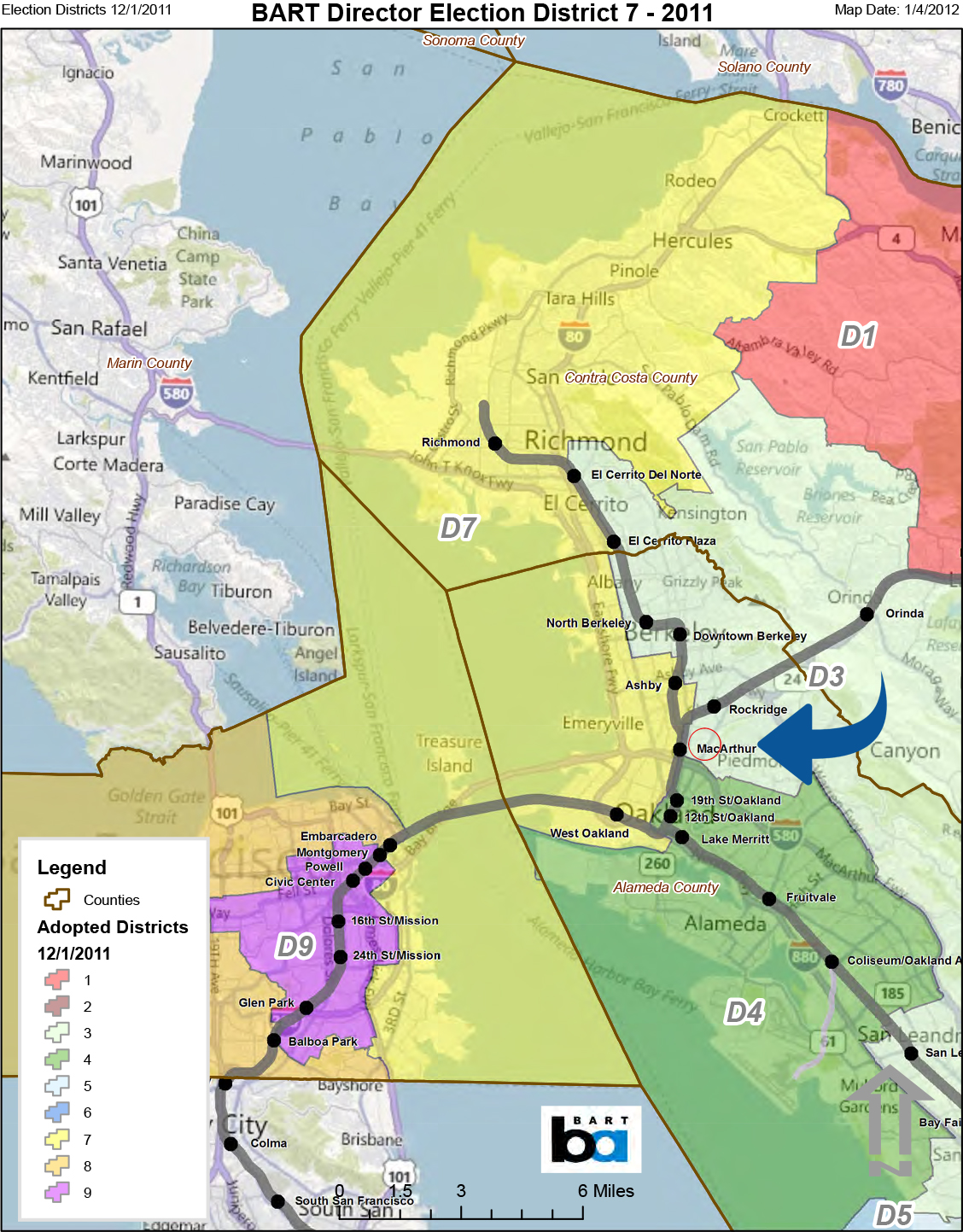
2011 BART District 7 Map, shaded in yellow, showng area of Simon’s residence (in red circle) near the MacArthur Station, just outside the district. Source: BART.gov. Circle and arrow added by The Herald.

Says she was assured by district staff her new Oakland residence was within District 7; seat now vacant

“advice Director Simon…was provided was from individuals that report directly to the BART Board…not the General Manager’s Office.  It appears bad advice may have been given…The residency issue was reported to my Office last Thursday, March 3, 2022.” – GM Powers

Director Dufty, Board VP Li want to bring back Simon or be appointed by the Board

Lateefah Simon. Source: Akonadi Foundation website

By Allen D. Payton

Following the BART board’s adoption of new redistricting maps on Thursday, March 10, 2022, BART announced it was determined as of Wednesday, the BART District 7 Board of Director seat is vacant. BART staff has confirmed Lateefah Simon has moved outside the boundaries of District 7.  Based on state law, this move disqualifies her from serving as a BART Director of District 7 which includes Hercules, Pinole, Richmond, San Pablo and a portion of El Cerrito in western Contra Costa County, and parts of Alameda and San Francisco counties.

A mother of two daughters and legally blind, Simon moved last year from her home in Richmond to an apartment complex adjacent to the MacArthur BART station.

According to a report by Bay City News, “Simon said in a statement to supporters that she moved from her previous residence last year due to threats her family received as a result of her support for police reform” and that she was assured by district staff that her new residence was within the District 7 boundaries.

Simon was first elected to the BART Board of Directors on November 8, 2016 and was reelected in 2020. She served as President of the BART Board in 2020.

Efforts to reach Simon for comment were unsuccessful Friday.

According to the BART press release issued on Friday, BART will now follow the procedures for filling a board vacancy including a public application process. The BART Board of Directors has 60 days to appoint someone to fill the vacancy. Ultimately, voters will choose a permanent successor. BART staff will post complete details outlining the process, qualifications, and application in the coming days here on our website.

Questions for BART Staff, Directors

An email was sent early Friday afternoon to the BART Communications Department asking, “Why did it take the district’s staff a year to determine that Ms. Simon had moved outside of District 7?  Did she provide her new address to staff at that time? If so, did staff check the boundary lines to ensure Ms. Simon’s new residence was within the boundary of her district? She’s now claiming district staff assured her that her new residence in Oakland…adjacent to the MacArthur Station was inside her district. Is that true? Was this a result of the latest redistricting process and staff discovered they had made a mistake last year?”

In addition, BART staff was asked, “If Ms. Simon wasn’t legally allowed to be on the board as the District 7 member, are all the votes she took since she moved to her new residence voided? Were there any 5-4 votes in which she was in the majority? If so, what were they and might those have to be voided and new votes taken?”

Finally, they were asked to provide a more detailed map for District 7 which was adopted in 2011 that identifies the exact boundary lines between District 7 and District 3.

BART Media Relations Manager James Allison responded, “The extent of the information we are able to provide at this time is contained in this website article,” the information from which is included above.

The same questions were then emailed to the remaining eight members of the Board of Directors.

General Manager Issues Comments on District 7 BART Board Vacancy

However, BART General Manager Bob Powers issued the following statement about the issue early Friday evening:

“Lateefah Simon has been a champion for BART and our riders. The determination that her seat had to be vacated is horribly unfortunate.

I understand there are many questions about how this situation could have occurred.  I have some of the same questions.  While I know that Director Simon was open, honest, and proud about her home at the MacArthur Transit Oriented Development, I am not able to speculate about any advice she was provided by BART’s board-appointed District Secretary.

According to BART’s Legal Department, state law requires BART Board Members to live in the district they represent, and if a Director moves outside of the district, the seat is vacated.

To prevent this situation from occurring in the future I’m committed to working with the District Secretary’s Office to ensure that when a director chooses to relocate, they will know if the new address falls within their existing district boundaries.

If I had the ability to return Lateefah to the BART Board, I would immediately.

As the leader of this organization, I understand that any issues regarding BART’s performance ultimately falls to me.  However, the advice Director Simon indicated she was provided was from individuals that report directly to the BART Board, and not the General Manager’s Office.  It appears bad advice may have been given to Director Simon, and on behalf of the District, I wholeheartedly apologize for that.

The residency issue was reported to my Office last Thursday, March 3, 2022.  Upon being notified, we immediately reported the concern to the General Counsel’s Office and the District Secretary’s Office.  The General Counsel’s Office then confirmed Director Simon’s address and made the determination that the District 7 seat was vacant.

BART needs more voices like Lateefah and I am saddened she is no longer a board member.  I will follow the Board’s direction and assist however needed to fill the District 7 seat.”

BART Director Foley Asks Legal  Counsel to Answer Questions

District 2 Director Mark Foley responded by saying, “I forwarded the questions to BART’s legal counsel and District Secretary’s Office to work together to answer them. Does it invalidate or does it not? We won’t know until an election expert looks it.”

Director Dufty, Board VP Li Ask GM About Returning Simon or Appointing to Board

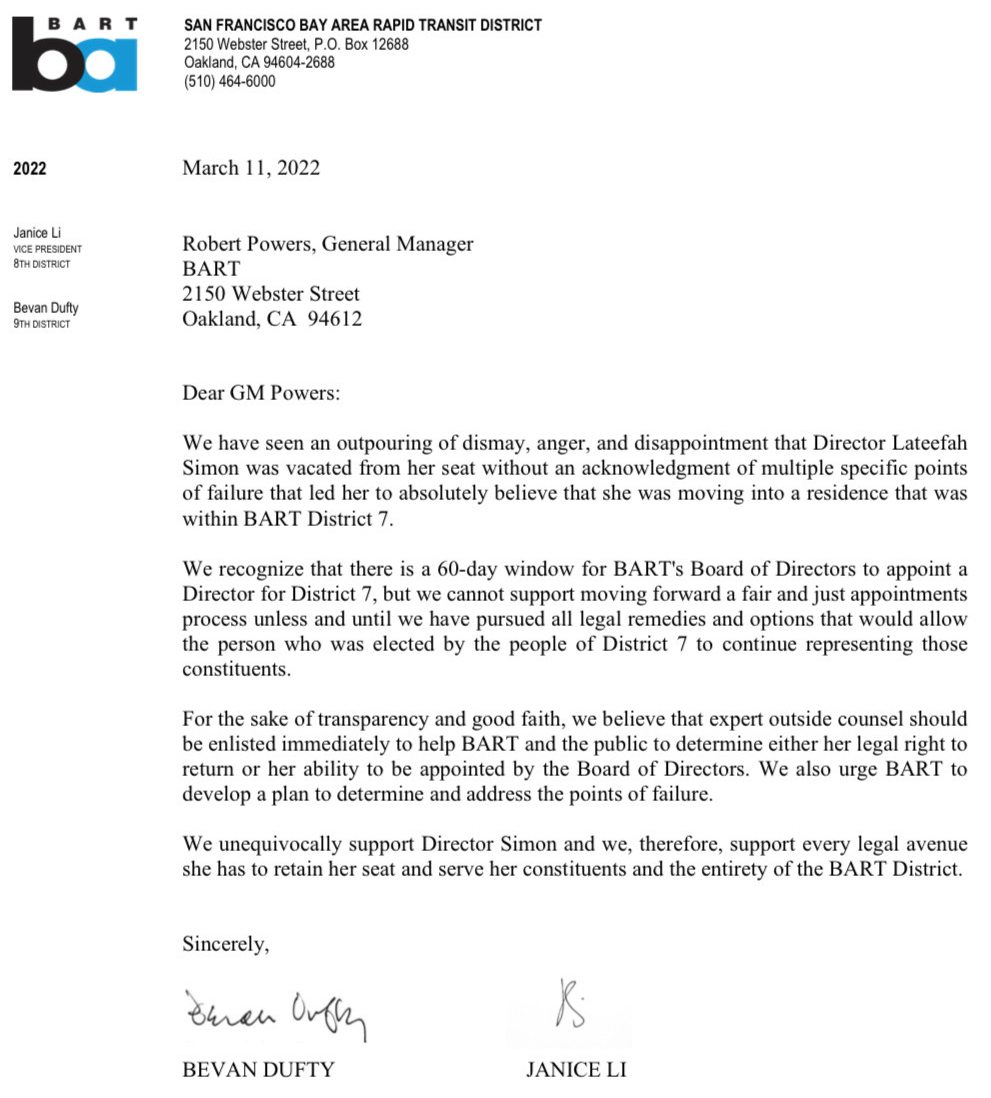
District 9 Director Bevan Dufty responded by sharing a letter he and District 8 Director and Board Vice President Janice Li sent to GM Powers on Friday writing, “Happy to share this letter on behalf of myself and Director Li.”

In the letter they ask Powers to enlist the help of expert outside legal counsel to determine either Simon’s “legal right to return or her ability to be appointed by the Board of Directors.”

“Dear GM Powers:

We have seen an outpouring of dismay, anger, and disappointment that Director Lateefah Simon was vacated from her seat without an acknowledgement of multiple specific points of failure that led to absolutely believe she was moving into a residence that was within BART District 7.

We recognize that there is a 60-day window for BART’s Board of Directors to appoint a Director for District 7, but we cannot support moving forward a fair and just appointments process unless and until we have pursued all legal remedies and options that would allow the person who was elected by the people of District 7 to continue representing those constituents.

For the sake of transparency and good faith, we believe that expert outside counsel should be enlisted immediately to help BART and the public determine either her legal right to return or her ability to be appointed by the Board of Directors. We also urge BART to develop a plan to determine and address the points of failure.

We unequivocally support Director Simon and we, therefore, support every legal avenue she has to retain her seat and serve her constituents and the entirety of the BART District.”

Dufty was asked via email late Friday night if they sent the letter to Powers before he issued his comments. He responded on Monday afternoon March 14, “I believe our letter was first.”

Please check back later for any updates to this report.

Filed Under: BART, Government, News, West County

BART board approves new redistricting map dividing Contra Costa into four districts

March 11, 2022 By Publisher Leave a Comment

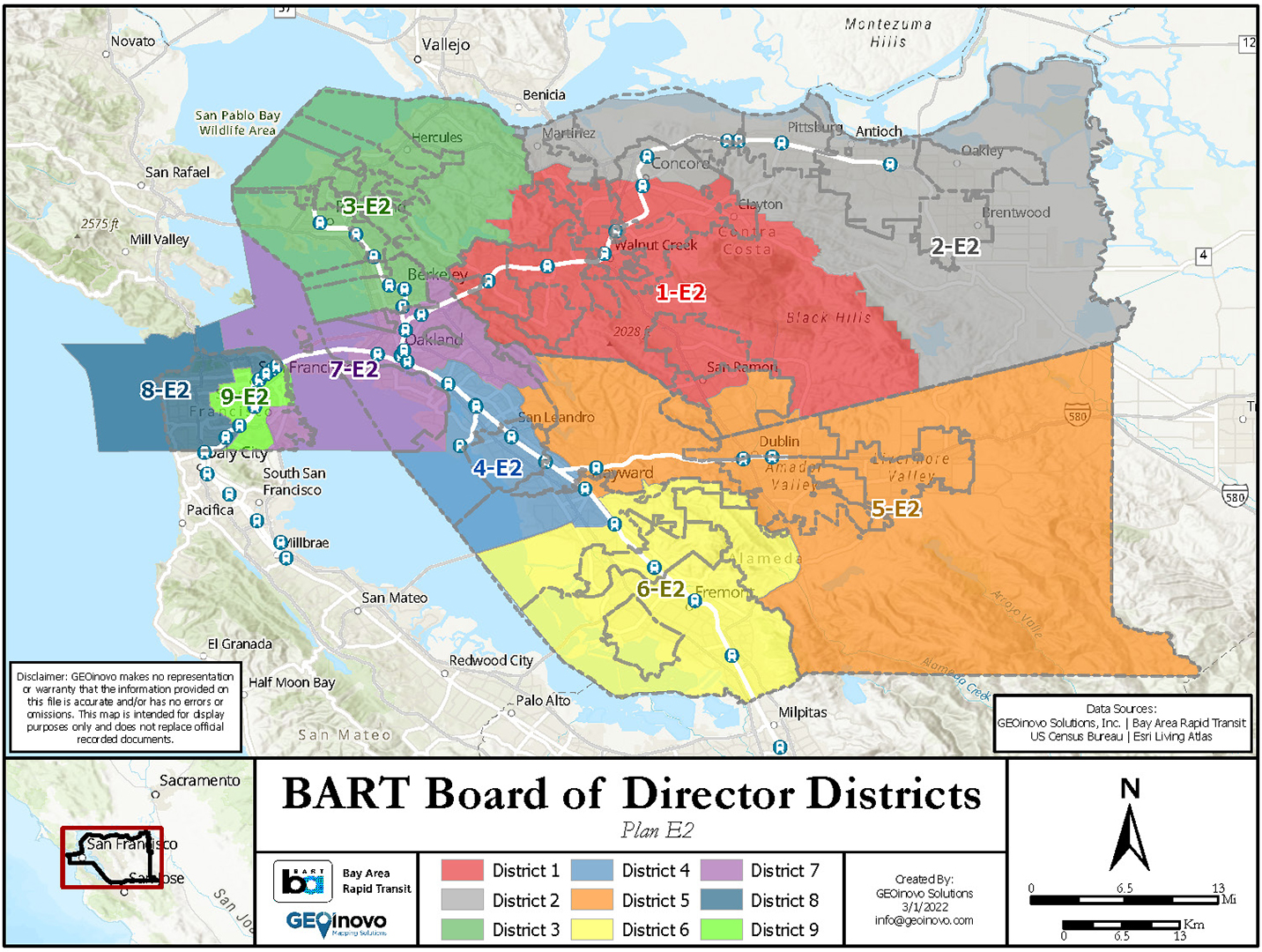
BART 2022 Adopted Redistricting Map. Source: BART.gov

On March 10, 2022, the BART Board of Directors voted to approve a final redistricting map for the nine districts which will affect elections for the next 10 years. View the presentation for the 3/10/22 board meeting

According to the Map Plan E2 Description, “This plan presents districts with varying levels of similarity to the current BART districts. The greatest change is in District 7 with only 27.9% of its current population remaining in District 7. The next district to show major changes is District 3 with 31.3% of its current population remaining in the proposed Plan E2, District 3.

District 4 maintains 48.8% of its current population. District 1 maintains greater than 75% of its current population. Districts 5, 8, and 9 maintain greater than 81% of their current populations. The districts most similar to the current boundaries are District 2 with 91.4% of its current population and District 6 with 95.6% of its current population.”

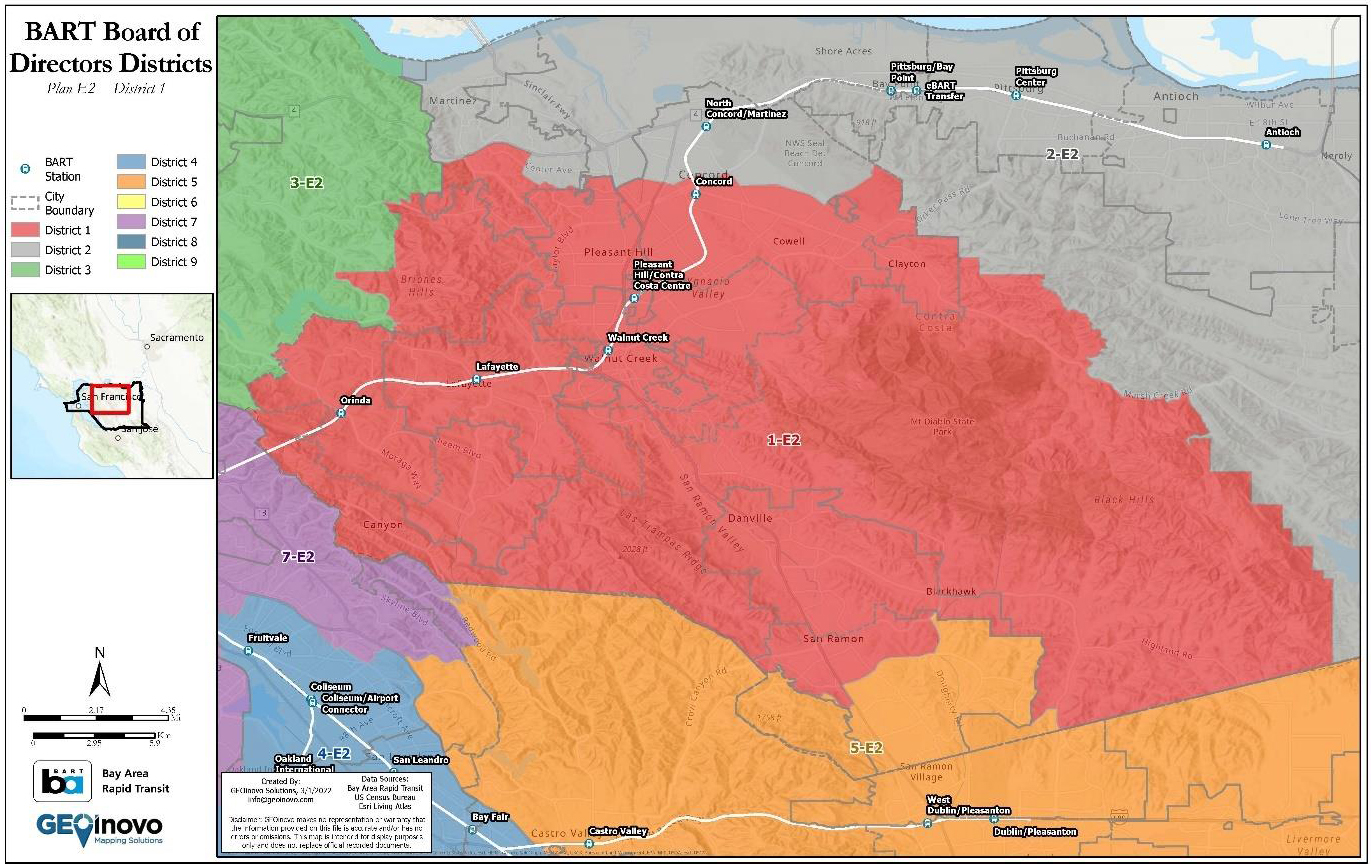
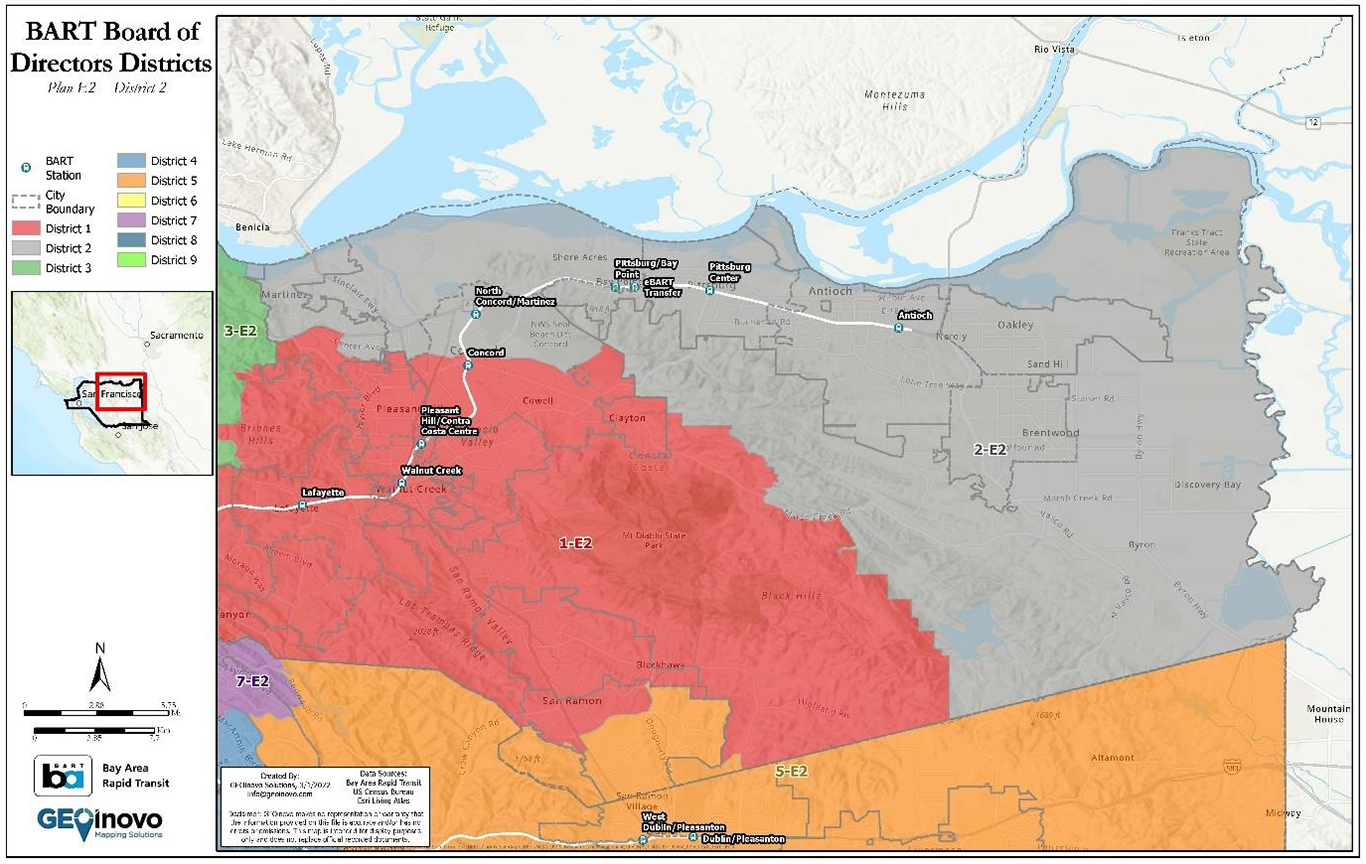
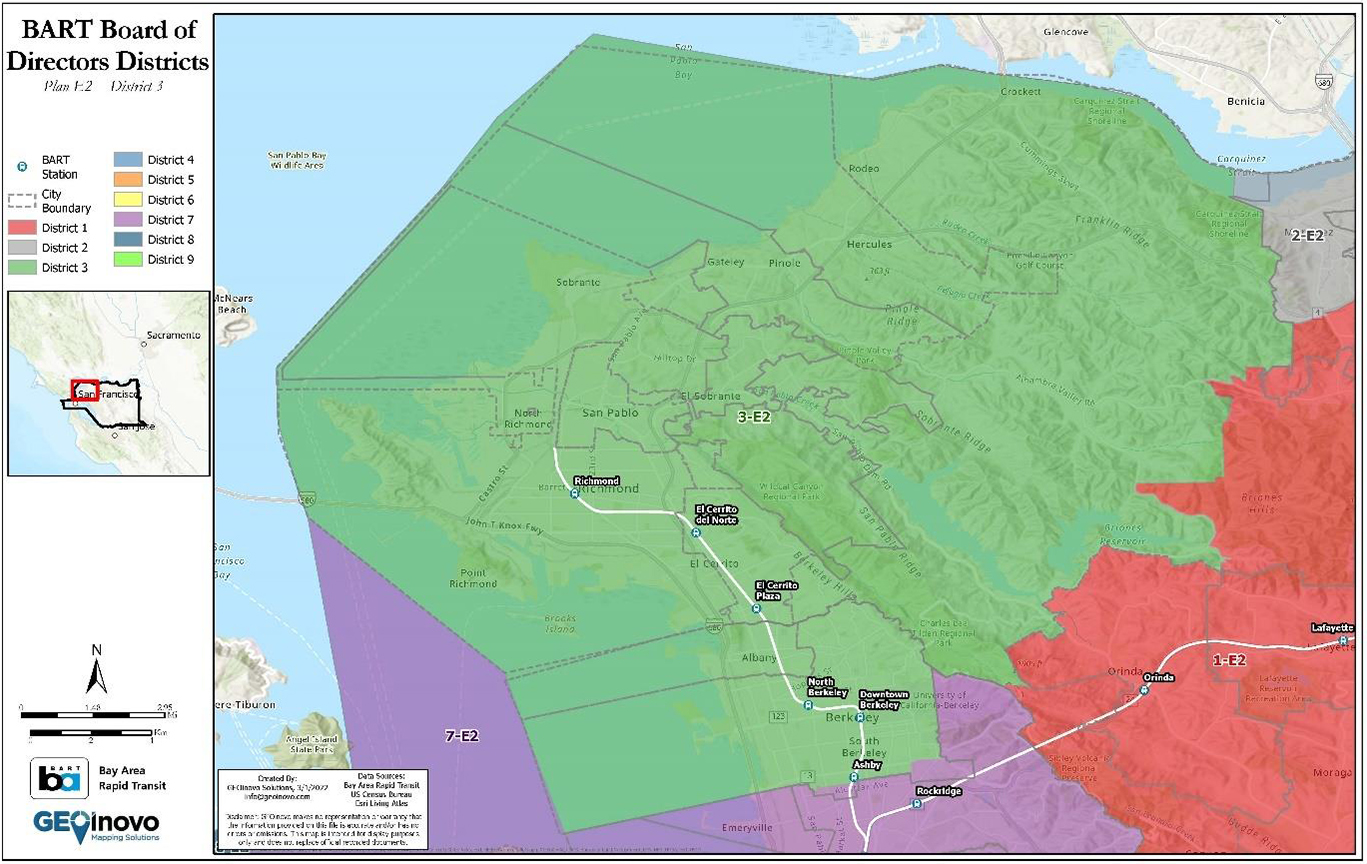
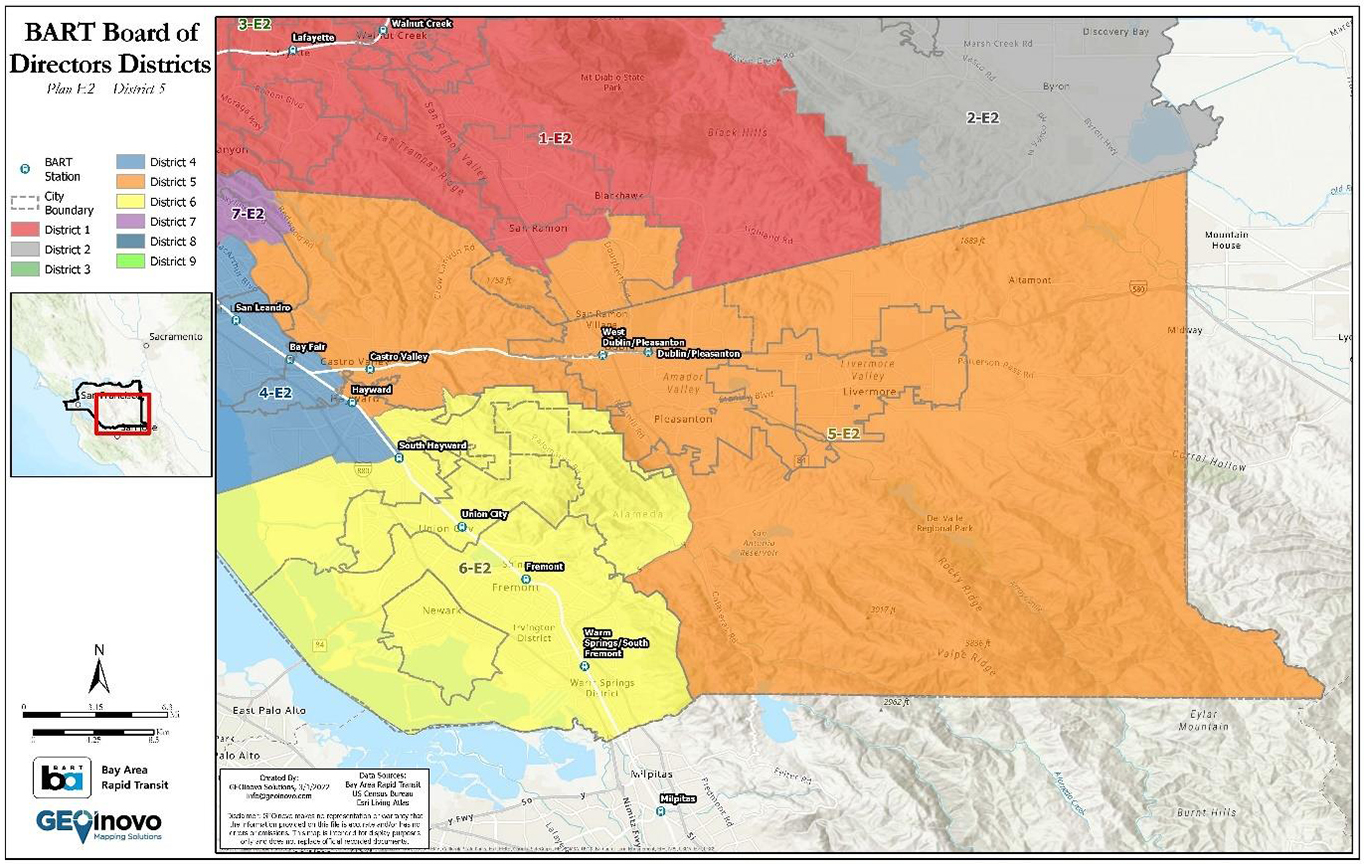
Most of Contra Costa County is now in Districts 1, 2 and 3, with portions of San Ramon in District 5.

BART 2022 District 1 map. Source: BART.gov

District 1

District 1 is in Contra Costa County and includes the Southern portion of the City of Martinez, Pleasant Hill, Walnut Creek, Town of Danville, the Northern part of the City of San Ramon, City of Lafayette, the Southern part of the City of Concord, including Cowell, Four Corners, and Meinert, City of Moraga, City of Orinda, and City of Clayton.

BART Stations included in District 1: Orinda, Lafayette, Walnut Creek, Pleasant Hill/Contra Costa Centre and Concord (shared with District 2)

BART 2022 District 2 map. Source: BART.gov

District 2

District 2 is in Contra Costa County and includes the City of Pittsburg, City of Antioch, City of Brentwood, City of Oakley, the Northeastern part of the City of Concord including the former Naval Weapons Station, and the Northern part of the City of Martinez including the unincorporated neighborhoods of Mountain View and Vine Hill.

BART Stations included in District 2: Concord (shared with District 1), North Concord / Martinez, Pittsburg / Bay Point, eBART Transfer, Pittsburg Center and Antioch.

BART 2022 District 3 map. Source: BART.gov

District 3

District 3 is in both Contra Costa and Alameda Counties and includes the City of Hercules, City of Pinole, City of San Pablo, City of Richmond, City of El Cerrito, City of Albany, the majority of the City of Berkeley including the University of California Berkeley and excepting a few neighborhoods to the South of Ashby Avenue, and unincorporated parts of Contra Costa County including North Richmond, El Sobrante, Rodeo and Crockett.

BART Stations included in District 3: Richmond, El Cerrito del Norte, El Cerrito Plaza, North Berkeley, Downtown Berkeley and Ashby (shared with District 7)

BART 2022 District 5 map. Source: BART.gov

District 5

District 5 is in Alameda and Contra Costa Counties and includes a portion of the City of Hayward ranging from the Castro Valley BART station in the North to the Hayward station in the South. Major places and landmarks in this area include the Bishop Ranch Regional Open Space, Lake Chabot Regional Park, Knowland Park, Fairview, Sunol Regional Wilderness, and San Antonio Reservoir. District 5 also includes the City of Pleasanton expect for a portion near Kilkare Woods, City of Livermore, City of Dublin, the Southeastern part of San Ramon, and rural areas of east Alameda County.

BART Stations included in District 5: Hayward (shared with District 4), Castro Valley, West Dublin / Pleasanton and Dublin / Pleasanton

The new districts will be in effect for the November elections which include Districts 2, 4, 6 and 8. Districts 1, 3, 5, 7 and 9 will be up for election in 2024.

Allen D. Payton contributed to this report.

Filed Under: BART, News, Politics & Elections

BART issues new schedule for 2022

February 9, 2022 By Publisher Leave a Comment

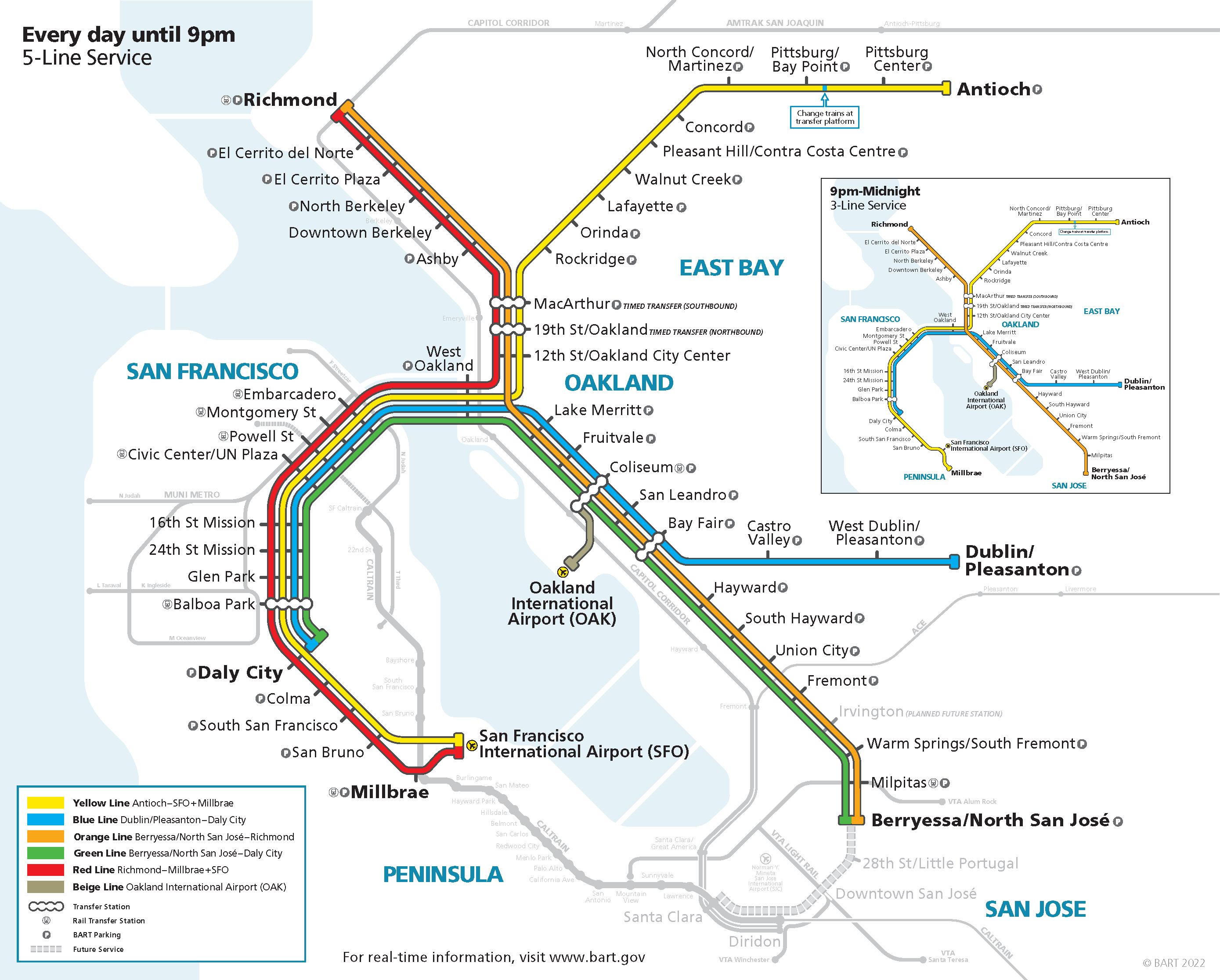
BART System Map. Source: BART.gov

BART’s schedule will change on Monday, February 14, 2022, with significant improvements to Sunday service. With this schedule change, BART will operate midnight service every night of the week representing a full restoration of pre-pandemic service hours.

Highlights include:

  • Extend service to midnight on Sundays
  • Run 5-line service every day (except for single-tracking Sundays) until about 9pm
  • Consistent 3-line service every day after 9pm
  • 4 trains an hour at SFO station on Sundays until 9pm
  • 15-minute even headways on the Yellow line as far as Pittsburg Bay Point on Saturdays until about 8pm
  • New transfer opportunity at Bay Fair for Dublin to Berryessa transfers every day
  • Improved connections with Caltrain at Millbrae on Sundays before 9pm
  • 12 single-tracking Sundays in 2022 when 3-line service will be provided

Some departure times will shift slightly. All riders are encouraged to look up their specific trips.

Sunday Service Improvements

Since the pandemic began BART has been closing at 9pm on Sundays to help accelerate infrastructure rebuilding projects. Beginning Sunday, February 20th, BART will extend Sunday service to midnight. Sunday service hours will be 8am-midight.

Starting Sunday, February 20, 2022, for the first time in history, BART will operate 5-line service on Sundays (except on 12 single-tracking Sundays when power cable replacement work takes place in San Francisco. 3-line service will run on single tracking Sundays). It is important to note the frequency of Sunday single tracking days that will remain as 3-line service with single tracking. March will have two Sundays of 5-line service. Some months will offer 5-line service on Sundays every other week. We’ve listed the 2022 Sunday single tracking days here.

Providing 5-line service on Sundays reduces the need to transfer for most riders and provides more frequency through the busiest core areas of our system. From 8am until evening (about 9pm), the Red line (Richmond to Millbrae + SFO) and Green line (Berryessa to Daly City) will run.

Running 5-Line service on Sundays provides more equitable service to Richmond and Berryessa line riders who previously had to transfer to complete their transbay trip-while other lines provided direct service. Based on ridership data 97% of Sunday riders will get to their destination without the need to transfer, up from 82%. Of those passengers who benefit from this change, about twice as many will ride the Red line than the Green line.

3-line service (Yellow, Blue and Orange lines) will operate every evening after around 9pm and on 12 select single-tracking Sundays. During 3-line service, the Yellow and Blue line will continue to run very close together through San Francisco to enable singling track through work zones. BART plans to improve this service pattern and run Yellow and Blue line trains more evenly spaced apart in the September 2022 schedule change.

Trains will continue to run on 30-minute headways on Sundays with some 15-minute levels of service due to running the Red and Green line. While some outlying areas will see 2 trains per hour on Sunday, most BART stations will see 4, 6, or 8 trains per hour.

New Transfer Opportunity at Bay Fair

More riders are coming in from the Dublin line and heading towards Berryessa. The schedule change includes a new transfer opportunity at Bay Fair every day during all service hours. Riders from Dublin on the Blue line will see a Green or Orange line train across the platform. This transfer has a tight window but the September 2022 schedule change will increase the window to allow for more flexibility to make the meet if there are delays.

Improved Connections with Other Transit Agencies

Most agencies operate the same schedule on Saturday and Sunday, making it difficult for them to design ideal transfers when BART schedules are different on Saturday and Sunday.  Starting in February, the seven night 3-Line service that begins about 9:00 pm is matched all seven days which allows partner agencies to match their schedules with BART more successfully.  The final trains of the night, all seven days in the week, share the same times.

We’ve updated the BART and Caltrain transfer timetable to outline the wait times of each connecting train. Offering 5-line service on Sundays reduces some wait times by 8 or 11 minutes. While weekdays and Saturday connections are very similar to what they were before, there are small improvements of 1-3 minutes shorter wait. For example, a 12-17 minute connection, becomes 9-14 minute connection.

Saturday Service

Saturday service hours will remain unchanged (6am-midnight). Trains will continue to run at 30-minute frequency with added trains on the Yellow line as far as Pittsburg/Bay Point until 8pm. This schedule change improves the Yellow line frequency with more even spaced 15 minute headways as far as Pittsburg/Bay Point compared to what was being offered before.

Weekday Service

Weekday service remains unchanged though some departure times have slightly shifted. Service hours continue to be 5am-midnight.

Pictured above is the system map showing 5-line service every day of the week for Sundays we are not single tracking.

Filed Under: BART, News, Transportation

BART Board will consider third proposed map during final redistricting public outreach meeting Wednesday

January 29, 2022 By Publisher Leave a Comment

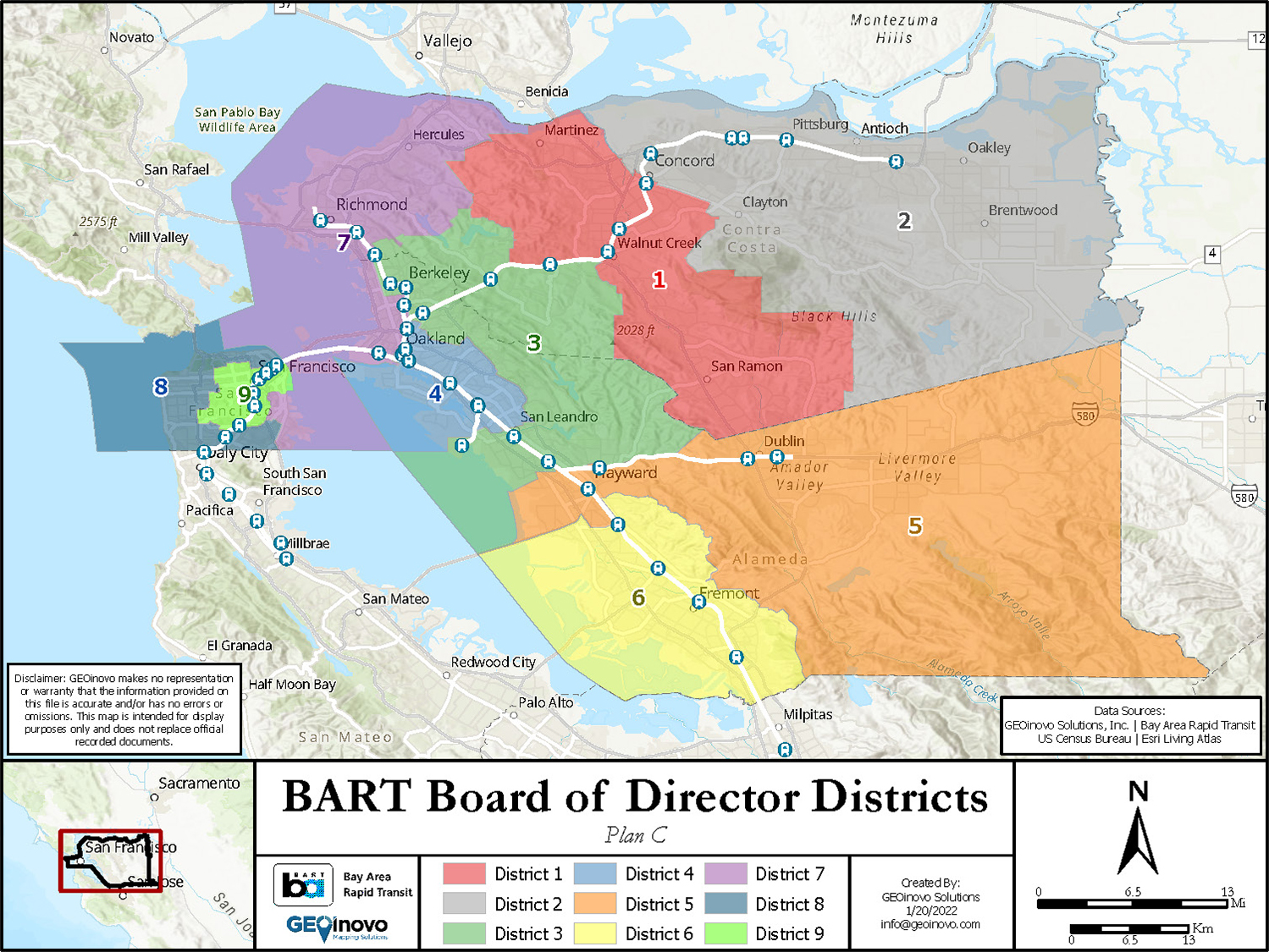
Proposed BART Districts 2022 Plan C.

Approaching critical phase – but few people seem interested, participating

The BART redistricting process is reaching a critical phase, with just one more virtual meeting for public outreach, scheduled for 6 pm on Wednesday, February 2nd. Few people seem interested in participating in the process in spite of the significant impact redistricting has on who will run for office and be elected over the next 10 years. Only two people offered public comments at the last BART meeting on redistricting, including the publisher of the Herald, Allen Payton.

Join the virtual meeting on 2/2/22 at 6pm on Zoom:

https://us06web.zoom.us/j/82168419186
Webinar ID: 821 6841 9186

Or Telephone US: +1 669 900 6833  (Toll Free) or 888 475 4499

BART election districts are redrawn every 10 years following the U.S. Census. The primary purpose of redistricting is to ensure population equality among districts.

Once the public outreach has concluded, the BART Board of Directors will continue to discuss the process and advance the work at upcoming Board meetings, including a special meeting of the Board of Directors. Meetings and agendas will be announced in advance. Sign up for Board meeting notices here.


BART has provided the following draft maps and census population and race/ethnicity data:

BART Board Districts Map Plan A

BART Board Districts Map Plan B

BART Board Districts Map Plan C

Census population and race/ethnicity data by District (Current, Plan A, Plan B, Plan C)

BART has rolled out mapping tools to enable public input for redistricting.

BART interactive mapping tool for redistricting: This tool gives residents the ability to create and share a Community of Interest and/or draft Board Member districts. Map submissions will appear in the gallery on the main landing page, enabling residents to view public input for redistricting.

BART Districts and Demographic Data: This web mapping tool is for visualizing BART districts and demographic data.
In addition to the interactive mapping tool, BART is providing a Community Input Map to allow residents to identify and provide supplemental information regarding their Community of Interest. This feature can be used on a mobile device and is offered in English and Spanish (Español), providing residents with an app that can be used to submit community information in their language of choice.

Community Input Map: English

Community Input Map: Spanish

Learn more about BART Redistricting at bart.gov/redistricting.

This process is guided by traditional redistricting principles as well as the U.S. Constitution, the California Constitution, the federal Voting Rights Act, the BART District Act, and the Fair and Inclusive Redistricting for Municipalities and Political Subdivisions (FAIR MAPS) Act.

Allen Payton contributed to this report.

Filed Under: BART, News, Politics & Elections

Participate in democracy during BART’s remaining redistricting meetings

January 15, 2022 By Publisher Leave a Comment

Proposed BART Districts 2022 Plan A

For redrawing BART director districts; next meeting today at 9:00 a.m.

RELEASE DATE: 01/14/2022

Have a direct say in democracy by participating in BART’s redistricting meetings. The next virtual meeting is scheduled for January 15, at 9 am, followed by two 6pm meetings on January 22nd and February 2nd.

BART election districts are redrawn every 10 years following the U.S. Census. The primary purpose of redistricting is to ensure population equality among districts.  This process is guided by traditional redistricting principles as well as the U.S. Constitution, the California Constitution, the federal Voting Rights Act and the BART District Act.

Districts must be contiguous and should also be compact, minimize splitting cities, respect communities of interest and follow natural and man-made boundaries.

Proposed BART Districts 2022 Plan B

Key Points to Consider in Redistricting

Traditional Redistricting Principles

Since decennial redistricting began in the late 1960s, traditional criteria and principles have developed. While the equal population of election districts is the overriding principle there are accompanying goals. In varying degrees, the criteria are compactness, continuity, respect for communities of interest, preserving political subdivisions, and the core of previous districts. All are not of equal weight and all are subordinate to an equal population. Care must be taken not to dilute the voting strength of minorities.

Compactness

Compactness refers to a districts’ geographic shape and how its interior is dispersed within its boundaries. A circle is a perfectly compact shape. In redistricting, the notion of compactness is difficult to evaluate because one begins with irregularly shaped borders and the political subdivisions may be irregular in shape. Geometric measures of compactness are often misleading because geographic features and relationships are more complex than simple geometry. The principle of compactness should be considered functionally and must compete with other criteria.

Continuity

Continuity requires that all parts of a district be connected. Districts can be drawn that are contiguous by way of water or a bridge. While crossing water is allowed it should be minimized as it makes it more difficult to respect communities of interest.

Preserving Political Subdivisions

An attempt should be made to minimize splitting cities and well-defined neighborhoods.

Respect for Communities of Interest

Communities of interest are subjective and difficult to define. A community of interest has some common thread of shared interest. Those communities can be based on such diverse elements as geography, language, socio-economic-cultural interests, even transportation corridors. Race may be considered, but it may not be the sole reason for drawing a district in a particular manner.

Preserving the Core of Prior Districts

Preserving the core of a previous district is thought to be the least disruptive to the voters in each area. One, of course, would not seek to maintain a previous district that was legally objectionable.

New districts should be drawn deliberatively and with common sense. Adherence to traditional redistricting principles and the federal Voting Rights Act will ensure fair and reasonable districts.

Community participation is available via Zoom on January 15, 2022 starting at 9 am at https://us06web.zoom.us/j/88956838390

You may join the Committee Meeting via Zoom by calling 1-669-900-6833 and entering access code 889 5683 8390. Dial *9 to raise your hand when you wish to speak, and dial *6 to unmute when you are requested to speak.

Virtual Meetings of BART’s Redistricting Committee and Archived Video 

The BART Redistricting Committee consists of Directors Lateefah Simon (Chairperson), Elizabeth Ames and Mark Foley. Here is the remaining proposed redistricting outreach meeting schedule, materials, zoom information, and videos of previous meetings are provided below the list of meetings dates:

  • Meeting 4: Saturday, January 15, 2022, 9 am
  • Meeting 5: Saturday, January 22, 2022, 6 pm
  • Meeting 6: Wednesday, February 2, 2022, 6 pm

January 8, 2022 Meeting – A virtual meeting was held Saturday, January 8, 2022 from 12 to 2 pm. Watch the video of the 1/8/22 meeting.

December 15, 2021 Meeting – A virtual meeting was held Wednesday, December 15, 2021 from 6 to 8 pm. Watch the video of the 12/15/21 meeting.

December 1, 2021 Meeting – A virtual meeting was held Wednesday, December 1, 2021 from 1 to 3 pm. Watch the video of the 12/1/21 meeting.

Documents from the December 1 meeting:

BART Board Districts Map Plan A
BART Board Districts Map Plan B
Table of BART District’s Citizen Voting Age Population (CVAP) by Race/Ethnicity
Table of Population by BART District, 1990-2030(estimate)

November 10, 2021 Meeting – The first virtual meeting was held Wednesday, November 10, 2021 from 1 to 3 pm. Watch the video of the 11/10/21 meeting.

Current District Maps and Early Drafts of Potential (Not Final) New Maps

District 1
Current District 1 Map
Potential new maps (not final):
District 1 Plan A
District 1 Plan B

District 2

Current District 2 Map
Potential new maps (not final):
District 2 Plan A
District 2 Plan B

District 3

Current District 3 Map
Potential new maps (not final):
District 3 Plan A
District 3 Plan B

District 4

Current District 4 Map
Potential new maps (not final):
District 4 Plan A
District 4 Plan B

District 5

Current District 5 Map
Potential new maps (not final):
District 5 Plan A
District 5 Plan B

District 6

Current District 6 Map
Potential new maps (not final):
District 6 Plan A
District 6 Plan B

District 7

Current District 7 Map
Potential new maps (not final):
District 7 Plan A
District 7 Plan B

District 8

Current District 8 Map
Potential new maps (not final):
District 8 Plan A
District 8 Plan B

District 9

Current District 9 Map
Potential new maps (not final):
District 9 Plan A
District 9 Plan B

Mapping Tools for Public Engagement

BART has rolled out mapping tools to enable public input for redistricting.

BART interactive mapping tool for redistricting: This tool gives residents the ability to create and share a Community of Interest and/or draft Board of Director districts. Map submissions will appear in the gallery on the main landing page, enabling residents to view public input for redistricting.

BART Districts and Demographic Data: This web mapping tool is for visualizing BART districts and demographic data.

In addition to the interactive mapping tool, BART is providing a Community Input Map to allow residents to identify and provide supplemental information regarding their Community of Interest. This feature can be used on a mobile device and is offered in English and Spanish (Español), providing residents with an app that can be used to submit community information in their language of choice. Explore these tools using the links below.

Community Input Map: English

Community Input Map: Spanish

Information about current District boundaries

BART 2011 Election Districts Final Report – Adopted 12/1/2011 (10 Mb .pdf file)
All BART Districts
Counties Included: Alameda, Contra Costa, San Francisco
Map: All BART Districts (.pdf file)

District: 1
Counties Included: Contra Costa
Cities Included: Acalanes Ridge, Alamo, Alhambra Valley, Blackhawk, Camino Tassajara, Castle Hill, Clayton, Concord, Contra Costa Centre, Danville, Diablo, Lafayette, Martinez, Mountain View, Norris Canyon, North Gate, Pacheco, Pleasant Hill, Port Costa, Reliez Valley, San Miguel, San Ramon, Saranap, Shell Ridge, Vine Hill, Walnut Creek
Map: BART District 1 (.pdf file)

District: 2
Counties Included: Contra Costa
Cities Included: Antioch, Bay Point, Bethel Island, Brentwood, Byron, Clyde, Concord, Discovery Bay, Knightsen, Oakley, Pacheco, Pittsburg, Vine Hill
Map: BART District 2 (.pdf file)

District: 3
Counties Included: Alameda, Contra Costa
Cities Included: Albany, Ashland, Berkeley, Castro Valley, Cherryland, El Cerrito, Kensington, Lafayette, Moraga, Oakland, Orinda, Piedmont, San Lorenzo
Map: BART District 3 (.pdf file)

District: 4
Counties Included: Alameda
Cities Included: Alameda, Oakland, San Leandro
Map: BART District 4 (.pdf file)

District: 5
Counties Included: Alameda
Cities Included: Castro Valley, Cherryland, Dublin, Fairview, Hayward, Livermore, Pleasanton, Sunol
Map: BART District 5 (.pdf file)

District: 6
Counties Included: Alameda
Cities Included: Fremont, Hayward (partial), Newark, Sunol, Union City
Map: BART District 6 (.pdf file)

District: 7
Counties Included: Alameda, Contra Costa, San Francisco
Cities Included: Albany, Bayview, Berkeley, Crockett, East Richmond Heights, El Cerrito, El Sobrante, Emeryville, Hercules, Kensington, Montalvin Manor, North Richmond, Oakland, Pinole, Richmond, Rodeo, Rollingwood, San Francisco, San Pablo, Tara Hills
Map: BART District 7 (.pdf file)

District: 8
Cities Included: San Francisco
Counties Included: San Francisco
Map: BART District 8 (.pdf file)

District: 9
Cities Included: San Francisco
Counties Included: San Francisco
Map: BART District 9 (.pdf file)

Learn more at www.bart.gov/redistricting.

Filed Under: BART, News, Politics & Elections

BART offers extended service for New Year’s Eve

December 30, 2021 By Publisher Leave a Comment

For New Year’s Eve BART will run standard Friday service but with an extended closing time to help people celebrate the arrival of 2022 as well as to support workers who are relying on BART to get to and from their late-night shifts.

The regular last trains of the evening (Yellow, Blue, and Orange lines) will be dispatched from the end of their lines at midnight and then at 1:00am, we will run another set of last trains of the evening to serve 48 out of our 50 stations. The 1am dispatched trains will not serve the airport stations (OAK and SFO) but will stop at all other stations. These last trains will be timed to easily transfer to other lines to get home.

For those celebrating in downtown San Francisco, the last East Bay-bound train running through downtown San Francisco will be at around 1:30am and the last southbound train heading toward Millbrae will run through downtown San Francisco at 2:10am.

BART will offer overtime shifts to train operators to run extra event trains that can be dispatched between the one-hour gap in between the midnight and 1:00am dispatch.

Unlike previous years, BART will not run skip-stop service on New Year’s Eve. All trains will make their regular stops, except for the 1:00am dispatch which will not stop at SFO or OAK airports.

1:00 AM Extended Service Details

  • Only the Yellow line (Millbrae to Antioch) will run transbay. Riders heading from San Francisco towards Richmond, Berryessa, and Dublin will need to transfer. The train will not serve SFO.
  • Southbound Yellow line (Antioch to Millbrae) trains will run to Millbrae, stopping at all stations except SFO.
  • The Blue line will operate from Bay Fair to Dublin only. If travelling from San Francisco, Dublin-bound riders need to transfer at 12th Street to a Berryessa (Orange line) bound train and then transfer to a Dublin (Blue line) train at Bay Fair to complete their trip. These transfers will be timed meets to reduce travel time.
  • The Orange line (Richmond to Berryessa) will also run hourly to coincide with the other trains. Riders coming from San Francisco who need to transfer to a Richmond-bound train will do so at MacArthur; riders who need to transfer to a Berryessa-bound train (or Dublin) will do so at 12th Street. These transfers will be timed meets to reduce travel time. BART to OAK service will not be operating after regular BART hours.

Parking
Parking is free after 3:00pm on Friday. You can also leave your car overnight if necessary. Parking is free on weekends.

Stay Safe

Save these numbers in your phone:

  • 510-200-0992 to text BART Police dispatch to discreetly report criminal activity
  • 510-464-7000 to call BART Police in an emergency (It’s faster than calling 911)

We also offer the free the BART Watch app–a free mobile app available on the App Store and Google Play that allows you to quickly and discreetly report criminal or suspicious activity directly to BART Police.

You can reach the train operator using call buttons in each car. On old cars the button is at the end of the car, on new cars, the call button is by the side doors.

Note your train car number when contacting police or the train operator. The train number is located above the doors on the inside of each end of the train car.

BART will have extra safety staff working on New Year’s Eve to have more staff on trains, on platforms and inside stations.

Tips for Riding

Masks are required at BART, even if fully vaccinated. Spread out among all the cars. The first and last cars are often less crowded than those in the middle.

To save time and hassle, it is recommended you get a Clipper card in advance with round trip fare loaded. You can add Clipper to your mobile wallet and pay for BART fares with Google Pay and Apple Pay. All riders can immediately load funds through their wallet to their Clipper card.

Saturday Service on New Year’s Day

New Year’s Day, January 1, 2022, will be a regular Saturday schedule with service running 6am until midnight.

Filed Under: BART, Holiday, News

  • « Previous Page
  • 1
  • …
  • 4
  • 5
  • 6
  • 7
  • 8
  • …
  • 13
  • Next Page »
Furniture-Clearance-02-26B
Liberty-Tax-Jan-Apr-2026
Deer-Valley-Chiro-06-22

Copyright © 2026 · Contra Costa Herald · Site by Clifton Creative Web