• Home
  • About The Herald
  • Local Agencies
  • Daily Email Update
  • Legal Notices
  • Classified Ads

Contra Costa Herald

News Of By and For The People of Contra Costa County, California

  • Arts & Entertainment
  • Business
  • Community
  • Crime
  • Dining
  • Education
  • Faith
  • Health
  • News
  • Politics & Elections
  • Real Estate

BART unveils, begins testing new DMU train for upcoming service to Antioch

July 2, 2016 By Publisher Leave a Comment

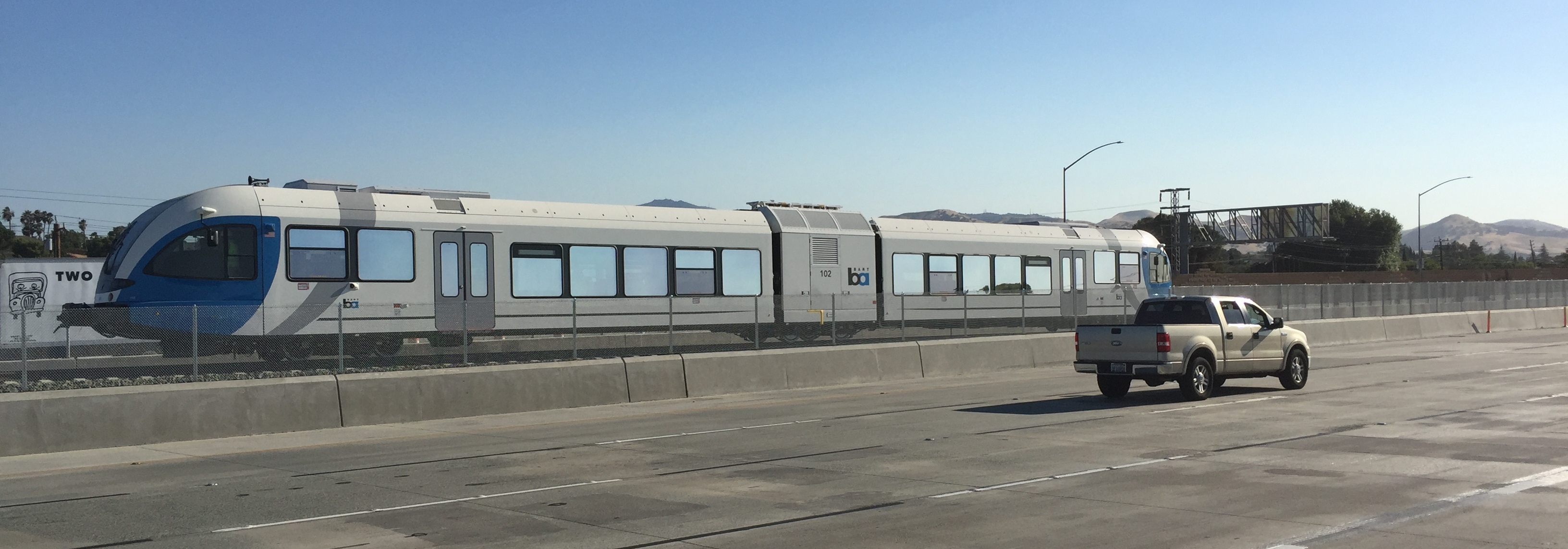
A two-car eBART train undergoes testing in the middle of Highway 4 between Hillcrest Avenue and A Street/Lone Tree Way on Friday evening, July 1st. photo by Allen Payton

A two-car eBART train undergoes testing in the middle of Highway 4 between Hillcrest Avenue and A Street/Lone Tree Way on Friday evening, July 1st. photo by Allen Payton

First of many tests over the next two years

The BART to Antioch Extension Project marked another important milestone Thursday morning, June 30th, with BART unveiling its sleek new diesel-powered trains, soon to be seen linking Pittsburg/Bay Point and Antioch down Highway 4’s median.

“We’ve been working on the arrival of BART to this part of the Bay Area for years, so it’s both thrilling and a bit surreal to finally be here aboard these amazing new vehicles,” said BART Director Joel Keller. “We couldn’t have made BART to Antioch happen without the long-term dedication of East County residents, and the commitment of the many leaders at the local, regional, state, and federal levels who came alongside us to help turn this visionary project into reality.”

The new train cars will run on separate tracks extending past the existing Pittsburg/Bay Point Station, and are a different type than those arriving in BART’s new Fleet of the Future.  This Diesel Multiple Unit (DMU) was chosen to bring rail service to East County residents while remaining cost-effective; the $525 million, 10-mile extension to Antioch is 60% less expensive than conventional BART. Stations for the new service will be located along Highway 4 near the Railroad Ave. intersection in Pittsburg and the Hillcrest Ave. intersection in Antioch, with all eight new vehicles set to arrive by this December prior to a year of state-mandated testing for safety and functionality.

A two-car eBART train could be seen undergoing testing in the middle of Highway 4 heading westbound from Hillcrest Avenue, about 6:15 p.m. Friday evening, July 1st.

“This is an exciting milestone with the first testing of the train on the tracks,” Keller added in a brief interview. “We’re still shooting for a May, 2018 opening, once we get the state approvals. This is the first of many tests.”

The new train cars, rated the most environmentally friendly out of all diesel-powered trains, will be able to move an estimated 2,400 people per hour during commute times, and boast a variety of amenities including six digital signs per vehicle (with multiple language support), automated audio announcements, clear station arrival / destination signage, and modern climate control systems.  Daily ridership of the BART extension to Antioch is expected to exceed 10,100 by 2030 through the Highway 4 corridor, with an initial expected daily ridership of 5,600.

BART to Antioch is part of the nearly-complete Highway 4 Widening Project, which expands Highway 4 from four to eight lanes between Loveridge Road in Pittsburg to just west of State Route 160 in Antioch, and from two to four lanes from Lone Tree Way in Oakley to Balfour Road in Brentwood.  The project provides greater mobility and access to multi-modal transportation, not only expanding lanes and building missing connector ramps at the State Route 160 interchange, but also providing funds for BART to Antioch.

The project has been carefully staged to keep the daily traffic of 130,000 cars moving, even as major construction and demolition work continue.

“The arrival of these new BART vehicles and the beginning of testing is a visible reminder of the progress being made to further economic growth and improve access to jobs and vital services for East County’s 250,000 residents,” said Dave Hudson, Chair of the Contra Costa Transportation Authority. “The Highway 4 Widening and BART to Antioch projects would not have been possible without either the backing of Contra Costa voters in 2004, or the help of partner agencies. We look forward to continued public support for additional innovations and improvements on the Highway 4 corridor in the future.”

Average travel time between stations is expected to be seven minutes between Antioch and Pittsburg Stations, and three minutes between Pittsburg and Pittsburg/Bay Point Stations.  The new stations will use the same BART fare collection machines and gates used elsewhere in the BART system, with full service set to begin winter 2017/2018.

For more information visit the project page.

Allen Payton contributed to this report.
Filed Under: BART, News, Transportation

Sen. Glazer says BART union agreement is “positive step forward”

April 15, 2016 By Publisher Leave a Comment

State Senator Steve Glazer released the following statement, this week, about the agreement the BART has entered with its labor unions:

“About 60 days ago, 40 state and local elected leaders joined me in sending a letter to the BART Board and their unions calling on them to take steps to restore the public’s trust in the financial management of the BART system.

Specifically, we asked that BART negotiate an extension to its labor contract that would ensure that the trains would keep running without a work stoppage for the next five years and to do so in a financially responsible way.

Given what we know today, this proposed agreement takes a positive step forward in delivering on those requirements. If approved by the unions and the BART Board, we can be confident that there will be continuous train operations for the next five years without debilitating strikes.

The BART unions and management should be commended for doing this.

Strikes are too debilitating for BART riders and commuters. That is why transit strikes are banned in New York, Chicago, Washington DC, Boston and San Francisco.

There is still much more that BART should do to raise the level of confidence in the financial and operational management of the system. And I encourage them to continue the momentum with these confidence-building steps.

They are:

  1. Do not apply these cost of living raises to highly-paid managers. Their pay should be based on merit, not a “Me Too” clause.
  2. Commit to undertaking a salary study before the expiration of the next contract so that that we can closely examine each position’s compensation with the marketplace.
  3. Set up a capital depreciation fund so that savings for repair and replacement is funded every year rather than in a balloon payment through new bond proposals.
  4. Present clear projections of retirement costs and how they will be funded.
  5. Support legislation banning future BART strikes.
  6. Explore ways to train replacement managers to operate the system in the case of future work stoppages.

The financial elements of this proposed deal are not what I would have negotiated. BART workers are highly paid and system financial needs are great. However, I respect the collective bargaining process, and even if I disagree with some of the financial terms, I appreciate that compromise is required to bring all parties together.

This proposed contract represents the start of a turnaround for BART. We were going down the tracks, these past few years, in a very negative direction. The actions today have stopped that negative train and we are now heading in a positive direction. Let’s keep that momentum going with the confidence building steps that I have outlined.”

Glazer represents most of Contra Costa County in the California State Senate.

Filed Under: BART, Transportation

East Bay Leadership Council: BART labor agreement a welcome development

April 14, 2016 By Publisher Leave a Comment

EBLC logoBy The East Bay Leadership Council

On Monday morning, BART and its major unions announced that a tentative agreement had been reached on a new four-year contract, a deal that helps put the brinkmanship of the 2013 strike behind us and five strike-free years ahead of us.

That is a welcome development, but a stoppage is still a threat. BART is plagued by $9.6 billion in deferred maintenance and a shutdown caused by equipment problems would be no better for riders than a strike.

The degraded condition of the BART system did not develop overnight and it is fair to question past decisions made by the Board and management. Ultimately, the Board is accountable for the system’s performance.

The East Bay must invest in this vital public service and demand accountability from an organization that our region needs to be at its best.

While the East Bay may not be pushed to the brink by a BART labor dispute for the next five years, its infrastructure is still at the brink of breakdown.

The EBLC has not endorsed the possible BART bond measure and will not take a formal position until the measure is approved by the Board, but we do believe it is time to face our reality and make wise infrastructure investments.

ABOUT THE EAST BAY LEADERSHIP COUNCIL

The East Bay Leadership Council (EBLC) is a private-sector, public-policy organization that advocates on issues affecting economic vitality and quality of life and represents leaders of business, industry, education, government, and the nonprofit community. For more information visit www.eastbayleadershipcouncil.com.

Filed Under: BART, Business

Rep. DeSaulnier, MTC Commissioner Amy Worth support BART labor agreement, Glazer will study it

April 13, 2016 By Publisher Leave a Comment

On Monday, Congressman Mark DeSaulnier (CA-11) issued the following statement on the agreement between Bart and the transit unions:

“I am grateful a tentative agreement has been reached between Bart and the transit unions. If approved, there will be no interruptions in services for  Bay Area commuters. I look forward to reviewing full details of the 5-year deal with an eye towards the long-term financial stability and sustainability of Bart. On the federal level, I will continue to advocate for meaningful performance standards for transit agencies to ensure the public is getting its value.”

Orinda City Councilmember Amy Rein Worth, who serves on the Metropolitan Transportation Commission (MTC) as the representative of the cities of Contra Costa County, on Monday issued this statement following the announcement of a tentative agreement between BART management and labor leaders:

“This morning BART announced a tentative agreement with its labor unions to extend BART labor contracts until 2021.I am pleased to support this financially prudent agreement that provides security to BART workers and service reliability to the BART riding public.

BART is a critical part of the East Bay economy and is relied upon by hundreds of thousands of East Bay commuters.I am hopeful that this agreement portends a future without service disruptions not just for the next five years, but sets a tone for the future beyond as well.

The critical role of BART service goes far beyond those who depend on it for a ride each day, as we have learned; the East Bay highway and transit network is not able to replace BART during a strike or a service disruption, which is why this agreement is so important.

BART, its workers and the public now can focus on the important shared task of rebuilding the system as its major priority.

I am grateful to state Senator Steve Glazer and the other local elected leaders in the East Bay who urged both BART’s management and labor to keep faith with the riding public by negotiating a new labor contract that recognizes the fiscal needs of the system and ensures that trains will keep running on schedule throughout the system.”

However, State Senator Steve Glazer, a critic of BART spending and strikes by BART employees issued the following statement on the tentative agreement:

“I have just been given an outline of the proposed 2017-21 labor agreement. I look forward to reviewing the details of the agreement and its implications to commuters and taxpayers,” he stated. “I will be consulting today with the 40 elected officials who co-signed my letter urging that BART rebuild its public trust with concrete, fiscally responsible actions before the November elections when BART is expected to ask voters for a multi-billion dollar bond.”

Filed Under: BART, Transportation

  • « Previous Page
  • 1
  • …
  • 11
  • 12
  • 13
Furniture-Clearance-02-26B
Liberty-Tax-Jan-Apr-2026
Deer-Valley-Chiro-06-22

Copyright © 2026 · Contra Costa Herald · Site by Clifton Creative Web