Source: Office of the California Governor
Increases K-12 spending by $2.5 billion,
Association of California School Administrators “rejects the Administration’s proposal”
California School Boards Association President, California Teachers Association President not satisfied
By John Fensterwald – This story was originally published by EdSource.org (republished with permission)
Top Takeaways
- The governor included $1.7 billion in his allocation to K-12 and community colleges, but is keeping $3.9 billion until next year.
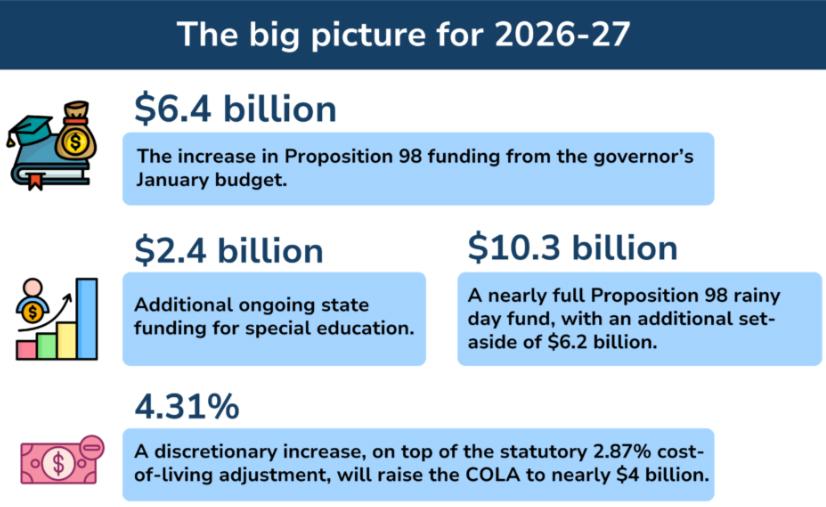
- Newsom would raise the statutory minimum COLA from 2.87% to 4.31%.
- The revised budget reduces the cost-of-living adjustment for the California State Preschool Program to 2.01% from the January proposal of 2.41%.
With one contentious exception, school districts can check off most items on their wish list for 2026-27 with the release on Thursday of Gov. Gavin Newsom’s revised state budget.
Newsom is proposing to target unexpected billions of dollars from surging state revenues to the priorities that school district leaders had prized, including a higher cost-of-living adjustment, billions of dollars more annually for special education, and a one-time, much larger discretionary block grant.
Also, all employees of community colleges and TK-12 schools will be entitled to up to 14 weeks of paid pregnancy disability leave beginning in 2026-27, which the higher COLA will pay for.
But there remains a major point of contention: Newsom is still withholding $3.9 billion in Proposition 98 funding that school organizations say should go to schools and community colleges now.
School districts had complained loudly that their base funding hadn’t kept up with rising expenses, particularly special education and declining enrollment. Amid overall record state funding, Newsom prioritized new initiatives, including the addition of transitional kindergarten, the creation of community schools and expanded learning after school and during the summer.
“People were looking for base money in their pocket,” said Sen. John Laird, D-Santa Cruz, who chairs the Senate Budget Committee. “The attention to a higher COLA and special education is welcome news.”
Source: EdSource.org
Ted Lempert, president of the nonprofit advocacy organization Children Now, said, “Big picture, the May revision puts $8.1 billion more than the January budget into education. While it’s not perfect, we really appreciate it. The governor and Legislature have done a better job in the last couple of years of protecting funding. That said, kids are still way behind.”
Tempering praise for the higher COLA and special education funding, California School Boards Association President Debra Schade said in a statement, “Unfortunately, the Governor’s May Revise masks the underfunding of the Proposition 98 school funding guarantee and the prolific use of one-time money to inflate funding levels in the short term without providing the stability and predictability schools need to plan effectively for student support. “
In his January budget, Newsom said he would withhold $5.6 billion from schools and community colleges until he was certain, early in 2027, that state revenue had actually come through. Schools objected, and the California Teachers Association and the school boards association have threatened to sue on the principle that the Prop. 98 allocations are a voter-approved constitutional guarantee.
In the May revision, Newsom included $1.7 billion in his allocation, but is still keeping $3.9 billion until early next year, when the next governor can reassess. This continues to frustrate school organizations.
“ACSA rejects the Administration’s proposal, as these funds belong in classrooms supporting students,” said Edgar Zazueta, executive director of the Association of California School Administrators. “As budget negotiations move forward, ACSA will continue advocating for a final budget that fully honors the state’s constitutional commitment to public education.”
CTA President David Goldberg said withholding the funds “causes serious harm to public schools. This means overcrowded, under-resourced, destabilized classrooms.” This week, he said, “more than 2,000 educators will find out if their layoff notice is permanent heading into the next school year … and their future is in jeopardy with threats to withhold vital funds from our local school districts.”
Asked about the issue during a state budget presentation Thursday, Newsom said education advocates should take a wider view.
“We made some accommodation to that concern, and I would just have them look at the entire balance sheet and be hard-pressed to find an administration over a seven-year period that’s invested more in transforming our TK — a brand new grade — to 12 education system,” Newsom told reporters “(We’ve made) unprecedented, historic investments per pupil, investments that are the envy of many other states.”
The revised funding estimate for Proposition 98, the 40% of the state general fund that must go to TK-12 and community colleges, would be a record $127.1 billion in 2026-27. Per student funding would increase to a record $21,013 per pupil. Funding per pupil from federal and other sources would be $28,282.
That overall revenue estimate, however, would appear at least several billion dollars less than the Senate and the independent Legislative Analyst’s Office had forecast. The May revision marks the starting line for a final dash toward the Legislature’s June 15 deadline, followed by negotiations between Newsom and legislative leaders, with final passage by the July 1 start of the fiscal year.
Laird said that including the withheld $3.9 billion for schools and community colleges will be one of the items. Additional revenue projections, based on May tax receipts, will be a factor.
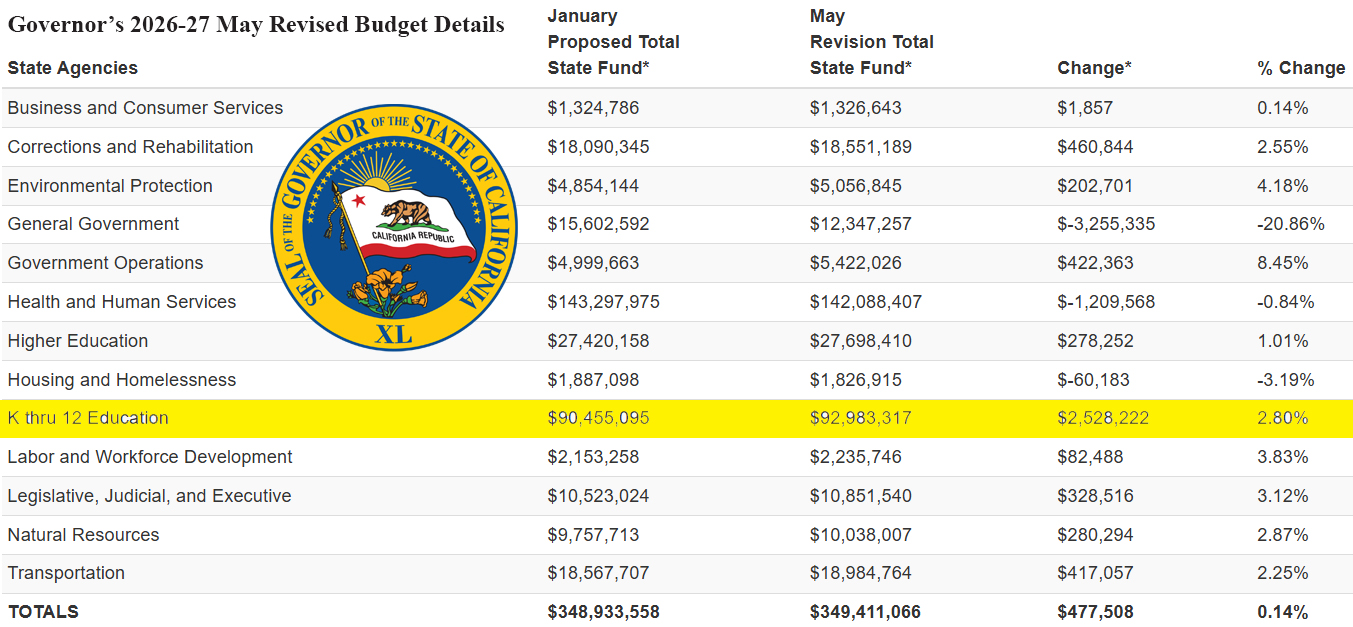
The table presents proposed and revised budget year expenditures for each agency area. These totals are comprised of State funds which include General Fund, special funds, and selected bond funds. These totals do not include federal funds, other non-governmental cost funds, or reimbursements. Source: Office of the California Governor
Here are some budget specifics:
COLA: Newsom would raise the statutory minimum COLA of 2.87%, determined by a federal formula that does not consider the price of housing, to 4.31%. The effect would raise COLA for districts’ operating expenses, through the Local Control Funding Formula, from $3.1 billion proposed in January to $4 billion. Other programs, including special education, would get the statutory COLA of 2.87%
The 4.31% would become the new base for determining COLA calculations in future years.
SPECIAL EDUCATION: State and federal special education fall well short of districts’ obligations for students with disabilities. Additional state funding for special education offsets districts’ base expenses. Newsom would add $1.8 billion to the extra $509 million increase he proposed in January for a total of $2.4 billion — 43% more than a year ago.
Newsom characterized it as “the largest investment in special education in California’s history … maybe in American history.”
“It’s an area that has continued to be anxiety-inducing because you meet with parents, and they’re demanding more, and we’ve heard that call,” he said.
BLOCK GRANT: In January, Newsom proposed a one-time $2.8 billion grant; he has raised it to $5 billion. He calls it the Student Support and Professional Development Block Grant, and implies it should be used for teacher training for math, reading and literacy support for English learners, along with career pathways and expanding dual enrollment. But districts will have wide latitude to spend the money as they choose.
RAINY DAY FUND: Newsom would raise the Proposition 98 reserve to $10.3 billion, approaching the statutory maximum, as a cushion in the event of a recession or if the spigot of projected revenues from tax receipts from AI startups runs dry.
John Affeldt, managing attorney for Public Advocates, a public interest law firm, warned that the state should plan for that to happen. “Our state cannot continue to rely on temporary AI stock market bubbles,” he said. “To build a budget that will enable our residents to thrive, California needs more robust permanent revenue streams to support our schools and healthy communities. We cannot ask teachers to transform students’ lives while those same teachers are being priced out of the communities they serve.”
COMMUNITY SCHOOLS: Newsom would add $1 billion to the $4.1 billion previously invested in creating 2,500 community schools, which provide community partnerships involving wellness, mental health and career opportunities. His May revision would also repurpose nearly $500 million in extension grants to add more community schools.
“We lead and dominate the nation in community schools,” Newsom said Thursday.
LITERACY AND MATH INSTRUCTION: Since 2019, the state has funded $715 million to hire and train reading specialists and coaches in high-poverty schools — a key element in the state’s comprehensive early literacy plan. But that money, in one-time grants, will expire over the next three years. Newsom proposes $440 million to extend the grants through 2031.
He would also add $60 million to the $30 million funded last year for the Mathematics Professional Learning Partnership, which is creating a statewide network to train coaches and math specialists in the 2023 math framework. Still missing: funding for elementary schools to hire coaches.
Newsom is also encouraging districts to use some of the $5 billion in the discretionary block grant for literacy and math instruction.
Early education and care
In his presentation, the governor largely overlooked early education and child care. The proposal allocates $15 million toward training to help with the implementation of programs such as Transitional Kindergarten and $5 million in ongoing funding to support the use of the Multitudes dyslexia screener at no cost to districts.
But the revised budget reduces the cost-of-living adjustment for the California State Preschool Program to 2.01% from the January proposal of 2.41%. The governor also did not address calls from early education advocates to help support pre-K programs that have been struggling after losing large numbers of children to the new TK programs offered by the state’s public schools.
Patricia Lozano, executive director of Early Edge California, a nonprofit organization that advocates for accessible, high-quality early learning, said the reduction to the cost-of-living adjustment sends a troubling signal to providers who are already operating on the margins.
“Access to affordable child care isn’t just an early learning issue, it’s essential to families’ economic well-being,” she said. “The governor has been a strong champion for children during his years in office, and we’ll be urging the Administration and the Legislature to fulfill the promise of funding additional child care slots and restoring COLA before the budget is finalized.”
In particular, the governor’s plan to significantly increase the cost-of-living allowance for TK-12 schools while cutting it for preschools drew fire.
“He decided to backstop health premiums and local schools, while punting on aiding families who desperately search for affordable child care,” said Bruce Fuller, who co-authored a new report from the UC Berkeley Equity and Excellence in Early Childhood alliance on the dire outlook many pre-K programs are facing.
Lempert, of Children Now, said he hoped the cuts to the early education COLA would be reversed by the Legislature in the final budget.
the STATE BUDGET PROCESS
Governor’s initial budget proposal:
- Must be released by Jan. 10.
- Assumes an estimate of revenues the state will collect over the next 18 months (by June 30, 2027). Actual revenues often differ significantly due to economic conditions, federal policy and unforeseen events, such as the destructive fires in Los Angeles.
MAY 14 revision:
Governor issues May budget with revised general fund revenues, including its impact on Proposition 98.
LATE MAY to EARLY JUNE:
Legislature’s budget subcommittees report to the full budget committees.
JUNE 15:
Constitutional deadline for the Legislature to pass the budget bill.
MID-JUNE TO LATE JUNE:
Negotiations between the Assembly speaker and the Senate president pro tempore with the governor; the Legislature passes the final budget, and the governor signs it before the fiscal year starts on July 1.
Legislature’s response:
The Assembly and Senate have until June 15 to hold hearings and respond with their own version.
Negotiation:
Behind closed doors, legislative leaders and the governor settle differences. Lawmakers sign off, and the governor signs the final version.
Governors have increasingly used the budget to rewrite statutes outside the legislative process. That’s why it’s important to read the fine print in massive “budget trailer bills” written after the budget is passed.
About 40% of the state’s general fund will go to schools and community colleges. The bulk goes to keeping schools running, but in some years, new money is spent on new programs, such as transitional kindergarten and community schools.
Budget summaries
You can find the full budget by areas here.
Leave a Reply