Source: MTC
A set of investments, projects and strategies to improve efficiency, reduce delays and move more people and buses across the most-traveled bridge in the Bay Area.
By Metropolitan Transportation Commission
 The San Francisco-Oakland Bay Bridge (Bay Bridge) corridor is a vital lifeline for commuter and business travel to and from the City of San Francisco and the East Bay. It is consistently ranked the most congested corridor in the region. Severe traffic congestion occurs on the approaches to the bridge, especially in the morning commute hours. Vehicles spend more hours delayed approaching the Bay Bridge than on all the other Bay Area east-west crossings combined. At times, this congestion prevents high-occupancy vehicles (HOVs) and buses from accessing the existing by-pass lanes at the toll plaza – and is worse than the congestion on the bridge itself. At the same time, high rates of people driving alone and lower transit ridership means that more than half of the seats in vehicles crossing the Bay Bridge are empty.
The Bay Bridge Forward Program proposes solutions that would increase the number of people moving through the area by filling empty seats. This would improve operations and reduce congestion without hefty capital investments. Bay Bridge Forward includes a suite of projects to: improve transit travel time and reliability; promote carpooling and transit ridership; increase the number of people who can move through the corridor (person throughput); and reducing greenhouse gas emissions.
Project 6 – Interstate 80, Bay Bridge & Carquinez Bridge HOV Lane Hours of Operation
Source: MTC
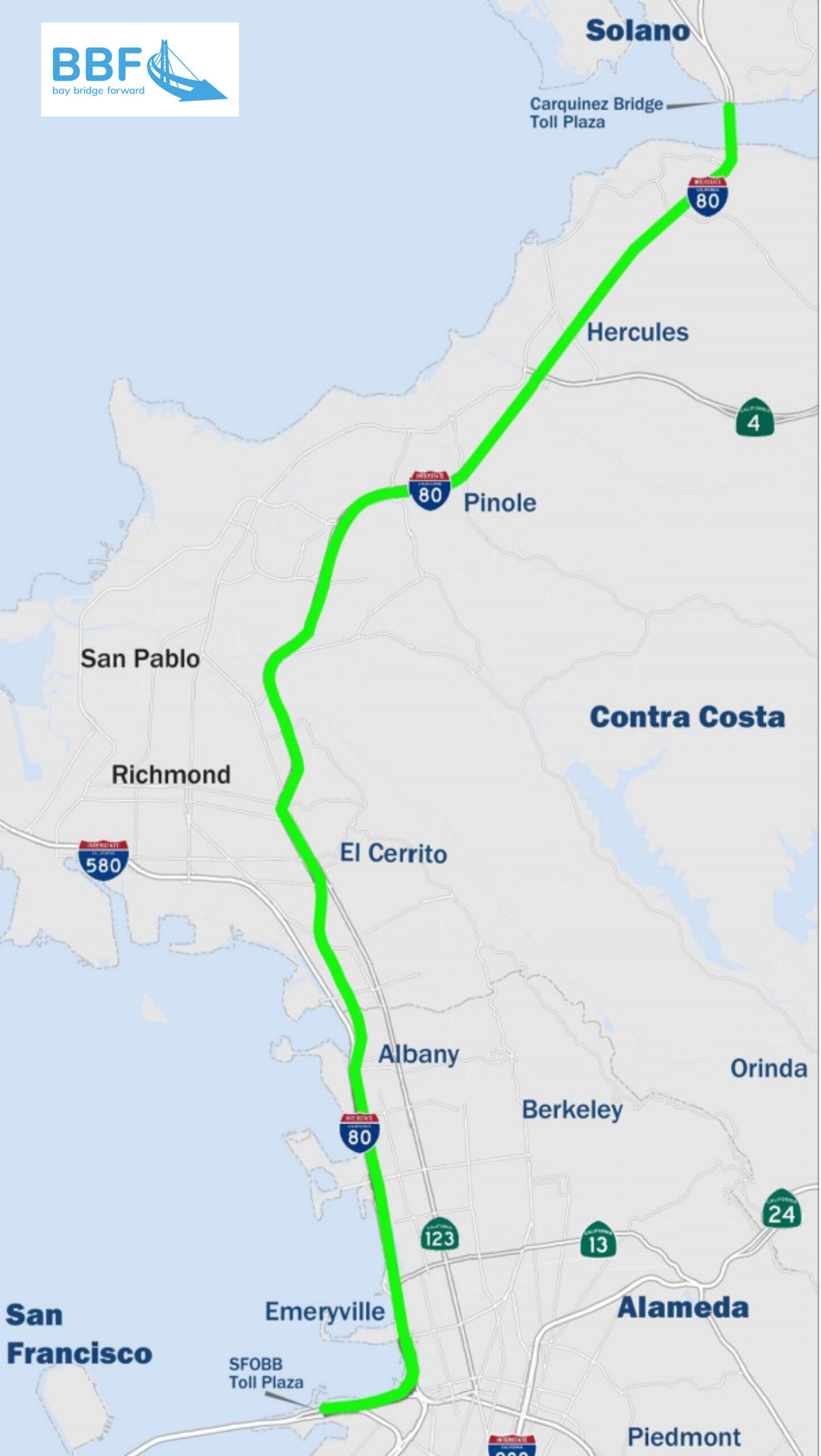
Part of the Bay Bridge Forward commute initiative, the Interstate 80, Bay Bridge & Carquinez Bridge HOV Lane Hours of Operation is one of several projects that aim to improve traffic congestion for the Interstate 80 (I-80) corridor between the Carquinez Bridge and the San Francisco-Oakland Bay Bridge.
- Overview
This project is evaluating extended hours of operation of the high-occupancy vehicle (HOV) lanes along the Interstate 80 corridor between the San Francisco-Bay Bridge and the Carquinez Bridge and at the approaches to both bridges.
While the corridor experiences significant congestion beyond traditional peak periods, the current HOV hours of operation are limited to weekdays between 5 a.m. and 10 a.m. and between 3 p.m. and 7 p.m. Project 6a’s analysis and implementation will evaluate expanding the hours to include midday and weekend operations.
This project aims to:
- Provide more reliable travel times for transit riders and carpools during periods of prevalent midday and weekend congestion; and
- Encourage transit use and carpooling.
- Project Schedule
As of the latest update in April 2026, the estimated completion dates for the Traffic Analysis is 2026, for Final Design is 2027 and for Construction is 2028.
Project 6 – Interstate 80 HOV Lane Access Restrictions
Also part of the Bay Bridge Forward commute initiative, the Interstate 80 HOV Lane Access Restrictions is one of several projects that aim to improve traffic congestion for the Interstate 80 (I-80) corridor between the Carquinez Bridge and the San Francisco-Oakland Bay Bridge.
- Overview
This project proposes to implement access restrictions along select segments of the existing high-occupancy vehicle (HOV) lanes on the Interstate 80 corridor between the San Francisco-Oakland Bay Bridge and the Carquinez Bridge. Access restrictions are expected to improve traffic flow in the HOV and general purpose lanes by limiting merges between lanes in congested areas.
Currently, the HOV lane is separated from general traffic by a dashed line, which indicates that it is OK to enter and exit the HOV lane at any point. Project 6b would add lane access restrictions by replacing the existing lane striping and painting double solid white lines between the existing HOV lane and the general-purpose lane, to restrict vehicles from entering or exiting the HOV lanes at select segments. Double white lines indicate it is illegal to enter and exit the lane.
- Project Schedule
As of April 20226, the Project Initiation Document was completed in April 2026, and the estimated completion date for the Project Approval & Environmental Document is sometime this year, the Final Design in 2027 and Construction in 2028.
Project 6 – Interstate 580 Westbound to Interstate 80 Eastbound Connector Bus Lane
The Interstate 580 Westbound to Interstate 80 Eastbound Connector Bus Lane is one of several projects of the Bay Bridge Forward commute initiative that aim to improve traffic congestion for the Interstate 80 (I-80) corridor between the Carquinez Bridge and the San Francisco-Oakland Bay Bridge.
- Overview
The Interstate 80 (I-80) Bus-on-Shoulder Feasibility Analysis assessed the feasibility of pursuing bus-on-shoulder or bus lane segments on or connecting to I-80, and identified potential segments to move into project development.
One of the segments moving forward is the Interstate 580 (I-580) westbound to I-80 eastbound Connector Bus Lane. This project would construct a bus-only lane by reducing the existing right and left shoulders on the westbound I-580 to eastbound I-80 direct connector ramp. The project aims to:
- Reduce bus delays;
- Provide travel time reliability for buses; and
- Encourage the use of public transit in this congested segment.
- Project Schedule
The Feasibility Analysis was completed in Summer 2025; the Project Initiation Document (PID) is expected to be completed sometime in 2026 and the estimated completion date for Project Approval & Environmental Document and Final Design is in 2027 and Construction in 2029.
Project 6 – Interstate 80 Localized Transit Priority/HOV Strategies
Source: MTC
Part of the Bay Bridge Forward commute initiative, Interstate 80 Localized Transit Priority/HOV Strategies is one of several projects that aim to improve traffic congestion for the Interstate 80 (I-80) corridor between the Carquinez Bridge and the San Francisco-Oakland Bay Bridge.
- Overview
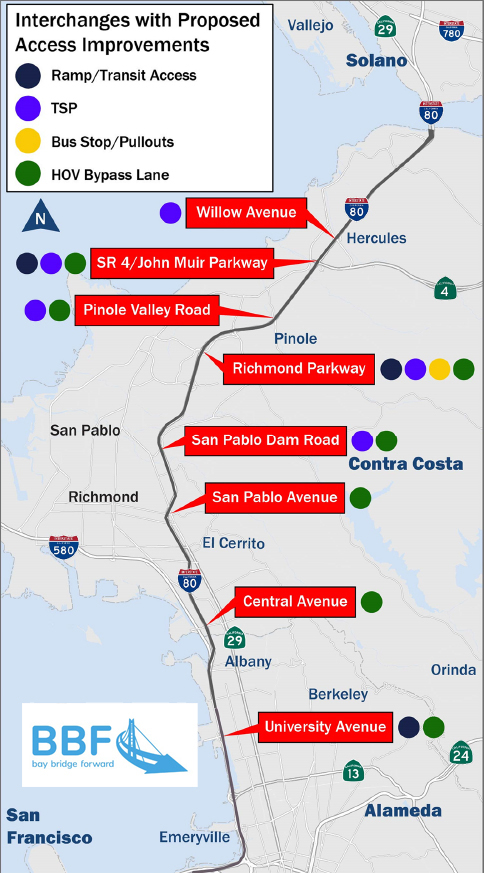
The Interstate 80 (I-80) Localized Transit Priority/HOV Strategies project aims to enhance access to HOV preferential lanes and/or add transit signal priority (TSP) equipment at nine interchange locations.
The project is intended to:
- Provide travel time savings for carpools and buses; and
- Increase bus system reliability.
- Project Schedule
The Preliminary Analysis was completed in Summer 2025; the estimated completion date for the Project Initiation Document (PID) is sometime in 2026, Project Approval/Environmental Document (PA/ED) in 2027, Final Design in 2028 and Construction in 2029.
Project 2 – Interstate 580 Westbound HOV Lane Extension
The Bay Bridge Forward’s Interstate 580 Westbound HOV Lane Extension project proposes to extend the existing high-occupancy vehicle (HOV) lane on westbound Interstate 580 to reduce traffic backup during morning peak hours.
Source: MTC
- Overview
The Interstate 580 (I-580) westbound corridor serves as an approach to the San Francisco-Oakland Bay Bridge and is a key transbay commute corridor that connects the East Bay to San Francisco.
The corridor experiences heavy traffic congestion during morning peak hours, with traffic backing up to the Interstate 980 (I-980)/State Route 24 (SR-24) interchange.
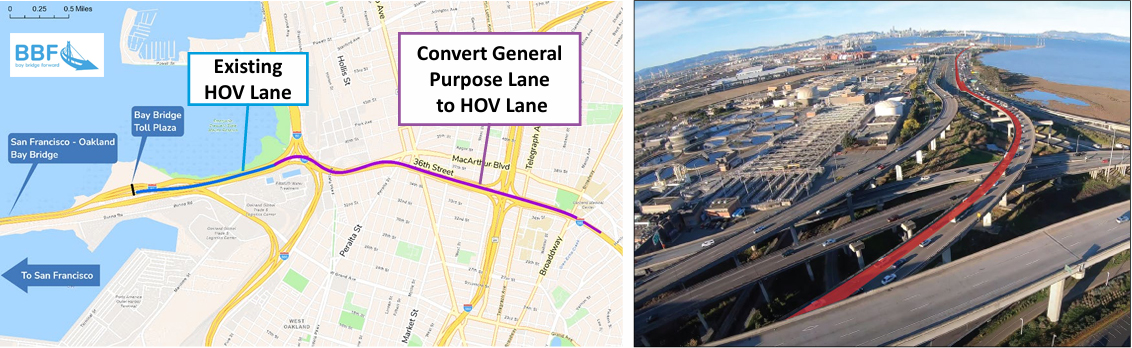
MTC – in partnership with Alameda County Transportation Commission – proposes to extend the existing HOV lane on I-580 westbound to the area by the I-980/SR-24 interchange as a near-term improvement.
The I-580 Westbound HOV Lane Extension Project seeks to:
- Move more people through the corridor during peak hours.
- Improve travel time reliability to support buses and HOVs.
- Provide time travel savings for HOV and transit users, to encourage people to carpool or take transit.
The project proposes to convert a portion of the far-left lane of westbound I-580 to an HOV lane. From just east of the Piedmont Avenue undercrossing in Oakland, the new HOV lane would connect with the existing HOV lane at the toll plaza approach (just west of the MacArthur maze), a distance of approximately 2.3 miles.
- Project Schedule
The Preliminary Engineering and Environmental Studies were completed in June 2024, Final Design was completed in October 2024, and Construction is estimated to be completed in 2027.
Source: MTC
Project 3 – Interstate 80/Powell Street Interchange Transit Access Improvements
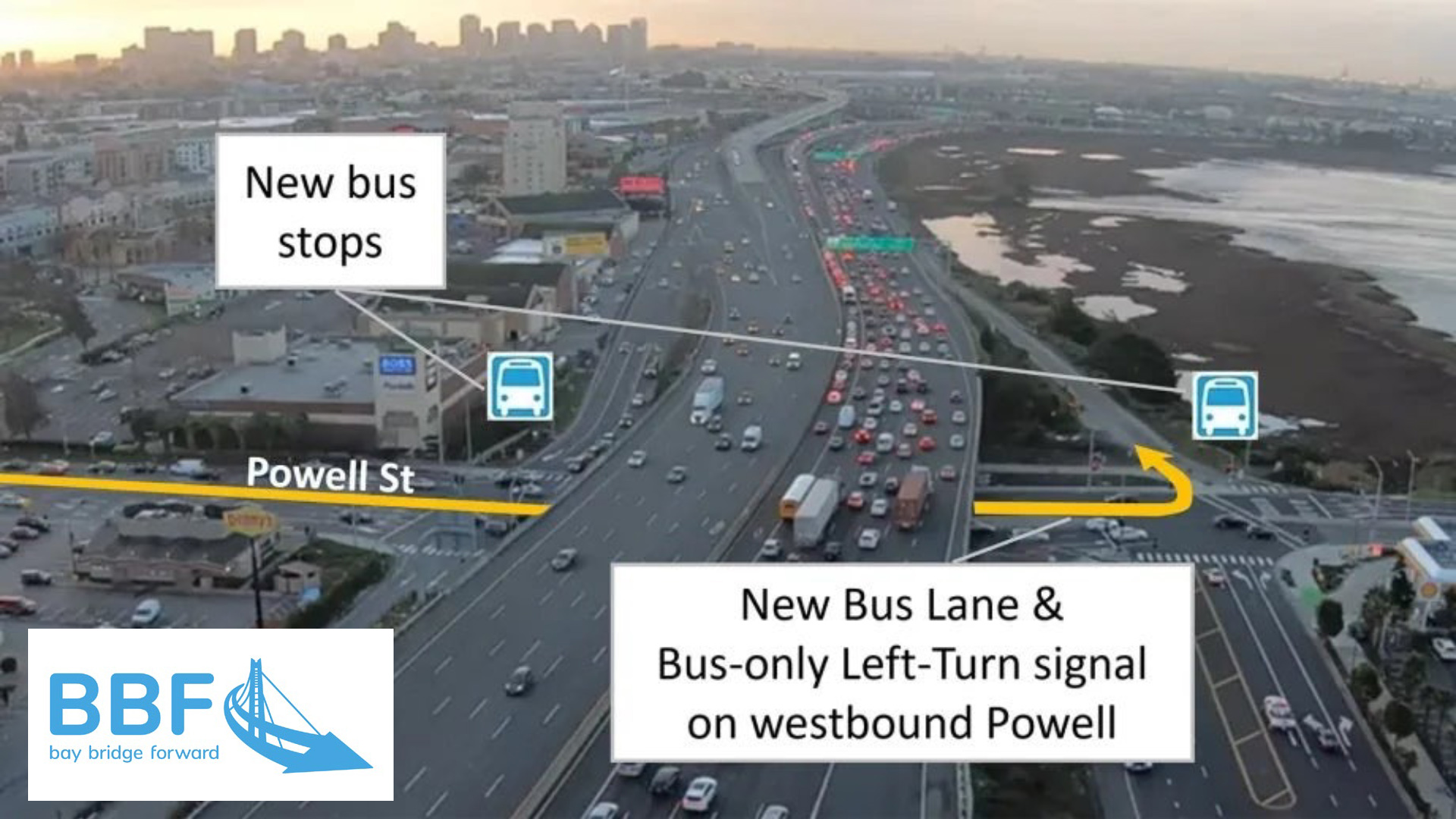
Another part of the Bay Bridge Forward commute initiative, the Interstate 80/Powell Street Interchange Transit Access Improvements project aims to improve traffic flow during morning peak commute hours for transit vehicles that enter and exit Interstate 80 through Powell Street.
- Overview
The Interstate 80 (I-80)/Powell interchange currently services multiple transbay bus routes including Alameda-Contra Costa Transit District (AC Transit) lines and the Capital Corridor (Amtrak) connecting bus between Emeryville Station and San Francisco.
The existing transit route on the West Frontage Road and I-80 Powell Street loop on-ramp are highly congested during morning peak commute hours. This project is needed to improve vehicle flow and reliability for transit vehicles that enter and exit I-80 through Powell Street.
MTC – in partnership with Alameda County Transportation Commission, the City of Emeryville and AC Transit – is proposing transit facility improvements within the I-80 Powell Street interchange to:
- Improve transit reliability and travel time;
- Improve transit accessibility;
- Promote safety for transit riders; and
- Encourage transit use.
The improvements include:
- The construction of a dedicated transit lane on Powell Street;
- New bus stops with improved pedestrian and bicycle access; and
- Dedicated transit-only signals and detectors at the ramp intersections to facilitate transit priority.
- Project Schedule
Preliminary Engineering & Environmental Studies were completed in July 2023, Final Design was estimated to be completed in Summer 2026, but completion of Construction is To Be Determined as of April 27, 2026.
Source: MTC
Project 4 – Interstate 80 Westbound HOV/Bus Lane
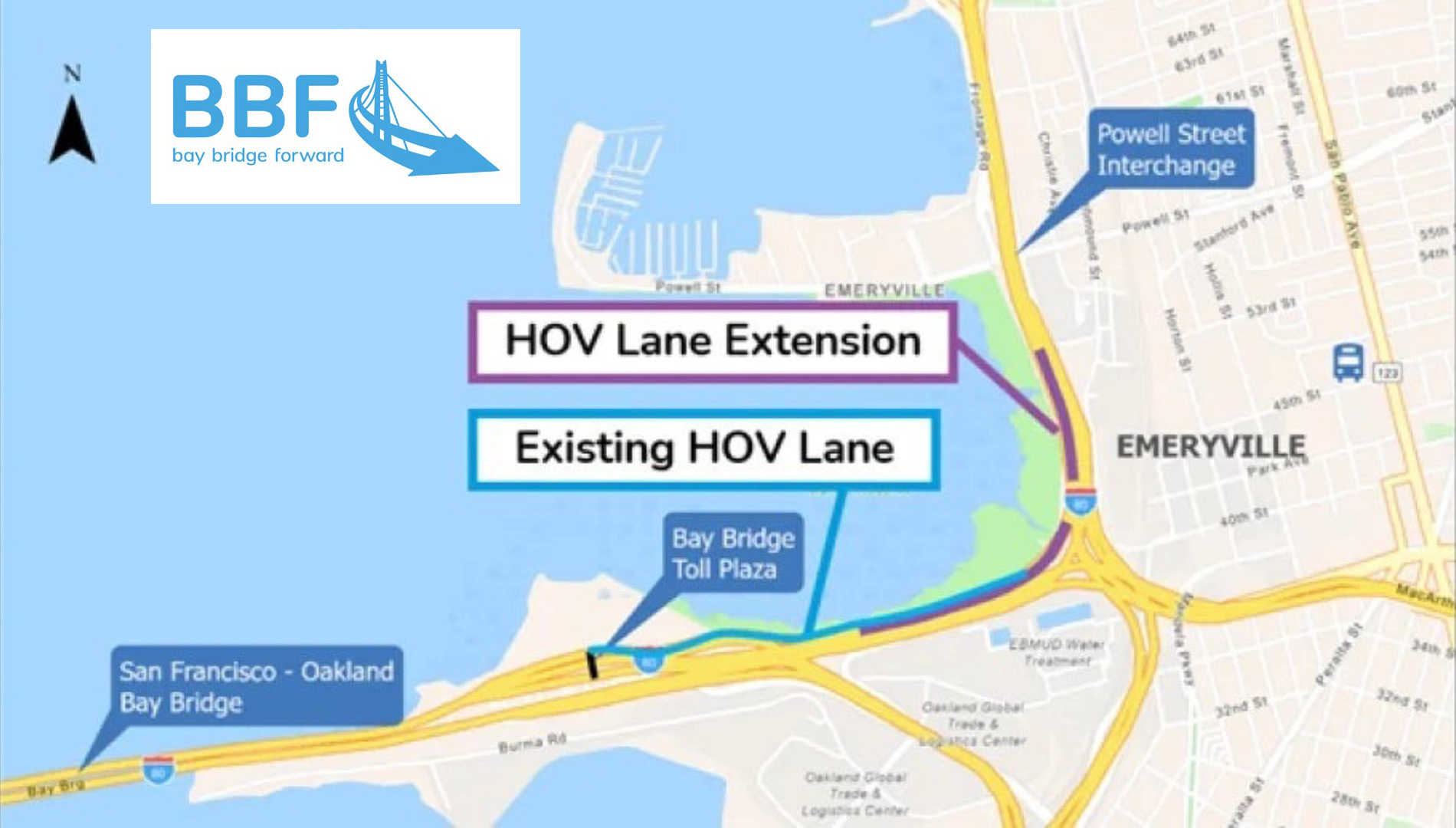
The Bay Bridge Forward’s Interstate 80 Westbound HOV/Bus Lane project proposes adding a high-occupancy vehicle (HOV) lane to westbound Interstate 80 (I-80) between the Powell Street Interchange and the Bay Bridge toll plaza.
- Overview
The Interstate 80 (I-80) westbound HOV lane and the HOV connector ramp (also known as the I-80 flyover ramp) serves HOV traffic on the I-80 corridor. The I-80 flyover ramp provides a direct connection to the San Francisco-Oakland Bay Bridge toll plaza, allowing buses and HOVs to bypass a major bottleneck north of the I-80/I-880/I-580 junction. Heavy traffic congestion in the vicinity of the I-80 Powell Street interchange can prevent buses and HOVs from accessing the I-80 flyover ramp.
MTC – in partnership with Alameda County Transportation Commission – proposes adding an HOV lane to the outside of the westbound I-80 between Powell Street Interchange and the Bay Bridge toll plaza. This project will benefit transit vehicles entering from the Powell Street interchange, as well as other HOVs traveling on westbound I-80 that cannot use the existing leftmost HOV lane due to congestion. This project seeks to:
- Improve the operational efficiency and travel time for buses and HOVs on westbound I-80;
- Move more people through the area during peak hours; and
- Encourage carpooling and transit use.
- Project Schedule
The Preliminary Engineering was completed in July 2025 and the estimated completion date for Environmental Studies is To Be Determined.
Source: MTC
Project 1 – West Grand Avenue Bus & High Occupancy Vehicle Lane
The Bay Bridge Forward’s West Grand Avenue Bus & High Occupancy Vehicle Lane project will construct a dedicated westbound bus and carpool lane on West Grand Avenue for travelers approaching the San Francisco-Oakland Bay Bridge.
- Overview
In 2016, MTC – in partnership with Caltrans and the City of Oakland – proposed the construction of a dedicated bus and carpool lane on West Grand Avenue to improve the travel time for buses and carpoolers approaching the Bay Bridge toll plaza from West Grand Avenue.
The project is separated into two phases.
- Phase 1: Complete
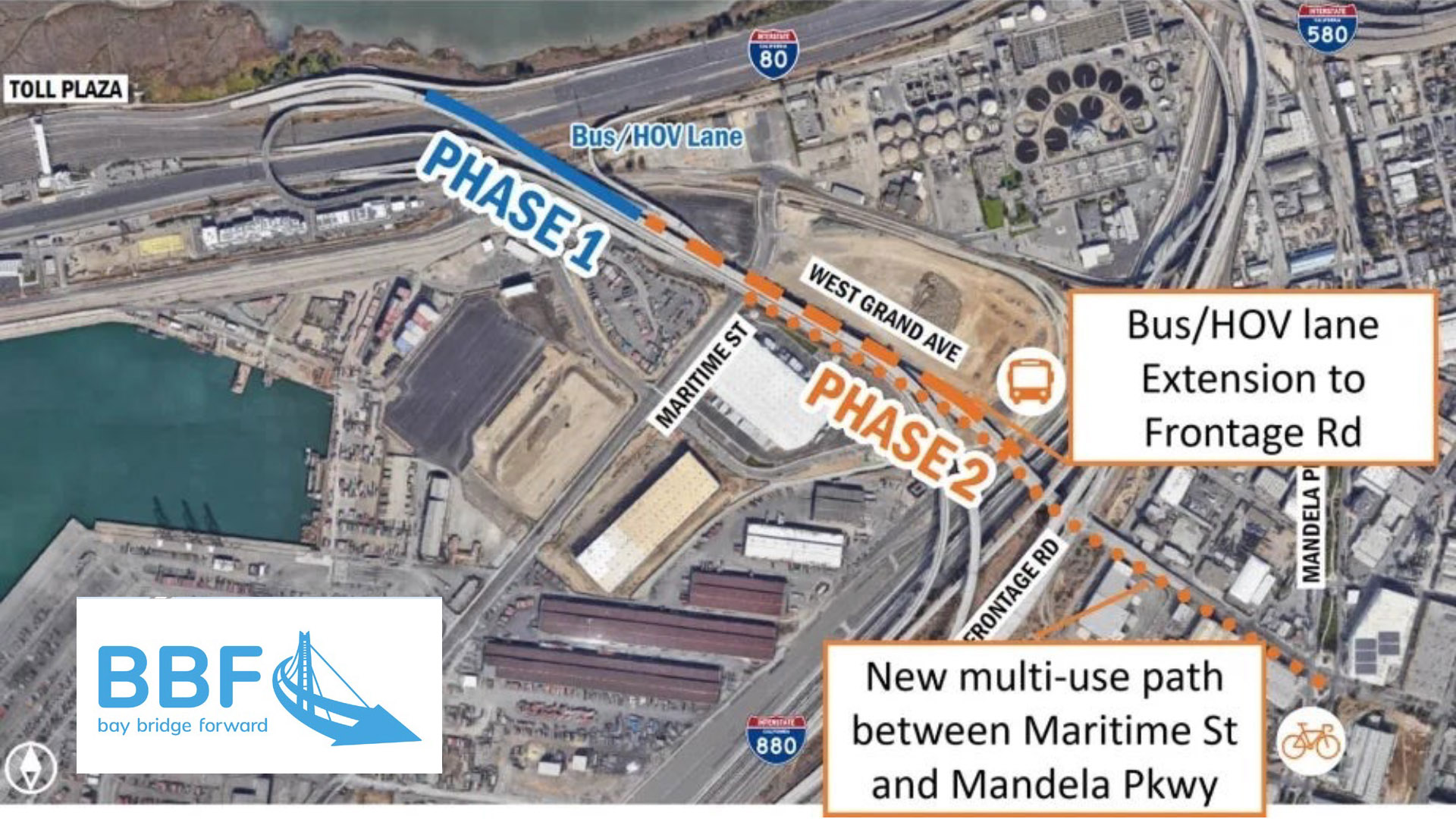
In 2019, the first phase was constructed, which created a high-occupancy vehicle (HOV) lane on the Interstate 80 (I-80) West Grand Avenue on-ramp. It converted approximately 1,300 feet of right shoulder into a bus/HOV lane.
The bus/HOV lane is open to buses 24 hours a day, seven days a week. HOVs with three or more occupants are allowed to use the lane during weekday peak hours, 5 a.m. to 10 a.m. and 3 p.m. to 7 p.m. The new HOV lane has provided substantial travel time savings for buses and HOVs, bypassing congestion during the morning peak period.
- Phase 2: In Progress
As of April 2026, development of the second phase is currently underway. It will extend the existing bus/HOV lane from its current terminus on the West Grand Avenue on-ramp further east to Frontage Road. This would allow buses to bypass a major queue on West Grand Avenue. The new bus/HOV lane will be open to HOVs with three or more occupants during the weekday peak hours (5 a.m. to 10 a.m. and 3 p.m. to 7 p.m.).
Phase two of the project also proposes to construct a class I multi-use path on the south side of West Grand Avenue to close a 0.7-mile gap in the existing West Oakland bicycle network. The multi-use path would provide a key connection to the existing class I multi-use path on Maritime Street to the west and class II bike lanes on Mandela Parkway to the east of the project area.
Phase two construction is expected to begin in 2027. When completed, the project will bring additional benefits for carpools, buses, pedestrians and bicyclists.
- Project Schedule
Phase 1 Construction was completed in 2019, Phase 2 Preliminary Engineering and Environmental Studies were completed in Summer 2023, Phase 2 Final Design is expected to be completed sometime in 2026 and Phase 2 Construction in winter 2027.
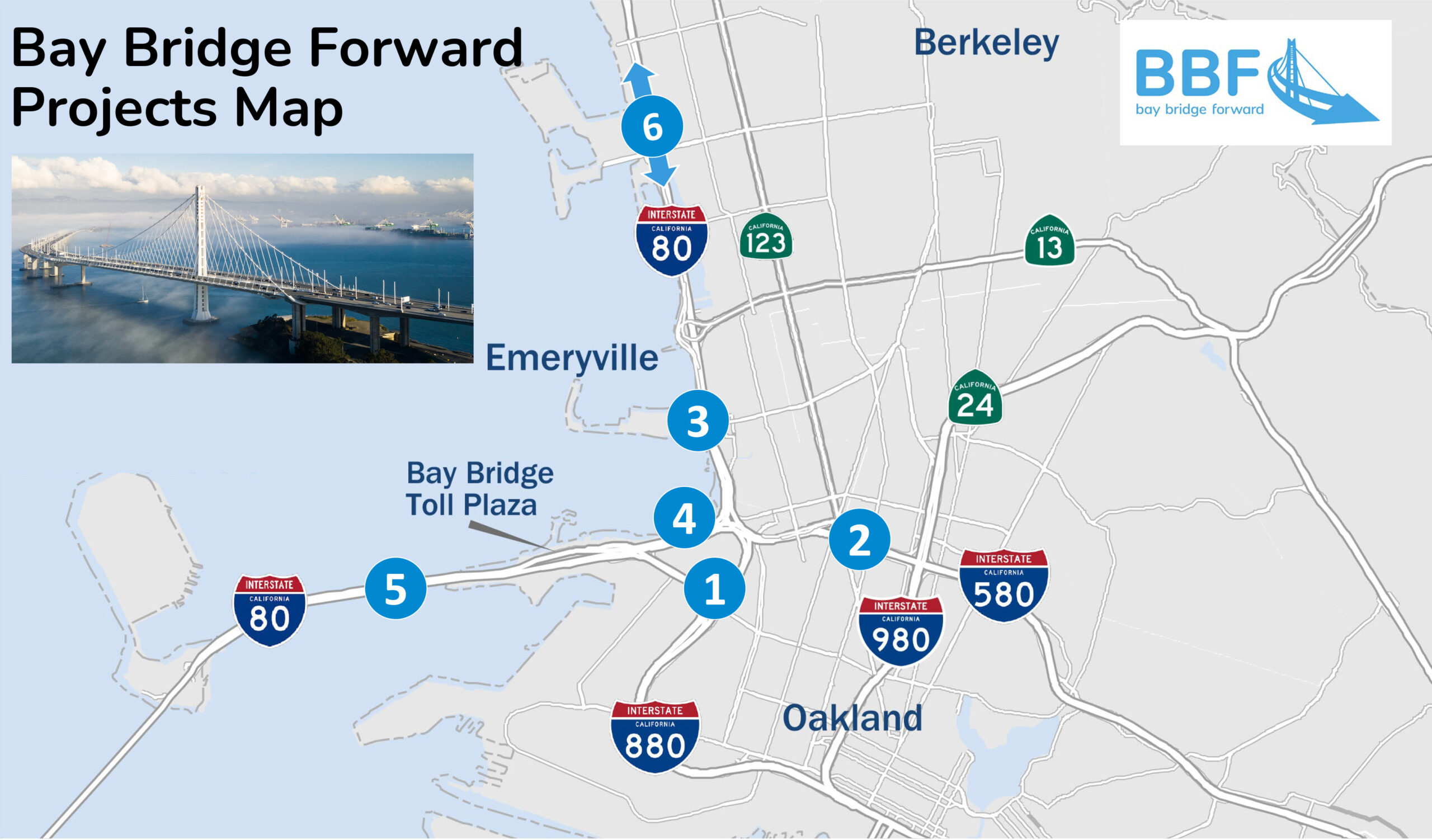
See an expanded version of the Bay Bridge Forward program projects map. Project details are below.
Photo: AC Transit
Project 5 – Smart Transbay Transit
The Bay Bridge Forward’s Smart Transbay Transit project aims to deliver near-term Intelligent Transportation Systems (ITS) enhancements.
- Project Overview
The Smart Transbay Transit project is split into two phases. Phase one, now complete, consisted of planning and analysis. A future phase two will include technical design.
In phase one, MTC collaborated with Contra Costa Transportation Authority, WestCat, AC Transit, Alameda County Transportation Commission and local cities in the East Bay.
The goals of the first phase were to:
- Assess current transbay bus operations;
- Analyze strategies to improve transbay bus service; and
- Define preferred corridors and concepts for project development.
The first phase recommended the implementation of Transit Signal Priority and traffic signal enhancements to select corridors. Traveler information strategies were also assessed.
- Project Schedule
Planning and Analysis were completed in Spring 2026, and the estimated completion dates for Technical Design is in 2027 and Implementation in 2027-28.
View the expanded Bay Bridge Forward Projects Map.
Leave a Reply