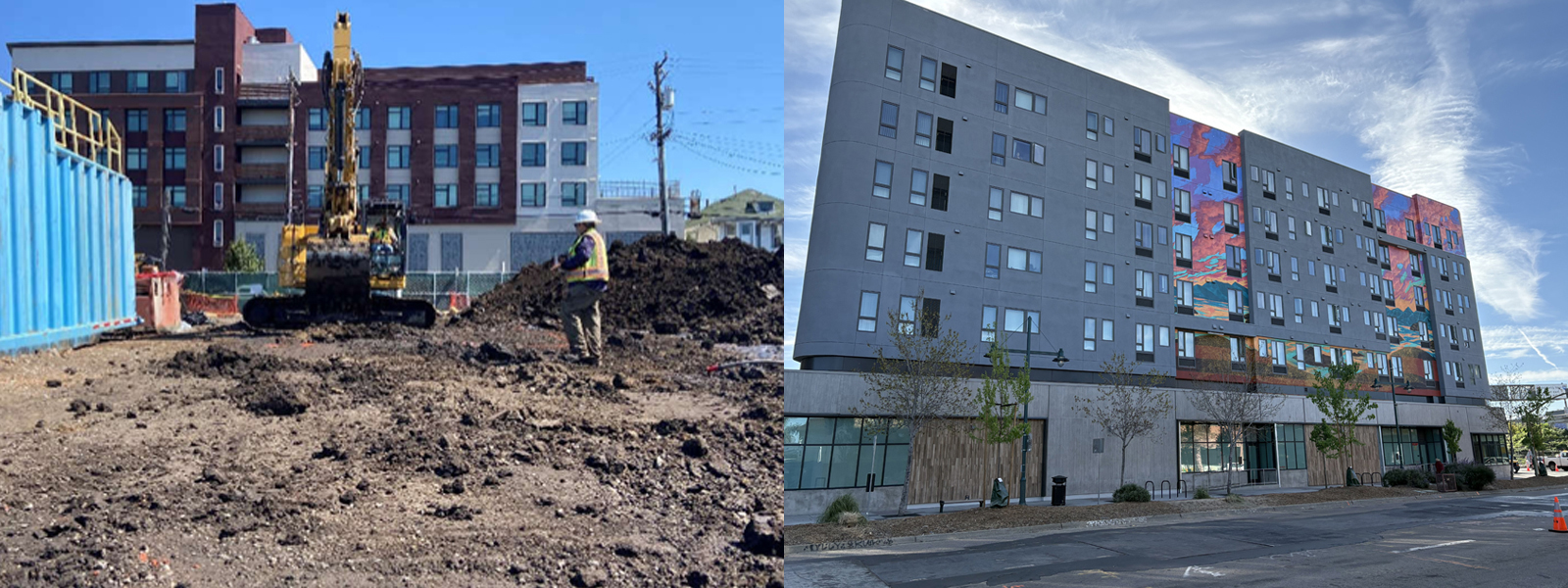
Before and after photos of the Nellie Hannon Gateway project in Emeryville. Source: DTSC
Including 43 units in Richmond
For low-income and unhoused residents
By California Department of Toxic Substance Control
 EMERYVILLE – More than 2,100 new affordable homes for low-income and unhoused Bay Area residents will be available thanks to state-funded cleanup of contamination on otherwise unusable land across the region.
Bay Area residents in need are beginning to move in. The opening of 90 new homes was celebrated today when state leaders and local officials gathered at the Nellie Hannon Gateway in Emeryville. Thirty-nine of the rental community’s units are reserved for individuals exiting homelessness. The development also includes a food bank on the ground floor. Seventy-six additional affordable homes will open later this spring at the newly constructed Native American Health Center in Oakland. Forty-three homes opened early this month at Legacy Court in Richmond.
The Department of Toxic Substance Control (DTSC) provided funding and oversight of the removal of contamination at these sites.
“Cleaning up contamination is an essential but often invisible part of solving California’s housing crisis. We are transforming places once dominated by pollution into places of endless possibilities. This complex will be more than a place to live. It will be home for dozens of new residents.” – DTSC Director Katherine Butler
Thousands of properties across California sit vacant because of pollution left behind by gas stations, auto repair shops, dry cleaners and industrial facilities. The Nellie Hannon Gateway was once the site of a dry cleaner. The Native American Health Center site was an auto repair shop. Richmond’s Legacy Court site was a gas station and junkyard. Cleanups at these sites are made possible through DTSC’s Equitable Communities Revitalization Grant program. DTSC is the state agency that oversees the investigation and cleanup of contaminated properties in California.
This work has made once unusable land safe for future residents — an often-overlooked opportunity for developers who otherwise see an insurmountable obstacle to building affordable housing in communities with high pollution burdens and economic disadvantages.
DTSC helps local governments, nonprofits and developers clean up and reuse contaminated properties — known as brownfields — for housing, parks, retail and community spaces. Statewide, DTSC is investing more than $130 million for the cleanup and reuse of more than 150 sites across 49 cities, preparing them for new life in communities that have historically faced environmental and economic barriers.
DTSC is part of a statewide effort, led by Governor Gavin Newsom, to address the need for affordable housing and homelessness.
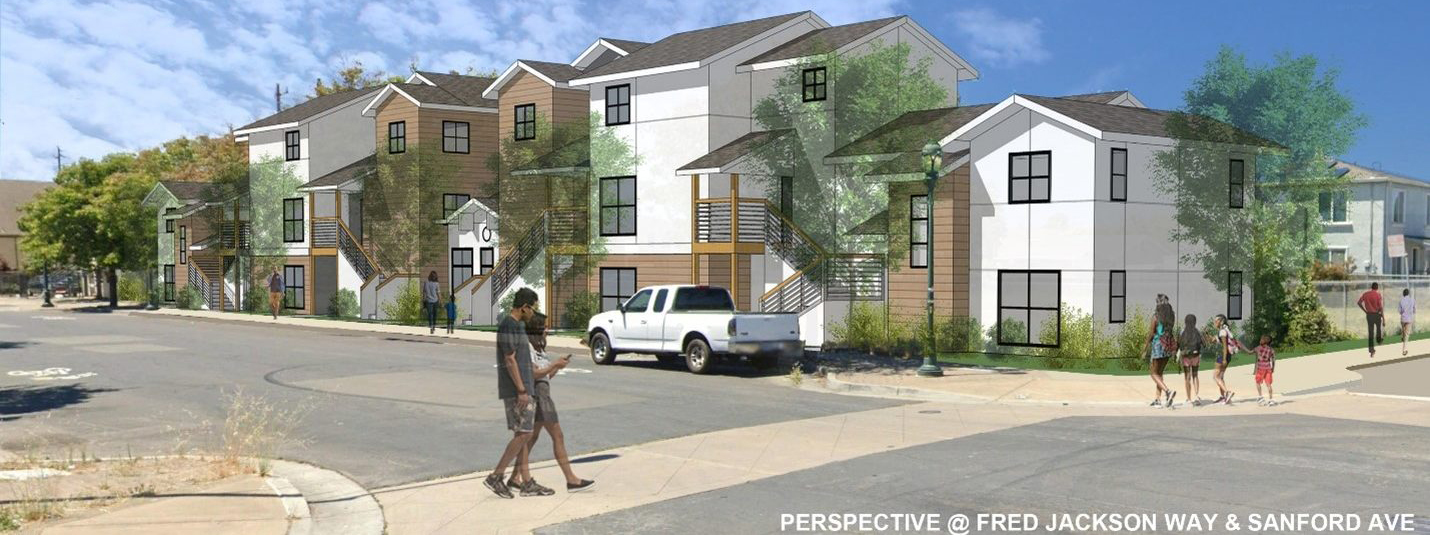
Rendering source: Eden Housing
Richmond’s Legacy Court
According to Eden Housing, Legacy Court, located at 1243, 1300 & 1329 Fred Jackson Way, is a 43-unit new construction family project in Richmond, CA. The proposed development will serve 42 low-income households earning 30-60 percent of the area’s median income (AMI).
The project will set aside thirteen units to support residents who are experiencing homelessness, at risk of experiencing homelessness and residents in need of mental health services. Contra Costa Behavioral Health Services will provide additional support services for these units, including case management, peer support, mental health care, substance use services, and benefits counseling and advocacy.
The development is designed as seven two to three-story buildings that will be situated across three different sites, all of which are located within one block from each other at the intersection of Fred Jackson Way and Sanford Avenue in North Richmond. The project will include a mix of one-bedroom, two-bedroom, and three-bedroom units. One of the units will be set aside for a live-in community manager, helping ensure that the property is well-managed at all times. On-site project amenities for residents will include a community room, community kitchen, laundry rooms, computer lab with high-speed internet, and bike parking. The common area amenities of the development will facilitate the socialization and sense of community that is important to successful developments and will serve as spaces for resident gatherings, community meetings, social events, programming for resident services such as exercise, health and wellness programs, and art, educational, and cultural activities.
Legacy Court is designed as all-electric and will incorporate energy-efficient appliances, and green elements maximized to reduce the carbon footprint of the project.
Reversing Decades of Inaction on Homelessness
Governor Newsom is creating a structural and foundational model for America:
✅ Creating shelter and support — Providing funding and programs for local governments, coupled with strong accountability measures to ensure that each local government is doing its share to build housing, and create shelter and support, so that people living in encampments have a safe place to go. This week, through a $77 million investment from California’s cap and invest program, Los Angeles announced the expansion and redevelopment of the largest public housing project in the region, the Jordan Downs Project.
✅ Addressing mental health and its impact on homelessness — Ending a long-standing 7,000 behavioral health bed shortfall in California by rapidly expanding community treatment centers and permanent supportive housing units. In 2024, voters approved Governor Newsom’s Proposition 1 which is transforming California’s behavioral health systems. When fully awarded, funding from Proposition 1 bonds is estimated to create 6,800 residential treatment beds and 26,700 outpatient treatment slots for behavioral health care.
✅ Creating new pathways for those who need the most help — Updating conservatorship laws for the first time in 50 years to include people who are unable to provide for their personal safety or necessary medical care, in addition to food, clothing, or shelter, due to either severe substance use disorder or serious mental health illness. Creating a new CARE court system that creates court-administered plans for up to 24 months for people struggling with schizophrenia and other psychotic disorders, often with substance use challenges.
✅ Streamlining and prioritizing building of new housing — Governor Newsom made creating more housing a state priority for the first time in history. He has signed into law groundbreaking reforms to break down systemic barriers that have stood in the way of building the housing Californians need, including broad CEQA reforms.
✅ Removing dangerous encampments — Governor Newsom has set a strong expectation for all local governments to address encampments in their communities and help connect people with support. In 2024, Governor Newsom filed an amicus brief with the Supreme Court defending communities’ authority to clear encampments. After the Supreme Court affirmed local authority, Governor Newsom issued an executive order directing state entities and urging local governments to clear encampments and connect people with support, using a state-tested model that helps ensure encampments are addressed humanely and people are given adequate notice and support.
In 2025, just a year after he issued an executive order urging local governments to better address encampments, the Governor announced his SAFE Task Force to address encampments in California’s ten largest cities. In just a few months, the task force has addressed encampments in San Francisco, Los Angeles, Long Beach, Sacramento, and Fresno — connecting dozens of people with shelter. Since 2021, Caltrans has removed more than 19,000 encampments on state right-of-way and collected approximately 354,000 cubic yards of litter and debris.
About Department of Toxic Substance Control
DTSC’s Mission is to protect California’s people, communities and environment from toxic substances, to enhance economic vitality by restoring contaminated land, and to compel manufacturers to make safer consumer products. Learn more about the department at About DTSC | Department of Toxic Substances Control.
Leave a Reply