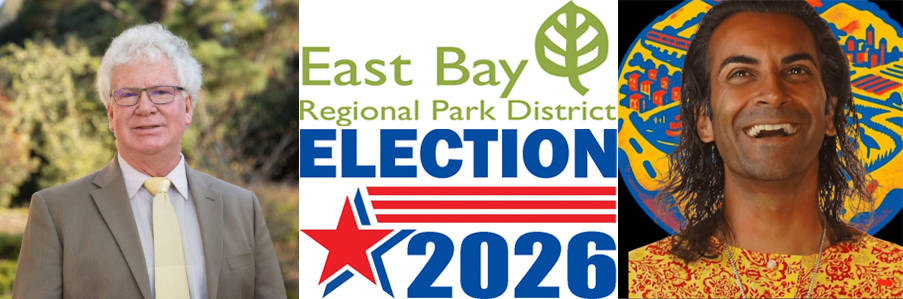
Incumbent Colin Coffey is facing challenger Inderprit Sekhon in this year’s East Bay Regional Park District Ward 7 race. Photos: EBRPD and LinkedIn
Colin Coffey touts his accomplishments and plans while Inderprit “Indy Rishi Singh” Sekhon, wants “to promote and educate about ecological medicine” and “dance for office instead”
By Allen D. Payton
Running for a third four-year term as a Director on the East Bay Regional Parks District in Ward 7, Colin Coffey faces a unique candidate, Inderprit “Indy Rishi Singh” Sekhon, who is running a different campaign while dancing to a different tune and offering an alternative focus and approach to the position. Ward 7 includes the northern waterfront portion of Contra Costa County from Pinole and Hercules in the west to the eastern county line north of Discovery Bay. (See map and below)
Cities and Communities in Ward 7 include: A portion of Alhambra Valley south of Martinez, Antioch, Bay Point, Bethel Island, Brentwood, Clyde, Crockett, Hercules, Knightsen, Martinez, and the adjacent Mountain View on the east side, Oakley, Pacheco, Pittsburg, Port Costa, Rodeo and Vine Hill between Martinez and Pacheco.
The Regional Parks in Ward 7 include: Antioch/Oakley Regional Shoreline, Bay Point Regional Shoreline, Big Break Regional Shoreline in Oakley, Black Diamond Mines Regional Preserve in Antioch, Briones Regional Park west of Pleasant Hill, Browns Island Regional Preserve north of Pittsburg, Carquinez Strait Regional Shoreline, Clayton Ranch Regional Preserve, Contra Loma Regional Park in Antioch, Crockett Hills Regional Park, Delta Access Regional Recreation Area north of Discovery Bay, Radke Martinez Regional Shoreline in Martinez, Rancho Pinole Regional Preserve east of Pinole, San Pablo Bay Regional Shoreline, and the Waterbird Regional Preserve/McNabney Marsh near Martinez.
Asked why Rancho Pinole doesn’t appear in the list of parks on the District’s website, Coffey shared, “Rancho Pinole lands in a section of the 2013 Master Plan that will be a regional park. It’s not currently operated by the District, but by the John Muir Land Trust. It includes Fernandez Ranch, about 1,000 acres, also includes the Franklin Canyon Ranch, surrounding the golf course. It totals about 2,000 acres so far. The Park District has partial ownership interest in Fernandez Ranch. The plans show someday it will all be converted to an East Bay Regional Park District park.”
Also, Deer Valley Regional Park south of Antioch, which includes the former Roddy Ranch Golf Course “is being returned to its original natural habitat. They’re ripping up the golf course paths as they’re not suitable for hiking,” he continued. “We recently acquired more land on Briones Valley Road near Brentwood. It will possibly break ground early next year. Within a year it’s possible we’ll open to the public. We already have a parking lot there, which really helps. We’re doing public programming there, already.”
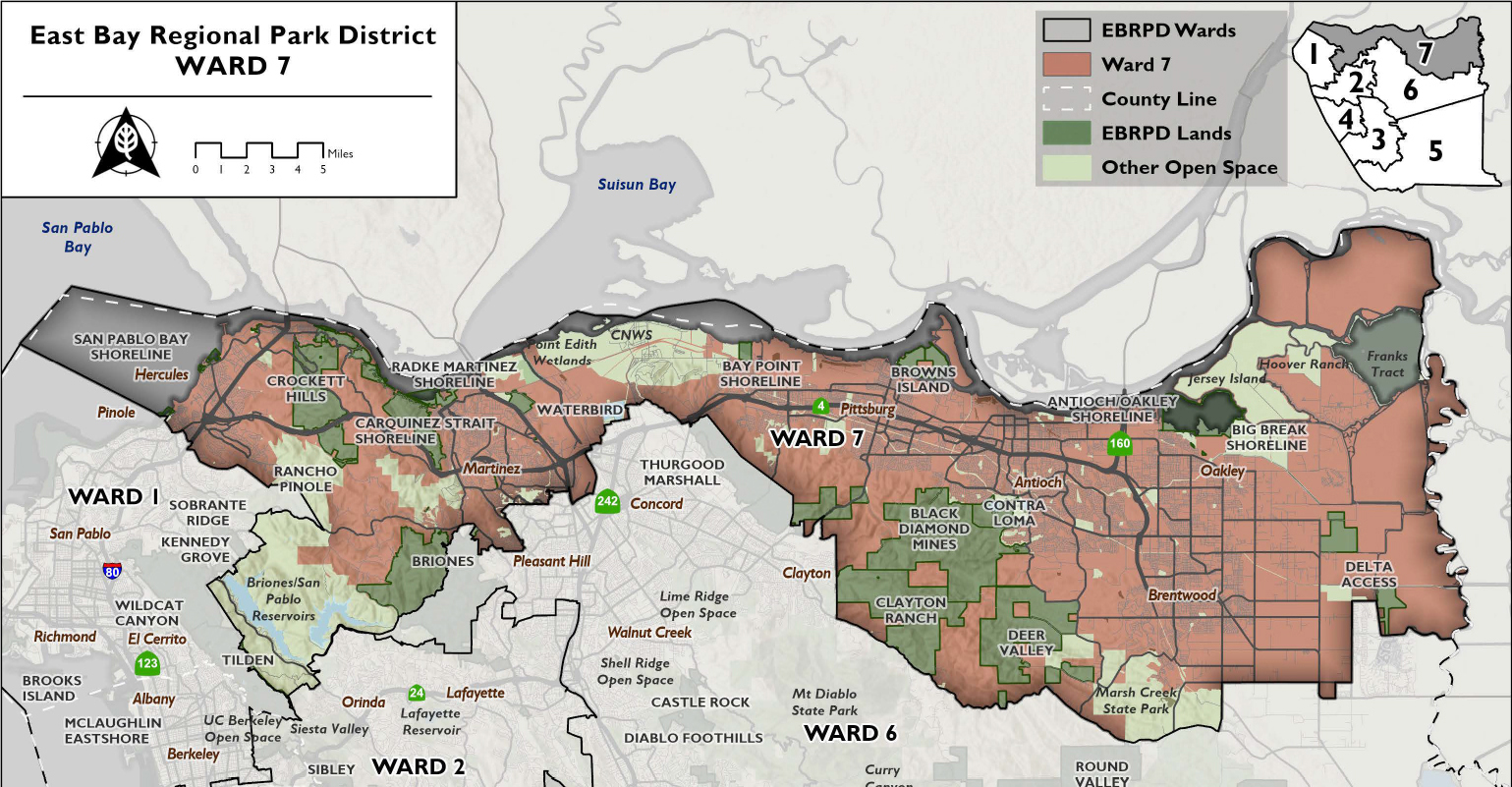
East Bay Regional Park District Ward 7 boundary map. Source: EBRPD
About Coffey
According to his bio on the East Bay Regional Parks District website, retired attorney Coffey is a resident of Hercules and “was appointed to the Board in January 2017. Previously, he served on the Park District’s Park Advisory Committee twice, first appointed by former EBRPD Director Ted Radke from 2001-2009 and appointed by the Contra Costa County Board of Supervisors from 2012- 2017. He has also been a volunteer Ambassador for the parks for 19 years. He is a longtime supporter of the John Muir Land Trust and a member of the Regional Parks Foundation.
“Director Coffey is a retired partner with the (law) firm Best, Best & Krieger in Walnut Creek. Director Coffey is a public health attorney, representing public and nonprofit healthcare providers. He is a past president of the Contra Costa Bar Association. Director Coffey is married, has two children and resides in Hercules. He is a lifelong resident of Contra Costa County.”
According to his campaign website, Coffey “was elected to the Board in 2018 and re-elected in 2022. He was a public health attorney, representing public and nonprofit healthcare providers and is a past president of the Contra Costa BAR association.
“Coffey’s family was politically active, and he served as an intern in then-Congressman George Miller’s Washington, DC office in his youth and later was the Congressman’s appointee to the Democratic Central Committee for 23 years.
“Coffey, his wife Mila and their two adult children are life-long parks and trails enthusiasts.”
His campaign is focused on the following issues: “Preservation of New Open Space and Wildlife Habitat / Aggressive Pursuit of Wildfire Risk Reduction / Enhanced Public Safety in the Parks; New Open Spaces; and Wildfire Mitigation.”
Coffey offers a long list of his accomplishments while in office under the categories of Leadership, Preservation of Open Space and Wildlife Habitat or Restoration of Natural Areas and Excellence in Programs and Policies.
He also shares under “Looking Forward – If Re-elected:” that fact that in “2027 I will be President of the Board and working with our new GM Max Korten. This will represent a huge opportunity for North and East Contra Costa input into open space preservation and wildlife habitat preservation. I will help complete a new 10 year Master Plan, highlighting future preservation of open space and wildlife habitat, more ways to enjoy open space, and continued focus on wildfire risk reduction.” Plus, other projects such as, “Extend the Marsh Creak Regional Trail to Dutch Slough on the North and to Round Valley Regional Park on the South” and “Build the proposed Delta Bay Trail from Bay Point to Antioch/Oakley and beyond,” and “Repairing and funding Hazel Atlas Mine and Great House Visitor Center to keep consistently open,” in East County.
Plus, “Rancho Pinole acquisitions and regional park development in partnership with JMLT (John Muir Land Trust) to create a future large regional park in the Hercules and Pinole area” and “Support Rodeo Community Association campaign to have EBRPD expand Lone Tree Point Park and clean up contaminated land in the area. Incorporate Greenway Vision for Rodeo shoreline into Master Plan” in West County.
About Inderprit “Indy Rishi Singh” Sekhon
According to the campaign website for Crockett resident Inderprit “Indy Rishi Singh” Sekhon, he “is a regenerative farmer, community organizer and systems thinker. His work focuses on the relationship between personal health, community wellbeing and the health of the land. He is running because he believes the Park District can build on its legacy of land protection and become a more active partner in public health, climate resilience, ecological restoration and community stewardship. His question is straightforward: How can the land we have already protected do more good for the people and places around it?”
In a post in August on his LinkedIn profile page, Sekhon wrote, “I’m on the California ballot as Inderprit Sekhon (government name). Check out what East Bay Regional Park District does and get involved with our campaign. We are seeking to collaborate with healers, artists, educators, ecological stewards, farmers, and anyone who feels like their skills/ideas are important, but not valued enough by government or current economic systems. Learn more about my intention to promote and educate about ecological medicine,” with a link to the website for his non-profit organization named Cultivating Self.
In that same LinkedIn post is a video which he says, “I don’t know why I’m doing this. But I’m running for office this fall. But, yeah, maybe I do know why I’m doing this. But I also feel it’s good to not know why I’m doing this,” with a laugh. “How can an organization with so much money and have so many resources how can it be a resource for the community, an asset for the community…how can that be part of our preventative, ecological medicine? That’s why I’m doing this. I don’t even know why and also, I do know that we need to do something…”
Then, in a post on Friday, Sept. 18, Sekhon wrote, “What if a neurodivergent Generalist ran for office? What if he decides to dance for office instead? find out what’s possible: https://lnkd.in/gsQVRw8h.”
That takes you to his campaign website where it shares his slogan, “Healthy land. Healthy people. Public money that works.” He writes, “The District has spent generations protecting land. Indy’s campaign asks how that protected land can more fully sustain the people and communities around it,” and his platform is to “Protect. Connect. Deliver.”
Under “Protect” Sekhon writes, “Care for the land before the emergency. Keep land, water, roads, trails and fire-prone landscapes healthy and safe — with maintenance and ecological stewardship matched to the places the District manages,” and lists “Wildfire resilience, Wetlands and shorelines, and Healthy soil and habitat.”
Under “Connect” he writes, “Make parks work for more people. Treat parks as public-health and belonging infrastructure, with better access, locally relevant programming and meaningful ways for residents to participate,” and lists, “Health and wellbeing, Transit and first-visit access, and Youth and paid stewardship.”
Finally, under “Deliver” Sekhon wants to, “Make public money produce visible results. Modernize field systems, publish priorities and costs, and make it easier to see what is being fixed, restored and improved,” and lists, “Transparent priorities, Modern field tools and Measurable outcomes.”
The first-time candidate also offers what he calls his Donut Vision 2036, of “A safe and thriving place for people and planet,” and writes, “Doughnut Economics asks how we meet more human needs without damaging the living systems we depend on. Indy’s 2036 vision applies that question to Ward 7’s parks and communities.”
Under the subheading, “People thrive” Sekhon shares about “Health, Food, Youth and Access,” and under the subheading, “Nature thrives” he writes about “Fire resilience, Shorelines, Biodiversity and Circular systems,” specifically, “Turn organic material back into useful ecological value.”
Sekhon also writes, “The theory of change: If we invest in parks as infrastructure for both people and planet, healthier land can support healthier communities, healthier communities can become stronger stewards, and accountable public systems can reinforce both.”
He then offers what the future will look like by following his vision, writing, “Ward 7, 2036. See the place. Imagine the next chapter.” Sekhon offers six parts to his vision: “The Shoreline We Can Restore, The Park That Heals, The Park That Feeds, The Park That Creates Work, The Government You Can See, and The Land We Care for Before Crisis.”
Under “Public money that works – You should be able to see what your Park District is doing,” Sekhon writes, “The argument is not that every public dollar is discretionary. It is that a large public institution should make its priorities, costs and results understandable.”
He includes eight focus areas: “Maintenance response & repair times; Trail & facility condition over time; Wildfire hazards treated & acres restored; Water quality & ecological outcomes; Residents reached; Local organizations contracted; Ward 7 investment; and Project costs, owners & timelines.”
Under “Heartstorming Ward 7 Listening that leads somewhere” Sekhon explains, “Most public engagement begins with a survey. Heartstorming begins with a place, a conversation and a practical question: What would help your community thrive here?” He lists five tasks to accomplish it: “1 Experience the place, 2 Share what you see and need, 3 Imagine what could change, 4 Connect ideas to policy and action, and 5 Invite people back into the work.”
Finally, Sekhon offers, “Plain-language FAQ What does this mean?” and asks and answers four questions: “Why call it ‘Doughnut Vision’? The doughnut is a simple model: make sure people can thrive while keeping ecological systems healthy. The campaign uses it as a long-horizon method, not as a prerequisite for understanding the platform.”
He continues, “Is every 2036 idea already an official Park District program? No. The site distinguishes campaign proposals and future concepts from existing District programs. Partnerships are not implied until they are actually established.”
Recognizing his limitations as only one of seven board members Sekhon writes, “What does one Park District director control? One director does not control the District alone. Indy would need to build public support and Board support for pilots, policies and investments.”
Finally, the challenger asks, “Why focus on public systems?” His answer is, “Maintenance, ecological care, field data and capital decisions are connected. Better information and clearer priorities can help staff, the Board and residents understand what needs attention and what progress looks like.”
Sekhon then invites voters to “Help shape Ward 7’s next decade. Vote. Volunteer. Share a park story. Come to a Heartstorming event. Help turn a long-horizon vision into practical work.”
He also shares more videos about his campaign on his Facebook page.
The election is Tuesday, Nov. 3.
Leave a Reply