Left graphic source: CABAT
Says “the District Board wrote the RTM Ballot Question…in a way that is intentionally confusing or misleading to voters.”
By Allen D. Payton
The Committee for Affordable Bay Area Transit (CABAT) organized to oppose the Regional Transit Measure (RTM) on the November ballot filed a lawsuit, Monday, against Election Officials in the five included counties and Kimberly Ward, the Public Transit Revenue Measure District Elections Official. If approved by voters, the tax measure, known as Connect Bay Area Transit, will raise a half-cent in four of the five counties, including Contra Costa, Alameda, Santa Clara and San Mateo and one-cent in San Francisco County for 14 years and raise an estimated $17 billion.
Labeled a VERIFIED PETITION FOR WRIT OF MANDATE AND PRELIMINARY INJUNCTION, the lawsuit was filed in Santa Clara County Superior Court by 10 petitioners including former State Senator Quentin L. Kopp, Gregg A. Diéguez, President of CABAT and Director of Sustainability for SHIFT Bay Area, and Marc Joffe, President of the Contra Costa Taxpayers Association, as well as Brian Holtz, Thomas Rubin and five others listed as individuals and electors in the Public Transit Revenue Measure District.
Kopp is also President of the San Francisco Taxpayers Association; Holtz is President of the Purissima Hills Water District Board of Directors in Santa Clara County and Secretary and Treasurer of the Libertarian Party of Santa Clara County; and Rubin is Vice President of the Alameda County Taxpayers Association, Inc.
Attorney Jason Bezis of Lafayette is representing them.
The District was formed to oversee the process for the transit tax measure. (See related article) According to the Fact Sheet for SB 63: Connect Bay Area Act, a separate oversight committee will be formed “to confirm money distribution follows the SB 63 expenditure plan” should the measure pass.
The lawsuit was filed before “the final printing deadline date” of “Friday, August 28, 2026, by which all ballot language and County Voter Information Guides (CVIG) materials must be finalized, including resolving any legal challenges in court.”
Transit Officials Were Warned But Did It Anyway
According to Joffe, “Transit officials cannot claim they were blindsided. On the night of July 23, 2026, the eve of the board’s special meeting, attorney Bezis sent a detailed pre-litigation demand letter urging the board not to approve the question as drafted. The letter was acknowledged multiple times and the measure was placed on the ballot with the slanted wording anyway.”
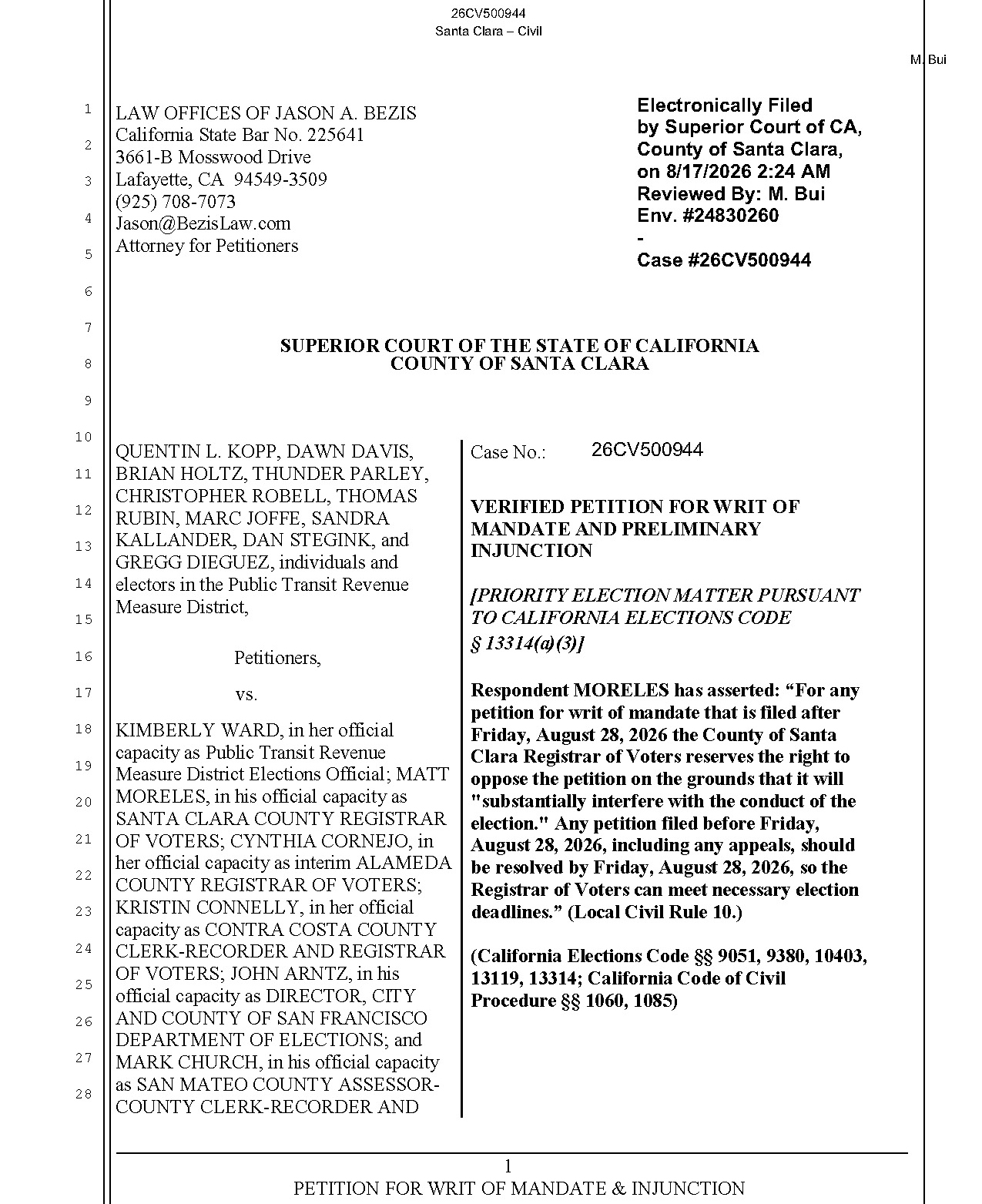
Lawsuit cover page. Source: CABAT
Legal Claims
The lawsuit “challenges biased, not neutral, untrue, partial, argumentative, and/or prejudicial wording in the RTM Ballot Question (also called ‘ballot label’ or ‘statement of the measure’) in violation of the Elections Code sections 9051(e) and 13119(c) standards and false and/or misleading wording in the RTM Ballot Question under the Elections Code section 9380/McDonough v. Superior Court (2012) 204 Cal.App.4th 1169 (‘McDonough’) standard. This lawsuit also challenges the Impartial Analysis authored by real party in interest DISTRICT Counsel KATHLEEN KANE as false, misleading, and/or not impartial in violation of Elections Code section 9380.”
The petitioners “seek a writ of mandate to compel amendment of the ballot question (also known as ‘ballot label’ or ‘statement of the measure’) and the impartial analysis that Respondents COUNTY ELECTIONS OFFICIALS and Ms. WARD are preparing for voter use in the Regional Transit Measure (‘RTM’) election to be held on November 3, 2026.”
Further, the lawsuit claims, “Petitioners assert that the DISTRICT and DISTRICT BOARD wrote the RTM Ballot Question…in a way that is intentionally confusing or misleading to voters.”
Current Ballot Language
The lawsuit explains, “As approved by the PTRMD BOARD at its July 24, 2026 meeting, the RTM Ballot Question (see District Resolution No. 2 Page 7) currently reads:
‘To prevent major service cuts to BART and other transit, avoid increased traffic, and reduce pollution by: Preserving BART, Caltrain, VTA, SamTrans, AC Transit, Muni, other transit for everyone, including workers, students, seniors, persons with disabilities; Supporting transit safety, cleanliness, affordability, reliability; Repairing targeted roads/potholes; Requiring financial transparency, oversight, accountability; shall the measure enacting a 0.5% (Alameda, Contra Costa, San Mateo, Santa Clara counties), and 1% (San Francisco) sales tax for 14 years generating approximately $980,000,000 annually, be adopted?’”
Challenges & Proposed Changes
However, the petitioners claim the adopted ballot language does not comply with state Elections Code and the amount is incorrect and should instead be $1.2 million per year. They claim the statement of the measure is not “a true and impartial synopsis of the purpose of the proposed measure,” is “argumentative” and “likely to create prejudice for or against the measure,” and that the “RTM Ballot question is inherently prejudicial” based on a survey MTC conducted last year. Furthermore, the petitioners “argue that components of the RTM Ballot Question are false and/or misleading.”
They want to make the following changes:
- Amend the phrase “Preserving BART …” to read “Funding BART …”
- Delete the phrase “for everyone, including workers, students, seniors, persons with disabilities”.
- Delete the phrase “To prevent major service cuts to BART and other transit”.
- Alternatively, strike the word “major” in the phrase “To prevent major service cuts …”
- Delete the phrase “avoid increased traffic”.
- Delete the phrase “reduce pollution”.
- Strike the phrase “/potholes”.
- Amend “Repairing targeted roads” to read “Repaving transit-served roads”.
- Strike the words “affordability, reliability”.
- Amend “enacting” to read “imposing”.
- Amend the phrase “sales tax” to read “sales and use tax”.
- Strike the word “oversight” in the phrase “Requiring … oversight”.
- Strike the word “accountability” in the phrase “Requiring … accountability”.
- Amend “$980,000,000 annually” (September 2025 estimate) to an updated number (an August 2026 estimate) or “$1,200,000,000 annually” (September 2025 estimates, averaged over 14 years).
Alternative Ballot Language
The lawsuit offers the following ballot language alternatives:
“If the Court were to order all of the amendments and corrections suggested by Petitioners supra, the RTM Ballot Question would read:
‘Funding BART, Caltrain, VTA, SamTrans, AC Transit, Muni, other transit; Supporting transit safety, cleanliness; Repaving transit-serving roads; Requiring financial transparency; shall the measure imposing a 0.5% (Alameda, Contra Costa, San Mateo, Santa Clara counties) and 1% (San Francisco) sales and use tax for 14 years generating approximately $1,200,000,000 annually, be adopted?’”
The lawsuit further reads, “If the Court were to order all of the amendments and corrections suggested by Petitioners supra, including use of the ‘Shall the measure … be adopted?’ format, the RTM Ballot Question would read:
‘Shall the measure imposing a 0.5% (Alameda, Contra Costa, San Mateo, Santa Clara counties) and 1% (San Francisco) sales and use tax for 14 years generating approximately $1,200,000,000 annually; Funding BART, Caltrain, VTA, SamTrans, AC Transit, Muni, other transit; Supporting transit safety, cleanliness; Repaving transit-serving roads; Requiring financial transparency; be adopted?’”
The petitioners also claim the “RTM Impartial Analysis is partial, false, and/or misleading” and that it should be written by either the California Attorney General, a county counsel or district attorney instead of Kathleen Kane who is he legal counsel for the District.
“Supporters of the Transit Measure need to use misleading advertising because voters won’t pass the measure if they have the real story that it is a regressive tax falling hardest on seniors and low-income families for 14 years,” Dieguez stated.
“Voters deserve the honest description the law guarantees them, and if the district won’t provide it, a court should,” Joffe added.
See the Public Transit Revenue Measure District’s Legal Counsel RTM Impartial Analysis.
See RTM Ballot Question Lawsuit Aug 17
For more information about CABAT visit Committee for Affordable Bay Area Transit.
The election is Tuesday, Nov. 3.
This part of your story is false: “ A separate oversight committee will be formed to verify proper expenditure of the funds should the measure pass.”
Debora,
From the Fact Sheet for SB 63: Connect Bay Area Act – “Independent Oversight Committee: SB 63 requires that the District appoint an Independent Oversight Committee to confirm money distribution follows the SB 63 expenditure plan. The Independent Oversight Committee will include at least one appointee from the five counties — Alameda, Contra Costa, San Francisco, San Mateo and Santa Clara — that comprise the District.”
Please see https://mtc.ca.gov/sites/default/files/documents/2026-03/Fact-Sheet_Connect-Bay-Area-Act-SB63_FINAL.pdf?cb=cc46f8a3.
Allen D. Payton
Publisher
The “Fact Sheet” for SB63 was written to purposely mislead voters into believing that there was strong oversight over how public money would be spent. It’s just not true. The polling for 2 years prior to 2026, told them that accountability and oversight was a top hurdle for voters. Your quote “oversight committee will be formed to verify proper expenditure of the funds” isn’t the same as what is in the fact sheet”: “Independent Oversight Committee to confirm money distribution follows the SB 63 expenditure plan”. The “Independent Oversight Committee” that is required by SB63 has only one purpose and that is to ensure that the tax revenues are “DISTRIBUTED” to transit agencies, MTC and county Transportation authorities in accordance with a very strictly prescribed formula laid out in SB63. Once they get the money, the Independent Oversight Committee’s job is done. In fact there is a loophole for MTC to be able to delegate the math check on distribution of funds to the BATA oversight committee and not form this committee at all. You article says they will “verify proper expenditure of the funds”. The expenditures are done by the transit agencies, MTC, CTA’s and there is NO VERIFICATION of their spending of the funds anywhere in SB63.