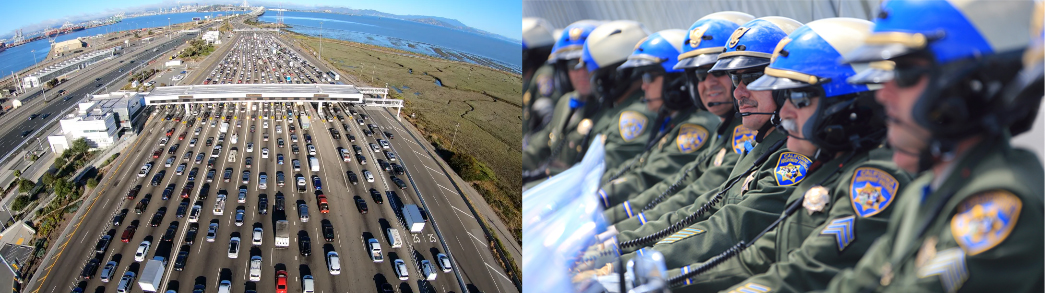
Photos: (Left) MTC (Right) Credit John Huseby, Caltrans
Carpools allowed in bus lane only during weekday peak periods
By Cindy Ramirez, CHP, Bart Ney, Caltrans and John Goodwin, Bay Area Toll Authority
SAN FRANCISCO, Sept. 9, 2026. . . The California Highway Patrol, in partnership with Caltrans and the Bay Area Toll Authority, this month will resume concentrated enforcement of the laws governing the westbound approach to the San Francisco-Oakland Bay Bridge. This includes strict enforcement of vehicle-type and vehicle-occupancy laws in the bus/carpool lane that bypasses the San Francisco-Oakland Bay Bridge toll plaza at the far-right side of the roadway.
This lane — which can be accessed by traffic approaching the bridge from Interstate 80, Interstate 880 or West Grand Avenue — may be used by buses, motorcycles or carpools with three or more occupants during the weekday commute periods of 5 a.m. to 10 a.m. and 3 p.m. to 7 p.m. Only buses may lawfully use the lane at other times, including all day on Saturdays and Sundays. Drivers cited for improper use of the bus/carpool lane outside weekday commute hours are subject to a fine of $490 or more.
“The signs at access points to the lane are clear and unambiguous. They read ‘Buses Only,’” noted Lt. Ed Clarke of the CHP’s Oakland Area. “But many drivers have not consistently followed the rule in recent years.” The CHP, Caltrans and BATA agree that focused enforcement will help address ongoing violations, improve compliance with the posted restrictions, and ensure the lane remains available for its intended use.
Acting Caltrans District 4 Director and BATA Commissioner Doanh Nguyen reminds drivers that the toll booths at the Bay Bridge and other state-owned toll bridges will soon be a thing of the past. “The transition to open-road tolling already is underway, with the new system set to debut next year at the Richmond-San Rafael Bridge. The comprehensive reconfiguration of the approaches to every state-owned toll bridge will improve safety and efficiency by allowing drivers to pay their tolls without having to slow down to squeeze past the obsolete toll booths.”
BATA administers all toll revenues from the region’s seven state-owned toll bridges. Caltrans owns and operates the state highway system, including state-owned toll bridges such as the Bay Bridge.
La Policía de Caminos de California (CHP) se enfoca en el acceso al puente Bay Bridge para una campaña de reforzar el control
Los vehículos compartidos solo pueden circular por el carril de autobuses durante las horas pico de los días laborables
SAN FRANCISCO, 9 de septiembre de 2026. . . La Policía de Caminos de California (CHP), en colaboración con Caltrans y la Autoridad de Peajes del Área de la Bahía, reanudará este mes la aplicación intensiva de las leyes que rigen el acceso en dirección oeste al puente San Francisco-Oakland Bay Bridge. Esto incluye la aplicación estricta de las leyes sobre el tipo y la ocupación de vehículos en el carril para autobuses y vehículos compartidos que evita la plaza de cobro del puente San Francisco-Oakland Bay Bridge por el lado extremo derecho de la carretera.
Este carril — al que pueden acceder los vehículos que se acercan al puente desde la Interestatal 80, la Interestatal 880 o West Grand Avenue — puede ser utilizado por autobuses, motocicletas o vehículos compartidos con tres o más ocupantes durante días laborables en los horarios pico de 5 a.m. a 10 a.m. y 3 p.m. a 7 p.m. Solo los autobuses pueden utilizar el carril en otros momentos legalmente, incluyendo todo el día los sábados y domingos. Los conductores
que reciban una infracción por el uso indebido del carril para autobuses y vehículos compartidos fuera de los horarios pico de los días laborables están sujetos a una multa de $490 o más.
“Las señales en los puntos de acceso al carril son claras e inequívocas. Dicen ‘Solo autobuses’,” señaló el teniente Ed Clarke del Área de Oakland de la CHP. “Sin embargo, muchos conductores han omitido cumplir la norma de forma consistente en los últimos años.” La CHP, Caltrans y la BATA coinciden en que una aplicación rigurosa de la ley ayudará a abordar las infracciones continuas, mejorará el cumplimiento de las restricciones establecidas y garantizará que el carril siga disponible para el uso previsto.
El director interino del Distrito 4 de Caltrans y comisionado de la BATA, Doanh Nguyen, recuerda a los conductores que las casetas de cobro en el puente de la Bahía y otros puentes de cuota de propiedad estatal pronto pasarán a ser historia. “La transición al sistema de cobro de cuotas en carretera abierta ya está en marcha, y está previsto que el nuevo sistema entre en funcionamiento el próximo año en el puente Richmond-San Rafael. La reconfiguración integral de los accesos a todos los puentes de cuota de propiedad estatal mejorará la seguridad y la eficiencia, al permitir que los conductores paguen sus cuotas sin tener que reducir la velocidad para pasar por las casetas de cobro obsoletas.”
BATA administra los ingresos de peajes de los siete puentes de peaje de propiedad estatal en la región. Caltrans es propietario y opera el sistema de carreteras estatales, incluyendo los puentes de cuota de propiedad estatal como el puente Bay Bridge.
CHP 針對海灣大橋引道展開強化執法行動
共乘車輛僅在工作日高峰時段才允許使用公車道
舊金山,2026年9月9日—加州公路巡警(CHP)將聯合加州交通局(Caltrans)
和灣區收費管理局(BATA),於本月恢復對舊金山-奧克蘭海灣大橋(San Francisco-Oakland Bay Bridge)西向引道相關交通法規的集中執法。執法重點包括加強監管位於最右側、可繞過海灣大橋收費站的公車/共乘專用車道,以確保使用該車道的車輛類型及載客人數符合規定。
該車道可供從 80 號州際公路、880 號州際公路或 West Grand Avenue 駛向大橋的車輛進入。在工作日通勤時段的上午 5 點至 10 點及下午 3 點至 7 點,公車、摩托車或載有三人及以上的共乘車輛可以使用該車道。在其他時段(包括週六和週日全天),僅公車可合法使用該車道。在工作日通勤時段以外違規使用該公車/共乘車道,將面臨 490 美元或以上罰款。
「車道入口處的標誌清晰明確,上面寫著『僅限公車』(Buses Only),」CHP 奧克蘭分局的 Ed Clarke 中尉指出,「但近年來,許多駕駛者並未始終遵守這項規定。」CHP、Caltrans 和 BATA 一致認為,開展集中執法有助於解決持續發生的違規行為,提高駕駛者對現場標示限制的遵守程度,並確保該車道維持其原定用途。
Caltrans 第 4 區代理局長兼 BATA 委員 Doanh Nguyen 提醒駕駛者,海灣大橋及其他州屬收費橋樑的收費亭即將成為歷史。「向開放式道路收費(open-road tolling)系統轉型的工作已經展開,新系統預計將於明年在Richmond-San Rafael大橋上率先啟用。對所有州屬收費橋樑引道進行全面重新規劃與改造,將讓駕駛者無須減速、穿越老舊的收費亭即可繳納通行費,從而提升道路安全與通行效率。」
BATA負責管理本地區七座州屬收費大橋的所有通行費收入。Caltrans負責擁有和營運州級公路系統,其中包括海灣大橋等州屬收費大橋。
Leave a Reply