• Home
  • About The Herald
  • Local Agencies
  • Daily Email Update
  • Legal Notices
  • Classified Ads

Contra Costa Herald

News Of By and For The People of Contra Costa County, California

  • Arts & Entertainment
  • Business
  • Community
  • Crime
  • Dining
  • Education
  • Faith
  • Health
  • News
  • Politics & Elections
  • Real Estate

Contra Costa issues mass isolation and quarantine orders for people with COVID-19 and their close contacts

April 4, 2020 By Publisher Leave a Comment

Latest county stats: 4,929 tested, 353 cases, 31 currently hospitalized, 5 deaths as of Saturday morning, April 4

“Our resources are stretched extremely thin and business as usual is not an option.” – Health Officer Dr. Chris Farnitano

From Contra Costa Health Services

Contra Costa County Health Officer Dr. Chris Farnitano announced Friday evening that the county is issuing a mass order for residents with COVID-19 and their close contacts to isolate and quarantine themselves.

The mass order is being issued to help slow COVID-19’s spread, protect vulnerable individuals, and prevent the healthcare system in the County from being overwhelmed. The county’s public health staff no longer have the capacity to individually notify and track everyone with COVID-19 and their close contacts who may have been exposed to the virus.  

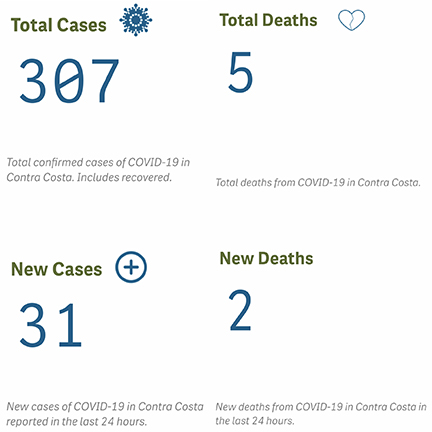
As of Friday, 307 county residents have tested positive for COVID-19 and five people have died from the virus. Contra Costa County had no local cases at the beginning of March.

“We’ve reached a critical point in the COVID-19 crisis here in Contra Costa,” Dr. Farnitano said. “Our resources are stretched extremely thin and business as usual is not an option. We believe this mass order is a creative and effective way of getting the job done to keep the sick isolated from others.”

Residents must isolate themselves in their home or another residence if they test positive for COVID-19. They may not leave their home except to receive necessary medical care or during an emergency that requires evacuation.  

COVID-positive individuals without symptoms must isolate for 7 days from the date of a positive test. Those with symptoms must isolate at least 7 days have passed since their symptoms started. Initially symptomatic people must also wait at least 72 hours have passed since after symptoms go away. Symptoms of COVID-19 include fever, coughing and shortness of breath.

County residents who test positive for COVID-19 will now be required to tell their close contacts that they need to quarantine themselves if they may have been exposed. Close contacts must then remain at home or another residence for 14 days from the last date that they were in contact with the person infected or with COVID-19.

People considered “close contacts” are persons who, during the sick individual’s infectious period, live in, or have stayed overnight, at the individual’s residence; are intimate sexual partners of the individual; or provided care to the individual without wearing a mask, gown, and gloves.

People can access instructions on how to isolate and quarantine themselves at cchealth.org/coronavirus.
Filed Under: Health, News

Contra Costa COVID-19 Update: Now 305 cases, two more deaths

April 3, 2020 By Publisher 1 Comment

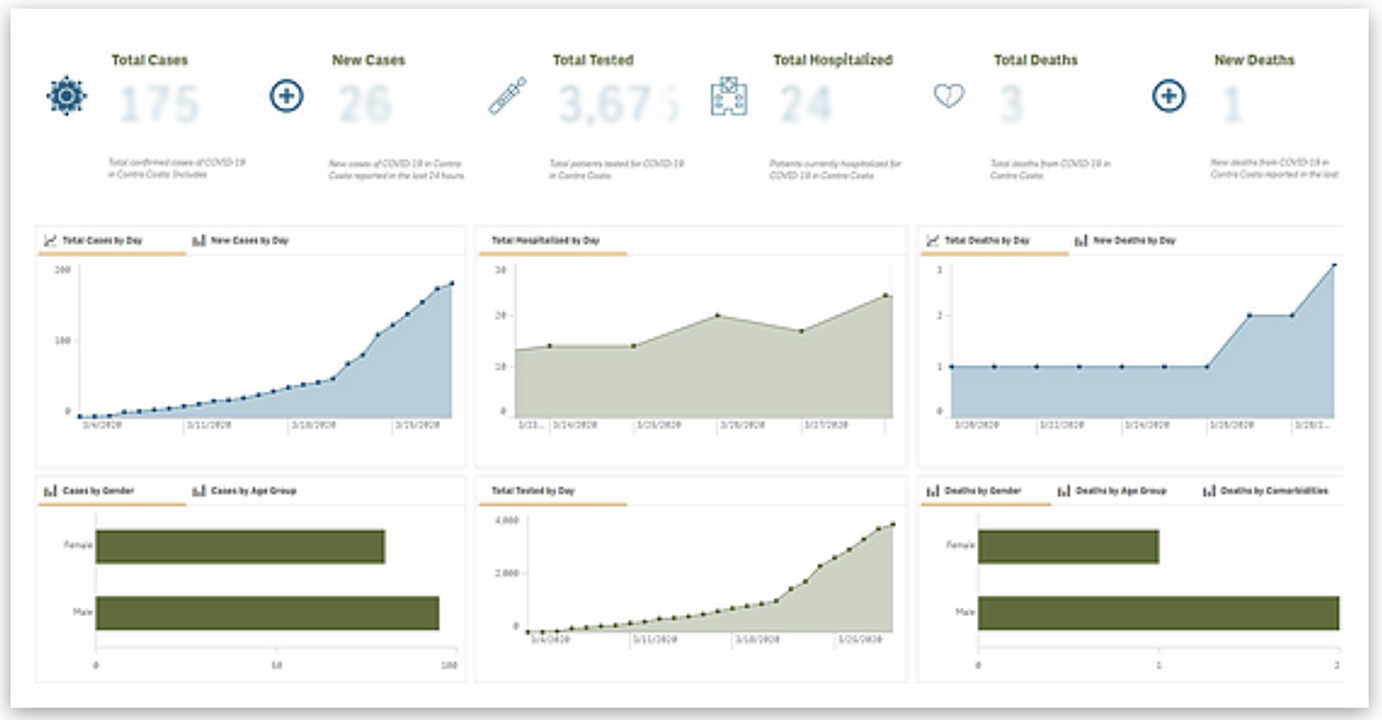
Cases and deaths from COVID-19 in Contra Costa County from the CCHS dashboard.

As of Friday, April 3, 2020 at 2:00 p.m. Contra Costa Health Services (CCHS) is reporting 31 more cases of COVID-19/coronavirus for a total of 305, and two more deaths in the county. There are 32 people diagnosed with the virus currently hospitalized, an increase of just one from Thursday’s update.

27 of the new cases are from the senior care home in Orinda. (See related article)

To see the all the statistics provided by CCHS, click here.

Filed Under: Health, News

Google releases Mobility Reports collected from cell phone data on social distancing, activities

April 3, 2020 By Publisher 1 Comment

By Allen Payton

Google released a treasure trove of information, Friday labeled Mobility Reports, based on cell phone users’ movements, during the coronavirus pandemic, that includes statistics showing activities such as shopping, use of parks, and going to work.

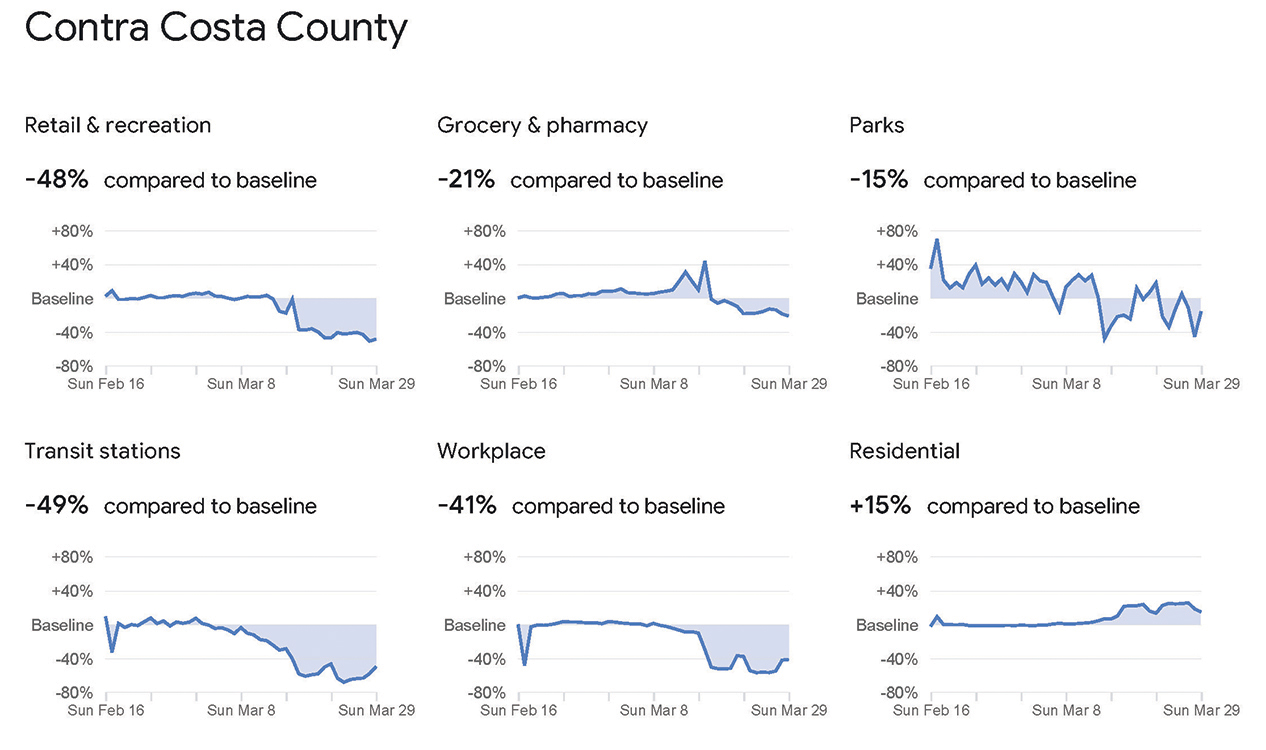
“Each Community Mobility Report is broken down by location and displays the change in visits to places like grocery stores and parks. This is an early release and reports will be updated regularly”, Google shared on their website.

In California, from February 16 through March 29, the data show a 50% drop in retail and recreation, a 24% decrease in grocery shopping and pharmacy visits, a 38% drop in visits to parks, a 54% decrease in use of public transit, but only a 39% drop in going to work. An even more interesting statistic is the data show only a 15% increase in going to places of residence.

The stats for Contra Costa County were similar, with a 48% drop in retail and recreation, a 21% decrease in grocery shopping and pharmacy visits, a 49% drop in using public transit, a 41% decrease in going to work, as well as the same 15% increase in visits to home. But there was only a 15% decrease in visits to parks.

Under the title “Helping public health officials combat COVID-19”,  Jen Fitzpatrick, SVP, Geo and Google Health’s Chief Health Officer, Karen DeSalvo, MD, M.P.H. issued the following statement, today, Friday, April 3:

“As global communities respond to the COVID-19 pandemic, there has been an increasing emphasis on public health strategies, like social distancing measures, to slow the rate of transmission. In Google Maps, we use aggregated, anonymized data showing how busy certain types of places are—helping identify when a local business tends to be the most crowded. We have heard from public health officials that this same type of aggregated, anonymized data could be helpful as they make critical decisions to combat COVID-19.

Starting today we’re publishing an early release of our COVID-19 Community Mobility Reports to provide insights into what has changed in response to work from home, shelter in place, and other policies aimed at flattening the curve of this pandemic. These reports have been developed to be helpful while adhering to our stringent privacy protocols and policies.

The reports use aggregated, anonymized data to chart movement trends over time by geography, across different high-level categories of places such as retail and recreation, groceries and pharmacies, parks, transit stations, workplaces, and residential. We’ll show trends over several weeks, with the most recent information representing 48-to-72 hours prior. While we display a percentage point increase or decrease in visits, we do not share the absolute number of visits. To protect people’s privacy, no personally identifiable information, like an individual’s location, contacts or movement, is made available at any point.

We will release these reports globally, initially covering 131 countries and regions. Given the urgent need for this information, where possible we will also provide insights at the regional level. In the coming weeks, we will work to add additional countries and regions to ensure these reports remain helpful to public health officials across the globe looking to protect people from the spread of COVID-19.”

Google also provided additional information about their reports, how they gathered the data and what they’re doing with it:

Preserving privacy

The Community Mobility Reports were developed to be helpful while adhering to our stringent privacy protocols and protecting people’s privacy. No personally identifiable information, such as an individual’s location, contacts or movement, will be made available at any point.

Insights in these reports are created with aggregated, anonymized sets of data from users who have turned on the Location History setting, which is off by default. People who have Location History turned on can choose to turn it off at any time from their Google Account and can always delete Location History data directly from their Timeline.

We also use the same world-class anonymization technology used in our products every day to keep your activity data private and secure. This includes differential privacy, which adds artificial noise to our datasets, enabling us to generate insights while preventing the identification of any individual person.

Visit Google’s Privacy Policy to learn more about how we keep your data private, safe and secure.

How long will these reports be available?

These reports will be available for a limited time, so long as public health officials find them useful in their work to stop the spread of COVID-19.

Filed Under: Health, News

Contra Costa Health Services confirms COVID-19 outbreak at senior facility, no deaths reported

April 3, 2020 By Publisher 1 Comment

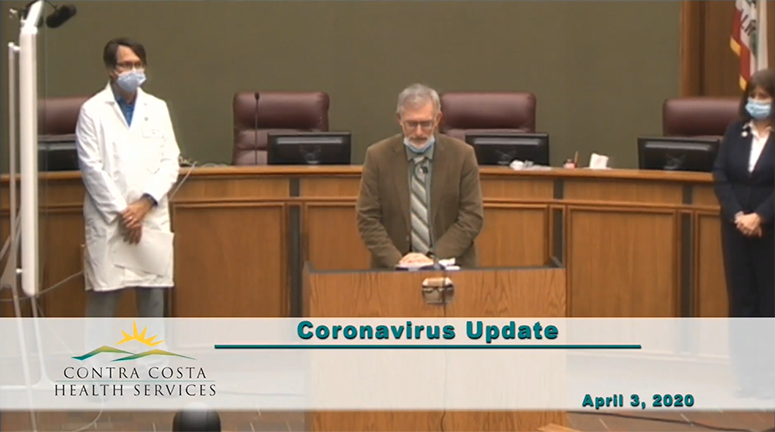
Dan Peddycord speaks from the Board of Supervisors chambers, as Dr. Chris Farnitano and Board of Supervisors Chair Candace Andersen look on, during the Contra Costa Health Services press conference 04-03-20. Screenshot of YouTube video.

At least 27 people who live or work at a skilled nursing facility in Orinda have tested positive for COVID-19, Contra Costa Health Services (CCHS) confirmed today.

No deaths have been reported in connection with the outbreak as of Friday morning.

“Public Health has prepared for the possibility of outbreaks happening in skilled nursing facilities and other congregate care settings, and we have provided clear guidance for facilities in responding and controlling the spread of illness,” Contra Costa Public Health Director Dan Peddycord said during a Friday afternoon press conference. “We are working closely with the facilities now to protect residents and staff.”

CCHS began investigating this week after two staff members working at Orinda Care Center sought medical care. Positive test results for those workers as well as two patients at the facility returned positive late Wednesday.

CCHS tested all patients and staff Thursday. While results continue to return, 24 residents and three staff members have tested positive so far. Two residents who tested positive are receiving care at local hospitals.

Most of the infections at the facility were discovered through the Public Health investigation. Staff and residents who do not have serious symptoms are medically isolated but not hospitalized.

Orinda Care Center is a skilled nursing facility with 45 residents located at 11 Altarinda Road. The facility is following all health recommendations to prevent further spread of the virus.

Public Health is also now in the early stages of investigating and testing at two other senior care facilities in the county.

“The situation is very serious, and we are deeply concerned about residents of our senior care facilities in Contra Costa County,” said Dr. Chris Farnitano, Contra Costa County health officer. “That is why we need everyone to follow the stay-at-home order, social distancing guidance and other measures in recent health orders – to protect the people in our community who are vulnerable to severe illness from COVID-19.”

CCHS did confirm two more coronavirus-related deaths of county residents on Friday unrelated to this outbreak. There have been five confirmed deaths in Contra Costa and more than 300 confirmed cases of COVID-19 infection.

Visit cchealth.org/coronavirus for up-to-date information about COVID-19 in Contra Costa County.

Filed Under: Health, News, Seniors

Contra Costa Health Services adds more statistics, data to their coronavirus webpage

April 2, 2020 By Publisher 3 Comments

Only 31 currently hospitalized out of 276 confirmed cases in the county

By Allen Payton

After requests by the public and the Herald, on readers’ behalf, the Contra Costa Health Services updated their webpage, today and are now reporting more statistics and information on what they refer to as the “dashboard.”

The only statistic not included that the public has been requesting, is the number of people diagnosed with the virus who have recovered.

“We’re working to get additional information to the public, as much as possible,” said Will Harper, Contra Costa Health Services spokesperson.

One bright spot in the additional statistics is that out of 276 confirmed cases in Contra Costa County, only 31 are currently hospitalized, which is a little over 11%, as of 1:00 a.m. Thursday morning, April 2. That’s out of 4,083 people who have been tested.

While the statistics show a greater number of people age 41-60 that have been diagnosed with COVID-19 than those age 61-100, which goes against international statistics, “What it doesn’t show is the severity of the cases,” Harper explained.

“We’re trying to prepare people for the fact that we haven’t seen the worst of it, yet,”

Filed Under: Health, News

Assemblymember Frazier chooses Byron winery owner Michelle Campos as AD11 Woman of the Year

April 2, 2020 By Publisher Leave a Comment

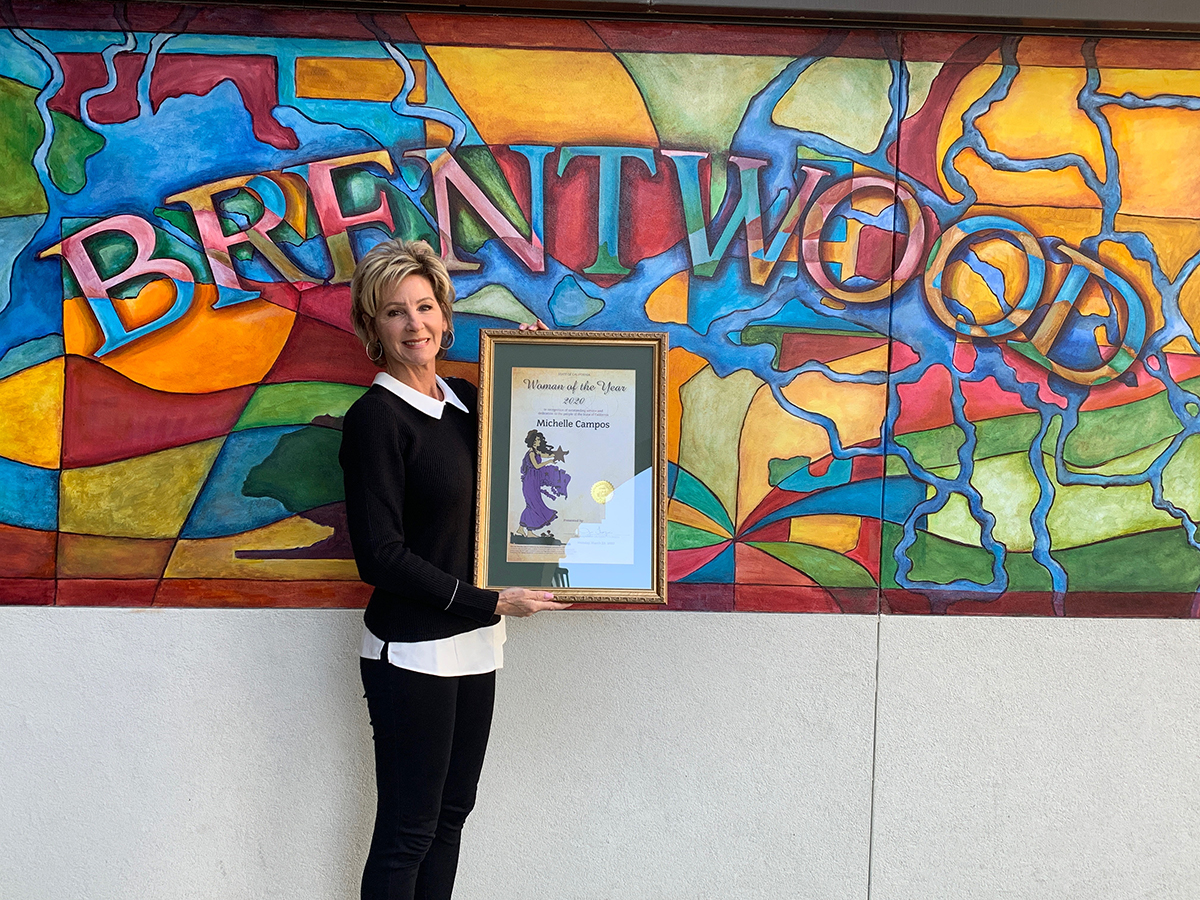
Michelle Campos with her plaque honoring her as Assembly District 11 Woman of the Year. Photo courtesy Office of Assemblymember Jim Frazier.

Sacramento – Assemblymember Jim Frazier (D- Fairfield), invites the public to join him in celebrating Michelle Campos in her selection as Assembly District 11’s Woman of the Year. Michelle’s contributions to her community include volunteering in programs at local schools, cancer philanthropy and founding a successful business that continues the tradition of giving back. Currently Michelle and her husband, Ric are proprietors of Campos Family Vineyards in Byron and live there, as well.

“In her nearly three decades of living in the area, Michelle’s commitment to her community and to those around her is astounding,” Frazier said. “From her involvement in the Performing Arts Program at Excelsior Middle School, the Avon Walk for Breast Cancer to creating not only a successful business, but one that is constantly finding new ways to share what she’s been given, Michelle has contributed much to our community. I am delighted and honored to nominate Michelle to represent the 11th Assembly District as Woman of the Year.”

Michelle was born and raised in San Leandro.  She graduated in 1977 from San Leandro High School, attended Chabot College and Western Career College.  Michelle worked as a Nurse in Family Practice, OB/GYN and Labor & Delivery at Washington Hospital in Fremont. She previously was a Childbirth Educator and Private Doula.  She also obtained her Real Estate License and sold new homes for Kaufman & Broad in Contra Costa County. Michelle and Ric married in 1991 and moved to Discovery Bay. Together they raised her two children and their daughter.

A heartfelt desire to become involved in the community and give back was important to Michelle.  As her children went through school, she was involved in and supported the Performing Arts Program at Excelsior Middle School and the Cheer Program at Liberty High School. Michelle and her husband started an environmental business (SWIMS) in 1996 out of their home garage. SWIMS now has six locations and more than 100 employees. Together she and Ric pioneered the storm water industry and both worked hands-on to grow and develop their business.

In 2016, Campos Family Vineyards was born, the result of the couple’s long-time dream and love for vineyards. Years of long drives through many California wine regions was a favorite pastime. Providing a place to gather the community, give back and produce award-winning wines is the heartbeat of both Campos Family Vineyards and Michelle. Being part of the community for more than 29 years, raising children and now grandchildren here, Michelle believes that creating a gathering place is very important. Raising awareness and funds for the Temple Grandin/Eustacia Cutler Autism Foundation is also near to Michelle’s heart, as her granddaughter Gianna (GiGi) is on the Autism Spectrum and has Aspergers.  It was Gigi’s idea, at age 11, to give back and help others.

Filed Under: East County, News, People

Richmond’s Craneway Pavilion to be converted to a 250-bed federal Medical Station for COVID-19 patients

April 2, 2020 By Publisher Leave a Comment

The Craneway section of the Ford Assembly Building, Richmond, California. Photo by Billy Hustace Photography.

By Kim McCarl, Assistant to the Director, Communications, Contra Costa Health Services

As part of local emergency preparations, Contra Costa County officials are working with Federal and state partners to convert the Craneway Pavilion in Richmond into a 250-bed medical station for COVID-19 patients.

Inside the Craneway Pavilion. Photo from Kickstarter.

Beds and medical supplies are being brought in by the National Guard this week to begin transforming the Craneway Pavilion, a large event center on the Richmond waterfront, into a temporary medical facility. The goal is to have the facility ready to receive patients by the third week of April, when health experts predict the Bay Area will see COVID-19 cases begin to peak.

“This is one more step to be better prepared for the anticipated COVID-19 surge,” said Candace Andersen, Chair of the Board of Supervisors. “We are very grateful for the cooperation of so many private and public entities that are making their venues available to serve the health needs of our community in this unprecedented crisis.”

The federal medical station would serve as an alternate care site for COVID-19 patients who don’t need ICU-level care. It would be used only in the event local hospitals lack capacity to handle a surge of COVID-19 cases. While equipment and supplies are provided by the Federal Government, the County would coordinate medical staffing of the site.

“Dedicated County physicians, nurses and other professional staff will provide vital medical care in this historic building to help prevent our local hospitals from becoming overburdened by an expected surge in patients” said Supervisor John Gioia, who represents the area where this site is located.

The County is also establishing other alternate care sites, including using hotels for homeless residents.
Contra Costa and other Bay Area counties recently extended a regional stay-at-home order through May 3 hoping that continued social-distancing measures will reduce the impact of COVID-19 on area hospitals.

The site will be secured and not open to visitors.

Managed by the Division of Strategic National Stockpile, federal medical stations are rapidly deployable caches containing beds, supplies, and medicines which can quickly turn a preidentified building into a temporary medical shelter during a national emergency.

Richmond Mayor Tom Butt stated that “The Craneway played an essential part in winning World War II.  Today it is being repurposed to fight another global war.  This facility will help not only our local communities but contribute to the overall effort to contain COVID-19.”

The Craneway Pavilion, located in the Ford Building, was a Ford Auto Plant from 1928 to 1956 and switched to assembling jeeps, tanks and military vehicles during World War II.

According to the Public Health Emergency webpage for the U.S. Department of Health & Human Services:

The Federal Medical Station (FMS) “is an HHS deployable healthcare facility that can provide surge beds to support healthcare systems anywhere in the U.S. that are impacted by disasters or public health emergencies. FMS are not mobile and cannot be relocated once established.

Each FMS comes with a three-day supply of medical and pharmaceutical resources to sustain from 50 to 250 stable primary or chronic care patients who require medical and nursing services. Staffing for an FMS can be provided using displaced local, regional or EMAC providers, or can be provided by the federal government (primary federal staff are Officers of the U.S. Public Health Service Commissioned Corps). Potential roles for an FMS include the following:

  • Provide temporary holding and care for patients to decompress a local hospital (increase beds available for patients with disaster-related trauma or illness
  • Receive patients from nursing homes and skilled nursing facilities forced to evacuate due to the disaster
  • Provide low acuity care for patients with chronic illnesses whose access to care is impeded due to the disaster

Because the equipment and supply cache does not include tents, each FMS requires an appropriate building of opportunity* in which to operate. Significant preparation is needed to employ FMSs in support of local, State, Tribal, and Territorial emergency plans. An FMS must be established in a structurally intact, accessible building with adequate hygiene facilities and functioning utilities (hot and cold potable water, electricity, heating, ventilation, and air conditioning, and internet accessibility or capability).

A 250-bed FMS requires roughly 40,000 square feet of open space, while a 50-bed FMS requires about 15,000 square feet. In addition, wrap around logistical services must be coordinated and in place before an FMS can be operational. Some of these include a 10-12 person set up team, contracted support for patient feeding, laundry, ice, medical oxygen, and biomedical waste disposal. Fewer beds can be set up in smaller facilities, but building attributes and wrap around services remain the same.

Once a request for FMS has been approved, the cache of equipment and supplies will be delivered in 24-48 hours, after which 12 hours is planned for set-up. ASPR Regional Emergency Coordinators are the primary points of contact for FMS preparedness by State, local, Tribal and Territorial authorities. CDC Division of Strategic National Stockpile (DSNS) can assist with site surveys and training for receipt and set-up of FMSs.”

Filed Under: Health, News, West County

Gov. Newsom launches campaign to protect health of older Californians during COVID-19 pandemic

April 1, 2020 By Publisher Leave a Comment

To combat social isolation, ‘Stay Home. Save Lives. Check In.’ campaign urges all Californians to check in on vulnerable neighbors with a call, text or physically-distanced door knock.

In coordination with non-profit local 2-1-1 systems, California also launches hotline to help Californians answer questions.

SACRAMENTO – Governor Gavin Newsom today announced the “Stay Home. Save Lives. Check In.” campaign urging Californians to help combat social isolation and food insecurity among Californians who are over the age of 65 – a community that is uniquely vulnerable to COVID-19.

During California’s stay at home order, older Californians may need friends and neighbors to help them obtain basic necessities like groceries and prescriptions.

“The most important way for older Californians to stay safe is to stay at home,” said Governor Newsom. “No older Californian should be forced to go outside to get groceries or their medication. It’s on all of us across the state to check in on the older adults in our lives – our friends, family and neighbors – to help them during this outbreak. Each and every one of us must reach out in a safe way to make sure our older neighbors have someone to talk to and have enough food to eat during these difficult times.”

The campaign urges all Californians to check in on their older neighbors with a call, text or physically-distanced door knock to make sure they’re ok. In addition, the state is urging local non-profits and faith-based organizations to call to check in on all of the older Californians in their networks.

The Governor also announced the creation of a statewide hotline — 833-544-2374 — in coordination with the non-profit local 2-1-1 systems, so that Californians have a one-stop shop to answer their questions and get assistance during this crisis. For example, the 2-1-1 system is able to help older Californians access grocery and medication delivery while staying at home.

The state, in partnership with AARP, will also send a mailer to older residents, 65 and older, with useful resources and information to help adapt to the stay at home order.

“Social isolation can be difficult for older Californians even in the best of times,” said Kim McCoy Wade, director of the California Department of Aging. “We have to help aging Californians feel connected – and we must ensure we all have access to any needed services right now. This work will save lives.”

The campaign builds on existing efforts by California Volunteers and Community Emergency Response Teams (CERT) to help older Californians and those who need food assistance.

California Volunteers has launched their Neighbor-to-Neighbor campaign, which calls on neighbors to be the first line of support for California’s most vulnerable residents who have been advised to stay at home during the COVID-19 pandemic. The Neighbor-to-Neighbor campaign is focused on older adults and promotes ways to safely check on your neighbors, family and friends.

To make the most vulnerable Californians more resilient to disasters, Listos California has pivoted to helping these communities stay safe during the pandemic. Leading the charge statewide are Community Emergency Response Teams (CERT) comprised of volunteers with at least 20 hours of FEMA preparedness training. These teams are conducting welfare checks on seniors, as well as distributing essential food and supplies in Sacramento, San Diego, San Bernardino, San Francisco, Los Angeles and Napa counties to help them through the pandemic. Listos California has also partnered with trusted community-based organizations across the state and programs like Meals on Wheels and other local senior-serving non-profits to deliver services and preparedness resources.


Filed Under: Health, News, Seniors

County braces for jump in COVID-19 cases, big deficit expected for 2020-2021 budget

April 1, 2020 By Publisher Leave a Comment

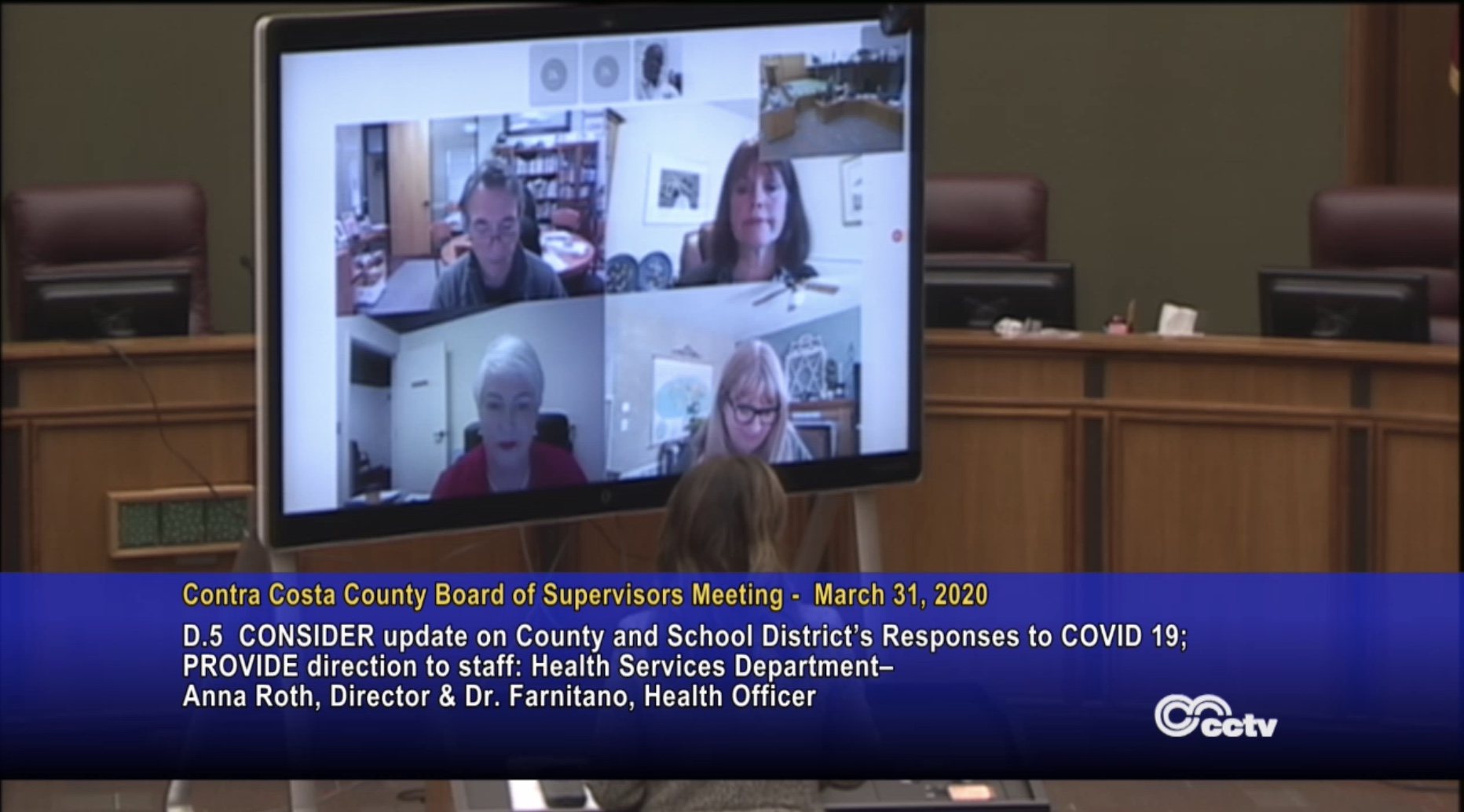
A county staff member addresses the members of the Board of Supervisors during their now, virtual weekly meeting, on Tuesday, March 31, 2020. Video screenshot.

Three deaths in county from 212 cases, so far

By Daniel Borsuk

Since the last time the Contra Costa County Board of Supervisors met two weeks ago, the number of Contra Costa residents with COVID-19 symptoms have tripled, Contra Costa County Health Services Director Anna Roth told Supervisors during a live-streamed meeting Tuesday.

Roth told supervisors the county had 212 cases of patients with COVID-19 symptoms and there had been three deaths. Two weeks ago, there 70 patients had COVID-19 symptoms and one patient had died from the virus.

In the meantime, county medical professionals are barely treading water in providing life-saving ventilators for COVID-19 stricken patients. County Health Officer Dr. Christopher Farnitano said hospitals have 76 ventilators in use and 100 more ventilators are on order, but over time additional equipment will be need.

“We are not going to save most of our patients who will need to be on ventilators. We will have 1,000 patients or more who will need to be on ventilators. Most will die. We need to reduce the number of people coming down with COVID-19 symptoms,” said Dr. Farnitano.

Dr. Farnitano said an alternate health care site is scheduled to open at the Antioch Fair Grounds next week to help accommodate additional COVID-19 patients.

County Administrator David Twa, who will retire at the end of the year, said rising health costs stemming from COVID-19 will force the county to plug up funding holes totaling $43 million a year for the next three years. The rising medical costs stem from recently signed labor agreements for hospital professionals and in-home care attendant workers.

Twa projected an 11 percent decline in property values will trigger a $27 million decrease in property tax revenue at least for the upcoming 2020/2021 fiscal year.

That projection from Twa caused District 4 Supervisor Karen Mitchoff of Pleasant Hill to warn her colleagues, “We may need to reduce the work force. We could be facing difficult times.”

Supervisors will get a better picture of the proposed 2020-2021 budget on April 21 when it is presented publicly. The budget will be formally adopted on May 12.

County Treasurer-Tax Collector Russell Watts said his office anticipates an increase in the number of property owners to file online penalty cancellation requests on April 10 because of COVID-19. Watts told supervisors he would inform property owners if any of the hundreds of financial institutions holding $450 million in impound escrow funds miss depositing funds in the county treasury the financial institutions will be held accountable. He also will report to the board of supervisors if any financial institutions fail to submit impound funds to the county.

“This revenue is essential for keeping the county, our cities and schools, and other local government agencies running and providing vital services that the public relies on, especially in times like these,” said Watts in a press release.

Under the current stay-at-home orders, the county’s more than 177,000 K-12 public school students are coping under while the stringent shelter-in-place mandate stays in place, Contra Costa County Office of Education Superintendent Lynn Mackey told supervisors.

Students are learning via distance learning although students in some school districts fall through the technology gaps more than others, said Mackey. Noting that 42 percent of the county’s students qualify for the free lunch program, the county superintendent said, “We are making sure that students don’t fall through the cracks in providing the computers and resources for distance learning.”

District 1 Supervisor John Gioia of Richmond succeeded in getting Supervisors’ support to have Deputy County Counsel Mary Ann Mason prepare a comprehensive report on the feasibility of the Board adopting a moratorium on evictions, a ban that Alameda, San Francisco, San Mateo, and Santa Clara Counties have already adopted.

The proposed imposition of an eviction moratorium was one of major topics supervisors heard from 120 emailed letters from residents. Other issues citizens wrote about connected to the COVID-19 pandemic were: Imposition of a moratorium on rent, Depopulating the county jails, and Protecting county social workers.

Temporary Emergency Worker Classification Created

Citing the possibility, the County might need temporary emergency workers during the COVID-19 pandemic, Supervisors unanimously approved County Administrator David Twa’s request to establish the classification with a salary range of $12 an hour to $35 an hour.

Supervisors approved County Administrator Twa’s request on a   5-0 vote even though Twa said he did not have the time to consult with labor representatives about the creation of the classification.

“Due to the COVID-19 pandemic, the county will need to hire additional workers to be able to continue providing current essential services to county residents, as well as services to provide information, protect health and save lives,” Twa’s request stated. “The County Administrator is recommending establishing the hourly classification of Temporary Emergency Worker.”

In other business, Supervisors appointed Walnut Creek-based commercial and residential developer Ross Hillesheim to fill the At-Large 2 seat on the Contra Costa County Planning Commission. Other applicants for the position, a four-year appointment, recommended by the Internal Operations Committee were former City of Concord planning commissioner LaMar Anderson, journalist Daniel Borsuk of Pittsburg, and North Richmond Residential Leadership team member Johana Gurdian.

Filed Under: Health, News, Supervisors

Gov. Newsom signs Executive Order providing relief to California small businesses

March 31, 2020 By Publisher Leave a Comment

Order provides 90-day extension in state and local taxes, including sales tax; extends licensing deadlines and requirements for a number of industries

SACRAMENTO – On Monday, Governor Gavin Newsom signed an executive order that will provide tax, regulatory and licensing extensions for businesses.

The executive order allows the California Department of Tax and Fee Administration (CDTFA) to offer a 90-day extension for tax returns and tax payments for all businesses filing a return for less than $1 million in taxes. That means small businesses will have until the end of July to file their first-quarter returns.

Additionally, the order extends the statute of limitations to file a claim for refund by 60 days to accommodate tax and fee payers.

The executive order also includes extensions that impact state government workers, as well as consumers. For instance, the Department of Motor Vehicles will limit in-person transactions for the next 60 days, allowing instead for mail-in renewals. Additionally, the Department of Consumer Affairs will waive continuing education requirements for several professions, also for the next 60 days.

Further, the order will extend the Office of Administrative Law’s deadlines to review regular department proposed regulations. The order also extends by 60 days the time period to complete investigation of public safety officers based on allegations of misconduct. Finally, deadlines for trainings, investigations, and adverse actions for state workers will also be extended.

A copy of the Governor’s executive order can be found here, and the text of the order can be found here.

For the latest on the state’s COVID-19 response, visit covid19.ca.gov.

Filed Under: Business, Government, Health, News, Taxes

  • « Previous Page
  • 1
  • …
  • 250
  • 251
  • 252
  • 253
  • 254
  • …
  • 370
  • Next Page »
Furniture-Clearance-02-26B
Celia's-3-26-A
Delta-RC-A
Deer-Valley-Chiro-06-22

Copyright © 2026 · Contra Costa Herald · Site by Clifton Creative Web