• Home
  • About The Herald
  • Local Agencies
  • Daily Email Update
  • Legal Notices
  • Classified Ads

Contra Costa Herald

News Of By and For The People of Contra Costa County, California

  • Arts & Entertainment
  • Business
  • Community
  • Crime
  • Dining
  • Education
  • Faith
  • Health
  • News
  • Politics & Elections
  • Real Estate

Bay Area rap legend from East County dies in car crash Monday morning

June 29, 2020 By Publisher Leave a Comment

Curtis “Young Curt” Denton. Photos from Twitter

By Luke Johnson

East County rapper Young Curt has died at 27 years old. According to the Contra Costa County Coroner’s office and the Eastern Contra Costa Fire Protection District he was killed in a solo-car crash on Byron Highway, early Monday morning. ‘

When California Highway Patrol arrived to the scene at Clifton Court Road in Byron a little after 2:39 a.m., officers said they found Curtis Denton’s (Young Curt) body on the side of the road and his 2019 Dodge Charger flipped upside down.

According to CHP, Denton was speeding southbound when “he drove off the roadway and collided into the dirt shoulder causing the vehicle to roll over several times.” Officers believe Denton wasn’t wearing a seat belt and was subsequently ejected through the sunroof of his car.

“He suffered major injuries and was transported by ambulance to Kaiser Medical center in Antioch but was unfortunately pronounced deceased at the hospital by emergency personnel,” the CHP reported.

Denton was from Antioch and Pittsburg. He rose to fame with his song “It’s the Mobb” — which was released in 2008 while he was attending Deer Valley High School.

His single “No B****” from 2009 regained traction earlier this year on viral video-sharing app Tik Tok.

Many musicians and entertainers — such as Tyga, Kehlani and Iamsu! — took to social media to pay tribute to the fallen rapper.

“The era of music birthed from Curt, and the industry at that moment, created a pinnacle in not only the 925, but the entire Bay Area music scene,” said rapper Pok’Chop. “Curt played an integral part in my career. I recorded my first song in Curt’s studio back in 2006. We challenged each other to the point of success — it was healthy competition.”

The CHP report said it is unknown if drugs or alcohol were a factor in the crash, but it is being investigated. On Denton’s Instagram page Sunday night, he posted on his story of what appeared to be a video of himself holding a bottle of prescription cough syrup.

If anyone witnessed this collision or the events leading up to it, they are asked to contact Contra Costa CHP in Martinez at (925) 646-4980.

Filed Under: Arts & Entertainment, CHP, East County, In Memoriam/Obituaries, News

Contra Costa Health Services evaluating COVID-19 reopening timeline

June 26, 2020 By Publisher 2 Comments

Timeline for July and August now contains qualifier

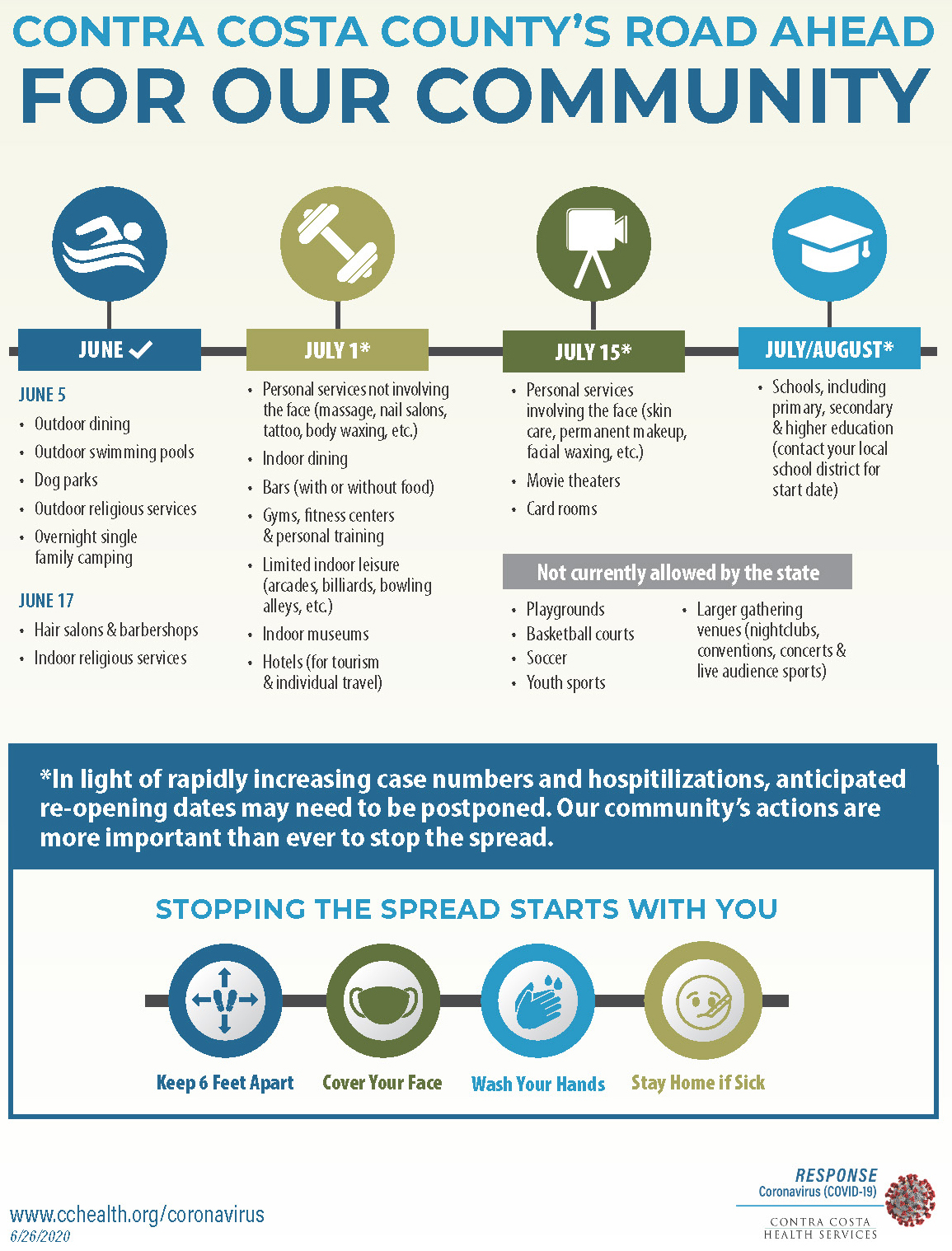
Friday, June 26, 2020 – Contra Costa Health Services (CCHS) is evaluating whether the county should continue its current reopening timeline, due to recent data showing COVID-19 activity is increasing in the community. The timeline for the reopening of businesses and activities scheduled for July 1st and 15th, as well as the school reopening scheduled for July and August include an asterisk and the following qualifier: “In light of rapidly increasing case numbers and hospitilizations, anticipated re-opening dates may need to be postponed. Our community’s actions are more important than ever to stop the spread.”

CCHS is closely monitoring key data indicators that show how the virus is spreading in the county and will announce a decision about the timeline Monday.

During the past seven days, the number of COVID-19 patients in hospitals in the county has increased 42%.

The seven-day average number of newly identified COVID-19 cases has increased from 39 a day to 68 a day. The positivity rate of test results – the percentage of COVID-19 tests that came back positive – has also increased. This suggests the change is not simply due to more testing, but indicates a true increase in community spread.

We are also seeing a shift with more young people testing positive. In June, 55% of cases were 40 years and under compared to 38% for that group in April. It’s a sign that younger people are playing a major role in driving the increase in new cases and potentially infecting vulnerable individuals. This highlights why it’s important for everyone to avoid social gatherings, observe physical distancing and wear masks or face coverings when around others.

CCHS encourages all residents to get tested. Increased testing for COVID-19 is a critical part of the community effort to slow local spread of the virus, and necessary to continue reopening in the future.

Contra Costa’s data are consistent with increases in COVID-19 activity now being experienced in communities across the state and the nation. To view the Contra Costa Health Services Coronavirus Dashboard for more statistics, click here.

There is concern that these increases may lead to a surge in very ill people that could overwhelm the local healthcare system. We realize many people are eager to resume normal activities. However, if we adjust the reopening timeline, it will be because we have a chance to prevent the pandemic from getting out of control in the county.

Any change to the timeline would immediately affect businesses and activities that are currently scheduled to resume July 1, including indoor dining, bars, gyms, hotels and some personal care services, including nail salons and tattoo parlors.

CCHS is releasing this information today to provide businesses and residents as much time as possible to prepare for a potential change to the timeline.

With the Fourth of July weekend approaching, CCHS also reminds everyone that it’s a healthy choice to observe physical distancing when outside the home – maintain six feet of space whenever possible – and to wear face coverings. Anyone who feels sick should stay home. People should also wash their hands frequently.

Allen Payton contributed to this report.


Filed Under: Arts & Entertainment, Business, Government, Health, News, Recreation

Contra Costa Road Ahead update: more projected reopenings – indoor dining & gyms July 1st, movie theaters July 15th

June 17, 2020 By Publisher 1 Comment

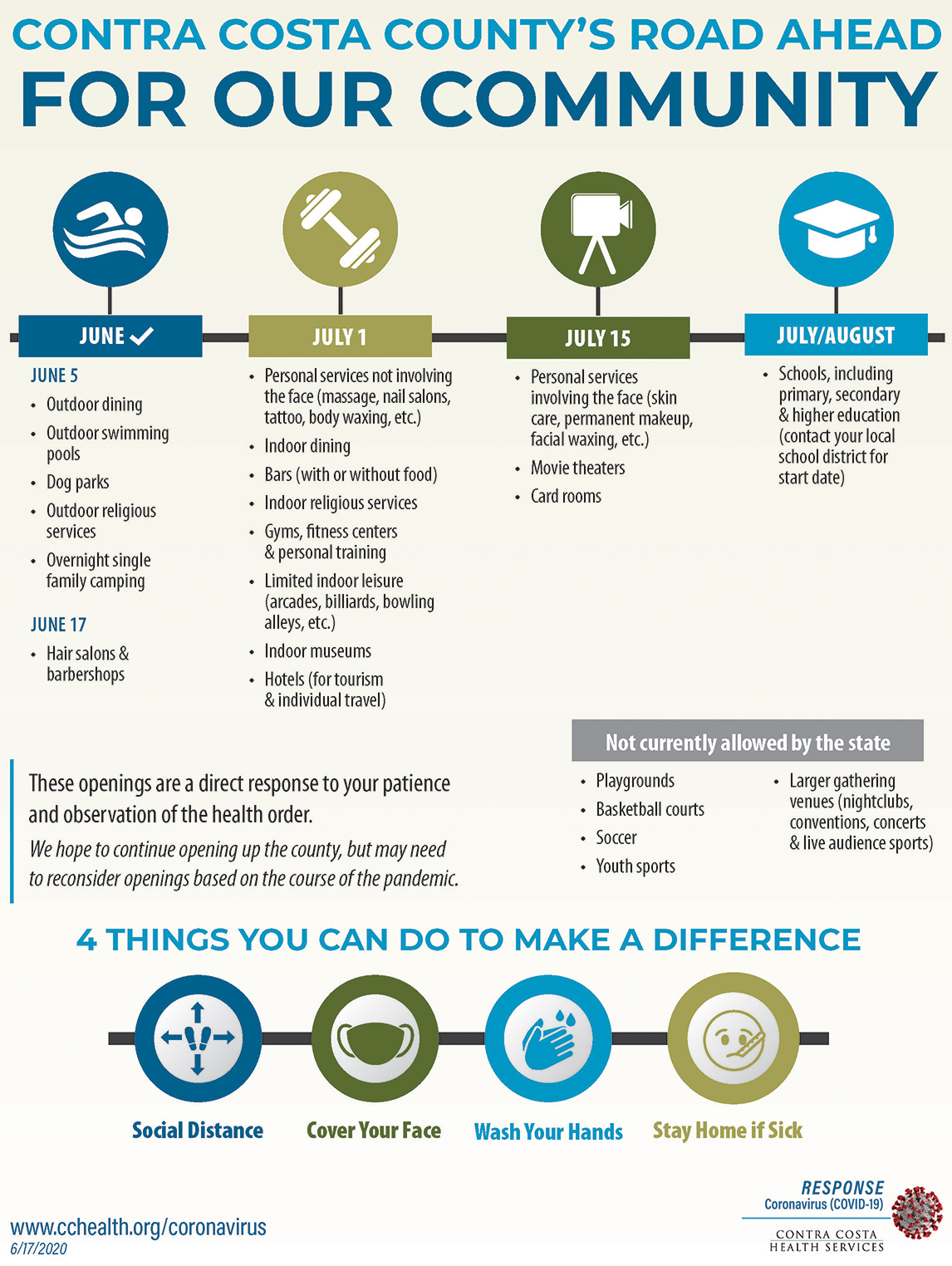
Following are the businesses that will be allowed to reopen and the activities that will be allowed to resume based on Contra Costa County’s updated Road Ahead issued Wednesday, June 17, 2020.

July 1st – Personal services not involving the face (massage, nail salons, tattoo, body waxing, etc.) • Indoor dining • Bars (with or without food) • Indoor religious services • Gyms, fitness centers & personal training • Limited indoor leisure (arcades, billiards, bowling alleys, etc.) • Indoor museums • Hotels (for tourism & individual travel).

July 15th – Personal services involving the face (skin care, permanent makeup, facial waxing, etc.) • Movie theaters.

However, although “These openings are a direct response to your patience and observation of the health order” as is written on the new Road Ahead, and they “hope to continue opening up the county” the county health officer “may need to reconsider openings based on the course of the pandemic.”

Download a copy of the latest Road Ahead, here.

Filed Under: Arts & Entertainment, Business, Faith, Government, Health, News, Recreation

Maya Cinemas in Pittsburg offers popcorn and concession zero-contact pickup program

April 13, 2020 By Publisher Leave a Comment

By Greg Heckmann, Creative Marketing Consultant, Maya Cinemas

Maya Cinemas is keeping the fresh popcorn popping while its guests are at home watching movies on the small screen. This is a way for Maya to stay connected to its movie going community. The first week of the program was incredibly well received and orders were beyond all expectations.

Maya Cinemas launched a new program on April 8th where customers can purchase a 2-gallon resealable bag of popcorn and 2 movie size candies for $12. $2 add-ons to this package are available with a full list on the website.

The program is available every Wednesday, Friday and Saturday. Orders can be called in between 9am and 3pm with zero-contact pickup at the theater between 2pm and 5pm. Pickups are assigned in 15-minute increments to ensure safe distancing between guests. All payments must be completed over the phone to ensure safe pickup, so no cash payments accepted.

All info including order phone numbers, candy available and more at https://www.mayacinemas.com/popcorn-pickup

Maya Cinemas in Pittsburg is located at 4085 Century Blvd.

Get your tickets now at mayacinemas.com, you can also signup for weekly email showtimes!

Maya Cinemas was chartered in 2001 with a mission to develop, build, own and operate modern, first-run, megaplex movie theaters in underserved, family oriented, Latino-dominant communities. Maya offers first-run Hollywood movies in high-end cinemas focused on quality of design and state-of-the-art presentation technologies while keeping a keen focus on superior customer service.

Filed Under: Arts & Entertainment, Business, East County, Food, News

School of Rock San Ramon keeps rocking with launch of remote learning program

March 26, 2020 By Publisher Leave a Comment

SAN RAMON, CA – School of Rock, the leader in performance-based music education, has launched virtual, one-on-one music lessons for its 40,000 students around the world through its School of Rock Remote program. The program is in response to the growing number of citizens being asked to remain in their homes or limit travel.

Students will use video conferencing to meet with their skilled music instructor from the comfort and safety of their own home. The new virtual lesson room coupled with School of Rock’s proprietary Method App™, SongFirst™ approach and Method Books™ will offer a comprehensive music learning experience that is fun, educational and safe during the current circumstances.

“At School of Rock, the health and safety of our students is our top priority, which is why we have rapidly adapted our operations in order to meet students’ needs,” said Rob Price, CEO of School of Rock. “School of Rock Remote along with our School of Rock Method App is a fantastic way to provide continuity and connection. Our instructors are gigging musicians, and they have shown their flexibility to make sure the music goes on.”

“We are thrilled to provide our students the ability to continue their music education from wherever they are, and allow them to maintain familiar routines while they are stuck inside and dealing with an uncertain reality.” says Toni Baker, Owner and GM of School of Rock San Ramon. “School of Rock Remote allows us to provide the same level of instruction that we’re known for, but in a way that prioritizes health and safety.”

Additionally, Hal Leonard, the world’s largest print music publisher of performance and instructional material, has partnered with School of Rock to provide students a free 60-day pass to SheetMusicDirect.com, a nearly endless library of notation in virtually every genre, including rock. Sheet Music Direct PASS is the world’s leading digital sheet music subscription service.

For more information about School of Rock Remote and how to sign up for virtual lessons, please visit https://locations.schoolofrock.com/sanramon

ABOUT SCHOOL OF ROCK:

School of Rock provides students of all ages an exciting and engaging learning environment for taking guitar lessons, drum lessons, bass lessons, keyboard lessons, and singing lessons. Drawing from all styles of rock and roll, School of Rock students learn theory and techniques via songs from legendary artists such as Pink Floyd, Led Zeppelin, and Frank Zappa. Thanks to the school’s performance-based approach, students around the world have gained superior instrumental skills and confidence on the big stage, with some moving on to record deals and larger platforms such as American Idol, The Voice and Broadway.


Filed Under: Arts & Entertainment, Business, Education

Complete list of Essential Critical Infrastructure Workers in California

March 23, 2020 By Publisher Leave a Comment

Updated 3/22/20

From Office of the Governor of California Coronavirus (COVID-19) Response

On March 19, 2020, Governor Newsom issued Executive Order N-33-20 directing all residents immediately to heed current State public health directives to stay home, except as needed to maintain continuity of operations of essential critical infrastructure sectors and additional sectors as the State Public Health Officer may designate as critical to protect health and well-being of all Californians.

In accordance with this order, the State Public Health Officer has designated the following list of “Essential Critical Infrastructure Workers” to help state, local, tribal, and industry partners as they work to protect communities, while ensuring continuity of functions critical to public health and safety, as well as economic and national security.

See the list, here. Updates to this list may be issued periodically, with the most recent updates reflected in blue text.

HEALTHCARE / PUBLIC HEALTH

Sector Profile

The Healthcare and Public Health (HPH) Sector is large, diverse, and open, spanning both the public and private sectors. It includes publicly accessible healthcare facilities, research centers, suppliers, manufacturers, and other physical assets and vast, complex public-private information technology systems required for care delivery and to support the rapid, secure transmission and storage of large amounts of HPH data.

Essential Workforce

  • Workers providing COVID-19 testing; Workers that perform critical clinical research needed for COVID-19 response.
  • Health care providers and caregivers (e.g., physicians, dentists, psychologists, mid-level practitioners, nurses and assistants, infection control and quality assurance personnel, pharmacists, physical and occupational therapists and assistants, social workers, speech pathologists and diagnostic and therapeutic technicians and technologists).
  • Hospital and laboratory personnel (including accounting, administrative, admitting and discharge, engineering, epidemiological, source plasma and blood donation, food service, housekeeping, medical records, information technology and operational technology, nutritionists, sanitarians, respiratory therapists, etc.).
  • Workers in other medical facilities (including Ambulatory Health and Surgical, Blood Banks, Clinics, Community Mental Health, Comprehensive Outpatient rehabilitation, End Stage Renal Disease, Health Departments, Home Health care, Hospices, Hospitals, Long Term Care, Organ Pharmacies, Procurement Organizations, Psychiatric, Residential, Rural Health Clinics and Federally Qualified Health Centers, cannabis retailers).
  • Manufacturers, technicians, logistics and warehouse operators, and distributors of medical equipment, personal protective equipment (PPE), medical gases, pharmaceuticals, blood and blood products, vaccines, testing materials, laboratory supplies, cleaning, sanitizing, disinfecting or sterilization supplies, personal care/hygiene products, and tissue and paper towel products.
  • Public health / community health workers, including those who compile, model, analyze and communicate public health information.
  • Behavioral health workers (including mental and substance use disorder) responsible for coordination, outreach, engagement, and treatment to individuals in need of mental health and/or substance use disorder services.
  • Blood and plasma donors and the employees of the organizations that operate and manage related activities.
  • Workers that manage health plans, billing, and health information, who cannot practically work remotely.
  • Workers who conduct community-based public health functions, conducting epidemiologic surveillance, compiling, analyzing and communicating public health information, who cannot practically work remotely.
  • Workers who provide support to vulnerable populations to ensure their health and well-being including family care providers
  • Workers performing cybersecurity functions at healthcare and public health facilities, who cannot practically work remotely.
  • Workers conducting research critical to COVID-19 response.
  • Workers performing security, incident management, and emergency operations functions at or on behalf of healthcare entities including healthcare coalitions, who cannot practically work remotely.
  • Workers who support food, shelter, and social services, and other necessities of life for economically disadvantaged or otherwise needy individuals, such as those residing in shelters.
  • Pharmacy employees necessary for filling prescriptions.
  • Workers performing mortuary services, including funeral homes, crematoriums, and cemetery workers.
  • Workers who coordinate with other organizations to ensure the proper recovery, handling, identification, transportation, tracking, storage, and disposal of human remains and personal effects; certify cause of death; and facilitate access to behavioral health services to the family members, responders, and survivors of an incident.
  • Workers supporting veterinary hospitals and clinics

EMERGENCY SERVICES SECTOR

Sector Profile

The Emergency Services Sector (ESS) is a community of highly-skilled, trained personnel, along with the physical and cyber resources, that provide a wide range of prevention, preparedness, response, and recovery services during both day-to-day operations and incident response. The ESS includes geographically distributed facilities and equipment in both paid and volunteer capacities organized primarily at the federal, state, local, tribal, and territorial levels of government, such as city police departments and fire stations, county sheriff’s offices, Department of Defense police and fire departments, and town public works departments. The ESS also includes private sector resources, such as industrial fire departments, private security organizations, and private emergency medical services providers.

Essential Workforce – Law Enforcement, Public Safety and First Responders

  • Including front line and management, personnel include emergency management, law enforcement, Emergency Management Systems, fire, and corrections, search and rescue, tactical teams including maritime, aviation, and canine units.
  • Emergency Medical Technicians
  • Public Safety Answering Points and 911 call center employees
  • Fusion Center employees
  • Fire Mitigation Activities
  • Hazardous material responders and hazardous devices teams, from government and the private sector.
  • Workers – including contracted vendors — who maintain digital systems infrastructure supporting law enforcement and emergency service operations.
  • Private security, private fire departments, and private emergency medical services personnel.
  • County workers responding to abuse and neglect of children, elders and dependent adults.
  • Animal control officers and humane officers

Essential Workforce – Public Works

  • Workers who support the operation, inspection, and maintenance of essential dams, locks and levees
  • Workers who support the operation, inspection, and maintenance of essential public works facilities and operations, including bridges, water and sewer main breaks, fleet maintenance personnel, construction of critical or strategic infrastructure, construction material suppliers, traffic signal maintenance, emergency location services for buried utilities, maintenance of digital systems infrastructure supporting public works operations, and other emergent issues
  • Workers such as plumbers, electricians, exterminators, and other service providers who provide services that are necessary to maintaining the safety, sanitation, and essential operation of residences.
  • Support, such as road and line clearing, to ensure the availability of needed facilities, transportation, energy and communications Support to ensure the effective removal, storage, and disposal of residential and commercial solid waste and hazardous waste.

FOOD AND AGRICULTURE

Sector Profile

The Food and Agricultural (FA) Sector is composed of complex production, processing, and delivery systems and has the capacity to feed people and animals both within and beyond the boundaries of the United States. Beyond domestic food production, the FA Sector also imports many ingredients and finished products, leading to a complex web of growers, processors, suppliers, transporters, distributors, and consumers. This sector is critical to maintaining and securing our food supply.

Essential Workforce

  • Workers supporting groceries, pharmacies, and other retail that sells food and beverage products, including but not limited to Grocery stores, Corner stores and convenience stores, including liquor stores that sell food, Farmers’ markets, Food banks, Farm and produce stands, Supermarkets, Similar food retail establishments, Big box stores that sell groceries and essentials
  • Restaurant carry-out and quick serve food operations – including food preparation, carry-out and delivery food employees
  • Food manufacturer employees and their supplier employees—to include those employed in food processing (packers, meat processing, cheese plants, milk plants, produce, etc.) facilities; livestock, poultry, seafood slaughter facilities; pet and animal feed processing facilities; human food facilities producing by-products for animal food; beverage production facilities; and the production of food packaging
  • Farm workers to include those employed in animal food, feed, and ingredient production, packaging, and distribution; manufacturing, packaging, and distribution of veterinary drugs; truck delivery and transport; farm and fishery labor needed to produce our food supply domestically
  • Farm workers and support service workers to include those who field crops; commodity inspection; fuel ethanol facilities; storage facilities; and other agricultural inputs
  • Employees and firms supporting food, feed, and beverage distribution (including curbside distribution and deliveries), including warehouse workers, vendor-managed inventory controllers, blockchain managers, distribution
  • Workers supporting the sanitation of all food manufacturing processes and operations from wholesale to retail
  • Company cafeterias – in-plant cafeterias used to feed employees
  • Workers in food testing labs in private industries and in institutions of higher education
  • Workers essential for assistance programs and government payments
  • Workers supporting cannabis retail and dietary supplement retail
  • Employees of companies engaged in the production of chemicals, medicines, vaccines, and other substances used by the food and agriculture industry, including pesticides, herbicides, fertilizers, minerals, enrichments, and other agricultural production aids
  • Animal agriculture workers to include those employed in veterinary health; manufacturing and distribution of animal medical materials, animal vaccines, animal drugs, feed ingredients, feed, and bedding, etc.; transportation of live animals, animal medical materials; transportation of deceased animals for disposal; raising of animals for food; animal production operations; slaughter and packing plants and associated regulatory and government workforce
  • Workers who support the manufacture and distribution of forest products, including, but not limited to timber, paper, and other wood products
  • Employees engaged in the manufacture and maintenance of equipment and other infrastructure necessary to agricultural production and distribution

ENERGY

Sector Profile

The Energy Sector consists of widely diverse and geographically dispersed critical assets and systems that are often interdependent of one another. This critical infrastructure is divided into three interrelated segments or subsectors—electricity, oil, and natural gas—to include the production, refining, storage, and distribution of oil, gas, and electric power, except for hydroelectric and commercial nuclear power facilities and pipelines. The Energy Sector supplies fuels to the transportation industry, electricity to households and businesses, and other sources of energy that are integral to growth and production across the Nation. In turn, it depends on the Nation’s transportation, information technology, communications, finance, water, and government infrastructures.

Essential Workforce – Electricity industry:

  • Workers who maintain, ensure, or restore the generation, transmission, and distribution of electric power, including call centers, utility workers, reliability engineers and fleet maintenance technicians
  • Workers needed for safe and secure operations at nuclear generation
  • Workers at generation, transmission, and electric blackstart facilities
  • Workers at Reliability Coordinator (RC), Balancing Authorities (BA), and primary and backup Control Centers (CC), including but not limited to independent system operators, regional transmission organizations, and balancing authorities
  • Mutual assistance personnel
  • IT and OT technology staff – for EMS (Energy Management Systems) and Supervisory Control and Data
  • Acquisition (SCADA) systems, and utility data centers; Cybersecurity engineers; cybersecurity risk management
  • Vegetation management crews and traffic workers who support
  • Environmental remediation/monitoring technicians
  • Instrumentation, protection, and control technicians


Essential Workforce – Petroleum workers:

  • Petroleum product storage, pipeline, marine transport, terminals, rail transport, road transport
  • Crude oil storage facilities, pipeline, and marine transport
  • Petroleum refinery facilities
  • Petroleum security operations center employees and workers who support emergency response services
  • Petroleum operations control rooms/centers
  • Petroleum drilling, extraction, production, processing, refining, terminal operations, transporting, and retail for use as end-use fuels or feedstocks for chemical manufacturing
  • Onshore and offshore operations for maintenance and emergency response
  • Retail fuel centers such as gas stations and truck stops, and the distribution systems that support them.

Essential Workforce – Natural and propane gas workers:

  • Natural gas transmission and distribution pipelines, including compressor stations
  • Underground storage of natural gas
  • Natural gas processing plants, and those that deal with natural gas liquids
  • Liquefied Natural Gas (LNG) facilities
  • Natural gas security operations center, natural gas operations dispatch and control rooms/centers natural gas emergency response and customer emergencies, including natural gas leak calls
  • Drilling, production, processing, refining, and transporting natural gas for use as end-use fuels, feedstocks for chemical manufacturing, or use in electricity generation
  • Propane gas dispatch and control rooms and emergency response and customer emergencies, including propane leak calls
  • Propane gas service maintenance and restoration, including call centers
  • Processing, refining, and transporting natural liquids, including propane gas, for use as end-use fuels or feedstocks for chemical manufacturing
  • Propane gas storage, transmission, and distribution centers

WATER AND WASTEWATER

Sector Profile

The Water and Wastewater Sector is a complex sector composed of drinking water and wastewater infrastructure of varying sizes and ownership types. Multiple governing authorities pertaining to the Water and Wastewater Sector provide for public health, environmental protection, and security measures, among others.

Essential Workforce

Employees needed to operate and maintain drinking water and wastewater/drainage infrastructure, including:

  • Operational staff at water authorities
  • Operational staff at community water systems
  • Operational staff at wastewater treatment facilities
  • Workers repairing water and wastewater conveyances and performing required sampling or monitoring
  • Operational staff for water distribution and testing
  • Operational staff at wastewater collection facilities
  • Operational staff and technical support for SCADA Control systems
  • Chemical disinfectant suppliers for wastewater and personnel protection
  • Workers that maintain digital systems infrastructure supporting water and wastewater operations

TRANSPORTATION AND LOGISTICS

Sector Profile

The Transportation Systems Sector consists of seven key subsectors, or modes:

– Aviation includes aircraft, air traffic control systems, and airports, heliports, and landing strips. Commercial aviation services at civil and joint-use military airports, heliports, and sea plane bases. In addition, the aviation mode includes commercial and recreational aircraft (manned and unmanned) and a wide variety of support services, such as aircraft repair stations, fueling facilities, navigation aids, and flight schools.

– Highway and Motor Carrier encompasses roadway, bridges, and tunnels. Vehicles include trucks, including those carrying hazardous materials; other commercial vehicles, including commercial motorcoaches and school buses; vehicle and driver licensing systems; taxis, transportation services including Transportation Network Companies, and delivery services including Delivery Network Companies; traffic management systems; AND cyber systems used for operational management.

– Maritime Transportation System consists of coastline, ports, waterways, and intermodal landside connections that allow the various modes of transportation to move people and goods to, from, and on the water.

– Mass Transit and Passenger Rail includes terminals, operational systems, and supporting infrastructure for passenger services by transit buses, trolleybuses, monorail, heavy rail—also known as subways or metros—light rail, passenger rail, and vanpool/rideshare.

– Pipeline Systems consist of pipelines carrying natural gas hazardous liquids, as well as various chemicals. Above-ground assets, such as compressor stations and pumping stations, are also included.

– Freight Rail consists of major carriers, smaller railroads, active railroad, freight cars, and locomotives.

– Postal and Shipping includes large integrated carriers, regional and local courier services, mail services, mail management firms, and chartered and delivery services.

  • Employees supporting or enabling transportation functions, including dispatchers, maintenance and repair technicians, warehouse workers, truck stop and rest area workers, and workers that maintain and inspect infrastructure (including those that require cross-border travel)
  • Employees of firms providing services that enable logistics operations, including cooling, storing, packaging, and distributing products for wholesale or retail sale or use.
  • Mass transit workers
  • Taxis, transportation services including Transportation Network Companies, and delivery services including Delivery Network Companies
  • Workers responsible for operating dispatching passenger, commuter and freight trains and maintaining rail infrastructure and equipment
  • Maritime transportation workers – port workers, mariners, equipment operators
  • Truck drivers who haul hazardous and waste materials to support critical infrastructure, capabilities, functions, and services
  • Automotive repair and maintenance facilities
  • Manufacturers and distributors (to include service centers and related operations) of packaging materials, pallets, crates, containers, and other supplies needed to support manufacturing, packaging staging and distribution operations
  • Postal and shipping workers, to include private companies
  • Employees who repair and maintain vehicles, aircraft, rail equipment, marine vessels, and the equipment and infrastructure that enables operations that encompass movement of cargo and passengers
  • Air transportation employees, including air traffic controllers, ramp personnel, aviation security, and aviation management
  • Workers who support the maintenance and operation of cargo by air transportation, including flight crews, maintenance, airport operations, and other on- and off- airport facilities workers

COMMUNICATIONS AND INFORMATION TECHNOLOGY

Sector Profile

The Communications Sector provides products and services that support the efficient operation of today’s global information-based society. Communication networks enable people around the world to contact one another, access information instantly, and communicate from remote areas. This involves creating a link between a sender (including voice signals) and one or more recipients using technology (e.g., a telephone system or the Internet) to transmit information from one location to another. Technologies are changing at a rapid pace, increasing the number of products, services, service providers, and communication options. The national communications architecture is a complex collection of networks that are owned and operated by individual service providers. Many of this sector’s products and services are foundational or necessary for the operations and services provided by other critical infrastructure sectors. The nature of communication networks involve both physical infrastructure (buildings, switches, towers, antennas, etc.) and cyber infrastructure (routing and switching software, operational support systems, user applications, etc.), representing a holistic challenge to address the entire physical-cyber infrastructure.

The IT Sector provides products and services that support the efficient operation of today’s global information-based society and are integral to the operations and services provided by other critical infrastructure Sectors. The IT Sector is comprised of small and medium businesses, as well as large multinational companies. Unlike many critical infrastructure Sectors composed of finite and easily identifiable physical assets, the IT Sector is a functions-based Sector that comprises not only physical assets but also virtual systems and networks that enable key capabilities and services in both the public and private sectors.

Essential Workforce – Communications:

  • Maintenance of communications infrastructure- including privately owned and maintained communication systems- supported by technicians, operators, call-centers, wireline and wireless providers, cable service providers, satellite operations, undersea cable landing stations, Internet Exchange Points, and manufacturers and distributors of communications equipment
  • Workers who support radio, television, and media service, including, but not limited to front line news reporters, studio, and technicians for newsgathering and reporting
  • Workers at Independent System Operators and Regional Transmission Organizations, and Network Operations staff, engineers and/or technicians to manage the network or operate facilities
  • Engineers, technicians and associated personnel responsible for infrastructure construction and restoration, including contractors for construction and engineering of fiber optic cables
  • Installation, maintenance and repair technicians that establish, support or repair service as needed
  • Central office personnel to maintain and operate central office, data centers, and other network office facilities
  • Customer service and support staff, including managed and professional services as well as remote providers of support to transitioning employees to set up and maintain home offices, who interface with customers to manage or support service environments and security issues, including payroll, billing, fraud, and troubleshooting
  • Dispatchers involved with service repair and restoration

Essential Workforce – Information Technology:

  • Workers who support command centers, including, but not limited to Network Operations Command Center, Broadcast Operations Control Center and Security Operations Command Center
  • Data center operators, including system administrators, HVAC & electrical engineers, security personnel, IT managers, data transfer solutions engineers, software and hardware engineers, and database administrators
  • Client service centers, field engineers, and other technicians supporting critical infrastructure, as well as manufacturers and supply chain vendors that provide hardware and software, and information technology equipment (to include microelectronics and semiconductors) for critical infrastructure
  • Workers responding to cyber incidents involving critical infrastructure, including medical facilities, SLTT governments and federal facilities, energy and utilities, and banks and financial institutions, and other critical infrastructure categories and personnel
  • Workers supporting the provision of essential global, national and local infrastructure for computing services (incl. cloud computing services), business infrastructure, web-based services, and critical manufacturing
  • Workers supporting communications systems and information technology used by law enforcement, public safety, medical, energy and other critical industries
  • Support required for continuity of services, including janitorial/cleaning personnel

OTHER COMMUNITY-BASED GOVERNMENT OPERATIONS AND ESSENTIAL FUNCTIONS

Essential Workforce

  • Critical government workers, as defined by the employer and consistent with Continuity of Operations Plans and Continuity of Government plans.
  • County workers responsible for determining eligibility for safety net benefits
  • The Courts, consistent with guidance released by the California Chief Justice
  • Workers to ensure continuity of building functions
  • Security staff to maintain building access control and physical security measures
  • Elections personnel
  • Federal, State, and Local, Tribal, and Territorial employees who support Mission Essential Functions and communications networks
  • Trade Officials (FTA negotiators; international data flow administrators)
  • Weather forecasters
  • Workers that maintain digital systems infrastructure supporting other critical government operations
  • Workers at operations centers necessary to maintain other essential functions
  • Workers who support necessary credentialing, vetting and licensing operations for transportation workers
  • Workers who are critical to facilitating trade in support of the national, state, and local emergency response supply chain
  • Workers supporting public and private childcare establishments, pre-K establishments, K-12 schools, colleges, and universities for purposes of distance learning, provision of school meals, or care and supervision of minors to support essential workforce across all sectors
  • Workers and instructors supporting academies and training facilities and courses for the purpose of graduating students and cadets that comprise the essential workforce for all identified critical sectors
  • Hotel Workers where hotels are used for COVID-19 mitigation and containment measures, including measures to protect homeless populations.
  • Construction Workers who support the construction, operation, inspection, and maintenance of construction sites and construction projects (including housing construction)
  • Workers such as plumbers, electricians, exterminators, and other service providers who provide services that are necessary to maintaining the safety, sanitation, construction material sources, and essential operation of construction sites and construction projects (including those that support such projects to ensure the availability of needed facilities, transportation, energy and communications; and support to ensure the effective removal, storage, and disposal of solid waste and hazardous waste)
  • Commercial Retail Stores, that supply essential sectors, including convenience stores, pet supply stores, auto supplies and repair, hardware and home improvement, and home appliance retailers
  • Workers supporting the entertainment industries, studios, and other related establishments, provided they follow covid-19 public health guidance around social distancing.
  • Workers critical to operating Rental Car companies that facilitate continuity of operations for essential workforces, and other essential travel
  • Workers that provide or determine eligibility for food, shelter, in-home supportive services, child welfare, adult protective services and social services, and other necessities of life for economically disadvantaged or otherwise needy individuals (including family members)
  • Professional services, such as legal or accounting services, when necessary to assist in compliance with legally mandated activities and critical sector services
  • Faith based services that are provided through streaming or other technology
  • Laundromats and laundry services
  • Workers at animal care facilities that provide food, shelter, veterinary and/or routine care and other necessities of life for animals.

CRITICAL MANUFACTURING

Sector Profile

The Critical Manufacturing Sector identifies several industries to serve as the core of the sector: Primary Metals Manufacturing, Machinery Manufacturing, Electrical Equipment, Appliance, and Component Manufacturing, Transportation Equipment Manufacturing Products made by these manufacturing industries are essential to many other critical infrastructure sectors.

  • Workers necessary for the manufacturing of materials and products needed for medical supply chains, transportation, energy, communications, food and agriculture, chemical manufacturing, nuclear facilities, the operation of dams, water and wastewater treatment, emergency services, and the defense industrial base.

HAZARDOUS MATERIALS

Essential Workforce

  • Workers at nuclear facilities, workers managing medical waste, workers managing waste from pharmaceuticals and medical material production, and workers at laboratories processing test kits
  • Workers who support hazardous materials response and cleanup
  • Workers who maintain digital systems infrastructure supporting hazardous materials management operations

FINANCIAL SERVICES

Sector Profile

The Financial Services Sector includes thousands of depository institutions, providers of investment products, insurance companies, other credit and financing organizations, and the providers of the critical financial utilities and services that support these functions. Financial institutions vary widely in size and presence, ranging from some of the world’s largest global companies with thousands of employees and many billions of dollars in assets, to community banks and credit unions with a small number of employees serving individual communities. Whether an individual savings account, financial derivatives, credit extended to a large organization, or investments made to a foreign country, these products allow customers to: Deposit funds and make payments to other parties; Provide credit and liquidity to customers; Invest funds for both long and short periods; Transfer financial risks between customers.

Essential Workforce

  • Workers who are needed to process and maintain systems for processing financial transactions and services (e.g., payment, clearing, and settlement; wholesale funding; insurance services; and capital markets activities)
  • Workers who are needed to provide consumer access to banking and lending services, including ATMs, and to move currency and payments (e.g., armored cash carriers)
  • Workers who support financial operations, such as those staffing data and security operations centers

CHEMICAL

Sector Profile

The Chemical Sector—composed of a complex, global supply chain—converts various raw materials into diverse products that are essential to modern life. Based on the end product produced, the sector can be divided into five main segments, each of which has distinct characteristics, growth dynamics, markets, new developments, and issues: Basic chemicals; Specialty chemicals; Agricultural chemicals; Pharmaceuticals; Consumer products

Essential Workforce

  • Workers supporting the chemical and industrial gas supply chains, including workers at chemical manufacturing plants, workers in laboratories, workers at distribution facilities, workers who transport basic raw chemical materials to the producers of industrial and consumer goods, including hand sanitizers, food and food additives, pharmaceuticals, textiles, and paper products.
  • Workers supporting the safe transportation of chemicals, including those supporting tank truck cleaning facilities and workers who manufacture packaging items
  • Workers supporting the production of protective cleaning and medical solutions, personal protective equipment, and packaging that prevents the contamination of food, water, medicine, among others essential products
  • Workers supporting the operation and maintenance of facilities (particularly those with high risk chemicals and/ or sites that cannot be shut down) whose work cannot be done remotely and requires the presence of highly trained personnel to ensure safe operations, including plant contract workers who provide inspections
  • Workers who support the production and transportation of chlorine and alkali manufacturing, single-use plastics, and packaging that prevents the contamination or supports the continued manufacture of food, water, medicine, and other essential products, including glass container manufacturing

DEFENSE INDUSTRIAL BASE

Sector Profile

The Defense Industrial Base Sector is the worldwide industrial complex that enables research and development, as well as design, production, delivery, and maintenance of military weapons systems, subsystems, and components or parts, to meet U.S. military requirements. The Defense Industrial Base partnership consists of Department of Defense components, Defense Industrial Base companies and their subcontractors who perform under contract to the Department of Defense, companies providing incidental materials and services to the Department of Defense, and government-owned/contractor-operated and government-owned/government-operated facilities. Defense Industrial Base companies include domestic and foreign entities, with production assets located in many countries. The sector provides products and services that are essential to mobilize, deploy, and sustain military operations.

Essential Workforce

  • Workers who support the essential services required to meet national security commitments to the federal government and U.S. Military. These individuals, include but are not limited to, aerospace; mechanical and software engineers, manufacturing/production workers; IT support; security staff; security personnel; intelligence support, aircraft and weapon system mechanics and maintainers
  • Personnel working for companies, and their subcontractors, who perform under contract to the Department of Defense providing materials and services to the Department of Defense, and government-owned/contractor-operated and government-owned/government-operated facilities

Filed Under: Agriculture, Arts & Entertainment, Business, Government, Health, News, State of California

2020 Contra Costa County Fair canceled due to the coronavirus (COVID-19)

March 19, 2020 By Publisher 1 Comment

By Joe Brengle, CEO Contra Costa County Event Park

ANTIOCH – As a major event facility, The Contra Costa Event Park has been monitoring the evolving coronavirus (COVID-19) situation. There is no higher priority than the safety of our Fairgrounds family, patrons, vendors, promoters and sponsors at the Contra Costa Event Park. Due to this ongoing situation the Contra Costa Event Park Board of Directors met last night and unanimously voted to cancel the 2020 Contra Costa County Fair scheduled for May 14 – 17.

The Fair Board realizes that the individual’s most affected by this cancellation is the youth livestock exhibitors of our county. The Fair Board did approve to let a committee of Contra Costa County 4H and FFA parents work on a Youth Fair where these youth livestock exhibitors could show and auction their animals. The Fair Board agreed to provide support to this committee as needed. If the Center for Disease Control and Prevention (CDC), Contra Costa County Health Department, or the Governor of California lengthen the current restrictions and orders, it is possible that a Youth Fair will not take place. At this time dates for Youth Fair are yet to be determined.

We thank the community for your continued support during these challenging times.

Mark your calendars for the 2021 Contra Costa County Fair May 13 – 16.

Filed Under: Animals & Pets, Arts & Entertainment, East County, News

Martinez Main Street Arts to hold smaller show in April, students’ show postponed until August

March 14, 2020 By Publisher Leave a Comment

Due to the coronavirus concerns, instead of the children’s show during the month of April, Main Street Arts in Martinez will have a “Small Wall” show featuring small paintings by the Main Street Arts gallery artists. (See related article)

“Confluence” featuring the wonderful artwork created by Patsy Taylor’s students, past and present, will be postponed to August. Thank you all, stay safe!

Filed Under: Arts & Entertainment, Central County, News

Martinez: Main Street Arts to host student art exhibit in April

March 10, 2020 By Publisher 1 Comment

Resplendent by Patsy Taylor and Coastal Waters by Kin Sethie. Courtesy of Main Street Arts.

Main Street Arts in Martinez presents “Confluence” featuring the wonderful artwork created by Patsy Taylor’s students, past and present.  The exhibition runs through April 2nd to 29th, with the reception April 4th from 4 to 7 p.m. at the gallery, 613 Main Street in Martinez.

Peppermints by Mark Milner

Patsy Taylor is an artist living in the East Bay. She has a Master of Fine Arts degree in Painting from the Academy of Art University in San Francisco and has been teaching since 2008 both privately and in community programs. She paints in the studio and outdoors.

As a teacher Ms. Taylor believes in establishing foundations and then, from there, allowing creativity to flow. With this in mind she teaches with a focus on individual development and exploration.

As an artist she has been mostly focused on landscape painting in oils. Expression of her love for the natural world and interest in connections with life has seen her work recently diverge into a different style with more intimate content. She intends to continue on this path with her painting.

Patsy has been teaching in the East Bay for many years and has been a great influence on a generation of painters.  We look forward to this talented group.

Main Street Arts was founded in 2016 by several of the Martinez Gallery Co-op members, in partnership with other local artists. Our goal is to make Martinez an important part of the Bay Area art scene by showing and promoting the best in local contemporary art.

We offer a wide range of collectible fine art, from fused glass, to photography, and paintings. It’s also a great destination to find the perfect gift, with affordable prints and other small items.

Hours: Open 11 am – 5 pm, Wednesday through Saturday; 10 am – 2 pm on Sundays
​Note, the Martinez Farmers Market is open year-round every Sunday from 10 am – 2 pm.

The Martinez art scene is undergoing an exciting revitalization!  Every 3rd Saturday of the month, Artcelerator puts on Art Beat in downtown Martinez. Main Street Arts will be open until 9 p.m. on Art Beat nights. 

For more information about Main Street Arts visit www.mainstreetarts.net or call (925) 269-8049.

Filed Under: Arts & Entertainment, Central County

Italian tenor Pasquale Esposito of PBS fame to perform operatic pop concert in March in Antioch

March 9, 2020 By Publisher 1 Comment

Pasquale Esposito at his piano.

By Allen Payton

Italian tenor and PBS star, Pasquale Esposito will perform operatic pop concert, From Italy With Love, with very special opening act, the Anthony “Nino” Lane Band on Saturday, March 21 at the historic El Campanil Theatre in Antioch. His performance will include a touch of opera, standards, Broadway and his originals. The concert begins at 3:00 p.m. and tickets for all reserved seating are $39.

Born in Naples, Italy, tenor Esposito grew up listening to the music of famous tenor Enrico Caruso, also from Naples and started singing when he was just six years old. By age seven Esposito began performing in church, the same church in which Caruso sang.

“I was born in his same neighborhood, which is why the inspiration,” Esposito said.

Following a visit to California in 1998, he decided to move to America where he studied music at San Jose State University. Esposito graduated with a degree in vocal performance in 2009.

“Don’t ask me to dance,” he said with a laugh.

He has gone on to perform during tours in both the U.S. and Italy, singing in multiple languages: Italian, English, Spanish and Neapolitan, the Italian dialect from Naples.

Esposito tours a couple times a year.

“We partner with PBS, then we follow with a concert in the area where the television show is aired,” he shared. “We do this a couple times a year,”

Enrico Caruso was born in the 1800’s and achieved amazing success in Italy, but mostly in the U.S. He was with the Metropolitan Opera and was one of the first to be recorded.

“We did another special on Italian Squares that we visited,” said Esposito. “The main concert was done in Rome.”

“What we will be doing in Antioch is a combination of these two shows,” he stated. “I think we are going to have an amazing video projection of media behind, to tell the story. It’s an interactive performance.”

He will have with him his “piano player, who has been with me for 12 years, a guitar player, a drummer, a percussionist and bass player,” Esposito added.

“We will also do some American standards and even some Spanish songs,” he shared.

About Neapolitan, he said “it is one of the most musical languages in the world. If you want to start in opera, you need to start with Neapolitan songs.”

Asked which one is his favorite, Esposito said, “I do have one, it’s one from an aria from an opera from Pucini. Turandot is the name of the opera. Nessun Dorma is the name of the aria.”

“I had the joy to collaborate in my first PBS special with Placido Domingo,” he said. “He has been my mentor and definitely a light in my life.”

About his career, Esposito said, “It was an amazing journey. If you ask me if it was something I chose, I would have to say no. I was lucky to win the green card lottery at age 22 and moved to the United States.”

“It’s the story of a new immigrant,” he stated. “The U.S. is still the land of opportunity, where if you work hard, your dreams can come true. I am able to support my family with this gift.”

Sorry, ladies, but Esposito is married and has three children, Vittorio, Roxanna and Valentina, named because she was born in February, and they live in the San Jose area.

“The last one was a beautiful surprise,” he shared. “She just turned one years old on Feb. 6.”

He finished a Christmas special for PBS that will air later this year.

Esposito said he travels between Italy and the U.S. but spends most of his time in California.

“It’s a joy to come to a new community,” he shared. “This show is not just made for Italians but music lovers. Even those who love rock ‘n roll will love this style of music.”

The concert is part of a series being brought to East County by Licata-Cardinale Productions, and partners Michael Licata and George Cardinale.

“This is a guy who has been a PBS star and never been on this side of the Bay,” Cardinale said. “He’s performed all over the world, in Vegas and Reno. We’re happy to bring his talent to historic downtown Antioch. You’ll enjoy the show very much. It’s really a treat for the people here who have never seen him, before.”

For tickets visit https://www.elcampaniltheatre.com/pasquale-esposito.html, call the Box Office at (925) 757-2500, or stop by Tuesday through Friday, 10 a.m. to 2 p.m. or one hour before shows at 602 W. 2nd Street in Rivertown, Antioch.

For more information about Pasquale Esposito visit pasqualeesposito.com.

Filed Under: Arts & Entertainment, East County

  • « Previous Page
  • 1
  • …
  • 10
  • 11
  • 12
  • 13
  • 14
  • …
  • 18
  • Next Page »
Monica's-Riverview-Jan-2026
Liberty-Tax-Jan-Apr-2026
Deer-Valley-Chiro-06-22

Copyright © 2026 · Contra Costa Herald · Site by Clifton Creative Web