• Home
  • About The Herald
  • Local Agencies
  • Daily Email Update
  • Legal Notices
  • Classified Ads

Contra Costa Herald

News Of By and For The People of Contra Costa County, California

  • Arts & Entertainment
  • Business
  • Community
  • Crime
  • Dining
  • Education
  • Faith
  • Health
  • News
  • Politics & Elections
  • Real Estate

Vote “No” on the Measure X “county services” sales tax increase

October 22, 2020 By Publisher Leave a Comment

By Sue Pricco and Michael Arata

Measure X, a 20-year, half-percent Contra Costa County sales tax increase, is on the November 3rd ballot. The “current pandemic” is among rationales advanced by the measure’s supporters.

In reality, however, Measure X got its start in May, 2019 – long before COVID-19 was even on the horizon – when five representatives of county employee organizations demanded that county supervisors drop a plan for a new transportation tax and sponsor a new “county services” tax instead.
The transportation-tax measure went ahead anyway, eventually as Measure J on March 3rd’s Primary ballot.  Itself pushing a half-percent sales-tax increase, Measure J failed.  Measure X deserves the same fate now.

For starters, Measure X is regressive, disproportionately affecting those least able to afford increased costs, particularly during a time of pandemic-driven financial hardship.  Thousands of small businesses have closed.  Millions of Californians are unemployed.   Those still working often see smaller paychecks.

Meanwhile, all must still pay (now or on a deferred basis) federal and state income taxes, payroll taxes, property taxes, auto-registration taxes, gasoline taxes, phone taxes, etc. ad nauseam.  With whatever money remains, individuals and families must still provide for necessities.

Except for food purchases, essential product needs — from paper towels to kids’ shoes, sometimes to replacement automobiles — have sales taxes added.

Oh, wait on the food exception.  If resources permit a sit-down restaurant dinner or a hot takeout meal, those foods ARE taxed.

Contra Costa sales-tax rates already range from 8.25% to 9.75%, tied for 7th highest among California’s 58 counties.  And another round of sales-tax leapfrog is not a game which County residents likely hope to “win.”

The Measure X ballot question (the summary voters see on ballots) advertises various specific purposes, implying falsely that some are new obligations.

But hiding in the underlying County ordinance’s fine print is the fact that Measure X is actually a general tax, “solely for general governmental purposes and not for specific purposes.”

In economic terms, Measure X dollars are fungible; they can be moved around.  So, for example, Measure X’s new millions could fund County-employee salary, current benefit, and large pension payments directly.

But behind a covering smokescreen of seeming legitimacy, the measure could alternatively finesse compensation boosts indirectly, by “freeing up” money budgeted for other purposes and then backfilling those budget categories with an injection of Measure X revenues.

It would not be the first time that a local government agency deployed such a maneuver.
As is, County employees have enjoyed a 20% salary/benefit increase over just the last three years, and a $166,673 average now in annual per-employee compensation cost — while many who’d pay the new sales tax would count themselves fortunate just to return to their own compensation levels of three years ago. 

What about the Measure X proponent claim of spending “oversight”?  An original ballot-question version characterized the measure as “requiring fiscal accountability.”  But a Superior Court judge removed that phrase after finding that the County’s related ordinance omitted it.  “Fiscal accountability” was apparently just an afterthought.

Finally, Measure X passage would leave at least seven Contra Costa city and town jurisdictions above the statutory 2% cap on local sales taxes.  So an underhanded legislative scheme was deployed.  State Senate Bill 1349, passed and signed at the last minute, allows the County’s sales-tax cap to increase from 2% effectively to at least 3.5% (or possibly 4%), in addition to the State’s 7.25% rate.

And this change, asserts the bill itself in Orwellian doublespeak, “does not constitute a change in, but is declaratory of, existing law.”

Measure X deserves your determined “NO” vote.  For more information, visit CoCoTax.org and NOonX.info.
Sue Pricco is president of the Contra Costa Taxpayers Association.  Michael Arata is a co-founder of the Alliance of Contra Costa Taxpayers.  
Filed Under: Politics & Elections, Taxes

Contra Costa Supervisors approve $17.4 million purchase of Motel 6 in Pittsburg as transitional housing for homeless

October 22, 2020 By Publisher 22 Comments

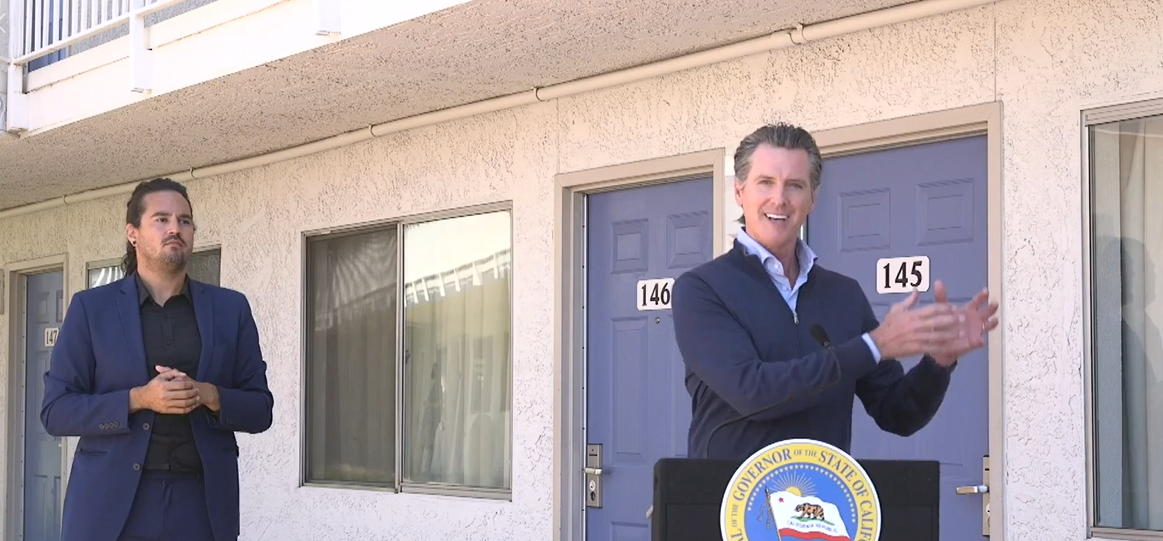
Gov Newsom speaks at Motel 6 in Pittsburg to announce the state’s new Homekey program on Tuesday, June 30, 2020. Screenshot from press conference video.

$21.6 million total for program; approved as a consent calendar item and the last item on the agenda without discussion; no appraisals included; Glover, Kramer split on issue; appraises for $16.7 million.

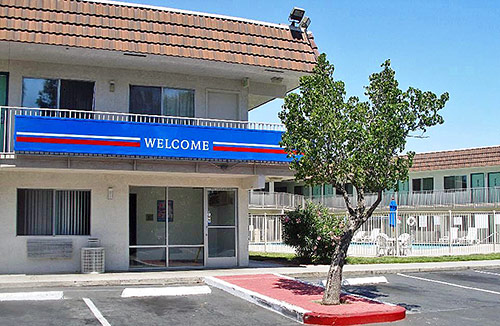
Motel 6 in Pittsburg. Photo by Motel 6.

By Daniel Borsuk

The light will be left on for homeless, now at the Motel 6 in Pittsburg. Contra Costa County Board of Supervisors may have quietly went about unanimously approving $21.6 million for the purchase of the motel and almost two years of operations, as part of the state’s Homekey program to help the homeless find shelter, food, jobs and get social services, but the Board’s consent action on Tuesday also demonstrates how far apart two political candidates – longtime District 5 Supervisor Federal Glover and challenger Contra Costa County Assessor Gus Kramer – are on the issue of homelessness.

The agenda item was quietly acted on as a consent item, and the last on the agenda. There was no discussion on the item, nor were copies of the two appraisals by the county’s Public Works Real Estate Division included with the agenda. Attempts to obtain the appraised value for the property from members of the Board, County Administrator David Twa, and the Public Works Real Estate Division were unsuccessful prior to publication time. However, Supervisors Federal Glover, in whose district the motel is located, as well as Candace Andersen and Diane Burgis said they would work to provide the information.

Located at 2101 Loveridge Road in Pittsburg, the County, with the state’s financial assistance decided that acquisition of the Motel 6 will increase the number of shelter beds permanently available in East County from 20 beds to 174 beds, a 770 percent increase.  In addition to providing shelter, the program, funded under the state’s Home Key Program, would provide health care, behavioral health and other services to residents.

Contra Costa, along with the counties of San Francisco, Alameda and Santa Clara have now drawn state Homekey funds in the fight to solve homeless issues.

“This will be a great opportunity to get people off the street,” said Supervisor Glover who faces Kramer in a November 3rd face-off election because neither candidate drew enough votes to surpass 50 percent threshold of the total votes in the March election.  In that March election, the District 5 Board Seat had three candidates competing for the District 5 seat covering the communities of Antioch, Alhambra Valley, Clyde, Crockett, Hercules, Martinez, Mountain View, Pacheco, Pittsburg, Port Costa, and Rodeo – Glover, Kramer and Martinez businessman Sean Trambley – and no candidate had mustered votes exceeding 50 percent of the votes counted.  As a result, Glover and Kramer are in a run-off election on November 3.

The Contra Costa County Behavioral Department will operate the county’s Homekey program.

County Assessor Kramer, who must appear in Superior Court Judge John Cope’s court room on today, for a jury trial on civil “corrupt or willful misconduct” charges took a different view on the Board of Supervisors’ action to acquire the 174-room motel from OKC of Pittsburg for use as a homeless  facility.

Kramer lashed out at his political opponent Glover and other supervisors for spending $21 million.  “It’s a great program, but it is a waste of resources,” he said. “What a horrible investment.  Shame on the Board and Federal.”

Kramer did offer a potential solution to the homeless problem in the county and perhaps the state by creating camps like what occurred during the Great Depression where job, health and other public services would also be provided to individuals.

10/27/20 UPDATE: Asked for copies of the appraisal, Chief Assistant County Administrator Eric Angstadt responded, “I’m only aware of one appraisal. It was contracted out. I can give you what the topline is, but the appraisal is not available until after escrow closes.”

“The appraised value is $16.7 million at $96,000 per room,” he stated. “It’s 4.2% above the appraised value.”

Asked if the appraisal was done internally or contracted out, Angstadt said, “We always contract out appraisals. We have staff with real estate licenses. But I don’t believe we have any licensed appraisers on staff.”

“The state was very public about how much they were willing to pay at $100,000 per room,” he continued. “So, it didn’t leave us with much room to negotiate.”

“We have not signed the purchase and sale agreement, yet. That will happen once we finish the due diligence. We are working our way through all of it. It’s scheduled to close escrow on November 10th,” Angstadt added.

Orange COVID-19 Metric Next Week?’ 

Supervisors were informed that by next Tuesday the county should transition into the orange COVID-19 criteria, Contra Costa County Health Services Director Anna Roth said.  “We should meet the orange metric next week,” she said.  A move to an orange metric would mean the removal of further restrictions on some businesses.

Since the County declared a State of Emergency because of COVID-19 in March, there have been 18,214 cases and 236 deaths, Roth reported.

The health director encouraged the public to continue to wash hands, keep their distance, and stay home from work or school if they felt ill.

Four Abatement Actions

Supervisors acted on four abatement actions at the recommendations of the Conservation and Development Department.

Properties the Supervisors took action on were:

Property at 2738 Dutch Slough Road, Oakley, owned by Elmo G. Wurts, for $8,141.20; property at 0 Stone Road, Bethel Island, owned by Thanh Ngyyen for $6,964;  property at 4603 Gateway Road, Bethel Island, owned by Franks Marina for $5,591.20; and property at 3901 La Colina Road, El Sobrante, owned by Rudolph N. Webbe for $3,256.70.

Supervisors did not hear any comments from either property owners or the public on the abatement items.

Please check back later for any updates to this report.

Allen Payton contributed to this report.


Filed Under: East County, Homeless, News, Real Estate, Supervisors

Motorcyclist hits car in high speed crash near Discovery Bay Tuesday night airlifted to trauma center

October 21, 2020 By Publisher Leave a Comment

Photos by ECCFPD.

By East Contra Costa Fire Protection District

At 6:45 pm Tuesday, Oct. 20, East Contra Costa Fire Protection District personnel from E52, E59, BC5, as well as from AMR and ConAir2, were called for a collision between a motorcycle and a car on Balfour Road near Bixler Road near Discovery Bay.

On arrival we found that the motorcycle had hit the rear of the car at a high speed. The motorcyclist was treated and transported by helicopter to our local trauma center at John Muir Hospital, Walnut Creek according to Battalion Chief Jeffrey Burris. The driver of the car had minor injuries. CHP is investigating.

Allen Payton contributed to this report.

Filed Under: News

College District governing board approves new Chancellor contract for Dr. Bryan Reece

October 21, 2020 By Publisher 3 Comments

Includes base annual salary of $315,000, with performance-based incentives

By Timothy Leong, Public Information Officer, CCCCD

Dr. Bryan Reece. From his website.

At their October 14, 2020, meeting, the Governing Board approved the contract for Dr. Bryan Reece to become the ninth permanent Chancellor of the Contra Costa Community College District (District). The Chancellor Emeritus of California Community Colleges was hired by a board vote during their meeting on Sept. 22. (See related article)

“We are excited to work with Dr. Reece because the District needs a strong and visionary leader to meet the challenges we face,” said Governing Board President Rebecca Barrett.  “He brings an exemplary higher education background and experiences that will help us address the social justice and equity issues we face, particularly for our students. We look forward to the transformation and innovation our District will make under his leadership that will increase the success of our students.”

Dr. Reece has been working in higher education for over 30 years, with 15 years of academic and private sector leadership experience. He has taught Political Science as a tenured community college faculty member for 19 years and has a documented record of moving community colleges in directions that improve the academic success for students across all groups and has particular expertise with student populations from historically underserved communities.

Dr. Reece has been a transformational figure at three California community colleges, including Cerritos College, Crafton Hills College and Norco College. His most recent accomplishment came under his leadership as the President of Norco College where he organized college and community leaders into teams that implemented programs to improve the lives of students, community members, and college personnel.

“I am honored the Governing Board has selected me to lead this great District,” said Reece.  “Our future success can only happen if we all work together for the good of our students. I look forward to the challenge of bringing together our trustees, faculty, classified professionals and managers as we engage more deeply with our community and business leaders, and transform the lives of our students as they achieve their educational goals with us.”

Dr. Reece will start work on November 1, 2020, and receive a base annual salary of $315,000, with performance-based incentives. The contract will run through June 30, 2022, at which time the Governing Board can consider up to a two-year extension based on an evaluation that exceeds expectations.

Dr. Reece has a Bachelor of arts degree, Master of arts degree and doctorate in Political Science from the University of Southern California.

About the College District

The Contra Costa Community College District (CCCCD) is one of the largest multi-college community college districts in California. The CCCCD serves a population of 1,019,640 people, and its boundaries encompass all but 48 of the 734-square-mile land area of Contra Costa County. The District is home to Contra Costa College in San Pablo, Diablo Valley College in Pleasant Hill, Los Medanos College in Pittsburg, as well as educational centers in Brentwood and San Ramon. The District headquarters is located in downtown Martinez.


Filed Under: Education, News

Regional housing needs proposal allocates 43,942 units for Contra Costa cities between 2023-31

October 20, 2020 By Publisher 5 Comments

Photo: ABAG.

Methodology emphasizes equity for projected 441,000 additional housing units needed Bay Area wide

“Housing Element Law emphasizes that all Bay Area communities have to share the increased state planning number…” – ABAG President and Berkeley Mayor Jesse Arreguin

Public comment period begins Oct. 25

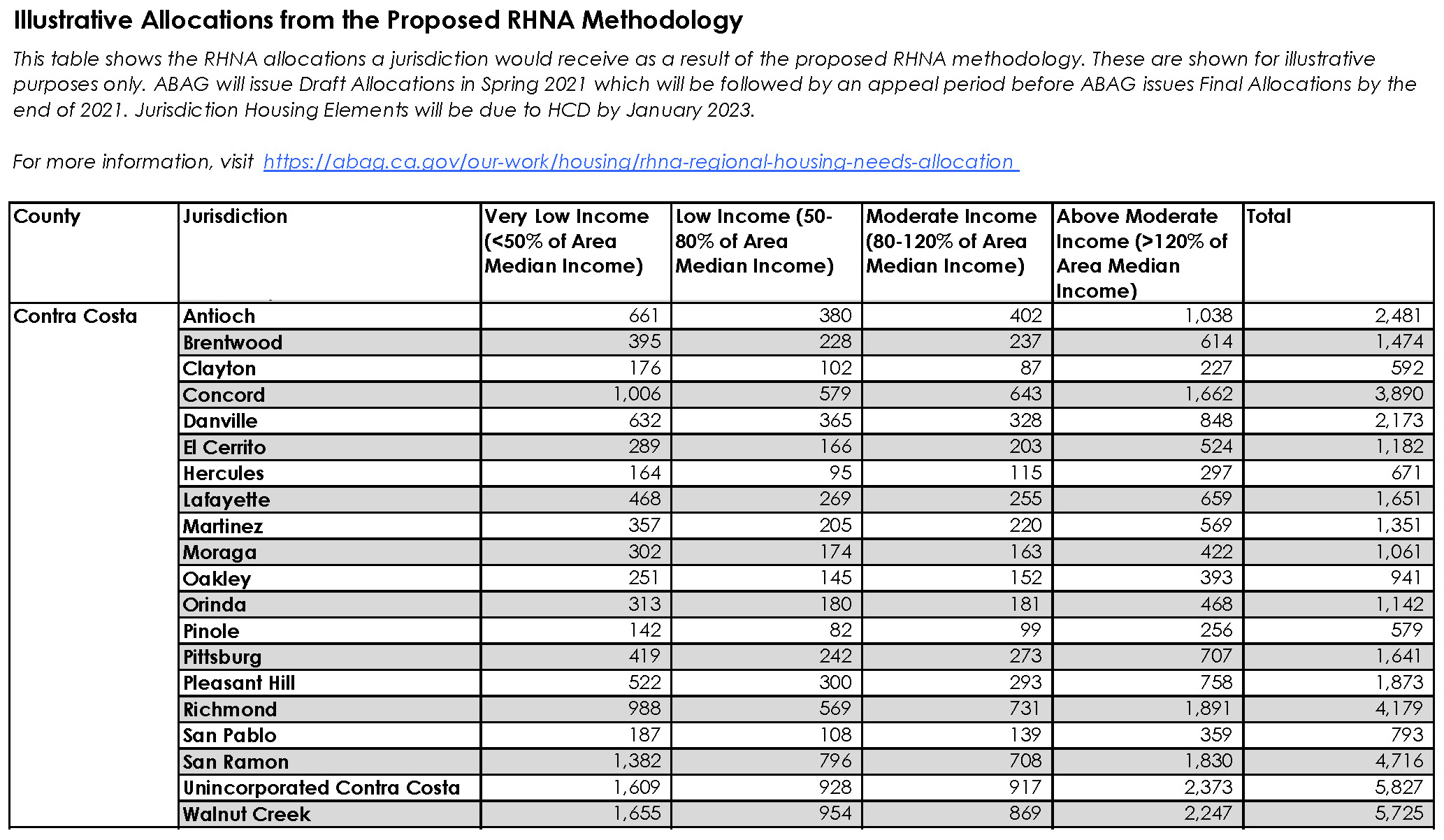
The Association of Bay Area Governments (ABAG)’s Executive Board at its meeting Thursday evening, Oct. 15 passed the Regional Housing Needs Allocation (RHNA) proposed methodology — a mathematical formula by which the state Department of Housing and Community Development (HCD)’s requirement that the Bay Area plan for more than 441,000 additional housing units during the 2023-2031 RHNA cycle will be distributed among the region’s nine counties and 101 cities and towns. New state laws — as well as the region’s strong economy and related job and household growth over the past decade — are also a significant reason for the growth in HCD’s determination, which will require the Bay Area to plan for 253,000 more units than required in the 2015- 2023 RHNA cycle. ABAG RHNA 10-15-20

Under the proposed methodology, communities in Contra Costa County would be expected to add 43,942 housing units, about 10% of the total, during the time period, with Walnut Creek, San Ramon, Richmond and Concord being allocated the highest number of housing units. Communities in Santa Clara County would be expected to account for about one-third of all new units to be incorporated into the housing elements of Bay Area jurisdictions’ general plans, and San Francisco, San Jose and Oakland are expected to have the highest expected planning numbers for individual cities.

From RHNA dated Oct. 15, 2020

ABAG President and Berkeley Mayor Jesse Arreguin commented, “Housing Element Law emphasizes that all Bay Area communities have to share the increased state planning numbers.  The adopted proposed methodology is the best way to share the housing responsibility among all our region’s local governments, to encourage housing in areas with good access to jobs and in locations designated by the state as high-opportunity areas, and to meet fair housing and greenhouse gas reduction requirements.”

With the Executive Board’s action, ABAG on Oct. 25 will open a public comment period on the proposed RHNA methodology. The comment period will include a public hearing at the Thursday,  Nov. 12 meeting of ABAG’s Regional Planning Committee, after which both the committee and the Executive Board will again weigh in on the methodology. If approved, ABAG will submit this draft methodology to HCD for review, likely in January 2021, and then use the state agency’s recommendations to develop a final methodology and draft RHNA allocation in spring 2021. Release of the draft allocation would then kick off an appeals period in the summer of 2021, with the final RHNA allocation assigned to each of the Bay Area’s local governments in late 2021.

According to the California Department of Housing and Community Development, “Since 1969, California has required that all local governments (cities and counties) adequately plan to meet the housing needs of everyone in the community. California’s local governments meet this requirement by adopting housing plans as part of their ‘general plan’ (also required by the state). General plans serve as the local government’s ‘blueprint’ for how the city and/or county will grow and develop and include seven elements: land use, transportation, conservation, noise, open space, safety, and housing. The law mandating that housing be included as an element of each jurisdiction’s general plan is known as ‘housing-element law.’

California’s housing-element law acknowledges that, in order for the private market to adequately address the housing needs and demand of Californians, local governments must adopt plans and regulatory systems that provide opportunities for (and do not unduly constrain), housing development. As a result, housing policy in California rests largely on the effective implementation of local general plans and, in particular, local housing elements.” Each of the regions in the state must develop a plan for their Regional Housing Needs Allocation and Housing Elements.

The allocation methodology is a formula for accommodating the Bay Area’s total housing need by quantifying the number of housing units — separated into above-moderate, moderate, low and very-low income categories — that will be assigned to each city, town and county.  The allocation must meet statutory objectives and be consistent with the forecasted development pattern from Plan Bay Area 2050. The final result of the RHNA process is the allocation of housing units by income category to each jurisdiction. Each local government must then update the Housing Element of its General Plan and its zoning to show how it can accommodate its RHNA allocation.

The proposed RHNA methodology was developed by ABAG’s Housing Methodology Committee (HMC) after nearly a year of meetings and technical analysis. The HMC process provided a forum for local elected officials, staff from city and county governments, various stakeholder groups, and members of the general public to formulate a data-driven proposal.  Members of the HMC were selected from a diverse pool of applicants and included representatives from each of the nine Bay Area counties.

President Arreguin praised the HMC for its challenging work: “The proposed methodology represents a big accomplishment not only for the HMC or for ABAG, but also for our region.  The committee members’ involvement in this complicated and sometimes contentious process brought together very diverse voices to develop a methodology that works for the entire Bay Area.”

Additional information about the proposed methodology and the RHNA process is available on ABAG’s website:  https://abag.ca.gov/our-work/housing/rhna-regional-housing-needs-allocation.

Founded in 1961, ABAG is the regional planning agency for the Bay Area’s nine counties and 101 cities and towns, and is recognized as the first council of governments in California.

Allen Payton contributed to this report.

Filed Under: Growth & Development, News

Contra Costa Community College District announces Spring 2021 will be online

October 20, 2020 By Publisher Leave a Comment

By Timothy Leong, Public Information Officer, CCCCD

The Contra Costa Community College District (District) has decided to offer predominantly online courses and student services for the entire 2020-21 academic year because of the COVID-19 pandemic. A limited number of students will continue to be allowed on campus to attend hard-to-convert courses and labs — strict adherence to county social distancing guidelines will be enforced to ensure student and employee safety. The District has been operating remotely since March 16, 2020.

“We thought it was best to make this decision as early as possible to give our students, classified professionals, faculty and administrators the opportunity to plan accordingly,” said interim chancellor Gene Huff. “This has been a challenging time for many of our students who are taking online courses for the first time, and we want to thank them for their perseverance and flexibility. Our many support services like tutoring and counseling are ready to assist our students achieve their academic goals with us.”

Registration for spring 2021 courses begins in November and depends on a student’s priority. To view what classes may be offered, students should visit their InSite account or college website of their choice for specific details.

Filed Under: Education, News

2021 Medicare Open Enrollment in a virtual world

October 20, 2020 By Publisher 1 Comment

Tips for navigating plan options during the COVID-19 Pandemic

By Rick Beavin, Desert Pacific Medicare President, Humana

The annual Medicare Advantage and Medicare Prescription Drug Plan open enrollment period is traditionally a time for educational events, classes and one on one meetings, but this year due to the COVID-19 pandemic, there are some new and different ways to learn about Medicare. October 15 to December 7 is the time when millions of people eligible for Medicare can access the latest information about available health plans for 2021. In California alone, more than 6.4 million people are enrolled in Medicare including more than 2.9 million with Medicare Advantage

There are resources to help you choose the plan that’s right for you without having to leave home, including informational websites, virtual educational events and one-on-one virtual meetings with sales agents. At the same time, it’s important to safely access Medicare information online while protecting your personal information and avoiding fake offers and other scams.

Here are some tips for how to prepare for the Medicare fall open enrollment period:

  1. Use an online tool

Go to the Medicare Plan Finder on Medicare.gov to compare plans, benefits and an estimated cost for each plan based on an average member.

If you are interested in Medicare Part D, which helps cover the cost of prescription medications, you can also enter the names of prescription medications you take to ensure those medications are covered by the plan you are considering. You can enroll directly on Medicare.gov.

On Medicare.gov, you can also learn about and enroll in Medicare Advantage plans, sometimes called Part C or MA Plans, and you can also visit an insurance company’s website to learn more about what they offer. Insurance companies that offer Medicare Advantage plans can provide you with detailed information about their plans and services, plus prescription pricing information and other benefits. You can also check to see if your primary care physician or other providers are in-network with the Medicare Advantage plan.

  1. Sign up for a virtual education workshop

Many insurance companies are offering online workshops to review 2021 Medicare Advantage plan options. Also, check to see if you can set up a virtual one-on-one meeting with an insurance company sales agent – meaning, by phone or video chat. Before you attend a virtual event or meeting, find out in advance how to log on to the meeting to avoid technical issues.  It’s a good idea to also prepare a list of questions so that you can ensure you get the information you need. Does the plan include vision, hearing and dental coverage? Will telehealth services be covered? Is transportation to your medical appointments included?

  1. Protect yourself against Medicare scams

The federal Medicare agency has warned that scammers may try to use the pandemic to steal Medicare beneficiaries’ Medicare numbers, banking information or other personal data. Scammers may try to reach out to you by phone, email, text message, social media or by visiting your home. Only give your Medicare number to your doctor, pharmacist, hospital, health insurer or other trusted health care provider. Do not click links in text messages and emails about COVID-19 from unknown sources, and hang up on unsolicited phone calls offering COVID-19 tests or supplies.

If you are not comfortable accessing plan information online, Medicare.gov has an option for setting up a phone call

For more information, go to Medicare.gov or call 1-800-MEDICARE (800-633-4227).

For more information about Humana plans, you can visit www.Humana.com/Medicare or speak with a licensed Humana sales agent by calling 1-800-213-5286 (TTY: 711) from 8 a.m. to 8 p.m. local time, seven days a week.

Rick Beavin is Desert Pacific Medicare President at Humana in California.


Filed Under: Health, News

Stockton man arrested in Blackhawk Sunday for attempted murder of Danville cops, Sheriff’s Deputy

October 19, 2020 By Publisher Leave a Comment

Tried to run them over with his car; held on $1.5 million bail

By Jimmy Lee, Director of Public Affairs, Contra Costa County Office of the Sheriff

On Sunday afternoon at about 2 PM, an unknown person entered the Blackhawk Police Substation in the Blackhawk community and contacted a deputy sheriff there. The subject displayed erratic behavior and was asked to leave the community.  Due to the subject contact, Danville police responded to the substation to assist the deputy.

As the man was leaving in his car, he accelerated his vehicle rapidly and deliberately attempted to run down the officers and deputy. The suspect’s vehicle struck the deputy and a Danville officer. Both fell to the ground. A Danville Police Sergeant discharged his firearm, striking the vehicle, but not the suspect. The suspect fled in his vehicle.

The suspect and his vehicle were located about a mile away by responding deputies. He was apprehended after a struggle with deputies.

The deputy who was hit by the vehicle was treated and released from a local hospital. The officer was treated at the scene by paramedics.

The suspect has been identified as 25-year-old Eduardo Carrillo of Stockton. After being interviewed by detectives, he was booked into the Martinez Detention Facility on three counts of attempted murder of a peace officer and a probation violation. He is being held in lieu of $1.5 million bail.

The investigation is ongoing. Anyone with any information is asked to contact the Investigation Division at (925) 313-2600. For any tips, email: tips@so.cccounty.us or call (866) 846-3592 to leave an anonymous voice message.

Filed Under: Crime, News, Police, San Ramon Valley, Sheriff

Antioch man dies from apparent suicide while in custody at West County Detention Facility

October 19, 2020 By Publisher Leave a Comment

Arrested for elder abuse, in jail since Oct. 2; Sheriff’s Office investigating

By Jimmy Lee, Director of Public Affairs, Contra Costa County Office of the Sheriff

On Saturday, October 17, 2020, at about 6:15 PM, a deputy sheriff escorted a Mental Health Clinician to speak with an inmate at the West County Detention Facility in Richmond.

As the deputy opened the door to the inmate’s cell, she found him unresponsive with a bed sheet wrapped around his neck. Deputies and jail medical staff provided life saving measures until an ambulance and the fire department arrived. The inmate was later pronounced deceased at the scene.

The inmate is identified as 42-year-old Gregory Lynds of Antioch. He was originally arrested by the Antioch Police Department and was booked into jail on October 2, 2020. He was being held on two felony counts of elder abuse (likely to produce great bodily harm or death), two felony counts of assault with a deadly weapon, parole violation, and battery on a peace officer.

The investigation into the apparent suicide is being investigated by the Contra Costa District Attorney’s Office and Contra Costa Sheriff’s Office.

The investigation is ongoing. Anyone with any information is asked to contact the Investigation Division at (925) 313-2600. For any tips, email: tips@so.cccounty.us or call (866) 846-3592 to leave an anonymous voice message.

Filed Under: Crime, East County, News, Police, Sheriff, West County

Letters: Writer wants change, new community college board member for Ward 5

October 17, 2020 By Publisher Leave a Comment

Editor:

Ward 5 of the Community College Board needs change – Enholm must go!

Ward 5 of the Contra Costa Community College District, including Bay Point, Pittsburg, Antioch, Brentwood, Oakley, Knightsen and Bethel Island, is badly in need of new leadership. The current Trustee for this area, Greg Enholm, has engaged in poor decisions, erratic behavior, and unethical acts that have not served the District, Los Medanos College in particular, very well.

This is not new, but enough is enough.

When the Board of Trustees approved in a 4-1 vote the building of the new Campus located in Brentwood, on donated land, with an approved Bond Measure E in 2014, Enholm continued to oppose its construction. An alternative site would have taken years for approval adding costs for acquisition of land and increased taxes. The new campus was needed as the existing leased building in a retail district of Brentwood was over-capacity. In 2016 Enholm also recommended the residents of the nearby Trilogy community sue the District to keep its construction at bay.

This opposition caused numerous delays, added hundreds of thousands of dollars to the cost due to litigation, and for a time imperiled the use of the approved Bond as expenditures needed to begin within an approved time. Covid-19 has impacted its opening, but the students will be served well by this new educational facility.

Especially troubling has been allegations of multiple ethics violations by Enholm that have recently come to light. He has not denied the allegations. The allegations were found to be true by an investigator of the District which included inappropriately trying to get a friend re-classified to be considered for a top-level position as well as ghost-writing an email to the District. As part of the investigation it was noted that Enholm went directly to the Chancellor to ask him to reconsider his friend for the position even though the person was already deemed to be unqualified for the position.

Of late, with the District facing challenges due to COVID-19, he also voted to terminate upper-level district managers, ignoring numerous requests from faculty and classified staff to reconsider that decision. Enholm has stopped listening to the faculty, staff, and his constituents and has engaged in recent actions that have put our District’s financial future at risk.

It is time for new leadership on the Contra Costa Community College District Board: Elect Fernando Sandoval.

Valerie T Lopez

Pittsburg


Filed Under: Education, Letters to the Editor, Opinion, Politics & Elections

  • « Previous Page
  • 1
  • …
  • 278
  • 279
  • 280
  • 281
  • 282
  • …
  • 488
  • Next Page »
Liberty-Tax-Jan-Apr-2026
Deer-Valley-Chiro-06-22

Copyright © 2026 · Contra Costa Herald · Site by Clifton Creative Web