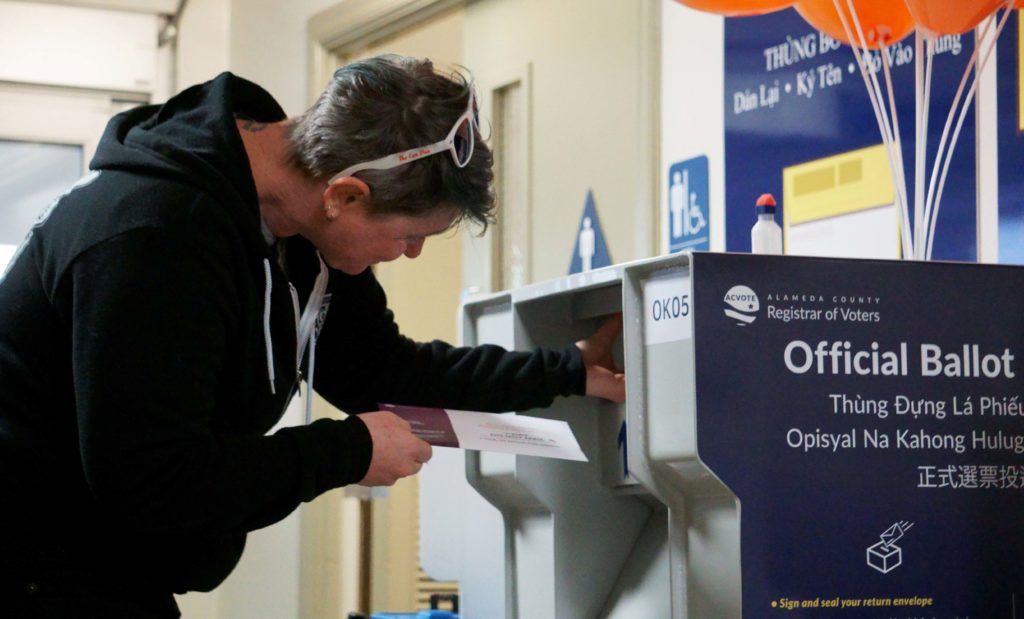
A voter casts a ballot during the presidential primary election on Super Tuesday in Oakland. Photo: Andrew Reed/EdSource
PRO: Teachers’ union leader says Prop. 3 would help lock in hard-won resources for student well-being
By Gloria Martinez, EdSource.org – republished with permission
When I was a special education teacher, I learned that one of the cruelest questions you can ask an underfunded school is: What can you afford to go without?
Before California voters passed Proposition 30 in 2012, this was not a hypothetical question. I saw firsthand how budget constraints affected students’ daily lives, especially in less affluent communities where resources were already stretched thin. Some schools lacked the counselors, school psychologists and social workers needed to recognize when a child was struggling. Teachers did what they could, but in classrooms of 30 or more students, we could not replace these trained professionals or meet every child’s needs alone.
By raising taxes on California’s highest earners (currently, couples earning more than $742,000), Proposition 30 generated additional revenue for public schools and higher education. In the years that followed, teachers across the state used collective bargaining to advocate for improvements that directly affected students and school communities: smaller class sizes, art and music programs, and mental health professionals who helped schools better support students’ overall well-being.
In Los Angeles, those resources also helped create conditions for educators to pursue further gains through common-good bargaining, including community schools, the Black Student Achievement Plan, and additional staffing. These were more than budget line items. They meant more readily available support for students, expanded opportunities for children from low-income backgrounds and from immigrant communities and communities of color, and greater capacity for schools to intervene when students and their families needed help.
Today, as voters consider Proposition 3, which would make these existing tax rates permanent for California’s highest-income earners, we must remember what it took to build that stronger foundation and what we stand to lose if it erodes.
If the tax rates expire in 2031, California would give its wealthiest households a massive tax cut and forgo an estimated $5 billion to $15 billion a year in state revenue. This financial pitfall will make it harder for school districts to sustain the programs and staffing students rely on, including mental health and student support services. Counselors, school psychologists and social workers — positions we worked to expand in our schools — could be at risk.
If the tax rates expire in 2031, California would give its wealthiest households a massive tax cut and forgo an estimated $5 billion to $15 billion a year in state revenue.
Protecting that investment is especially urgent as students face increasingly complex mental health challenges. For young people experiencing depression, anxiety or suicidal thoughts, school-based mental health services reach more than twice as many as primary care or child welfare services. For many students, school may be the most accessible place to find help.
The need is not theoretical. Despite declines in youth suicide in California, serious mental health challenges persist. Schools need trained professionals who can recognize warning signs, respond to crises and connect students with appropriate care.
Students also bring fears into school that originate far beyond campus. Immigration raids across California have exacerbated students’ anxieties about family separation, fears for parents’ safety, and difficulty concentrating in class. In moments like these, psychiatric social workers have provided students with weekly check-ins, psychological counseling and information about legal support services. They have also facilitated community circles where students can discuss unfolding events and how those events affect them.
If schools lose these professionals, students and families will have fewer places to turn for help. Families with the means to do so may be able to pay for private counseling, but families without those means can lose access to critical support altogether.
The gains made possible by Proposition 30 demonstrate what sustained public investment can achieve. Without continued funding that would come from Proposition 3, it’s hard to see how schools can maintain those hard-won gains, preserve mental health services and build the capacity they need to respond to students’ changing needs.
Years from now, our students will have to live with the consequences of the choices we make during this election. Children need more than academic instruction to thrive. They need the stability and support that allow them to recover from setbacks, develop confidence and imagine a future beyond their immediate challenges.
Proposition 3 will not magically fix California’s schools. But without this revenue, schools will struggle to maintain the staffing and programs our students deserve. The question we must ask is not simply what California can afford to fund, but what we are willing to risk going without.
Gloria Martinez is the president of United Teachers Los Angeles.
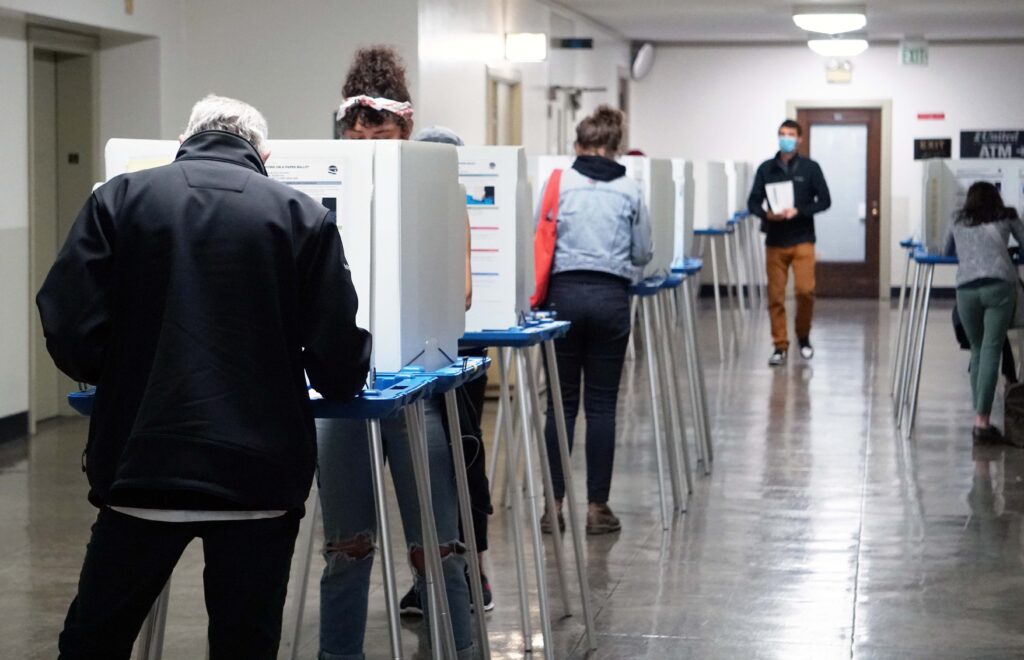
Voters at a polling place. Credit: Andrew Reed / EdSource
CON: Taxpayers leader says California doesn’t need another forever tax
As statewide student enrollment declines
By Robert Gutierrez, EdSource.org – republished with permission
Proposition 3 asks voters to approve a massive tax increase that would not take effect until 2031, when California’s finances may look completely different from how they do today. Voters should reject Proposition 3 and keep their options open.
In 2031, there will be a new president in the Oval Office, a new governor, and a different political landscape in California — especially if voters approve Proposition 40 to impose a wealth tax that could prompt an exodus of the taxpayers targeted by Proposition 3.
The state also will have significantly fewer students in our public schools. The Department of Finance projects a decline of 710,500 students from 2026 through 2036, and by the midpoint of this decline, we undoubtedly will see some major changes in the education structure.
This is only the beginning of the list of unknowns. Other questions include:
- Will Californians still be paying billions of dollars per year for a nonfunctioning “high-speed” railroad system in 2031, rather than prioritizing schools for that spending?
- Will taxpayers still be paying for ineffective programs that haven’t solved homelessness?
- Will startups launch in California, or take their jobs and economic benefits to states with more competitive tax rates?
In short, it makes no sense to amend the state constitution to commit to a tax increase now, five years in advance, when we have no idea what condition the state will be in when the tax would take effect.
What difference could five years make?
California’s finances can change substantially in a short period. Total state revenue for the current fiscal year is projected to be $21.5 billion higher than the amount collected five years earlier. The Department of Finance also recently reported that general fund revenue was running $5.5 billion above the projection used to draft the 2026-27 budget just six months earlier. This means the education funding guarantee will go up, too.
It makes no sense to amend the state constitution to commit to a tax increase now, five years in advance, when we have no idea what condition the state will be in when the tax would take effect.
Timing is only one of the problems. While Proposition 3 is marketed as a “tax extension” that would only affect high-income residents, the truth is that it’s a major tax increase that would hit millions of small businesses as well as high-income individuals. The result: California’s affordability crisis gets worse.
The small-business aspect of Proposition 3 hasn’t received enough attention. California’s tax structure does not neatly separate business income from personal income, and many small businesses operate as sole proprietorships, partnerships, or S corporations that report business earnings on personal income tax returns.
This means the higher tax rates imposed by Proposition 3 would increase taxes on many small businesses, ultimately leading to higher prices for customers, fewer job opportunities for workers, or both.
The Public Policy Institute of California reported in February that sole proprietorships accounted for more than 3 million California businesses in 2023. But the number of those businesses whose owners would be impacted by Proposition 3 depends on their taxable income.
To the extent that Proposition 3 would hit high-income earners, it would make California more reliant on the most volatile source of revenue, while simultaneously making it even more volatile by giving high-income residents a new incentive to leave the state.
California already imposes the nation’s highest personal income taxes and would have a top personal income tax rate of 10.3% on income over $1 million without Proposition 3. The state also imposes a 1.3% State Disability Insurance tax on all income from salaries and wages, bringing the top tax rate to 11.6% on those forms of income, without Proposition 3.
As for the issue of an “extension” versus an “increase,” the fact is clear: If Proposition 3 is approved, Californians will pay $5 billion to $15 billion a year more in state income tax than if the initiative is defeated (according to estimates by the Legislative Analyst’s Office). That’s an increase — and a very large one, at that.
Finally, the measure would continue the trend in which “temporary” taxes in California never seem to go away. As the proponents of Proposition 40 are discovering, voters are extremely distrustful of taxes described as temporary. Why? In large part because of Proposition 3 and its predecessor, Proposition 55 of 2016, asking voters to renew a tax originally described as a temporary charge to cover an emergency.
The ballot argument for the original initiative, Proposition 30 of 2012, said the taxes “are temporary, balanced and necessary to protect schools and safety” — one of the argument’s five mentions of the allegedly temporary nature.
With revenue arriving above projections and the state spending billions on questionable programs without proper controls or a review of effectiveness, it can no longer be said that California has a fiscal emergency.
The voters should give much-needed relief to small businesses and their customers, avoid making fiscal decisions prematurely, and let the “emergency tax” expire on schedule. Vote NO on Proposition 3.
Robert Gutierrez is president of the California Taxpayers Association, which is celebrating its 100th year of serving as the state’s largest and oldest association representing taxpayers in this state.
The opinions expressed in this commentary are those of the author. EdSource welcomes commentaries representing diverse points of view.
Leave a Reply