
Photo: Vanderbilt Policy Accelerator for Political Economy and Regulation
“Sold Out: How state and local governments pay for Live Nation’s monopoly”
“A federal jury found that Live Nation monopolized the amphitheater market, which has led to higher prices and fewer choices for music fans across the country.” – Report Co-Author Brian Shearer
“This is not a credible report. State and local governments invest in live entertainment because venues are economic engines…” – Live Nation spokesperson. Shares statements on jury verdict and DOJ settlement
By Vanderbilt Policy Accelerator, Vanderbilt University
Concord, CA–A recent analysis published by the Vanderbilt Policy Accelerator for Political Economy and Regulation (VPA) reveals that state and local governments own nearly half of Live Nation’s large outdoor amphitheaters and stadiums and have been subsidizing the company’s live events business to the tune of more than $420 million. The report raises questions about the propriety of local governments devoting significant public resources to a company as large and as powerful as Live Nation, particularly as nearly two-thirds of independent music venues struggle to turn a profit.
The report examines 64 large outdoor amphitheaters and stadiums operated by Live Nation across the country, including Toyota Pavilion at Concord in Concord, CA and Shoreline Amphitheatre in Mountain View, CA. VPA’s researchers found that in 30 of 64 instances, these venues are not owned by Live Nation or another private actor. Instead, Live Nation operates buildings owned by state or local governments.
The City of Concord owns the Pavilion, and the City of Mountain View owns Shoreline.
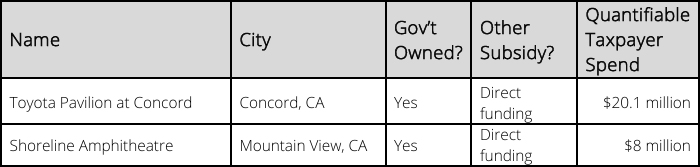
Sections of Live Nation’s venue chart. Source: VPA
These contracts are often never subject to competitive bidding, resulting in highly favorable terms for Live Nation, including cheap rent, the ability to generate revenue by selling naming rights to a government building, and even taxpayer support to build and maintain the properties from which Live Nation profits. Rarely, if ever, do these contracts insist on terms to advance the public interest, such as requirements to operate the venue as an “open room” for artists not promoted by Live Nation, limits on excessive fees, or street pricing for concessions.
In addition, Vanderbilt Policy Accelerator found that at least $420 million in taxpayer money went toward benefiting Live Nation, not including the value of below-market rent or profits from selling naming rights on government buildings.
“A federal jury found that Live Nation monopolized the amphitheater market, which has led to higher prices and fewer choices for music fans across the country,” said Brian Shearer, director of competition and regulatory policy at Vanderbilt Policy Accelerator and a co-author of the report. “But cities and states don’t need to wait for a court order to begin rectifying this problem. They can simply stop financing Live Nation’s venues and evict them from public-owned venues.”
The findings also highlight that government contracting could be a powerful lever for addressing Live Nation’s monopoly. To help local governments build a live music ecosystem that reinvests in local communities rather than enriching a powerful monopoly, the report proposes two potential solutions.
The first, an “outsourcing with conditions” model, would open venue operating contracts to competitive bidding with strict conditions to advance the public interest and a preference for independent venue operators familiar with the unique needs of local communities. The second, a “public D.I.Y.” model, proposes that cities operate their properties through a specially chartered public nonprofit corporation. Both approaches would enable local governments to operate their large venues and advance important public-interest goals while avoiding siphoning taxpayer funds onto the balance sheets of an extractive monopoly.
Read about the report in VPA’s Substack and watch the YouTube video.
Live Nation Responds
In response to the report, a spokesperson for Live Nation wrote, “This is not a credible report. It is a poorly researched and one-sided advocacy piece backed by independent venues who don’t want to compete against new and renovated venues regardless of the benefits to fans and communities. State and local governments invest in live entertainment because venues are economic engines that bring artists, fans, jobs and spending to their communities. Our amphitheaters generate an estimated $5.8 billion in local economic activity and $800 million in municipal taxes each year, while supporting nearly 48,000 jobs. And over the last decade, we’ve invested more than $825 million of our own funds improving these venues.”
In addition, they provided the following facts:
- $5.8B in estimated annual local economic activity generated outside our amphitheaters by concerts and fans
- ~$800M annually in municipal taxes from taxable amphitheater revenue streams, including tickets, food & beverage and merchandise
- 47,609 full- and part-time employees, representing approximately $225M in annual wages
- $825M+ invested in renovations and improvements across the amphitheater portfolio over the last 10 years
- ~$450M in rent paid to government landlords across 30 amphitheaters over the last 10 years
- Public investment in major sports and entertainment venues is commonplace. Recent examples include:
- Kansas City Chiefs — $1.8B new stadium
- Tennessee Titans — $1.26B new stadium
- Washington Commanders — $1.0B new stadium
- Buffalo Bills — $850M new stadium
- San Antonio Spurs — $800M new arena
- Jacksonville Jaguars — $775M stadium renovation
When pressed further and asked about the federal jury findings, Live Nation shared the following statements on the settlement issued on March 9, 2026 and the jury verdict issued on April 15, 2026:
Live Nation Entertainment Reaches Settlement With U.S. Department of Justice
Live Nation Entertainment, Inc., the world’s leading live entertainment company, announced today (March 9, 2026) that the company has reached a settlement with the United States Department of Justice (DOJ) in the antitrust lawsuit brought by the DOJ. The company has consistently maintained that the DOJ’s allegations were without merit, and a portion of the original claims were dismissed by the court before trial began. This settlement will resolve all remaining matters with the DOJ, without any admission of wrongdoing, and the settlement will be reflected in a final proposed judgement that will be submitted to the court for approval.
-Live Nation Entertainment issued the following statement:
We are pleased to have settled our lawsuit with the United States Department of Justice.
“Today marks a major step in improving the concert experience for artists and fans throughout the United States. Live Nation is proud to lead the way enhancing this experience with our amphitheaters, which will be open to all promoters, allowing these promoters to decide how best to distribute up to 50% of the tickets, and capping ticketing service fees at 15%. By giving artists greater flexibility in choosing their promotional partners and ticketing strategy while also keeping the cost of a concert more affordable for fans, we are putting more power where it should be – with artists and fans,” said Michael Rapino, President and CEO of Live Nation Entertainment.
In addition, Live Nation will be divesting its 13 exclusive booking agreements with amphitheaters nationwide. All owned and operated amphitheaters will continue to be operated by Live Nation as open venues, promoting competition and maximizing show volume.
In ticketing, Ticketmaster will be providing both exclusive and non-exclusive ticketing proposals to all major concert venues, which preserves the rights of venues to seek the type of contracts they preferred over the years while providing the government with restrictions to mitigate their concerns. At the same time, for venues that choose to do so, they may distribute some portion of their tickets through other primary ticketing marketplaces.
“We have never relied on exclusivity to drive our ticketing business, it has simply been the result of having the best products, services and people in the industry. We are happy to take greater steps to empower artists and venues in their ticketing decisions, and are confident we will continue to succeed on the quality of what we deliver,” continued Rapino.
This settlement will also include an eight-year extension of the company’s consent decree with the DOJ, including retaliation and conditioning terms, providing venues ongoing comfort the company does not condone such behavior.
There is no financial component to the settlement with the DOJ. This does not settle the claims of all plaintiffs in the lawsuit, and the company has created a $280 million settlement fund to address the states’ damages claims.
Statement on Jury Verdict
The jury’s verdict is not the last word on this matter. Pending motions will determine whether the liability and damages rulings stand.
Live Nation will soon renew its motion for judgment as a matter of law, which the Court deferred until after the jury returned its verdict. That motion addresses all liability theories. The Court previously noted that Live Nation’s motion raises serious issues.
There is also a pending motion to strike the damages testimony on which the jury’s award was based. The Court deferred ruling on that motion as well, while noting significant concerns with the damages expert’s analysis.
Of course, Live Nation can and will appeal any unfavorable rulings on these motions.
The jury’s award of $1.72 per ticket applies to a limited number of tickets—those sold at 257 venues, which represent about 20% of total tickets—and only to purchases by fans (excluding brokers) in certain states over the past five years. Based on that scope, we believe the aggregate single damages figure would be below $150 million, which would be trebled. In connection with the DOJ settlement, Live Nation has already accrued $280 million toward state damages and civil penalty claims.
Injunctive relief will be determined by the Court after the states make a remedy proposal, which we expect in the coming weeks. In the meantime, the Tunney Act proceedings regarding the DOJ settlement will continue. We remain confident that the ultimate outcome of the States’ case will not be materially different than what is envisioned by the DOJ settlement.
No Outside Funding for VPA Research, Report
VPA was asked who funded or helped develop their research and how much was contributed financially to the effort.
They responded, “VPA is an independent academic center at Vanderbilt University. There was no outside sponsor for this research, and VPA did not receive any external funding to compile this report.”
City of Concord Studying Report
In response to the report, Colleen Awad, City of Concord Community Relations Manager wrote, “We are now reviewing it, as it was just released, and do not have a comment at this time.”
City of Mountain View Responds
Also in response, Lenka Wright, the City of Mountain View’s Chief Communications Officer in the Communications and Outreach Division of the City Manager’s Office wrote, “Mountain View’s Shoreline Amphitheatre is a premier outdoor concert venue that is operated by Live Nation. Upon entering the initial lease with Live Nation, the City has not paid for any facility upgrades or expansions. Per the lease, these are Live Nation’s expenses and the City Council must approve any recommended facility improvements. The rent that Live Nation pays to the City for Shoreline Amphitheatre operations is also competitive. In addition, the City has retained the naming rights to the venue, unlike some other California jurisdictions named in the report.”
About Live Nation Entertainment
Live Nation Entertainment (NYSE: LYV) is the world’s leading live entertainment company comprised of global market leaders: Ticketmaster, Live Nation Concerts and Live Nation Media & Sponsorship. For additional information, visit www.livenationentertainment.com.
About VPA
The Vanderbilt Policy Accelerator for Political Economy and Regulation (VPA) focuses on cutting-edge topics in political economy and regulation to swiftly bring research, education, and policy proposals from infancy to maturity. To learn more about our work, visit vu.edu/vpa.
Please check back later for any updates.
Allen D. Payton contributed to this report.
Leave a Reply