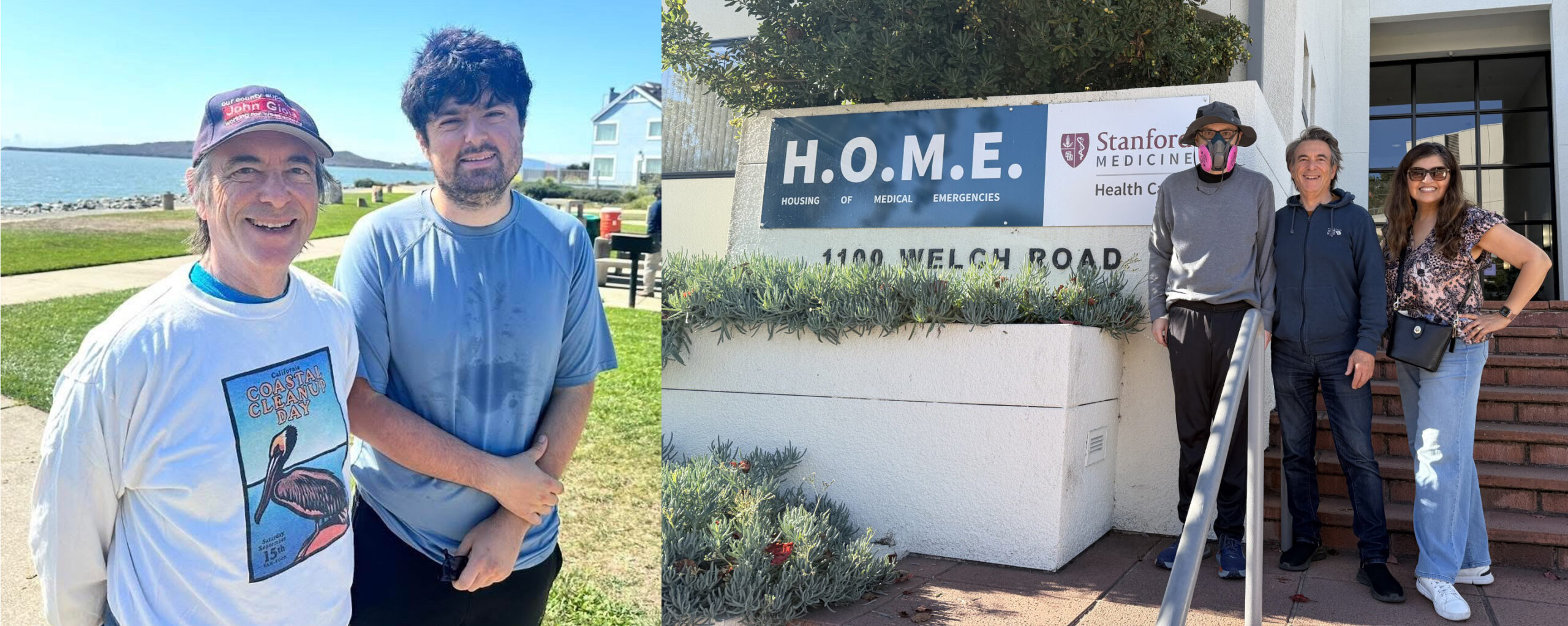
Contra Costa County Supervisor John Gioia with his son, Chris at past Coastal Cleanup in Richmond, and with Chris’ mother Maria “Charo” Gioia at the Stanford Medical Center housing. Photos courtesy of John Gioia
Family members share of Chris Gioia’s health journey, call for donors
By Allen D. Payton
Last summer, Chris Gioia, the 33-year-old son of Contra Costa County District 1 Supervisor John Gioia, underwent a bone marrow stem cell transplant for his aplastic anemia and Gioia, Chris’s mother, Maria “Charo” Gioia, and her husband, Marc Joffe recently shared about his experience. Spanish-language television channel, Telemundo first reported about Chris’ health challenges and journey on Friday, Nov. 28, 2025.
In a Facebook post later that day, Supervisor Gioia wrote, “During Thanksgiving, I give thanks and express gratitude for the positive things in my life.
This year I am especially thankful for my son Chris’ health after his successful bone marrow stem cell transplant at Stanford Hospital to cure his rare life threatening autoimmune disease – Aplastic Anemia.
Thanks to Pilar Nino and Telemundo 48’s great TV story about my son’s recovery and publicizing the need for more stem cell donors. They interviewed Chris, his mom, me and a Contra Costa Health Doctor.
If you’re under 36 you can register to be a stem cell donor at nmdp.org and help save a life.”
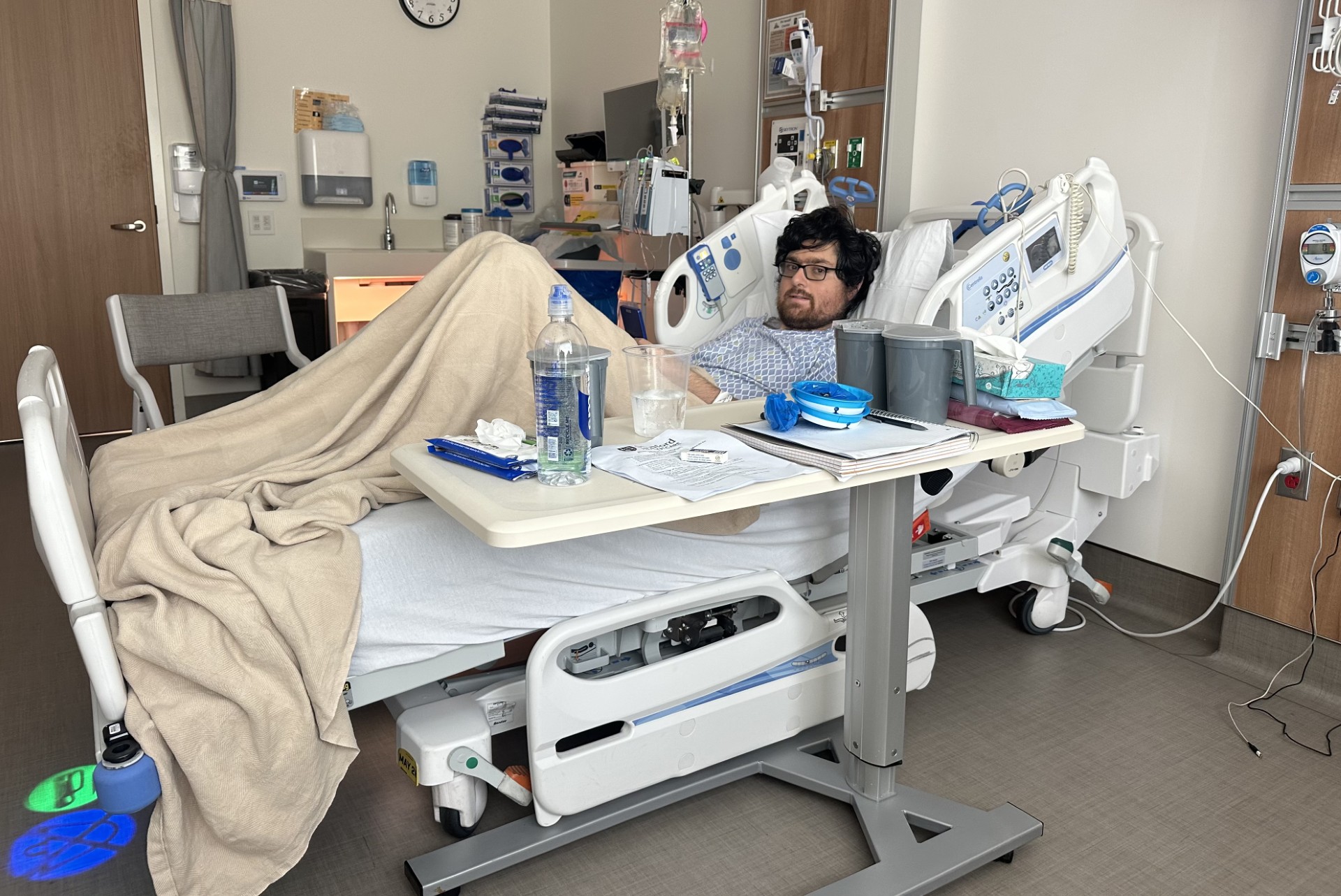
Chris Gioia in hospital bed preparing for the transplant.
About Aplastic Anemia
According to the Mayo Clinic, “Aplastic anemia is a condition that happens when your bone marrow stops making enough new blood cells. The condition leaves you tired and more prone to infections and uncontrolled bleeding.
“A rare and serious condition, aplastic anemia can develop at any age. It can happen suddenly, or it can come on slowly and worsen over time. It can be mild or severe.
“Treatment for aplastic anemia might include medicines, blood transfusions or a stem cell transplant, also known as a bone marrow transplant.
Mom Shares Details of Successful Transplant
In an interview with the Herald, Charo Gioia shared more details about her son’s experience.
“The whole process began in early April, this year. Marc and I were in Europe, in Croatia. Chris was with his dad, John who called me and told me what happened,” she shared.
“He was diagnosed in April, and he was hospitalized at Kaiser in Oakland. He was there for almost two months,” Charo continued. “He stopped working, and basically all activities. He was receiving daily transfusions. Once his numbers related to platelets became higher than 10, the doctors felt he could go home until the bone marrow transplant. Chris went to his dad’s home.”
“In late July, Stanford Hospital called and said they were ready for the transplant. Chris was hospitalized again to receive chemo, radiation and other treatments to prepare for the transplant,” she explained. “He was in the hospital for about one month before and after the bone marrow transplant. The actual transplant was on August 5.”
“We were very lucky because then the doctors at Stanford wanted him to stay close to the hospital for two months and we were provided an apartment by Stanford across from the hospital,” Charo said. “I stayed with Christopher and my sister helped out.”
“His autoimmune system was down, he had to be isolated and have his meals prepared by someone else,” she shared. “Chris’s autoimmune system improved immediately after the transplant. He then stayed with me and Marc at our house for about a month. His numbers improved. His platelet count was at like 10. Right now, they’re at 140. So, it’s a huge jump.”
Donor from Germany, Amazing News
“He received new stem cells from a donor in Germany. She’s 24 and that’s all we know,” Charo stated.
But first, Chris received some amazing news.
“This is very important. Stanford has a worldwide bank of donors. They go all over the world,” she explained. “Chris received a letter telling him that his match was his own stem cells from a donation he made 10 years ago while in college. But they wouldn’t work. I was not a match, his dad was not a match, nor his sister.”
“The donor from Germany, a young lady took a lot of tests to make sure that she’s very healthy inside and out,” Charo continued. “They took the mother cells from her bone marrow. They have to be taken from Germany all the way to Stanford within 48 hours after they’re extracted. The blood had to be fresh.”
“After a year, the hospital can contact her and ask her if she wants contact with us to say, ‘thank you’ and have an exchange. She can either accept or decline,” Charo stated. “She does not get any compensation as it’s against the law. But she gets her expenses covered.”
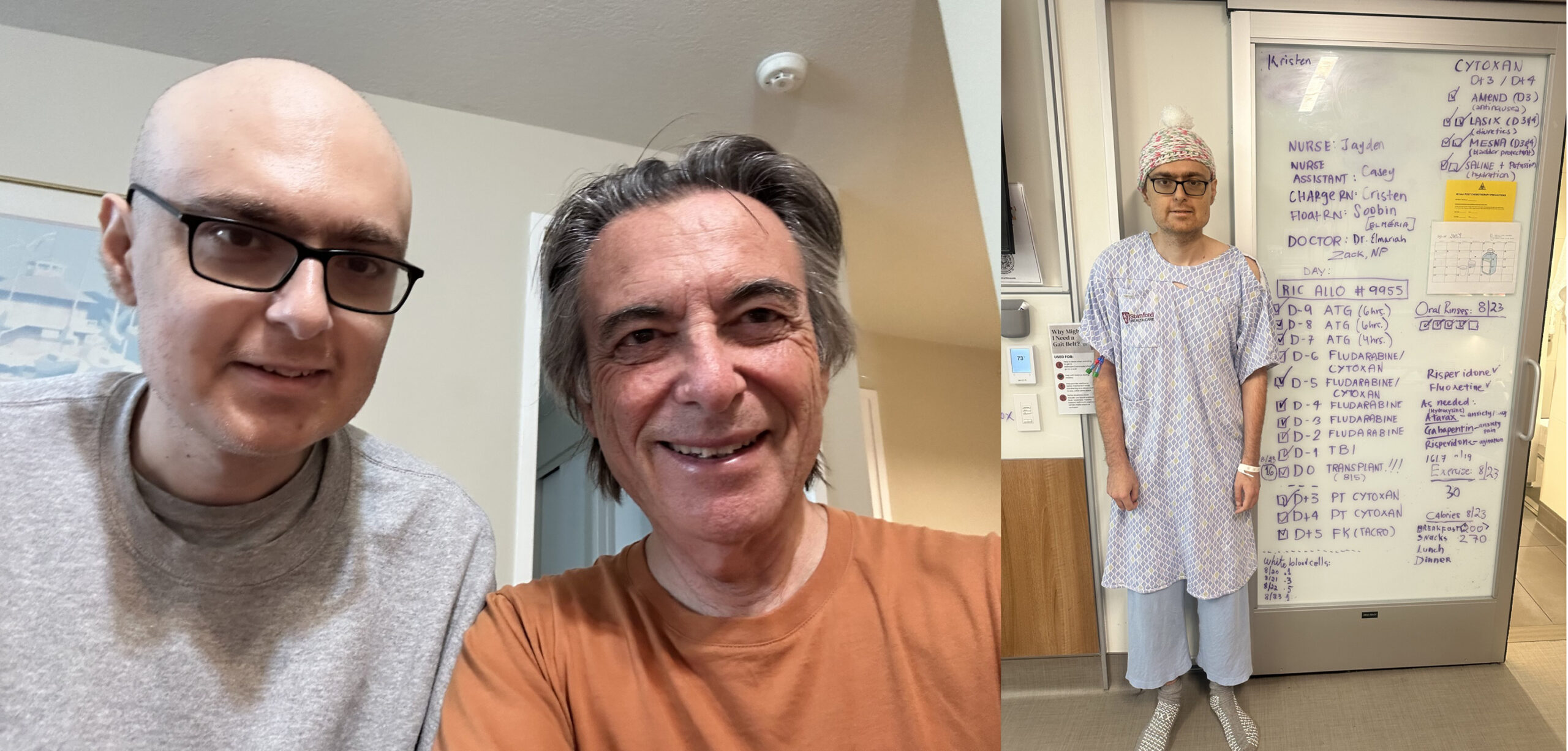
Chris with dad, John after the transplant and standing next to his list of treatments two weeks after the procedure.
Greater Need for Donations from African Americans, Asians and Latinos
“The donors, if you are white, you have a much higher percent of finding a match,” she said. “But if you’re African American, Asian or Latino the numbers go down because people don’t donate. Either they’re not aware or don’t donate enough. So, they’re pushing for people in those communities to donate.”
“Doctors mentioned a possible fear,” as the reason for the lack of donations, Charo explained. “But nothing is going to be cut from your body. This is not an organ donation. It’s a blood donation.”
“For Chris’ aplastic anemia, which is not cancer but a blood disease, the lady had to go through total anesthesia. They had to inject a needle into her bone to extract the bone marrow. There was some pain after,” she shared. “For other cancers, the donor doesn’t have to go through that. It would be a regular blood donation. The donor can always say, ‘no’. It’s all voluntary, of course.”
“We are forever thankful to that young woman, because she’s a total stranger. An angel,” Charo exclaimed. “For aplastic anemia, if Chris chose not to have the transplant, he would have had to stay in doors for the rest of his life and go have transfusions.”
“Eleanor Roosevelt died of the same disease. This one is a miracle story,” she added
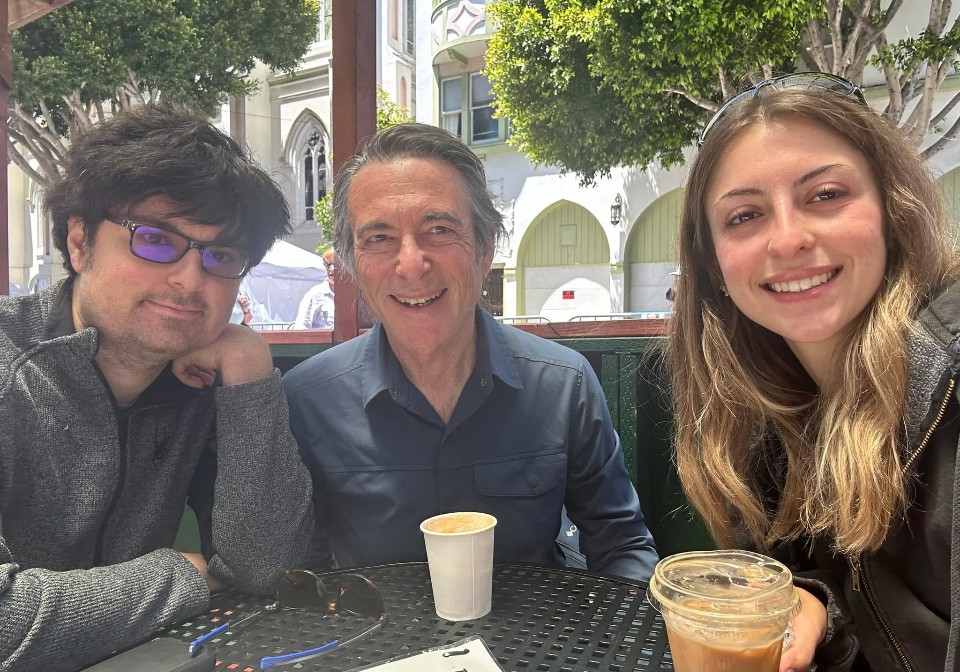
Chris with dad, John and sister, Emilia Gioia in San Francisco for Father’s Day 2024.
Stepdad Shares
Joffe posted on Facebook a link to the Telemundo report on Nov. 29 and wrote, “My stepson Chris is recovering nicely from a bone marrow transplant he received in August. In this Spanish language news story he and my wife Maria Iberico Gioia discuss the experience and thank the as-yet anonymous donor. She’ll have the option of making herself known to us one year after the transplant.
Earlier this year, Chris’ blood counts suddenly fell to near zero due to a case of aplastic anemia, a rare condition in which the patient’s bone marrow stops producing platelets as well as red and white blood cells.
He got great care at Stanford Medical Center and benefited from the advocacy and support provided by his mom, aunt, and his dad, John Gioia who arranged for this story to appear on Telemundo.
If you’re between 18 and 35 and want the chance to be someone else’s hero, please join the bone marrow donor registry: https://www.nmdp.org/get-involved/join-the-registry
County Health Now Partners with NMDP
“The Contra Costa County Health Department has now formed a partnership with NMDP and is hosting events to get donors,” Supervisor Gioia added.
About NMDP, formerly National Marrow Donor Program
NMDP is a global nonprofit leader in cell therapy, helping find cures and save lives for patients with blood cancers and disorders. Since our founding in 1987, the world has evolved—and so have we. Throughout the years, we’ve been known by many names, including the National Marrow Donor Program® and Be The Match®. In early 2024, we changed our name to NMDPSM—a single, modernized brand that’s flexible enough to meet our ambitious future.
This post brought back memories of my late husband who lost his battle due to complications of graft vs host after a bone marrow transplant for aplastic anemia. He was fortunate that his sister was a match and living in the states at that time. UCSF was his home for a long time. Words can not express our gratitude for the care received by the staff nurses and Dr Willis Navarro and team who were very clear with us from the get go that it was going to be touch and go and an up hill battle giving him a 20% chance of surviving. Life changing experience for him and the whole family. He lost his battle March of 2004 but not without a fight. Leaving behind wife and four young children. We need to spread the word to the world of the the need of bone marrow transplant donors to save some ones life. That life might be yours.
It’s a fact: if you are Caucasian, need a stem cell transplant, you’ll be matched within days. Wait times for non-Caucasians are longer. Why? The NMDP registry for Caucasians is full of registered donors. Please register for these events, close the gap for non-Caucasian donors. Same for blood donation!!!!!