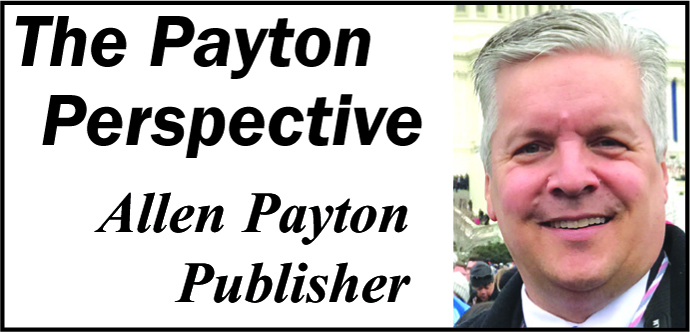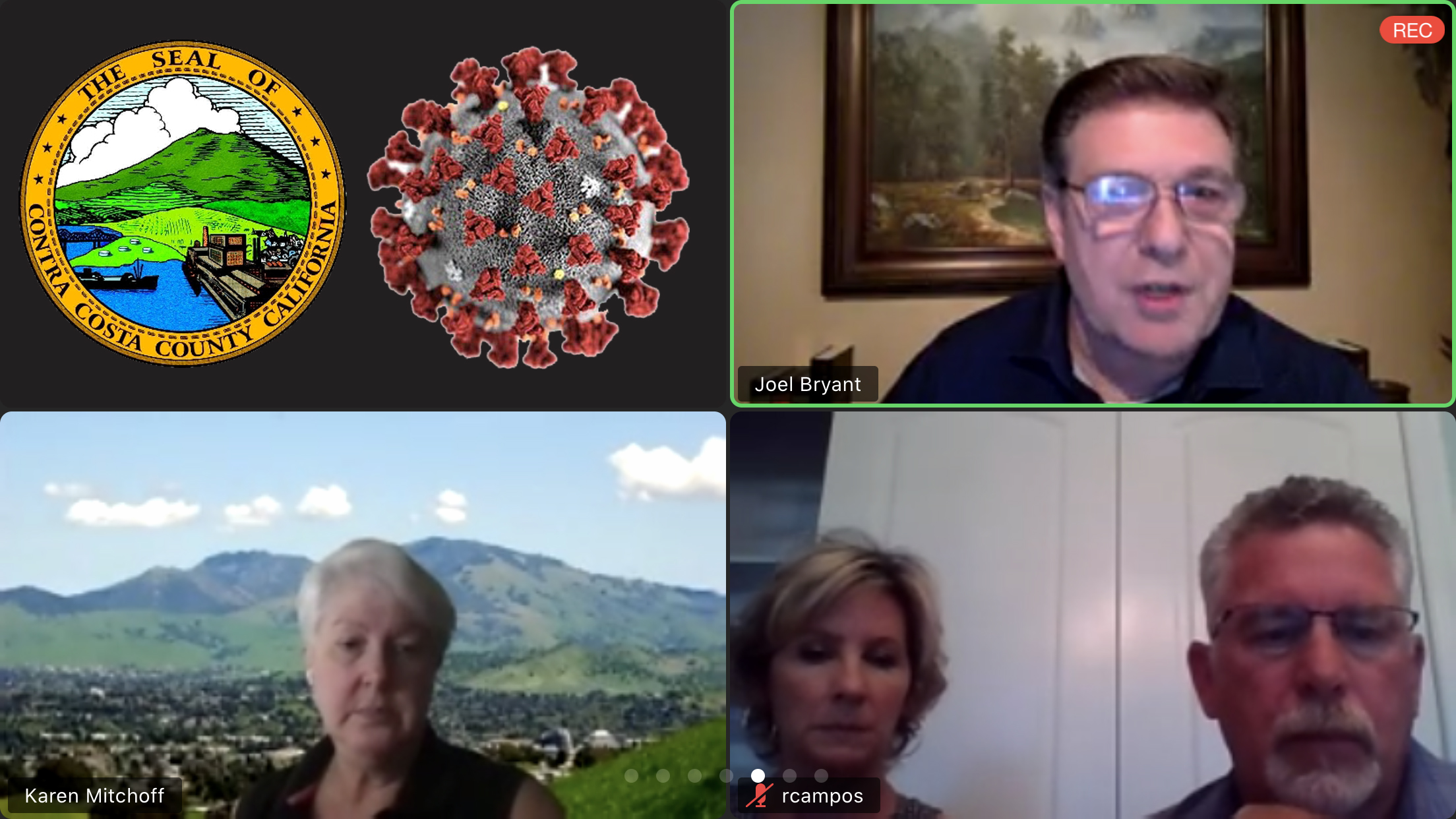
Screenshot of Board of Supervisors’ May 28, 2020 COVID-19 Ad Hoc Committee meeting using Zoom. Brentwood Vice Mayor Joel Bryant (upper right) speaks as Supervisor Karen Mitchoff (bottom left) and Michelle and Ric Campos listen.
Spiritual counseling is allowed in county, church services still aren’t; waiting for update next Tuesday to determine new orders
By Allen Payton
During the meeting of the Contra Costa County Board of Supervisors’ Ad Hoc Committee on COVID-19 Economic Impact and Recovery on Thursday, May 28, 2020, Board Chair Candace Andersen, Supervisor Karen Mitchoff, and County Health Officer Dr. Chris Farnitano heard from frustrated county residents on reopening the county. According to the agenda, the meeting was to “Consider the impacts of COVID-19 on religious gatherings and discuss pathways that may allow them to resume, if possible, within the limitations established by” Farnitano.
General Public Comments
A variety of residents spoke during public comments on issues not on the agenda
“Take back control from the Contra Costa County health officer and move on to Phase 3,” said Gertrud Jeffries.
Brentwood Vice Mayor Joel Bryant said he was, “asking our Supervisors of the Board to tell the county health officer to follow the governor in the guidelines.”
A woman who identified herself as “They Call Me Non-Esssential” spoke about the information provided by a doctor at John Muir Medical Center in Walnut Creek about more suicides than COVID-19 deaths in the county. “Dr. Farnitano said he hadn’t seen that data,” she said.
Robert Jackson, owner and CEO of Proforma Health Club in Walnut Creek, asked for guidance for health clubs that have a large outdoor area, and “more clarity on timeliness for reopening…after the expiration.”
Ric Campos of Campos Family Vineyards in Byron said, “We’re very involved in our community…hosting fundraising events and we have a tasting room. We can meet all the protocols. We submitted them to the supervisors. We also have a church that meets here, on Sundays. These numbers just don’t add up.”
“I understand Dr. Farnitano has a job to do. But he’s focusing on the medical. I’m asking our supervisors to look at the big picture, because this virus is hurting our businesses,” Campos continued. “Only 37 have died, which is horrible. But most of them are over 80 and 90 years old and others are over 70 years old. I’m asking our supervisors to step up. You have the authority to override the doctor. Something has to be done. It’s getting bad. So, please…”
“…help this community we’ve elected you to oversee,” said Michelle Campos, concluding her husband’s remarks.
Patricia McBroom spoke of “a community pool we can accommodate small groups. I would like the county to follow the CDC guidelines on small housing…for them to schedule their own uses. It doesn’t make sense to have one category.”
Tricia Wilkalis said, “I want to talk about these small businesses, I’d rather shop at them than the large retailers. I think they’re more safe.” She then spoke of mental health and a young man who attempted suicide. “I want you to reevaluate this lockdown and what it’s doing to our citizens.”
“There are exceptions to wearing masks,” said Supervisor Candace Andersen.
Dr. Farnitano said, “About wearing masks, this is about changing science and recommendations from the Centers for Disease Control. Most transmissions are from people without symptoms. Universal face coverings have a big effect on limiting the spread. People with medical conditions where wearing masks restrict their breathing, we need to let business owners know not to interfere with them not wearing masks.”
A question about dance, gymnastics and camps was asked.
“Where do you see dance classes coming in from the state order?” asked Andersen.
“The state has not provided guidance on that, yet. Our current order allows outdoor activities that allow for six feet apart, like Tai Chi classes,” Dr. Farnitano said. “I haven’t seen any differentiation, yet.”
He was then asked by Andersen about suicides, and that “the shelter in place does cause a huge emotional strain.”
“When we see recessions in general, that causes physical stress that leads to mental stress,” Dr. Farnitano said. “The shelter-in-place is causing a tremendous amount of stress. Looking across the county we’re not seeing a change in suicides. We’re reaching out to the hospitals to gather the data. It is a concern.”
Andersen encouraged people to dial 2-11 for crisis intervention or health services, for counseling and for help.
“This issue has been dominant in our calls between supervisors and health staff,” said Supervisor Karen Mitchoff. “Our sheriff will be gathering 24 months of data. There have been additional numbers of suicide in the count. But he’s not seeing a trend there. We don’t have that data, today.”
Andersen asked about outdoor dining, tasting rooms. When do you anticipate…where do you see that falling in, Chris?”
“Seated dining as opposed to take-out is in the state’s Phase 3. The state’s order doesn’t allow that anywhere in the state, yet,” Dr. Farnitano said. “A lot of health officers are talking about outdoor dining, first, because of the air flows and the spacing. It’s probably coming and the state’s going to be coming up with guidance on that.”
“We’re almost at two weeks next Tuesday since the last loosening of restrictions. What will the new order include…so businesses can prepare,” Andersen.
“We are working with the Bay Area. We are one human ecosystem…because a lot of people shop and work among the counties,” Dr. Farnitano explained. He then spoke of “expanding childcare to all folks not just those who are working, but people who are seeking childcare. We are looking at some services that don’t require close customer contact, like house cleaning, car washes, outdoor museums. But the higher risk, like the indoor retail…when to address the religious gatherings, which we know are high risk…there’s a large desire for that. The state just came out with guidance on those in the last few days.”
“We can’t make decisions without data and we need at least two weeks of data to see where the trends are heading,” he continued. “We are looking at next Tuesday, and if the data shows we aren’t looking at a new surge, then we will consider more opening.”
“Will we know before Tuesday so businesses can prepare?” Andersen asked.
Shelter-In-Place Order Doesn’t Expire on May 31st
“The current order expires May 31st” said Mitchoff.
“No, the current order doesn’t expire. It was extended indefinitely,” Dr. Farnitano responded. “Until we get two weeks of data which is Tuesday. We could put out something on Monday that this may be coming. When you put out an order, there is some lag time for it going into effect.”
Asked about a community pool with a small number of houses using the pool, maybe people can sign up with this household using the pool from 9:00 to 9:30 a.m., etc.?” Andersen.
“The state order does not allow for them. The local order cannot be more loose than the state. But I can look into guidance from the state,” Dr. Farnitano replied.
Asked about opening up playgrounds, he replied, “The two concerns about playgrounds are transmission from surfaces, which are difficult to be wiped down between uses and the closeness of those who gather. These prohibitions may be looked at in the future.”
Supervisors Don’t Have Authority to Override Health Officer
“We were asked about the authority to override the county health officer,” Mitchoff stated. “We do not have the authority to override a health officer according to state law. We have repeatedly check with legal authorities. You can imagine that when there is a public health issue you don’t want politicians interfering with that.”
Asked about housecleaners returning to work in Contra Costa County
“That is something we do have consensus on…and those services that don’t have close contact between the customer and the service provider. “Piano tuners would fall in with that, as well,” Dr. Farnitano replied.
Asked about football teams practicing and preparing for the fall season he said, “There is a lot of outdoor…conditioning that doesn’t require a lot of contact. Throwing back and forth of a football between two people, like throwing a baseball or playing tennis…those are the kinds of things you can stay far apart. Those are the kinds of things that are allowed. There are a lot of…conditioning things you can do.
Religious Gatherings
Andersen then steered the meeting toward the main topic of focus, religious gatherings.
“If we can’t go to the full 100 like the governor’s order…there may be some ways we can allow people to meet in person for worship services,” said Andersen.
Shawna Garvin spoke first during public comments on the item, said she attends “Golden Hills Community Church, a large church, 100 people, I don’t know how we would make that work. But I do know one way we could make it work, small groups. A consistent group of people, four to six people, ours is 14 to 16 people in our group. We are not supposed to be apart and separated in our faith.”
“Hebrews 10:24 and 25 reads ‘we should not make it a habit not to meet together’. This is a command,” she continued. “How can we meet in small groups? Sitting six to 10 feet apart. I’m not going to have my freedoms totally stretched.”
Wendi a member of Community Presbyterian Church in Danville said, “I’m totally in line with not opening churches. But I’m totally in line with what Shawna said about small groups.”
“Personally, I’m dying inside, not just spiritually,” she continued. “This goes for me as a Christian, but this goes way beyond this…about community…waiting for county orders to allow small groups. As if the county health officer can’t decide. He’s the one who decides. We’re stricter than the state.”
Chuck said, “our church has a capacity of 1,200. Why would we have to have seat coverings when restaurants don’t? The 100-person limit, frankly is arbitrary. What I’ve seen is people are starting to disregard rules, period. When you don’t have rules that make sense…that’s more dangerous. You need to relax the rules, now.”
A Mr. Cottle said, “Last Sunday I was in Sacramento and ate inside a BJ’s. It was nice. In addition to being a scientist that deals with infectious disease in healthcare…54% of churches have less than 100 people who attend on a Sunday. I’m privileged to pastor a small church…we seat 177. We could seat 35 people easy with social distance.”
“Back on the 11th you opened up a small group gathering for a graduation event,” he continued. “Allowing one and not allowing the other is a constitutional violation.” Cottle then called for “opening up churches along the state guidelines immediately.”
A member of St. Agnews Church in Concord said they have about 125 who attend their services. “When we put a 100-person limit would we have a problem if those extra 25 people sit outside and listen to the service, while social distancing? I challenge you to show data where people sitting six-feet apart outdoors is a problem from a healthcare perspective.”
“I’m really urging our supervisors to encourage, as well as Dr. Farnitano to really look at this, again,” said Joel Bryant. “As an elected official I feel personally responsible for everyone in my community.”
He then spoke of the need for counseling for those in need. “I encourage opening up and at least match the state…to eliminate some of these tragedies that are being brought on because of the COVID-19 situation.”
Jared Thompson, pastor of a Christian church in Walnut Creek said he was, “Asking what is permitted for me as a pastor. I have people suffering from depression in my congregation. I was told to try to deal with it virtually. We’re a church without a permanent facility. We rent Valle Verde Elementary. As soon as all this went down our services were cancelled.”
He referred to “outdoor fitness where people are six feet apart, I’ve even heard that singing is a deterrent. If a community group can be six feet apart, why can’t a small church meet outdoors? I wish there were more clarity. There are other churches that meet at schools and none of us know what we can do. And the disparity. We’ve been praying for you all as you make these decisions.”
A woman named Barbara said, “I’m from North Creek Church, but I’m not representing them. I’m a counselor there. We have 50 counselors. We’ve seen an increase in counselees…that have a lot of issues that are going on. I’ve been Zooming for 10 weeks, now, two-and-a-half to three hours. Zooming is not enough. You can’t read body language. When you have 0.11% of Contra Costa County that has been affected by COVID this really doesn’t make sense. Mental health is a big thing we deal with…we’re just ignoring that aspect. Also, let our pastors shepherd their flock and let them be responsible.”
Michelle Campos then said, “Doctor, I would like to challenge you. Suicides, violence, child molestation, these are things happening in Contra Costa County because you are keeping us locked down and that goes against how our Father has designed us. I’m not understanding why liquor stores, smoke shops, abortion clinics are deemed essential, but our churches…are not essential.”
“We’ve done our part Zooming for 10-12 weeks,” she continued. “We were not designed to live on science and data. I implore our supervisors to do something.”
“37 deaths, come one,” said her husband Ric Campos. “Doctor, please look at the big picture, not just the science and data. This is killing our society. I’m seeing him (Farnitano) do videos and 99% of the people are asking you to reopen and you just ignore us.”
Michael Weisman spoke of suicides in Contra Costa County and referred to a Bay Area TV news report in which the John Muir doctors presented the information. “Why would two doctors…lie?” he asked.
Weisman then spoke of the statistics from a couple months ago that showed, “3.4% of those who have died. The latest CDC statistics show 10% of that. I believe it is now time for the health official to reconsider his position. The supervisors should make a change in that position. The health officer doesn’t seem to care about our faith.”
Kent Dresdow, Senior Pastor at North Creek Church asked about their 1,200-person sanctuary. “To have a 100-person limit is pretty restrictive for us,” he said. “We want to follow our authorities. We are people waiting on both sides. We can meet with 25% capacity. Not the 100-person or less.”
“Would it allow for us to meet 100 people at different spaces on campus at the same time?” Dresdow asked. “My main concern is to be in compliance and super safe. Other churches…will have the same questions. Larger churches will.”
Igor Skaredoff said, “One of the reasons we have such low numbers of deaths…is because we have been practicing good social distances. But, listening to all these comments…I really commend your guidelines in a step by step fashion. The coronavirus takes two weeks to show up. If you continue to operate the same way…we can get there without losing too many people.”
A man named Stan said, “I hear a complete lack of flexibility in enforcing the rules. I don’t know if Dr. Farnitano can be more strict, or more relaxed. Do you have discretion? Whose interests do you have in mind? What I’m hearing ii your complete lack of flexibility…it’s big brother in Sacramento. To the pastor who wants to have an outdoor service, tell them you’re going to have an outdoor workout.”
Robert said “A lot of what you’re hearing is fairness. Fairness is really, really difficult to see in this. If we’re going to open up churches to 100 people, why are we all suffering so much and ruining our businesses? It’s like why can’t I go exercise at my health club but I can go to McDonald’s. It doesn’t make sense.”
Denise Porchia from Clayton said, “Karen you are my servant, government supervisor.”
“Uh, huh,” responded Mitchoff.
“We the people believe that God is the Creator of as us acknowledged in the Declaration of Independence” which she then read. “Let’s not forget we the people are creators of government…we demand our servant government…of the jealously guarding of our unalienable rights.”
A woman named Karen then said, “We remind you of the oath that you have…sworn when you became our public servants,” and then read the oath of office all elected officials take in California. The Constitution of the U.S. is the supreme law of the land…for every level of government.” She then quoted Alexander Hamilton from Federalist 78.
Paul Taylor then said, “The Supreme Court of the United States…that no law is contrary to the Constitution is valid. Our state is ruling outside of its control. Government is servant to the people not the master. Servant is not authorized to force the people to wear masks…to stay at home…to close their businesses. It does not matter if the servant believes such mandates will keep the people safe or that most people want it. Let us never forget that the Constitution guarantees to each state a Republican form of government where the rights are supreme.”
Michelle O’Connor asked, “Do you know if the de facto orders upon the people are legal? Or do you rely on the advice of the people. If you don’t know the supreme law how do you know if you’re violating them? Do you know what the penalty is for violating them? There is not immunity for acting against the contract. You will be held accountable.”
Scott Bennett a former U.S. Army Officer said he was notifying the supervisors of violating the rights of the people.
“They shall be fined…and imprisoned no more than 10 years” he stated. “I hereby give legal notice…if an rights or any citizens of the United States of wearing a mask, or taking a vaccine…you will be criminally prosecuted and civilly prosecuted. You have been notified.”
Supervisors Respond, Mitchoff Defends Herself
The two supervisors then took up the matter.
Mitchoff spoke first saying, “Candace as a matter of protocol, we have another Zoom meeting at 3:00 p.m. We have to leave ample time for remarks…” from her, Andersen and Dr. Farnitano.
“Some of the questions put to Chris are directed at us,” said Mitchoff. “I found some of the comments to be personal attacks on Dr. Farnitano, which I find to be inappropriate. He has no personal stake in this order. He is using his best medical and scientific background in coordination with other Bay Area health officers. Personal attacks are inappropriate.”
“People who are either for or against an issue appear to be in the majority because they’re engaged, when people speak to it, it appears more or for or against it,” she continued. “We are a representative government, not servant government. We can’t just listen to the loudest voices in the room. Someone said…he was ignoring their pleas. That’s not true.”
“What we have told Dr. Farnitano is to be more consistent with the state,” Mitchoff said. “I’m a faith-oriented person. I know Candace is and the rest of our board is. We are sharing the same concerns you are. So, we understand the issue. I’d love for any of you to take my place and to have any other issue. I’m very aware of what the Constitution says, and I’d be more than happy to be put under scrutiny that I’ve followed the laws of the state of California.”
“There are five indicators issued by the state of California. We don’t even meet three of them,” she said. “Relative to church services…I know it’s hard. My church probably holds 400 people. The smaller number would be the 25% of square footage. We can talk to our health officer about different types of church services. I’m looking at a variety of churches that have a number of different buildings. Church services can be staggered. I feel I must do what is best for everyone in this county.”
“We can have our faith-based communities come together sooner rather than later,” said Supervisor Andersen.
Dr. Farnitano Responds
“I want to thank everyone who has offered me their prayers,” said Dr. Farnitano. “We have passed two key milestones in the last day or so. There have been over 100,000 deaths in the U.S. We have only had 37 deaths in our county…that is because our community has followed the guidelines. If we had the same statistics as the country, we would have had over 300 deaths. We know that Contra Costa County is older than the U.S. and we know that age is a factor in the mortality rate. The other milestone is 100,000 cases in California. The Bay Area put the shelter-in-place order sooner. It has opened up step by step but slower than the state. If we had the same rate of cases as the State of California, we would have had double the cases.”
“Contra Costa County is a more dense county than a lot of the state,” he continued. “We have to look at the deaths that have occurred but also those we have prevented.”
“Worship is really important to me, too,” Dr. Farnitano said. “My church has been doing Zoom services for several weeks, now and I understand it’s not the same. One issue is around spiritual counseling…it’s part of mental health. Spiritual counseling is allowed. I want to make sure our FAQ’s are clear and include that.”
As for churches holding services, again he said, “There’s a lot of science that outdoor meetings are less of a risk. Indoor meetings are more of a risk. There was an outbreak in Mendocino County because of a church service. We can look at following the state guidelines in allowing church services.”
“We have a data team looking at data state by state, what’s leading one state without a surge, are they opening up completely or in stages, has there not been enough time, or testing,” Dr. Farnitano explained. “We’re trying to learn from that. We tried to learn from China’s and Asia’s experience, Europe’s experience, and now the other states’ experiences.”
“Each area is unique. Contra Costa County has unique industries…density,” he stated. “We are also looking across the Bay Area at some surges. In Alameda County we are starting to see a surge in hospitals to the levels in March.”
Dr. Farnitano mentioned patients being transferred from a hospital in Richmond to one in Alameda County. “Some of those hospital numbers in Alameda County are residents of Contra Costa County,” he added.
“These decisions are mine…but I’m not looking at them in a vacuum,” Dr. Farnitano stated. “I’m taking input from meetings such as this. I have several deputy health officers. I take input from the Board of Supervisors…also hearing from businesses. Also talking with other health officers across the Bay Area and at the state.”
“We want to open safely and not have another surge,” he said.
“We want to open as soon as we can,” Andersen said. “We won’t get back to normal. We are hearing from several of you about opening up. We are close to families getting back together.”
“We really are looking at with the state these expanded bubbles…small support groups in the church, having a more expanded group, your extended family, your small groups. We are looking at ways to have that happening,” Dr. Farnitano concluded.
“I do believe we will have more information from the state on their order. Maybe half of the agenda (for next week’s Ad Hoc Committee meeting) can be devoted to the new order that will be coming out,” said Mitchoff. “I do want to address dance and other recreation. I’d like to talk about restaurants. But I don’t think we’re there. I’d like to start with businesses with the least amount of impact.”
With that, Supervisor Andersen concluded the meeting.