• Home
  • About The Herald
  • Local Agencies
  • Daily Email Update
  • Legal Notices
  • Classified Ads

Contra Costa Herald

News Of By and For The People of Contra Costa County, California

  • Arts & Entertainment
  • Business
  • Community
  • Crime
  • Dining
  • Education
  • Faith
  • Health
  • News
  • Politics & Elections
  • Real Estate

BART offers 50% off all Clipper fares all September

September 1, 2021 By Publisher Leave a Comment

Discount will apply to all fares on Clipper and will be stackable with Youth, Senior, RTC, Clipper Start and Gator Pass Clipper discounts.

BART will offer a special promotion of 50% off all fares on Clipper for the entire month of September 2021.

The discount will apply to all fares on Clipper and will be stackable with other Clipper discounts. That means 50% off will be given on top of already discounted Clipper cards such as Youth, Senior, RTC, Clipper Start, and the Gator Pass.

The reduced fare will be automatically deducted when using Clipper at the fare gates. Our online Trip Planner and Fare Calculator have been updated to show discounted fares during the month of September. While BART will share discounted fares with other apps and websites , we can’t guarantee that non-BART sources will display them.

Printed fare charts at vending machines in each station will not be changed for the month of September but a large decal will be posted noting there is 50% off the published fares.

BART is extending the discount to welcome riders back to the system and to thank those who have continued to ride throughout the pandemic. BART’s ridership continues to grow each week. Current weekday ridership is at 100,000 trips, representing 25% of pre-COVID weekday ridership. Weekends are recovering at a faster rate. Weekend ridership is at 45K-65K trips, representing 40% of pre-COVID weekend ridership.

As of September 1, the various transit agencies that connect with BART will have new schedules in place that offer improved connections between systems. Many agencies are also offering discounts and other special promotions during the month of September.

Visit www.AllAboardBayArea.com for details on how all 27 Bay Area agencies are collaborating to deliver services that will restart our region and get people where they need to go.

Get Clipper

The discount is only available when using Clipper. It is not available on magstripe paper tickets. 98.6% of our riders use Clipper cards. There is a one-time $3 fee to purchase a new Clipper card from a BART station vending machine. Clipper is currently offering free Clipper cards when setting up a new Clipper card using the new Clipper app. The card is also free if you  order it online and set up automatic reloading.

Clipper Discount Cards

BART’s 50% off in September promotion is stackable with other Clipper discounts available for youth, seniors, riders with disabilities, and low-income adult riders. Proof of eligibility is required for discount Clipper cards and therefore are not available at station vending machines.

  • Youth 5-18 years old get 50% off BART with a youth Clipper card.
  • Seniors 65 and over get 62.5% off BART with a Senior Clipper card.
  • Qualifying low-income adult riders get 20% off BART with Clipper START.
  • Riders with qualifying disabilities get 62.5% off BART with the RTC Clipper card.

Youth, senior, and START cards are all free and BART does not charge for RTC cards when obtained at our customer service window at the Lake Merritt Station.

Filed Under: BART, News

BART schedule change begins Monday, March 22

March 18, 2021 By Publisher Leave a Comment

Few changes but paves the way for potential increases in service; agents added to Antioch Station 

BART will make some minor adjustments to its schedule effective March 22, 2021. While service hours will remain unchanged for now, BART staff will closely monitor ridership and demand as the region begins to reopen.

The new schedule starting on March 22nd is now available on our Trip Planner and on the BART (Official) App. PDF’s of the current and new schedule timetables can also be found here.

Preparing to add more service as riders return

Weekday riders will have the same frequency they experience now but the new schedule allows us to add 26 additional trips to enhance 15-minute commute periods when and where ridership data reflects more riders are returning. BART’s 15 Step Plan to Welcome Riders Back calls for matching service levels with demand. BART will add these new trips when train car loading data shows there are consistently more than 30 people per car on a train. Current ridership has not yet surpassed a post COVID high of 55K weekday riders.

Saturday service will match Sunday service

Starting Saturday, March 27, Saturday and Sunday will have identical schedules.  Saturday service will run as three route service (Yellow, Orange, and Blue), which means some riders may have to transfer to finish their trip like they do on Sundays.

Station Agents added to Antioch Station

For the first time since its grand opening in May 2018, the Antioch Station will be staffed with Station Agents. The extension was initially developed as a new concept to provide customer service through supervisors in the nearby control center and call buttons at the station. As part of the General Manager’s Listening Tour in 2019, BART General Manager Bob Powers rode the first trains of the morning with Antioch customers. Part of the feedback he received was that riders felt they were on their own at the station and they wanted to see more BART staff onsite. Adding Station Agents will help make a more seamless riding experience and will better integrate the BART to Antioch extension into the core part of the system, highlighting Station Agent interaction as being an integral part of the BART experience.

Improved service for Millbrae riders

BART trains will arrive and depart at Millbrae Station from Platform 3, the one closest to Caltrain at the station. This significant improvement will allow riders at Millbrae to cross the same platform to transfer instead of the previous walk up and through the concourse. BART and Caltrain transfer times and wayfinding at the station will also receive improvements.

One seat ride to SFO for weekday Richmond riders

Trains from Richmond will now have a one-seat ride to SFO (via Millbrae) instead of requiring a transfer at MacArthur on weekday. This change means SFO is effectively the terminal station for both the Yellow and Red Lines on weekdays.

Sunday single tracking days

On Sunday single tracking days, the Dublin/Pleasanton (Blue) line will now terminate at Montgomery, riders will need to transfer to a Yellow line train to finish their trip. Previously the Blue line extended to 24th Street/Mission on single tracking days. On Sundays when there is no single tracking to upgrade the electrical power system in Downtown San Francisco, the Blue line will terminate at Daly City.

Filed Under: BART, News

Pittsburg man charged with 5 counts, including attempted kidnap of potential BART patron

March 11, 2021 By Publisher Leave a Comment

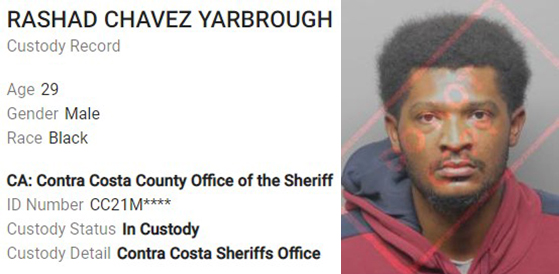
Source: CCCSheriff.

Has history of arrests dating back to 2014

By Scott Alonso, Public Information Officer, Office of the District Attorney Contra Costa County

Yesterday, Wednesday, March 10, 2021, the Contra Costa County District Attorney’s Office filed five counts against Rashad Chavez Yarbrough (30-year-old Pittsburg resident), including a felony count for the attempted kidnapping on March 6 of a female. The case was investigated by the BART Police Department and presented to our office for a filing decision on March 10.

On March 6, the victim called for an Uber ride to go to the Pittsburg Bay Point BART station. When she left her residence, she spoke with the defendant who offered her a ride to the station. She declined the offer, yet the defendant followed her Uber ride to the station. The victim did not know the defendant, nor had she seen him before.

Once the victim’s Uber ride dropped her off at the BART station, the defendant followed her down an access road. The defendant tried to entice the victim to enter his car, but she refused. Yarbrough eventually got out of his car and approached the victim. He grabbed at her arm and tried to get her into his vehicle. In doing so, her wallet fell out of her purse and he picked up her wallet.

The victim ended up fleeing the area to a nearby shopping center. After the police were called to the scene, the defendant fled the area in his vehicle. The following day, when police went to check in on the victim, the defendant arrived at her residence and he was arrested. A search of his vehicle revealed a firearm and methamphetamine.

The complete counts filed against Yarbrough are as follows:

  • Attempted Kidnapping, Felony
  • Possession of a Firearm by a Felon, Felony
  • Petty Theft, Misdemeanor
  • Possession of Controlled Substance, Methamphetamine, Misdemeanor
  • Possession of a Smoking Device, Misdemeanor

Case information: People v. Rashad Chavez Yarbrough, Docket Number 04-201433-0

According to localcrimenews.com Yarbrough has a history of arrests dating back to 2014, by various agencies including Pittsburg PD, Antioch PD, Concord PD, Fremont PD and Oakland PD, for burglary, resisting arrest, possession of drug paraphernalia and grand theft.


Filed Under: BART, Crime, District Attorney, East County, News

BART Ambassadors mark one-year anniversary: “We see a lot of things”

February 11, 2021 By Publisher Leave a Comment

Ambassador Sequoia Taylor talks with a customer on a train.

Story by MELISSA JORDAN | Photos by MARIA J. AVILA BART Communications 

The word “ambassador” derives from the Latin ambactus, which dates to the 14th century and means servant or minister.

BART Police’s Transit Ambassadors mark their first anniversary on the job today. They are public servants, ministering to the needs of passengers on BART train – offering free face masks, giving safety tips, helping with directions, connecting those in crisis with services.

And they are making a difference.

“Having additional uniformed personnel has been received very well by our riders and employees,” said Deputy Chief Angela Averiett, who heads the Bureau of Progressive Policing and Community Engagement, a new unit created by Police Chief Ed Alvarez last year. “They are the face of BART out there interacting with the public.”

Since the start of the program, Ambassadors have made more than 12,000 educational contacts, the highest number of any type of contact. They checked in with nearly 10,000 people on platforms and handed out more than 1,000 masks to members of the public who needed one. In only a fraction of contacts, 132, did they need to contact a Police Officer for assistance.

The Ambassadors are part of a larger shift within BART Police to find new approaches using unarmed personnel to respond to people in crisis, such as mental health emergencies, drug overdoses or the unhoused population. With additional crisis intervention specialists yet to be hired, there will be an infusion of 40 additional positions in total, all devoted to train presence.

Ambassadors Brandon Fenwick (foreground) and Sequoia Taylor walk a train car.

“With just that one piece of the Ambassadors, that alone is a huge accomplishment,” Averiett said. “I can’t wait to see the impact in our system when we have all of these positions in place.”

Like a diplomatic corps, the Ambassadors speak a multitude of languages – Spanish, Chinese, Tagalog, Cambodian, Farsi – and they are dedicated to communication, education and presence.

Ambassador Brandon Fenwick’s Spanish language skills proved lifesaving one day when he and his partner persuaded a man who was experiencing a mental health crisis to get out of the trackway at Glen Park Station.

“The Millbrae train was just 1 minute out, and he didn’t speak any English,” Fenwick recalled. “We were able to get him out of the trackway just in time.”

Fenwick was part of the original group of 10 Ambassadors who started their work on Feb. 10, 2020.

Ambassadors Fenwick and Taylor give a mask to customer and ask him to wear it.

Fidel Escario said he wanted to be an Ambassador because the job involves working closely with the public and has an immediate positive impact.

“We help people and answer their questions,” he said. “If they don’t have a mask, we give them one. We see a lot of things.”

The Ambassadors are trained in de-escalation and anti-bias techniques and carry radios to call for backup from a BART Police Officer if needed. Escario recalled one situation on a train when a man was exposing himself and cursing at Ambassadors; they radioed for backup and Officers arrested the man.

Ambassador Sequoia Taylor checks the platform during a stop at Coliseum Station.

Sequoia Taylor joined the ranks of the Ambassadors just last month in January 2021.
“I grew up in Oakland,” said Taylor, who has seen firsthand the issues that can result from disproportionate policing impacts in Black and brown neighborhoods. “You’ve got to treat people with respect. You can convey so much just with how you carry yourself, your demeanor.
Two of the original Ambassadors have moved up into other positions within the BART Police Department, showing the path of upward mobility that can be available for workers starting in the entry-level Ambassador roles.

“We have a lot of good interactions with riders,” Fenwick said. “They’ll say ‘thank you’ or give us a thumbs-up.”

The Ambassador Program won an Innovation in Public Safety Award from the national foundation Transit Center in 2020

Filed Under: BART, News

BART announces its 50 accomplishments in 2020

January 6, 2021 By Publisher Leave a Comment

At BART, we are firm believers that by thinking strategically, working hard, and engaging community, we can and will achieve remarkable things. With that, we chose to end 2020 with optimism.

Here is a list of 50 BART accomplishments in 2020.

Let’s start with improvements to the rider experience:

  • We now have 17 Fleet of the Future trains in service
  • We opened Berryessa and Milpitas Stations
  • We began offering 20% fare discount for eligible low-income riders with Clipper Start

We launched some new features:

  • Contactless parking payment via the official BART app
  • Customized in-app notifications to make it easy to get the information you need
  • Option to text BART police (510) 200-0992
  • An online merchandise store so you can celebrate your love for BART

We took big steps forward on exciting multi-year projects:

  • Awarded the contract to design and build a modern Communications Based Train Control System that will dramatically improve future BART service
  • Awarded the contract for BART’s Digital Railway project to bring next-generation wireless connectivity to riders across the system
  • Awarded contracts and began construction to build 22 canopies over entrances at BART stations along Market St. in downtown San Francisco
  • Began construction to replace 41 escalators at downtown San Francisco stations
  • Initiated Fare Coordination & Integration Study with MTC and regional transit agencies

We made changes within policing:

  • Hired Ed Alvarez, a 23-year veteran of the BART Police Department, bringing a new vision for safety
  • Created a train team of 12 police officers dedicated to riding trains and walking platforms on nights and weekends
  • Launched the successful and award-winning unarmed Ambassador Pilot and formalized the program
  • Hired 35 officers, bringing vacancies to a new low of 20
  • Established the new Progressive Policing and Community Engagement Bureau within BPD

We advanced police reforms:

  • Began Integrating Communications, Assessment, and Tactics (ICAT) training to give officers the skills to safely defuse critical incidents with people experiencing a mental health crisis
  • Banned the use of the Carotid Control Hold
  • Expanded the officer-worn body camera activation buffer with new audio requirement
  • Held 16 stakeholder outreach meetings to solicit feed-back on new public safety approaches with 1000 survey responses

We focused on infrastructure:

  • Completed two major track rebuilding projects at Orinda and Hayward
  • Accelerated 34.5kV power cable replacement, rail profiling, rail and third rail replacement, tunnel waterproofing, lighting projects and more

We continued efforts to modernize our stations:

  • Began construction for 19th Street Oakland Station Modernization; advanced modernization construction at Powell Street and El Cerrito del Norte stations
  • Designed and installed new swing style fare gates with a dramatic costs savings due to innovation while also uncoupling BART from a single vendor
  • Started construction of energy-efficient lighting upgrades across 14 parking structures, saving the District approximately $22M in energy and maintenance costs over 20 years
  • Awarded $3.5 million in Cycle 1 of Measure RR Safe Routes to BART Grant Program to four cities to improve last mile bike/ped access to BART stations

We supported local, small businesses:

  • Hosted 44 outreach and matchmaking events between small businesses and Primes to increase opportunities available to small businesse, helping to continue essential construction projects
  • Awarded a Progressive Design-Build contract for the new BART Headquarters in Oakland with 32% small business participation

We continued our Transit Oriented Development (TOD) efforts:

  • Adopted AB 2923 development principles and released BART’s TOD Work Plan
  • Amended policy to support the production of affordable housing by allowing for a discount of up to 60% from fair market value for land for projects with affordable housing
  • Approved plans for development at West Oakland Station that includes 762 housing units, 30% affordable
  • Selected development team to advance development at El Cerrito Plaza Station
  • Our development partners completed over 600 new homes during the pandemic, and broke ground on 400 new homes, 150,000sf of office, & 164 room hotel

We focused on financial stability:

  • Secured AAA bond rating
  • Advocated for and secured emergency relief funds
  • Secured dedicated funding for our long-term efforts to reduce crowding and increase service:
    • Full Funding Grant Agreement for FTA Capital Investment Grant ($1.169B)
    • California Transit and Intercity Rail Program ($107M)
    • California Solutions for Congested Corridors ($60M)

We invested in our employees:

  • Developed an emergency budget plan to avoid lay-offs
  • Approved new labor contracts more than 6 months early
  • 16 employees from 10 departments completed the Government Alliance on Race and Equity training series and established a Race and Equity Action Plan
  • Increased inventory and distribution of PPE and disinfecting products, deployed free COVID testing and contact tracing

We prioritized COVID-19 response:

  • Was one of the first transit agencies in the U.S. to release a comprehensive pandemic response plan with the launch of the 15-Step Welcome Back Plan
  • Made available free masks at all stations
  • Offered free hand sanitizer stations systemwide
  • Sharing crowding data 
  • Testing disinfecting technologies and upgraded air filters
  • Reprioritized cleaning schedules to ensure all train cars are sprayed with disinfecting mist every 24 hours
  • Coordinated with the region’s transit systems to develop the Healthy Transit Plan, establishing a baseline set of COVID-19 response measures across all systems
  • Accelerated efforts for a contactless experience with 100% Clipper only conversion systemwide
  • Partnered with community organizations, county officials and medical groups to provide free COVID-19 testing in our parking lots and plazas


Filed Under: BART, News

Parking and circulation improvements at Antioch BART Station in January

December 31, 2020 By Publisher 1 Comment

Graphic: BART

As we expand parking at Antioch Station, we will be making some modifications to the existing parking lot to increase permit parking. Effective January 11, 2021, Lot B, which is the parking area directly in front of Antioch Station, will be converted to all permit parking. The only exceptions are that the ADA stalls will remain fee parking and the motorcycle stalls will remain free. These modifications require adjustments in signage and pavement markings.

All parking stalls that are to be closed temporarily for construction will be signed at least 72 hours in advance. Please look out for barricades and signage to guide you around the work areas during this time.

Please see the attached map of work areas and the final parking lot configuration. Be advised that the final configuration will require customers parking in the solar panel covered lot (Lot B) to display a BART parking permit, available from Select-a-Spot.com. Fee parkers may park in the adjacent parking lots. Additional fee parking (roughly 850 parking stalls) will also be available Spring 2021.

We apologize for this inconvenience and appreciate your patience during this construction.

During the current COVID-19 pandemic, some BART projects, including Antioch Station Parking Expansion Project, have been designated as essential. For this reason, construction activities on the Antioch Station Parking Expansion Project will continue for the time being. BART and Contractors will ensure that workers comply with all CDC guidelines including the social distancing requirement. BART and Contractors will make adjustments as updates to the current situation are provided.


Filed Under: BART, East County, News

Senator Glazer calls BART labor contract extension “premature”, “big mistake”, Director Allen one of two to oppose

December 4, 2020 By Publisher 1 Comment

State Senator Steve Glazer and screenshot of BART Board meeting, Thursday, Dec. 3, 2020.

Board approves contract “after secret negotiations were held during BART Directors’ campaign elections” he said.

“…giving space to someone who can’t pronounce our past GM’s name or spell eBART correctly and someone who makes false claim after false claim is a disservice to the public and spreads lies.” – BART Director Li

“These agreements offer BART budgetary stability as we plan our recovery from COVID-19.” – Board V.P. Foley who voted in support.

“The contract extensions come seven months before the contracts are due to expire, locking in employee costs at pre-pandemic levels…at the level that it was when we were carrying 410,000 riders each week day and now we carry about 50 (thousand).” – BART Director Allen

By Allen Payton

In an attempt to get them to reconsider the proposed labor contract with employee unions, State Senator Steve Glazer challenged the BART Board during their meeting on Thursday, Dec. 3. He asked why they were considering the contract long before it’s set to expire, and more is known about the impacts of COVID-19 next year. In response, he was called a liar by one director.

Nevertheless, the BART Board voted 7-2 in favor of the contract, with Directors Debora Allen from Contra Costa County and Liz Ames from Alameda County casting the votes against. Board Vice President Mark Foley who represents other portions of Contra Costa County voted in favor of the contract extension.

Glazer issued a statement earlier this week about BART’s announcement “on Thanksgiving eve…(about) a tentative labor contract with their represented groups, after secret negotiations were held during BART Directors’ campaign elections.”

“Along with other specific contract changes, this tentative agreement is premature and a big mistake and will likely harm BART riders, commuters and taxpayers through fare hikes and service erosion,” his statement continued.

Glazer read most of the statement during the Thursday meeting, but offering additional comment.

“I want to be clear what I have to say reflects my views of accountability and trust that the public expects from all of us,” he said. “I think we all agree that BART is in a financial meltdown due to the pandemic and it’s not clear to me that you have a clear plan for recovery. The district’s own financial analysis projects a shortfall of tens of millions of dollars by next summer amidst the steepest decline in ridership in your agency’s history. My view, the district needs all the flexibility it can to avoid a financial disaster. Yet, BART is tying its hands with this agreement.”

“In the first half of 2021 BART will have a clearer idea about the COVID-19 vaccine availability, ridership improvements, any potential financial bailout assistance from the federal government, and the results of your early retirement incentives that have already been offered to existing employees,” Glazer explained. “All of these potential outcomes will provide important budgetary insight that should shape any new contract terms. But instead of waiting for that information, you are now rushing to approve a contract, negotiated behind closed doors, with no public notice and it will prevent you from making any kind of targeted salary reductions if your revenues do not recover. This will likely lead to service reductions and fare increases which will hurt the very people you are here to serve.”

His statement issued on Monday adds, “BART is leaving few options but to lay off employees and curtail the number of trains, which would further depress ridership and deepen the agency’s financial crisis.

“So, I come here with a question,” Glazer continued during the meeting. “The current labor contract with your representative employee groups doesn’t expire until July 1st, 2021. So, why did the district make an early agreement with so many economic unknowns?”

“It’s my understanding that BART has not even done a salary survey of other transit districts and public agencies to determine if the current salaries called for in this agreement are needed to recruit and retain qualified employees, basic data needed to inform any effective negotiation,” he said. “I question whether the failure to conduct a salary survey is keeping with board policy and procedures.”

“Now, the public was never told when your negotiations started. I’m told these negotiations were initiated by the Board in September and October. If true, that means that directors were negotiating with BART unions on their salaries and benefits on one hand, while asking the same unions for campaign contributions with the other hand. This is an outrageous injection of politics in a hugely consequential employer-employee agreement. And by setting the terms of the agreement at three years rather than four years based on past contract durations, the future contract will be negotiated during another election year.”

“You know that, Board members, before you came to this board for the most of you, had worked for a long time to ensure the contract negotiations would not be immersed in politics and election year circumstances. So, that four-year duration was done purposely. You unravel that in this proposed contract before you.

“In this agreement, for the most part, you’ve abandoned any of the work rule changes that were central to the 2013 contract negotiations. Where have those work rules been laid out, publicly disclosed and discussed, so that we can understand why they’ve been abandoned in this agreement.”

“You know, when the strike happened in 2013, BART management was clear that the work rules were probably more important than the salaries and benefits being negotiated. It had that kind of consequence and impact on the agency. But there’s a complete void of understanding or knowledge about what efforts were made to negotiate those work rules.”

It reversed important e-BART reforms that were instituted by former General Manager Grace Crunican. Again, BART, the board members, and the management (were) very involved in establishing those eBART reforms which you’re throwing out in this proposed contract.”

So, it’s not surprising to me, that you are moving forward with due haste to approve these negotiations and rush this contract through with very little public review, and I think that it’s because the details and the consequences are uncomfortable.

“I would hope that you will reconsider what you are doing, today and take a more deliberate and cautious approach to these negotiations as you consider the full impact of the pandemic on our economy. It would be best for your financial well-being and more importantly for BART riders throughout the Bay Area.”

“In conclusion, let me just say that the foundation of your service as board members is to ensure that this transportation system is able to function during good times and bad times. This contract continues the limitation against training management to run the trains during a work stoppage. So, all of BART riders, many of them low-income people who can’t afford to stay home, will be prevented from getting to work under this contract provision. We’re talking about teachers and nurses, social workers, grocery clerks and other essential workers, who will all be left stranded if your trains stop running because you created this self-inflicted problem.”

“This strike protection provision is an abdication of your sacred duty and will limit future boards from helping the commuters when matters cannot be worked out at the bargaining table. And listen, we all would strongly hope that all matters can be worked out at the bargaining table.”

In  his issued statement, Glazer included, “BART’s management doesn’t want the public to see what they are doing because they know that BART riders and other Bay Area residents would not support this agreement if they understood its details and its consequences.”

The BART Directors then took up the issue of the labor union contract.

General Manager Robert Powers responded to Glazer, saying, “I was the one…negotiating these tentative agreements with our labor partners. There were no elected officials in those discussions. I was supported primarily by our chief labor negotiations officer as well as our AGM of Operations. I wanted to be…crystal clear that it was me leading these negotiations under the authorization granted to me by the BART Board.”

During public comments, Sal Cruz, president of AFSCME Local 3093 said, “Our work has accelerated during this pandemic at great risk to our employees, as we position ourselves for the recovery we know will come. Proper positioning will be critical for the survival of all transit and for the Bay Area economy that is now linked to BART. Thank you for your leadership during these challenging times. Every transit agency in the country is in the same position as you are, now. The decision before you, today, is not an easy one. But it allows us to focus on rebuilding o ur system, continuing to provide safe transportation for our essential workers and preparing for the return of our riders. The workforce is behind you, the riders are behind you and the Bay Area is behind you.”

Li Calls Out Glazer

BART Director Li speaks in favor of the contract. Video screenshot of board meeting, Dec. 3, 2020.

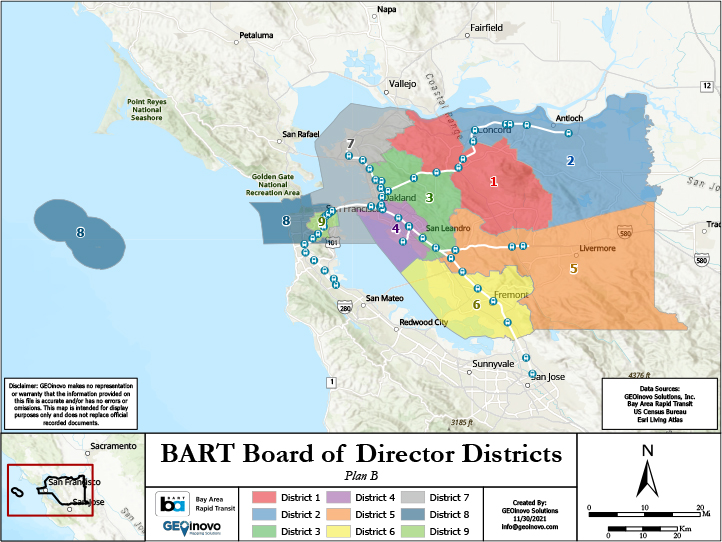
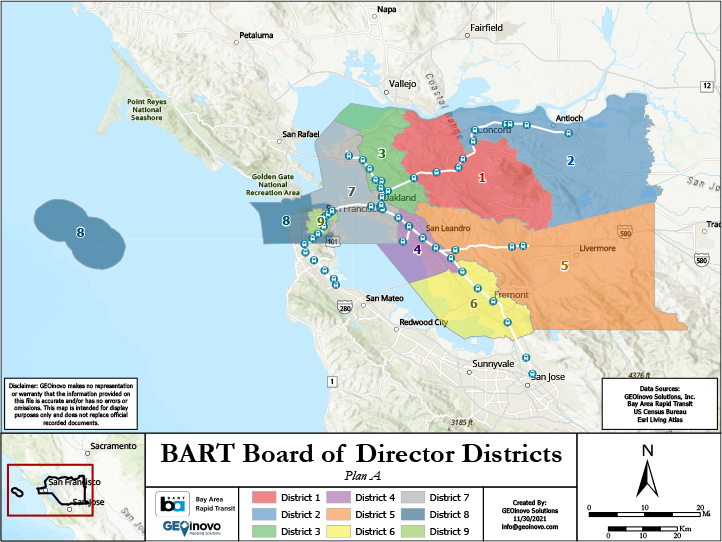
BART Director Janice Li, who represents District 8 which includes portions of San Francisco, spoke next calling out Glazer for lying, mispronouncing the past general manager and misspelling eBART (it was spelled “e-Bart” in his statement from earlier in the week.

“I am proud to vote yes on this action, today. A yes vote, today is a yes vote for BART, is a yes for our riders and a very, very important yes for our workers,” she said. “Voting no makes BART an enemy to our workers and our riders.”

“There has been a lot of talk about this decision coming forward as too early or as a result of private meetings. I just want to be very clear that this claim is factually not true,” she stated. “First, I’m a member of the board’s labor negotiations review committee. We have been meeting since May of this year, then again in July, then again in August. These meetings are open to the public. They are publicly noticed and at subsequent board meetings we always give updates during board reports.”

“Second, we have held multiple closed session meetings regarding labor relations in recent months, and once again they have always been noticed as part of our board agenda,” Li continued. “Third, people who are saying that this is too early are saying that because the financial situation ahead is so unclear and that the board should wait until more is known. The truth is that things will inevitably change. But our staff has been doing excellent work in scenario planning and being transparent about all the potential futures, both good and bad. Furthermore, this contract is not one in the same as our budget revisions. In fact, this does not mean layoffs can’t or won’t happen. So, saying that by voting, yes it ties our hands or limits our options is incorrect.”

“And fourth, respectfully, I strongly refute the false claims made by Senator Glazer. Honestly, giving space to someone who can’t pronounce our past GM’s name or spell eBART correctly and someone who makes false claim after false claim is a disservice to the public and spreads lies. The idea that this was timed with elections is wrong and I will speak for myself, I was not up for election, re-election and I have not raised a cent for re-election, this year and I was not even endorsed by unions when I first ran in 2018.”

“So, what we actually have before us is a result of an incredible collaboration between BART management and labor unions and at the end of the day, who benefits?” she asked. “It’s our riders.”

She then thanked “the entire BART team for rebuilding trust with our labor unions and of course I want to thank our labor union partners for being collaborative at an incredibly difficult time.”

“As a board member I’m incredibly grateful that this decision is coming to us sooner rather than later so we can get back to focusing on running a safe system for our essential workers and implement a successful recovery plan during and through the pandemic that has raged every public transit agency, every public institution and every aspect of our lives. Let’s vote yes on this, today and if you remember our new slogan from the board workshop, earlier this year which, I know feels like years ago, ‘Let’s Go,’” she concluded.

Allen Offers Arguments Against Contract

BART Director Debora Allen speaks during the board meeting on Thursday, Dec. 3, 2020. Video screenshot.

Director Allen spoke against the contracts and supported what Glazer said.

“First, I want to touch on the private meetings because that seems to be a contentious little dialogue. I believe that is absolutely how these contracts come to be,” she said. “It is unfortunate the board discussion about these agreements doesn’t happen in public session. I believe we shouldn’t be discussing the contract extensions in closed door sessions where board members may say things that they would not say in public. In addition, I really do believe not enough of our own closed board discussion has occurred prior to this day of ratification.”

“There’s so much operational uncertainty, right now for BART and I’m not comfortable that the financial projections and plan give us the data we need for this decision,” Allen continued. “It’s really hard to say whether these are fair contracts. But despite having received $377 million in federal CARES Act subsidies already, this year, BART  projects another $210 million deficit over the next 18 months and that is the case after we slashed the capital and pension funding allocations from the Fiscal Year ‘21 budget, along with the load shedding to the capital budget that has occurred throughout this year.”

“From my view we should be receiving regular updates of projected deficits for three years…and that information should be part of any decision by this board to extend labor contracts for three years out. They go together. Labor is 80% of our budget,” she stated.

“So, now we are all hopeful that another $377 million will come to us from D.C. and we’re hopeful that the retirement incentive will induce enough people to retire from exactly the right positions that we can afford to eliminate which we know is not really a reasonable assumption. We already know that some people are retiring from positions that we are going to have to turn around and refill,” Allen said. “We shouldn’t be budgeting to hopeful or aspiration. This is what we did back in June when we passed the budget, and it didn’t work out. We really projected far more revenue than we have. But, if even if those other things come true…it will likely only fund another three-quarters to one year of operating deficits. And it won’t do anything to make up for the lack of capital funding and pension funding that we put aside in ’21 and are likely to do, again in Fiscal Year ’22.”

“The contract extensions come seven months before the contracts are due to expire, locking in employee costs at pre-pandemic levels even as revenue projects remain wildly uncertain well into the next couple of years,” she explained. “Costs will be locked in at the level that it was when we were carrying 410,000 riders each weekday and now, we carry about 50 (thousand).”

Foley Speaks in Support

Board Vice President Mark Foley speaks on the matter during the meeting on Thursday, Dec. 3, 2020. Video screenshot.

Foley shared his thoughts in support of the contract.

“There was a lot of hard work that went in to making this happen. I am fully in support of this prudent approach to labor negotiations during the pandemic,” he said. “These agreements offer BART budgetary stability as we plan our recovery from COVID-19. A wage freeze, next year, coupled with two years, of at most, very modest increases, increases that are directly tied to returning ridership and BART’s financial recovery, is a responsible course of action to take.”

“More importantly, you know these contracts provide language to allow us to reopen negotiations, a necessary safety net during these challenging times,” Foley continued. “These proactive steps are being taken to hopefully avoid further service cuts, like closing stations, eliminating weekend service or laying off employees, employees that will be needed when we ramp up service.”

“And to those employees I say thank you. You are BART’s most important asset,” he stated. “We wouldn’t have been successful if not for the collaboration of your union leadership and union partners.”

“And lastly, I’d like to thank the district secretary’s office for bringing this item, publishing this agenda to the board, two days early rather than publishing it during the Thanksgiving holiday. This gave us additional transparency around this action. I urge my fellow board members to vote in support of these tentative agreements and I fully support this motion,” Foley concluded.

Other board members spoke, mainly in favor of the contract extension and they then voted 7-2 to approve.

Filed Under: BART, Finances, Labor & Unions, News

Op-Ed: BART-Board Director Debora Allen deserves re-election

October 27, 2020 By Publisher Leave a Comment

Publisher’s Note: This is in response to an Op-Ed published on August 28. There have been challenges with our email account info@contracostaherald.com and although sent on Sept. 4 this Op-Ed was not seen until recently. For both the Contra Costa Herald and Antioch Herald, please for now, use editor@antiochherald to submit letters to the editor or opinion pieces. Thank you and apologies for any inconvenience.

By Michael Arata

Joshua Anijar says the Bay Area “deserves leadership that doesn’t divide us” (Op-ed, Aug. 28).

But as executive director of Contra Costa County’s AFL-CIO Labor Council, Anijar’s stock in trade is division.  In the present case, that involves a cynical campaign to replace BART-Board incumbent Director Debora Allen in BART’s District One (South County and much of Central County).

Allen has been a voice of fiscal and regulatory sanity on the nine-member BART Board.  So she’s appreciated by sensible BART passengers and attentive citizens at large whose taxes subsidize BART operations and capital projects — but not by Anijar and some other special-interest activists.

Allen’s rationality is particularly needed during the time of COVID-19 restrictions and outright shutdowns.  As she wrote in July, BART has lost 88 percent of its ridership during the pandemic, with a resultant $35 million drop per month in farebox revenue.

But over Allen’s objections, the BART Board majority’s new budget foolishly increases operating expenses by 6 percent anyway, including a $32.5 million labor-cost increase.

Anijar’s breezy reference to “400,000 trips per day” represents merely an historical artifact; present reality is only 48,000 trips per day.  Allen speaks for the grownup position: “BART’s failure to cut operating expenses will continue to worsen its grave financial condition and cause irreparable harm to the long-term sustainability of the system.”

Last year, following the fatal stabbing of a BART passenger, Allen wrote about BART’s obligation to insure safety on the system’s trains and in its stations.  She noted insufficient police presence, rampant fare evasion, and aggressive panhandling as contributing factors in a widespread perception of unsafe conditions.

The 2018-19 Alameda County Civil Grand Jury documented similar concerns:   “Violent crime on BART, including robberies and aggravated assaults, increased by 115% over the last five years…. Rider satisfaction with BART fell from a high of 84% in 2012 to a low of 56% in 2018…. [S]ince at least 2012, cleanliness has been a top concern for riders who responded to the survey.”
The Grand Jury report continued: “Respondents… cite ‘personal security in BART system’ as the second largest service rating decline…, just after fare evasion.  Lack of visible police presence on trains and in stations has long been a concern of riders…. News reports of the three homicides in July 2018 and video in October 2018 of a man swinging two chain saws while riding BART reinforced worries among Bay Area residents about their safety on BART.”

So, Anijar’s assertion that Debora Allen’s Bart Board record “shows her to be unresponsive to public wishes and hostile to public input” is false.  And her real-world track record is exemplary, not “shameful.”

Anijar’s primary interest, meanwhile, is presumably the next round of increases in BART-employee salaries, current benefits, and pensions.  As is, nearly 1,000 BART employees receive total annual compensation already exceeding $200,000 (2019 figures, available at TransparentCalifornia.com).

Anijar has been busy on another front as well.  He’s a principal coordinator and ballot-argument signer for Measure X, a regressive half-percent sales-tax increase for all of Contra Costa County, lasting 20 years, at a time of pandemic-driven financial distress for much of the County’s population.

The measure, appearing on this November ballot, advertises specific purposes — but it’s framed officially as a general tax instead, “solely for general governmental purposes and not for specific purposes.”

Representatives of County employee organizations demanded such a tax measure 15 months ago.   And as a general tax, its proceeds could be used to “free up” current general-fund expenditures to pay for compensation increases, while backfilling the general fund with new Measure X dollars.

Arata is a co-founder of the Alliance of Contra Costa Taxpayers, and a signatory to ballot arguments opposing Measure X.   


Filed Under: BART, Opinion, Politics & Elections

Op-Ed: Union leader opposes Allen for re-election to BART Board over her support for more police

August 28, 2020 By Publisher 3 Comments

By Joshua Anijar

In the Bay Area, BART connects us all, and it deserves leadership that doesn’t divide us.

One of the best things about the Bay Area is the way its people live their beliefs. Hardly an election goes by without residents voting to support the places, institutions and services that matter most to them, whether those are schools, parks or libraries, or public transit. BART in particular is a beloved symbol of the region. It knits together our diverse communities, and allows more than 400,000 trips per day, day after day, helping people work, shop, play, visit friends and family, and more.

While BART faces real challenges, from capacity and cost issues to reduced ridership in the age of coronavirus, it stands as a truly unifying institution. That’s why it deserves leadership that doesn’t divide the communities it serves.

Since 2016, (former) Republican Debora Allen has been BART director for District 1, which includes Contra Costa County. During her time on the board of directors, she has promoted aggressive policing policies for BART, pursuing a crackdown agenda the community has roundly rejected. In the face of white officers shooting Black riders, Allen has repeatedly insisted that the answer is more officers, and more enforcement of petty crimes like fare evasion and panhandling. In a recent discussion, she strenuously objected to public comments criticizing BART police, and said the following: “I get that we can’t silence the public, but, I think it’s important we address some of these statements that are made that aren’t true. BART PD murders people? That’s not true. The definition of murder is the unlawful premeditated killing of one human being by another.”

Her behavior at recent meetings proves that Debora Allen is more interested in arguing about the dictionary definition of the word “murder” than in preventing further violence. Allen’s history on the BART board of directors further shows her to be unresponsive to public wishes and hostile to public input. Instead of effectively advocating for expanded service hours or reduced fare costs or improved car cleanliness, Allen has tried to double the number of BART police, extending the politics of resentment and repression, and signaling clearly to the community that she rejects their preferences wholesale.

No one who rides BART would call it a perfect system. However, its challenges can only be solved by people whose priorities are to make it cleaner, faster, friendlier, and, yes, safer. None of those goals are obviously served by spending the system’s few dollars on more armed officers. The community, including Oscar Grant’s family, is correct when it calls for Debora Allen’s ouster and a transit system that is fair, friendly, safe, and welcoming for all. Other BART directors are correct when they go on the record to “completely disavow” Allen’s public comments, or call them “vicious, toxic, and racist.”

BART serves the entire area. That is what is wonderful about it. Debora Allen’s shameful track record clearly indicates that she believes BART should serve only the rich and those who agree with her. Our community deserves better, and in November, we should vote accordingly to replace Debora Allen on BART’s Board of Directors.

Anijar is the Executive Director of the Contra Costa County Labor Council, AFL-CIO, a federated body of more than 85 unions representing more than 85,000 members who live, work, and build their families in Contra Costa County.

Editor’s Note: Debora Allen is no longer a Republican. She left the party a few years ago and is now a registered independent.

Filed Under: BART, Opinion, Politics & Elections

BART launches Text BART Police initiative

August 28, 2020 By Publisher Leave a Comment

The BART Police Department is launching a new initiative that gives riders another way to request assistance from officers while they’re in the system.  Text BART Police allows riders, employees, and others to directly contact the BPD Dispatch Center.  The launch builds on the success of the BART Watch app, which has been downloaded 89,000 times.

“I want to give our riders as many ways as possible to reach us while they’re on our trains and in our stations,” said BART Police Chief Ed Alvarez.  “Text BART Police makes it easy for anyone to use their phone to discreetly contact us if a need should arise.”

The number for Text BART Police is 510-200-0992.  Text BART Police is operational 24 hours a day, seven days a week and can also be used to send pictures to BPD.  Much like the BART Watch app, the number should be primarily used for non-emergency reports.  Anyone with an emergency is still urged to call 911 or contact their Train Operator.

Filed Under: BART, News, Police

  • « Previous Page
  • 1
  • …
  • 5
  • 6
  • 7
  • 8
  • 9
  • …
  • 12
  • Next Page »
Monicas-11-25
Deer-Valley-Chiro-06-22

Copyright © 2026 · Contra Costa Herald · Site by Clifton Creative Web