• Home
  • About The Herald
  • Local Agencies
  • Daily Email Update
  • Legal Notices
  • Classified Ads

Contra Costa Herald

News Of By and For The People of Contra Costa County, California

  • Arts & Entertainment
  • Business
  • Community
  • Crime
  • Dining
  • Education
  • Faith
  • Health
  • News
  • Politics & Elections
  • Real Estate

Four McNerney bills included in Infrastructure Investment and Jobs Act

November 17, 2021 By Publisher Leave a Comment

Signed by Biden on Monday

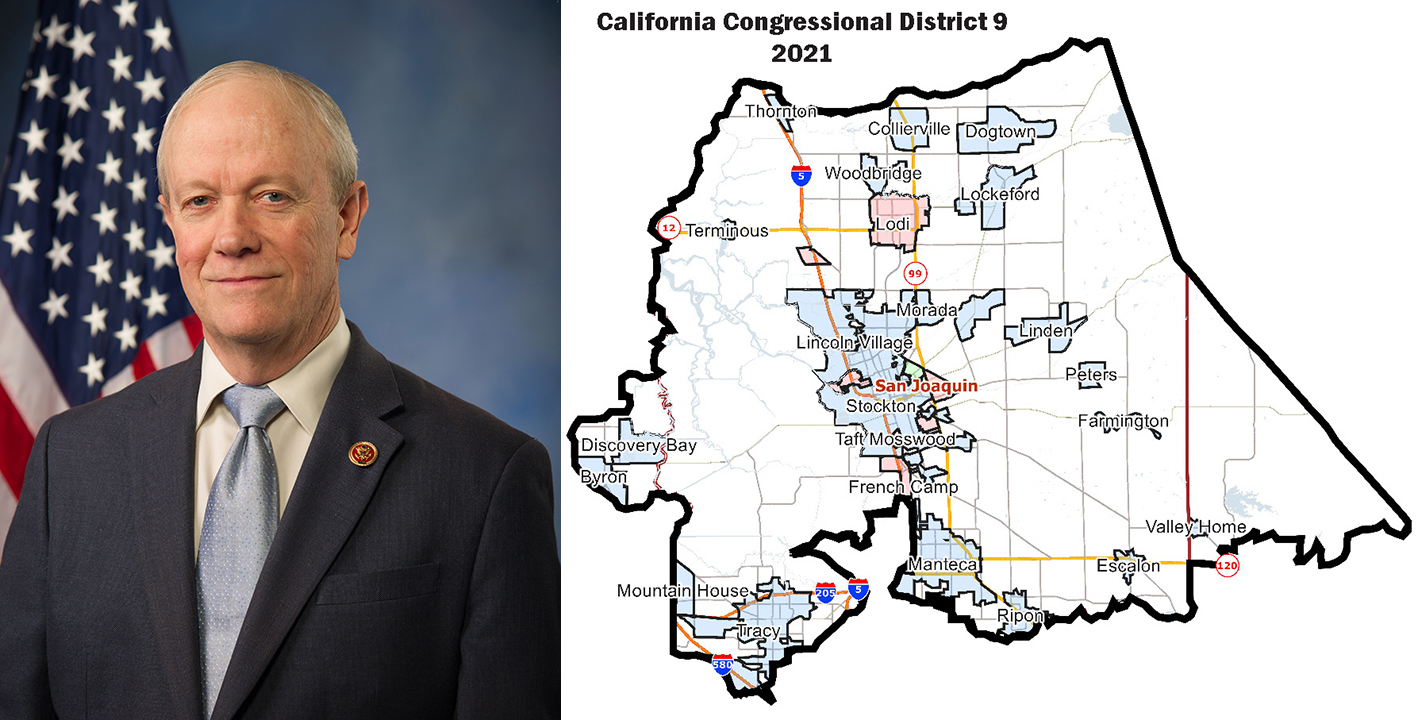
Rep. Jerry McNerney

Washington, DC – In response to President Joe Biden signing the Infrastructure Investment and Jobs Act into law, Congressman Jerry McNerney (CA-09) issued the following statement on Monday, Nov. 15:

“Today, I had the privilege of joining President Biden as he signed into law the largest federal infrastructure investment in nearly a century. Americans called on us for action, and we answered ‘yes’ to rebuilding our communities, ‘yes’ to good union wages, ‘yes’ to expanding opportunity, and ‘yes’ to doing it all while tackling the climate crisis.

“Building back better is no longer just a promise, but a reality that Americans will see throughout their communities and across our nation. I am extremely proud that four bills I authored were encompassed in this historic law. As part of the law’s $65 billion broadband investment, the Digital Equity Act will provide $2.75 billion to help close gaps in broadband adoption and increase digital literacy. Connectivity and digital skills are essential for opening gateways to economic opportunity, and this funding is crucial for lifting up communities across the country – including many in my district. Additionally, the Cyber Sense Act and the Enhancing Grid Security Through Public-Private Partnerships Act will help bolster the cybersecurity of our electric utilities to better secure our grid as we confront a growing number of cyber threats. Finally, the Grid Hardening Act will dedicate $3 billion to modernize the electric grid, including upgrades to increase resiliency against wildfires.”

“Through investments such as the $55 billion allotted to update our drinking water infrastructure and $17 billion marked for ports and waterway enhancements, we will create an average of 1.5 million jobs per year over the next 10 years. Our roads and bridges will be repaired and rebuilt with an emphasis on climate change mitigation, and our commitment to reducing greenhouse emissions will be honored with the largest investment in public transit in our nation’s history.”

Rep. Jerry McNerney represents California’s 9th Congressional District in the U.S. House of Represents that includes portions of Contra Costa, San Joaquin and Sacramento Counties. For more information on the Congressman’s work, follow him on Facebook and on Twitter @RepMcNerney.


Filed Under: Infrastructure, Legislation, News

Enrollment for Poetry Out Loud 2021-22 competition for high school students now open

November 17, 2021 By Publisher Leave a Comment

Poetry Out Loud (POL) is an exciting National competition started in 2005 by the National Endowment for the Arts and the Poetry Foundation. The contest challenges high school students to memorize and recite poetry, a chance to showcase their talents, build self-confidence, and gain both an appreciation and understanding of poetry.

The Arts and Culture Commission of Contra Costa County has been an official local partner of California Arts Council’s for Poetry Out Loud since 2007. Every Contra Costa County high school is encouraged to participate. Local arts non-profit organizations and libraries are welcome and encouraged to participate as well. Each year ten to fifteen high schools representing East, West, and Central County have participated. These include public schools, private schools, charter schools, alternative schools, court schools, and homeschool groups.

Poetry Out Loud is a free program!

There is no cost to either the school or the students.

HOW DOES POL WORK?

Poetry Out Loud is a tiered competition structure that begins in the classroom. High school teachers use the free Poetry Out Loud teacher toolkit (https://www.poetryoutloud.org/teachers-organizers/lesson-plans/) to teach poetry recitation and run classroom competitions. Class winners advance to the school-wide competition, then one school champion enters the county competition. The County winner is eligible to compete in the state competition, and the state winner competes in the national finals in Washington D.C. for a grand prize of $20,000.

Poetry Out Loud has been made accessible to accommodate in-person and virtual teaching environments at the school level. Additional information on this year’s hybrid model will be shared with participating schools.

Please complete the form by 12/15/21! POETRY OUT LOUD 2021-22

Please feel free to email our county coordinator, Brennan DeFrisco, at bdeeppoetry@gmail.com or call (925) 984-4031 for any questions you may have.

Thank you for your interest in supporting Poetry Out Loud!


Filed Under: Arts & Entertainment, News, Youth

14 children in Antioch given wrong, high doses of COVID-19 vaccine at Sutter Delta clinic last weekend

November 17, 2021 By Publisher Leave a Comment

Source: CDC

At least two at “home sick Monday with bad stomachaches”

By Allen Payton

Fourteen children were given higher doses of the Pfizer-BioNTech COVID-19 vaccine than they should have received at Sutter Health’s Antioch Urgent Care clinic in the Blue Rock Center over the weekend.

A statement was issued by Dr. Jimmy Hu, a pediatrician and Chair of the Sutter Health COVID-19 Vaccine Task Force:

“This weekend 14 patients at our Antioch pediatric vaccine clinic received vaccines with an incorrect amount of diluent. As soon as we learned of this, we contacted the parents and advised them of CDC guidance in this situation. The safety of our patients is our top priority, and we immediately reviewed our processes to help make sure this doesn’t happen again. According to the CDC, patients who receive vaccine with an incorrect diluent volume may experience more arm soreness, fatigue, headache, or a fever in response to the dose given.”

According to Sutter Health spokesperson, Monique Binkley-Smith, the children received more than the 5- to 11-year-old dose of 10 micrograms, and approximately two-thirds the dose of what a 12-year-old or older would get of 30 micrograms.

The vaccine dilution/prep process is done on-site-at the clinics, the same day it’s administered.

According to an ABC news report, two of the children got sick after receiving the vaccine.

“I’m here tonight to report my story because it’s unacceptable; you expect your medical professionals to give you correct doses,” parent Denise Iserloth said.

Denise and her husband Shawn’s eight and 11-year-old children were among the kids given the wrong amount of coronavirus vaccine.

“The Iserloths, whose children were both home sick Monday with bad stomachaches, say their two children were given 20 micrograms of dosage instead of the recommended 10. They’re now very concerned about any long-term effects,” according to the ABC report.

The children are expected to be fine.

“According to the CDC, patients who receive vaccine with an incorrect diluent volume may experience more arm soreness, fatigue, headache, or a fever in response to the dose given,” Binkley-Smith shared.

Also according to the CDC, “Scientists have conducted clinical trials with about 3,000 children, and the Food and Drug Administration (FDA) has determined that the Pfizer-BioNTech COVID-19 Vaccine has met the safety and efficacy standards for authorization in children ages 5 through 11 years old.  The safety of COVID-19 vaccines continues to be monitored.”

Filed Under: Children & Families, East County, Health, News

Pharmacy strike canceled as tentative agreement reached with Kaiser Permanente and the Guild for Professional Pharmacists

November 15, 2021 By Publisher Leave a Comment

Statement from Kaiser Permanente

November 15, 2021

By Deniene Erickson, Issues Manager, Kaiser Permanente Northern California

We are very pleased to announce that at about 1:00 a.m. this morning, Kaiser Permanente and the Guild for Professional Pharmacists reached a tentative agreement for a new 3-year contract for pharmacists in our Northern California region. The tentative agreement reflects our respect for Kaiser Permanente pharmacy professionals and the exceptional care they provide and provides industry-leading wage and benefit packages. The agreement is aligned with our commitment to high quality, affordable health care and to being the best place to work in health care, and includes the following:

  • Wage increases: Guaranteed across-the-board wage increases each year through the duration of the three year contract
  • Health benefits: No reductions or takeaways to already low-cost family medical and dental coverage with the same low copays for prescriptions and office visits
  • Retirement benefits: Maintains generous retirement income benefits and employer-subsidized retiree medical.
  • Bonus opportunities: Higher incentive bonus opportunities
  • Agreement on important operational matters

In light of this, the Guild for Professional Pharmacists has canceled the strike that was expected to begin November 15 and our pharmacies will return to normal operations later today.

This agreement comes on the heels of Saturday’s landmark tentative agreement between Kaiser Permanente and the Alliance of Health Care Unions, affecting nearly 50,000 Kaiser Permanente employees across the enterprise.

We are continuing to bargain in good faith with Local 39 Operating Engineers and the National Union of Healthcare Workers (NUHW), and are confident we will reach agreements with these unions very soon. At this time there is no change in the Local 39 Operating Engineers strike. Other unions have not yet rescinded their one-day sympathy strike notices for Thursday, November 18 and Friday, November 19. NUHW, the union that represents our mental health professionals has also announced a one-day strike for Friday, November 19, which remains in effect.

As always, our first priority is our members and patients and we have taken steps to ensure they will continue to receive high-quality, safe care and service should these strikes take place.

Filed Under: Health, Labor & Unions, News

With minimal public input Contra Costa Supervisors choose redistricting map

November 14, 2021 By Publisher 1 Comment

Contra Costa County Board of Supervisors 2021 Redistricting Map D.

Endorse Map D keeping their districts mostly the same

Splits Concord minimally; keeps Antioch split but along different lines; reunites Pinole; moves Alamo, Blackhawk and Camino Tassajara into the same district as the rest of the San Ramon Valley

By Daniel Borsuk

With scant public testimony and only three complete community map submissions, during their meeting on Tuesday, Nov. 9, Contra Costa Supervisors decided to move forward with the 2021 redistricting effort by selecting Map D as the preferred alternative. It creates proposed supervisorial boundaries that will be in place for the next 10 years.  CCCBOS Redistricting 2021 NOV 9 presentation-part 1    CCCBOS Redistricting 2021 NOV 9 presentation-part 2

With the clock ticking for supervisors to wrap up the federally mandated redistricting effort by Dec. 15, county officials have not received an abundance of public input at public hearings and workshops on proposed supervisorial maps, but after supervisors again heard meager public input on the proposed maps, the elected officials decided to move forward to comply with federal law.

At the end of day, of the four maps proposed by county staff and the three complete alternative maps submitted by the public, supervisors chose Map D mainly because it presents the fewest revisions from the current districts. However, it offers districts with the greatest deviation of 9.77% in population between districts of all four maps offered by county staff. It only splits up the cities of Concord, Antioch and Walnut Creek.

Impacts

The chosen map results in Districts 3 and 5 with the least population, 11,568 and 11,425 fewer residents than average, respectively, and Districts 2 and 4 with the most population of 11,264 and 9,273 greater than average. So, Districts 3 and 5 Supervisors will represent about 21,000 to 23,000 fewer residents than Districts 2 and 4. District 1 will have the lowest deviation from average population of just 2,455 residents or 1.05%.

Map D reunites Pinole moving a portion from the current District 5 into District 1 in West County.

It moves Alamo, Blackhawk and Tassajara Valley from the current District 3 into District 2, allowing them to join the rest of the San Ramon Valley.

It keeps Antioch split in two between Districts 3 and 5, as the city currently is, but along different streets and the Union Pacific Railroad right-of-way, in one part.

It keeps the Rossmoor community of Walnut Creek split from the rest of that city, and leaves it in District 2, while the rest of the city will be in District 4.

The map also shifts a portion of Concord from District 4 into District 5.

District 4 Supervisor Karen Mitchoff, who announced she will not seek re-election next year, liked Map D because it presents the “least intrusion into Concord.”  District 4 would also pick up the Morgan Territory area.

“If I could have all of Antioch I would,” said Board Chair Burgis.

District 1 Supervisor John Gioia, whose seat is also up for election next year, acknowledged with Map D his district cannot go beyond Pinole and El Sobrante. The neighboring and nearby communities of Hercules and Crockett will be fully represented by District 5 Supervisor Federal Glover.

Contra Costa Herald proposed CCC Board of Supervisors Redistricting Map and statistics. (Note: The district numbers are incorrect as the Herald’s publisher couldn’t figure out how to choose the correct ones while using the county’s online mapping tool.)

Alternative Maps

There were only 12 community submissions with eight complete maps and four community of interest maps, using the county’s online mapping tool. Two of the complete maps were submitted by one person and three by another, So, only five people submitted complete, alternative maps.  CCCBOS Redistricting 2021 Community Submission Maps Oct05&19    CCCBOS Redistricting 2021 Community Submission Maps Nov09

Two of the complete maps offered total population deviations between the districts of 10.55% and 13.38%, which is greater than the 10% maximum deviation legally allowed. The population of each district can only be 5% greater or lesser than average. The other five maps split up communities of interest

The community submission of a complete map of the five districts, by the Contra Costa Herald, complied with the population deviation requirement of no greater or fewer than 5% from average. The map offers districts with the least population deviation of just 1.67% compared to the four maps proposed by county staff, while respecting both city and community boundaries, except for Concord and Antioch, the county’s largest cities. In general, the Contra Costa Herald map uses major city streets as the dividing lines, such as A Street in Antioch, and the districts are as compact as possible.

Allen Payton contributed to this report.

Filed Under: News, Politics & Elections, Supervisors

Supervisors approve address change of properties in Saranap area from Walnut Creek to Lafayette

November 14, 2021 By Publisher Leave a Comment

Lafayette Saranap Mailing Address Place Change Affected Parcels. Source: CCC

Unincorporated area between the two cities south and west of the 680-24 interchange

It might violate Proposition 19 and the property inheritance rights of children of current property owners – County Assessor Gus Kramer

County receives $7.4 million more in federal American Rescue Plan Act funds

By Daniel Borsuk

Over the objections of Contra Costa County Assessor Gus Kramer, the Contra Costa County Board of Supervisors on Tuesday approved the situs address change from Walnut Creek to Lafayette of 465 properties in the upscale Saranap area for purposes of the upcoming 2022 delivery of the secured property tax roll to the Auditor. Those properties are located within the Lafayette School District.

At the request of Area 2 Supervisor Candace Andersen of Danville, supervisors voted 5-0 to approve the unusual request that will very likely boost property values of the 465 properties tagged in the situs address change from Walnut Creek to Lafayette. Andersen told supervisors she had been approached by property owners in the Saranap area since 2019 to make the change because the properties are located within the boundaries of the Lafayette School District and are in the sphere of influence of the City of Lafayette.

But Kramer opposed the situs change contending it might violate Proposition 19 and the property inheritance rights of children of current property owners.

“I am concerned about the legal issues,” said the county assessor. “I suggest that you put this off a bit. It is a bit premature.”

Thirty-year Saranap homeowner Joyce Coleman told supervisors she supports the situs change because it will help future residents know what schools their children will attend.

“There’s always been confusion over whether children will attend Walnut Creek or Lafayette schools. This will help solve that problem,” she said.

Prior to the vote, Area 4 Supervisor Karen Mitchoff, who has announced she will not seek re-election in 2022, commented “It’s just beyond me. You’re already in the Lafayette school district. I am doing this only out of respect for Supervisor Andersen.”

Supervisor Andersen noted that after petitioning the United States Postal Service, the USPS approved the request to add Lafayette to its mailing routing system as a recognized city mailing address for the 465 properties. The postal service now recognizes both Lafayette and Walnut Creek as city addresses for the area, The Zip Code remains unchanged at 94595.

County Receives $7.4 million in American Rescue Plan Act Funds

Supervisors learned additional federal American Rescue Plan Act (ARPA) funds will be heading to county coffers in ensuing months after $7.4 million have been spent during the first quarter of 2021.

The county Employment and Human Services Department has received $4,694,377, the county Health Services Department has received $2,604,182 and the Department of Conservation and Development has received $90,215, said assistant County Administrative Officer Tim Elway.

Through Sept. 30, county departments spent $71.6 million ARPA funds for rental assistance services. The Health Services Department submitted an expenditure of $20.9 million for pandemic responses.

Last August, the County Administrator’s Office had identified $317,327.304 in ARPA funds allocated to the county. Of that amount, $127,606.231 had been received by the county and represents two of the largest funding sources for the county – $112,029,451 for the Coronavirus State and Local Fiscal Recovery Fund and $15,576,780 for the Emergency Rental Assistance Program.

Hire New Director of Child Support Services from San Joaquin County

Supervisors voted 5-0 to hire San Joaquin County Director of Child Support Services Lori Cruz as the new Contra Costa County Director of Child Support Services at an annual salary of $345,796 of which $56,489 are pension costs.

Cruz, a California licensed attorney, who holds a Juris Doctor from Catholic University of America, Columbus School of Law, and a Bachelor of Arts Political Science and Print Journalism from the University of Southern California, has served as the Director of Child Support Services in San Joaquin County, the same county where Contra Costa County Administrator Monica Nina was county administrator until her appointment late last year.

Cruz replaces the current director of child support services Melinda Self, who is retiring on Dec. 31, 2021.

Upon accepting the supervisors’ hiring, Ms. Cruz said, “I can bring my 31 years of child support experience to Contra Costa County and bring positive outcomes to your constituents.”

Cruz, who has been a member of the California State Bar since 1989, has served as director of San Joaquin County Child Support Services from April 2014 to present date. From June 2002 to April 2014, she was employed as the Deputy Director of Operations of the Los Angeles County Child Support Services Department. During her career she developed programs to analyze departmental data to measure performance and effectiveness of services, leading a statewide effort to obtain significant data to measure performance and effectiveness of services, and leading a statewide effort to obtain a new funding model for local child support agencies.

Filed Under: Central County, Government, News

California Citizens Redistricting Commission releases draft district maps for 2022 elections

November 12, 2021 By Publisher 1 Comment

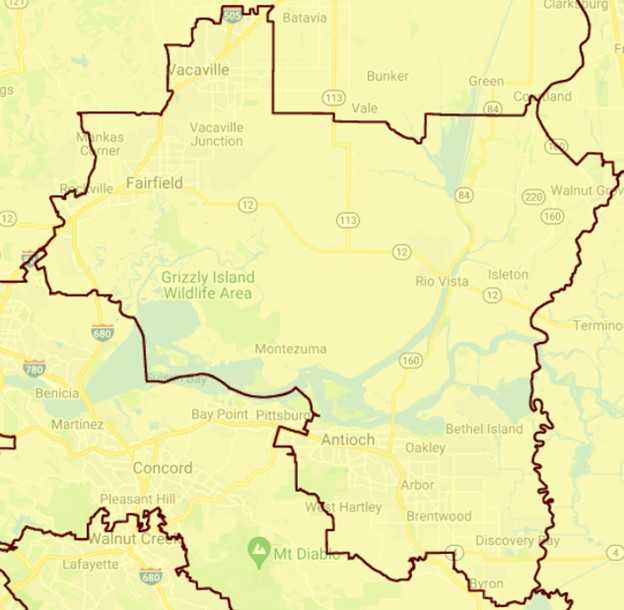
Proposed new Congressional Districts for Contra Costa for the next 10 years divide the county into two instead of among five districts, as it is currently. Source: California Citizens Redistricting Commission

For Congressional, State Senate, State Assembly, Board of Equalization districts; changes will affect who represents Contra Costa.

The draft State Senate district maps split Contra Costa into three districts, placing Brentwood with communities as far away as Rohnert Park, Calistoga and Dunigan.

More public input encouraged.

SACRAMENTO, CA—On Wednesday, the 2020 California Citizens Redistricting Commission released draft maps for the state’s Congressional, State Senate, Assembly and Board of Equalization districts ahead of the CA Supreme Court mandated November 15, 2021 deadline.

“We are finally here. We proudly present these draft maps to the people of California as a starting point for public discussion. These are not intended to be final maps and we strongly encourage Californians to continue weighing in until we get it right,” stated Commission Chair Trena Turner. “A global pandemic and delayed census data would not stop this commission from delivering on its promise to create maps that encourage fair representation. We will have final maps completed and certified by the December 27, 2021 deadline. There is still plenty of time for the public to get involved. We urge you to join us because everything is on the lines.”

A major consideration in redrawing the Congressional districts was the fact that California lost a seat in the decennial reapportionment due to population shifts away from the state. That reduces the delegation in the House of Representatives from 53 to 52. According to the U.S. Census Bureau, across the country, the Golden State was joined by Illinois, Michigan, Ohio, New York, Pennsylvania and West Virginia in losing one Congressional seat each. Oregon, Montana, Colorado, North Carolina and Florida each gained one seat, while Texas gained two Congressional seats.

Proposed new State Senate Districts for Contra Costa County puts Far East County in the same district as all of Solano and Yolo Counties and portions of Sacramento, Napa and Sonoma Counties.

Impacts to Contra Costa County Districts

The draft maps show Contra Costa County split in just two Congressional districts compared to four, currently. The draft State Senate district maps split Contra Costa into three districts, with Far East County cities and communities of Brentwood, Oakley, Discovery Bay, Byron, Bethel Island and Knightsen included with all of Solano and Yolo Counties and portions of Sacramento, Napa and even Sonoma County communities as far away as Rohnert Park, Calistoga and Dunigan. The draft State Assembly districts map split the county into four districts, with Pinole, Hercules, Rodeo, Crockett and Port Costa included in the same district as Solano County.

According to an SFGate.com news report, “In the Bay Area…Contra Costa County has been the biggest source of complaints…some…Antioch residents have complained about African American neighborhoods being split up, while residents south of them in the Tri-Valley area are annoyed that San Ramon and Dublin were kept in separate congressional districts.”

Using the multitude of communities of interest testimony the Commission received throughout the summer, they assessed how that testimony could potentially inform district boundaries considering the tradeoffs that needed to be made in eventual maps. The Commission produced three sets of visualizations (October 27-29, November 2-4, November 7-9) that incorporated additional public input to evolve into draft maps.

Draft maps can be found here and below.

Approved Draft Maps
CONGRESS

  • 11.10.21 Congressional Draft Map
  • 11.10.21 Congressional Shape Files
  • 11.10.21 Congressional Equivalency Files

STATE SENATE

  • 11.10.21 State Senate Draft Map
  • 11.10.21 State Senate Shape Files
  • 11.10.21 State Senate Equivalency Files

ASSEMBLY

  • 11.10.21 Assembly Draft Map
  • 11.10.21 Assembly Shape Files
  • 11.10.21 Assembly Equivalency Files

BOARD OF EQUALIZATION

  • 11.10.21 Board of Equalization Draft Map
  • 11.10.21 Board of Equalization Shape Files
  • 11.10.21 Board of Equalization Equivalency Files

We encourage the public to provide feedback using this form.

Proposed new Assembly Districts for Contra Costa County would include Pinole, Hercules and Crockett with Solano County in the same district.

Public comment shall be taken for at least 14 days from the date of public display of the first preliminary statewide (draft) maps of the Congressional, State Senatorial, Assembly, and State Board of Equalization districts. The Commission shall not display any other map for public comment during the 14-day period.

Draft Map Public Input Meeting Schedule
November 17, 2021—Congressional District Feedback
November 18, 2021—Assembly District Feedback
November 19, 2021—Senate District Feedback
November 20, 2021—Board of Equalization & Any District Feedback
November 22, 2021—Any District Feedback
November 23, 2021—Any District Feedback

Public input meeting appointments can be made here.

In accordance with the California Constitution, the Commission followed these criteria, in this order, to draw district maps:

  1. Districts must be of equal population to comply with the U.S. Constitution.
  2. Districts must comply with the Voting Rights Act to ensure that minorities have an equal opportunity to elect representatives of their choice.
  3. Districts must be drawn contiguously, so that all parts of the district are connected to each other.
  4. Districts must minimize the division of cities, counties, neighborhoods and communities of interest to the extent possible.
  5. Districts should be geographically compact: such that nearby areas of population are not bypassed for a more distant population. This requirement refers to density, not shape. Census blocks cannot be split.
  6. Where practicable each Senate District should be comprised of two complete and adjacent Assembly Districts, and Board of Equalization districts should be comprised of 10 complete and adjacent State Senate Districts.

In addition, the place of residence of any incumbent or political candidate may not be considered in the creation of a map, and districts may not be drawn for the purpose of favoring or discriminating against an incumbent, political candidate, or political party.

Every 10 years, after the federal government publishes updated census information, California must redraw the boundaries of its electoral districts so that the state’s population is evenly allocated among the new districts.

In 2008, California voters passed the Voters First Act, authorizing the creation of the independent California Citizens Redistricting Commission to draw new State Senate, State Assembly, and State Board of Equalization district lines. In 2010, the Voters First Act for Congress gave the Commission the responsibility of drawing new Congressional districts following every census.

For more information, please visit www.WeDrawTheLinesCA.org.

Allen Payton contributed to this report.
 

Filed Under: News, Politics & Elections

A brief history of Veterans Day

November 11, 2021 By Publisher Leave a Comment

From military.com

Veterans Day, formerly known as Armistice Day, was originally set as a U.S. legal holiday to honor the end of World War I, which officially took place on November 11, 1918. In legislation that was passed in 1938, November 11 was “dedicated to the cause of world peace and to be hereafter celebrated and known as ‘Armistice Day.'” As such, this new legal holiday honored World War I veterans.

In 1954, after having been through both World War II and the Korean War, the 83rd U.S. Congress — at the urging of the veterans service organizations — amended the Act of 1938 by striking out the word “Armistice” and inserting the word “Veterans.” With the approval of this legislation on June 1, 1954, Nov. 11 became a day to honor American veterans of all wars.

In 1968, the Uniforms Holiday Bill ensured three-day weekends for federal employees by celebrating four national holidays on Mondays: Washington’s Birthday, Memorial Day, Veterans Day, and Columbus Day. Under this bill, Veterans Day was moved to the fourth Monday of October. Many states did not agree with this decision and continued to celebrate the holiday on its original date. The first Veterans Day under the new law was observed with much confusion on Oct. 25, 1971.

Finally, on September 20, 1975, President Gerald R. Ford signed a law which returned the annual observance of Veterans Day to its original date of Nov. 11, beginning in 1978. Since then, the Veterans Day holiday has been observed on Nov. 11.

Celebrating the Veterans Day Holiday

If the Nov. 11 holiday falls on a non-workday — Saturday or Sunday — the holiday is observed by the federal government on Monday (if the holiday falls on Sunday) or Friday (if the holiday falls on Saturday). Federal government closings are established by the U.S. Office of Personnel Management. State and local government closings are determined locally, and non- government businesses can close or remain open as they see fit, regardless of federal, state or local government operation determinations.

United States Senate Resolution 143, which was passed on Aug. 4, 2001, designated the week of Nov. 11 through Nov. 17, 2001, as “National Veterans Awareness Week.” The resolution calls for educational efforts directed at elementary and secondary school students concerning the contributions and sacrifices of veterans.

The difference between Veterans Day and Memorial Day

Memorial Day honors servicemembers who died in service to their country or as a result of injuries incurred during battle. Deceased veterans are also remembered on Veterans Day but the day is set aside to thank and honor living veterans who served honorably in the military – in wartime or peacetime.

From the Herald – thank you to our military veterans for your service. We know freedom isn’t free and without your service and sacrifice Americans wouldn’t enjoy the freedoms we do, today. Remembering that and honoring you, today.


Filed Under: History, Military, Veterans

CHP focuses on eliminating teen distracted driving

November 9, 2021 By Publisher Leave a Comment

Source: National Highway Traffic Safety Administration (NHTSA)

By Jaime Coffee, Information Officer II, California Highway Patrol

Source: NHTSA

Using cell phones, eating or drinking, adjusting a radio, or simply talking with friends are all activities teens engage in every day, but these activities become life-threatening hazards while driving.   Unfortunately, many of these distractions will lead to crashes resulting in an injury or death. 

To address these concerns, the California Highway Patrol (CHP) is partnering with traffic safety organizations promoting safe driving behaviors for teens.  The grant-funded Teen Distracted Drivers campaign consists of an education component that will allow for CHP officers and traffic safety partners to make appearances at schools and community events throughout the state. Distracted driving enforcement operations for this grant began October 1, 2021, and will continue through September 30, 2022.

According to the California Department of Motor Vehicles, there are nearly 750,000 licensed teenage drivers in California.  Data from the CHP’s Statewide Integrated Traffic Records System indicated that in 2019 there were nearly 44,000 crashes involving teen drivers between 15 to 19 years of age, including 231 fatal crashes.  Although preliminary figures for 2020 indicated a drop in total crashes involving teen drivers in California, the number of teen driver-involved fatal crashes increased to 258.

“The combination of inattention and inexperience behind the wheel can lead to tragedy,” said CHP Commissioner Amanda Ray.  “This grant will assist our officers in keeping California’s roads safe, while addressing California’s distracted driving crisis among the state’s teens.”

Funding for this program was provided by a grant from the California Office of Traffic Safety, through the National Highway Traffic Safety Administration.

The mission of the CHP is to provide the highest level of Safety, Service, and Security.


Filed Under: CHP, News, Youth

Free entrance, parking at East Bay parks for active and retired military on Veterans Day

November 9, 2021 By Publisher Leave a Comment

The East Bay Regional Park District honors active and retired military members on Veterans Day with free access and parking at the regional parks, including Ardenwood Historic Farm in Fremont. Fee waiver only covers parking and park entry. Fee waiver DOES NOT include dog fees, boat launch or inspection fees, fishing permits, or concessions, such as merry-go-round, train, etc.

The East Bay Regional Park District is the largest regional park system in the nation, comprising 73 parks, 55 miles of shoreline, and over 1,300 miles of trails for hiking, biking, horseback riding, and environmental education. The Park District receives more than 25 million visits annually throughout Alameda and Contra Costa counties in the San Francisco Bay Area.


Filed Under: Holiday, Military, Parks, Veterans

  • « Previous Page
  • 1
  • …
  • 218
  • 219
  • 220
  • 221
  • 222
  • …
  • 484
  • Next Page »
Monica's-Riverview-Jan-2026
Liberty-Tax-Jan-Apr-2026
Deer-Valley-Chiro-06-22

Copyright © 2026 · Contra Costa Herald · Site by Clifton Creative Web