






 By Pittsburg Police Department
Thursday evening, May 21, 2020, at approximately 6:45 P.M. Pittsburg Police Officers were called to the 4000 block of Harbor Street after receiving reports of a man suffering from multiple injuries. When officers arrived, the man was found suffering from life threatening injuries and officers began to preform life saving measure. Medical staff arrived and transported the man to a local hospital where he died.
The Pittsburg Police Department’s Investigations Division responded to continue this investigation. During the investigation it was learned that the victim and suspect knew each other and had engaged in an argument prior to the incident. During the argument, the suspect retrieved a weapon and repeatedly struck the victim. The victim left the area and was later located by officers where he was found suffering from multiple wounds to the legs and rear torso.
Detectives were able to learn of the suspect’s identity and officers began a search for his whereabouts. Just after 2:00 A.M. this morning, officers located the suspect and place him under arrest. The suspect, identified as 36-year-old Gabriel Young, was later interviewed by detectives and is now being held at the Martinez Detention Facility.
This continues to be a very active investigation and no further details are available at this time. The Pittsburg Police Department will be presenting this case to the District Attorney next week to file charges on the suspect. This is the City of Pittsburg’s second homicide of the year.
Read More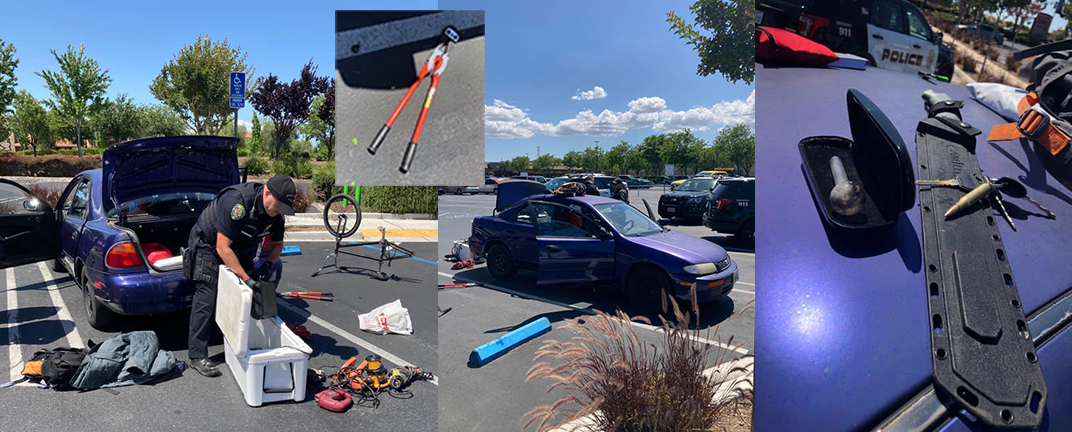
Stolen items, stolen car, burglary tools, drug paraphernalia and large knife confiscated from the suspect on Thursday, May 21, 2020. Photos by Brentwood PD
By Brentwood Police Department
You never know what you will find!
Another day of patrolling our community, on Thursday, May 21, 2020, keeping eyes peeled for anything suspicious and then, there it was … a stolen car parked in the Raley’s parking lot! Someone was sitting inside! Officers quickly moved into position and soon the car was surrounded. A man sitting in the passenger seat exited the car and was detained by the officers. During the investigation, an officer noticed a man exit Raley’s and start walking in the direction of the stolen car. The man quickly turned and began walking in the opposite direction, towards Beach Hut Deli. An officer greeted 30 year-old Eric Freitas (Oakley) sitting near the deli and while conducting their investigation, removed two knives and over $100 of stolen merchandise from Freitas.
Freitas was walked back to the stolen car, where he admitted to behaving badly. He had been driving the stolen vehicle, had stolen items from Raley’s and had burglary tools and drug paraphernalia in the car. The passenger in the car was later released.
Freitas received a courtesy shuttle to county jail! He was charged with vehicle theft, possession of a stolen vehicle, possession of burglary tools, a probation violation and other additional charges.
Read More
The White House
May 22, 2020
Our Nation mourns for every life lost to the coronavirus pandemic, and we share in the suffering of all those who endured pain and illness from the outbreak. Through our grief, America stands steadfast and united against the invisible enemy. May God be with the victims of this pandemic and bring aid and comfort to their families and friends. As a mark of solemn respect for the victims of the coronavirus pandemic, by the authority vested in me as President of the United States by the Constitution and the laws of the United States of America, I hereby order that the flag of the United States shall be flown at half-staff at the White House and upon all public buildings and grounds, at all military posts and naval stations, and on all naval vessels of the Federal Government in the District of Columbia and throughout the United States and its Territories and possessions until sunset, May 24, 2020. I also direct that the flag shall be flown at half-staff for the same length of time at all United States embassies, legations, consular offices, and other facilities abroad, including all military facilities and naval vessels and stations.
IN WITNESS WHEREOF, I have hereunto set my hand this twenty-first day of May, in the year of our Lord two thousand twenty, and of the Independence of the United States of America the two hundred forty-fourth.
DONALD J. TRUMP
Read More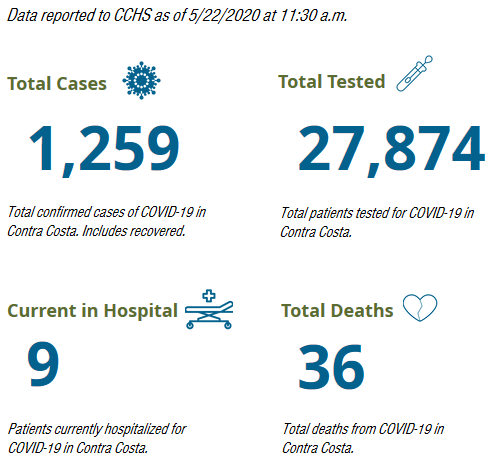
By Allen Payton
As of this morning, Friday, May 22, 2020 at 11:30 a.m. Contra Costa Health Services (CCHS) is reporting a total of 1,259 cases of COVID-19/coronavirus, and a total of 36 deaths in the county. A total of 1,056 have recovered, which is 83.9%, consistent with the previously reported number of those who have tested positive for the virus and recovered.
There were 25 new cases reported in the past 24 hours, but only 9 people diagnosed with the virus currently hospitalized.
A total of 27,874 people have been tested for the virus in the county.
To see the all the statistics provided by CCHS, click here.
Read More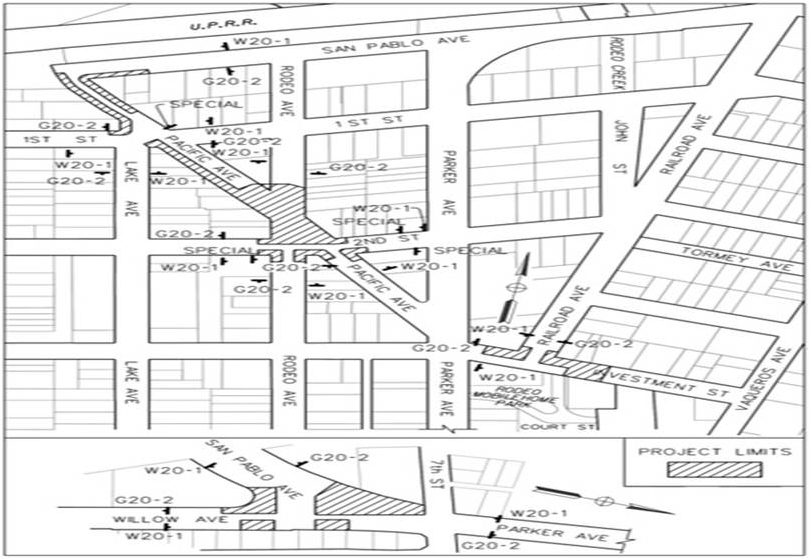
Site map of construction area in downtown Rodeo. By CCCPWD.
By Kelly Kalfsbeek, Public Information Officer, Contra Costa County Public Works Department
May 20, 2020, Rodeo, CA – The Contra Costa County Public Works Department will begin construction of the Rodeo Downtown Infrastructure Project. Construction will begin on Tuesday, May 26, 2020 and last until August 28, 2020, 7:00 am-5:00 pm, Monday-Friday, weather permitting. Drivers should expect delays during construction.
The work to be done generally consists of infrastructure including Americans with Disabilities Act (ADA) compliant sidewalks, curbs, gutters, a storm water treatment area with landscaping components, storm drain installation, a bike lane, an ADA compliant concrete path and soldier pile walls. Current shelter-in-place and social distancing protocol will be followed.
This project is funded by gas tax revenues provided by the SB1 Road Repair and Accountability Act and Measure J funds. More information for this project can be found at http://www.cccounty.us/pwdmap.
Read More The Clerk-Recorder is now offering marriage licenses and civil marriage ceremonies online for County residents. Clerk-Recorder staff perform the civil ceremonies using Zoom or FaceTime.
“June is traditionally a month of many weddings,” Deborah Cooper, County Clerk-Recorder said. “We are pleased to offer our constituents a creative new method to be married during this crisis.”
California Governor Gavin Newsom recently issued an Executive Order permitting the issuance of marriage licenses and the conduct of remote civil wedding ceremonies via teleconferencing technologies.
At least one of the parties to the marriage must be a Contra Costa County resident. The couple must appear together on the video and be physically present within the State of California. Invited guests may join in to view the ceremony. No additional software is required for the license or the ceremony, but the couple must complete the forms in advance of the ceremony. A computer, tablet, or cell phone with a microphone/camera and an internet connection is required.
Marriage service appointments are currently available Tuesday through Thursday, during the month of June. If couples would like more information or to schedule an appointment, email marriages@cr.cccounty.us or call (925) 335-7900.
Read More
In partnership with the Food Bank of Contra Costa & Solano
By Brit Hotaling, Communications and Development Associate, The Society of St. Vincent de Paul of Contra Costa County
St Vincent de Paul of Contra Costa County (SVdP) will hold a major drive-thru food distribution event in partnership with the Food Bank of Contra Costa & Solano on Friday, May 22.
WHAT: St. Vincent de Paul of Contra Costa County will hold a food distribution of 500 boxes of food and fresh produce to the Pittsburg community while observing social distancing. Food will be available on a drive-thru and walk-up basis. SVdP has ramped up their regular emergency food services in recent months in response to the COVID-19 pandemic.
The food distribution will take place at SVdP’s Family Resource Center in Pittsburg, with volunteers directing traffic and handing out food supplies.
WHO: St. Vincent de Paul of Contra Costa County
WHEN: Friday, May 22, 2020 from 9 am – 10:30 am, or until supplies last
WHERE: 2210 Gladstone Drive, Pittsburg
WHY: Many neighbors right here in Pittsburg, who have never needed help before, are reaching out for help with food, rental assistance and other bills they are not be able to meet due to loss of income. SVdPCCC is open and serving neighbors-in-need. The SVdPCCC Family Resource Center in Pittsburg remains open to serve via our Free Dining Room (operated in partnership with Loaves & Fishes of Contra Costa), Emergency Food Pantry, Daytime Homeless Shelter for Winter Nights clients, and referral to additional social services.
For additional information: Barb Hunt, b.hunt@svdp-cc.org, (925) 330-6732 or Steven Krank, 925-439-5060 ext 28, s.krank@svdp-cc.org
Read More
Map by CCC Public Works.
By Kelly Kalfsbeek, Public Information Officer, CCC Public Works
El Sobrante, CA – The Contra Costa County Public Works Department will begin construction of the San Pablo Dam Road Traffic Safety Improvements project between the city limits of Richmond and city limits of Orinda. Construction will start Wednesday, May 27, 2020 through July 31, 2020, 8:00 am to 4:00 pm, Monday-Friday, barring unforeseen circumstances. Drivers can expect traffic delays up to 30 minutes.
The project will consist of installing a centerline rumble strip and channelizers, reconstructing median islands, replacing roadside signs to meet new retro-reflectivity standards, installation of speed feedback signs, partial slurry seal, removal and replacement of thermoplastic stripes and pavement markings, and restriping of a bike lane at two intersections of San Pablo Dam Road and Old San Pablo Dam Road. Current shelter-in-place and social distancing protocol will be followed.
Funding for this project is gas tax revenues provided by the SB1 Road Repair and Accountability Act and the Highway Safety Improvement Program funds. More information for this project can be found at http://www.cccounty.us/pwdmap.
Read More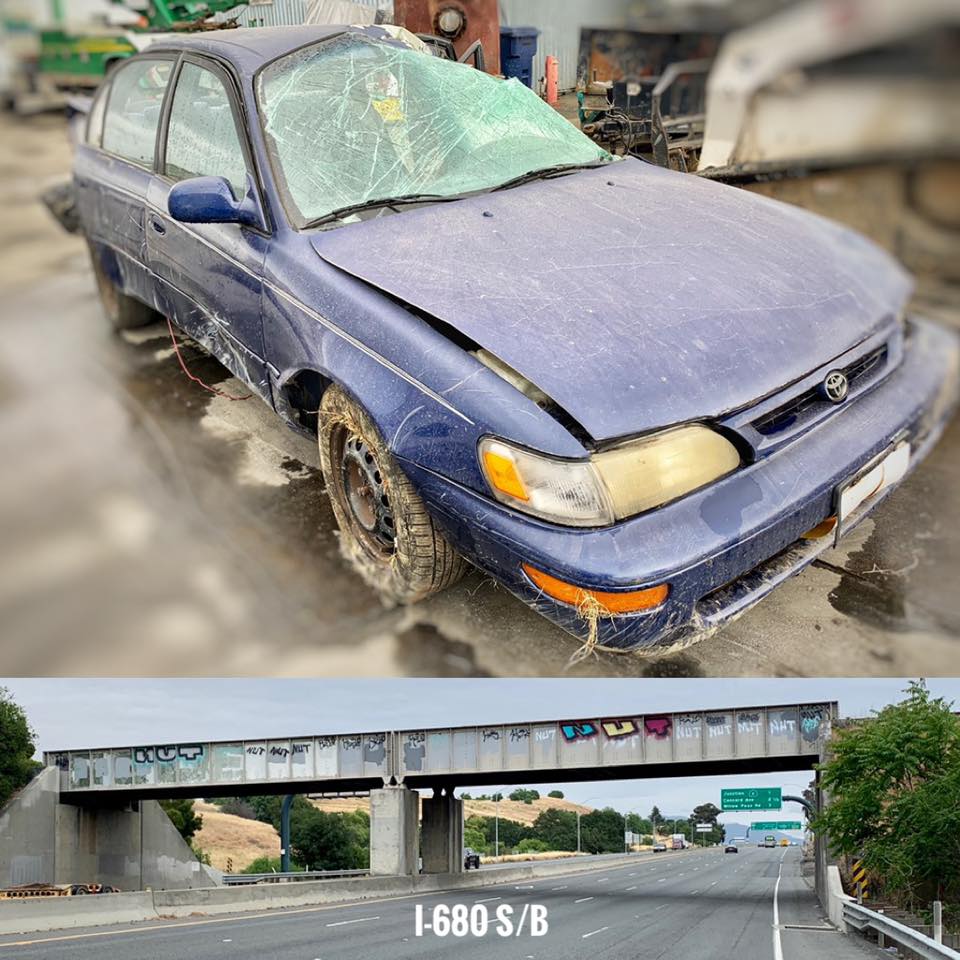
Fatal hit and run victim’s car and the railroad overpass in Martinez on March 3, 2020. Photos by CHP.
By CHP – Contra Costa
On the morning of Friday March 6, 2020, at approximately 5:25am, Contra Costa CHP responded to a collision on I-680 southbound, north of Highway 4 in Martinez. The victim of the collision was driving a 1990’s blue Toyota Corolla, that had spun out across the lanes of traffic and collided with a light pole and tree on the right shoulder area, sustaining major damage. The driver of the Toyota was not responsive and transported to John Muir Hospital. Tragically the man died days later due to his injuries from the collision.
A witness related they saw a vehicle bump into the Toyota, which caused it to go out of control resulting in the crash, and then fled the scene. They described the second vehicle as being a dark colored lowered sedan with oversized rims. They were unable to see the make or model. They also related they saw it approaching quickly through their rearview mirror and moving in and out of the traffic lanes just before the crash.
CHP is asking for your HELP to locate the second vehicle described by the witness above. If you were traveling on I-680 southbound in this location on the morning of March 6 between about 5:20am to 5:30am, and may have witnessed this collision (either just before, at the moment of the crash, or just after) or think you remember seeing a dark colored lowered sedan with oversized rims in the same location, or any information that could help in this investigation, please contact the Contra Costa CHP in Martinez at (925) 646-4980. Ask for Investigating Officer Lane and leave your contact info for him.
Read More“It’s encouraging. We’re wanting it to continue going down. It certainly isn’t going up.” -County Health Officer, Dr. Chris Farnitano regarding COVID-19 statistics in Contra Costa.
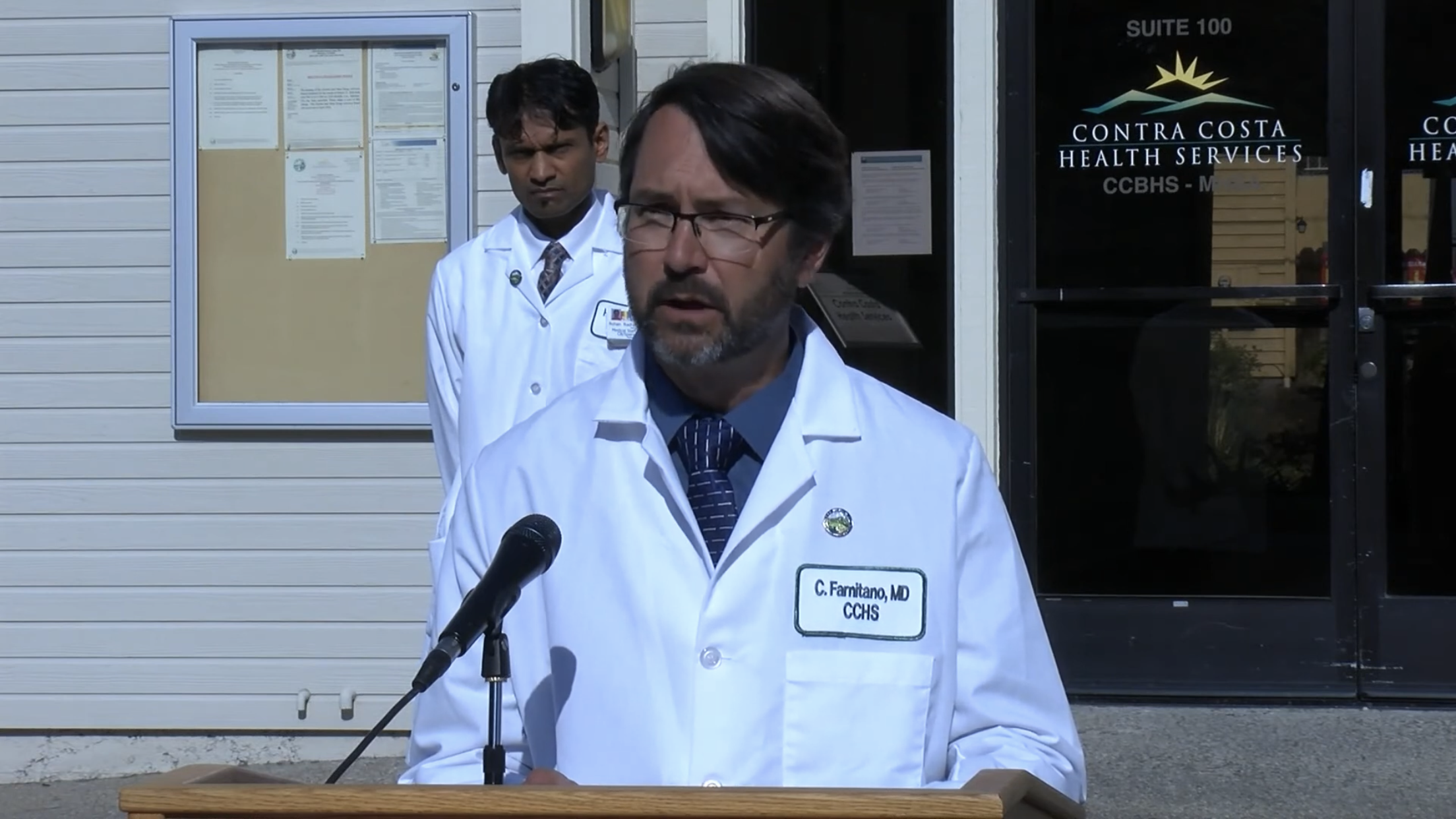
Contra Costa County Health Officer Dr. Christ Farmitano speaks during a press conference on Friday, March 20, 2020. Screenshot of YouTube video.
By Allen Payton
Due to the positive results over the past few weeks with the COVID-19 statistics in Contra Costa County, County Health Officer Dr. Chris Farnitano issued a new order, yesterday, Monday, May 18, 2020 that went into effect, today allowing certain retail and other businesses to reopen, within certain guidelines.
But, concerns from business owners and retail center property manager asking how it’s supposed to work raised questions.
Asked if he or his staff spoke with retail store owners or shopping center property managers about the order before issuing it and how it’s supposed to work, Dr. Farnitano replied, “We’ve been getting feedback from different stores and businesses. We haven’t specifically asked them to review this particular language. This comes from state guidelines. So, our guidelines are in line with the state’s Phase 2. They allowed it on the 8th of May, 11 days ago.”
“It may be more helpful for small retail stores that don’t have an online presence, not a larger store that does,” he added. “Like craft breweries that weren’t allowed prior, or other products that folks that people were used to going to the retail store for.”
“The other big changes are the associated manufacturing and logistics, which pretty much covers any manufacturing that wasn’t already allowed, like refineries, or agricultural product manufacturing,” Farnitano continued. “The Tesla plant in Alameda County is one example.”
“We might be going in a slightly slower pace than the state,” he shared. “But there’s less variability from one county to the next for the particular rules for a business to reopen.”
When asked if the shelter-in-place order still ends on May 31st, Dr. Farnitano answered, “the new order that was issued yesterday and went into effect, today doesn’t have an end date. That’s really not practical or the intent, which was to reevaluate the situation before that date.” (See related article)
“What we’re really doing is to make a change, give it some time to see the affects of that change, and see the impact on our matrix,” he continued. “We did that the last time two weeks ago on May 4 and because of the positive results from that we’re able to open up more.”
So, the reopening will be through a gradual, step by step process “driven by the data,” Dr. Farnitano added.
“It’s been pretty flat,” he said about the curve. “We’ve been looking at seven-day averages. We’ve been running at 10 to 15 new cases a day for the past two weeks, and 15 to 20 in the hospital, each day”
“It’s encouraging. We’re wanting it to continue going down. It certainly isn’t going up,” Dr. Farnitano stated.
Asked when will the next order for more reopening be issued,” We don’t really have a time or particular day,” he said. “We give it a couple weeks which is the incubation period for someone to be exposed and then experience symptoms.” Then they reevaluate the situation at that time.
So, we can expect another update and hopefully more reopening of businesses and activities the first week of June.
Read More









By Pittsburg Police Department
Thursday evening, May 21, 2020, at approximately 6:45 P.M. Pittsburg Police Officers were called to the 4000 block of Harbor Street after receiving reports of a man suffering from multiple injuries. When officers arrived, the man was found suffering from life threatening injuries and officers began to preform life saving measure. Medical staff arrived and transported the man to a local hospital where he died.
The Pittsburg Police Department’s Investigations Division responded to continue this investigation. During the investigation it was learned that the victim and suspect knew each other and had engaged in an argument prior to the incident. During the argument, the suspect retrieved a weapon and repeatedly struck the victim. The victim left the area and was later located by officers where he was found suffering from multiple wounds to the legs and rear torso.
Detectives were able to learn of the suspect’s identity and officers began a search for his whereabouts. Just after 2:00 A.M. this morning, officers located the suspect and place him under arrest. The suspect, identified as 36-year-old Gabriel Young, was later interviewed by detectives and is now being held at the Martinez Detention Facility.
This continues to be a very active investigation and no further details are available at this time. The Pittsburg Police Department will be presenting this case to the District Attorney next week to file charges on the suspect. This is the City of Pittsburg’s second homicide of the year.
Read MoreStolen items, stolen car, burglary tools, drug paraphernalia and large knife confiscated from the suspect on Thursday, May 21, 2020. Photos by Brentwood PD
By Brentwood Police Department
You never know what you will find!
Another day of patrolling our community, on Thursday, May 21, 2020, keeping eyes peeled for anything suspicious and then, there it was … a stolen car parked in the Raley’s parking lot! Someone was sitting inside! Officers quickly moved into position and soon the car was surrounded. A man sitting in the passenger seat exited the car and was detained by the officers. During the investigation, an officer noticed a man exit Raley’s and start walking in the direction of the stolen car. The man quickly turned and began walking in the opposite direction, towards Beach Hut Deli. An officer greeted 30 year-old Eric Freitas (Oakley) sitting near the deli and while conducting their investigation, removed two knives and over $100 of stolen merchandise from Freitas.
Freitas was walked back to the stolen car, where he admitted to behaving badly. He had been driving the stolen vehicle, had stolen items from Raley’s and had burglary tools and drug paraphernalia in the car. The passenger in the car was later released.
Freitas received a courtesy shuttle to county jail! He was charged with vehicle theft, possession of a stolen vehicle, possession of burglary tools, a probation violation and other additional charges.
Read More
The White House
May 22, 2020
Our Nation mourns for every life lost to the coronavirus pandemic, and we share in the suffering of all those who endured pain and illness from the outbreak. Through our grief, America stands steadfast and united against the invisible enemy. May God be with the victims of this pandemic and bring aid and comfort to their families and friends. As a mark of solemn respect for the victims of the coronavirus pandemic, by the authority vested in me as President of the United States by the Constitution and the laws of the United States of America, I hereby order that the flag of the United States shall be flown at half-staff at the White House and upon all public buildings and grounds, at all military posts and naval stations, and on all naval vessels of the Federal Government in the District of Columbia and throughout the United States and its Territories and possessions until sunset, May 24, 2020. I also direct that the flag shall be flown at half-staff for the same length of time at all United States embassies, legations, consular offices, and other facilities abroad, including all military facilities and naval vessels and stations.
IN WITNESS WHEREOF, I have hereunto set my hand this twenty-first day of May, in the year of our Lord two thousand twenty, and of the Independence of the United States of America the two hundred forty-fourth.
DONALD J. TRUMP
Read MoreBy Allen Payton
As of this morning, Friday, May 22, 2020 at 11:30 a.m. Contra Costa Health Services (CCHS) is reporting a total of 1,259 cases of COVID-19/coronavirus, and a total of 36 deaths in the county. A total of 1,056 have recovered, which is 83.9%, consistent with the previously reported number of those who have tested positive for the virus and recovered.
There were 25 new cases reported in the past 24 hours, but only 9 people diagnosed with the virus currently hospitalized.
A total of 27,874 people have been tested for the virus in the county.
To see the all the statistics provided by CCHS, click here.
Read MoreSite map of construction area in downtown Rodeo. By CCCPWD.
By Kelly Kalfsbeek, Public Information Officer, Contra Costa County Public Works Department
May 20, 2020, Rodeo, CA – The Contra Costa County Public Works Department will begin construction of the Rodeo Downtown Infrastructure Project. Construction will begin on Tuesday, May 26, 2020 and last until August 28, 2020, 7:00 am-5:00 pm, Monday-Friday, weather permitting. Drivers should expect delays during construction.
The work to be done generally consists of infrastructure including Americans with Disabilities Act (ADA) compliant sidewalks, curbs, gutters, a storm water treatment area with landscaping components, storm drain installation, a bike lane, an ADA compliant concrete path and soldier pile walls. Current shelter-in-place and social distancing protocol will be followed.
This project is funded by gas tax revenues provided by the SB1 Road Repair and Accountability Act and Measure J funds. More information for this project can be found at http://www.cccounty.us/pwdmap.
Read MoreThe Clerk-Recorder is now offering marriage licenses and civil marriage ceremonies online for County residents. Clerk-Recorder staff perform the civil ceremonies using Zoom or FaceTime.
“June is traditionally a month of many weddings,” Deborah Cooper, County Clerk-Recorder said. “We are pleased to offer our constituents a creative new method to be married during this crisis.”
California Governor Gavin Newsom recently issued an Executive Order permitting the issuance of marriage licenses and the conduct of remote civil wedding ceremonies via teleconferencing technologies.
At least one of the parties to the marriage must be a Contra Costa County resident. The couple must appear together on the video and be physically present within the State of California. Invited guests may join in to view the ceremony. No additional software is required for the license or the ceremony, but the couple must complete the forms in advance of the ceremony. A computer, tablet, or cell phone with a microphone/camera and an internet connection is required.
Marriage service appointments are currently available Tuesday through Thursday, during the month of June. If couples would like more information or to schedule an appointment, email marriages@cr.cccounty.us or call (925) 335-7900.
Read MoreIn partnership with the Food Bank of Contra Costa & Solano
By Brit Hotaling, Communications and Development Associate, The Society of St. Vincent de Paul of Contra Costa County
St Vincent de Paul of Contra Costa County (SVdP) will hold a major drive-thru food distribution event in partnership with the Food Bank of Contra Costa & Solano on Friday, May 22.
WHAT: St. Vincent de Paul of Contra Costa County will hold a food distribution of 500 boxes of food and fresh produce to the Pittsburg community while observing social distancing. Food will be available on a drive-thru and walk-up basis. SVdP has ramped up their regular emergency food services in recent months in response to the COVID-19 pandemic.
The food distribution will take place at SVdP’s Family Resource Center in Pittsburg, with volunteers directing traffic and handing out food supplies.
WHO: St. Vincent de Paul of Contra Costa County
WHEN: Friday, May 22, 2020 from 9 am – 10:30 am, or until supplies last
WHERE: 2210 Gladstone Drive, Pittsburg
WHY: Many neighbors right here in Pittsburg, who have never needed help before, are reaching out for help with food, rental assistance and other bills they are not be able to meet due to loss of income. SVdPCCC is open and serving neighbors-in-need. The SVdPCCC Family Resource Center in Pittsburg remains open to serve via our Free Dining Room (operated in partnership with Loaves & Fishes of Contra Costa), Emergency Food Pantry, Daytime Homeless Shelter for Winter Nights clients, and referral to additional social services.
For additional information: Barb Hunt, b.hunt@svdp-cc.org, (925) 330-6732 or Steven Krank, 925-439-5060 ext 28, s.krank@svdp-cc.org
Read MoreMap by CCC Public Works.
By Kelly Kalfsbeek, Public Information Officer, CCC Public Works
El Sobrante, CA – The Contra Costa County Public Works Department will begin construction of the San Pablo Dam Road Traffic Safety Improvements project between the city limits of Richmond and city limits of Orinda. Construction will start Wednesday, May 27, 2020 through July 31, 2020, 8:00 am to 4:00 pm, Monday-Friday, barring unforeseen circumstances. Drivers can expect traffic delays up to 30 minutes.
The project will consist of installing a centerline rumble strip and channelizers, reconstructing median islands, replacing roadside signs to meet new retro-reflectivity standards, installation of speed feedback signs, partial slurry seal, removal and replacement of thermoplastic stripes and pavement markings, and restriping of a bike lane at two intersections of San Pablo Dam Road and Old San Pablo Dam Road. Current shelter-in-place and social distancing protocol will be followed.
Funding for this project is gas tax revenues provided by the SB1 Road Repair and Accountability Act and the Highway Safety Improvement Program funds. More information for this project can be found at http://www.cccounty.us/pwdmap.
Read MoreFatal hit and run victim’s car and the railroad overpass in Martinez on March 3, 2020. Photos by CHP.
By CHP – Contra Costa
On the morning of Friday March 6, 2020, at approximately 5:25am, Contra Costa CHP responded to a collision on I-680 southbound, north of Highway 4 in Martinez. The victim of the collision was driving a 1990’s blue Toyota Corolla, that had spun out across the lanes of traffic and collided with a light pole and tree on the right shoulder area, sustaining major damage. The driver of the Toyota was not responsive and transported to John Muir Hospital. Tragically the man died days later due to his injuries from the collision.
A witness related they saw a vehicle bump into the Toyota, which caused it to go out of control resulting in the crash, and then fled the scene. They described the second vehicle as being a dark colored lowered sedan with oversized rims. They were unable to see the make or model. They also related they saw it approaching quickly through their rearview mirror and moving in and out of the traffic lanes just before the crash.
CHP is asking for your HELP to locate the second vehicle described by the witness above. If you were traveling on I-680 southbound in this location on the morning of March 6 between about 5:20am to 5:30am, and may have witnessed this collision (either just before, at the moment of the crash, or just after) or think you remember seeing a dark colored lowered sedan with oversized rims in the same location, or any information that could help in this investigation, please contact the Contra Costa CHP in Martinez at (925) 646-4980. Ask for Investigating Officer Lane and leave your contact info for him.
Read More“It’s encouraging. We’re wanting it to continue going down. It certainly isn’t going up.” -County Health Officer, Dr. Chris Farnitano regarding COVID-19 statistics in Contra Costa.
Contra Costa County Health Officer Dr. Christ Farmitano speaks during a press conference on Friday, March 20, 2020. Screenshot of YouTube video.
By Allen Payton
Due to the positive results over the past few weeks with the COVID-19 statistics in Contra Costa County, County Health Officer Dr. Chris Farnitano issued a new order, yesterday, Monday, May 18, 2020 that went into effect, today allowing certain retail and other businesses to reopen, within certain guidelines.
But, concerns from business owners and retail center property manager asking how it’s supposed to work raised questions.
Asked if he or his staff spoke with retail store owners or shopping center property managers about the order before issuing it and how it’s supposed to work, Dr. Farnitano replied, “We’ve been getting feedback from different stores and businesses. We haven’t specifically asked them to review this particular language. This comes from state guidelines. So, our guidelines are in line with the state’s Phase 2. They allowed it on the 8th of May, 11 days ago.”
“It may be more helpful for small retail stores that don’t have an online presence, not a larger store that does,” he added. “Like craft breweries that weren’t allowed prior, or other products that folks that people were used to going to the retail store for.”
“The other big changes are the associated manufacturing and logistics, which pretty much covers any manufacturing that wasn’t already allowed, like refineries, or agricultural product manufacturing,” Farnitano continued. “The Tesla plant in Alameda County is one example.”
“We might be going in a slightly slower pace than the state,” he shared. “But there’s less variability from one county to the next for the particular rules for a business to reopen.”
When asked if the shelter-in-place order still ends on May 31st, Dr. Farnitano answered, “the new order that was issued yesterday and went into effect, today doesn’t have an end date. That’s really not practical or the intent, which was to reevaluate the situation before that date.” (See related article)
“What we’re really doing is to make a change, give it some time to see the affects of that change, and see the impact on our matrix,” he continued. “We did that the last time two weeks ago on May 4 and because of the positive results from that we’re able to open up more.”
So, the reopening will be through a gradual, step by step process “driven by the data,” Dr. Farnitano added.
“It’s been pretty flat,” he said about the curve. “We’ve been looking at seven-day averages. We’ve been running at 10 to 15 new cases a day for the past two weeks, and 15 to 20 in the hospital, each day”
“It’s encouraging. We’re wanting it to continue going down. It certainly isn’t going up,” Dr. Farnitano stated.
Asked when will the next order for more reopening be issued,” We don’t really have a time or particular day,” he said. “We give it a couple weeks which is the incubation period for someone to be exposed and then experience symptoms.” Then they reevaluate the situation at that time.
So, we can expect another update and hopefully more reopening of businesses and activities the first week of June.
Read More