






Source: BART
On five non-consecutive weekends
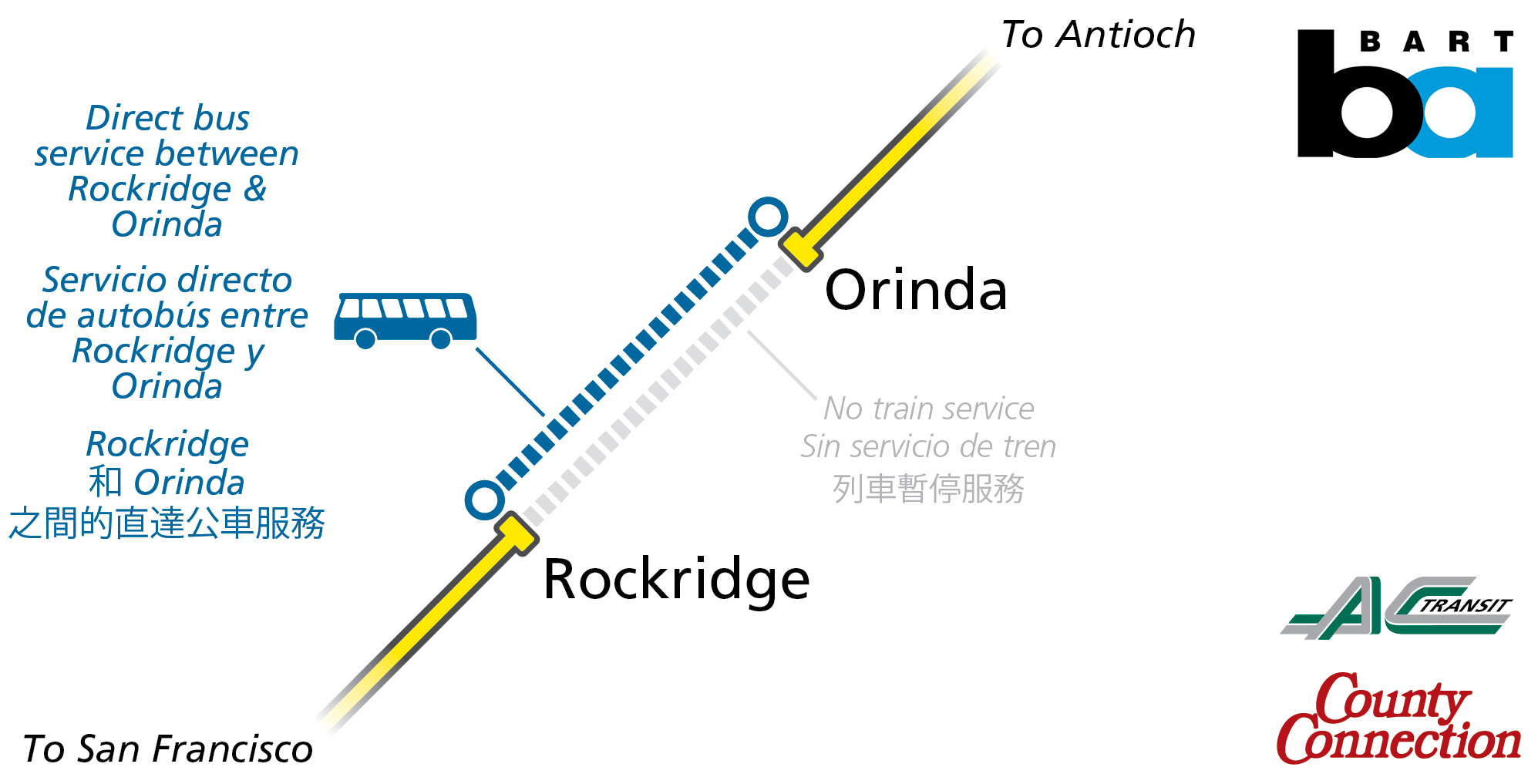
BART’s next major track improvement project will focus on a portion of the Yellow Line. On five non-consecutive weekends in April, May, and June workers will replace an interlocking between Rockridge and Orinda stations. Interlockings allow BART to safely move trains from line to line and are an essential part of the system. Free buses will replace train service between Rockridge and Orinda stations on all five weekends.
The weekend dates for this project are April 1-2, April 15-16, May 13-14, May 27-29 (Memorial Day weekend), and June 10-11. Riders can expect delays of 30 minutes in the work area on shutdown weekends.
Yellow Line trains will run every 30 minutes on shutdown weekends. On each night of the weekend shutdowns the last scheduled departure from Antioch to Orinda that normally leaves at 11:44pm will be cancelled. Riders traveling westbound from Antioch must catch the earlier train at 11:14pm each night.
The equipment being replaced is decades old and has outlived its design life. Riders will enjoy a smoother, safer, more reliable, and quieter ride once the projects are complete. The Yellow Line is the busiest in the BART system.
This upcoming work is part of BART’s overall effort to improve the safety and reliability of the 131-mile, 50 station system. There are now more rebuilding projects happening across BART than at any point in its 50-year history. You can learn more about the progress of this work by reading the 2022 Measure RR Annual Report published by the independent Measure RR Bond Oversight Committee.
You can keep up with the latest updates for trackway repair projects that impact service by going to our Alerts and Advisories page. BART’s Trip Planner has been improved to show the full customer journey including bus bridges.
Learn more about the work happening between Rockridge and Orinda stations on our Frequently Asked Questions (FAQ) page and Fact Sheet for the project.
Read More
Female victim held hostage by suspect
By Brentwood Police Department
On March 12, 2023 at around 9:00 p.m., Brentwood Officers were investigating an unrelated incident in the area of Brentwood Blvd. and Sycamore Ave. when they were approached by an individual reporting a possible hostage situation at the Brentwood Garden Apartments, located in the 160 block of Sycamore Avenue. This individual reported an adult female victim was being held against her will by a known male suspect armed with a handgun.
Several officers responded to the apartment complex and heard gunshots. As officers approached the suspect and victim situated in a breezeway between several apartments, the suspect fired multiple shots in the direction of the officers. Fearing for their lives and the safety of the victim, at least one officer returned fire striking the suspect, a 30-year-old from Long Beach. Both the suspect and victim were transported to area hospitals for treatment of injuries sustained as a result of the shooting, both are expected to survive. No officers or innocent bystanders were injured during the shooting, however, the suspects errant rounds struck unoccupied vehicles in the parking lot. A loaded firearm and expended shell casings were recovered from the scene.
Preliminary information suggests this was an isolated incident with no threat to public safety and there are no outstanding suspects. When the suspect is medically cleared from the hospital, he will be booked at the Martinez Detention Facility on several felonies, including attempted murder on a peace officer.
Contra Costa County District Attorney investigators are conducting a parallel investigation per county protocol.
Anyone with information related to this shooting, who has not already been interviewed by law enforcement is asked to contact Detective Agostinho at 925-809-7870.
This investigation is ongoing and no additional information is being released at this time.
Read More
Arrested in 2018 at Pleasant Hill parking lot where he arranged meeting
 By Ted Asregadoo, PIO, Contra Costa District Attorney’s Office
On March 9th, 37-year-old Ahmed Kamal Ismaiel was convicted by a jury in Contra Costa County on three felony violations, including unlawful electronic contact with a minor and arranging to meet a minor for sex. (See related article)
Ismaiel was arrested on April 6, 2018, by the Contra Costa County Internet Crimes Against Children Task Force when he arrived at a parking lot in Pleasant Hill to meet the minor. He was charged with three felony counts of child sexual exploitation and released on bail pending trial. However, as of Monday, March 13, the Contra Costa County Sheriff’s Office has him in custody at the West County Detention Facility in Richmond while awaiting sentencing by Judge Rebecca Hardie on April 7th. At the time of his arrest, he worked as a network engineer for the Martinez Unified School District. At the time the complaint was filed, he was a resident of Martinez.
During the trial, the prosecution established that Ismaiel attempted to coerce and entice a person he reasonably believed to be a 14-year-old girl into meeting him for sex.
“The Defendant’s behavior was clear, unambiguous, and unacceptable,” noted Deputy District Attorney Chris Sansoe. “Not only that, but so were his attempts to excuse this behavior.”
The evidence against the former Martinez resident also proved that over the course of two days, Ismaiel engaged in sexually suggestive communications with the minor, sent her sexually suggestive photos, and ultimately arranged to meet the minor for sex. Prior to that meeting, Ismaiel stopped at a local grocery store to purchase condoms.
He faces a maximum prison term of four years and a $5,000 fine.
The investigation of Ismaiel was conducted by the multi-agency Internet Crimes Against Children Task Force, including detectives and investigators from the Walnut Creek, Danville, Pleasant Hill, Concord, Pittsburg, San Ramon, Brentwood, and Moraga Police Departments, the Contra Costa County Sheriff’s Office, United States Secret Service, Homeland Security Investigations, and Inspectors from the Contra Costa County District Attorney’s Office.
Parents seeking additional resources can visit www.kidsmartz.org or the website for the Silicon Valley Internet Crimes Against Children Task Force at www.svicac.org. Reports of illegal activity involving minor victims on the internet should be reported at once to your local police department.
Case #01-001853779 | The People of the State of California v. Ismaiel, Ahmed Kamal
Allen D. Payton contributed to this report.
Read More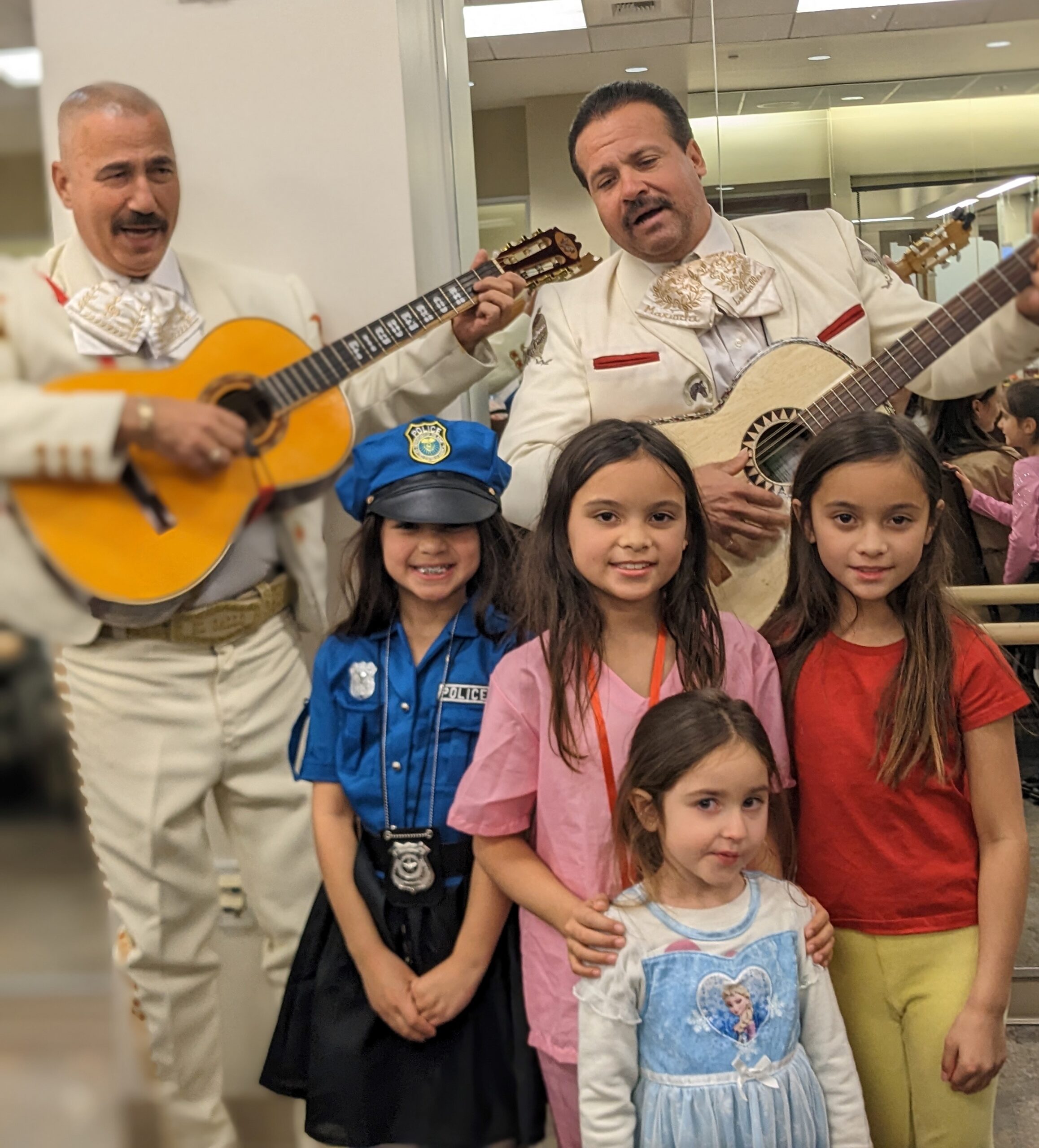
Children enjoy Mariachi music at the “Purim in Mexico” fiesta on March 7, 2023. Photos by Chabad of the Delta.
Commemorates deliverance of the Jewish people from Haman’s plot to destroy them and Queen Esther’s actions to save her people
By Mashie Goldschmid
On Tuesday, March 7th marked Purim a festive holiday for the Jewish people. It was a fun fiesta as a happy throng of the Brentwood Jewish community of all ages gathered with Chabad of the Delta to celebrate Purim! The theme was Purim in Mexico, and everyone had a blast, eating traditional three-cornered Hamantaschen cookies, and a Mexican feast. The sound of the mariachi band transported us right to Mexico.
The kids enjoyed lots of activities and prizes.
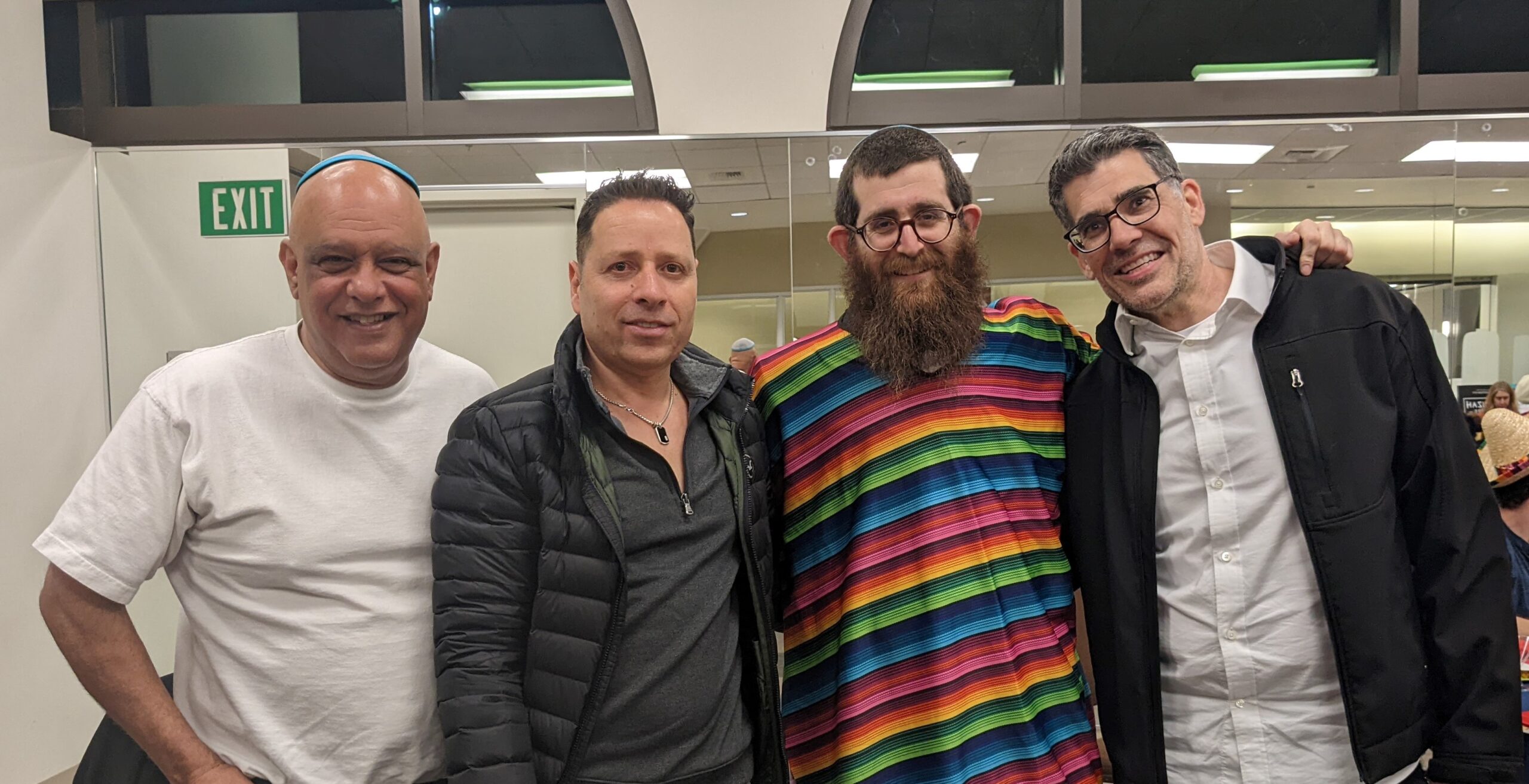
Rabbi Peretz Goldshmid (2nd from right) and attendees celebrate Purim during a Mexican fiesta on March 7, 2023.
Purim commemorates the salvation of the Jewish people in Ancient Persia from Haman’s plot to destroy every Jew. It is celebrated by reading the Scroll of Esther (known as the Megillah), gifts of food, charity, feasting and merriment.
As we all know, joy is best when it is shared. To that end, a dedicated group of volunteers packaged and delivered beautifully wrapped Share the Joy packages to many Jewish homes in the area. Thank you to our wonderful volunteers.
For more photos and to learn more about Chabad of the Delta visit: JewishDelta.com.
Read More
Meet the Ewoks, Darth Vader and more at Concord Hilton Hotel; Kids 9 & under are FREE! Plus, FREE parking
 Co-promoted by American Brick Builders

Contra Costa Con 5 is coming to Concord this Sunday, Mar. 12, at the Hilton Concord Hotel featuring actors and behind the scenes creators from the Star Wars family celebrating Return of the Jedi 40th Anniversary movie release.
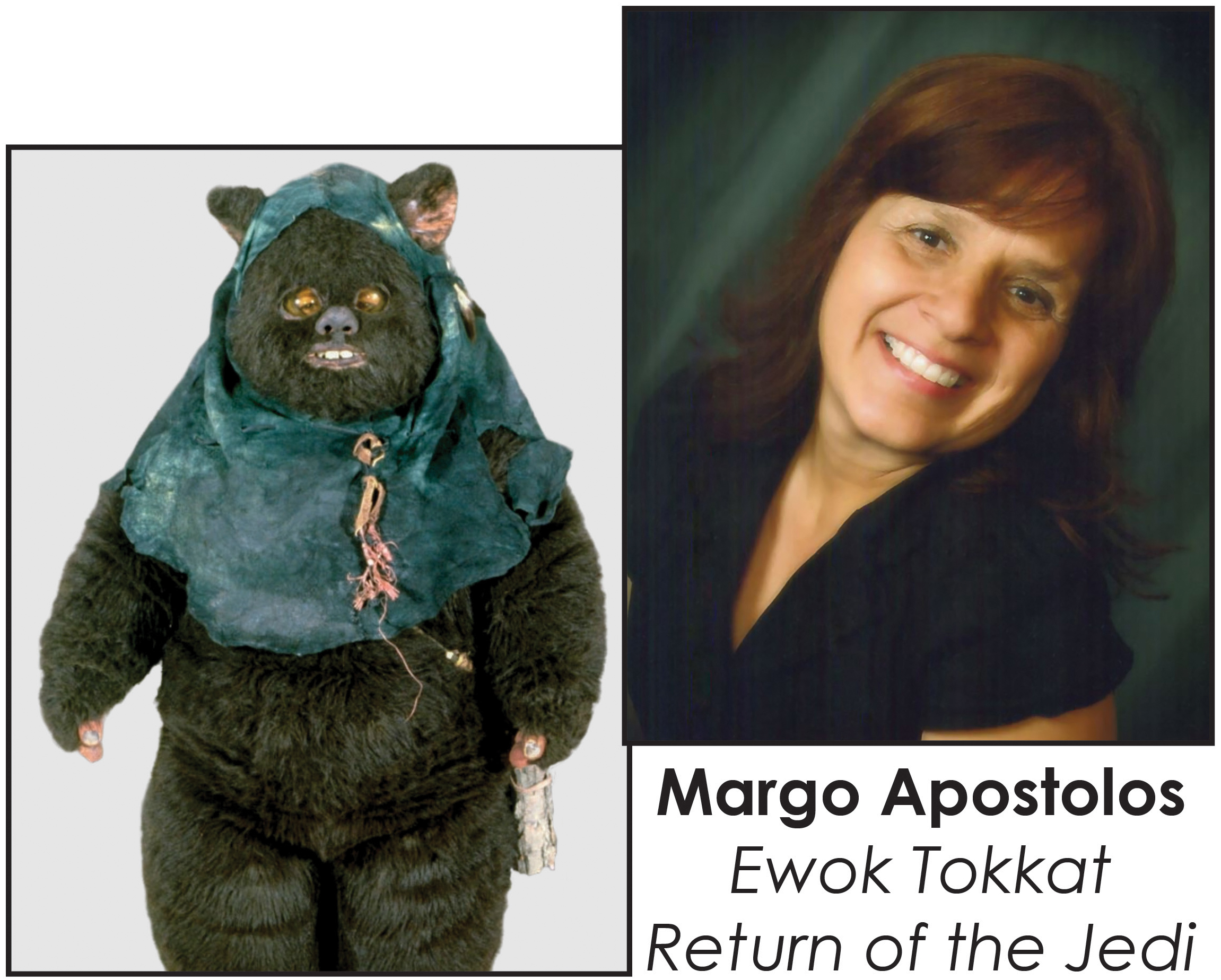
Actors from Return of the Jedi and other Star Wars films on hand at Contra Costa Con 5 include C. Andrew Nelson (Darth Vader), Margo Apostolos (Ewok Tokkat), Kevin Thompson (Ewok Chubbray), Alan Fernandes (Tusken Raider) and David Gonzalez (Ak-Rev–Jabba the Hutt’s drum master).

Kevin Thompson
Adding to their star power is one of the most prominent voice actors of the past 30 years, Mark Dodson. He voiced Salacious Crumb in Return of the Jedi and provided various voices for Ewoks: The Battle for Endor and Star Wars: Episode VII The Force Awakens. Dodson is perhaps best known as the voice of the eponymous creatures in Gremlins and Gremlins 2: The New Batch.
Emmy Award-winning director, writer and producer Kirk R. Thatcher (Return of the Jedi, Star Trek, Spider-Man, Muppets and RoboCop) is part of the behind-the-scenes talents from Industrial Light & Magic at Contra Costa Con 5 that also includes David Carson (Return of the Jedi, Empire Strikes Back), Randy Ottenberg (Return of the Jedi, Star Wars: Episodes I and II), Selwyn Eddy III (Return of the Jedi, Empire Strikes Back, Ewoks: The Battle for Endor) and David Tanaka (Star Wars: Episodes I and IV).
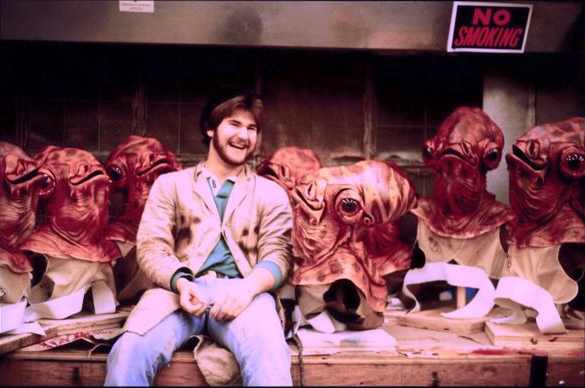
Kirk Thatcher
There will be panels with the actors and ILM technical stars at Contra Costa Con 5.
The Rebel Legion Endor Base, Mandolorian Mercs Teren Clan, 501st Legion Golden Gate Garrison and Droid Builders members will come as their favorite Star War characters to meet and have photos taken with fans of the iconic movies.
Toys, art, comics, LEGO, anime, vintage and new collectibles, games, jewelry, apparel and much more will be featured at the family-friendly show hosted by Bay Area Festivals and American Brick Builders.
Contra Costa Con 5 is open from 10 a.m. to 4 p.m. with free parking at the Hilton. The first 300 families get a free Toy Bag.

Featured guests enjoy meeting and chatting with attendees. However, the ticket admission price does not include picture, autograph or audio with featured guests.
A free, family-friendly Star Wars Cosplay Costume Contest for attendees awards cash prizes in different age groups. Contest registration will be taken during the day with contest judging at 3 p.m.
 New items and collectibles from Star Wars, Disney, Transformers, Funko Pop, LEGO, Pokémon, G.I. Joe, Marvel, DC, Dragon Ball Z, My Hero Academia, Hot Wheels and much more will be available from the wide variety of exhibitors at the show. Posters, anime, art, prints, t-shirts, hats, books, buttons, classic video games, jewelry and cards are featured too.
The Hilton is located at 1970 Diamond Blvd, two blocks off Interstate 680 in Concord. For more information visit www.ContraCostaCon.com.
Tickets for Contra Costa Con 5 are on sale now at www.ContraCostaCon.com. Advance ticket buyers get entered in a free raffle and get a free $2 Shopping Buck at check-in. Children nine and under are free. Presented by Bay Area Festivals and co-promoted by American Brick Builders of Antioch.
Read More
Hikers on the trail near Cave Point and Riggs Canyon. Photo: Scott Hein
To open March 29 from Balancing Rock to Riggs Canyon on Mount Diablo
By Laura Kindsvater, Communications Manager, Save Mount Diablo
On March 29, Save Mount Diablo will officially open the Knobcone Point to Riggs Canyon trail connection. This section of trail winds through the upper 560 acres of Mount Diablo’s Curry Canyon Ranch, through one of Mount Diablo’s wildest areas. It travels from Balancing Rock and Knobcone Point, to Cave Point, to Windy Point and Riggs Canyon.
Although the trail was once available to the public ranging all over the mountain before proliferation of cattle fencing, it’s been nearly a hundred years since it was legal.
The 1.25-mile-long trail will considerably expand the amount of open space available to explore on Mount Diablo’s southern hills. It will effectively fully connect Rock City and Mount Diablo to Riggs Canyon, Morgan Territory, and Los Vaqueros via publicly accessible trails.
Curry Canyon is the final missing major canyon entrance to Mount Diablo. Curry Canyon Ranch has over nine miles of fire roads, most of which will continue to be closed for now, while Save Mount Diablo works with California State Parks to transfer much of the property to the park.

Map showing the new trail segment. Map by Roxana Lucero, Save Mount Diablo
Currently Mount Diablo State Park visitors must climb in and out of four canyons from Rock City to Riggs Canyon—going forward, they can follow a ridgeline with spectacular views.
Right now, state park staff must leave the state park to reach Riggs Canyon. Opening the ridgeline fire road on Save Mount Diablo’s property will solve this access and management issue.
In preparation for the grand opening, Save Mount Diablo’s staff and volunteers have been installing infrastructure, including access gates and informational signage.
They have also been removing dead material to minimize fire risk in the area. The removal of dead and scorched plants in this area will encourage new growth of native and endemic wildflowers and chaparral plants this spring.
This project has been a decade in the making, in the works since Save Mount Diablo acquired the 1,080-acre Curry Canyon Ranch property in 2013.

Rocky cliffs in the Knobcone Point area of Save Mount Diablo’s Curry Canyon Ranch. Photo: Scott Hein
“Thanks to our terrific supporters, staff, partners, and volunteers, like our Trail Dogs, Save Mount Diablo has created and opened a number of public trails the last two years. Last year, we created and opened over four miles of trails at our new Mangini Ranch Educational Preserve. This year, we will finish and open an important 1.25 +/- mile trail on Save Mount Diablo’s Curry Canyon Ranch that will allow the public to hike from Knobcone Point at Mount Diablo State Park, through the upper portions of our spectacular Curry Canyon Ranch, to Riggs Canyon at the state park. All these trails we have built are portals that allow the public to enter nature and be transformed for the better,” said Ted Clement, Save Mount Diablo Executive Director.
As part of its goal of getting more people into nature, Save Mount Diablo has been opening more land to the public and creating new trails over the years. In 2022, Save Mount Diablo opened several miles of trails at its Mangini Ranch Educational Preserve in Concord for people to enjoy.
Now the highly anticipated Knobcone Point trail connection will further open up opportunities to enjoy Mount Diablo’s majestic views and wilderness—recreationalists will experience a rarely seen part of the mountain.
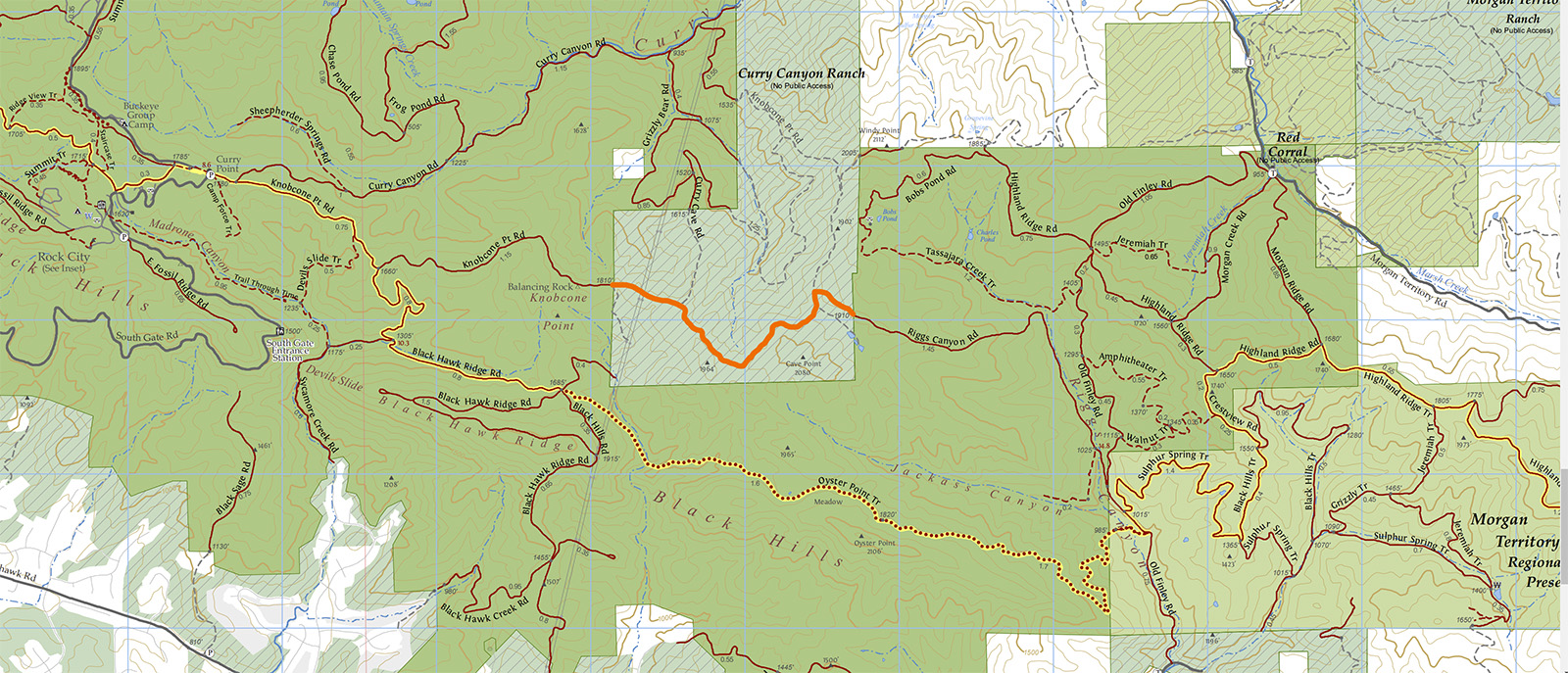
Vicinity map showing the new trail segment highlighted in orange. Map by Save Mount Diablo
“This trail is the major recreational puzzle piece in the Mount Diablo area, allowing park users to connect the mountain to Morgan Territory and beyond to Los Vaqueros, furthering their adventure into this extraordinary place,” said Sean Burke, Save Mount Diablo Land Programs Director.
Traveling along this newly opened trail, visitors will be immersed in the knobcone pine forests after which the area is named and stunning sandstone rock formations. They may see golden eagles and songbirds fly overhead.
This trail will open up a rarely traveled area; it will give hikers an opportunity to explore and experience the solitude of one of the extraordinary parts of Mount Diablo.
A trail opening ceremony will take place on the property at the Knobcone Point gate near Balancing Rock at 11:00 AM on March 29, weather permitting. We invite the public to hike in and join us. If you’d like to come, meet at Curry Point in Mount Diablo State Park on South Gate Road at 9:30 AM. There is a park entrance fee of $10, and parking at Curry Point is limited. The hike from Curry Point to the ceremony is a little over two miles.

The Knobcone Point Road trail segment travels along the ridgeline from Knobcone Point to Riggs Canyon. Photo: Scott Hein
After the ceremony, staff will lead a hike to the Riggs Canyon gate. The hike from the Knobcone Point gate to the Riggs Canyon gate is 1.25 miles.
In the event of heavy rain, the trail will still be opened to the public on March 29, but we will cancel the trail opening ceremony.
It is with great pride and excitement that Save Mount Diablo will open this trail connection and share the beauty of Knobcone Point, Cave Point, and Riggs Canyon with all who visit.
About Save Mount Diablo
Save Mount Diablo is a nationally accredited, nonprofit land trust founded in 1971 with a mission to preserve Mount Diablo’s peaks, surrounding foothills, watersheds, and connection to the Diablo Range through land acquisition and preservation strategies designed to protect the mountain’s natural beauty, biological diversity, and historic and agricultural heritage; enhance our area’s quality of life; and provide educational and recreational opportunities consistent with protection of natural resources. To learn more, please visit www.savemountdiablo.org.
Read More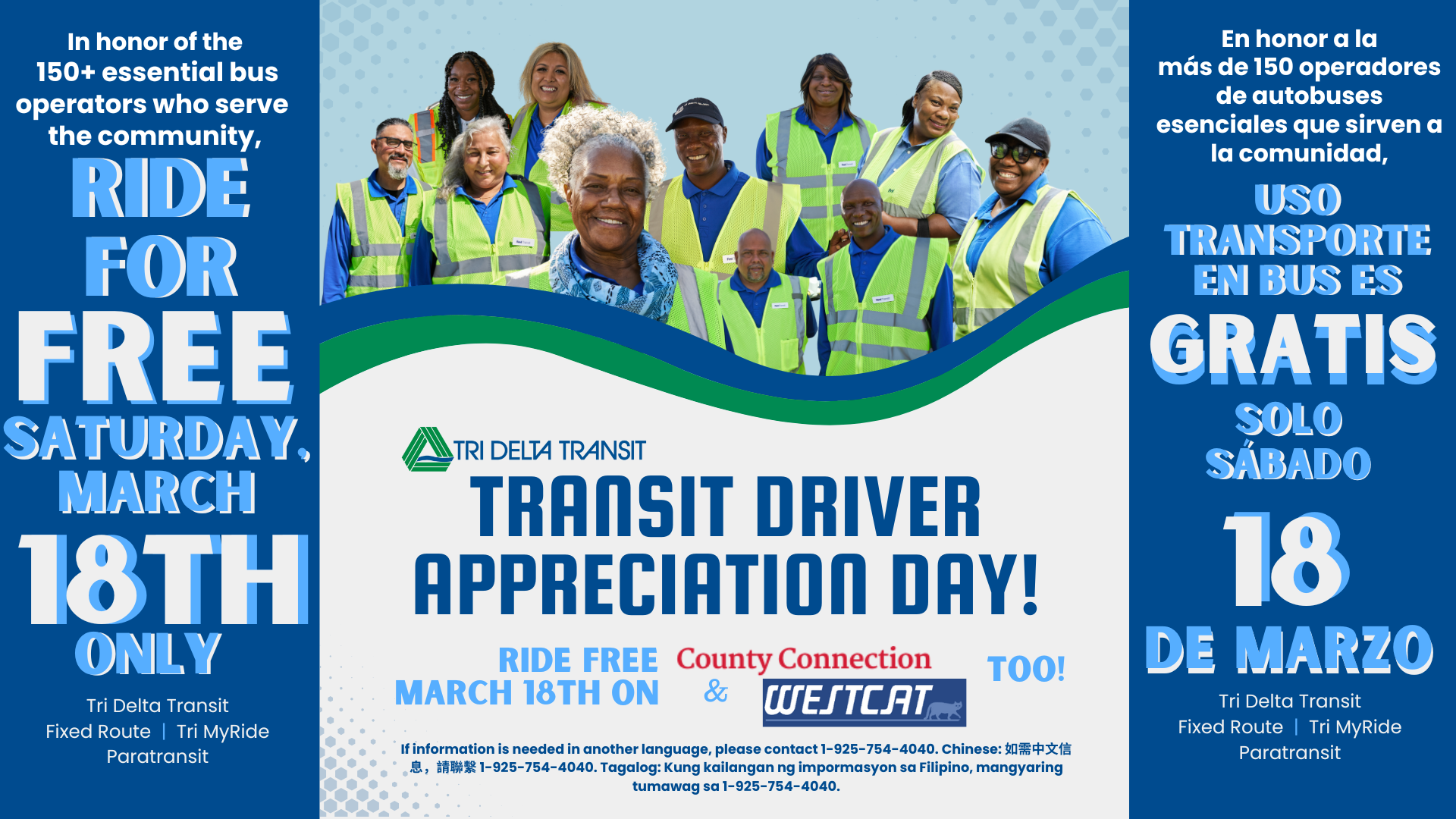
By Leeann Loroño, Manager of Customer Service and Marketing, Tri Delta Transit
Transit Driver Appreciation Day is Saturday, March 18 and Tri Delta Transit, County Connection, and WestCAT are celebrating in a special way– by going FARE FREE for the day. No payment will be required on all three agencies buses for fixed route and paratransit. Additionally, Tri Delta Transit’s ride-hailing service, Tri MyRide, will not require any payment for the day either.
Transit Driver Appreciation Day started in 2009 in Seattle as a blog about appreciating bus drivers. By 2014 the name was changed to cover the diverse transportation available throughout the United States. The day is set aside to thank and appreciate transit drivers for the great contributions they make to the community.
“The contribution drivers make has never been realized more than over the past three years of the pandemic. Transit operators performed a critical and essential service during this time by continuing to provide public transportation,” said Tri Delta Transit CEO, Rashidi Barnes. “Through these unprecedented times, our drivers showed continued courage, patience and perseverance.”
Transit Driver Appreciation Day, also known as Transit Operator Appreciation Day, continues to be a notable day for those who value public transportation. Through COVID-19 and risking possible exposure to the virus, transit operators continue to show up, adapting to ever changing regulations and working with unpredictable changes in ridership numbers as well as adapting to new schedules. Plus, national driver shortages add new responsibilities to cover shifts, perform extra cleaning and sanitizing of vehicle, all to ensure our transit system can keep running.
“There’s been a lot of unknowns in the past few years in public transit operations,” acknowledged Bill Churchill, General Manager of County Connection. “There can be a lot of multifaceted work a transit driver has to perform, including, thoroughly checking their vehicle before every route starts to ensure the safety of the riders, navigating traffic and accidents, learning new technology, and remembering customer service duties,” Churchill added, “We’re so proud that, despite any setbacks, we’ve maintained a high on-time performance rate—a testament to the dedication and hard work of our drivers.”
Rob Thompson, General Manager of WestCAT shared a similar sentiment of transit drivers, stating, “Our drivers truly are the front line for our agencies, their commitment and hard work are invaluable in providing public transit to our communities.”
Drivers are dedicated and hardworking because they drive as a service to the community. “We hope by going fare free, riders can focus on the driver and their rider experience, and visa-versa, instead of focusing on fares,” says Tri Delta Transit Board Chair Anissa Williams. “For Transit Driver Appreciation Day, agencies hope everyone takes a moment to thank their transit driver when riding the bus and posts positive messages on the social media pages of the system you ride so that the drivers can see them.” The transit agencies were also happy to offer free fares, as a day of fare free riding is also nice for passengers and helps to bring attention to this annual day of recognition.
To learn more about these transit agencies, visit TriDeltaTransit.com, CountyConnection.com and Westcat.org.
Read More
In the midst of contract negotiations
“a physician vacancy does not mean that there is a clinical vacancy, nor that care is compromised.” – Kim McCarl, CCHS
“A bigger medical and dental staff would help alleviate some of the load that our current employed members are carrying.” – Dr. David MacDonald, President, PDOCC
By Allen D. Payton
Last month the Physicians’ and Dentists Organization of Contra Costa (PDOCC) released data showing a high number of doctor vacancies in Contra Costa County Health Services.
According to a Feb. 16, 2023, PDOCC press release, based on county data, there are currently 83 out of 285 employed positions listed as vacant in Contra Costa Health Services, a 29 percent vacancy rate in the system. That includes 27 vacant positions in family medicine and primary care adult medicine, 5 vacant dentist positions and 5 vacant OB/GYN positions. With 19 vacant psychiatrist positions, only 27 percent of employed psychiatry positions are currently filled. 11 vacant employed positions in the emergency department – half of the department’s employed positions – means the county is unable to safely staff the emergency room.
Since November, 5 emergency department doctors have left county employment. The county interviewed and offered positions to 21 new emergency department applicants, but the offer was declined by every applicant.
The problem is expected to get a lot worse in 2024 when Contra Costa County will need an additional 40 primary care providers to care for 30,000 new Medi-Cal patients being added to the county’s health services due to an agreement between the county and California’s Department of Health Services.
The problem continues to worsen. Contra Costa County Health Services added 12,200 patients in the last two months, while only adding 1 new primary care physician. The result is that the average primary care physician employed by the county now has almost 200 more patients on their panel than at the end of 2022. There are no new primary care physicians anticipated to join county employment before July 2023.
On average, the county has only been able to fill three primary care doctor vacancies annually over the last three years.
In response, CCHS Communications Officer Kim McCarl, said doctor shortages are a nationwide challenge, are not compromising care, and confirmed that negotiations between the union and county “are underway”.
She wrote, “We value the medical staff who work across our department.
Health systems across the country are struggling to recruit and retain medical staff at all levels. Contra Costa Health is no different.
It’s important to note that a physician vacancy does not mean that there is a clinical vacancy, nor that care is compromised. We are confident that the right provider is caring for the right patient in the right way at Contra Costa Regional Medical Center and Health Centers every day.
We provide flexibility in work schedule, an emphasis on proactive care, and mission-oriented work that helps us recruit and retain physicians who want to practice in an integrated environment. It’s not uncommon for our physicians to be expert in many areas of clinical medicine which our system values.
We value physicians who embrace our mission and choose to work for Contra Costa Health on a full-time, permanent basis but we also welcome doctors who take a less traditional approach to their careers by working part time or in partnership with other health care entities. These approaches help to alleviate the burnout that has been so costly to hospitals and healthcare systems since the height of the pandemic.
We are proud to be home to one of the most highly rated family medicine training programs in the country. We recruit well-trained physicians who are familiar with our system from each graduating class.
Recruitment and retention of physicians is a top priority at Contra Costa Health. We will continue to explore ways to fill every vacancy across our healthcare system.”
Doctors, Dentists Disagree
That opinion, however, is not shared by the county’s doctors and dentists or by best practice standards for patient care.
The severe shortages most certainly impact patient care, including the time a physician can devote to each patient along with the availability of appointments, according to county doctors.
Contra Costa County’s own policies recommend no more than 1,500 patients to a primary care physician’s panel (the number of patients assigned to a physician). Currently the average panel size for Contra Costa’s employed primary care physicians is 1,879.
“County leaders may be willing to turn a blind eye to severe staffing shortages, but doctors care too much about our patients to let the problem go unaddressed any longer,” said Dr. David MacDonald, PDOCC President. “We hear from patients all the time about how difficult it is for them to schedule appointments in our system. When they finally get an appointment, it is rarely for the amount of time they need because doctors are overstretched and taking on more patients because of all the vacancies. The patients who rely on Contra Costa County Health Services for care should not have to settle for less time and attention than patients in other systems or ones with private healthcare.”
In addition to the primary care vacancies, there are 5 vacant dentist positions and 5 vacant OB/GYN positions. With 19 vacant psychiatrist positions, only 27 percent of employed psychiatry positions are currently filled. 11 vacant employed positions in the emergency department – half of the department’s employed positions – means the county is unable to safely staff the emergency room.
The problem is expected to get exponentially worse in 2024 when Contra Costa County will need an additional 40 primary care providers to care for 30,000 new Medi-Cal patients being added to the county’s health services due to an agreement between the county and California’s Department of Health Services.
PDOCC is calling on county leaders to be proactive by filling the position vacancies which will improve patient care and support county revenues. “It’s hard to believe that Contra Costa County is not working more closely with our union to help it become more attractive and competitive in retaining and recruiting medical and dental talent. I believe the county is moving in the wrong direction and I’m concerned that patients are being put at risk,” MacDonald said.
PDOCC members are currently in negotiations with county management towards a new contract. Issues raised in negotiations by PDOCC members include high patient caseloads, insufficient time for administrative tasks, long waits for primary care appointments and specialty referrals, chronic short staffing and high turnover – all of which combine to negatively impact patient care and health impacts. PDOCC members also state that burnout is at an all-time high.
County Health, PDOCC Respond to Questions
Questions were sent to both McCarl and the union’s spokesman asking if the PDOCC is in the midst of contract negotiations with the county and if so, is this an effort to obtain an increase in compensation for its members.
While McCarl responded, “Yes, negotiations are underway” she did not respond to the additional question about their criticism.
The questions were also sent Tuesday afternoon to Dr. David MacDonald with the PDOCC.
He responded, “PDOCC is engaged with Contra Costa County in negotiations at the level of state mediation. We have one more session to go.
We are focused on improving patient care and making the workplace in Contra Costa Health Services (CCHS) more sustainable.
We have to be able to hire new medical and dental talent, so compensation has to be more market competitive. This would also help with retention. A bigger medical and dental staff would help alleviate some of the load that our current employed members are carrying. The situation at this time is untenable. And, per an agreement between CCHS and the state’s Department of Health Services, CCHS will become the single system to provide care for MediCal patients in the county (aside from small fraction of MediCal patients covered by Kaiser). This will mean for an additional 30,000 new patients into our system as of January 1, 2024. We’re not ready for that. We will need an additional 40 new primary care providers to handle the influx of new patients. The County is nowhere close to hiring that many (I believe the County has 3 new providers scheduled to start after July of this year).
In addition, half of our emergency department employed positions are vacant. This means that the County partially fills the gap with very expensive temp doctors. We think it would be smarter for the County to take the funds doled out to temps and invest that money in committed, dedicated and County career minded docs who will be here for the long term.
Another issue is that our primary care providers need more protected time to manage their patient panels. The in-basket work – lab follow up, med refills, answering patient calls & emails, etc., has been escalating. Our physicians take this work home with them and it takes away time from their families and individual restorative activities.
All of this after the three-year pandemic onslaught has left our physicians and dentists suffering more from burnout than ever before. The County must step up, be proactive, and work with our union on how to achieve meaningful improvements that will enhance patient care and move our system in the right direction.”
Read More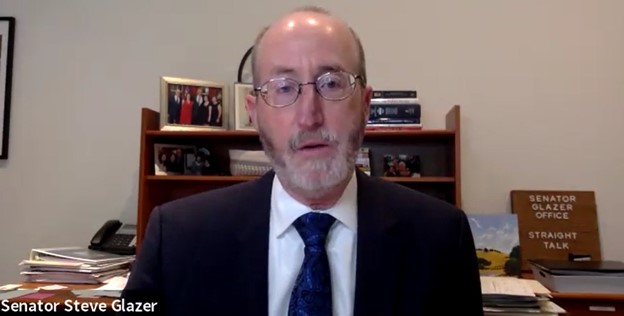
State Senator Steve Glazer speaks on the legal challenge to SB1349 during a virtual media briefing on Monday, March 6, 2023. Video screenshot
Joined by Common Cause, Consumer Watchdog for media briefing on “what’s at stake if big money wins lawsuit to terminate anti-corruption law”
On Monday, March 6, 2023, a coalition of policy experts, including representatives from Common Cause and Consumer Watchdog, joined State Senator Steve Glazer (SD7, D-Contra Costa) held a briefing on the special interest lawsuit to terminate SB 1439, what they refer to as “a common sense anti-corruption law that would help end the cycle of scandals caused by special interests’ massive campaign contributions to the local officials they have business before.”
Authored by Contra Costa State Senator Steve Glazer and signed into last year, SB1439 prohibits a local elected official from voting on a matter if they have received a contribution from the party to the matter or their agent of more than $250 during the 12 months prior to the date a final decision is made on the matter. It also prohibits local officials from receiving a contribution of more than $250 in the 12 months after the proceeding from party to the matter or the party’s agent. But the bill also allows an official to return a contribution to avoid violating the new law and still vote on the matter.
According to Common Cause which proposed the bill, California law prohibited anyone seeking a contract, permit, or license from the government from making a campaign contribution of more than $250 to the officials responsible for decisions about that contract, permit, or license. The limitation applied while the contract, permit, or license was pending and for three months after. But local elected officials were exempted from the law. The bill extended the prohibitions from three to 12 months and included local elected officials.
The panel of policy and democracy experts warned the public of the high-stakes consequences of the special interest lawsuit, by eight trade associations and two Sacramento area local elected officials, to terminate SB 1439 at a virtual press conference. The legislation, signed into law last year, is a common-sense, anti-corruption law that would help end the cycle of scandals caused by special interests’ massive campaign contributions to local officials they have business before.
The panel discussed the urgent need to uphold the lawful, long-overdue legislation that holds local leaders accountable to the people they serve, not to special interests. Local stakeholders illustrated how special interests meddling in local politics hinders democracy and harms our communities.
“We have become numb to the legal corruption that has enveloped our democracy. Pay-to-play is antithetical to an honest and ethical government, and it should be rooted out and killed like a cancer that has affected the body politic,” said Glazer.
Regarding the importance of expanding our anti-corruption laws:
“California’s local governments have been plagued by scandals in which special interest entities pump campaign cash to the local government officials who determine their fate on licenses, permits, and contracts. The examples are endless – SB 1439 is a common sense, narrowly tailored solution to an acute and documented problem to protect our communities,” said Jonathan Mehta Stein, Executive Director of California Common Cause. “It has been tried in other states and in a long list of California cities, and it has never been knocked down because of legal challenges. We trust SB 1439 will succeed in the courts.”
Regarding how SB 1439 expands the Political Reform Act:
“SB 1439 is one of the most significant pieces of legislation in the last 10 years. It gets right to the heart of the corruption problem – people think that elected officials are acting in the best interest of their contributors, not in the public interest. This law expands the purposes of the Political Reform Act and is a major effort to correct this problem and public perception, thus the law should be upheld by the courts,” said Bob Stern, policy expert and principal co-author of the Political Reform Act of 1974.
Regarding how big money in our local politics hurts our communities:
“Supporting SB 1439 as a bill was an easy choice for us – we see and feel regularly the impact of corporate money in the Inland Empire. Increasingly, it’s felt that regardless of how loudly residents and voters push back against certain kinds of local projects, developer money will always drown out our voice,” said Sky Allen, Executive Director of Inland Empire United. “Over the past 20 years, the Inland Empire has become the largest logistics hub in the world – so instead of green space and local businesses, we’re surrounded by massive warehouses and, as a result, we breathe some of the worst air and are offered fewer quality jobs. Laws like AB 1439 give us hope that moving forward, the scales will be more balanced.”
Regarding how big money in our local politics hurts consumers:
“Local politicians have tremendous influence and direct impact on the policies that impact consumers the most, like zoning laws, environmental regulations, and business licensing. When corporations and wealthy individuals use their financial resources to influence local elections and create favor with local elected officials, they successfully steer public policy in ways that are sympathetic to their own interests at the expense of consumers as a whole,” said Ben Powell, Staff Attorney for Consumer Watchdog. “Laws like SB 1439 address this by ensuring that local politicians are working in favor of the public interest, not bids for re-election or trading favors with wealthy donors.”
“It’s imperative that we ensure local elections stay equitable for everyone. When big money comes into play, socioeconomic barriers are strengthened and the community is ultimately the one who loses,” said Emmanuel Estrada, Mayor of Baldwin Park. “In Baldwin Park, we enacted a local ordinance barring city contractors from directly donating to candidates and adding stricter contribution limits. When we sent it to the voters to reinforce the ordinance, over 80 percent were in favor, illustrating the massive desire to remove the influence of big money from our local politics.”
California Fair Political Practices Commission Chair, Richard C. Miadich, who was unable to attend the briefing said, “We’re disappointed to learn a lawsuit has been filed regarding SB 1439 after the Commission voted unanimously to support it and months after it unanimously passed the legislature and was signed by the Governor.”
“It also comes months after we’ve begun issuing guidance, gathering public input and crafting regulations to implement the law. We’ll continue doing just that and will continue to enforce the law unless and until a court ruling says otherwise,” he added.
To watch the full briefing, click here.
Allen D. Payton contributed to this report.
Read More

Photo source: EBRPD
The East Bay Regional Park District is looking to hire over 50 new lifeguards for the 2023 swim season at its 12 East Bay swim facilities, which include lakes, lagoons, and swimming pools. All new lifeguard positions are seasonal, full-time positions from May through September. Anyone ages 16 and over before April 22, 2023, are encouraged to apply. Starting pay is $20.78 per hour. Applications will be accepted through March 27, 2023.
There are six lifeguard testing dates scheduled in March. Participants will be asked to swim 550 yards in under 10 minutes, carry a rescue board 50 feet, retrieve three dive rings under four to seven feet of water, tread water for two minutes using only their legs, and retrieve a 10-pound brick from underwater. There will also be a short informal interview after successful completion of the swim test on the same day.
Testing Schedule:
• Saturday, March 11, at Buchanan Pool, Pittsburg
• Sunday, March 12, at Granada High School Pool, Livermore
• Saturday, March 18, at San Leandro High School Pool, San Leandro
• Sunday, March 19, at Granada High School Pool, Livermore
• Saturday, March 25, at Buchanan Pool, Pittsburg
• Sunday, March 26, at Castro Valley High School Pool, Castro Valley
Participants who pass the tests will be invited to the Park District’s Lifeguard Academy beginning Saturday April 22, 2023, where they will receive paid training and certification in open water lifeguarding. The Lifeguard Academy takes place over five consecutive weekends in April and May, with the swim season beginning in late May for most facilities.
“Working as a lifeguard is one of the few ways a young adult can give back to their community and learn about public service,” said East Bay Regional Park District Aquatics Manager Pete DeQuincy. “Promoting water safety and educating park visitors on how to safely recreate in, on, and around water is paramount in what a lifeguard does.”
Lifeguards can work at any of the Park District’s swim facilities in various cities in Alameda and Contra Costa counties, such as Antioch, Concord, Livermore, Hayward, Castro Valley, Oakland, Alameda, and Berkeley.
For information and how to apply, visit www.ebparks.org/public-safety/lifeguard/jobs.
The East Bay Regional Park District is the largest regional park system in the nation, comprising 73 parks, 55 miles of shoreline, and over 1,300 miles of trails for hiking, biking, horseback riding, and environmental education. The Park District receives more than 25 million visits annually throughout Alameda and Contra Costa counties in the San Francisco Bay Area.
Read More











Source: BART
On five non-consecutive weekends
BART’s next major track improvement project will focus on a portion of the Yellow Line. On five non-consecutive weekends in April, May, and June workers will replace an interlocking between Rockridge and Orinda stations. Interlockings allow BART to safely move trains from line to line and are an essential part of the system. Free buses will replace train service between Rockridge and Orinda stations on all five weekends.
The weekend dates for this project are April 1-2, April 15-16, May 13-14, May 27-29 (Memorial Day weekend), and June 10-11. Riders can expect delays of 30 minutes in the work area on shutdown weekends.
Yellow Line trains will run every 30 minutes on shutdown weekends. On each night of the weekend shutdowns the last scheduled departure from Antioch to Orinda that normally leaves at 11:44pm will be cancelled. Riders traveling westbound from Antioch must catch the earlier train at 11:14pm each night.
The equipment being replaced is decades old and has outlived its design life. Riders will enjoy a smoother, safer, more reliable, and quieter ride once the projects are complete. The Yellow Line is the busiest in the BART system.
This upcoming work is part of BART’s overall effort to improve the safety and reliability of the 131-mile, 50 station system. There are now more rebuilding projects happening across BART than at any point in its 50-year history. You can learn more about the progress of this work by reading the 2022 Measure RR Annual Report published by the independent Measure RR Bond Oversight Committee.
You can keep up with the latest updates for trackway repair projects that impact service by going to our Alerts and Advisories page. BART’s Trip Planner has been improved to show the full customer journey including bus bridges.
Learn more about the work happening between Rockridge and Orinda stations on our Frequently Asked Questions (FAQ) page and Fact Sheet for the project.
Read MoreFemale victim held hostage by suspect
By Brentwood Police Department
On March 12, 2023 at around 9:00 p.m., Brentwood Officers were investigating an unrelated incident in the area of Brentwood Blvd. and Sycamore Ave. when they were approached by an individual reporting a possible hostage situation at the Brentwood Garden Apartments, located in the 160 block of Sycamore Avenue. This individual reported an adult female victim was being held against her will by a known male suspect armed with a handgun.
Several officers responded to the apartment complex and heard gunshots. As officers approached the suspect and victim situated in a breezeway between several apartments, the suspect fired multiple shots in the direction of the officers. Fearing for their lives and the safety of the victim, at least one officer returned fire striking the suspect, a 30-year-old from Long Beach. Both the suspect and victim were transported to area hospitals for treatment of injuries sustained as a result of the shooting, both are expected to survive. No officers or innocent bystanders were injured during the shooting, however, the suspects errant rounds struck unoccupied vehicles in the parking lot. A loaded firearm and expended shell casings were recovered from the scene.
Preliminary information suggests this was an isolated incident with no threat to public safety and there are no outstanding suspects. When the suspect is medically cleared from the hospital, he will be booked at the Martinez Detention Facility on several felonies, including attempted murder on a peace officer.
Contra Costa County District Attorney investigators are conducting a parallel investigation per county protocol.
Anyone with information related to this shooting, who has not already been interviewed by law enforcement is asked to contact Detective Agostinho at 925-809-7870.
This investigation is ongoing and no additional information is being released at this time.
Read More
Arrested in 2018 at Pleasant Hill parking lot where he arranged meeting
By Ted Asregadoo, PIO, Contra Costa District Attorney’s Office
On March 9th, 37-year-old Ahmed Kamal Ismaiel was convicted by a jury in Contra Costa County on three felony violations, including unlawful electronic contact with a minor and arranging to meet a minor for sex. (See related article)
Ismaiel was arrested on April 6, 2018, by the Contra Costa County Internet Crimes Against Children Task Force when he arrived at a parking lot in Pleasant Hill to meet the minor. He was charged with three felony counts of child sexual exploitation and released on bail pending trial. However, as of Monday, March 13, the Contra Costa County Sheriff’s Office has him in custody at the West County Detention Facility in Richmond while awaiting sentencing by Judge Rebecca Hardie on April 7th. At the time of his arrest, he worked as a network engineer for the Martinez Unified School District. At the time the complaint was filed, he was a resident of Martinez.
During the trial, the prosecution established that Ismaiel attempted to coerce and entice a person he reasonably believed to be a 14-year-old girl into meeting him for sex.
“The Defendant’s behavior was clear, unambiguous, and unacceptable,” noted Deputy District Attorney Chris Sansoe. “Not only that, but so were his attempts to excuse this behavior.”
The evidence against the former Martinez resident also proved that over the course of two days, Ismaiel engaged in sexually suggestive communications with the minor, sent her sexually suggestive photos, and ultimately arranged to meet the minor for sex. Prior to that meeting, Ismaiel stopped at a local grocery store to purchase condoms.
He faces a maximum prison term of four years and a $5,000 fine.
The investigation of Ismaiel was conducted by the multi-agency Internet Crimes Against Children Task Force, including detectives and investigators from the Walnut Creek, Danville, Pleasant Hill, Concord, Pittsburg, San Ramon, Brentwood, and Moraga Police Departments, the Contra Costa County Sheriff’s Office, United States Secret Service, Homeland Security Investigations, and Inspectors from the Contra Costa County District Attorney’s Office.
Parents seeking additional resources can visit www.kidsmartz.org or the website for the Silicon Valley Internet Crimes Against Children Task Force at www.svicac.org. Reports of illegal activity involving minor victims on the internet should be reported at once to your local police department.
Case #01-001853779 | The People of the State of California v. Ismaiel, Ahmed Kamal
Allen D. Payton contributed to this report.
Read MoreChildren enjoy Mariachi music at the “Purim in Mexico” fiesta on March 7, 2023. Photos by Chabad of the Delta.
Commemorates deliverance of the Jewish people from Haman’s plot to destroy them and Queen Esther’s actions to save her people
By Mashie Goldschmid
On Tuesday, March 7th marked Purim a festive holiday for the Jewish people. It was a fun fiesta as a happy throng of the Brentwood Jewish community of all ages gathered with Chabad of the Delta to celebrate Purim! The theme was Purim in Mexico, and everyone had a blast, eating traditional three-cornered Hamantaschen cookies, and a Mexican feast. The sound of the mariachi band transported us right to Mexico.
The kids enjoyed lots of activities and prizes.
Rabbi Peretz Goldshmid (2nd from right) and attendees celebrate Purim during a Mexican fiesta on March 7, 2023.
Purim commemorates the salvation of the Jewish people in Ancient Persia from Haman’s plot to destroy every Jew. It is celebrated by reading the Scroll of Esther (known as the Megillah), gifts of food, charity, feasting and merriment.
As we all know, joy is best when it is shared. To that end, a dedicated group of volunteers packaged and delivered beautifully wrapped Share the Joy packages to many Jewish homes in the area. Thank you to our wonderful volunteers.
For more photos and to learn more about Chabad of the Delta visit: JewishDelta.com.
Read MoreMeet the Ewoks, Darth Vader and more at Concord Hilton Hotel; Kids 9 & under are FREE! Plus, FREE parking
Co-promoted by American Brick Builders
Contra Costa Con 5 is coming to Concord this Sunday, Mar. 12, at the Hilton Concord Hotel featuring actors and behind the scenes creators from the Star Wars family celebrating Return of the Jedi 40th Anniversary movie release.
Actors from Return of the Jedi and other Star Wars films on hand at Contra Costa Con 5 include C. Andrew Nelson (Darth Vader), Margo Apostolos (Ewok Tokkat), Kevin Thompson (Ewok Chubbray), Alan Fernandes (Tusken Raider) and David Gonzalez (Ak-Rev–Jabba the Hutt’s drum master).
Kevin Thompson
Adding to their star power is one of the most prominent voice actors of the past 30 years, Mark Dodson. He voiced Salacious Crumb in Return of the Jedi and provided various voices for Ewoks: The Battle for Endor and Star Wars: Episode VII The Force Awakens. Dodson is perhaps best known as the voice of the eponymous creatures in Gremlins and Gremlins 2: The New Batch.
Emmy Award-winning director, writer and producer Kirk R. Thatcher (Return of the Jedi, Star Trek, Spider-Man, Muppets and RoboCop) is part of the behind-the-scenes talents from Industrial Light & Magic at Contra Costa Con 5 that also includes David Carson (Return of the Jedi, Empire Strikes Back), Randy Ottenberg (Return of the Jedi, Star Wars: Episodes I and II), Selwyn Eddy III (Return of the Jedi, Empire Strikes Back, Ewoks: The Battle for Endor) and David Tanaka (Star Wars: Episodes I and IV).
Kirk Thatcher
There will be panels with the actors and ILM technical stars at Contra Costa Con 5.
The Rebel Legion Endor Base, Mandolorian Mercs Teren Clan, 501st Legion Golden Gate Garrison and Droid Builders members will come as their favorite Star War characters to meet and have photos taken with fans of the iconic movies.
Toys, art, comics, LEGO, anime, vintage and new collectibles, games, jewelry, apparel and much more will be featured at the family-friendly show hosted by Bay Area Festivals and American Brick Builders.
Contra Costa Con 5 is open from 10 a.m. to 4 p.m. with free parking at the Hilton. The first 300 families get a free Toy Bag.
Featured guests enjoy meeting and chatting with attendees. However, the ticket admission price does not include picture, autograph or audio with featured guests.
A free, family-friendly Star Wars Cosplay Costume Contest for attendees awards cash prizes in different age groups. Contest registration will be taken during the day with contest judging at 3 p.m.
New items and collectibles from Star Wars, Disney, Transformers, Funko Pop, LEGO, Pokémon, G.I. Joe, Marvel, DC, Dragon Ball Z, My Hero Academia, Hot Wheels and much more will be available from the wide variety of exhibitors at the show. Posters, anime, art, prints, t-shirts, hats, books, buttons, classic video games, jewelry and cards are featured too.
The Hilton is located at 1970 Diamond Blvd, two blocks off Interstate 680 in Concord. For more information visit www.ContraCostaCon.com.
Tickets for Contra Costa Con 5 are on sale now at www.ContraCostaCon.com. Advance ticket buyers get entered in a free raffle and get a free $2 Shopping Buck at check-in. Children nine and under are free. Presented by Bay Area Festivals and co-promoted by American Brick Builders of Antioch.
Read MoreHikers on the trail near Cave Point and Riggs Canyon. Photo: Scott Hein
To open March 29 from Balancing Rock to Riggs Canyon on Mount Diablo
By Laura Kindsvater, Communications Manager, Save Mount Diablo
On March 29, Save Mount Diablo will officially open the Knobcone Point to Riggs Canyon trail connection. This section of trail winds through the upper 560 acres of Mount Diablo’s Curry Canyon Ranch, through one of Mount Diablo’s wildest areas. It travels from Balancing Rock and Knobcone Point, to Cave Point, to Windy Point and Riggs Canyon.
Although the trail was once available to the public ranging all over the mountain before proliferation of cattle fencing, it’s been nearly a hundred years since it was legal.
The 1.25-mile-long trail will considerably expand the amount of open space available to explore on Mount Diablo’s southern hills. It will effectively fully connect Rock City and Mount Diablo to Riggs Canyon, Morgan Territory, and Los Vaqueros via publicly accessible trails.
Curry Canyon is the final missing major canyon entrance to Mount Diablo. Curry Canyon Ranch has over nine miles of fire roads, most of which will continue to be closed for now, while Save Mount Diablo works with California State Parks to transfer much of the property to the park.
Map showing the new trail segment. Map by Roxana Lucero, Save Mount Diablo
Currently Mount Diablo State Park visitors must climb in and out of four canyons from Rock City to Riggs Canyon—going forward, they can follow a ridgeline with spectacular views.
Right now, state park staff must leave the state park to reach Riggs Canyon. Opening the ridgeline fire road on Save Mount Diablo’s property will solve this access and management issue.
In preparation for the grand opening, Save Mount Diablo’s staff and volunteers have been installing infrastructure, including access gates and informational signage.
They have also been removing dead material to minimize fire risk in the area. The removal of dead and scorched plants in this area will encourage new growth of native and endemic wildflowers and chaparral plants this spring.
This project has been a decade in the making, in the works since Save Mount Diablo acquired the 1,080-acre Curry Canyon Ranch property in 2013.
Rocky cliffs in the Knobcone Point area of Save Mount Diablo’s Curry Canyon Ranch. Photo: Scott Hein
“Thanks to our terrific supporters, staff, partners, and volunteers, like our Trail Dogs, Save Mount Diablo has created and opened a number of public trails the last two years. Last year, we created and opened over four miles of trails at our new Mangini Ranch Educational Preserve. This year, we will finish and open an important 1.25 +/- mile trail on Save Mount Diablo’s Curry Canyon Ranch that will allow the public to hike from Knobcone Point at Mount Diablo State Park, through the upper portions of our spectacular Curry Canyon Ranch, to Riggs Canyon at the state park. All these trails we have built are portals that allow the public to enter nature and be transformed for the better,” said Ted Clement, Save Mount Diablo Executive Director.
As part of its goal of getting more people into nature, Save Mount Diablo has been opening more land to the public and creating new trails over the years. In 2022, Save Mount Diablo opened several miles of trails at its Mangini Ranch Educational Preserve in Concord for people to enjoy.
Now the highly anticipated Knobcone Point trail connection will further open up opportunities to enjoy Mount Diablo’s majestic views and wilderness—recreationalists will experience a rarely seen part of the mountain.
Vicinity map showing the new trail segment highlighted in orange. Map by Save Mount Diablo
“This trail is the major recreational puzzle piece in the Mount Diablo area, allowing park users to connect the mountain to Morgan Territory and beyond to Los Vaqueros, furthering their adventure into this extraordinary place,” said Sean Burke, Save Mount Diablo Land Programs Director.
Traveling along this newly opened trail, visitors will be immersed in the knobcone pine forests after which the area is named and stunning sandstone rock formations. They may see golden eagles and songbirds fly overhead.
This trail will open up a rarely traveled area; it will give hikers an opportunity to explore and experience the solitude of one of the extraordinary parts of Mount Diablo.
A trail opening ceremony will take place on the property at the Knobcone Point gate near Balancing Rock at 11:00 AM on March 29, weather permitting. We invite the public to hike in and join us. If you’d like to come, meet at Curry Point in Mount Diablo State Park on South Gate Road at 9:30 AM. There is a park entrance fee of $10, and parking at Curry Point is limited. The hike from Curry Point to the ceremony is a little over two miles.
The Knobcone Point Road trail segment travels along the ridgeline from Knobcone Point to Riggs Canyon. Photo: Scott Hein
After the ceremony, staff will lead a hike to the Riggs Canyon gate. The hike from the Knobcone Point gate to the Riggs Canyon gate is 1.25 miles.
In the event of heavy rain, the trail will still be opened to the public on March 29, but we will cancel the trail opening ceremony.
It is with great pride and excitement that Save Mount Diablo will open this trail connection and share the beauty of Knobcone Point, Cave Point, and Riggs Canyon with all who visit.
About Save Mount Diablo
Save Mount Diablo is a nationally accredited, nonprofit land trust founded in 1971 with a mission to preserve Mount Diablo’s peaks, surrounding foothills, watersheds, and connection to the Diablo Range through land acquisition and preservation strategies designed to protect the mountain’s natural beauty, biological diversity, and historic and agricultural heritage; enhance our area’s quality of life; and provide educational and recreational opportunities consistent with protection of natural resources. To learn more, please visit www.savemountdiablo.org.
Read More
By Leeann Loroño, Manager of Customer Service and Marketing, Tri Delta Transit
Transit Driver Appreciation Day is Saturday, March 18 and Tri Delta Transit, County Connection, and WestCAT are celebrating in a special way– by going FARE FREE for the day. No payment will be required on all three agencies buses for fixed route and paratransit. Additionally, Tri Delta Transit’s ride-hailing service, Tri MyRide, will not require any payment for the day either.
Transit Driver Appreciation Day started in 2009 in Seattle as a blog about appreciating bus drivers. By 2014 the name was changed to cover the diverse transportation available throughout the United States. The day is set aside to thank and appreciate transit drivers for the great contributions they make to the community.
“The contribution drivers make has never been realized more than over the past three years of the pandemic. Transit operators performed a critical and essential service during this time by continuing to provide public transportation,” said Tri Delta Transit CEO, Rashidi Barnes. “Through these unprecedented times, our drivers showed continued courage, patience and perseverance.”
Transit Driver Appreciation Day, also known as Transit Operator Appreciation Day, continues to be a notable day for those who value public transportation. Through COVID-19 and risking possible exposure to the virus, transit operators continue to show up, adapting to ever changing regulations and working with unpredictable changes in ridership numbers as well as adapting to new schedules. Plus, national driver shortages add new responsibilities to cover shifts, perform extra cleaning and sanitizing of vehicle, all to ensure our transit system can keep running.
“There’s been a lot of unknowns in the past few years in public transit operations,” acknowledged Bill Churchill, General Manager of County Connection. “There can be a lot of multifaceted work a transit driver has to perform, including, thoroughly checking their vehicle before every route starts to ensure the safety of the riders, navigating traffic and accidents, learning new technology, and remembering customer service duties,” Churchill added, “We’re so proud that, despite any setbacks, we’ve maintained a high on-time performance rate—a testament to the dedication and hard work of our drivers.”
Rob Thompson, General Manager of WestCAT shared a similar sentiment of transit drivers, stating, “Our drivers truly are the front line for our agencies, their commitment and hard work are invaluable in providing public transit to our communities.”
Drivers are dedicated and hardworking because they drive as a service to the community. “We hope by going fare free, riders can focus on the driver and their rider experience, and visa-versa, instead of focusing on fares,” says Tri Delta Transit Board Chair Anissa Williams. “For Transit Driver Appreciation Day, agencies hope everyone takes a moment to thank their transit driver when riding the bus and posts positive messages on the social media pages of the system you ride so that the drivers can see them.” The transit agencies were also happy to offer free fares, as a day of fare free riding is also nice for passengers and helps to bring attention to this annual day of recognition.
To learn more about these transit agencies, visit TriDeltaTransit.com, CountyConnection.com and Westcat.org.
Read More
In the midst of contract negotiations
“a physician vacancy does not mean that there is a clinical vacancy, nor that care is compromised.” – Kim McCarl, CCHS
“A bigger medical and dental staff would help alleviate some of the load that our current employed members are carrying.” – Dr. David MacDonald, President, PDOCC
By Allen D. Payton
Last month the Physicians’ and Dentists Organization of Contra Costa (PDOCC) released data showing a high number of doctor vacancies in Contra Costa County Health Services.
According to a Feb. 16, 2023, PDOCC press release, based on county data, there are currently 83 out of 285 employed positions listed as vacant in Contra Costa Health Services, a 29 percent vacancy rate in the system. That includes 27 vacant positions in family medicine and primary care adult medicine, 5 vacant dentist positions and 5 vacant OB/GYN positions. With 19 vacant psychiatrist positions, only 27 percent of employed psychiatry positions are currently filled. 11 vacant employed positions in the emergency department – half of the department’s employed positions – means the county is unable to safely staff the emergency room.
Since November, 5 emergency department doctors have left county employment. The county interviewed and offered positions to 21 new emergency department applicants, but the offer was declined by every applicant.
The problem is expected to get a lot worse in 2024 when Contra Costa County will need an additional 40 primary care providers to care for 30,000 new Medi-Cal patients being added to the county’s health services due to an agreement between the county and California’s Department of Health Services.
The problem continues to worsen. Contra Costa County Health Services added 12,200 patients in the last two months, while only adding 1 new primary care physician. The result is that the average primary care physician employed by the county now has almost 200 more patients on their panel than at the end of 2022. There are no new primary care physicians anticipated to join county employment before July 2023.
On average, the county has only been able to fill three primary care doctor vacancies annually over the last three years.
In response, CCHS Communications Officer Kim McCarl, said doctor shortages are a nationwide challenge, are not compromising care, and confirmed that negotiations between the union and county “are underway”.
She wrote, “We value the medical staff who work across our department.
Health systems across the country are struggling to recruit and retain medical staff at all levels. Contra Costa Health is no different.
It’s important to note that a physician vacancy does not mean that there is a clinical vacancy, nor that care is compromised. We are confident that the right provider is caring for the right patient in the right way at Contra Costa Regional Medical Center and Health Centers every day.
We provide flexibility in work schedule, an emphasis on proactive care, and mission-oriented work that helps us recruit and retain physicians who want to practice in an integrated environment. It’s not uncommon for our physicians to be expert in many areas of clinical medicine which our system values.
We value physicians who embrace our mission and choose to work for Contra Costa Health on a full-time, permanent basis but we also welcome doctors who take a less traditional approach to their careers by working part time or in partnership with other health care entities. These approaches help to alleviate the burnout that has been so costly to hospitals and healthcare systems since the height of the pandemic.
We are proud to be home to one of the most highly rated family medicine training programs in the country. We recruit well-trained physicians who are familiar with our system from each graduating class.
Recruitment and retention of physicians is a top priority at Contra Costa Health. We will continue to explore ways to fill every vacancy across our healthcare system.”
Doctors, Dentists Disagree
That opinion, however, is not shared by the county’s doctors and dentists or by best practice standards for patient care.
The severe shortages most certainly impact patient care, including the time a physician can devote to each patient along with the availability of appointments, according to county doctors.
Contra Costa County’s own policies recommend no more than 1,500 patients to a primary care physician’s panel (the number of patients assigned to a physician). Currently the average panel size for Contra Costa’s employed primary care physicians is 1,879.
“County leaders may be willing to turn a blind eye to severe staffing shortages, but doctors care too much about our patients to let the problem go unaddressed any longer,” said Dr. David MacDonald, PDOCC President. “We hear from patients all the time about how difficult it is for them to schedule appointments in our system. When they finally get an appointment, it is rarely for the amount of time they need because doctors are overstretched and taking on more patients because of all the vacancies. The patients who rely on Contra Costa County Health Services for care should not have to settle for less time and attention than patients in other systems or ones with private healthcare.”
In addition to the primary care vacancies, there are 5 vacant dentist positions and 5 vacant OB/GYN positions. With 19 vacant psychiatrist positions, only 27 percent of employed psychiatry positions are currently filled. 11 vacant employed positions in the emergency department – half of the department’s employed positions – means the county is unable to safely staff the emergency room.
The problem is expected to get exponentially worse in 2024 when Contra Costa County will need an additional 40 primary care providers to care for 30,000 new Medi-Cal patients being added to the county’s health services due to an agreement between the county and California’s Department of Health Services.
PDOCC is calling on county leaders to be proactive by filling the position vacancies which will improve patient care and support county revenues. “It’s hard to believe that Contra Costa County is not working more closely with our union to help it become more attractive and competitive in retaining and recruiting medical and dental talent. I believe the county is moving in the wrong direction and I’m concerned that patients are being put at risk,” MacDonald said.
PDOCC members are currently in negotiations with county management towards a new contract. Issues raised in negotiations by PDOCC members include high patient caseloads, insufficient time for administrative tasks, long waits for primary care appointments and specialty referrals, chronic short staffing and high turnover – all of which combine to negatively impact patient care and health impacts. PDOCC members also state that burnout is at an all-time high.
County Health, PDOCC Respond to Questions
Questions were sent to both McCarl and the union’s spokesman asking if the PDOCC is in the midst of contract negotiations with the county and if so, is this an effort to obtain an increase in compensation for its members.
While McCarl responded, “Yes, negotiations are underway” she did not respond to the additional question about their criticism.
The questions were also sent Tuesday afternoon to Dr. David MacDonald with the PDOCC.
He responded, “PDOCC is engaged with Contra Costa County in negotiations at the level of state mediation. We have one more session to go.
We are focused on improving patient care and making the workplace in Contra Costa Health Services (CCHS) more sustainable.
We have to be able to hire new medical and dental talent, so compensation has to be more market competitive. This would also help with retention. A bigger medical and dental staff would help alleviate some of the load that our current employed members are carrying. The situation at this time is untenable. And, per an agreement between CCHS and the state’s Department of Health Services, CCHS will become the single system to provide care for MediCal patients in the county (aside from small fraction of MediCal patients covered by Kaiser). This will mean for an additional 30,000 new patients into our system as of January 1, 2024. We’re not ready for that. We will need an additional 40 new primary care providers to handle the influx of new patients. The County is nowhere close to hiring that many (I believe the County has 3 new providers scheduled to start after July of this year).
In addition, half of our emergency department employed positions are vacant. This means that the County partially fills the gap with very expensive temp doctors. We think it would be smarter for the County to take the funds doled out to temps and invest that money in committed, dedicated and County career minded docs who will be here for the long term.
Another issue is that our primary care providers need more protected time to manage their patient panels. The in-basket work – lab follow up, med refills, answering patient calls & emails, etc., has been escalating. Our physicians take this work home with them and it takes away time from their families and individual restorative activities.
All of this after the three-year pandemic onslaught has left our physicians and dentists suffering more from burnout than ever before. The County must step up, be proactive, and work with our union on how to achieve meaningful improvements that will enhance patient care and move our system in the right direction.”
Read MoreState Senator Steve Glazer speaks on the legal challenge to SB1349 during a virtual media briefing on Monday, March 6, 2023. Video screenshot
Joined by Common Cause, Consumer Watchdog for media briefing on “what’s at stake if big money wins lawsuit to terminate anti-corruption law”
On Monday, March 6, 2023, a coalition of policy experts, including representatives from Common Cause and Consumer Watchdog, joined State Senator Steve Glazer (SD7, D-Contra Costa) held a briefing on the special interest lawsuit to terminate SB 1439, what they refer to as “a common sense anti-corruption law that would help end the cycle of scandals caused by special interests’ massive campaign contributions to the local officials they have business before.”
Authored by Contra Costa State Senator Steve Glazer and signed into last year, SB1439 prohibits a local elected official from voting on a matter if they have received a contribution from the party to the matter or their agent of more than $250 during the 12 months prior to the date a final decision is made on the matter. It also prohibits local officials from receiving a contribution of more than $250 in the 12 months after the proceeding from party to the matter or the party’s agent. But the bill also allows an official to return a contribution to avoid violating the new law and still vote on the matter.
According to Common Cause which proposed the bill, California law prohibited anyone seeking a contract, permit, or license from the government from making a campaign contribution of more than $250 to the officials responsible for decisions about that contract, permit, or license. The limitation applied while the contract, permit, or license was pending and for three months after. But local elected officials were exempted from the law. The bill extended the prohibitions from three to 12 months and included local elected officials.
The panel of policy and democracy experts warned the public of the high-stakes consequences of the special interest lawsuit, by eight trade associations and two Sacramento area local elected officials, to terminate SB 1439 at a virtual press conference. The legislation, signed into law last year, is a common-sense, anti-corruption law that would help end the cycle of scandals caused by special interests’ massive campaign contributions to local officials they have business before.
The panel discussed the urgent need to uphold the lawful, long-overdue legislation that holds local leaders accountable to the people they serve, not to special interests. Local stakeholders illustrated how special interests meddling in local politics hinders democracy and harms our communities.
“We have become numb to the legal corruption that has enveloped our democracy. Pay-to-play is antithetical to an honest and ethical government, and it should be rooted out and killed like a cancer that has affected the body politic,” said Glazer.
Regarding the importance of expanding our anti-corruption laws:
“California’s local governments have been plagued by scandals in which special interest entities pump campaign cash to the local government officials who determine their fate on licenses, permits, and contracts. The examples are endless – SB 1439 is a common sense, narrowly tailored solution to an acute and documented problem to protect our communities,” said Jonathan Mehta Stein, Executive Director of California Common Cause. “It has been tried in other states and in a long list of California cities, and it has never been knocked down because of legal challenges. We trust SB 1439 will succeed in the courts.”
Regarding how SB 1439 expands the Political Reform Act:
“SB 1439 is one of the most significant pieces of legislation in the last 10 years. It gets right to the heart of the corruption problem – people think that elected officials are acting in the best interest of their contributors, not in the public interest. This law expands the purposes of the Political Reform Act and is a major effort to correct this problem and public perception, thus the law should be upheld by the courts,” said Bob Stern, policy expert and principal co-author of the Political Reform Act of 1974.
Regarding how big money in our local politics hurts our communities:
“Supporting SB 1439 as a bill was an easy choice for us – we see and feel regularly the impact of corporate money in the Inland Empire. Increasingly, it’s felt that regardless of how loudly residents and voters push back against certain kinds of local projects, developer money will always drown out our voice,” said Sky Allen, Executive Director of Inland Empire United. “Over the past 20 years, the Inland Empire has become the largest logistics hub in the world – so instead of green space and local businesses, we’re surrounded by massive warehouses and, as a result, we breathe some of the worst air and are offered fewer quality jobs. Laws like AB 1439 give us hope that moving forward, the scales will be more balanced.”
Regarding how big money in our local politics hurts consumers:
“Local politicians have tremendous influence and direct impact on the policies that impact consumers the most, like zoning laws, environmental regulations, and business licensing. When corporations and wealthy individuals use their financial resources to influence local elections and create favor with local elected officials, they successfully steer public policy in ways that are sympathetic to their own interests at the expense of consumers as a whole,” said Ben Powell, Staff Attorney for Consumer Watchdog. “Laws like SB 1439 address this by ensuring that local politicians are working in favor of the public interest, not bids for re-election or trading favors with wealthy donors.”
“It’s imperative that we ensure local elections stay equitable for everyone. When big money comes into play, socioeconomic barriers are strengthened and the community is ultimately the one who loses,” said Emmanuel Estrada, Mayor of Baldwin Park. “In Baldwin Park, we enacted a local ordinance barring city contractors from directly donating to candidates and adding stricter contribution limits. When we sent it to the voters to reinforce the ordinance, over 80 percent were in favor, illustrating the massive desire to remove the influence of big money from our local politics.”
California Fair Political Practices Commission Chair, Richard C. Miadich, who was unable to attend the briefing said, “We’re disappointed to learn a lawsuit has been filed regarding SB 1439 after the Commission voted unanimously to support it and months after it unanimously passed the legislature and was signed by the Governor.”
“It also comes months after we’ve begun issuing guidance, gathering public input and crafting regulations to implement the law. We’ll continue doing just that and will continue to enforce the law unless and until a court ruling says otherwise,” he added.
To watch the full briefing, click here.
Allen D. Payton contributed to this report.
Read More
Photo source: EBRPD
The East Bay Regional Park District is looking to hire over 50 new lifeguards for the 2023 swim season at its 12 East Bay swim facilities, which include lakes, lagoons, and swimming pools. All new lifeguard positions are seasonal, full-time positions from May through September. Anyone ages 16 and over before April 22, 2023, are encouraged to apply. Starting pay is $20.78 per hour. Applications will be accepted through March 27, 2023.
There are six lifeguard testing dates scheduled in March. Participants will be asked to swim 550 yards in under 10 minutes, carry a rescue board 50 feet, retrieve three dive rings under four to seven feet of water, tread water for two minutes using only their legs, and retrieve a 10-pound brick from underwater. There will also be a short informal interview after successful completion of the swim test on the same day.
Testing Schedule:
• Saturday, March 11, at Buchanan Pool, Pittsburg
• Sunday, March 12, at Granada High School Pool, Livermore
• Saturday, March 18, at San Leandro High School Pool, San Leandro
• Sunday, March 19, at Granada High School Pool, Livermore
• Saturday, March 25, at Buchanan Pool, Pittsburg
• Sunday, March 26, at Castro Valley High School Pool, Castro Valley
Participants who pass the tests will be invited to the Park District’s Lifeguard Academy beginning Saturday April 22, 2023, where they will receive paid training and certification in open water lifeguarding. The Lifeguard Academy takes place over five consecutive weekends in April and May, with the swim season beginning in late May for most facilities.
“Working as a lifeguard is one of the few ways a young adult can give back to their community and learn about public service,” said East Bay Regional Park District Aquatics Manager Pete DeQuincy. “Promoting water safety and educating park visitors on how to safely recreate in, on, and around water is paramount in what a lifeguard does.”
Lifeguards can work at any of the Park District’s swim facilities in various cities in Alameda and Contra Costa counties, such as Antioch, Concord, Livermore, Hayward, Castro Valley, Oakland, Alameda, and Berkeley.
For information and how to apply, visit www.ebparks.org/public-safety/lifeguard/jobs.
The East Bay Regional Park District is the largest regional park system in the nation, comprising 73 parks, 55 miles of shoreline, and over 1,300 miles of trails for hiking, biking, horseback riding, and environmental education. The Park District receives more than 25 million visits annually throughout Alameda and Contra Costa counties in the San Francisco Bay Area.
Read More