






 National Labor Relations Board to hold legal hearing March 19 in Oakland
By Sean Wherley, Media Relations Specialist, SEIU-United Healthcare Workers West
The federal government recently indicted healthcare giant Kaiser Permanente for refusing to negotiate a contract affecting 85,000 employees in seven states and the District of Columbia, and for wrongly tying those negotiations to a ban on political activity against the company.
“The workers who have helped make this company so successful over the years now feel that their concerns are validated,” said Dave Regan, president of SEIU-United Healthcare Workers West. “No longer can Kaiser Permanente claim it was trying to do right by its employees and patients by holding up bargaining and trying to stop workers from speaking out.”
 Kaiser Permanente has until Jan. 11 to respond to the decision, and a legal hearing will begin March 19 in Oakland, according to the indictment released Dec. 28 by the National Labor Relations Board.
Kaiser Permanente employees filed a complaint in May 2018 because the company repeatedly canceled contract negotiations with the Coalition of Kaiser Permanente Unions, which comprises 11 labor unions in California, Oregon, Washington, Colorado, Hawaii, Virginia, Maryland and the District of Columbia. The coalition’s national agreement with Kaiser Permanente expired Sept. 30, 2018. The company had previously negotiated contracts with the coalition since 1997.
Last November, Kaiser Permanente settled a contract with a different group of labor unions that prohibits those unions from taking action against the company, whether through ballot initiatives, legislation or other public campaigns. Kaiser tried to apply the same condition to bargaining with the Coalition of Kaiser Permanente Unions; however, the Dec. 28 indictment blocks that effort.
Kaiser Permanente’s refusal to bargain comes in the midst of a plan to outsource jobs to “save” money, despite the corporation reporting reserves of $30 billion and profits of $3.8 billion in 2017. In addition, the Kaiser CEO is paid more than $10 million annually, and 30 executives are paid more than $1 million a year.
Read More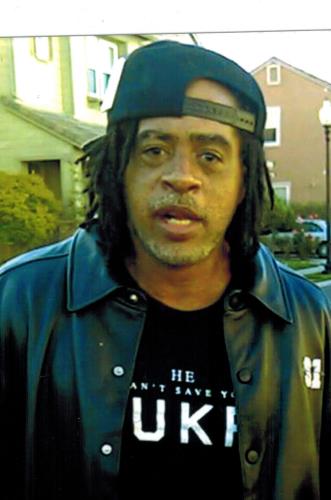
James Cooper
By Jimmy Lee, Director of Public Affairs, Contra Costa County Office of the Sheriff
Sheriff-Coroner David O. Livingston announced today that a Coroner’s Jury has reached a finding in the January 24, 2018 death of 45-year-old Jeffrey James Darryl Cooper of Vallejo. The finding of the jury is that the death is an accident.
The Coroner’s Jury reached the verdict after hearing the testimony of witnesses called by the hearing officer, Matthew Guichard.
A Coroner’s Inquest, which Sheriff-Coroner Livingston convenes in fatal incidents involving peace officers, is a public hearing, during which a jury rules on the manner of a person’s death. Jury members can choose from the following four options when making their finding: Accident, Suicide, Natural Causes, or At the hands of another person, other than by accident.
At about 12:47 AM on Jan. 24, 2018, a Deputy Sheriff was doing a room check at the Martinez Detention Facility (MDF) when he noticed Cooper was unresponsive in his bunk. The Deputy immediately called for medical assistance and started CPR.
Medical staff at MDF continued life-saving measures. An ambulance and the fire department responded to MDF. Cooper was later pronounced deceased. On January 18, 2018, he was booked into MDF on a warrant for domestic violence. He also had three arrest warrants from Solano County. His death appeared to be medically related. (See related article).
Read More
Kelly Gonzales
By Allen Payton
The owner of Pacific Senior Care Services, an elder care placement agency, Kelly Gonzales has decided to open her own independent living home in Antioch.
“It’s a project for the community, focusing on the needs of Antioch residents with limited income, looking for a stable place and some care,” she said. “It will open on January 15th.”
The independent living facility for adults will be staffed by a certified nurse assistant who will be providing some care as needed. The home offers four bedrooms.
Gonzales launched Pacific Senior Care Services LLC in 2014 to help seniors and families by providing a resource to make the right choices, while offering many services for the senior community.
Her company won the 2018 Spectrum Award for excellence in customer service and earned a rating of five out of five stars. The coveted service award was presented City Beat News.
Also, Gonzales was honored with another award at the beginning of 2018 from Global Health and Pharma News, as the Best Senior Care Services Provider 2018 – San Francisco Bay
“It’s impossible for me to forget all the extraordinary people who have played a role in my life since we opened Pacific Senior Care Services,” she said. “I want to thank each one for helping me pursue this project, and giving me the support and guidance to make this vision come true. I am so honored, humble and grateful.”
For more information about the company, visit www.pacificseniorcareservices.net.
Read More
 By Sergeant Robert Garcia, Traffic Unit/Special Events, Concord Police Department
On Wednesday, Jan. 2, 2019, at approximately 3:19pm, Concord PD Officers were dispatched to an auto vs. pedestrian collision that occurred just north of the intersection of Ayers Road and Valley Crest Drive. A vehicle traveling south on Ayers Road from Clayton Road struck and killed an 86-year-old female, a Clayton resident, who was crossing the southbound lane midblock, outside of the crosswalk.
The male driver, a 58-year-old Concord resident, remained on scene and cooperated with police. Drugs and/or alcohol do not appear to be a contributing factor.
Ayers Road, between Clayton Road and Valley Crest Drive, was closed for approximately 3 hours in order to conduct the collision investigation.
The name of the deceased is not being released pending notification of next of kin.
As this is an ongoing investigation, no further details are being released at this time.
Anyone who may have witnessed the collision is asked to contact Traffic Investigator Justin Wilson at the Concord Police Department, 925-671-5962.
Read More But, still turn in that overdue book, please
As part of the Contra Costa County Library’s continued efforts to improve access, balances on all library accounts have been cleared. This move goes hand-in-hand with the elimination of fines announced last month. As of January 1, 2019, all library cards are returned to good standing and patrons who may have been staying away from the library can come back and enjoy all the services the library has to offer. With accounts now cleared, the Library hopes to see patrons returning all the overdue items they were afraid to return due to fines.
“No matter how old, no matter why it was late, we want you to bring it back. No questions asked,” said County Librarian Melinda Cervantes.
Library staff will evaluate all returned items for relevance, condition and popularity so that materials may be reintroduced to the collection.
Patrons previously blocked from library services will once again be able to check out books, magazines and DVDs and use all the online services available through ccclib.org. Moving forward, the Library will no longer charge daily overdue fines on library materials. Checkout periods will remain the same and charges for lost or damaged books will still apply.
“Yes, you still need to return library materials. That hasn’t changed,” said Deputy County Librarian Nancy Kreiser. “But when your schedule is hectic, or you need another day or two to finish a great book, you can do so without worrying about late fines.”
The elimination of fines and clearing of all accounts, helps to meet the Library’s goal of removing barriers to access and making it easy, equitable and enjoyable for everyone.
“These new policies introduce an ongoing amnesty,” said Cervantes. “It allows everyone regardless of age, location or ability to pay, the opportunity to have continued access to the library.”
For more information on the elimination of fines including Frequently Asked Questions, please visit ccclib.org.
Read More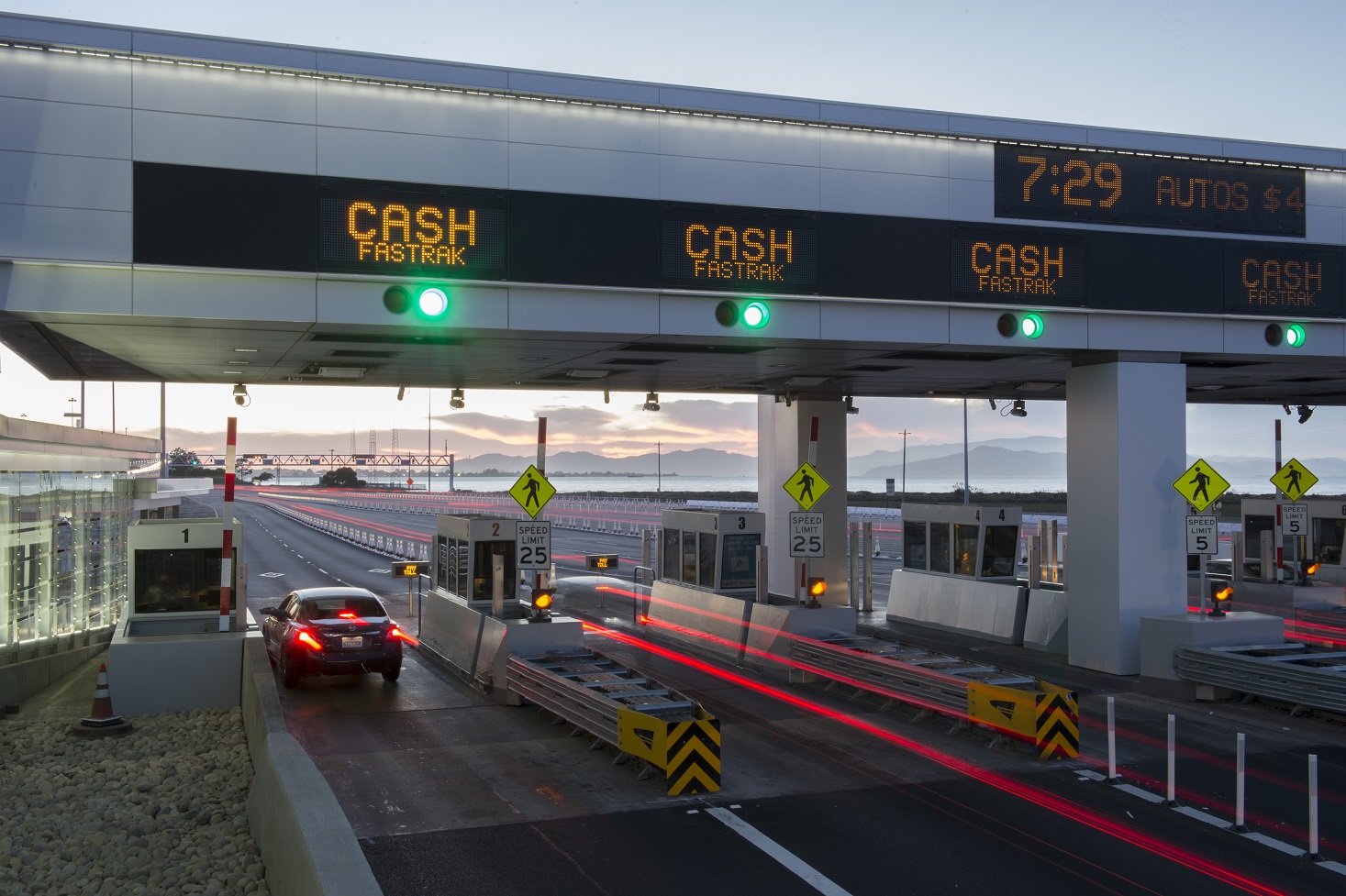
Bay Bridge Toll Plaza photos taken 9 /16 & 18/13. Karl Nielsen Photography www.karlnielsenphotography.com (805) 570-3395
First of three voter-approved increases
The Bay Area Toll Authority (BATA) reminds drivers that several important changes take effect Jan. 1, 2019, at the region’s seven state-owned toll bridges. These include the first of the $1 toll increases approved last year through state Senate Bill 595 and confirmed by voters through Regional Measure 3 in June 2018. This will mark the first toll hike at the state-owned toll bridges since 2010. Additional $1 increases will go into effect on Jan. 1, 2022, and on Jan. 1, 2025.
Regular tolls for two-axle cars and trucks (as well as for motorcycles) at the Antioch, Benicia-Martinez, Carquinez, Dumbarton, Richmond-San Rafael and San Mateo-Hayward bridges will rise to $6 from the current $5 on Jan. 1, 2019.
At the San Francisco-Oakland Bay Bridge, regular tolls will climb to $7 from the current $6 on weekdays from 5 a.m. to 10 a.m. and from 3 p.m. to 7 p.m. During weekday off-peak hours from 12 midnight to 5 a.m., from 10 a.m. to 3 p.m., and from 7 p.m. to midnight, Bay Bridge tolls will rise from $4 to $5; and on Saturdays and Sundays, Bay Bridge tolls will increase to $6 from the current $5.
Tolls for vehicles with three or more axles also will rise by $1 on Jan. 1, 2019, at all seven of the state-owned toll bridges: to $16 for three axles, $21 for four-axles, $26 for five axles, $31 for six axles, and $36 for combinations with seven or more axles.
Senate Bill 595 continues the peak-period toll discount for motorcycles, carpools and qualifying clean-air vehicles crossing any of the state-owned toll bridges on weekdays from 5 a.m. to 10 a.m. and from 3 p.m. to 7 p.m. The discounted toll is scheduled to increase to $3 on Jan. 1, 2019, from the current $2.50. To qualify for this discount, carpoolers, motorcyclists and drivers of qualifying clean-air vehicles must use FasTrak to pay their tolls electronically and must use a designated carpool lane at each toll plaza.
Senate Bill 595 also established a 50-cent toll discount for two-axle vehicles crossing more than one of the state-owned toll bridges during weekday commute hours of 5 a.m. to 10 a.m. and 3 p.m. to 7 p.m. To be eligible for the toll discount, which is to be applied to the second toll crossing of the day, motorists must pay their tolls electronically with FasTrak. Carpools, motorcycles and qualifying clean-air vehicles making a second peak-period toll crossing in a single day will qualify for an additional 25-cent discount off the already-discounted carpool toll. The two-bridge discount will not be available to drivers who use cash to pay their tolls.
New FasTrak customers can obtain toll tags at hundreds of Walgreens and Costco stores around the Bay Area. A complete list of participating locations — as well as an online enrollment and registration feature — is available on the FasTrak Web site at bayareafastrak.org. Customers also may enroll in the FasTrak program by phone at 1-877-229-8655; by calling 511 and asking for “FasTrak” at the first prompt; or in person at the FasTrak customer service center at 375 Beale Street in San Francisco. Operating hours are Monday-Friday, 8:30 a.m. to 5:30 p.m. and Saturdays, 9 a.m. to 1 p.m. FasTrak can be used in all lanes at all Bay Area toll plazas.
On Wednesday, Dec. 19, 2018 BATA formally approved the new toll schedule through adoption of BATA Resolution No. 128 at its regular December meeting. The Authority today also adopted BATA Resolution No. 129, which authorizes arrangements for the escrow of Regional Measure 3 funds pending the resolution of two lawsuits challenging state Senate Bill 595 and Regional Measure 3. Both lawsuits are pending in Superior Court in the City and County of San Francisco. Under BATA Resolution No. 129, the Regional Measure 3 toll increases, when collected, will be placed into an escrow account managed by an independent trustee. Following a process similar to voter-approved sales tax measures that face legal challenge, these funds will be transferred at least once each week from BATA to a Union Bank (Mitsubishi United Financial Group – MUFG) trust account, where the funds will be managed by a bank trust officer until final resolution of all litigation. Once the BATA legal team certifies there is a final resolution, the Authority will be asked to release the escrow. If BATA prevails in the litigation, the funds will be applied to BATA-approved programs. If BATA should lose the litigation, the funds will be reimbursed to tollpayers.
BATA, which is directed by the same policy board as the Metropolitan Transportation Commission (MTC), administers toll revenues from the Bay Area’s seven state-owned toll bridges. Toll revenues from the Golden Gate Bridge are administered by the Golden Gate Bridge, Highway and Transportation District, which joined with BATA to operate a single regional FasTrak customer service center in San Francisco. MTC is the transportation planning, financing and coordinating agency for the nine-county San Francisco Bay Area.
Read MoreAlso continues on Insurance and Veterans Affairs Committees
Assemblyman Jim Frazier
Sacramento, CA – Assemblymember Jim Frazier (D–Discovery Bay) made the following statement after Speaker Anthony Rendon (D – Paramount) reappointed him as Chair of the Assembly Transportation Committee:
“I am honored that Speaker Rendon has given me the privilege to continue as Chair of the Assembly Transportation Committee. Serving as chair of this Committee has given me the opportunity to help lead California into a golden age of transportation infrastructure repair.”
“A strong economy depends on roads and highways that are safe and efficient and California is now a leader in the nation on finding transportation solutions that keep the residents of our cities, counties and state moving. This historic infrastructure investment will put tens of thousands of Californians to work throughout the state.”
In addition to Chair of the Assembly Transportation Committee, Assemblymember Frazier was also reappointed to the Committees on Insurance, and Veterans Affairs, and was newly appointed to the Budget Subcommittee No. 1 on Health and Human Services.
Assemblymember Frazier represents the 11th Assembly District, which includes the communities of Antioch, Bethel Island, Birds Landing, Brentwood, Byron, Collinsville, Discovery Bay, Fairfield, Isleton, Knightsen, Locke, Oakley, Pittsburg (partial), Rio Vista, Suisun City, Travis AFB, Vacaville and Walnut Grove.
Read More By CHP Contra Costa
At approximately 10:43 this morning, CHP units responded to a collision on Cummings Skyway, north of Highway 4. Upon arrival, officers located a two-vehicle collision involving a Nissan X-Terra and a Ford sedan. The driver of the Nissan suffered fatal injuries and was pronounced as deceased on scene. The driver of the Ford suffered major, but non-life-threatening injuries and was transported to a local hospital.
Our preliminary investigation revealed that the driver of the Ford appeared to have drifted off the roadway and onto a dirt shoulder. The driver of the Ford then appears to have overcorrected and crossed into oncoming traffic, causing the Nissan to collide with the passenger side of the Ford.
At this time this is still an active scene and Cummings Skyway remains closed. We are still investigating whether drugs or alcohol were a factor in this collision, and are asking any witnesses to call the CHP at 925-646-4980.
Read More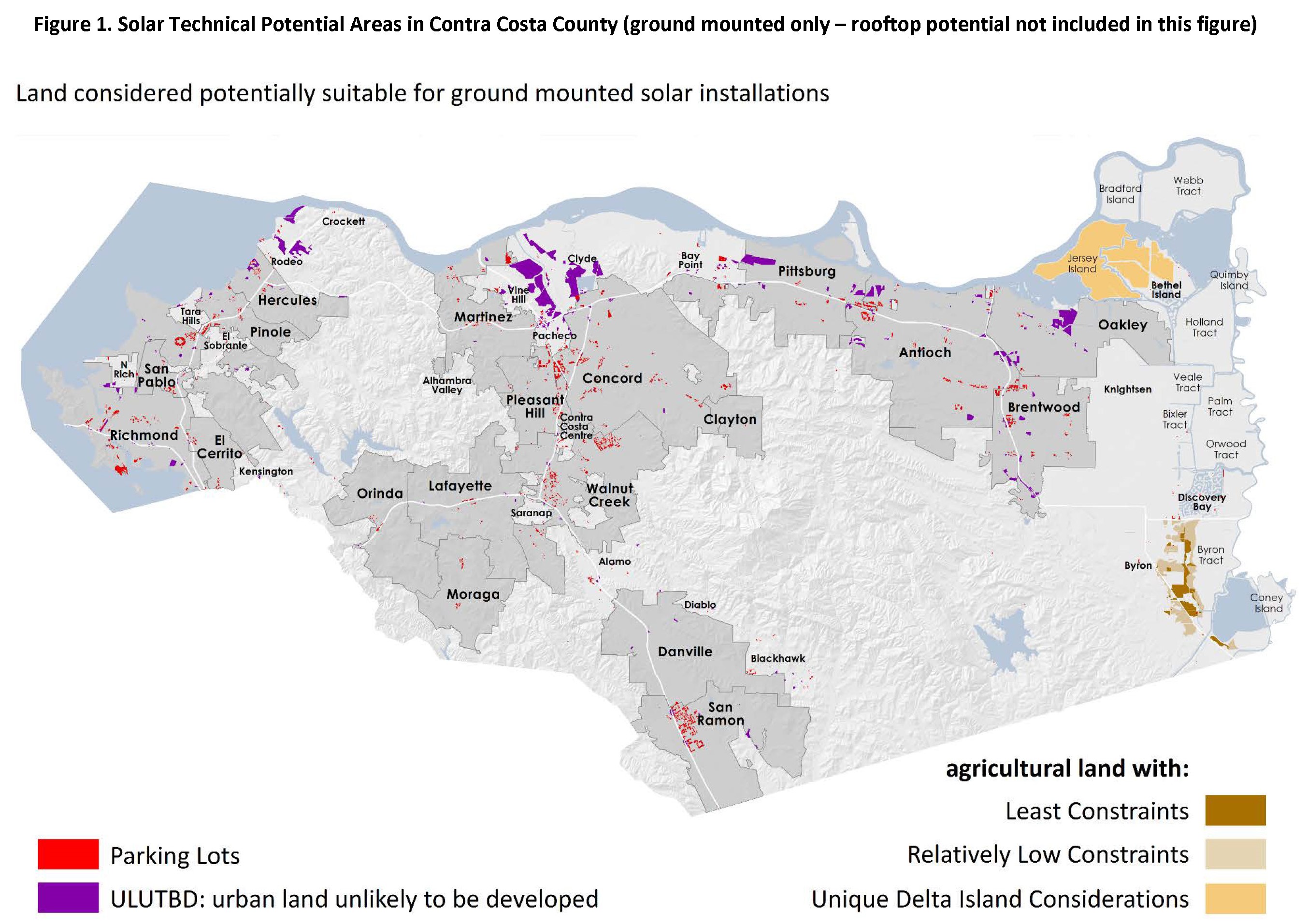
Courtesy CCC Department of Conservation and Development.
Forgive $5.8 Million in Library Book Late Fees Dating Back to 1995
By Daniel Borsuk
The Contra Costa County Board of Supervisors flashed the green light for Contra Costa County Development and Conservation Department (DCD) officials to conduct additional studies on how solar power can be expanded, especially in the Far East environmentally sensitive Delta areas of Bethel Island and Jersey Island.
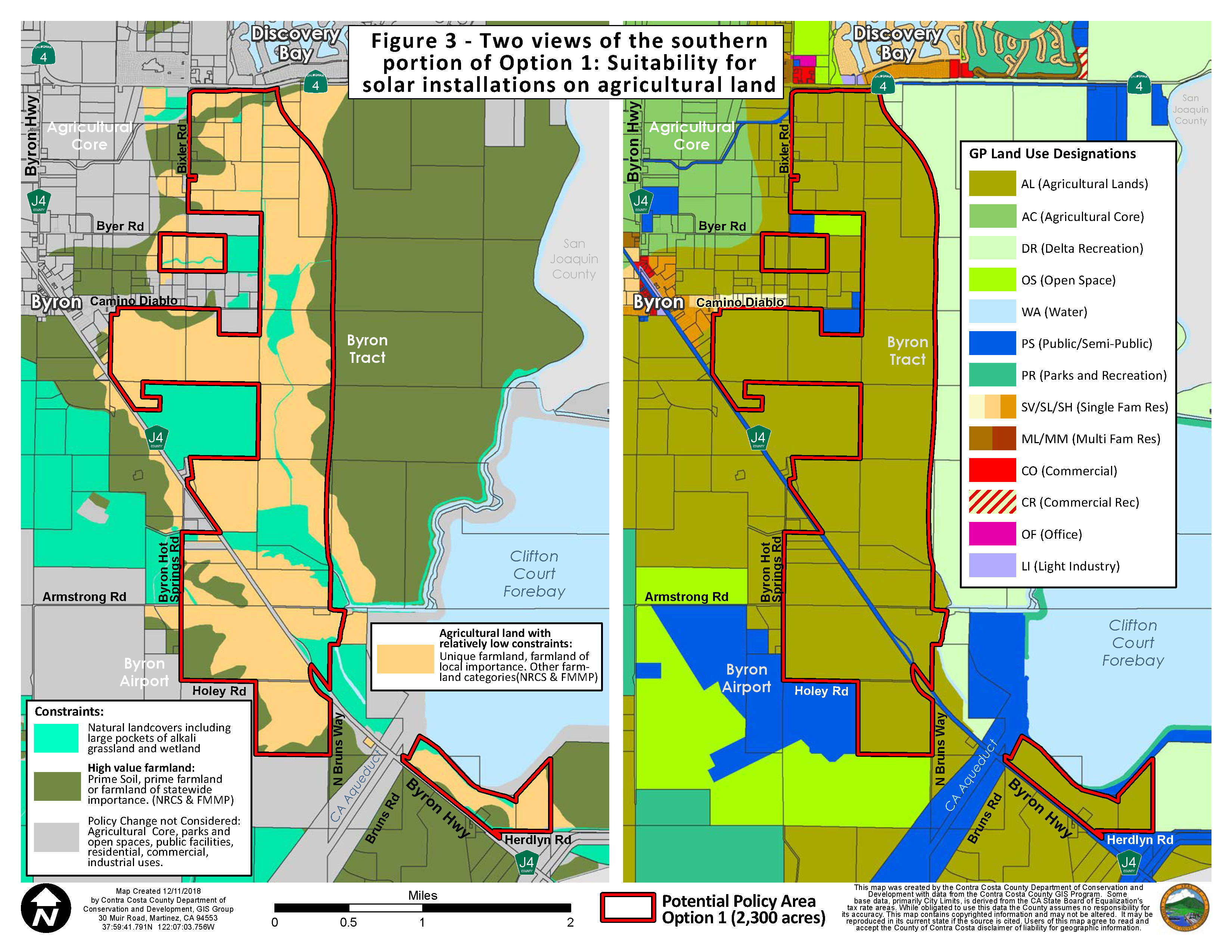 Supervisors also allowed county planners to study the feasibility of identifying underutilized parking lots countywide that could be used as solar farms in partnership with MCE, the main electricity provider for unincorporated Contra Costa County and the cities of Concord, Danville, Martinez, Oakley, Pinole, Pittsburg, and San Ramon.
Freeway cloverleafs are also on the DCD’s list of potential new sites for renewable energy.
“Fifty to eighty percent of the county could be used for renewable energy,” Jody London, a DCD official, told supervisors. London said solar energy represents 85 percent of the renewable energy that could be developed on rural land. The remaining 15 percent would be energy generated from wind power or biomass.
London said the county could also expand solar energy by issuing more permits to homeowners to install solar panels on roofs.
The house rooftop option drew the support of District 3 Supervisor Dianne Burgis of Brentwood, whose district also covers Bethel Island and Jersey Island. “I’d be open to option one,” she said. “We have so many rooftops in Contra Costa County. I’d like to work with MCE.”
Board chair Karen Mitchoff of Pleasant Hill cautioned DCD staff that she was uncertain the DCD recommendation concerning 450-acre Jersey Island as a potential solar power farm might run into opposition from the island’s owner, the Ironhouse Sanitary District.
London said she would look into that issue.
“We support development of solar energy on brownfield sites, parking lots and infill areas such as freeway cloverleafs,” Bill Chilson of the Mount Diablo Audubon Society wrote in a letter to the supervisors. The environmental organization opposes wind and solar development in the Delta agricultural and wildlife areas, Chilson wrote.
Juan Pablo Galwan, Save Mt. Diablo Land Use Manager, criticized the plan, writing:
“Advances in solar technology may increase the frequency of collocation or allow an area of land to concurrently be farmed and produce solar energy without negatively impacting or perhaps even increasing crop productivity. However, currently the most likely scenario is that solar development removes land from most or all ties of agricultural production for the duration of lease which may last several decades. Therefore, the county renewable energy policies should not encourage solar development on viable agricultural land.”
A $47,000 grant from the California Strategic Growth Council developed the energy study for the County.
Supervisors Approve $362,505 State Grant for 2020 Census
The county is getting ready for the 2020 census and took its first step when supervisors unanimously accepted a $362,505 County-Option Outreach Agreement grant from the state.
The grant will aid the county in developing communications and outreach strategies that will target both geographic and demographic populations who are least likely to respond to the 2020 census.
Barbara Rivera of the Contra Costa County Administrators Office said the upcoming census will be the first one where Californians can respond by going online, but this raised cyber security issues from Julia Marks of the Asian Law Caucus. “There is a lot fear over confidentiality,” said Marks.
Choice in Aging’s Debbie Toth Honored as Board Chair Recipient
Debbie Toth, the Chief Executive Officer of Choice in Aging, was honored by the Contra Costa County Board of Supervisors Chair Karen Mitchoff, as Board Chair Recipient for 2018.
Mitchoff, of Pleasant Hill, selected Toth, who was named CEO of Choice in Aging in 2012 that serves 600 senior citizens in residential facilities at the Bedford Center in Antioch and the Mt. Diablo Center in Pleasant Hill, for being an advocate for senior access to housing, health and transit.
Mitchoff, who was re-elected to the District 3 supervisorial seat in June, cited her personal experience with her mother as a key factor in nominating the CIA’s Chief Executive Officer for the award.
After Tuesday’s meeting, it is expected District 1 Supervisor John Gioia of Richmond will be elected as Chair of the Board when supervisors reconvene at their next regular meeting slated for January 15, 2019.
Supervisors Forgive $5.8 Million in Library Book Late Fees
A week after the Board of Supervisors made the historic move to eliminate the practice of collecting overdue book and material fees, they approved on a 5-0 vote to discharge about $5,800,100 from public library patron accounts.
The agenda consent item did not attract public comment.
The bookkeeping item covers uncollected fees dating back to 1995 to the present, County Librarian Melinda Cervantes wrote in a report to the Board. “Of this amount, 73 percent is the value of materials, not cash outstanding.” There is no financial impact on the county general fund.
Last week supervisors adopted the library commission’s recommendation to cease the collection of overdue book fines beginning Jan. 1, 2019 based on the recommendations in a policy titled Project Equitable Access with the goal of ensuring everyone has access to library materials.
To view the entire meeting agenda, click here.
Read More Board of Supervisors seeks applicants for appointment
Contra Costa County is accepting applications for the upcoming Member at Large opening on the Aviation Advisory Committee (AAC). The term begins upon appointment by the Board of Supervisors and expires on February 28, 2022. Residents of and/or employees in Contra Costa County are eligible to fill this position to represent all County stakeholders in matters related to Buchanan Field and Byron Airport.
The AAC serves as an advisory group to the Contra Costa County Board of Supervisors (Board) to provide advice and recommendations to the Board on aviation matters related to the Contra Costa County Airports. The AAC typically meets once per month at either Buchanan Field or Byron Airport.
Application forms can be obtained from the Clerk of the Board of Supervisors by calling 925.335.1900 or at http://www.contracosta.ca.gov/3418/Appointed-Bodies-Committees-and-Commissi. Applications should be submitted online or returned to the Clerk of the Board of Supervisors, Room 106, County Administration Building, 651 Pine Street, Martinez, CA 94553, no later than 5:00 p.m. on Monday, January 28, 2019. Applicants should plan to be available for public interviews on Wednesday, February 13, 2019.
For more information on the Contra Costa County Airports or the AAC visit us at http://www.contracostacountyairports.org/4694/Airports or by calling (844) Fly-ToUs or 844.359.8687.
Read More











National Labor Relations Board to hold legal hearing March 19 in Oakland
By Sean Wherley, Media Relations Specialist, SEIU-United Healthcare Workers West
The federal government recently indicted healthcare giant Kaiser Permanente for refusing to negotiate a contract affecting 85,000 employees in seven states and the District of Columbia, and for wrongly tying those negotiations to a ban on political activity against the company.
“The workers who have helped make this company so successful over the years now feel that their concerns are validated,” said Dave Regan, president of SEIU-United Healthcare Workers West. “No longer can Kaiser Permanente claim it was trying to do right by its employees and patients by holding up bargaining and trying to stop workers from speaking out.”
Kaiser Permanente has until Jan. 11 to respond to the decision, and a legal hearing will begin March 19 in Oakland, according to the indictment released Dec. 28 by the National Labor Relations Board.
Kaiser Permanente employees filed a complaint in May 2018 because the company repeatedly canceled contract negotiations with the Coalition of Kaiser Permanente Unions, which comprises 11 labor unions in California, Oregon, Washington, Colorado, Hawaii, Virginia, Maryland and the District of Columbia. The coalition’s national agreement with Kaiser Permanente expired Sept. 30, 2018. The company had previously negotiated contracts with the coalition since 1997.
Last November, Kaiser Permanente settled a contract with a different group of labor unions that prohibits those unions from taking action against the company, whether through ballot initiatives, legislation or other public campaigns. Kaiser tried to apply the same condition to bargaining with the Coalition of Kaiser Permanente Unions; however, the Dec. 28 indictment blocks that effort.
Kaiser Permanente’s refusal to bargain comes in the midst of a plan to outsource jobs to “save” money, despite the corporation reporting reserves of $30 billion and profits of $3.8 billion in 2017. In addition, the Kaiser CEO is paid more than $10 million annually, and 30 executives are paid more than $1 million a year.
Read MoreJames Cooper
By Jimmy Lee, Director of Public Affairs, Contra Costa County Office of the Sheriff
Sheriff-Coroner David O. Livingston announced today that a Coroner’s Jury has reached a finding in the January 24, 2018 death of 45-year-old Jeffrey James Darryl Cooper of Vallejo. The finding of the jury is that the death is an accident.
The Coroner’s Jury reached the verdict after hearing the testimony of witnesses called by the hearing officer, Matthew Guichard.
A Coroner’s Inquest, which Sheriff-Coroner Livingston convenes in fatal incidents involving peace officers, is a public hearing, during which a jury rules on the manner of a person’s death. Jury members can choose from the following four options when making their finding: Accident, Suicide, Natural Causes, or At the hands of another person, other than by accident.
At about 12:47 AM on Jan. 24, 2018, a Deputy Sheriff was doing a room check at the Martinez Detention Facility (MDF) when he noticed Cooper was unresponsive in his bunk. The Deputy immediately called for medical assistance and started CPR.
Medical staff at MDF continued life-saving measures. An ambulance and the fire department responded to MDF. Cooper was later pronounced deceased. On January 18, 2018, he was booked into MDF on a warrant for domestic violence. He also had three arrest warrants from Solano County. His death appeared to be medically related. (See related article).
Read MoreKelly Gonzales
By Allen Payton
The owner of Pacific Senior Care Services, an elder care placement agency, Kelly Gonzales has decided to open her own independent living home in Antioch.
“It’s a project for the community, focusing on the needs of Antioch residents with limited income, looking for a stable place and some care,” she said. “It will open on January 15th.”
The independent living facility for adults will be staffed by a certified nurse assistant who will be providing some care as needed. The home offers four bedrooms.
Gonzales launched Pacific Senior Care Services LLC in 2014 to help seniors and families by providing a resource to make the right choices, while offering many services for the senior community.
Her company won the 2018 Spectrum Award for excellence in customer service and earned a rating of five out of five stars. The coveted service award was presented City Beat News.
Also, Gonzales was honored with another award at the beginning of 2018 from Global Health and Pharma News, as the Best Senior Care Services Provider 2018 – San Francisco Bay
“It’s impossible for me to forget all the extraordinary people who have played a role in my life since we opened Pacific Senior Care Services,” she said. “I want to thank each one for helping me pursue this project, and giving me the support and guidance to make this vision come true. I am so honored, humble and grateful.”
For more information about the company, visit www.pacificseniorcareservices.net.
Read More
By Sergeant Robert Garcia, Traffic Unit/Special Events, Concord Police Department
On Wednesday, Jan. 2, 2019, at approximately 3:19pm, Concord PD Officers were dispatched to an auto vs. pedestrian collision that occurred just north of the intersection of Ayers Road and Valley Crest Drive. A vehicle traveling south on Ayers Road from Clayton Road struck and killed an 86-year-old female, a Clayton resident, who was crossing the southbound lane midblock, outside of the crosswalk.
The male driver, a 58-year-old Concord resident, remained on scene and cooperated with police. Drugs and/or alcohol do not appear to be a contributing factor.
Ayers Road, between Clayton Road and Valley Crest Drive, was closed for approximately 3 hours in order to conduct the collision investigation.
The name of the deceased is not being released pending notification of next of kin.
As this is an ongoing investigation, no further details are being released at this time.
Anyone who may have witnessed the collision is asked to contact Traffic Investigator Justin Wilson at the Concord Police Department, 925-671-5962.
Read MoreBut, still turn in that overdue book, please
As part of the Contra Costa County Library’s continued efforts to improve access, balances on all library accounts have been cleared. This move goes hand-in-hand with the elimination of fines announced last month. As of January 1, 2019, all library cards are returned to good standing and patrons who may have been staying away from the library can come back and enjoy all the services the library has to offer. With accounts now cleared, the Library hopes to see patrons returning all the overdue items they were afraid to return due to fines.
“No matter how old, no matter why it was late, we want you to bring it back. No questions asked,” said County Librarian Melinda Cervantes.
Library staff will evaluate all returned items for relevance, condition and popularity so that materials may be reintroduced to the collection.
Patrons previously blocked from library services will once again be able to check out books, magazines and DVDs and use all the online services available through ccclib.org. Moving forward, the Library will no longer charge daily overdue fines on library materials. Checkout periods will remain the same and charges for lost or damaged books will still apply.
“Yes, you still need to return library materials. That hasn’t changed,” said Deputy County Librarian Nancy Kreiser. “But when your schedule is hectic, or you need another day or two to finish a great book, you can do so without worrying about late fines.”
The elimination of fines and clearing of all accounts, helps to meet the Library’s goal of removing barriers to access and making it easy, equitable and enjoyable for everyone.
“These new policies introduce an ongoing amnesty,” said Cervantes. “It allows everyone regardless of age, location or ability to pay, the opportunity to have continued access to the library.”
For more information on the elimination of fines including Frequently Asked Questions, please visit ccclib.org.
Read MoreBay Bridge Toll Plaza photos taken 9 /16 & 18/13. Karl Nielsen Photography www.karlnielsenphotography.com (805) 570-3395
First of three voter-approved increases
The Bay Area Toll Authority (BATA) reminds drivers that several important changes take effect Jan. 1, 2019, at the region’s seven state-owned toll bridges. These include the first of the $1 toll increases approved last year through state Senate Bill 595 and confirmed by voters through Regional Measure 3 in June 2018. This will mark the first toll hike at the state-owned toll bridges since 2010. Additional $1 increases will go into effect on Jan. 1, 2022, and on Jan. 1, 2025.
Regular tolls for two-axle cars and trucks (as well as for motorcycles) at the Antioch, Benicia-Martinez, Carquinez, Dumbarton, Richmond-San Rafael and San Mateo-Hayward bridges will rise to $6 from the current $5 on Jan. 1, 2019.
At the San Francisco-Oakland Bay Bridge, regular tolls will climb to $7 from the current $6 on weekdays from 5 a.m. to 10 a.m. and from 3 p.m. to 7 p.m. During weekday off-peak hours from 12 midnight to 5 a.m., from 10 a.m. to 3 p.m., and from 7 p.m. to midnight, Bay Bridge tolls will rise from $4 to $5; and on Saturdays and Sundays, Bay Bridge tolls will increase to $6 from the current $5.
Tolls for vehicles with three or more axles also will rise by $1 on Jan. 1, 2019, at all seven of the state-owned toll bridges: to $16 for three axles, $21 for four-axles, $26 for five axles, $31 for six axles, and $36 for combinations with seven or more axles.
Senate Bill 595 continues the peak-period toll discount for motorcycles, carpools and qualifying clean-air vehicles crossing any of the state-owned toll bridges on weekdays from 5 a.m. to 10 a.m. and from 3 p.m. to 7 p.m. The discounted toll is scheduled to increase to $3 on Jan. 1, 2019, from the current $2.50. To qualify for this discount, carpoolers, motorcyclists and drivers of qualifying clean-air vehicles must use FasTrak to pay their tolls electronically and must use a designated carpool lane at each toll plaza.
Senate Bill 595 also established a 50-cent toll discount for two-axle vehicles crossing more than one of the state-owned toll bridges during weekday commute hours of 5 a.m. to 10 a.m. and 3 p.m. to 7 p.m. To be eligible for the toll discount, which is to be applied to the second toll crossing of the day, motorists must pay their tolls electronically with FasTrak. Carpools, motorcycles and qualifying clean-air vehicles making a second peak-period toll crossing in a single day will qualify for an additional 25-cent discount off the already-discounted carpool toll. The two-bridge discount will not be available to drivers who use cash to pay their tolls.
New FasTrak customers can obtain toll tags at hundreds of Walgreens and Costco stores around the Bay Area. A complete list of participating locations — as well as an online enrollment and registration feature — is available on the FasTrak Web site at bayareafastrak.org. Customers also may enroll in the FasTrak program by phone at 1-877-229-8655; by calling 511 and asking for “FasTrak” at the first prompt; or in person at the FasTrak customer service center at 375 Beale Street in San Francisco. Operating hours are Monday-Friday, 8:30 a.m. to 5:30 p.m. and Saturdays, 9 a.m. to 1 p.m. FasTrak can be used in all lanes at all Bay Area toll plazas.
On Wednesday, Dec. 19, 2018 BATA formally approved the new toll schedule through adoption of BATA Resolution No. 128 at its regular December meeting. The Authority today also adopted BATA Resolution No. 129, which authorizes arrangements for the escrow of Regional Measure 3 funds pending the resolution of two lawsuits challenging state Senate Bill 595 and Regional Measure 3. Both lawsuits are pending in Superior Court in the City and County of San Francisco. Under BATA Resolution No. 129, the Regional Measure 3 toll increases, when collected, will be placed into an escrow account managed by an independent trustee. Following a process similar to voter-approved sales tax measures that face legal challenge, these funds will be transferred at least once each week from BATA to a Union Bank (Mitsubishi United Financial Group – MUFG) trust account, where the funds will be managed by a bank trust officer until final resolution of all litigation. Once the BATA legal team certifies there is a final resolution, the Authority will be asked to release the escrow. If BATA prevails in the litigation, the funds will be applied to BATA-approved programs. If BATA should lose the litigation, the funds will be reimbursed to tollpayers.
BATA, which is directed by the same policy board as the Metropolitan Transportation Commission (MTC), administers toll revenues from the Bay Area’s seven state-owned toll bridges. Toll revenues from the Golden Gate Bridge are administered by the Golden Gate Bridge, Highway and Transportation District, which joined with BATA to operate a single regional FasTrak customer service center in San Francisco. MTC is the transportation planning, financing and coordinating agency for the nine-county San Francisco Bay Area.
Read MoreAlso continues on Insurance and Veterans Affairs Committees
Assemblyman Jim Frazier
Sacramento, CA – Assemblymember Jim Frazier (D–Discovery Bay) made the following statement after Speaker Anthony Rendon (D – Paramount) reappointed him as Chair of the Assembly Transportation Committee:
“I am honored that Speaker Rendon has given me the privilege to continue as Chair of the Assembly Transportation Committee. Serving as chair of this Committee has given me the opportunity to help lead California into a golden age of transportation infrastructure repair.”
“A strong economy depends on roads and highways that are safe and efficient and California is now a leader in the nation on finding transportation solutions that keep the residents of our cities, counties and state moving. This historic infrastructure investment will put tens of thousands of Californians to work throughout the state.”
In addition to Chair of the Assembly Transportation Committee, Assemblymember Frazier was also reappointed to the Committees on Insurance, and Veterans Affairs, and was newly appointed to the Budget Subcommittee No. 1 on Health and Human Services.
Assemblymember Frazier represents the 11th Assembly District, which includes the communities of Antioch, Bethel Island, Birds Landing, Brentwood, Byron, Collinsville, Discovery Bay, Fairfield, Isleton, Knightsen, Locke, Oakley, Pittsburg (partial), Rio Vista, Suisun City, Travis AFB, Vacaville and Walnut Grove.
Read MoreBy CHP Contra Costa
At approximately 10:43 this morning, CHP units responded to a collision on Cummings Skyway, north of Highway 4. Upon arrival, officers located a two-vehicle collision involving a Nissan X-Terra and a Ford sedan. The driver of the Nissan suffered fatal injuries and was pronounced as deceased on scene. The driver of the Ford suffered major, but non-life-threatening injuries and was transported to a local hospital.
Our preliminary investigation revealed that the driver of the Ford appeared to have drifted off the roadway and onto a dirt shoulder. The driver of the Ford then appears to have overcorrected and crossed into oncoming traffic, causing the Nissan to collide with the passenger side of the Ford.
At this time this is still an active scene and Cummings Skyway remains closed. We are still investigating whether drugs or alcohol were a factor in this collision, and are asking any witnesses to call the CHP at 925-646-4980.
Read MoreCourtesy CCC Department of Conservation and Development.
Forgive $5.8 Million in Library Book Late Fees Dating Back to 1995
By Daniel Borsuk
The Contra Costa County Board of Supervisors flashed the green light for Contra Costa County Development and Conservation Department (DCD) officials to conduct additional studies on how solar power can be expanded, especially in the Far East environmentally sensitive Delta areas of Bethel Island and Jersey Island.
Supervisors also allowed county planners to study the feasibility of identifying underutilized parking lots countywide that could be used as solar farms in partnership with MCE, the main electricity provider for unincorporated Contra Costa County and the cities of Concord, Danville, Martinez, Oakley, Pinole, Pittsburg, and San Ramon.
Freeway cloverleafs are also on the DCD’s list of potential new sites for renewable energy.
“Fifty to eighty percent of the county could be used for renewable energy,” Jody London, a DCD official, told supervisors. London said solar energy represents 85 percent of the renewable energy that could be developed on rural land. The remaining 15 percent would be energy generated from wind power or biomass.
London said the county could also expand solar energy by issuing more permits to homeowners to install solar panels on roofs.
The house rooftop option drew the support of District 3 Supervisor Dianne Burgis of Brentwood, whose district also covers Bethel Island and Jersey Island. “I’d be open to option one,” she said. “We have so many rooftops in Contra Costa County. I’d like to work with MCE.”
Board chair Karen Mitchoff of Pleasant Hill cautioned DCD staff that she was uncertain the DCD recommendation concerning 450-acre Jersey Island as a potential solar power farm might run into opposition from the island’s owner, the Ironhouse Sanitary District.
London said she would look into that issue.
“We support development of solar energy on brownfield sites, parking lots and infill areas such as freeway cloverleafs,” Bill Chilson of the Mount Diablo Audubon Society wrote in a letter to the supervisors. The environmental organization opposes wind and solar development in the Delta agricultural and wildlife areas, Chilson wrote.
Juan Pablo Galwan, Save Mt. Diablo Land Use Manager, criticized the plan, writing:
“Advances in solar technology may increase the frequency of collocation or allow an area of land to concurrently be farmed and produce solar energy without negatively impacting or perhaps even increasing crop productivity. However, currently the most likely scenario is that solar development removes land from most or all ties of agricultural production for the duration of lease which may last several decades. Therefore, the county renewable energy policies should not encourage solar development on viable agricultural land.”
A $47,000 grant from the California Strategic Growth Council developed the energy study for the County.
Supervisors Approve $362,505 State Grant for 2020 Census
The county is getting ready for the 2020 census and took its first step when supervisors unanimously accepted a $362,505 County-Option Outreach Agreement grant from the state.
The grant will aid the county in developing communications and outreach strategies that will target both geographic and demographic populations who are least likely to respond to the 2020 census.
Barbara Rivera of the Contra Costa County Administrators Office said the upcoming census will be the first one where Californians can respond by going online, but this raised cyber security issues from Julia Marks of the Asian Law Caucus. “There is a lot fear over confidentiality,” said Marks.
Choice in Aging’s Debbie Toth Honored as Board Chair Recipient
Debbie Toth, the Chief Executive Officer of Choice in Aging, was honored by the Contra Costa County Board of Supervisors Chair Karen Mitchoff, as Board Chair Recipient for 2018.
Mitchoff, of Pleasant Hill, selected Toth, who was named CEO of Choice in Aging in 2012 that serves 600 senior citizens in residential facilities at the Bedford Center in Antioch and the Mt. Diablo Center in Pleasant Hill, for being an advocate for senior access to housing, health and transit.
Mitchoff, who was re-elected to the District 3 supervisorial seat in June, cited her personal experience with her mother as a key factor in nominating the CIA’s Chief Executive Officer for the award.
After Tuesday’s meeting, it is expected District 1 Supervisor John Gioia of Richmond will be elected as Chair of the Board when supervisors reconvene at their next regular meeting slated for January 15, 2019.
Supervisors Forgive $5.8 Million in Library Book Late Fees
A week after the Board of Supervisors made the historic move to eliminate the practice of collecting overdue book and material fees, they approved on a 5-0 vote to discharge about $5,800,100 from public library patron accounts.
The agenda consent item did not attract public comment.
The bookkeeping item covers uncollected fees dating back to 1995 to the present, County Librarian Melinda Cervantes wrote in a report to the Board. “Of this amount, 73 percent is the value of materials, not cash outstanding.” There is no financial impact on the county general fund.
Last week supervisors adopted the library commission’s recommendation to cease the collection of overdue book fines beginning Jan. 1, 2019 based on the recommendations in a policy titled Project Equitable Access with the goal of ensuring everyone has access to library materials.
To view the entire meeting agenda, click here.
Read MoreBoard of Supervisors seeks applicants for appointment
Contra Costa County is accepting applications for the upcoming Member at Large opening on the Aviation Advisory Committee (AAC). The term begins upon appointment by the Board of Supervisors and expires on February 28, 2022. Residents of and/or employees in Contra Costa County are eligible to fill this position to represent all County stakeholders in matters related to Buchanan Field and Byron Airport.
The AAC serves as an advisory group to the Contra Costa County Board of Supervisors (Board) to provide advice and recommendations to the Board on aviation matters related to the Contra Costa County Airports. The AAC typically meets once per month at either Buchanan Field or Byron Airport.
Application forms can be obtained from the Clerk of the Board of Supervisors by calling 925.335.1900 or at http://www.contracosta.ca.gov/3418/Appointed-Bodies-Committees-and-Commissi. Applications should be submitted online or returned to the Clerk of the Board of Supervisors, Room 106, County Administration Building, 651 Pine Street, Martinez, CA 94553, no later than 5:00 p.m. on Monday, January 28, 2019. Applicants should plan to be available for public interviews on Wednesday, February 13, 2019.
For more information on the Contra Costa County Airports or the AAC visit us at http://www.contracostacountyairports.org/4694/Airports or by calling (844) Fly-ToUs or 844.359.8687.
Read More