






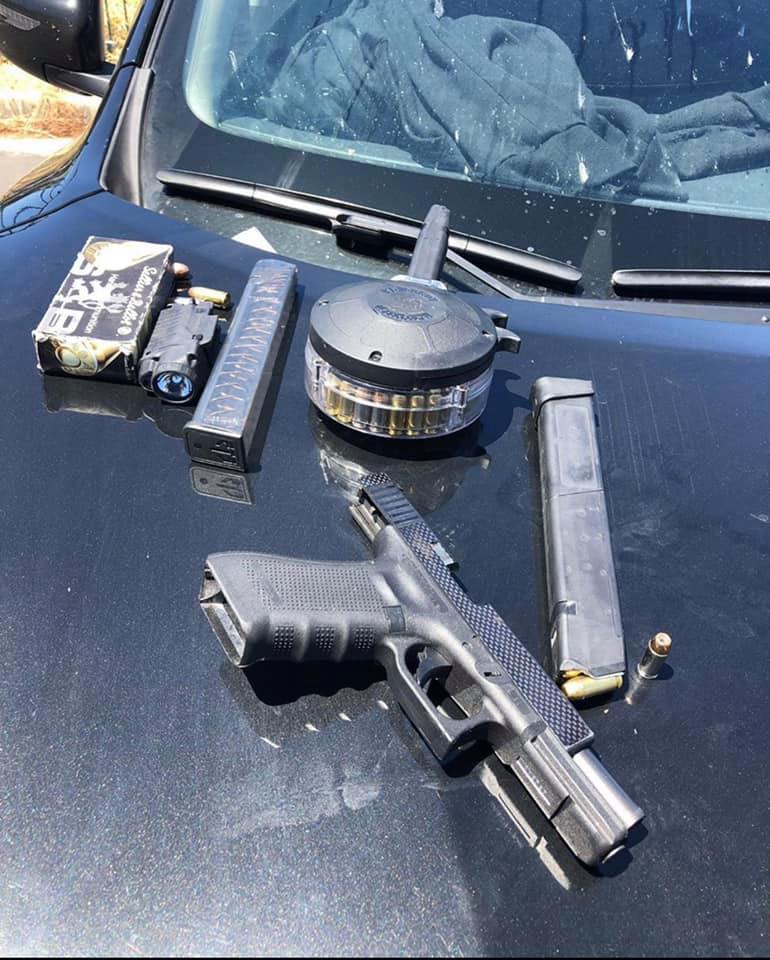
The gun, multiple high-capacity magazines and ammunition found with the suspect on July 31, 2020. Photo by PPD.
Site of homeless program praised by Governor Newsom during June 30 press conference at the location
By Pittsburg Police Department
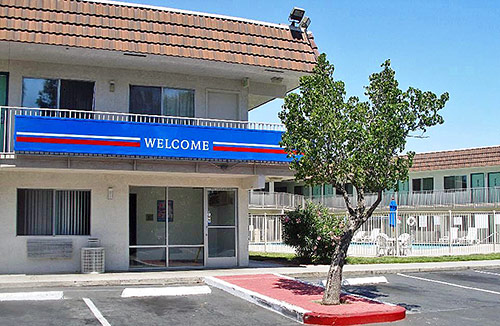
Motel 6 in Pittsburg. Photo by Motel 6.
On Thursday, July 30, 2020, Pittsburg officers responded to Motel 6 at 2101 Loveridge Road in Pittsburg, for the report of a kidnapping during which the suspect, “pistol whipped” the female victim with a handgun causing a significant injury, threatened to kill her son, etc. The suspect was positively identified by the victim and Motel 6 cameras. The suspect in the Motel 6 incident was also found to have an active felony warrant for a similar pistol whip incident that occurred in the City of Oakland days prior. Furthermore, the suspect had just recently been released from prison and was on active parole for prior violent felonies convictions.
The motel was the site for a press conference by Governor Gavin Newsom about the state’s Project Roomkey and new Project Homekey programs on June 30. (See related article) UPDATE: However, according to Contra Costa Health Services spokesperson Kim McCarl, the program does not include the entire motel, and the victim and suspect involved in the incident, which occurred in the other building, were not part of it.
On Friday, July 31, Pittsburg officers were patrolling the area where the suspect was believed to frequent. Officers located the suspect exiting the same vehicle he was driving during the Motel 6 incident. The suspect fled from the vehicle on foot, a perimeter was established and a short time later he was apprehended without incident. The vehicle was searched, and the above pictured firearm was located inside along with multiple high-capacity magazines and ammunition. The suspect was transported to jail on multiple different charges. -P375
Allen Payton contributed to this report.
Read More The Contra Costa County Board of Supervisors is seeking an individual to serve on the Contra Costa Transportation Authority (CCTA) Citizen Advisory Committee (CAC) as Public Representative on behalf of the County. The individual selected for this position must live in the unincorporated area of the County, be available to attend committee meetings on the 4th Wednesday of every month at 6:00 pm, normally held at the CCTA offices located at 2999 Oak Road, Suite 100, Walnut Creek, have the ability to review CAC agenda packets, and develop input on agenda items beforehand. Due to the COVID-19 pandemic, meetings presently occur via videoconference. The individual will serve a four-year term in a volunteer capacity and be eligible for reimbursement for travel expenses.
The CCTA Citizen Advisory Committee reviews transportation programs and plans throughout the County (https://ccta.net/about-us/#what-we-do), with the objective of advising and providing recommendations to the CCTA Board of Directors. This includes transportation projects and programs funded by the county half-cent transportation sales tax (“Measure J”) (https://ccta.net/2018/10/17/measure-j), which CCTA oversees. CCTA maintains its standing CAC in order to provide citizen perspective, participation, and involvement in the Measure J-funded and voter-approved Transportation Expenditure Plan and Growth Management Program. The CAC members have an opportunity to learn about and influence transportation and growth issues within Contra Costa County and in other jurisdictions through scheduled presentations by transportation experts, advocates, and CCTA staff.
The deadline to apply is August 31, 2020. For more information on this position, please call (925) 674-7822. To apply, visit the Contra Costa County Boards and Commissions website at www.contracosta.ca.gov/6408, or download an application at www.contracosta.ca.gov/DocumentCenter/View/6433. Applicants can fax the completed form to the attention of Robert Sarmiento at (925) 674-7250.
Read More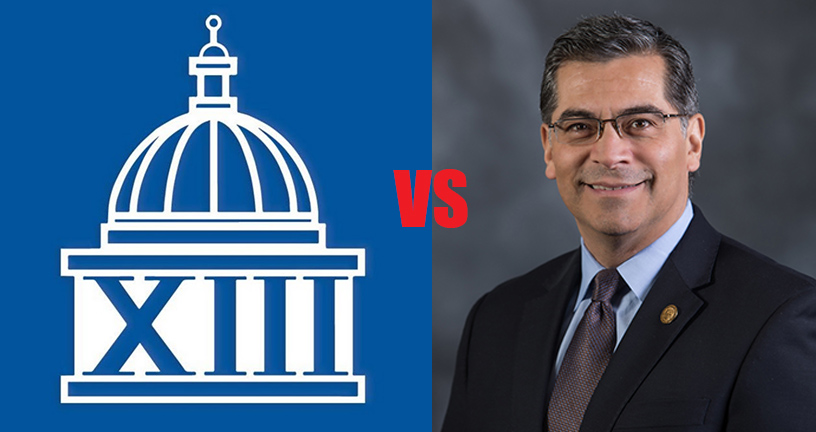
“This blatant manipulation of the ballot label as well as the title and summary is in direct contravention of the Attorney General’s fiduciary duty to prepare impartial ballot material.” – Jon Coupal, President of Howard Jarvis Taxpayers Association
 Today, July 29, 2020, the Howard Jarvis Taxpayers Association filed a lawsuit against California Attorney General Xavier Becerra for his abject failure to produce impartial ballot material related to Proposition 15, the “split roll” attack that seeks the partial repeal of Proposition 13.
Past criticism of Becerra’s bias has been vocal but has now reached a crescendo. Just this past week, editorial boards and columnists have lambasted Becerra. In fact, the specific deficiencies of Prop 15’s ballot label as well as the title and summary are well identified in the media reports themselves:
- “The ballot title on Prop. 15 begins by stating that it ‘increases funding sources for public schools, community colleges and local government services.’ It would do so, it states, by ‘changing tax assessment – not raisingtaxes-on commercial and industrial property.” (John Diaz, California attorney general loads language on 2 November measures, The S.F. Chronicle, July 26, 2020, https://www.sfchronicle.com/opinion/diaz/article/California-attorney-general-loads-language-on-2-15434094.php, emphasis in original.)
- “The title and summary of Proposition 15 are not only tilted toward one side, they are less than fully accurate. Property in California is not taxed on ‘purchase price.’ It’s taxed on fair market value at the time of purchase, adjusted annually, for inflation with increases capped at 2 percent per year… To say property is currently taxed on ‘purchase price’ conveys an impression that property taxes do not rise at all, which is misleading in a way that favors the measure’s proponents who seek to raise taxes. It’s also misleading, if not completely false, to state that Proposition 15 ‘increases funding sources.’ It doesn’t add new sources, it increases taxes on existing sources: businesses in California.” (The Editorial Board, Editorial: Biased ballot measure titles and summaries distort our democracy, Southern California News Group + Bay Area News Group, July 22, 2020, https://www.ocregister.com/2020/07/22/biased-ballot-measure-titles-and-summaries-distort-our-democracy/.)
- “California Attorney General Xavier Becerra has once again written a biased ballot title and summary, which deliberately misleads voters about Prop. 15…” “The attorney general contorts the English language to avoid using the word ‘tax.’ Unfortunately, he can’t call Prop 15 a revenue increase, since, as the nonpartisan Legislative Analyst’s Office says, some rural governments could lose money if Prop 15 passes.” (Katy Grimes, Prop. 15: Messy Title, Feud With Signer, and Ironic Zuckerberg Contributions, California Globe, July 27, 2020, https://californiaglobe.com/section-2/prop-15-messy-title-feud-with-signer-and-ironic-zuckerberg-contributions/.)
- “Rather than simply describe Proposition 15 for what it does, Becerra’s official title summarizes it this way: ‘Increases funding for public schools, community colleges, and local government services by changing tax assessment of commercial and industrial property.'” (Dan Walters, Becerra slants two ballot measure titles, CALmatters, July 27, 2020, “https://calmatters.org/commentary/dan-walters/2020/07/california-becerra-partisan-ballot-measure-titles/.)
“This blatant manipulation of the ballot label as well as the title and summary is in direct contravention of the Attorney General’s fiduciary duty to prepare impartial ballot material,” said Jon Coupal, President of Howard Jarvis Taxpayers Association.
California voters are entitled by law to “a true and impartial statement of the purpose of the measure in such language that the ballot title and summary shall neither be an argument, nor be likely to create prejudice, for or against the proposed measure.” Instead, Attorney General Becerra has bowed to the political power of special interests who seek to hide from the voters that the measure they have put on the ballot is the biggest property tax increase in California history.
Read More

“You are not being inconvenienced that much.” – Supervisor Karen Mitchoff
-
Half-Cent Sales Tax Ballot Measure Plans Hung Up in Sacramento
-
Sheriff Continues Cooperation with ICE
By Daniel Borsuk
Over citizen objections, the Contra Costa County Board of Supervisors voted 5-0, Tuesday to approve fines for non-commercial and commercial public health violations in connection with the COVID-19 pandemic.
The new ordinance that goes into effect immediately requires citizens to wear face masks in the public and in commercial settings or one can be subject to a fine, or multiple fines.
Contra Costa County Health Services Director Anna Roth told supervisors the county needs an ordinance setting down fines because as of Tuesday the county’s COVID-19 caseload is still rising with 7,304 cases. In the county there have been 108 COVID-19 related deaths, she reported, of which 70 percent occurred in long term care facilities. County health officials have observed a sharp rise in COVID-19 cases since May. Roth pointed out the county is on the state’s COVID-19 Monitoring List.
Deputy County Health Director Randy Sawyer explained there is an “urgent need” for county supervisors to adopt an ordinance establishing fees so that county health enforcement officers can enforce public health orders especially during the current pandemic. Citizens are not wearing masks and are not practicing social distancing, Sawyer said.
Sawyer said there are about 200 businesses that the county has ongoing public health complaint issues with the department.
Similar ordinances have recently been adopted in Marin and Napa counties, and the Contra Costa County ordinance requires persons to wear masks when engaged in noncommercial and commercial activities. In Contra Costa, for the first noncommercial violation the fine is $100, $200 for the second violation and $500 for each additional violation within one year of the initial violation.
For commercial activity violations, the fine for the first violation is $250, $500 for a second violation, and $1,000 for each additional violation within one year of the initial violation. “If a violation continues to more than one day, each day is a separate violation,” the ordinance states.
Public Opposition to Mask Ordinance & Fines
Speakers opposing the ordinance said requiring persons to wear masks violates their Constitutional rights. “I oppose this ordinance because it violates our liberties, “said Dave Sutton. “It restricts our liberties.”
Similarly, Deborah Thompson said, “I oppose the ordinance because it is an abridgement of our liberties.”
Comments like those sparked District One Supervisor John Gioia of Richmond to say, “I am shocked by the lack of literacy and scant knowledge that people have.”
The supervisor said some people don’t understand that this virus is causing a public health crisis where this county “may soon run out of ICU beds and two thirds of the people who have died in the county lived in congregant living facilities.”
“We are out to get these numbers down,” Supervisor Karen Mitchoff of Pleasant Hill said in reference to the rising number of COVID-19 cases in the county. “A health order will do that. You are not being inconvenienced that much.”
Mitchoff, who noted Contra Costa County’s fines are less than other Bay Area county fines, said the new ordinance will mean persons will now be required to wear a mask when they out of their house, even when they go to the fast-food drive thru. “If you don’t want to wear a mask then get used to wearing a ventilator,” the supervisor warned.
Richmond resident Edith Alderman supported the ordinance commenting,” I’m 100 percent in favor of the ordinance. This can help get a handle on this disease.”
Speaking on behalf of the board, Chair Candace Andersen of Danville said “Many people are following the Health Order, but we need to increase our efforts together to slow the spread of COVID-19 in our community. To further our progress, to protect lives and reopen more local businesses and activities, we need a tool to send a fair message that everyone has to adhere to health orders to prevent the spread of the virus.”
“With a 14 percent unemployment rate, this is not the time for a sales tax hike”
– Board Chair Candace Andersen
Half-Cent Sales Tax Ballot Measure Plans Hung Up in Sacramento
 With the legislative clock ticking in Sacramento, the supervisors plan to meet at a special teleconferenced meeting next Tuesday in order to get a status report to waive the second reading on the supervisors’ resolution calling for a Nov. 3 half cent sales tax ballot proposal.
The special meeting was called because state legislators have not convened to act on proposed legislation, especially Contra Costa County State Senator Steve Glazer’s Senate Bill 1349, a transactions and use tax law, that the supervisors need the state Legislature to pass and Governor Gavin Newsom to sign by August 18 or the supervisors’ half cent sales proposal will not appear on the November ballot.
Deputy County Administrator Tim Ewell explained without passage of SB 1349, the county will lose $800,000 to $1 million in state revenue to cover printing costs tied to the ballot measure, but the clock is ticking and the supervisors need to have SB 1349 passed in the legislature and signed by the governor by August 18.
“I want those funds,” said supervisor Mitchoff, “but it will only move forward if the legislature acts.”
Supervisors voted 4-1, with Chair Candace Andersen of Danville casting the lone opposing vote, to move forward to meet next Tuesday.
“I will not support it” said Andersen, who also opposed the tax increase proposal at the board’s July 14 meeting. “With a 14 percent unemployment rate, this is not the time for a sales tax hike with such high unemployment rate.”
One of the few speakers opposing the proposal Tom Townsend of El Cerrito, said, “I am taxed to the limit and I oppose the half cent sales tax.”
“I am unsure if this ballot measure will pass,” warned District 3 Supervisor Mitchoff, but she voted in favor of it anyway.
Tax proponent Supervisor Gioia said a county resident would typically pay $60 to $80 a year should the tax measure pass in November.
The proposed language for the county tax measure reads:
“To keep Contra Costa’s regional hospital open and staffed; fund community health centers; provide timely fire and emergency response; support crucial safety-net services; invest in early childhood services, shall the Contra Costa County measure levying a ½ cent sales tax, exempting food sales, providing an estimated $81,000,000 annually for 20 years that the state cannot take, requiring fiscal accountability, with funds benefitting county residents, be adopted?”

Sheriff Continues Cooperation With ICE
Sheriff David Livingston ran into criticism from the public about how the Sheriff’s Office works with the United States Immigration and Customs Enforcement (ICE) but is not expected to change his policies.
“The Sheriff continues to respond to ICE notification requests,” said Melanie Kim, a staff attorney for Advance Justice – Asian Law Caucus. “These practices are especially cruel given that COVID-19 is running rampant inside ICE facilities. People in ICE custody are vulnerable to grave illness or death.”
The sheriff told supervisors that because of the COVID-19 hygiene practices that his officers and the inmates use at the West Contra Costa facility in Richmond and Martinez jail, there have been no reported COVID-19 cases.
The sheriff reported that in the past year his office detained for ICE enforcement purposes, 72 were Hispanic prisoners, 18 were Asian prisoners, one was a Black prisoner, three were white prisoners, and two “other” prisoners.
Sheriff Livingston said of the 95 prisoners reported to ICE, 71 were charged for miscellaneous felonies, four for penal or murder, five for robbery, two for car jackings, and for 11 for assaults with deadly weapons.
While there were a number of critics of the Sheriff’s Office asking that the Board of Supervisors to reduce funding for the upcoming 2020-2021 fiscal year, Karen Clarkson was one of few backers of Sheriff Livingston’s department requesting that funding remain unchanged. “I support the Sheriff,” she said. “It is an unsafe practice to defund the Sheriff.”
“This county should be safe for everyone, whether they are documented or undocumented,” said Anisha Walker, who requested that supervisors cut funds to the Sheriff’s Office.
“I have no sympathy for those who break the law and are violent criminals, “said Supervisor Mitchoff. “I support the sheriff. And I support social justice and equality at a time we are in a COVID -19 pandemic.”
Read MoreBy Jimmy Lee, Director of Public Affairs, Contra Costa County Office of the Sheriff
 This afternoon at about 12:48 PM, the Lafayette Police Department was advised of a collision between a pedestrian and vehicle on the 500 block of Merriewood Drive in Lafayette. Officers arrived on scene and immediately began rendering medical aid to the juvenile victim. The 10-year-old boy was transported to a local hospital where he was later pronounced deceased. He is not being identified at this time.
The investigation into this collision which apparently involved the boy who was on a bicycle and a delivery vehicle is ongoing. The driver of the vehicle has been cooperating with police and has been interviewed.
The Lafayette Police Department is asking anyone with information on this collision to contact detectives at (925) 283-3680 or (925) 299-3234 or email Sergeant Rossberg at tross@so.cccounty.us. Tips could also be emailed to the Lafayette Police Department at: 94549TIP@gmail.com.
Read MoreNon-commercial activities: $100, $200 and $500 fines
Commercial activities: $250, $500 and $1,000 fines.
If a violation continues for more than one day, each day is a separate violation.
By Susan Shiu, Director, Office of Communications and Media, Contra Costa County
 (Martinez, CA) – On July 28, 2020, the Contra Costa County Board of Supervisors used its emergency powers under state law to pass Urgency Ordinance No. 2020-21 that establishes administrative fines for violations of public health orders pertaining to the COVID-19 pandemic.
The Board unanimously determined the ordinance, effective immediately, is necessary to provide an alternative to criminal enforcement of public health orders that will augment the ability of the County and other local agencies to ensure compliance with public health orders and combat the spread of COVID-19.
“Many people are following the Health Orders, but we need to increase our efforts together to slow the spread of COVID-19 in our community,” said Board Chair, Supervisor Candace Andersen. “To further our progress to protect lives and reopen more local businesses and activities, we need a tool to send a fair message that everyone has to adhere to health orders to prevent the spread of the virus.”
For health order violations involving non-commercial activities, the amount of the fine is $100 for a first violation, $200 for a second violation, and $500 for each additional violation within one year of the initial violation. For violations involving commercial activity, the amount of the fine is $250 for a first violation, $500 for a second violation, and $1,000 for each additional violation within one year of the initial violation. If a violation continues for more than one day, each day is a separate violation.
Throughout this pandemic, Contra Costa leaders and law enforcement have encouraged “educational enforcement” before issuing penalties. Before issuing a Notice of Fine, an enforcement officer can first issue a Notice of Violation, which gives a person or business up to two days to correct a violation. In cases where the enforcement officer determines that issuing a Notice of Violation is unnecessary or ineffective, the enforcement officer can immediately issue a Notice of Fine.
Because Public Health Officer orders apply countywide, this ordinance also applies countywide under Government Code section 8634. The ordinance may be enforced in cities and special districts by officials designated by those agencies to enforce the ordinance.
For more information, read Ordinance No. 2020-21 (PDF) available on the County website.
Read MoreOwner of Viking Pavers, Inc. must pay over $2.2 million
By Scott Alonso, Public Information Officer, Office of the District Attorney, Contra Costa County
 Martinez, Calif. – Yesterday, Maurosan Milhomem pleaded no contest to six felonies related to his complex fraud schemes of insurance premium fraud and payroll tax fraud. He also admitted a white collar crime enhancement that he caused the loss of more than $500,000. Milhomem is the owner of Viking Pavers, Inc., a construction company based out of Point Richmond, California. The successful resolution to this criminal case was a result of a joint investigation by the Fraud Division of the California Department of Insurance, Criminal Investigation Division of the Employment Development Department, and the DA’s Office.
“This investigation demonstrated a strong working relationship with our partners that resulted in a successful prosecution in this case. We need to ensure employers follow state law and protect their employees. The defendant explicitly ran fraudulent schemes to avoid paying taxes and ultimately jeopardizing the health and safety of his workers,” stated Contra Costa County District Attorney Diana Becton.
The Contractors’ State Licensing Board and Department of Industrial Relations previously issued Viking Pavers, Inc. civil citations in 2017. Investigators from the Board and Marin County District Attorney’s Office discovered a subcontractor work crew operating for the company without a license and without worker compensation insurance under the name FF Services during a random job site inspection. The Business and Professions Code does not permit construction companies to subcontract construction work unless the crews have their own license. This is because licensed subcontractors are required to have their own bond and workers compensation insurance to protect homeowners and employees.
The District Attorney’s Office learned of the fraud after employees of Viking Pavers were involved in a vehicle accident. The employees were never reported during premium audits as employees or subcontractors. These audits help confirm if an employer is following the law and ensure the appropriate classifications for their employees and subcontractors.
The investigation by the Contra Costa County District Attorney’s Office revealed that Viking Pavers continued to use FF Services as an unlicensed subcontractor after the civil citations and throughout 2018. The company re-routed the payments off the books to avoid detection during required audits. Forensic accountants traced payments to FF Services and other unlicensed and uninsured work crews, initially through a check cashing service in Richmond, California, and then through the bank accounts of a newly created a shell company. A subsequent search warrant at the business resulted in the seizure of over $80,000 in cash.
Milhomem’s guilty plea was accepted by the Honorable Laurel Brady in Department 31. The defendant will serve 364 days in county jail and is eligible to serve the sentence through electronic home detention. In addition, the defendant will serve five years of formal probation. He is ordered to pay $1,109,603 to Markel Corporation for the underpayment of workers’ compensation insurance premium, $808,455.34 to the Employment Development Department for the underpayment of tax liability and $312,000 to Berkshire Hathaway for the underpayment of workers’ compensation insurance premium. The Court ordered the seized cash forfeited as criminal restitution pursuant to the plea agreement.
Insurance premium fraud by employers is unfair to workers, who may see questions about their employment status result in delayed or even denied coverage after an injury. Such fraud is also unfair to law-abiding competitors who cannot compete as they pay the legally required costs to provide coverage for their own workers. A forensic audit estimated that Viking Pavers evaded over $2 million dollars of insurance premiums and taxes that a law-abiding competitor would have had to pay over the same seven-year period.
The District Attorney’s Office reminds employers, particularly in the construction industry, that lying to an insurance carrier, either on the application for a policy or during payroll reporting and audit is insurance fraud punishable by up to five years state prison and an additional fine of up double the amount of the fraud.
The case was prosecuted by Deputy District Attorneys Jeremy Seymour and Michael Panikowski. Anyone with information about possible insurance fraud can report it to the District Attorney’s Office via email at DA-ReportFraud@contracostada.org.
Case information: People v. Maurosan Milhomem Docket Number 01-193357-1
Read MoreDear Editor:
 This is in response to the recent Op/Ed from Dronenburg and Coupal.
Most of us want similar things: good schools for our children, a healthy family, and safe neighborhoods. But for more than four decades, big corporations have not been paying their fair share, leaving California’s school funding falling behind. California now has the most overcrowded classrooms in the U.S. and some of the worst ratios of counselors, librarians, and nurses per student. This has taken an enormous toll.
Schools & Communities First is not an effort to undo Prop 13- it is simply an effort to ensure that our schools and communities come first – with the resources to educate all of our kids and the services to support all of our families.
It accomplishes this by closing commercial property tax loopholes only- not residences, not agriculture and not small businesses. In fact, it will impact only a small fraction of large corporations.
SCF will reclaim $12 billion every year to fund world-class schools and strengthen local economies to lift up all Californians
It’s time to invest in California again- we cannot afford to wait.
Janet Hoy
Walnut Creek
Read More
ECCFPD Fire Chief Brian Helmick. Screenshot of YouTube video.
By Steve Aubert, Fire Marshal/PIO, ECCFPD
 Brentwood, CA — East Contra Costa Fire Protection District (ECCFPD), the local fire agency serving Brentwood and Oakley Discovery Bay, Bethel Island, Knightsen, Byron, Marsh Creek, and Morgan Territory. Fire season is well underway with multiple fires occurring within the District since June. Join Fire Chief Brian Helmick for our first Facebook Live event sharing key videos from our “We Are Listening” initiative and offering a question and answer session.
Our first event is scheduled for July 27, 2020 beginning at 6:00 P.M. Please login into Facebook.com/EastContraCostaFireProtectionDistrict for this great opportunity directly with the Chief.
Future events scheduled for August 3, 10, 18, 25 and September 14.
Learn more at www.eccfpd.org.
ABOUT THE EAST CONTRA COSTA FIRE PROTECTION DISTRICT:
The East Contra Costa Fire Protection District (ECCFPD) is a rural-funded fire district that currently operates 3 fire stations and has a 3-station deficit. The District protects a population of more than 128,000 across its 249 square-mile service area. ECCFPD provides firefighting personnel, emergency medical services (basic life support) and fire prevention to the residents and businesses of the cities of Brentwood and Oakley, and unincorporated communities of Discovery Bay, Bethel Island, Knightsen, Byron, Marsh Creek, and Morgan Territory. Learn more at www.eccfpd.org or social media via Facebook (East Contra Costa Fire Protection District), Instagram(@east_contra_costa_fire), Twitter (@ECCFPD ) or our YouTube channel (East Contra Costa Fire Protection District).
Read MoreBy Jon Coupal and Ernest Dronenburg
Come November, Proposition 13 faces its biggest political battle at the ballot box. It is instructive to ask whether that iconic tax affordability measure remains good tax policy for California.
As the just-released property tax assessments rolls from several California counties reveal, Proposition 13 is working exceedingly well at keeping homeowners and small business owners from losing their properties to skyrocketing property taxes, while delivering government a reliable source of revenue. Voters would be foolish to repeal one of its major protections this November.
Take San Diego County, for example. The assessed value of all taxable property increased to a record high $604.75 billion, more than a five percent increase over last year. Because the state-set “lien date” is January 1st, any potential impact from COVID-19 won’t show up in this year’s numbers. Nonetheless, there is little to suggest that the county will see any major downturn in the real estate market, notwithstanding the pandemic.
San Diego’s experience with Proposition 13, as with most California counties, should lay to rest the notion that Proposition 13 has starved local government of revenue. Since 1978, increases in property tax revenue for local governments have far exceeded population and inflation. And while California now has the highest income tax rate, gas tax and sales tax rate in America, we remain in the top third (17th out of 50) in per capita property tax revenue. In short, we are not a low property tax state.
Hardly an outlier, San Diego County’s benefits from Prop. 13 are evident in the other counties that just reported their assessment rolls. These eleven counties all enjoyed big increases in taxable value that produced more revenue for schools and governments, including Fresno (up 5.5 percent), Marin (4.5 percent) and Orange (4.72 percent).
So how is it possible that, over the course of 41 years of history, Prop. 13 continues to work so well? Prop. 13 is an implicit contract with government that says property owners agree to pay a maximum property tax rate of 1 percent for as long as they own the property and agree to an annual increase of that taxable value up to 2 percent. When the property changes owners, it is reassessed at the market value and the new owner gets the benefit of a transparent and predictable tax they can afford. Prior to Prop. 13, every year was a guessing game as to whether you could afford your property taxes.
But now, far-left progressives and tax-hungry public sector labor interests want to strip away that protection from business and industrial properties in order to seize what they believe to be between $6 billion to $12 billion annually in taxes. Even their estimate of revenue has huge volatility.
Their Proposition 15 proposal on the November ballot would require continuous reassessment of business properties by removing the two percent cap on annual increases.
There are many reasons to reject Prop. 15. But as the 58 counties release their assessment rolls, it’s more evident than ever that Prop. 13 has delivered affordability for property owners and a stable and growing revenue source for schools and local governments. We shouldn’t abandon a system that’s working.
We should reject Proposition 15 in November. It’s obvious that it will have a negative impact on revenue stability for our schools and on stability for taxpayers. We will see businesses closing not because of the pandemic, but because they cannot afford to pay their property taxes.
Jon Coupal is the president of the Howard Jarvis Taxpayers Association and Ernest J. Dronenburg, Jr. is the elected San Diego County Assessor/Recorder/Clerk and former 20-year member of the California Board of Equalization and Chairman of its Property Tax Committee.
Read More











The gun, multiple high-capacity magazines and ammunition found with the suspect on July 31, 2020. Photo by PPD.
Site of homeless program praised by Governor Newsom during June 30 press conference at the location
By Pittsburg Police Department
Motel 6 in Pittsburg. Photo by Motel 6.
On Thursday, July 30, 2020, Pittsburg officers responded to Motel 6 at 2101 Loveridge Road in Pittsburg, for the report of a kidnapping during which the suspect, “pistol whipped” the female victim with a handgun causing a significant injury, threatened to kill her son, etc. The suspect was positively identified by the victim and Motel 6 cameras. The suspect in the Motel 6 incident was also found to have an active felony warrant for a similar pistol whip incident that occurred in the City of Oakland days prior. Furthermore, the suspect had just recently been released from prison and was on active parole for prior violent felonies convictions.
The motel was the site for a press conference by Governor Gavin Newsom about the state’s Project Roomkey and new Project Homekey programs on June 30. (See related article) UPDATE: However, according to Contra Costa Health Services spokesperson Kim McCarl, the program does not include the entire motel, and the victim and suspect involved in the incident, which occurred in the other building, were not part of it.
On Friday, July 31, Pittsburg officers were patrolling the area where the suspect was believed to frequent. Officers located the suspect exiting the same vehicle he was driving during the Motel 6 incident. The suspect fled from the vehicle on foot, a perimeter was established and a short time later he was apprehended without incident. The vehicle was searched, and the above pictured firearm was located inside along with multiple high-capacity magazines and ammunition. The suspect was transported to jail on multiple different charges. -P375
Allen Payton contributed to this report.
Read MoreThe Contra Costa County Board of Supervisors is seeking an individual to serve on the Contra Costa Transportation Authority (CCTA) Citizen Advisory Committee (CAC) as Public Representative on behalf of the County. The individual selected for this position must live in the unincorporated area of the County, be available to attend committee meetings on the 4th Wednesday of every month at 6:00 pm, normally held at the CCTA offices located at 2999 Oak Road, Suite 100, Walnut Creek, have the ability to review CAC agenda packets, and develop input on agenda items beforehand. Due to the COVID-19 pandemic, meetings presently occur via videoconference. The individual will serve a four-year term in a volunteer capacity and be eligible for reimbursement for travel expenses.
The CCTA Citizen Advisory Committee reviews transportation programs and plans throughout the County (https://ccta.net/about-us/#what-we-do), with the objective of advising and providing recommendations to the CCTA Board of Directors. This includes transportation projects and programs funded by the county half-cent transportation sales tax (“Measure J”) (https://ccta.net/2018/10/17/measure-j), which CCTA oversees. CCTA maintains its standing CAC in order to provide citizen perspective, participation, and involvement in the Measure J-funded and voter-approved Transportation Expenditure Plan and Growth Management Program. The CAC members have an opportunity to learn about and influence transportation and growth issues within Contra Costa County and in other jurisdictions through scheduled presentations by transportation experts, advocates, and CCTA staff.
The deadline to apply is August 31, 2020. For more information on this position, please call (925) 674-7822. To apply, visit the Contra Costa County Boards and Commissions website at www.contracosta.ca.gov/6408, or download an application at www.contracosta.ca.gov/DocumentCenter/View/6433. Applicants can fax the completed form to the attention of Robert Sarmiento at (925) 674-7250.
Read More“This blatant manipulation of the ballot label as well as the title and summary is in direct contravention of the Attorney General’s fiduciary duty to prepare impartial ballot material.” – Jon Coupal, President of Howard Jarvis Taxpayers Association
Today, July 29, 2020, the Howard Jarvis Taxpayers Association filed a lawsuit against California Attorney General Xavier Becerra for his abject failure to produce impartial ballot material related to Proposition 15, the “split roll” attack that seeks the partial repeal of Proposition 13.
Past criticism of Becerra’s bias has been vocal but has now reached a crescendo. Just this past week, editorial boards and columnists have lambasted Becerra. In fact, the specific deficiencies of Prop 15’s ballot label as well as the title and summary are well identified in the media reports themselves:
- “The ballot title on Prop. 15 begins by stating that it ‘increases funding sources for public schools, community colleges and local government services.’ It would do so, it states, by ‘changing tax assessment – not raisingtaxes-on commercial and industrial property.” (John Diaz, California attorney general loads language on 2 November measures, The S.F. Chronicle, July 26, 2020, https://www.sfchronicle.com/opinion/diaz/article/California-attorney-general-loads-language-on-2-15434094.php, emphasis in original.)
- “The title and summary of Proposition 15 are not only tilted toward one side, they are less than fully accurate. Property in California is not taxed on ‘purchase price.’ It’s taxed on fair market value at the time of purchase, adjusted annually, for inflation with increases capped at 2 percent per year… To say property is currently taxed on ‘purchase price’ conveys an impression that property taxes do not rise at all, which is misleading in a way that favors the measure’s proponents who seek to raise taxes. It’s also misleading, if not completely false, to state that Proposition 15 ‘increases funding sources.’ It doesn’t add new sources, it increases taxes on existing sources: businesses in California.” (The Editorial Board, Editorial: Biased ballot measure titles and summaries distort our democracy, Southern California News Group + Bay Area News Group, July 22, 2020, https://www.ocregister.com/2020/07/22/biased-ballot-measure-titles-and-summaries-distort-our-democracy/.)
- “California Attorney General Xavier Becerra has once again written a biased ballot title and summary, which deliberately misleads voters about Prop. 15…” “The attorney general contorts the English language to avoid using the word ‘tax.’ Unfortunately, he can’t call Prop 15 a revenue increase, since, as the nonpartisan Legislative Analyst’s Office says, some rural governments could lose money if Prop 15 passes.” (Katy Grimes, Prop. 15: Messy Title, Feud With Signer, and Ironic Zuckerberg Contributions, California Globe, July 27, 2020, https://californiaglobe.com/section-2/prop-15-messy-title-feud-with-signer-and-ironic-zuckerberg-contributions/.)
- “Rather than simply describe Proposition 15 for what it does, Becerra’s official title summarizes it this way: ‘Increases funding for public schools, community colleges, and local government services by changing tax assessment of commercial and industrial property.'” (Dan Walters, Becerra slants two ballot measure titles, CALmatters, July 27, 2020, “https://calmatters.org/commentary/dan-walters/2020/07/california-becerra-partisan-ballot-measure-titles/.)
“This blatant manipulation of the ballot label as well as the title and summary is in direct contravention of the Attorney General’s fiduciary duty to prepare impartial ballot material,” said Jon Coupal, President of Howard Jarvis Taxpayers Association.
California voters are entitled by law to “a true and impartial statement of the purpose of the measure in such language that the ballot title and summary shall neither be an argument, nor be likely to create prejudice, for or against the proposed measure.” Instead, Attorney General Becerra has bowed to the political power of special interests who seek to hide from the voters that the measure they have put on the ballot is the biggest property tax increase in California history.
Read More
“You are not being inconvenienced that much.” – Supervisor Karen Mitchoff
-
Half-Cent Sales Tax Ballot Measure Plans Hung Up in Sacramento
-
Sheriff Continues Cooperation with ICE
By Daniel Borsuk
Over citizen objections, the Contra Costa County Board of Supervisors voted 5-0, Tuesday to approve fines for non-commercial and commercial public health violations in connection with the COVID-19 pandemic.
The new ordinance that goes into effect immediately requires citizens to wear face masks in the public and in commercial settings or one can be subject to a fine, or multiple fines.
Contra Costa County Health Services Director Anna Roth told supervisors the county needs an ordinance setting down fines because as of Tuesday the county’s COVID-19 caseload is still rising with 7,304 cases. In the county there have been 108 COVID-19 related deaths, she reported, of which 70 percent occurred in long term care facilities. County health officials have observed a sharp rise in COVID-19 cases since May. Roth pointed out the county is on the state’s COVID-19 Monitoring List.
Deputy County Health Director Randy Sawyer explained there is an “urgent need” for county supervisors to adopt an ordinance establishing fees so that county health enforcement officers can enforce public health orders especially during the current pandemic. Citizens are not wearing masks and are not practicing social distancing, Sawyer said.
Sawyer said there are about 200 businesses that the county has ongoing public health complaint issues with the department.
Similar ordinances have recently been adopted in Marin and Napa counties, and the Contra Costa County ordinance requires persons to wear masks when engaged in noncommercial and commercial activities. In Contra Costa, for the first noncommercial violation the fine is $100, $200 for the second violation and $500 for each additional violation within one year of the initial violation.
For commercial activity violations, the fine for the first violation is $250, $500 for a second violation, and $1,000 for each additional violation within one year of the initial violation. “If a violation continues to more than one day, each day is a separate violation,” the ordinance states.
Public Opposition to Mask Ordinance & Fines
Speakers opposing the ordinance said requiring persons to wear masks violates their Constitutional rights. “I oppose this ordinance because it violates our liberties, “said Dave Sutton. “It restricts our liberties.”
Similarly, Deborah Thompson said, “I oppose the ordinance because it is an abridgement of our liberties.”
Comments like those sparked District One Supervisor John Gioia of Richmond to say, “I am shocked by the lack of literacy and scant knowledge that people have.”
The supervisor said some people don’t understand that this virus is causing a public health crisis where this county “may soon run out of ICU beds and two thirds of the people who have died in the county lived in congregant living facilities.”
“We are out to get these numbers down,” Supervisor Karen Mitchoff of Pleasant Hill said in reference to the rising number of COVID-19 cases in the county. “A health order will do that. You are not being inconvenienced that much.”
Mitchoff, who noted Contra Costa County’s fines are less than other Bay Area county fines, said the new ordinance will mean persons will now be required to wear a mask when they out of their house, even when they go to the fast-food drive thru. “If you don’t want to wear a mask then get used to wearing a ventilator,” the supervisor warned.
Richmond resident Edith Alderman supported the ordinance commenting,” I’m 100 percent in favor of the ordinance. This can help get a handle on this disease.”
Speaking on behalf of the board, Chair Candace Andersen of Danville said “Many people are following the Health Order, but we need to increase our efforts together to slow the spread of COVID-19 in our community. To further our progress, to protect lives and reopen more local businesses and activities, we need a tool to send a fair message that everyone has to adhere to health orders to prevent the spread of the virus.”
“With a 14 percent unemployment rate, this is not the time for a sales tax hike”
– Board Chair Candace Andersen
Half-Cent Sales Tax Ballot Measure Plans Hung Up in Sacramento
With the legislative clock ticking in Sacramento, the supervisors plan to meet at a special teleconferenced meeting next Tuesday in order to get a status report to waive the second reading on the supervisors’ resolution calling for a Nov. 3 half cent sales tax ballot proposal.
The special meeting was called because state legislators have not convened to act on proposed legislation, especially Contra Costa County State Senator Steve Glazer’s Senate Bill 1349, a transactions and use tax law, that the supervisors need the state Legislature to pass and Governor Gavin Newsom to sign by August 18 or the supervisors’ half cent sales proposal will not appear on the November ballot.
Deputy County Administrator Tim Ewell explained without passage of SB 1349, the county will lose $800,000 to $1 million in state revenue to cover printing costs tied to the ballot measure, but the clock is ticking and the supervisors need to have SB 1349 passed in the legislature and signed by the governor by August 18.
“I want those funds,” said supervisor Mitchoff, “but it will only move forward if the legislature acts.”
Supervisors voted 4-1, with Chair Candace Andersen of Danville casting the lone opposing vote, to move forward to meet next Tuesday.
“I will not support it” said Andersen, who also opposed the tax increase proposal at the board’s July 14 meeting. “With a 14 percent unemployment rate, this is not the time for a sales tax hike with such high unemployment rate.”
One of the few speakers opposing the proposal Tom Townsend of El Cerrito, said, “I am taxed to the limit and I oppose the half cent sales tax.”
“I am unsure if this ballot measure will pass,” warned District 3 Supervisor Mitchoff, but she voted in favor of it anyway.
Tax proponent Supervisor Gioia said a county resident would typically pay $60 to $80 a year should the tax measure pass in November.
The proposed language for the county tax measure reads:
“To keep Contra Costa’s regional hospital open and staffed; fund community health centers; provide timely fire and emergency response; support crucial safety-net services; invest in early childhood services, shall the Contra Costa County measure levying a ½ cent sales tax, exempting food sales, providing an estimated $81,000,000 annually for 20 years that the state cannot take, requiring fiscal accountability, with funds benefitting county residents, be adopted?”
Sheriff Continues Cooperation With ICE
Sheriff David Livingston ran into criticism from the public about how the Sheriff’s Office works with the United States Immigration and Customs Enforcement (ICE) but is not expected to change his policies.
“The Sheriff continues to respond to ICE notification requests,” said Melanie Kim, a staff attorney for Advance Justice – Asian Law Caucus. “These practices are especially cruel given that COVID-19 is running rampant inside ICE facilities. People in ICE custody are vulnerable to grave illness or death.”
The sheriff told supervisors that because of the COVID-19 hygiene practices that his officers and the inmates use at the West Contra Costa facility in Richmond and Martinez jail, there have been no reported COVID-19 cases.
The sheriff reported that in the past year his office detained for ICE enforcement purposes, 72 were Hispanic prisoners, 18 were Asian prisoners, one was a Black prisoner, three were white prisoners, and two “other” prisoners.
Sheriff Livingston said of the 95 prisoners reported to ICE, 71 were charged for miscellaneous felonies, four for penal or murder, five for robbery, two for car jackings, and for 11 for assaults with deadly weapons.
While there were a number of critics of the Sheriff’s Office asking that the Board of Supervisors to reduce funding for the upcoming 2020-2021 fiscal year, Karen Clarkson was one of few backers of Sheriff Livingston’s department requesting that funding remain unchanged. “I support the Sheriff,” she said. “It is an unsafe practice to defund the Sheriff.”
“This county should be safe for everyone, whether they are documented or undocumented,” said Anisha Walker, who requested that supervisors cut funds to the Sheriff’s Office.
“I have no sympathy for those who break the law and are violent criminals, “said Supervisor Mitchoff. “I support the sheriff. And I support social justice and equality at a time we are in a COVID -19 pandemic.”
Read MoreBy Jimmy Lee, Director of Public Affairs, Contra Costa County Office of the Sheriff
This afternoon at about 12:48 PM, the Lafayette Police Department was advised of a collision between a pedestrian and vehicle on the 500 block of Merriewood Drive in Lafayette. Officers arrived on scene and immediately began rendering medical aid to the juvenile victim. The 10-year-old boy was transported to a local hospital where he was later pronounced deceased. He is not being identified at this time.
The investigation into this collision which apparently involved the boy who was on a bicycle and a delivery vehicle is ongoing. The driver of the vehicle has been cooperating with police and has been interviewed.
The Lafayette Police Department is asking anyone with information on this collision to contact detectives at (925) 283-3680 or (925) 299-3234 or email Sergeant Rossberg at tross@so.cccounty.us. Tips could also be emailed to the Lafayette Police Department at: 94549TIP@gmail.com.
Read MoreNon-commercial activities: $100, $200 and $500 fines
Commercial activities: $250, $500 and $1,000 fines.
If a violation continues for more than one day, each day is a separate violation.
By Susan Shiu, Director, Office of Communications and Media, Contra Costa County
(Martinez, CA) – On July 28, 2020, the Contra Costa County Board of Supervisors used its emergency powers under state law to pass Urgency Ordinance No. 2020-21 that establishes administrative fines for violations of public health orders pertaining to the COVID-19 pandemic.
The Board unanimously determined the ordinance, effective immediately, is necessary to provide an alternative to criminal enforcement of public health orders that will augment the ability of the County and other local agencies to ensure compliance with public health orders and combat the spread of COVID-19.
“Many people are following the Health Orders, but we need to increase our efforts together to slow the spread of COVID-19 in our community,” said Board Chair, Supervisor Candace Andersen. “To further our progress to protect lives and reopen more local businesses and activities, we need a tool to send a fair message that everyone has to adhere to health orders to prevent the spread of the virus.”
For health order violations involving non-commercial activities, the amount of the fine is $100 for a first violation, $200 for a second violation, and $500 for each additional violation within one year of the initial violation. For violations involving commercial activity, the amount of the fine is $250 for a first violation, $500 for a second violation, and $1,000 for each additional violation within one year of the initial violation. If a violation continues for more than one day, each day is a separate violation.
Throughout this pandemic, Contra Costa leaders and law enforcement have encouraged “educational enforcement” before issuing penalties. Before issuing a Notice of Fine, an enforcement officer can first issue a Notice of Violation, which gives a person or business up to two days to correct a violation. In cases where the enforcement officer determines that issuing a Notice of Violation is unnecessary or ineffective, the enforcement officer can immediately issue a Notice of Fine.
Because Public Health Officer orders apply countywide, this ordinance also applies countywide under Government Code section 8634. The ordinance may be enforced in cities and special districts by officials designated by those agencies to enforce the ordinance.
For more information, read Ordinance No. 2020-21 (PDF) available on the County website.
Read MoreOwner of Viking Pavers, Inc. must pay over $2.2 million
By Scott Alonso, Public Information Officer, Office of the District Attorney, Contra Costa County
Martinez, Calif. – Yesterday, Maurosan Milhomem pleaded no contest to six felonies related to his complex fraud schemes of insurance premium fraud and payroll tax fraud. He also admitted a white collar crime enhancement that he caused the loss of more than $500,000. Milhomem is the owner of Viking Pavers, Inc., a construction company based out of Point Richmond, California. The successful resolution to this criminal case was a result of a joint investigation by the Fraud Division of the California Department of Insurance, Criminal Investigation Division of the Employment Development Department, and the DA’s Office.
“This investigation demonstrated a strong working relationship with our partners that resulted in a successful prosecution in this case. We need to ensure employers follow state law and protect their employees. The defendant explicitly ran fraudulent schemes to avoid paying taxes and ultimately jeopardizing the health and safety of his workers,” stated Contra Costa County District Attorney Diana Becton.
The Contractors’ State Licensing Board and Department of Industrial Relations previously issued Viking Pavers, Inc. civil citations in 2017. Investigators from the Board and Marin County District Attorney’s Office discovered a subcontractor work crew operating for the company without a license and without worker compensation insurance under the name FF Services during a random job site inspection. The Business and Professions Code does not permit construction companies to subcontract construction work unless the crews have their own license. This is because licensed subcontractors are required to have their own bond and workers compensation insurance to protect homeowners and employees.
The District Attorney’s Office learned of the fraud after employees of Viking Pavers were involved in a vehicle accident. The employees were never reported during premium audits as employees or subcontractors. These audits help confirm if an employer is following the law and ensure the appropriate classifications for their employees and subcontractors.
The investigation by the Contra Costa County District Attorney’s Office revealed that Viking Pavers continued to use FF Services as an unlicensed subcontractor after the civil citations and throughout 2018. The company re-routed the payments off the books to avoid detection during required audits. Forensic accountants traced payments to FF Services and other unlicensed and uninsured work crews, initially through a check cashing service in Richmond, California, and then through the bank accounts of a newly created a shell company. A subsequent search warrant at the business resulted in the seizure of over $80,000 in cash.
Milhomem’s guilty plea was accepted by the Honorable Laurel Brady in Department 31. The defendant will serve 364 days in county jail and is eligible to serve the sentence through electronic home detention. In addition, the defendant will serve five years of formal probation. He is ordered to pay $1,109,603 to Markel Corporation for the underpayment of workers’ compensation insurance premium, $808,455.34 to the Employment Development Department for the underpayment of tax liability and $312,000 to Berkshire Hathaway for the underpayment of workers’ compensation insurance premium. The Court ordered the seized cash forfeited as criminal restitution pursuant to the plea agreement.
Insurance premium fraud by employers is unfair to workers, who may see questions about their employment status result in delayed or even denied coverage after an injury. Such fraud is also unfair to law-abiding competitors who cannot compete as they pay the legally required costs to provide coverage for their own workers. A forensic audit estimated that Viking Pavers evaded over $2 million dollars of insurance premiums and taxes that a law-abiding competitor would have had to pay over the same seven-year period.
The District Attorney’s Office reminds employers, particularly in the construction industry, that lying to an insurance carrier, either on the application for a policy or during payroll reporting and audit is insurance fraud punishable by up to five years state prison and an additional fine of up double the amount of the fraud.
The case was prosecuted by Deputy District Attorneys Jeremy Seymour and Michael Panikowski. Anyone with information about possible insurance fraud can report it to the District Attorney’s Office via email at DA-ReportFraud@contracostada.org.
Case information: People v. Maurosan Milhomem Docket Number 01-193357-1
Read MoreDear Editor:
This is in response to the recent Op/Ed from Dronenburg and Coupal.
Most of us want similar things: good schools for our children, a healthy family, and safe neighborhoods. But for more than four decades, big corporations have not been paying their fair share, leaving California’s school funding falling behind. California now has the most overcrowded classrooms in the U.S. and some of the worst ratios of counselors, librarians, and nurses per student. This has taken an enormous toll.
Schools & Communities First is not an effort to undo Prop 13- it is simply an effort to ensure that our schools and communities come first – with the resources to educate all of our kids and the services to support all of our families.
It accomplishes this by closing commercial property tax loopholes only- not residences, not agriculture and not small businesses. In fact, it will impact only a small fraction of large corporations.
SCF will reclaim $12 billion every year to fund world-class schools and strengthen local economies to lift up all Californians
It’s time to invest in California again- we cannot afford to wait.
Janet Hoy
Walnut Creek
Read MoreECCFPD Fire Chief Brian Helmick. Screenshot of YouTube video.
By Steve Aubert, Fire Marshal/PIO, ECCFPD
Brentwood, CA — East Contra Costa Fire Protection District (ECCFPD), the local fire agency serving Brentwood and Oakley Discovery Bay, Bethel Island, Knightsen, Byron, Marsh Creek, and Morgan Territory. Fire season is well underway with multiple fires occurring within the District since June. Join Fire Chief Brian Helmick for our first Facebook Live event sharing key videos from our “We Are Listening” initiative and offering a question and answer session.
Our first event is scheduled for July 27, 2020 beginning at 6:00 P.M. Please login into Facebook.com/EastContraCostaFireProtectionDistrict for this great opportunity directly with the Chief.
Future events scheduled for August 3, 10, 18, 25 and September 14.
Learn more at www.eccfpd.org.
ABOUT THE EAST CONTRA COSTA FIRE PROTECTION DISTRICT:
The East Contra Costa Fire Protection District (ECCFPD) is a rural-funded fire district that currently operates 3 fire stations and has a 3-station deficit. The District protects a population of more than 128,000 across its 249 square-mile service area. ECCFPD provides firefighting personnel, emergency medical services (basic life support) and fire prevention to the residents and businesses of the cities of Brentwood and Oakley, and unincorporated communities of Discovery Bay, Bethel Island, Knightsen, Byron, Marsh Creek, and Morgan Territory. Learn more at www.eccfpd.org or social media via Facebook (East Contra Costa Fire Protection District), Instagram(@east_contra_costa_fire), Twitter (@ECCFPD ) or our YouTube channel (East Contra Costa Fire Protection District).
Read MoreBy Jon Coupal and Ernest Dronenburg
Come November, Proposition 13 faces its biggest political battle at the ballot box. It is instructive to ask whether that iconic tax affordability measure remains good tax policy for California.
As the just-released property tax assessments rolls from several California counties reveal, Proposition 13 is working exceedingly well at keeping homeowners and small business owners from losing their properties to skyrocketing property taxes, while delivering government a reliable source of revenue. Voters would be foolish to repeal one of its major protections this November.
Take San Diego County, for example. The assessed value of all taxable property increased to a record high $604.75 billion, more than a five percent increase over last year. Because the state-set “lien date” is January 1st, any potential impact from COVID-19 won’t show up in this year’s numbers. Nonetheless, there is little to suggest that the county will see any major downturn in the real estate market, notwithstanding the pandemic.
San Diego’s experience with Proposition 13, as with most California counties, should lay to rest the notion that Proposition 13 has starved local government of revenue. Since 1978, increases in property tax revenue for local governments have far exceeded population and inflation. And while California now has the highest income tax rate, gas tax and sales tax rate in America, we remain in the top third (17th out of 50) in per capita property tax revenue. In short, we are not a low property tax state.
Hardly an outlier, San Diego County’s benefits from Prop. 13 are evident in the other counties that just reported their assessment rolls. These eleven counties all enjoyed big increases in taxable value that produced more revenue for schools and governments, including Fresno (up 5.5 percent), Marin (4.5 percent) and Orange (4.72 percent).
So how is it possible that, over the course of 41 years of history, Prop. 13 continues to work so well? Prop. 13 is an implicit contract with government that says property owners agree to pay a maximum property tax rate of 1 percent for as long as they own the property and agree to an annual increase of that taxable value up to 2 percent. When the property changes owners, it is reassessed at the market value and the new owner gets the benefit of a transparent and predictable tax they can afford. Prior to Prop. 13, every year was a guessing game as to whether you could afford your property taxes.
But now, far-left progressives and tax-hungry public sector labor interests want to strip away that protection from business and industrial properties in order to seize what they believe to be between $6 billion to $12 billion annually in taxes. Even their estimate of revenue has huge volatility.
Their Proposition 15 proposal on the November ballot would require continuous reassessment of business properties by removing the two percent cap on annual increases.
There are many reasons to reject Prop. 15. But as the 58 counties release their assessment rolls, it’s more evident than ever that Prop. 13 has delivered affordability for property owners and a stable and growing revenue source for schools and local governments. We shouldn’t abandon a system that’s working.
We should reject Proposition 15 in November. It’s obvious that it will have a negative impact on revenue stability for our schools and on stability for taxpayers. We will see businesses closing not because of the pandemic, but because they cannot afford to pay their property taxes.
Jon Coupal is the president of the Howard Jarvis Taxpayers Association and Ernest J. Dronenburg, Jr. is the elected San Diego County Assessor/Recorder/Clerk and former 20-year member of the California Board of Equalization and Chairman of its Property Tax Committee.
Read More