






“Racism exists in our county and in our county department” – Supervisor Federal Glover
“Racism is a public health crisis” – Contra Costa Health Department Director Anna Roth
County COVID-19 ranking lowered to Red Tier as health officials warn about holiday season upsurge
 By Daniel Borsuk
The Contra Costa County Board of Supervisors on Tuesday, Nov. 10, 2020 unanimously passed a proposal to create a county funded Office of Racial Equity and Social Justice to address increasing concerns about rising issues of racial inequality and social injustice especially in how the county delivers health services to people of color.
The nonprofit San Francisco Foundation will provide the biggest donation of $75,000 to help launch the formation of the new office. Other organizations providing funding are the Contra Costa Regional Health Foundation, $20,000; East Bay Community Foundation, $10,000; John Muir Community Benefits, $10,000; Dean and Margaret Lesher Foundation, $25,000; Public Health Advocates, $25,000; Republic Services, $25,000; Richmond Community Foundation, $5,000: The California Endowment, $25,000 and Y&H Soda Foundation, $25,000.
Before supervisors voted to start the planning process to potentially launch a county Office of Racial Equity and Social Justice, supervisors had unanimously approved a resolution Declaring Racism as a Public Health Crisis. Some of the resolution’s 12 clauses were:
“WHEREAS, disproportionately higher rates of chronic disease, shorter life expectancy, maternal and infant mortality, and health inequities for Black/African Americans and other racial groups are widely recognized and documented, yet continue in particular as well as other communities of color; and
“WHEREAS the COVID-19 pandemic has exacerbated racial and social inequities by disproportionately impacting the Latinx community as well as other communities of color; and
“WHEREAS Contra Costa Health Services cares for and improves the health of all people in Contra Costa County, and yet as a system has perpetuated racism and anti-black racism; and
“WHEREAS the Contra Costa Health Services cares for and improves the health of all people in Contra Costa County, and yet as a system has perpetuated racism and anti-black racism.”
If Contra Costa County moves ahead in to create in the 2021-2022 fiscal year an Office of Racial Equity and Social Justice, the county will join San Francisco and Oakland that had both established similar offices in 2019.
“Racism exists in our county and in our county department,” said Supervisor Federal Glover of Pittsburg, who along with Gioia pushed for the formation of the new county office.
“I have always attacked the health disparities, particularly when it impacts our low income communities,” said the supervisor who was reelected last week to a seventh four-year term in a runoff election last week against Contra Costa County Assessor Gus Kramer.
“Racism is a public health crisis,” concurred Contra Costa Health Department Director Anna Roth. Roth said there exist ethnic-economic-racial-social inequities in health care throughout Contra Costa County.
“This is a major issue no matter if it is intentional or unintentional,” said District 1 Supervisor John Gioia of Richmond. “We have seen it all in our own county.”
“I support the eventuality of a Contra Costa County Office of Racial Equity,” said Supervisor Karen Mitchoff of Pleasant Hill, who at one point disputed with Gioia over how to fund the operation of the proposed new office if it reaches that point by next May. Both supervisors agreed to not bring up the funding issue until May when supervisors will review the 2021—2022 budget.
County Returns to COVID-19 Red Tier With More Restrictions
The 2020 holiday season is around the corner and Contra Costa County Public Health officials are sparing no time in ramping up efforts to advise residents to wear face coverings, maintain social distances, use disposable dining ware and stay outdoors instead of indoors during the upcoming Thanksgiving holiday, Contra Costa County Board of Supervisors were informed Tuesday. County health officials announced the public safety measure as the county’s COVID-19 tier ranking was lowered Tuesday from purple tier to red tier.
County health officials saw a 200 percent boost in the number of COVID-19 cases during the past two weeks, Contra Costa Health Department Director Anna Roth said. Even with news on Monday that Pfizer Inc. has developed a vaccine that has notched a 90 percent safety record, Roth said the county reported an increase in COVID-19 cases over the past two weeks, 20,166 cases and 46 deaths.
“With the holiday season approaching, we recommend, keep it small, keep it outside with no more than 13 persons and lasting no more than three hours,” Roth said. In addition, Roth said persons should wash hands and faces frequently, remain outside as much as possible, wear face coverings, and maintain six-feet separations.
Roth reported that a county sponsored COVID-19 test event held in San Pablo on Saturday, Nov. 7 was a success because 673 persons were tested. Eighty-five percent of the test takers were first-time participants. A majority of those participating in the free tests were residents of Latinx descent.
Count health officer Dr. Chris Farnitano said the county is prepared to store the Pfizer vaccine that has been reported to be 90 percent effective but requires extreme cold refrigeration. “The county has purchased the ultra-cold storage capability to story up to 70,000 doses,” Dr. Farnitano informed supervisors. The storage unit can keep the vaccine cold at 70 degrees below zero.
Read More

Shaun Wilson, Proshop staff (left), Callaway driver winner and veteran Al Bella (center) and Rex Choe, COO, Brentwood Golf Club, also a veteran. Photo: Brentwood Golf Club.
Give away Callaway Epic Driver to veteran golfer with lowest score
On November 11, the Bentwood Golf Club gave more than 30 veterans a round of free golf to thank them for their service. Rex Choe, Chief Operating Officer and an Air Force veteran and sergeant, said “I wanted to do something special for the men and women who sacrifice so much for our country.”
The thirty veteran golfers also competed for a Callaway Epic Driver valued at $499. The winner, Al Bella of Brentwood, also an Air Force veteran and sergeant, won the the driver with a score of 65.5 (including his 11.5 handicap). Bella thanked the golf course for the recognition and was “happy to win the fabulous prize.”
Choe, who has been has at the golf course for a year, said “The community has supported us, and we want to give back whenever we can. I can think of no better way than to support our veterans.”
Read More
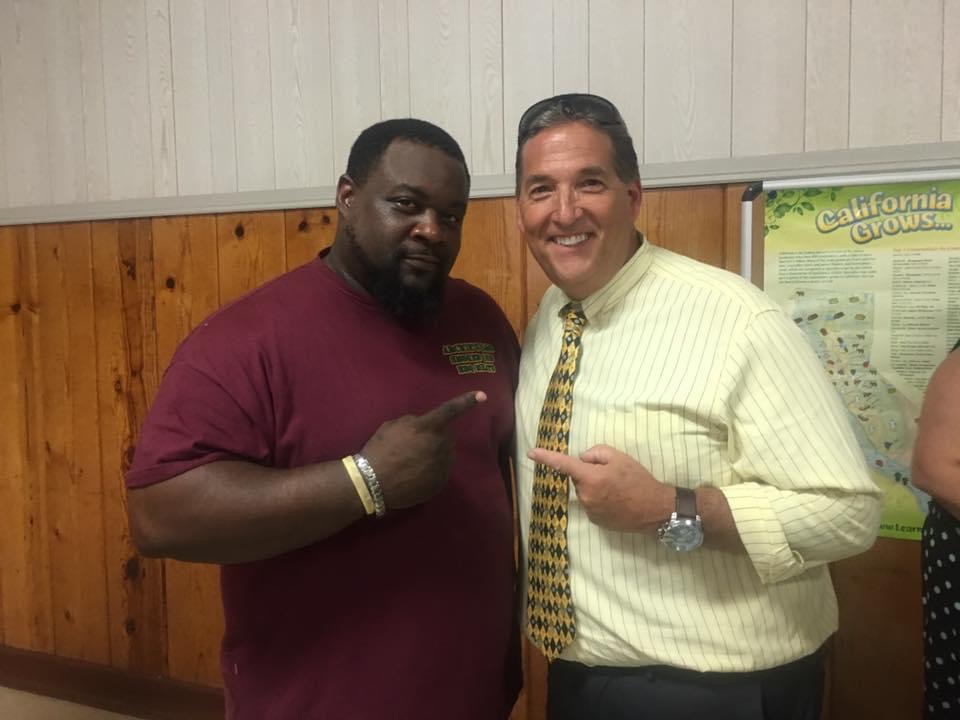
11th Assembly District Veteran of the Year Archie Smith with Assemblymember Jim Frazier. Photo courtesy of Office of Assemblymember Jim Frazier.
Has volunteered as a Chapter and Post Service Officer for DAV Chapter 21 in Vallejo, American Legion Post 161 in Antioch and VFW Post 10789 in Brentwood
SACRAMENTO – Assemblymember Jim Frazier, D-Fairfied, honored Pittsburg resident and United States Air Force Senior Airman Archie Smith (Retired) as Assembly District 11’s 2020 Veteran of the Year.
“One of the best things I get to do every year is name the 11th AD Veteran of the Year to highlight the military service and contributions of a veteran resident of our district,” Frazier said. “Archie Smith is someone who often offers aid to others before they even think to ask. He is passionate about working with veterans and civic organizations to make a difference in our community. It is my honor to recognize U.S. Air Force Senior Airmen and veteran community advocate Archie Smith as this year’s Veteran of the Year.”
Smith was deployed overseas three times during his four years of service, twice to Bahrain and once to Incirlik Air Base, Turkey, where he was awarded the Air Force Achievement Medal for managing his weapons load crew through an emergency quick-turn munitions load resulting in the destruction of 40 Iraqi Air Defense Systems and one surface-to-air missile site. Exposures to Gulf War airborne toxins and job-related orthopedic injuries caused Smith to be discharged honorably with the rank of Senior Airman.
Following his service, Smith applied for disability benefits through the Disabled American Veterans Service Organization (DAV) and was offered a job with them as a Transitional and future National Service Officer and supervisor. For the next 12 years, working out of the Oakland and Sacramento offices, Archie provided hundreds of benefit seminars and record reviews to newly discharging veterans, traveling monthly to five different military bases in Northern California. Smith has represented hundreds of veterans at personnel hearings before administrative law judges with the Department of Veterans Affairs and has conducted thousands of interviews, teaching his interpretation of claims development.
Continuing his commitment to service while living in Pittsburg, Archie retired early and began volunteering as a Chapter and Post Service Officer for DAV Chapter 21 in Vallejo, American Legion Post 161 in Antioch and VFW Post 10789 in Brentwood. He also has volunteered more than 1,000 hours counseling veterans and their families, cooking for veterans at community events, and creating his own way of veteran outreach through targeted claims development seminars.
Since April 12, 2018, Smith has held the position of Director of Veterans Services for the Veterans Health Navigation Partnership (VHNP) between La Clinica and VFW Post 10789. This alliance started for two reasons: to help bring awareness of potential health care options at La Clinica, which is closer to our community’s veteran population than the Martinez VA Hospital, and to bring businesses and organizations who support veterans and family members together several times a year to network and learn about claims development and service organization membership, as well as one-on-one personal counseling sessions.
Along with conducting private interviews, phone calls, and responding to emails from veterans across the country, Smith has also conducted three target seminars, reaching a couple hundred of our community’s veterans and their families.
For nearly the last decade along with continued veteran service, Smith has also been the proud owner of Archie’s S&Q Smoked and BBQ Meats in Pittsburg. A true community staple of BBQ and famous sides, always willing to lend a hand at veteran and community events. If you have not tried it yet, best get yourself out there to order some of the best in town.
Smith joins a growing list of veterans tapped for the Assembly District 11 Veteran of the Year honor by Frazier, including Jeff Jewell, Derek McGinnis, Janet Wilson, Mike Brimer, Steve Todd, Enrico Cinquini, Jesse Branch and Ed Parisarda.
Read More Retail stores 100 people or 50% max;

Gyms reduced to 10% capacity;
Office workspaces must operate remotely;
No changes to indoor worship, theaters from previous order
In response to evidence that COVID-19 is spreading rapidly in Contra Costa, the California Department of Public Health (CDPH) today moved the county back into the red tier of its Blueprint for a Safer Economy, restoring more safety requirements to slow the virus and save lives.
The state’s action today adds these additional requirements, effective starting Friday, Nov. 13 in Contra Costa:
- Retail stores that operate indoors must scale back their maximum occupancy to 50% or 100 people, whichever is lower.
- Indoor shopping malls must reduce their occupancy and reduce the occupancy of food courts to 25% or 100 people, whichever is fewer.
- Office workspaces must operate remotely.
- Higher education institutions must keep indoor lectures and student gatherings to 25% occupancy or 100 people, whichever is fewer.
- Gyms and fitness centers must scale back their indoor occupancies to 10%.
- Communal indoor pools must close.
- Indoor family entertainment centers, such as bowling alleys, must close their indoor operations. Amusement parks cannot operate.
- Most live outdoor theatrical, musical or artistic performances are prohibited.
The average daily number of new, confirmed COVID-19 is on the rise in Contra Costa, and across the Bay Area and the U.S. Health officials urge county residents to consider how they are protecting themselves and their families from the virus, and what they can do to make the holiday season safer.
“The most critical way to protect against COVID-19 is to wear a face covering whenever you are near people who do not live with you, and whenever you go in a building that is not your home,” said Dr. Chris Farnitano, Contra Costa Health Officer. “Face coverings help prevent people who do not know they are infected from spreading the virus to others. My mask protects you. Your mask protects me. Masks also provide some direct protection for the wearer.”
Most new COVID-19 cases in Contra Costa are spread within the home, with an infected member of a household passing the virus to people with whom they live. Face coverings in public reduce the risk of bringing COVID-19 into the home, where people usually do not mask or practice physical distancing.
Data from Contra Costa show that the average daily number of newly identified COVID-19 infections has risen steadily since the county entered the orange tier of the state’s plan on October 27.
On Tuesday, the 7-day average, per-capita number of new cases (the “adjusted case rate”) was 5.3 in Contra Costa, higher than permitted for counties in the orange tier for a second consecutive week. That triggered the county’s shift back into the more restrictive red tier, effective today.
Other data show an alarming rise in local cases. On Nov. 8, for example, there were 46 people hospitalized with COVID-19 in Contra Costa – the highest one-day total since September.
In response to the data, Contra Costa Health Services (CCHS) issued a local health order last week that restored red-tier safety restrictions for a number of businesses and activities, though the county remained in the orange tier at the time.
Those changes remain in place today, including requirements for reduced occupancy during indoor worship services and for indoor dining and movie theaters, and the closure of bars that do not serve meals with alcohol. Cardrooms are required to operate outdoors only.
The tier change does not affect the ability of schools to reopen for in-person instruction, following state and local health guidelines. Outdoor playgrounds may also remain open.
Visit cchealth.org/coronavirus for local information about COVID-19. For questions about details of state or local health orders in Contra Costa County, visit our online FAQ or call 1-844-729-8410.
Read More
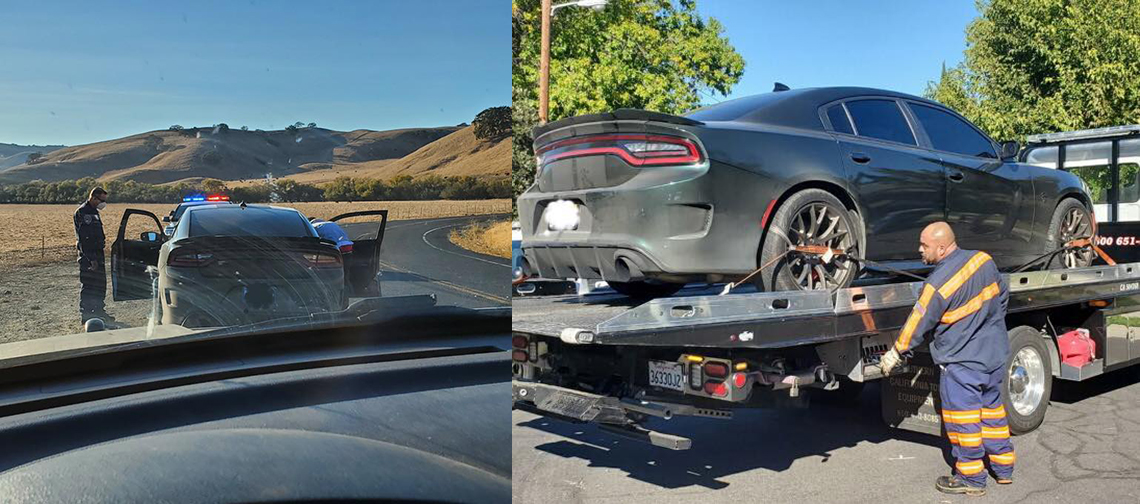
Photos by CHP – Contra Costa.
By CHP – Contra Costa
CAR JAIL
Recently this vehicle and its driver had been reported numerous times driving recklessly within Contra Costa County. We located it while the driver was in the act and filming a video for an online/social media video channel . The driver was issued a citation on scene for reckless driving. Then a warrant was later issued to impound the vehicle for 30 DAYS due to the totality of the circumstances that were discovered.
Long story short; we do respond to these types of incidents around the county, we do conduct follow up investigation, and there are repercussions for reckless driving acts. This incident was a citation and 30 impound. Now you know. #instantkarma #dontdoit #chp
Read More
By Jimmy Lee, Director of Public Affairs, Contra Costa County Office of the Sheriff

Luc Toan Chanh Ciel
Contra Costa County Sheriff-Coroner David Livingston announces that a Coroner’s Jury has reached a finding in the April 11, 2019 death of 55-year-old Luc Toan Chanh Ciel of Richmond. The finding of the jury is that the death is a suicide.
The Coroner’s Jury reached the 10-0 verdict after hearing the testimony of witnesses called by the hearing officer, Matthew Guichard.
According to a Richmond Standard news report, Ciel, who had a restraining order against him for prior domestic violence incidents, was fatally shot by Richmond Police when he was stabbing his family members and turned on them.
According to a police statement, “Officers interrupted the suspect’s physical assault on a family member, then fired when the armed suspect ignored commands and advanced on them. The suspect was later pronounced deceased on scene. Officers rescued an adult female suffering from a laceration to her stomach and a male juvenile suffering from a laceration to his face.”
A Coroner’s Inquest, which Sheriff-Coroner David Livingston convenes in fatal incidents involving police officers, is a public hearing, during which a jury rules on the manner of a person’s death. Jury members can choose from the following four options when making their finding: Accident,Suicide, Natural Causes or At the hands of another person, other than by accident.
Read More
Early election results show strong countywide support; 70,000 votes left to count in the county
 This week’s election results saw a wide majority of county voters vote in support of Measure X. As of the Friday afternoon results update on November 6, 58% of ballots counted were in favor of the measure. The 0.5% general sales tax is intended to fund services that county residents most need.
Semi-Official Results – Update #1 can be found by clicking here.
Following the latest results, County Supervisor John Gioia remarked,“Recent firestorms and health impacts from COVID-19 have underscored the need for services like firefighting, access to health care, early childhood programming and other safety net services. Measure X creates a new sustainable revenue source, which the state cannot take away, allowing us to maintain and increase these and other essential services at a time when they’re needed most.”
Measure X was grounded in the County Needs Assessment developed through a working group comprised of county nonprofits, community organizations and labor unions. The report highlighted public- and community-provided services in greatest need of funding to better serve county residents and families.
Measure X, which only required a simple majority to pass, received extensive support across the county. “I am really appreciative that we had such a broad and diverse group of support for this measure, from labor unions, to nonprofits, community and faith-based organizations, to the local business leaders,” said Josh Anijar of Contra Costa Central Labor and Co-Chair of the Working Group. “It’s not often that all of these groups come together to support a measure, but we all recognized the benefits Measure X will have for our county residents and workers.”
In a year that has left many county residents feeling insecure about meeting their most basic needs, the passage of Measure X will provide an opportunity to not only help service providers recover from the current crisis, but also address the long-term challenges they’ve faced.
“With Measure X election results moving in the right direction, a crucial next step is to establish a Measure X oversight body that holds supervisors accountable to efficiently and effectively spend the revenue as intended,” said Working Group Co-Chair and Ensuring Opportunity Senior Director Mariana Moore. “We look forward to providing community feedback to the board once the ballots are certified.”
Healthy and Safe Contra Costa, Yes on Measure X will generate an estimated $81 million annually to fund services most essential to Contra Costa County’s needs.
According to County Elections Office staff there are currently 70,000 ballots remaining to be counted, including 65,000 vote-by-mail ballots and 5,000 provisionals. The next update will be provided on Friday, November 13th at 5:00 p.m.
Read More
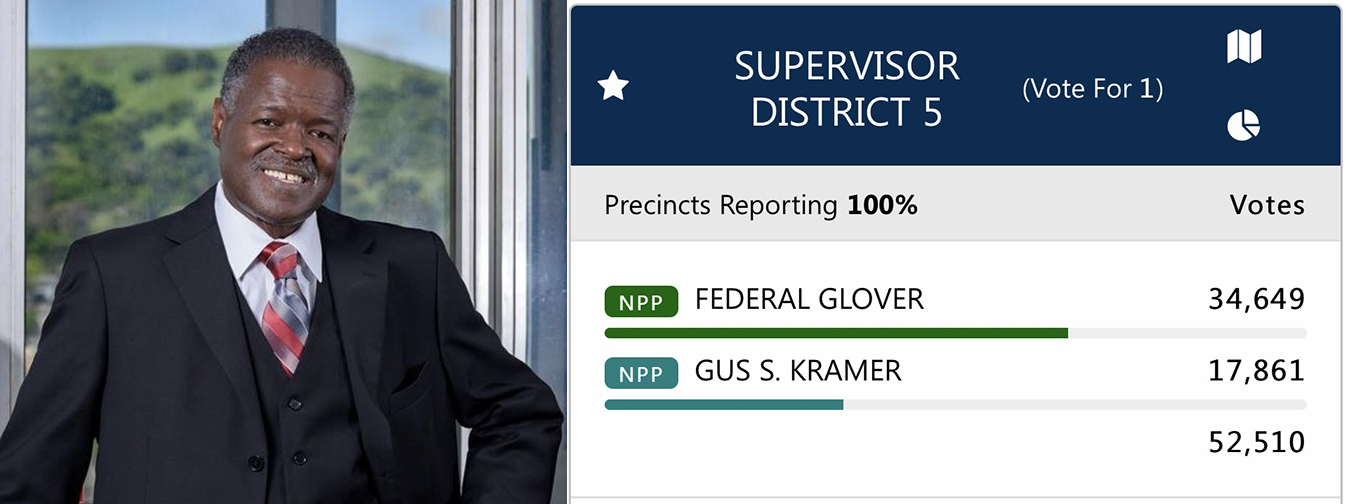
Supervisor Federal Glover won re-election to a sixth term in District 5. Unofficial results as of Tuesday, Nov. 3, 2020 at 11:44 pm. Screenshot from CoCoVote.us.
Sandoval beating Enholm in college board Ward 5 seat; incumbent Gordon trailing former community college president Walters in Ward 2 seat;
Avila Farias leading incumbent in county Board of Education Area 3 race; incumbent Alleynne won’t claim victory yet in close race for Area 1
By Daniel Borsuk
Five-term Contra Costa County Board of Supervisors member Federal Glover won a sixth term of office on Tuesday, trouncing Contra Costa County Assessor Gus Kramer by almost two-to-one with 34,649 votes to 17,861 votes for Kramer, according to the latest update from the Contra Costa Elections Division.
Glover told the Herald: “I want to thank the people for this opportunity to serve. I have to recognize the hard work that the people on the ground put into my campaign. I want to thank the people for their support for me over the years.”
Glover said he will work to provide the resources to “keep people safe from COVID-19.”
Over the upcoming four years Glover, a retired Dow Chemical worker who had served five years on the Pittsburg city council before starting his Board of Supervisors career, said he envisions the rollout of the Northern Waterfront Plan that will help ignite economic development along the county’s waterfront from Pinole to Oakley.
The supervisor said the recent announcement that Amazon will operate a 150,000 square foot operation at the Contra Costa Logistics Center in Oakley is a prime example of what the waterfront plan aims to create. The Amazon Fulfillment Center will create more than 2,000 jobs.
Kramer, who is currently involved in a Superior Court case for “willful or corrupt misconduct for making unwelcome sexual comments to people in his office” told the Contra Costa Herald about his election defeat. “I wish Federal well. I thought that the citizens of Contra Costa County deserved a choice and that I made that choice for them.”
The runoff election pitting Glover and Kramer was called when neither candidate mustered more than 50 percent of the vote in the March election when a third candidate, Martinez businessman and Planning Commissioner Sean Trambley also ran, splitting the vote.
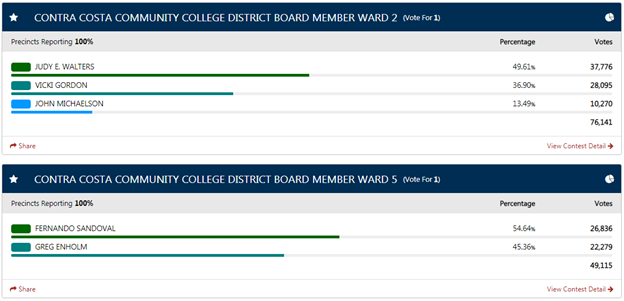
Unofficial election results for Community College Board Wards 2 and 5 as of Tues., Nov. 3, 2020 at 11:44 pm. From CoCoVote.us.
Sandoval Beating Enholm for Community College Board Seat Ward 5
In another election race, Fernando Sandoval in his second attempt is defeating two-term Contra Costa Community College District Board Ward 5 Commissioner Greg Enholm drawing 26,836 of the votes to 22,279 votes for Enholm. Ward 5 includes Pittsburg, Oakley, and portions of Antioch, Brentwood, Byron, and Discovery Bay.
Sandoval, who campaigned for educational excellence and fiscal accountability, defeated the retired college professor Enholm. Sandoval said in a statement, “I’d like to acknowledge Greg Enholm for his service to the District. I am grateful to all the voters and my supporters for helping me to achieve this victory! I am excited to turn my policy platform of education equity, fiscal transparency, expansion of innovative online learning approaches and strengthening private/public partnerships into action. I plan to hold myself accountable to further these goals and to bring ‘Community’ back into the Community College District. Our students, faculty, staff and residents deserve this type of leadership and I look forward to working with my fellow trustees to take our district to the next level of excellence.”
An enthusiastic Sandoval told the Herald he was happy with the results and thinks the gap in votes will be too much for Enholm to overtake him.
UPDATE: When reached for comment Enholm responded, “It is very clear to me that voters are expressing their frustration and even anger about colleges and schools not having in-person classes for students. Both College Board incumbents, both County Board of Education incumbents, and many school district (K-5, K-12, and high school) incumbents could lose when the final vote totals are released. None of us incumbents caused the pandemic and we all made difficult decisions to assure safety of our students, staffs, and visitors by minimizing the risk of illness or death from the coronavirus. The voters have the right to remove incumbents from office for any reasons they choose.”
Walters Beating Gordon for College Board Ward 2 Seat
Career community college professional Judy Walters of Martinez, won the Ward 5 seat to the Contra Costa Community College District, with 37,776 votes or 49.6 percent of the total votes cast for the seat held by incumbent Vicki Gordon of Martinez who has been on the College Board since 2012. She garnered 28,095 votes or 36.9%, so far. John Michaelson also ran, collecting 10,270 votes for third place.
UPDATE: When reached for comment Walters responded Thursday night Nov. 5, “I am honored by the trust voters have placed in me to be their representative on the Contra Costa Community College Board. As promised, I will lead with integrity and use my experience to ensure the educational excellence of our colleges while keeping student success at the core of my decision-making.”
Ward 2 encompasses Lafayette, Orinda, Walnut Creek, Martinez, Rodeo, Crockett, and parts of Alamo and Pleasant Hill.

Unofficial election results for county Board of Education Areas 1 and 3 as of Tues., Nov. 3, 2020 at 11:44 pm. From CoCoVote.us.
County Board of Education Area 1 Race Too Close to Call
In the tight race for the Contra Costa County Board of Education Area 1 seat, incumbent Dr. Fatima Alleynne, had a narrow lead over challenger retired West Contra Costa Unified School District teacher Consuelo Lara, collecting 26,024 votes versus 25,586. “I do not feel comfortable claiming victory, as of yet,” she wrote in an email sent to the Herald. “Given the number of uncounted votes and how close the race is…I would prefer to wait for the process to conclude.”
The CCC Board of Education Area 1 includes El Cerrito, El Sobrante, Kensington, San Pablo, and parts of Pinole and Richmond.
Farias Leading Incumbent Chavez for County Board of Education Area 3 Seat
In another County Board of Education race, AnaMarie Avila Farias was leading with 30,257 votes or 52.9 percent of the votes over incumbent Vicki Chavez with 26,871 votes for the Area 3 seat. The Area 3 trustee represents Pacheco and parts of Clayton, Concord, Martinez, Pittsburg, Pleasant Hill, and Walnut Creek. The former Martinez councilwoman, Farias had previously run unsuccessfully for Supervisor against Federal Glover in 2016.
Next Election Results Update Friday at 5:00 PM
The Contra Costa Elections Division is continuing to count the ballots that arrived by yesterday and will continue to arrive for as long as 17 more days including today. They have 28 days to finish the count and certify the election. So, final results may be as much as four weeks away. The next update of results is expected this Friday at 5:00 p.m.
Read More

By Brentwood Police Department
It was the call that every officer dreads to hear…
On September 20, 2020, at around 2:54 AM, Brentwood officers responded to a residence in the 50 block of Havenwood Ave. to investigate a report of an unresponsive 2 year-old child, later identified as Jasani Kerry. His mother, 22-year-old Genesis Barrera-Galdamez, had found him unresponsive and telephoned emergency personnel.
When officers and emergency personnel arrived on scene, they performed CPR for several minutes, however, Jasani was ultimately declared deceased. The preliminary investigation revealed drug paraphernalia and illicit drugs that later tested positive for fentanyl in the presence of Jasani preceding his death. Weeks later, a Contra Costa County Coroner’s pathologist determined Jasani’s cause of death was due to acute fentanyl intoxication.
Following an extensive follow-up investigation, Brentwood investigators prepared an arrest warrant for Genesis charging her with murder.
On October 30, 2020 at around 3:30 PM, investigators located Genesis at the Comfort Inn Hotel located at 2436 Mahogany Way in Antioch and took her into custody without incident. Genesis was booked at the Martinez Detention Facility on the outstanding arrest warrant.
Yesterday the Contra Costa County District Attorney’s Office formally charged Genesis with second-degree murder, possession of narcotics for sale, and child abuse resulting in death. Genesis is being held on $1.1 million dollar bail.
Our deepest condolences go out to the family and friends who have been affected by this tragedy. The loss of any child is difficult for anyone to bear; we hope the arrest in this case can bring some peace to those affected.
Rest in peace Jasani.
Arraignment Scheduled For November 18
Contra Costa District Attorney’s Office Public Information Officer Scott Alonso issued the following about the case Thursday morning:
Earlier this week, the Contra Costa County District Attorney’s Office filed murder charges against Genesis Barrera-Galdamez (22-year-old resident of Brentwood) for the death of her two-year-old son, Jasani Kerry, Jr. Barrera-Galdamez was also charged with felony child abuse and felony possession of Fentanyl to sell. Two enhancements were also filed tied to the child abuse charge against the defendant: willful harm causing injury and great bodily injury resulting in brain damage and paralysis. The young child consumed fentanyl under the care of Barrera-Galdamez. The child’s autopsy report later ruled the toddler’s death was caused by Acute Fentanyl Toxicity.
Brentwood Police Department investigated the case and presented it to our Office for filing. Homicide Unit Supervisor Derek Butts reviewed the investigation and filed the charges listed above.
“While the Defendant did not intend that her son Jasani die, the evidence shows that she was aware her Fentanyl possession and use was dangerous to human life and despite this knowledge, exposed Jasani to the danger which ultimately led to his death, stated Deputy District Attorney Butts. “Well known amongst abusers, Fentanyl is an exceptionally toxic and dangerous substance. The act of exposing people to or supplying others with Fentanyl, if death results, can lead to murder charges.”
In the early morning hours of September 20, the defendant called police and stated her son was not breathing and non-responsive. She told the police that her son appeared blue and his body was very cold. CPR performed at the scene by Brentwood Police Officers and continued by American Medical Response personnel for over 30 minutes did not revive the boy. Officers at the scene located multiple items of drug paraphernalia on and around the bed the Defendant shared with Jasani, including 13 grams of powdered Fentanyl, baggies and tin foil pieces containing Fentanyl residue and a torch lighter.
After Jasani’s death, Barrera-Galdamez attempted to sell Fentanyl to multiple parties. Brentwood Police Department officers obtained a warrant for the arrest of the defendant on October 29th. The following day, Barrera-Galdamez was arrested at the Comfort Inn in Antioch, where she was engaging in Fentanyl sales.
Barrera-Galdamez made her first appearance in court yesterday and she remains in custody with bail set at $1,100,000. Her arraignment on the charges was set for November 18th.
Case information: People v. Genesis Barrera-Galdamez, Docket Number 04-200626-0.
Read More
 With data from the past week showing a marked increase in COVID-19 cases and hospitalizations in Contra Costa County, health officials are taking steps to protect the community with modest changes to local health orders.
Contra Costa entered the orange tier of California’s Blueprint for a Safer Economy on Oct. 27, triggering an expansion of community reopening activities in the county. But since that date, the average daily number of new cases in the county has grown substantially higher.
If the trend continues, the county is at risk of moving backward into the more-restrictive red tier of the state’s reopening plan as soon as next week. In the meantime, Contra Costa has amended its health orders to rein in some of the riskier indoor activities permitted under the orange tier in hopes of preventing outbreaks and keeping the county out of the red.
Contra Costa County’s health officer issued new orders today limiting the number of spectators allowed at professional and collegiate sporting events, while also reimposing restrictions on other high-risk activities.
The health order on sporting events limits the number of spectators at pro or college games to 25 people from no more than three different households. This is consistent with the County’s guidance on private social gatherings, said Dr. Chris Farnitano, the County’s health officer.
The health officer also issued another order restoring stricter limitations on high-risk activities, such as prolonged indoor gatherings and gatherings involving eating and drinking where masks must be removed. Wearing face coverings when around others from outside your household is one of the most effective ways people can stop the spread of COVID, Dr. Farnitano said.
Under the new order, select high-risk activities must be modified:
- Outdoor bars prohibited (except where allowed under restaurant guidance with drinks as part of a meal)
- Indoor dining allowed at a maximum of 25% occupancy or 100 people, whichever is fewer (down from 50% occupancy and 200 people)
- Indoor movie theaters can operate at a maximum 25% of occupancy or 100 people, whichever is fewer (down from 50% occupancy or 200 people)
- Religious services indoors allowed at a maximum 25% occupancy or 100 people, whichever is fewer (down from 50% occupancy or 200 people)
- Cardrooms and satellite wagering sites can’t operate indoors (they previously could operate indoors at 25% capacity)
“We believe these measures are necessary to reduce the spread of COVID in our community,” Dr. Farnitano said.
The state allows counties to impose stricter standards so local health departments can respond to circumstances in their communities. The order in Contra Costa will go into effect Friday, Nov. 6. Over the past months, the Bay Area counties have made the decisions they’ve felt best around opening or not opening businesses and activities. San Francisco pulled back on their timeline for opening last week. Alameda and Santa Clara have all taken a slower pace than the state tier system allows. All three of these counties are essentially operating at red tier level restrictions even though they are in orange or yellow tiers.
Contra Costa County is still in the orange tier, but case rates are increasing again into the more restrictive red-tier level. The most recent data show an adjusted rate of 4.9 daily cases per 100,000 people in Contra Costa – above the orange-tier benchmark of fewer than 4 per 100,000 people.
If those numbers hold for another week or increase, Contra Costa will move back into the more restrictive red tier.
In addition, there were 40 people hospitalized on Nov. 2 due to COVID in local hospitals, compared to a low point of 17 in mid-October.
For now, other activities not cited in the new order will still be allowed under orange-tier criteria, including indoor swimming pools and indoor family entertainment centers can continue “naturally distanced” activities, such as bowling alleys, escape rooms and climbing-wall gyms, at 25% occupancy.
For more information, visit cchealth.org/coronavirus.
Read More











“Racism exists in our county and in our county department” – Supervisor Federal Glover
“Racism is a public health crisis” – Contra Costa Health Department Director Anna Roth
County COVID-19 ranking lowered to Red Tier as health officials warn about holiday season upsurge
By Daniel Borsuk
The Contra Costa County Board of Supervisors on Tuesday, Nov. 10, 2020 unanimously passed a proposal to create a county funded Office of Racial Equity and Social Justice to address increasing concerns about rising issues of racial inequality and social injustice especially in how the county delivers health services to people of color.
The nonprofit San Francisco Foundation will provide the biggest donation of $75,000 to help launch the formation of the new office. Other organizations providing funding are the Contra Costa Regional Health Foundation, $20,000; East Bay Community Foundation, $10,000; John Muir Community Benefits, $10,000; Dean and Margaret Lesher Foundation, $25,000; Public Health Advocates, $25,000; Republic Services, $25,000; Richmond Community Foundation, $5,000: The California Endowment, $25,000 and Y&H Soda Foundation, $25,000.
Before supervisors voted to start the planning process to potentially launch a county Office of Racial Equity and Social Justice, supervisors had unanimously approved a resolution Declaring Racism as a Public Health Crisis. Some of the resolution’s 12 clauses were:
“WHEREAS, disproportionately higher rates of chronic disease, shorter life expectancy, maternal and infant mortality, and health inequities for Black/African Americans and other racial groups are widely recognized and documented, yet continue in particular as well as other communities of color; and
“WHEREAS the COVID-19 pandemic has exacerbated racial and social inequities by disproportionately impacting the Latinx community as well as other communities of color; and
“WHEREAS Contra Costa Health Services cares for and improves the health of all people in Contra Costa County, and yet as a system has perpetuated racism and anti-black racism; and
“WHEREAS the Contra Costa Health Services cares for and improves the health of all people in Contra Costa County, and yet as a system has perpetuated racism and anti-black racism.”
If Contra Costa County moves ahead in to create in the 2021-2022 fiscal year an Office of Racial Equity and Social Justice, the county will join San Francisco and Oakland that had both established similar offices in 2019.
“Racism exists in our county and in our county department,” said Supervisor Federal Glover of Pittsburg, who along with Gioia pushed for the formation of the new county office.
“I have always attacked the health disparities, particularly when it impacts our low income communities,” said the supervisor who was reelected last week to a seventh four-year term in a runoff election last week against Contra Costa County Assessor Gus Kramer.
“Racism is a public health crisis,” concurred Contra Costa Health Department Director Anna Roth. Roth said there exist ethnic-economic-racial-social inequities in health care throughout Contra Costa County.
“This is a major issue no matter if it is intentional or unintentional,” said District 1 Supervisor John Gioia of Richmond. “We have seen it all in our own county.”
“I support the eventuality of a Contra Costa County Office of Racial Equity,” said Supervisor Karen Mitchoff of Pleasant Hill, who at one point disputed with Gioia over how to fund the operation of the proposed new office if it reaches that point by next May. Both supervisors agreed to not bring up the funding issue until May when supervisors will review the 2021—2022 budget.
County Returns to COVID-19 Red Tier With More Restrictions
The 2020 holiday season is around the corner and Contra Costa County Public Health officials are sparing no time in ramping up efforts to advise residents to wear face coverings, maintain social distances, use disposable dining ware and stay outdoors instead of indoors during the upcoming Thanksgiving holiday, Contra Costa County Board of Supervisors were informed Tuesday. County health officials announced the public safety measure as the county’s COVID-19 tier ranking was lowered Tuesday from purple tier to red tier.
County health officials saw a 200 percent boost in the number of COVID-19 cases during the past two weeks, Contra Costa Health Department Director Anna Roth said. Even with news on Monday that Pfizer Inc. has developed a vaccine that has notched a 90 percent safety record, Roth said the county reported an increase in COVID-19 cases over the past two weeks, 20,166 cases and 46 deaths.
“With the holiday season approaching, we recommend, keep it small, keep it outside with no more than 13 persons and lasting no more than three hours,” Roth said. In addition, Roth said persons should wash hands and faces frequently, remain outside as much as possible, wear face coverings, and maintain six-feet separations.
Roth reported that a county sponsored COVID-19 test event held in San Pablo on Saturday, Nov. 7 was a success because 673 persons were tested. Eighty-five percent of the test takers were first-time participants. A majority of those participating in the free tests were residents of Latinx descent.
Count health officer Dr. Chris Farnitano said the county is prepared to store the Pfizer vaccine that has been reported to be 90 percent effective but requires extreme cold refrigeration. “The county has purchased the ultra-cold storage capability to story up to 70,000 doses,” Dr. Farnitano informed supervisors. The storage unit can keep the vaccine cold at 70 degrees below zero.
Read More
Shaun Wilson, Proshop staff (left), Callaway driver winner and veteran Al Bella (center) and Rex Choe, COO, Brentwood Golf Club, also a veteran. Photo: Brentwood Golf Club.
Give away Callaway Epic Driver to veteran golfer with lowest score
On November 11, the Bentwood Golf Club gave more than 30 veterans a round of free golf to thank them for their service. Rex Choe, Chief Operating Officer and an Air Force veteran and sergeant, said “I wanted to do something special for the men and women who sacrifice so much for our country.”
The thirty veteran golfers also competed for a Callaway Epic Driver valued at $499. The winner, Al Bella of Brentwood, also an Air Force veteran and sergeant, won the the driver with a score of 65.5 (including his 11.5 handicap). Bella thanked the golf course for the recognition and was “happy to win the fabulous prize.”
Choe, who has been has at the golf course for a year, said “The community has supported us, and we want to give back whenever we can. I can think of no better way than to support our veterans.”
Read More
11th Assembly District Veteran of the Year Archie Smith with Assemblymember Jim Frazier. Photo courtesy of Office of Assemblymember Jim Frazier.
Has volunteered as a Chapter and Post Service Officer for DAV Chapter 21 in Vallejo, American Legion Post 161 in Antioch and VFW Post 10789 in Brentwood
SACRAMENTO – Assemblymember Jim Frazier, D-Fairfied, honored Pittsburg resident and United States Air Force Senior Airman Archie Smith (Retired) as Assembly District 11’s 2020 Veteran of the Year.
“One of the best things I get to do every year is name the 11th AD Veteran of the Year to highlight the military service and contributions of a veteran resident of our district,” Frazier said. “Archie Smith is someone who often offers aid to others before they even think to ask. He is passionate about working with veterans and civic organizations to make a difference in our community. It is my honor to recognize U.S. Air Force Senior Airmen and veteran community advocate Archie Smith as this year’s Veteran of the Year.”
Smith was deployed overseas three times during his four years of service, twice to Bahrain and once to Incirlik Air Base, Turkey, where he was awarded the Air Force Achievement Medal for managing his weapons load crew through an emergency quick-turn munitions load resulting in the destruction of 40 Iraqi Air Defense Systems and one surface-to-air missile site. Exposures to Gulf War airborne toxins and job-related orthopedic injuries caused Smith to be discharged honorably with the rank of Senior Airman.
Following his service, Smith applied for disability benefits through the Disabled American Veterans Service Organization (DAV) and was offered a job with them as a Transitional and future National Service Officer and supervisor. For the next 12 years, working out of the Oakland and Sacramento offices, Archie provided hundreds of benefit seminars and record reviews to newly discharging veterans, traveling monthly to five different military bases in Northern California. Smith has represented hundreds of veterans at personnel hearings before administrative law judges with the Department of Veterans Affairs and has conducted thousands of interviews, teaching his interpretation of claims development.
Continuing his commitment to service while living in Pittsburg, Archie retired early and began volunteering as a Chapter and Post Service Officer for DAV Chapter 21 in Vallejo, American Legion Post 161 in Antioch and VFW Post 10789 in Brentwood. He also has volunteered more than 1,000 hours counseling veterans and their families, cooking for veterans at community events, and creating his own way of veteran outreach through targeted claims development seminars.
Since April 12, 2018, Smith has held the position of Director of Veterans Services for the Veterans Health Navigation Partnership (VHNP) between La Clinica and VFW Post 10789. This alliance started for two reasons: to help bring awareness of potential health care options at La Clinica, which is closer to our community’s veteran population than the Martinez VA Hospital, and to bring businesses and organizations who support veterans and family members together several times a year to network and learn about claims development and service organization membership, as well as one-on-one personal counseling sessions.
Along with conducting private interviews, phone calls, and responding to emails from veterans across the country, Smith has also conducted three target seminars, reaching a couple hundred of our community’s veterans and their families.
For nearly the last decade along with continued veteran service, Smith has also been the proud owner of Archie’s S&Q Smoked and BBQ Meats in Pittsburg. A true community staple of BBQ and famous sides, always willing to lend a hand at veteran and community events. If you have not tried it yet, best get yourself out there to order some of the best in town.
Smith joins a growing list of veterans tapped for the Assembly District 11 Veteran of the Year honor by Frazier, including Jeff Jewell, Derek McGinnis, Janet Wilson, Mike Brimer, Steve Todd, Enrico Cinquini, Jesse Branch and Ed Parisarda.
Read MoreRetail stores 100 people or 50% max;
Gyms reduced to 10% capacity;
Office workspaces must operate remotely;
No changes to indoor worship, theaters from previous order
In response to evidence that COVID-19 is spreading rapidly in Contra Costa, the California Department of Public Health (CDPH) today moved the county back into the red tier of its Blueprint for a Safer Economy, restoring more safety requirements to slow the virus and save lives.
The state’s action today adds these additional requirements, effective starting Friday, Nov. 13 in Contra Costa:
- Retail stores that operate indoors must scale back their maximum occupancy to 50% or 100 people, whichever is lower.
- Indoor shopping malls must reduce their occupancy and reduce the occupancy of food courts to 25% or 100 people, whichever is fewer.
- Office workspaces must operate remotely.
- Higher education institutions must keep indoor lectures and student gatherings to 25% occupancy or 100 people, whichever is fewer.
- Gyms and fitness centers must scale back their indoor occupancies to 10%.
- Communal indoor pools must close.
- Indoor family entertainment centers, such as bowling alleys, must close their indoor operations. Amusement parks cannot operate.
- Most live outdoor theatrical, musical or artistic performances are prohibited.
The average daily number of new, confirmed COVID-19 is on the rise in Contra Costa, and across the Bay Area and the U.S. Health officials urge county residents to consider how they are protecting themselves and their families from the virus, and what they can do to make the holiday season safer.
“The most critical way to protect against COVID-19 is to wear a face covering whenever you are near people who do not live with you, and whenever you go in a building that is not your home,” said Dr. Chris Farnitano, Contra Costa Health Officer. “Face coverings help prevent people who do not know they are infected from spreading the virus to others. My mask protects you. Your mask protects me. Masks also provide some direct protection for the wearer.”
Most new COVID-19 cases in Contra Costa are spread within the home, with an infected member of a household passing the virus to people with whom they live. Face coverings in public reduce the risk of bringing COVID-19 into the home, where people usually do not mask or practice physical distancing.
Data from Contra Costa show that the average daily number of newly identified COVID-19 infections has risen steadily since the county entered the orange tier of the state’s plan on October 27.
On Tuesday, the 7-day average, per-capita number of new cases (the “adjusted case rate”) was 5.3 in Contra Costa, higher than permitted for counties in the orange tier for a second consecutive week. That triggered the county’s shift back into the more restrictive red tier, effective today.
Other data show an alarming rise in local cases. On Nov. 8, for example, there were 46 people hospitalized with COVID-19 in Contra Costa – the highest one-day total since September.
In response to the data, Contra Costa Health Services (CCHS) issued a local health order last week that restored red-tier safety restrictions for a number of businesses and activities, though the county remained in the orange tier at the time.
Those changes remain in place today, including requirements for reduced occupancy during indoor worship services and for indoor dining and movie theaters, and the closure of bars that do not serve meals with alcohol. Cardrooms are required to operate outdoors only.
The tier change does not affect the ability of schools to reopen for in-person instruction, following state and local health guidelines. Outdoor playgrounds may also remain open.
Visit cchealth.org/coronavirus for local information about COVID-19. For questions about details of state or local health orders in Contra Costa County, visit our online FAQ or call 1-844-729-8410.
Read More
Photos by CHP – Contra Costa.
By CHP – Contra Costa
CAR JAIL
Recently this vehicle and its driver had been reported numerous times driving recklessly within Contra Costa County. We located it while the driver was in the act and filming a video for an online/social media video channel . The driver was issued a citation on scene for reckless driving. Then a warrant was later issued to impound the vehicle for 30 DAYS due to the totality of the circumstances that were discovered.
Long story short; we do respond to these types of incidents around the county, we do conduct follow up investigation, and there are repercussions for reckless driving acts. This incident was a citation and 30 impound. Now you know. #instantkarma #dontdoit #chp
Read More
By Jimmy Lee, Director of Public Affairs, Contra Costa County Office of the Sheriff
Luc Toan Chanh Ciel
Contra Costa County Sheriff-Coroner David Livingston announces that a Coroner’s Jury has reached a finding in the April 11, 2019 death of 55-year-old Luc Toan Chanh Ciel of Richmond. The finding of the jury is that the death is a suicide.
The Coroner’s Jury reached the 10-0 verdict after hearing the testimony of witnesses called by the hearing officer, Matthew Guichard.
According to a Richmond Standard news report, Ciel, who had a restraining order against him for prior domestic violence incidents, was fatally shot by Richmond Police when he was stabbing his family members and turned on them.
According to a police statement, “Officers interrupted the suspect’s physical assault on a family member, then fired when the armed suspect ignored commands and advanced on them. The suspect was later pronounced deceased on scene. Officers rescued an adult female suffering from a laceration to her stomach and a male juvenile suffering from a laceration to his face.”
A Coroner’s Inquest, which Sheriff-Coroner David Livingston convenes in fatal incidents involving police officers, is a public hearing, during which a jury rules on the manner of a person’s death. Jury members can choose from the following four options when making their finding: Accident,Suicide, Natural Causes or At the hands of another person, other than by accident.
Read More
Early election results show strong countywide support; 70,000 votes left to count in the county
This week’s election results saw a wide majority of county voters vote in support of Measure X. As of the Friday afternoon results update on November 6, 58% of ballots counted were in favor of the measure. The 0.5% general sales tax is intended to fund services that county residents most need.
Semi-Official Results – Update #1 can be found by clicking here.
Following the latest results, County Supervisor John Gioia remarked,“Recent firestorms and health impacts from COVID-19 have underscored the need for services like firefighting, access to health care, early childhood programming and other safety net services. Measure X creates a new sustainable revenue source, which the state cannot take away, allowing us to maintain and increase these and other essential services at a time when they’re needed most.”
Measure X was grounded in the County Needs Assessment developed through a working group comprised of county nonprofits, community organizations and labor unions. The report highlighted public- and community-provided services in greatest need of funding to better serve county residents and families.
Measure X, which only required a simple majority to pass, received extensive support across the county. “I am really appreciative that we had such a broad and diverse group of support for this measure, from labor unions, to nonprofits, community and faith-based organizations, to the local business leaders,” said Josh Anijar of Contra Costa Central Labor and Co-Chair of the Working Group. “It’s not often that all of these groups come together to support a measure, but we all recognized the benefits Measure X will have for our county residents and workers.”
In a year that has left many county residents feeling insecure about meeting their most basic needs, the passage of Measure X will provide an opportunity to not only help service providers recover from the current crisis, but also address the long-term challenges they’ve faced.
“With Measure X election results moving in the right direction, a crucial next step is to establish a Measure X oversight body that holds supervisors accountable to efficiently and effectively spend the revenue as intended,” said Working Group Co-Chair and Ensuring Opportunity Senior Director Mariana Moore. “We look forward to providing community feedback to the board once the ballots are certified.”
Healthy and Safe Contra Costa, Yes on Measure X will generate an estimated $81 million annually to fund services most essential to Contra Costa County’s needs.
According to County Elections Office staff there are currently 70,000 ballots remaining to be counted, including 65,000 vote-by-mail ballots and 5,000 provisionals. The next update will be provided on Friday, November 13th at 5:00 p.m.
Read More
Supervisor Federal Glover won re-election to a sixth term in District 5. Unofficial results as of Tuesday, Nov. 3, 2020 at 11:44 pm. Screenshot from CoCoVote.us.
Sandoval beating Enholm in college board Ward 5 seat; incumbent Gordon trailing former community college president Walters in Ward 2 seat;
Avila Farias leading incumbent in county Board of Education Area 3 race; incumbent Alleynne won’t claim victory yet in close race for Area 1
By Daniel Borsuk
Five-term Contra Costa County Board of Supervisors member Federal Glover won a sixth term of office on Tuesday, trouncing Contra Costa County Assessor Gus Kramer by almost two-to-one with 34,649 votes to 17,861 votes for Kramer, according to the latest update from the Contra Costa Elections Division.
Glover told the Herald: “I want to thank the people for this opportunity to serve. I have to recognize the hard work that the people on the ground put into my campaign. I want to thank the people for their support for me over the years.”
Glover said he will work to provide the resources to “keep people safe from COVID-19.”
Over the upcoming four years Glover, a retired Dow Chemical worker who had served five years on the Pittsburg city council before starting his Board of Supervisors career, said he envisions the rollout of the Northern Waterfront Plan that will help ignite economic development along the county’s waterfront from Pinole to Oakley.
The supervisor said the recent announcement that Amazon will operate a 150,000 square foot operation at the Contra Costa Logistics Center in Oakley is a prime example of what the waterfront plan aims to create. The Amazon Fulfillment Center will create more than 2,000 jobs.
Kramer, who is currently involved in a Superior Court case for “willful or corrupt misconduct for making unwelcome sexual comments to people in his office” told the Contra Costa Herald about his election defeat. “I wish Federal well. I thought that the citizens of Contra Costa County deserved a choice and that I made that choice for them.”
The runoff election pitting Glover and Kramer was called when neither candidate mustered more than 50 percent of the vote in the March election when a third candidate, Martinez businessman and Planning Commissioner Sean Trambley also ran, splitting the vote.
Unofficial election results for Community College Board Wards 2 and 5 as of Tues., Nov. 3, 2020 at 11:44 pm. From CoCoVote.us.
Sandoval Beating Enholm for Community College Board Seat Ward 5
In another election race, Fernando Sandoval in his second attempt is defeating two-term Contra Costa Community College District Board Ward 5 Commissioner Greg Enholm drawing 26,836 of the votes to 22,279 votes for Enholm. Ward 5 includes Pittsburg, Oakley, and portions of Antioch, Brentwood, Byron, and Discovery Bay.
Sandoval, who campaigned for educational excellence and fiscal accountability, defeated the retired college professor Enholm. Sandoval said in a statement, “I’d like to acknowledge Greg Enholm for his service to the District. I am grateful to all the voters and my supporters for helping me to achieve this victory! I am excited to turn my policy platform of education equity, fiscal transparency, expansion of innovative online learning approaches and strengthening private/public partnerships into action. I plan to hold myself accountable to further these goals and to bring ‘Community’ back into the Community College District. Our students, faculty, staff and residents deserve this type of leadership and I look forward to working with my fellow trustees to take our district to the next level of excellence.”
An enthusiastic Sandoval told the Herald he was happy with the results and thinks the gap in votes will be too much for Enholm to overtake him.
UPDATE: When reached for comment Enholm responded, “It is very clear to me that voters are expressing their frustration and even anger about colleges and schools not having in-person classes for students. Both College Board incumbents, both County Board of Education incumbents, and many school district (K-5, K-12, and high school) incumbents could lose when the final vote totals are released. None of us incumbents caused the pandemic and we all made difficult decisions to assure safety of our students, staffs, and visitors by minimizing the risk of illness or death from the coronavirus. The voters have the right to remove incumbents from office for any reasons they choose.”
Walters Beating Gordon for College Board Ward 2 Seat
Career community college professional Judy Walters of Martinez, won the Ward 5 seat to the Contra Costa Community College District, with 37,776 votes or 49.6 percent of the total votes cast for the seat held by incumbent Vicki Gordon of Martinez who has been on the College Board since 2012. She garnered 28,095 votes or 36.9%, so far. John Michaelson also ran, collecting 10,270 votes for third place.
UPDATE: When reached for comment Walters responded Thursday night Nov. 5, “I am honored by the trust voters have placed in me to be their representative on the Contra Costa Community College Board. As promised, I will lead with integrity and use my experience to ensure the educational excellence of our colleges while keeping student success at the core of my decision-making.”
Ward 2 encompasses Lafayette, Orinda, Walnut Creek, Martinez, Rodeo, Crockett, and parts of Alamo and Pleasant Hill.
Unofficial election results for county Board of Education Areas 1 and 3 as of Tues., Nov. 3, 2020 at 11:44 pm. From CoCoVote.us.
County Board of Education Area 1 Race Too Close to Call
In the tight race for the Contra Costa County Board of Education Area 1 seat, incumbent Dr. Fatima Alleynne, had a narrow lead over challenger retired West Contra Costa Unified School District teacher Consuelo Lara, collecting 26,024 votes versus 25,586. “I do not feel comfortable claiming victory, as of yet,” she wrote in an email sent to the Herald. “Given the number of uncounted votes and how close the race is…I would prefer to wait for the process to conclude.”
The CCC Board of Education Area 1 includes El Cerrito, El Sobrante, Kensington, San Pablo, and parts of Pinole and Richmond.
Farias Leading Incumbent Chavez for County Board of Education Area 3 Seat
In another County Board of Education race, AnaMarie Avila Farias was leading with 30,257 votes or 52.9 percent of the votes over incumbent Vicki Chavez with 26,871 votes for the Area 3 seat. The Area 3 trustee represents Pacheco and parts of Clayton, Concord, Martinez, Pittsburg, Pleasant Hill, and Walnut Creek. The former Martinez councilwoman, Farias had previously run unsuccessfully for Supervisor against Federal Glover in 2016.
Next Election Results Update Friday at 5:00 PM
The Contra Costa Elections Division is continuing to count the ballots that arrived by yesterday and will continue to arrive for as long as 17 more days including today. They have 28 days to finish the count and certify the election. So, final results may be as much as four weeks away. The next update of results is expected this Friday at 5:00 p.m.
Read More
By Brentwood Police Department
It was the call that every officer dreads to hear…
On September 20, 2020, at around 2:54 AM, Brentwood officers responded to a residence in the 50 block of Havenwood Ave. to investigate a report of an unresponsive 2 year-old child, later identified as Jasani Kerry. His mother, 22-year-old Genesis Barrera-Galdamez, had found him unresponsive and telephoned emergency personnel.
When officers and emergency personnel arrived on scene, they performed CPR for several minutes, however, Jasani was ultimately declared deceased. The preliminary investigation revealed drug paraphernalia and illicit drugs that later tested positive for fentanyl in the presence of Jasani preceding his death. Weeks later, a Contra Costa County Coroner’s pathologist determined Jasani’s cause of death was due to acute fentanyl intoxication.
Following an extensive follow-up investigation, Brentwood investigators prepared an arrest warrant for Genesis charging her with murder.
On October 30, 2020 at around 3:30 PM, investigators located Genesis at the Comfort Inn Hotel located at 2436 Mahogany Way in Antioch and took her into custody without incident. Genesis was booked at the Martinez Detention Facility on the outstanding arrest warrant.
Yesterday the Contra Costa County District Attorney’s Office formally charged Genesis with second-degree murder, possession of narcotics for sale, and child abuse resulting in death. Genesis is being held on $1.1 million dollar bail.
Our deepest condolences go out to the family and friends who have been affected by this tragedy. The loss of any child is difficult for anyone to bear; we hope the arrest in this case can bring some peace to those affected.
Rest in peace Jasani.
Arraignment Scheduled For November 18
Contra Costa District Attorney’s Office Public Information Officer Scott Alonso issued the following about the case Thursday morning:
Earlier this week, the Contra Costa County District Attorney’s Office filed murder charges against Genesis Barrera-Galdamez (22-year-old resident of Brentwood) for the death of her two-year-old son, Jasani Kerry, Jr. Barrera-Galdamez was also charged with felony child abuse and felony possession of Fentanyl to sell. Two enhancements were also filed tied to the child abuse charge against the defendant: willful harm causing injury and great bodily injury resulting in brain damage and paralysis. The young child consumed fentanyl under the care of Barrera-Galdamez. The child’s autopsy report later ruled the toddler’s death was caused by Acute Fentanyl Toxicity.
Brentwood Police Department investigated the case and presented it to our Office for filing. Homicide Unit Supervisor Derek Butts reviewed the investigation and filed the charges listed above.
“While the Defendant did not intend that her son Jasani die, the evidence shows that she was aware her Fentanyl possession and use was dangerous to human life and despite this knowledge, exposed Jasani to the danger which ultimately led to his death, stated Deputy District Attorney Butts. “Well known amongst abusers, Fentanyl is an exceptionally toxic and dangerous substance. The act of exposing people to or supplying others with Fentanyl, if death results, can lead to murder charges.”
In the early morning hours of September 20, the defendant called police and stated her son was not breathing and non-responsive. She told the police that her son appeared blue and his body was very cold. CPR performed at the scene by Brentwood Police Officers and continued by American Medical Response personnel for over 30 minutes did not revive the boy. Officers at the scene located multiple items of drug paraphernalia on and around the bed the Defendant shared with Jasani, including 13 grams of powdered Fentanyl, baggies and tin foil pieces containing Fentanyl residue and a torch lighter.
After Jasani’s death, Barrera-Galdamez attempted to sell Fentanyl to multiple parties. Brentwood Police Department officers obtained a warrant for the arrest of the defendant on October 29th. The following day, Barrera-Galdamez was arrested at the Comfort Inn in Antioch, where she was engaging in Fentanyl sales.
Barrera-Galdamez made her first appearance in court yesterday and she remains in custody with bail set at $1,100,000. Her arraignment on the charges was set for November 18th.
Case information: People v. Genesis Barrera-Galdamez, Docket Number 04-200626-0.
Read More
With data from the past week showing a marked increase in COVID-19 cases and hospitalizations in Contra Costa County, health officials are taking steps to protect the community with modest changes to local health orders.
Contra Costa entered the orange tier of California’s Blueprint for a Safer Economy on Oct. 27, triggering an expansion of community reopening activities in the county. But since that date, the average daily number of new cases in the county has grown substantially higher.
If the trend continues, the county is at risk of moving backward into the more-restrictive red tier of the state’s reopening plan as soon as next week. In the meantime, Contra Costa has amended its health orders to rein in some of the riskier indoor activities permitted under the orange tier in hopes of preventing outbreaks and keeping the county out of the red.
Contra Costa County’s health officer issued new orders today limiting the number of spectators allowed at professional and collegiate sporting events, while also reimposing restrictions on other high-risk activities.
The health order on sporting events limits the number of spectators at pro or college games to 25 people from no more than three different households. This is consistent with the County’s guidance on private social gatherings, said Dr. Chris Farnitano, the County’s health officer.
The health officer also issued another order restoring stricter limitations on high-risk activities, such as prolonged indoor gatherings and gatherings involving eating and drinking where masks must be removed. Wearing face coverings when around others from outside your household is one of the most effective ways people can stop the spread of COVID, Dr. Farnitano said.
Under the new order, select high-risk activities must be modified:
- Outdoor bars prohibited (except where allowed under restaurant guidance with drinks as part of a meal)
- Indoor dining allowed at a maximum of 25% occupancy or 100 people, whichever is fewer (down from 50% occupancy and 200 people)
- Indoor movie theaters can operate at a maximum 25% of occupancy or 100 people, whichever is fewer (down from 50% occupancy or 200 people)
- Religious services indoors allowed at a maximum 25% occupancy or 100 people, whichever is fewer (down from 50% occupancy or 200 people)
- Cardrooms and satellite wagering sites can’t operate indoors (they previously could operate indoors at 25% capacity)
“We believe these measures are necessary to reduce the spread of COVID in our community,” Dr. Farnitano said.
The state allows counties to impose stricter standards so local health departments can respond to circumstances in their communities. The order in Contra Costa will go into effect Friday, Nov. 6. Over the past months, the Bay Area counties have made the decisions they’ve felt best around opening or not opening businesses and activities. San Francisco pulled back on their timeline for opening last week. Alameda and Santa Clara have all taken a slower pace than the state tier system allows. All three of these counties are essentially operating at red tier level restrictions even though they are in orange or yellow tiers.
Contra Costa County is still in the orange tier, but case rates are increasing again into the more restrictive red-tier level. The most recent data show an adjusted rate of 4.9 daily cases per 100,000 people in Contra Costa – above the orange-tier benchmark of fewer than 4 per 100,000 people.
If those numbers hold for another week or increase, Contra Costa will move back into the more restrictive red tier.
In addition, there were 40 people hospitalized on Nov. 2 due to COVID in local hospitals, compared to a low point of 17 in mid-October.
For now, other activities not cited in the new order will still be allowed under orange-tier criteria, including indoor swimming pools and indoor family entertainment centers can continue “naturally distanced” activities, such as bowling alleys, escape rooms and climbing-wall gyms, at 25% occupancy.
For more information, visit cchealth.org/coronavirus.
Read More