







Fair workers also needed
ANTIOCH – Online entries for the 2022 Contra Costa County Fair exhibit competitions close Friday, April 8th. Imagine the thrill of winning a blue ribbon at the Fair for a special talent. Think you own the best pig, bake the most delicious apple pie, made a beautiful quilt, or have an uncanny knack for making crafts? Want to see who’s the best in all of Contra Costa County? Then be sure to enter the Contra Costa County Fair’s competitive exhibits!
Entry information available on the fair’s website www.contracostafair.com
Cows, Corndogs & Carnival Rides. Oh My!! May 12-15 is sure to be a fun event for children of all ages, with new exhibits & entertainment, the carnival, livestock and the always popular Fair food. Money saving pre-sale tickets will be available starting April 22 and ending May 9.
Are you interested in working at The Fair? We are looking for Parking Attendants, Ticket Takers, Ticket Sellers and Information Booth Attendants. Visit contracostafair.com for details on each job position and to print out an application. Interviews and hiring will be on April 30th from 9am to 2pm at The Fair Administration Office Board Room.
For additional information visit our website at www.contracostafair.com, or like us on Facebook.
The County Fair is held at the Contra Costa Event Park at 1201 West 10th Street in Antioch.
Read More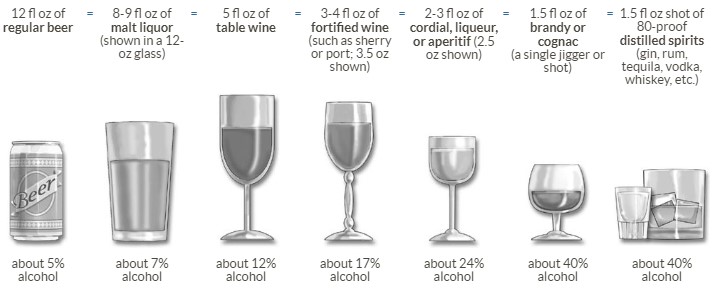
What is a Standard Drink? Although the drinks pictured here are different sizes, each contains approximately the same amount of alcohol and counts as one U.S. standard drink or one alcoholic drink-equivalent. Source: NIAAA
This year’s theme is “Connecting the Dots: Opportunity for Recovery.”
How aware are you?
If you are not aware of what one “drink” means it could be any of the following: 12 oz. of beer, 8 oz. of malt liquor, 5 oz. of table wine, 5 oz. of 80 proof liquor or 1.5 ounces of distilled spirits
 By AlcoholAwareness.org
While you may not know, April is Alcohol Awareness Month, a good time to reflect on our drinking patterns and the role that alcohol plays in our lives.
This is a tradition that started as a way to increase awareness about a disease many Americans suffer from. The idea is to spread information locally, statewide, and overall nationwide. Alcohol has touched almost all of our lives in one way or another. The general goal of this month is to create some sort of catalyst for change and awareness.
According to the National Institute on Alcohol Abuse and Alcoholism, “Most adults in the United States who drink alcohol drink moderately and without complications. At the same time, alcohol-related problems are among the most significant public health issues in the country. Alcohol use disorder (AUD) affects about 15 million adults in the United States, and an estimated 88,000 people die from alcohol-related causes annually, making alcohol the third leading preventable cause of death in the nation.”
In 2018, the World Health Organization reported that alcohol contributed to more than 200 diseases and injury-related health conditions, ranging from liver diseases, road injuries, and violence, to cancers, cardiovascular diseases, suicides, tuberculosis, and HIV/AIDS. The National Institutes of Health (NIH) offers additional facts and statistics about alcohol misuse in the United States.
Connecting the Dots: Opportunity for Recovery
This year’s theme is “Connecting the Dots: Opportunity for Recovery.” This year’s efforts are being directed towards young individuals. These are the people that can be easily influenced by alcohol and drugs if not informed. As a parent the best thing you can do for your child is interfere. While you may want to let your kids grow and learn on their own, it is your job to actively educate them. A whopping 50% of children are less likely to use drugs and alcohol that have conversations with their parents about the risks, than those who do not.
Whether we drink, or have been surrounded by those who do drink, alcohol is a huge part of the lives of Americans. At a time in our lives when we are being molded, the use of substances can change our lives forever. The use of alcohol at a young age opens the possibility of developing substance abuse issues later in life. As a parent every effort to help your children “connect the dots” will make a world of difference.
A huge part of Alcohol Awareness Month is Alcohol-Free Weekend which takes the first weekend in April. The aim of this weekend is to go 72 hours without drinking a single drop of alcohol. This may seem like a small task to some, but to others it could be almost impossible. That is the reason this weekend is so important. If it allows even one person to come to realization that they can’t go even 72 hours without alcohol, maybe that will inspire them to get some help.
The origins of Alcohol Awareness Month
Alcohol awareness month was started in 1987 by the National Council on Alcoholism and Drug Dependence (NCADD). It was started as a way to get the word out and possibly draw attention to those who suffer from alcohol use disorder. Most of us associate this disease as alcoholism.
The National Council on Alcoholism and Drug Dependence, originally called the National Committee for Education on Alcoholism, was founded by Marty Mann in 1944.
Once an alcoholic herself, she knew that there were many others going through the same struggles she had to, without anyone there to help. There was a stigmatism surrounding alcoholism. It wasn’t looked at as a disease like it is today. She wanted to reach out and share her experiences with others to help aid in their recovery.
The three creeds of the National Council on Alcoholism and Drug Dependence are:
- Alcoholism is a disease, and the alcoholic is a sick person;
- The alcoholic can be helped, and is worth helping;
- Alcoholism is a public health problem, and therefore a public responsibility.
Mann traveled the country educating individuals on the effects of alcohol. She needed people to understand the consequences drinking had on the body. Though she died before alcohol awareness month was created, she was the inspiration for it.
Alcohol Use Disorder
To understand why there is an alcohol awareness month, you must first understand the disease itself. A lot of us have heard of the term alcoholism and assume that this is the only form of alcohol abuse that occurs. Many are not aware that alcohol abuse can come in several different forms. The true term for alcohol abuse is Alcohol Use Disorder. This can still include alcoholism but is not limited to only that.
Alcohol Use Disorder is an affliction that can be observed if you use alcohol to the point where it becomes an issue. If you cannot control your urges and continue to use it even though it causes problems, you could be suffering from this. You may also start to notice withdrawal symptoms if you stop drinking and an increase in your tolerance.
Binge drinking is another type of Alcohol Use Disorder. This is the consumption of excessive alcohol in a short period of time. For women this means consuming 4 drinks within 2 hours, for men, 5 drinks. This can have long term and short term effects on your health. This is not an obvious form of alcohol abuse, mostly because it can occur as little as once a week. However, this is the most common form of Alcohol Use Disorder.
The NIH defines a standard drink as having about 14 grams of pure alcohol. If you are not aware of what one “drink” means it could be any of the following:
- 12 oz. of beer, which is usually about 5% alcohol
- 8 oz. of malt liquor, which is about 7% alcohol
- 5 oz. of table wine, which is typically about 12% alcohol
- 5 oz. of 80 proof liquor, which is about 40-50% alcohol
- 1.5 ounces of distilled spirits, which is about 40% alcohol
What is moderate drinking?
The Dietary Guidelines for Americans recommends that adults of legal drinking age can choose not to drink, or to drink in moderation by limiting intake to two drinks or less in a day for men or one drink or less in a day for women, on days when alcohol is consumed. The Guidelines also do not recommend that individuals who do not drink alcohol start drinking for any reason and that if adults of legal drinking age choose to drink alcoholic beverages, drinking less is better for health than drinking more.
What signs to look for
There are many different signs to look for when determining if someone suffers from alcohol use disorder. Some are very apparent while others require you to take notice. If you are experiencing hangovers often accompanied by nausea, shakiness, sweating, and trouble sleeping; these are short term symptoms. Many people try to fight off these symptoms by drinking more. While these may seem like minor consequences, if this becomes a pattern that is sign there may be a problem. If you try to stop drinking and are unable to because you constantly crave alcohol this is a clear sign it is time to ask for help.
Drinking can cause a lot of conflict in your life aside from your health. If you start missing out on daily activities like work or outside interests due to hangovers than your life is being affected by drinking. Keep an eye out for family and friends. They may not consciously realize what they are doing. When drinking creates problems with friends or family it is a clear sign that you may have an addiction. Ask yourself how is my drinking affecting myself and those I care about?
Organizations Fighting Alcohol Use Disorder
Taking that first step toward recovery may seem daunting. Though we have already mentioned the National Council on Alcoholism and Drug Dependence, many organizations and groups have been developed and funded to help aid in the recovery of alcohol use disorder:
Alcoholics Anonymous- The first and most common would be AA or Alcoholics Anonymous. The reason this group has gained so much popularity is because it is run by a community of recovering alcoholics. They too have been where you are now and will understand better than anyone what you need to her. They have free meetings in almost every city or town around the country. Their 12 step process will give you an optimistic, driven path to follow on the road to recovery.
National Institute on Alcohol Abuse and Alcoholism (NIAAA)- This is an organization that publishes material to help you stay informed. They stay up to date with alcohol and treatment research so that you always have a place to find the answers. If you have questions about the effects of alcohol and other consequences this is the organization to reach out to. Rethinking Drinking is a resource that can help you assess your drinking habits and provide valuable, research-based information to help you cut back or stop drinking if needed. It is available online as an interactive tool at https://www.rethinkingdrinking.niaaa.nih.gov and as a brochure that can be downloaded at https://pubs.niaaa.nih.gov/publications/RethinkingDrinking/Rethinking_Drinking.pdf.
National Institute on Drug Abuse (NIDA)- If you have questions about the science behind alcohol abuse, this is the organization to check out. They release data that shows the long term and short-term effects of alcohol use. They also may help lead you to a correct diagnosis; if you are unsure of how severe the problem is that you or someone you care about is struggling with.
Al-Anon and Alateen- There are a lot of resources available to those on the path to recovery. However, they are not the only ones that need help. If you know someone struggling with this disease you may not know how to help them or deal with the stress that accompanies supporting someone through this tough time. This is group you can reach out to in person or over the phone when things seem to be getting too hard. They will show you how to be both encouraging and understanding.
While these are only a few of the groups that you can reach out to, there are many more ready and willing to help. Check your area to find groups that are specific to your local and may be able to help.
What resources can you use?
Once you are ready to address the problem, seeking out treatment is a good next step. Since this is already a hard step to take; you do not want to have to worry about how costly it can be too. Private rehab centers can be very expensive. But they are not the only choice. There are a lot of options that don’t put a drain on your finances.
Two less expensive avenues you can take are government funded treatment and non-profit treatment. While the two rely on very different funding support, both can help assist you in a less costly matter. If you are not ready to take that extreme of a step, there are countless helplines that you can call. Just having the opportunity to talk to someone anonymously can make a difference.
Impact of Alcohol Awareness Month
What can on month do for the lives of so many alcoholics? The important of awareness is more critical now than ever. A 2014 study from the CDC revealed that excessive alcohol consumption was responsible for the death of almost 1 in 10 U.S. adults between the ages of 20 and 64. This means that approximately 88,000 lives are a lost to excessive alcohol use every year. What this accounts for is roughly 2.5 million years of potential life lost every year. These are a result of a combination of long term and short-term effects.
This is why it is so important to raise awareness on a local, state, and national scale. There are about 20 million individuals and their family members who are living in recovery. This proves that anything is possible.
Spread the word
While a month is not enough time to educate and help everyone recover, it at least gets the public talking. Do what you can in your community. Create pamphlets, or newsletters and distribute them around your neighborhood town. Host an event and invite everyone around the community to learn and spread alcohol awareness. Host a fundraiser to donate money to a local non-profit treatment facility.
The most important thing we can do as a society is to recognize that there is a problem. With that realization only then can we move forward. There are many people still in the dark about this disease. There are those who struggle with the disease or some who may know, but not recognize someone who is suffering. Maybe this month is an opportunity for us to fix that.
Allen D. Payton contributed to this report.
Read More

Photos: CCCSheriff
By Jimmy Lee, Director of Public Affairs, Contra Costa County Office of the Sheriff
A new module for inmates who have mental illnesses has opened at the Martinez Detention Facility. This follows an 18-month remodel of a module which previously held 52 inmates. Now, it will house only 24 inmates who have mental illnesses. They will be supervised 24/7 by county health staff in addition to deputy sheriffs. The cells are all single-occupancy and include 5 cells for acute cases. There are also two private medical evaluation suites in the module.
“I am proud of this new module which is part of the jail modernization we planned many years ago,” said Contra Costa County Sheriff David Livingston. “Now, inmates who have mental illnesses will have a dedicated housing unit where they will receive mental health treatment, programming, and services, in addition to healthcare.

Photos: CCCSheriff
The new module has incorporated the latest technology and best practices for detention facilities. This includes state of the art software for managing the module, furnishings that will help prevent suicides and a design that allows for greater observation of the inmates. The new module also uses a biophilic design to create a calm environment, reduce stress, and is more conducive to therapy.
“This new module sets the standard for these types of detention facilities,” said Livingston. “This reflects the commitment of the Contra Costa Sheriff’s Office and Contra Costa County in serving the needs of inmates who are living with mental health issues.”
Read More

Source: National Highway Traffic Safety Administration (NHTSA)
April is Distracted Driving Awareness Month
By Sarah Richards, Commander & Fran Clader, Director of Communications, CHP Office of Community Outreach & Media Relations
SACRAMENTO, Calif. – Any time drivers take their eyes off the road to look at or use a phone, they are driving blind. For example, looking down at a cell phone to read a text takes a driver’s eyes off the road for an average of five seconds – at 55 mph, that is the equivalent of driving the length of a 300-foot football field without looking.
As part of April’s Distracted Driving Awareness Month, the California Highway Patrol (CHP), California Office of Traffic Safety (OTS), and Impact Teen Drivers (ITD) are working together to increase education and enforcement efforts to raise awareness about the dangers of distracted driving.
Many distractions interfere with safe driving, but cell phones continue to be the most common distraction.
“Nothing on your phone is worth endangering a life when you drive,” said CHP Commissioner Amanda Ray. “Your primary focus should always be on the road and the task of driving your vehicle safely.”
In 2021, the CHP issued more than 55,800 citations for distracted driving. According to preliminary data compiled in the Statewide Integrated Traffic Records System, that same year driver inattention resulted in over 13,000 crashes. Sadly, at least 56 distracted drivers were involved in fatal crashes and nearly 6,300 other distracted drivers were involved in injury crashes throughout California.
“Silence your phone and put it away while driving,” OTS Director Barbara Rooney said. “It is a simple, yet significant action that keeps yourself and others on the road safe.”
While officers enforce distracted driving and other violations daily, on April 7 and 20, they will pay close attention to citing distracted drivers caught engaging in this dangerous driving behavior as part of statewide enforcement campaigns. From April 11-24, the OTS will run a new education campaign encouraging drivers to stay off the phone and ditch the distractions.
Car crashes are the number one killer of teens, and the monthlong traffic safety campaign will include a special emphasis during California Teen Safe Driving Week, April 4-10, on educating the state’s newest drivers about the dangers of reckless and distracted driving.
“Remember to be the driver you want your kids to be – eyes on the road, hands on the wheel, and your mind focused on the drive,” said ITD Executive Director Kelly Browning. “Parents, you are the number one influencer of your kids’ driving attitudes and behaviors.”
With grant funding provided by OTS, the CHP has partnered with ITD, a Sacramento-based nonprofit, to help spread the message of safe, distraction-free driving. The ITD program uses a multifaceted approach to deliver evidence-based education to teens and parents across the nation.
The mission of the CHP is to provide the highest level of Safety, Service, and Security.
Read More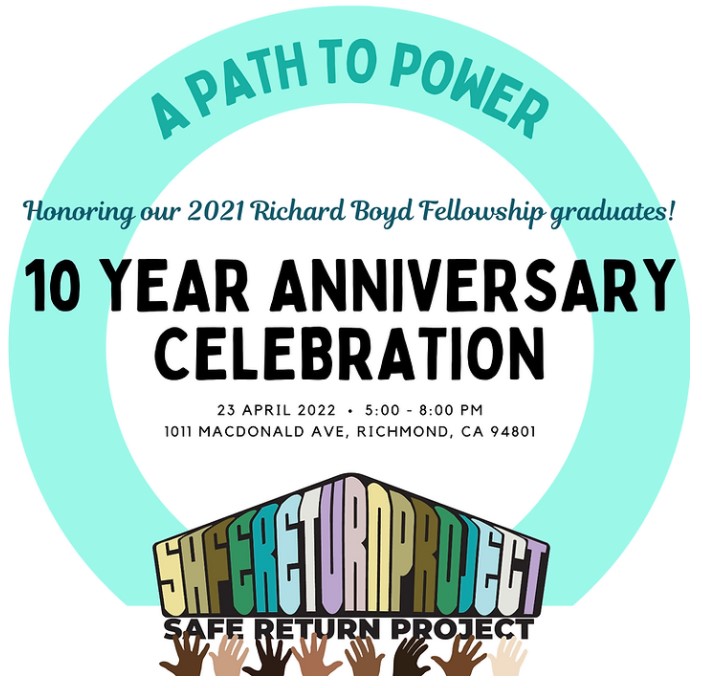
It has been ten incredible years since the launch of the Safe Return Project and we are looking forward to the promise of a new decade that brings us closer to mass liberation, racial equity, and a more just world.
To celebrate the positive impact we have had on the lives of thousands of formerly incarcerated individuals and their families, our accomplishments in policy and advocacy, the community we have built for ourselves, and this year’s graduating fellows, we will be hosting our 10-year anniversary celebration on April 23, 2022 from 5:00 – 8:00 PM.
Join us for great music, local food and drink, and the chance to build community as we celebrate the empowerment of our fellows! I can think of no greater cause for celebration than the incredible personal transformations our fellows have developed within Richard Boyd Fellowship program! They really have done an incredible job – this is their day!
Read More
Co-sponsored by Republican Club of Rossmoor and League of Women Voters Diablo Valley
 The Republican Club of Rossmoor has announced a Nonpartisan Candidates Forum for Contra Costa County candidates for District Attorney, Sheriff, and County Clerk/Recorder co-sponsored by the League of Women Voters Diablo Valley. The event will take place on Wednesday, April 6, from 4 to 7 pm in the Tahoe Room of the Event Center at Rossmoor. The Event Center is located at 1021 Stanley Dollar Drive in Walnut Creek.
Participants include Diana Becton and Mary Knox, for Contra Costa County District Attorney; David Livingston and Benjamin Therriault, for Contra Costa County Sheriff; and Vicki Gordon, Devin Murphy, and Nick Spinner, for Contra Costa County Clerk/Recorder. Kristen Connelly, who is also a candidate for Clerk/Recorder, is unable to attend.
The Leagues of Women Voters of Berkeley/Albany/Emeryville, Oakland, and Diablo Valley will provide moderators for the forum. The League’s purpose is to inform voters with a nonpartisan format, which neither supports nor opposes candidates; and to provide a venue for all candidates to promote issues that they feel are important to their constituents. Attendees will be furnished question cards for all the candidates. Questions will be asked in a format that any candidate for that office will be able to answer. The League never shares questions with candidates in advance. Usually, there are more questions than can be asked in the time available.
Read More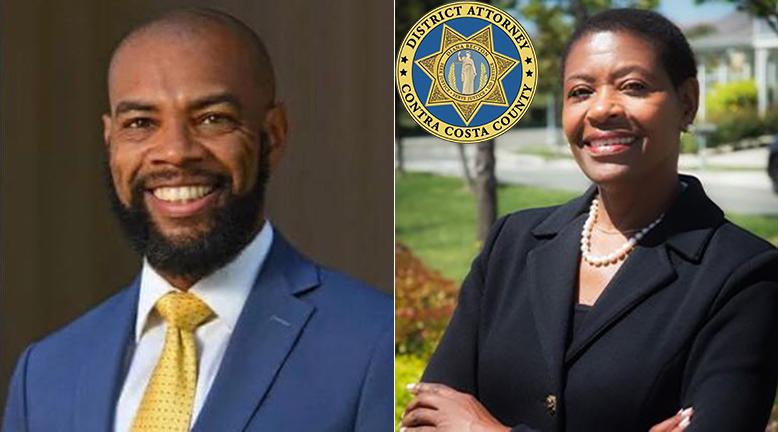
Antioch Mayor Thorpe and Contra Costa County District Attorney Diana Becton.
Three days after Thorpe’s DUI arrest and while under investigation by DA’s office
Says Becton asked them to cooperate with investigation of APD, won’t say how he’s helping
By Allen D. Payton
During a press conference, Wednesday morning, April 4, 2022 on Antioch Police Department staffing, hiring incentives and the investigation of officers by the FBI and Contra Costa D.A.’s office, Mayor Lamar Thorpe confirmed what had been previously reported, of a private meeting that he had with Contra Costa District Attorney Diana Becton on Tuesday, March 22, the day before the investigation occurred. He said Interim Antioch City Manager Con Johnson was also in attendance. The meeting was held just three days following Thorpe’s arrest for DUI and while he was under investigation by her department. (See related article)
Thorpe said the meeting was held by Becton to request his and Johnson’s cooperation in the investigation and they were to “keep confidentiality as this was an ongoing investigation”. Asked if the information he had received as one of the five council members was shared with all of the other four, Thorpe replied, “no, because the district attorney said to keep this confidential between myself and the city manager, because they were soliciting our help in the investigation.” (See related article)
Asked how he as a civilian was helping the investigation, Thorpe replied, “I’m not going to get into that.” He later said, “Let me just clarify something. I was asked to be down there as the mayor of Antioch. So, beyond that I’m not going to answer how or what.”
Read MorePreviously the subject of a 2015 Antioch investigation, also arrested by Antioch Police in 2017 for lewd acts upon a child and sexual exploitation of a child, history of arrests in Concord, Martinez, Pleasant Hill
By Ted Asregadoo, Public Information Officer, Contra Costa County Distict Attorney
 50-year-old Concord resident Patrick Steven Yelton was charged with three counts of forcible sexual abuse of a child under 13 which he allegedly committed in 2015. The charges were filed on March 28, 2022, in Contra Costa County Superior Court in Martinez. Yelton was previously charged on April 15, 2021, with one count of possession of child pornography, and is currently in custody at the Martinez Detention Facility.
In March 2020, the Internet Crimes Against Children Taskforce received information that Yelton was storing images of child pornography in his Google account. Concord Police officers contacted Yelton about the alleged images. Pursuant to a search warrant, Officers seized Yelton’s smartphone and additional photos of child pornography were located on the device. A year later, in February 2021, the ICAC Task Force received another tip that Yelton had pornographic images of children on his Yahoo account which yielded further evidence of unlawful activity.
Yelton was previously the subject of a 2015 Antioch investigation concerning sexual abuse of a child under 13. While reviewing the material in Yelton’s accounts relating to child pornography, evidence was discovered relating to the 2015 investigation. As a result, Yelton has now been charged with the 2015 forcible sexual abuse offenses, in addition to the original child pornography charge.
The investigation was conducted by a multi-agency, Internet Crimes Against Children Task Force, which is managed by the San Jose Police Department. In Contra Costa County, detectives and investigators from the Walnut Creek, Pleasant Hill, Martinez, San Ramon, Concord and Moraga Police Departments, the Contra Costa County Sheriff’s Office, United States Secret Service, Homeland Security Investigations, the Contra Costa County Probation Department, and Inspectors from the Contra Costa County District Attorney’s Office participated in the task force.
According to localcrimenews.com Yelton has a history of arrests including by Pleasant Hill Police in 2016 for driving with a license suspended for drunk driving; three times by Antioch Police in 2017 including one for false imprisonment by violence, forcible lewd acts upon a child and sexual exploitation of a child under 18 years, and again in 2017 for inflicting corporal injury on spouse/cohabitant, threats of violence and receiving or concealing stolen property; by the Martinez Police also in 2017 for possession of drug paraphernalia; and seven times by the Concord Police including twice in 2018, first for possession of a controlled substance and later for battery on a spouse / cohabitant / former spouse and threats of violence
Parents are encouraged to talk to their children about online safety and can visit the website www.kidsmartz.org or the District Attorney’s website for further information.
Case information: People v. Yelton, Dockett Number 01-195896-6
Allen D. Payton contributed to this report.
Read More
Students gather around a giant oak at the Mangini Ranch Educational Preserve. Photo: Scott Hein.
First of its kind in Contra Costa County; 207.8-acre preserve available for free to local schools, groups
By Laura Kindsvater, Communications Manager, Save Mount Diablo
On March 30, 2022, Save Mount Diablo opened its Mangini Ranch Educational Preserve to the public, the first of its kind in Contra Costa County. People gathered at a special ceremony at the preserve during which Assemblymember Rebecca Bauer-Kahan and Save Mount Diablo Board President Jim Felton cut the ribbon to celebrate the opening.
The 207.8-acre preserve is situated between the Crystyl Ranch residential development in Concord and Lime Ridge Open Space in Walnut Creek.
Save Mount Diablo’s Mangini Ranch Educational Preserve is available for reservations free of charge to a variety of local schools and community groups, of all ages and backgrounds, pursuing educational purposes. Examples include, but are not limited to, the following:
- environmental science classes
- nature photography courses
- yoga classes
- plein-air artists gatherings
- addiction recovery groups
- acoustic music in nature ensembles
- meditation classes
- grief counseling support groups
- church groups
- homeowners association groups
- hiking, trail running, and mountain bike clubs
Interested groups can submit a request to reserve the property for a day up to six months in advance by utilizing the online form on Save Mount Diablo’s website. The size of a group must be at least three people to no larger than 100 people. The preserve is day-use only (no camping). Location and access will be provided upon reservation. A docent will be on-sight to provide access, an overview of the property and any assistance.
The preserve includes grassland, stream canyons, blue oak woodland, chaparral, and oak savannas.
It’s home to rare species such as the northernmost stand of desert olive, rare Hospital Canyon larkspur, and threatened Alameda whipsnake. Deer, coyote, burrowing owls, kestrels, and lots of other wildlife live here too.
The preserve’s high ridgeline provides views of most of central Contra Costa County and to Marin, Sonoma, and Solano counties.
As you move away from the staging area of the preserve and into the open space along Galindo Creek and up the ridgeline, the sounds of cars and radios fade. They become birdsong and gentle breezes rustling through trees.
Here you will find you are transported into another space where senses are heightened and connecting to nature is inevitable.
About Save Mount Diablo
Save Mount Diablo is a nationally accredited, nonprofit land trust founded in 1971 with a mission
to preserve Mount Diablo’s peaks, surrounding foothills, watersheds, and connection to the Diablo Range through land acquisition and preservation strategies designed to protect the mountain’s natural beauty, biological diversity, and historic and agricultural heritage; enhance our area’s quality of life; and provide educational and recreational opportunities consistent with protection of natural resources. To learn more, please visit www.savemountdiablo.org.
Read More
Marrico Williams (left) and Torion Young. Photos by Richmond PD
Third defendant guilty of lesser crime
By Ted Asregadoo, Public Information Officer, Contra Costa County Distict Attorney
On Wednesday, March 30, 2022, a Contra Costa County jury found defendants 24-year-old Marrico Williams and 23-year-old Torion Young, guilty of multiple charges for their roles in a prolific crime spree committed by members of the North Richmond criminal street gang known as the “Swerve Team.”
Williams was found guilty of two counts of murder, conspiracy to commit murder, three attempted murders, three assaults with a firearm, nine robberies, three burglaries, two carjackings, along with various firearm and injury enhancements.
Young was found guilty of two counts of murder, conspiracy to commit murder, four attempted, one assault with a firearm, one residential burglary, along with various enhancements.
The jury convicted 26-year-old defendant Cardell Waters of conspiracy to possess an illegal firearm — but was unable to reach a verdict on the remaining counts.
In 2016, over a six-month period, members of the Swerve Team committed a string of violent crimes against rival gang members and innocent community members throughout Contra Costa County. The crime spree ended on September 30, 2016, when Williams and fellow Swerve Team gang members were arrested following a high-speed chase through multiple cities, which ended in San Pablo.
Police searched the vehicle driven by Williams and found evidence from cell phones and camera images. Williams, Young, Waters, and five other Swerve Team gang members were indicted in 2017 by a grand jury following a massive federal and state investigation centering on multiple shootings, including three homicides. The trial against the defendants was based on ballistic evidence, cellular records, and forensic evidence, along with the testimony of 185 witnesses.
The sentencing will be heard later this year before the Honorable Judge Charles “Ben” Burch in Martinez. Williams and Young face multiple 25 to life prison sentences. The remaining case against Waters is scheduled for a future court date. A determination has yet to be made as to whether Waters will be retried.
This case was investigated by numerous law enforcement agencies throughout the county including Police Departments in Richmond, Antioch, Brentwood, Pittsburg, Danville, Pinole, San Pablo, Contra Costa County Sheriff’s Department, along with several out of county agencies. The Contra Costa County FBI Safe Streets Task Force also participated in the wire investigation into the Swerve Team in September of 2016. Deputy District Attorney Chad Mahalich prosecuted this case on behalf of the People.
This extensive jury trial lasted approximately 8 months, beginning in August of 2021, and ended on March 30, 2022.
Case information: People v. B. Williams, M. Williams, T. Brown, J. Hicks Jr., T. Young, R. Fluker, T. Woods, and C. Waters: 5-181436-7.
Read More










Fair workers also needed
ANTIOCH – Online entries for the 2022 Contra Costa County Fair exhibit competitions close Friday, April 8th. Imagine the thrill of winning a blue ribbon at the Fair for a special talent. Think you own the best pig, bake the most delicious apple pie, made a beautiful quilt, or have an uncanny knack for making crafts? Want to see who’s the best in all of Contra Costa County? Then be sure to enter the Contra Costa County Fair’s competitive exhibits!
Entry information available on the fair’s website www.contracostafair.com
Cows, Corndogs & Carnival Rides. Oh My!! May 12-15 is sure to be a fun event for children of all ages, with new exhibits & entertainment, the carnival, livestock and the always popular Fair food. Money saving pre-sale tickets will be available starting April 22 and ending May 9.
Are you interested in working at The Fair? We are looking for Parking Attendants, Ticket Takers, Ticket Sellers and Information Booth Attendants. Visit contracostafair.com for details on each job position and to print out an application. Interviews and hiring will be on April 30th from 9am to 2pm at The Fair Administration Office Board Room.
For additional information visit our website at www.contracostafair.com, or like us on Facebook.
The County Fair is held at the Contra Costa Event Park at 1201 West 10th Street in Antioch.
Read MoreWhat is a Standard Drink? Although the drinks pictured here are different sizes, each contains approximately the same amount of alcohol and counts as one U.S. standard drink or one alcoholic drink-equivalent. Source: NIAAA
This year’s theme is “Connecting the Dots: Opportunity for Recovery.”
How aware are you?
If you are not aware of what one “drink” means it could be any of the following: 12 oz. of beer, 8 oz. of malt liquor, 5 oz. of table wine, 5 oz. of 80 proof liquor or 1.5 ounces of distilled spirits
By AlcoholAwareness.org
While you may not know, April is Alcohol Awareness Month, a good time to reflect on our drinking patterns and the role that alcohol plays in our lives.
This is a tradition that started as a way to increase awareness about a disease many Americans suffer from. The idea is to spread information locally, statewide, and overall nationwide. Alcohol has touched almost all of our lives in one way or another. The general goal of this month is to create some sort of catalyst for change and awareness.
According to the National Institute on Alcohol Abuse and Alcoholism, “Most adults in the United States who drink alcohol drink moderately and without complications. At the same time, alcohol-related problems are among the most significant public health issues in the country. Alcohol use disorder (AUD) affects about 15 million adults in the United States, and an estimated 88,000 people die from alcohol-related causes annually, making alcohol the third leading preventable cause of death in the nation.”
In 2018, the World Health Organization reported that alcohol contributed to more than 200 diseases and injury-related health conditions, ranging from liver diseases, road injuries, and violence, to cancers, cardiovascular diseases, suicides, tuberculosis, and HIV/AIDS. The National Institutes of Health (NIH) offers additional facts and statistics about alcohol misuse in the United States.
Connecting the Dots: Opportunity for Recovery
This year’s theme is “Connecting the Dots: Opportunity for Recovery.” This year’s efforts are being directed towards young individuals. These are the people that can be easily influenced by alcohol and drugs if not informed. As a parent the best thing you can do for your child is interfere. While you may want to let your kids grow and learn on their own, it is your job to actively educate them. A whopping 50% of children are less likely to use drugs and alcohol that have conversations with their parents about the risks, than those who do not.
Whether we drink, or have been surrounded by those who do drink, alcohol is a huge part of the lives of Americans. At a time in our lives when we are being molded, the use of substances can change our lives forever. The use of alcohol at a young age opens the possibility of developing substance abuse issues later in life. As a parent every effort to help your children “connect the dots” will make a world of difference.
A huge part of Alcohol Awareness Month is Alcohol-Free Weekend which takes the first weekend in April. The aim of this weekend is to go 72 hours without drinking a single drop of alcohol. This may seem like a small task to some, but to others it could be almost impossible. That is the reason this weekend is so important. If it allows even one person to come to realization that they can’t go even 72 hours without alcohol, maybe that will inspire them to get some help.
The origins of Alcohol Awareness Month
Alcohol awareness month was started in 1987 by the National Council on Alcoholism and Drug Dependence (NCADD). It was started as a way to get the word out and possibly draw attention to those who suffer from alcohol use disorder. Most of us associate this disease as alcoholism.
The National Council on Alcoholism and Drug Dependence, originally called the National Committee for Education on Alcoholism, was founded by Marty Mann in 1944.
Once an alcoholic herself, she knew that there were many others going through the same struggles she had to, without anyone there to help. There was a stigmatism surrounding alcoholism. It wasn’t looked at as a disease like it is today. She wanted to reach out and share her experiences with others to help aid in their recovery.
The three creeds of the National Council on Alcoholism and Drug Dependence are:
- Alcoholism is a disease, and the alcoholic is a sick person;
- The alcoholic can be helped, and is worth helping;
- Alcoholism is a public health problem, and therefore a public responsibility.
Mann traveled the country educating individuals on the effects of alcohol. She needed people to understand the consequences drinking had on the body. Though she died before alcohol awareness month was created, she was the inspiration for it.
Alcohol Use Disorder
To understand why there is an alcohol awareness month, you must first understand the disease itself. A lot of us have heard of the term alcoholism and assume that this is the only form of alcohol abuse that occurs. Many are not aware that alcohol abuse can come in several different forms. The true term for alcohol abuse is Alcohol Use Disorder. This can still include alcoholism but is not limited to only that.
Alcohol Use Disorder is an affliction that can be observed if you use alcohol to the point where it becomes an issue. If you cannot control your urges and continue to use it even though it causes problems, you could be suffering from this. You may also start to notice withdrawal symptoms if you stop drinking and an increase in your tolerance.
Binge drinking is another type of Alcohol Use Disorder. This is the consumption of excessive alcohol in a short period of time. For women this means consuming 4 drinks within 2 hours, for men, 5 drinks. This can have long term and short term effects on your health. This is not an obvious form of alcohol abuse, mostly because it can occur as little as once a week. However, this is the most common form of Alcohol Use Disorder.
The NIH defines a standard drink as having about 14 grams of pure alcohol. If you are not aware of what one “drink” means it could be any of the following:
- 12 oz. of beer, which is usually about 5% alcohol
- 8 oz. of malt liquor, which is about 7% alcohol
- 5 oz. of table wine, which is typically about 12% alcohol
- 5 oz. of 80 proof liquor, which is about 40-50% alcohol
- 1.5 ounces of distilled spirits, which is about 40% alcohol
What is moderate drinking?
The Dietary Guidelines for Americans recommends that adults of legal drinking age can choose not to drink, or to drink in moderation by limiting intake to two drinks or less in a day for men or one drink or less in a day for women, on days when alcohol is consumed. The Guidelines also do not recommend that individuals who do not drink alcohol start drinking for any reason and that if adults of legal drinking age choose to drink alcoholic beverages, drinking less is better for health than drinking more.
What signs to look for
There are many different signs to look for when determining if someone suffers from alcohol use disorder. Some are very apparent while others require you to take notice. If you are experiencing hangovers often accompanied by nausea, shakiness, sweating, and trouble sleeping; these are short term symptoms. Many people try to fight off these symptoms by drinking more. While these may seem like minor consequences, if this becomes a pattern that is sign there may be a problem. If you try to stop drinking and are unable to because you constantly crave alcohol this is a clear sign it is time to ask for help.
Drinking can cause a lot of conflict in your life aside from your health. If you start missing out on daily activities like work or outside interests due to hangovers than your life is being affected by drinking. Keep an eye out for family and friends. They may not consciously realize what they are doing. When drinking creates problems with friends or family it is a clear sign that you may have an addiction. Ask yourself how is my drinking affecting myself and those I care about?
Organizations Fighting Alcohol Use Disorder
Taking that first step toward recovery may seem daunting. Though we have already mentioned the National Council on Alcoholism and Drug Dependence, many organizations and groups have been developed and funded to help aid in the recovery of alcohol use disorder:
Alcoholics Anonymous- The first and most common would be AA or Alcoholics Anonymous. The reason this group has gained so much popularity is because it is run by a community of recovering alcoholics. They too have been where you are now and will understand better than anyone what you need to her. They have free meetings in almost every city or town around the country. Their 12 step process will give you an optimistic, driven path to follow on the road to recovery.
National Institute on Alcohol Abuse and Alcoholism (NIAAA)- This is an organization that publishes material to help you stay informed. They stay up to date with alcohol and treatment research so that you always have a place to find the answers. If you have questions about the effects of alcohol and other consequences this is the organization to reach out to. Rethinking Drinking is a resource that can help you assess your drinking habits and provide valuable, research-based information to help you cut back or stop drinking if needed. It is available online as an interactive tool at https://www.rethinkingdrinking.niaaa.nih.gov and as a brochure that can be downloaded at https://pubs.niaaa.nih.gov/publications/RethinkingDrinking/Rethinking_Drinking.pdf.
National Institute on Drug Abuse (NIDA)- If you have questions about the science behind alcohol abuse, this is the organization to check out. They release data that shows the long term and short-term effects of alcohol use. They also may help lead you to a correct diagnosis; if you are unsure of how severe the problem is that you or someone you care about is struggling with.
Al-Anon and Alateen- There are a lot of resources available to those on the path to recovery. However, they are not the only ones that need help. If you know someone struggling with this disease you may not know how to help them or deal with the stress that accompanies supporting someone through this tough time. This is group you can reach out to in person or over the phone when things seem to be getting too hard. They will show you how to be both encouraging and understanding.
While these are only a few of the groups that you can reach out to, there are many more ready and willing to help. Check your area to find groups that are specific to your local and may be able to help.
What resources can you use?
Once you are ready to address the problem, seeking out treatment is a good next step. Since this is already a hard step to take; you do not want to have to worry about how costly it can be too. Private rehab centers can be very expensive. But they are not the only choice. There are a lot of options that don’t put a drain on your finances.
Two less expensive avenues you can take are government funded treatment and non-profit treatment. While the two rely on very different funding support, both can help assist you in a less costly matter. If you are not ready to take that extreme of a step, there are countless helplines that you can call. Just having the opportunity to talk to someone anonymously can make a difference.
Impact of Alcohol Awareness Month
What can on month do for the lives of so many alcoholics? The important of awareness is more critical now than ever. A 2014 study from the CDC revealed that excessive alcohol consumption was responsible for the death of almost 1 in 10 U.S. adults between the ages of 20 and 64. This means that approximately 88,000 lives are a lost to excessive alcohol use every year. What this accounts for is roughly 2.5 million years of potential life lost every year. These are a result of a combination of long term and short-term effects.
This is why it is so important to raise awareness on a local, state, and national scale. There are about 20 million individuals and their family members who are living in recovery. This proves that anything is possible.
Spread the word
While a month is not enough time to educate and help everyone recover, it at least gets the public talking. Do what you can in your community. Create pamphlets, or newsletters and distribute them around your neighborhood town. Host an event and invite everyone around the community to learn and spread alcohol awareness. Host a fundraiser to donate money to a local non-profit treatment facility.
The most important thing we can do as a society is to recognize that there is a problem. With that realization only then can we move forward. There are many people still in the dark about this disease. There are those who struggle with the disease or some who may know, but not recognize someone who is suffering. Maybe this month is an opportunity for us to fix that.
Allen D. Payton contributed to this report.
Read More
Photos: CCCSheriff
By Jimmy Lee, Director of Public Affairs, Contra Costa County Office of the Sheriff
A new module for inmates who have mental illnesses has opened at the Martinez Detention Facility. This follows an 18-month remodel of a module which previously held 52 inmates. Now, it will house only 24 inmates who have mental illnesses. They will be supervised 24/7 by county health staff in addition to deputy sheriffs. The cells are all single-occupancy and include 5 cells for acute cases. There are also two private medical evaluation suites in the module.
“I am proud of this new module which is part of the jail modernization we planned many years ago,” said Contra Costa County Sheriff David Livingston. “Now, inmates who have mental illnesses will have a dedicated housing unit where they will receive mental health treatment, programming, and services, in addition to healthcare.
Photos: CCCSheriff
The new module has incorporated the latest technology and best practices for detention facilities. This includes state of the art software for managing the module, furnishings that will help prevent suicides and a design that allows for greater observation of the inmates. The new module also uses a biophilic design to create a calm environment, reduce stress, and is more conducive to therapy.
“This new module sets the standard for these types of detention facilities,” said Livingston. “This reflects the commitment of the Contra Costa Sheriff’s Office and Contra Costa County in serving the needs of inmates who are living with mental health issues.”
Read More
Source: National Highway Traffic Safety Administration (NHTSA)
April is Distracted Driving Awareness Month
By Sarah Richards, Commander & Fran Clader, Director of Communications, CHP Office of Community Outreach & Media Relations
SACRAMENTO, Calif. – Any time drivers take their eyes off the road to look at or use a phone, they are driving blind. For example, looking down at a cell phone to read a text takes a driver’s eyes off the road for an average of five seconds – at 55 mph, that is the equivalent of driving the length of a 300-foot football field without looking.
As part of April’s Distracted Driving Awareness Month, the California Highway Patrol (CHP), California Office of Traffic Safety (OTS), and Impact Teen Drivers (ITD) are working together to increase education and enforcement efforts to raise awareness about the dangers of distracted driving.
Many distractions interfere with safe driving, but cell phones continue to be the most common distraction.
“Nothing on your phone is worth endangering a life when you drive,” said CHP Commissioner Amanda Ray. “Your primary focus should always be on the road and the task of driving your vehicle safely.”
In 2021, the CHP issued more than 55,800 citations for distracted driving. According to preliminary data compiled in the Statewide Integrated Traffic Records System, that same year driver inattention resulted in over 13,000 crashes. Sadly, at least 56 distracted drivers were involved in fatal crashes and nearly 6,300 other distracted drivers were involved in injury crashes throughout California.
“Silence your phone and put it away while driving,” OTS Director Barbara Rooney said. “It is a simple, yet significant action that keeps yourself and others on the road safe.”
While officers enforce distracted driving and other violations daily, on April 7 and 20, they will pay close attention to citing distracted drivers caught engaging in this dangerous driving behavior as part of statewide enforcement campaigns. From April 11-24, the OTS will run a new education campaign encouraging drivers to stay off the phone and ditch the distractions.
Car crashes are the number one killer of teens, and the monthlong traffic safety campaign will include a special emphasis during California Teen Safe Driving Week, April 4-10, on educating the state’s newest drivers about the dangers of reckless and distracted driving.
“Remember to be the driver you want your kids to be – eyes on the road, hands on the wheel, and your mind focused on the drive,” said ITD Executive Director Kelly Browning. “Parents, you are the number one influencer of your kids’ driving attitudes and behaviors.”
With grant funding provided by OTS, the CHP has partnered with ITD, a Sacramento-based nonprofit, to help spread the message of safe, distraction-free driving. The ITD program uses a multifaceted approach to deliver evidence-based education to teens and parents across the nation.
The mission of the CHP is to provide the highest level of Safety, Service, and Security.
Read More
It has been ten incredible years since the launch of the Safe Return Project and we are looking forward to the promise of a new decade that brings us closer to mass liberation, racial equity, and a more just world.
To celebrate the positive impact we have had on the lives of thousands of formerly incarcerated individuals and their families, our accomplishments in policy and advocacy, the community we have built for ourselves, and this year’s graduating fellows, we will be hosting our 10-year anniversary celebration on April 23, 2022 from 5:00 – 8:00 PM.
Join us for great music, local food and drink, and the chance to build community as we celebrate the empowerment of our fellows! I can think of no greater cause for celebration than the incredible personal transformations our fellows have developed within Richard Boyd Fellowship program! They really have done an incredible job – this is their day!
Read More
Co-sponsored by Republican Club of Rossmoor and League of Women Voters Diablo Valley
The Republican Club of Rossmoor has announced a Nonpartisan Candidates Forum for Contra Costa County candidates for District Attorney, Sheriff, and County Clerk/Recorder co-sponsored by the League of Women Voters Diablo Valley. The event will take place on Wednesday, April 6, from 4 to 7 pm in the Tahoe Room of the Event Center at Rossmoor. The Event Center is located at 1021 Stanley Dollar Drive in Walnut Creek.
Participants include Diana Becton and Mary Knox, for Contra Costa County District Attorney; David Livingston and Benjamin Therriault, for Contra Costa County Sheriff; and Vicki Gordon, Devin Murphy, and Nick Spinner, for Contra Costa County Clerk/Recorder. Kristen Connelly, who is also a candidate for Clerk/Recorder, is unable to attend.
The Leagues of Women Voters of Berkeley/Albany/Emeryville, Oakland, and Diablo Valley will provide moderators for the forum. The League’s purpose is to inform voters with a nonpartisan format, which neither supports nor opposes candidates; and to provide a venue for all candidates to promote issues that they feel are important to their constituents. Attendees will be furnished question cards for all the candidates. Questions will be asked in a format that any candidate for that office will be able to answer. The League never shares questions with candidates in advance. Usually, there are more questions than can be asked in the time available.
Read MoreAntioch Mayor Thorpe and Contra Costa County District Attorney Diana Becton.
Three days after Thorpe’s DUI arrest and while under investigation by DA’s office
Says Becton asked them to cooperate with investigation of APD, won’t say how he’s helping
By Allen D. Payton
During a press conference, Wednesday morning, April 4, 2022 on Antioch Police Department staffing, hiring incentives and the investigation of officers by the FBI and Contra Costa D.A.’s office, Mayor Lamar Thorpe confirmed what had been previously reported, of a private meeting that he had with Contra Costa District Attorney Diana Becton on Tuesday, March 22, the day before the investigation occurred. He said Interim Antioch City Manager Con Johnson was also in attendance. The meeting was held just three days following Thorpe’s arrest for DUI and while he was under investigation by her department. (See related article)
Thorpe said the meeting was held by Becton to request his and Johnson’s cooperation in the investigation and they were to “keep confidentiality as this was an ongoing investigation”. Asked if the information he had received as one of the five council members was shared with all of the other four, Thorpe replied, “no, because the district attorney said to keep this confidential between myself and the city manager, because they were soliciting our help in the investigation.” (See related article)
Asked how he as a civilian was helping the investigation, Thorpe replied, “I’m not going to get into that.” He later said, “Let me just clarify something. I was asked to be down there as the mayor of Antioch. So, beyond that I’m not going to answer how or what.”
Read MorePreviously the subject of a 2015 Antioch investigation, also arrested by Antioch Police in 2017 for lewd acts upon a child and sexual exploitation of a child, history of arrests in Concord, Martinez, Pleasant Hill
By Ted Asregadoo, Public Information Officer, Contra Costa County Distict Attorney
50-year-old Concord resident Patrick Steven Yelton was charged with three counts of forcible sexual abuse of a child under 13 which he allegedly committed in 2015. The charges were filed on March 28, 2022, in Contra Costa County Superior Court in Martinez. Yelton was previously charged on April 15, 2021, with one count of possession of child pornography, and is currently in custody at the Martinez Detention Facility.
In March 2020, the Internet Crimes Against Children Taskforce received information that Yelton was storing images of child pornography in his Google account. Concord Police officers contacted Yelton about the alleged images. Pursuant to a search warrant, Officers seized Yelton’s smartphone and additional photos of child pornography were located on the device. A year later, in February 2021, the ICAC Task Force received another tip that Yelton had pornographic images of children on his Yahoo account which yielded further evidence of unlawful activity.
Yelton was previously the subject of a 2015 Antioch investigation concerning sexual abuse of a child under 13. While reviewing the material in Yelton’s accounts relating to child pornography, evidence was discovered relating to the 2015 investigation. As a result, Yelton has now been charged with the 2015 forcible sexual abuse offenses, in addition to the original child pornography charge.
The investigation was conducted by a multi-agency, Internet Crimes Against Children Task Force, which is managed by the San Jose Police Department. In Contra Costa County, detectives and investigators from the Walnut Creek, Pleasant Hill, Martinez, San Ramon, Concord and Moraga Police Departments, the Contra Costa County Sheriff’s Office, United States Secret Service, Homeland Security Investigations, the Contra Costa County Probation Department, and Inspectors from the Contra Costa County District Attorney’s Office participated in the task force.
According to localcrimenews.com Yelton has a history of arrests including by Pleasant Hill Police in 2016 for driving with a license suspended for drunk driving; three times by Antioch Police in 2017 including one for false imprisonment by violence, forcible lewd acts upon a child and sexual exploitation of a child under 18 years, and again in 2017 for inflicting corporal injury on spouse/cohabitant, threats of violence and receiving or concealing stolen property; by the Martinez Police also in 2017 for possession of drug paraphernalia; and seven times by the Concord Police including twice in 2018, first for possession of a controlled substance and later for battery on a spouse / cohabitant / former spouse and threats of violence
Parents are encouraged to talk to their children about online safety and can visit the website www.kidsmartz.org or the District Attorney’s website for further information.
Case information: People v. Yelton, Dockett Number 01-195896-6
Allen D. Payton contributed to this report.
Read MoreStudents gather around a giant oak at the Mangini Ranch Educational Preserve. Photo: Scott Hein.
First of its kind in Contra Costa County; 207.8-acre preserve available for free to local schools, groups
By Laura Kindsvater, Communications Manager, Save Mount Diablo
On March 30, 2022, Save Mount Diablo opened its Mangini Ranch Educational Preserve to the public, the first of its kind in Contra Costa County. People gathered at a special ceremony at the preserve during which Assemblymember Rebecca Bauer-Kahan and Save Mount Diablo Board President Jim Felton cut the ribbon to celebrate the opening.
The 207.8-acre preserve is situated between the Crystyl Ranch residential development in Concord and Lime Ridge Open Space in Walnut Creek.
Save Mount Diablo’s Mangini Ranch Educational Preserve is available for reservations free of charge to a variety of local schools and community groups, of all ages and backgrounds, pursuing educational purposes. Examples include, but are not limited to, the following:
- environmental science classes
- nature photography courses
- yoga classes
- plein-air artists gatherings
- addiction recovery groups
- acoustic music in nature ensembles
- meditation classes
- grief counseling support groups
- church groups
- homeowners association groups
- hiking, trail running, and mountain bike clubs
Interested groups can submit a request to reserve the property for a day up to six months in advance by utilizing the online form on Save Mount Diablo’s website. The size of a group must be at least three people to no larger than 100 people. The preserve is day-use only (no camping). Location and access will be provided upon reservation. A docent will be on-sight to provide access, an overview of the property and any assistance.
The preserve includes grassland, stream canyons, blue oak woodland, chaparral, and oak savannas.
It’s home to rare species such as the northernmost stand of desert olive, rare Hospital Canyon larkspur, and threatened Alameda whipsnake. Deer, coyote, burrowing owls, kestrels, and lots of other wildlife live here too.
The preserve’s high ridgeline provides views of most of central Contra Costa County and to Marin, Sonoma, and Solano counties.
As you move away from the staging area of the preserve and into the open space along Galindo Creek and up the ridgeline, the sounds of cars and radios fade. They become birdsong and gentle breezes rustling through trees.
Here you will find you are transported into another space where senses are heightened and connecting to nature is inevitable.
About Save Mount Diablo
Save Mount Diablo is a nationally accredited, nonprofit land trust founded in 1971 with a mission
to preserve Mount Diablo’s peaks, surrounding foothills, watersheds, and connection to the Diablo Range through land acquisition and preservation strategies designed to protect the mountain’s natural beauty, biological diversity, and historic and agricultural heritage; enhance our area’s quality of life; and provide educational and recreational opportunities consistent with protection of natural resources. To learn more, please visit www.savemountdiablo.org.
Read MoreMarrico Williams (left) and Torion Young. Photos by Richmond PD
Third defendant guilty of lesser crime
By Ted Asregadoo, Public Information Officer, Contra Costa County Distict Attorney
On Wednesday, March 30, 2022, a Contra Costa County jury found defendants 24-year-old Marrico Williams and 23-year-old Torion Young, guilty of multiple charges for their roles in a prolific crime spree committed by members of the North Richmond criminal street gang known as the “Swerve Team.”
Williams was found guilty of two counts of murder, conspiracy to commit murder, three attempted murders, three assaults with a firearm, nine robberies, three burglaries, two carjackings, along with various firearm and injury enhancements.
Young was found guilty of two counts of murder, conspiracy to commit murder, four attempted, one assault with a firearm, one residential burglary, along with various enhancements.
The jury convicted 26-year-old defendant Cardell Waters of conspiracy to possess an illegal firearm — but was unable to reach a verdict on the remaining counts.
In 2016, over a six-month period, members of the Swerve Team committed a string of violent crimes against rival gang members and innocent community members throughout Contra Costa County. The crime spree ended on September 30, 2016, when Williams and fellow Swerve Team gang members were arrested following a high-speed chase through multiple cities, which ended in San Pablo.
Police searched the vehicle driven by Williams and found evidence from cell phones and camera images. Williams, Young, Waters, and five other Swerve Team gang members were indicted in 2017 by a grand jury following a massive federal and state investigation centering on multiple shootings, including three homicides. The trial against the defendants was based on ballistic evidence, cellular records, and forensic evidence, along with the testimony of 185 witnesses.
The sentencing will be heard later this year before the Honorable Judge Charles “Ben” Burch in Martinez. Williams and Young face multiple 25 to life prison sentences. The remaining case against Waters is scheduled for a future court date. A determination has yet to be made as to whether Waters will be retried.
This case was investigated by numerous law enforcement agencies throughout the county including Police Departments in Richmond, Antioch, Brentwood, Pittsburg, Danville, Pinole, San Pablo, Contra Costa County Sheriff’s Department, along with several out of county agencies. The Contra Costa County FBI Safe Streets Task Force also participated in the wire investigation into the Swerve Team in September of 2016. Deputy District Attorney Chad Mahalich prosecuted this case on behalf of the People.
This extensive jury trial lasted approximately 8 months, beginning in August of 2021, and ended on March 30, 2022.
Case information: People v. B. Williams, M. Williams, T. Brown, J. Hicks Jr., T. Young, R. Fluker, T. Woods, and C. Waters: 5-181436-7.
Read More